
Our readers keep the lights on and the weekend projects moving. As an Amazon Associate, I earn from qualifying purchases.
The warmth and musicality of an analog mixer bring a tangible character to a home studio that digital emulation still struggles to replicate. You are likely tired of flat, sterile digital recordings and crave the natural saturation, the forgiving EQ curves, and the simple, tactile control that an analog signal path provides. This guide is built for home producers, singer-songwriters, and podcasters who want to inject genuine analog soul into their workflow without breaking the bank or dealing with the complexity of a large-format console.
I’m Rikta — the co-founder and writer behind FitlyFast. I have spent hundreds of hours dissecting the technical specifications, preamp designs, routing flexibility, and real-world performance of dozens of analog mixers to find the absolute best solutions for a home studio environment. The guide that follows places a heavy emphasis on signal-to-noise ratio, preamp quality, and practical I/O, because those specs define whether your recordings sound professional or amateur.
Whether you are recording vocals, blending synthesizers, or building a simple live-streaming rig, finding the right analog mixer for home studio means balancing channel count, preamp transparency, built-in effects quality, and connectivity to your computer — all within a form factor that fits your desk.
How To Choose The Best Analog Mixer For Home Studio
An analog mixer is the heart of a direct, no-latency recording chain. Unlike digital consoles, analog mixers apply EQ and level adjustments in the analog domain before the signal ever touches an A/D converter. This means your focus should be on the analog components themselves — the preamps, the EQ circuit, the physical build, and how the mixer connects to your recording interface.
Preamp Quality and Noise Floor
Every signal in your studio passes through the mic preamp first. A high-quality preamp with a low noise floor (measured in dBu, typically -128 dBu E.I.N. or better) preserves detail and headroom. Preamps like Mackie’s Onyx or Allen & Heath’s GS-Pre are designed to deliver clean gain up to 60 dB or more without introducing audible hiss. Cheaper preamps may sound thin or noisy when you push the gain to capture quiet sources like acoustic guitar or spoken word.
Channel Count and I/O Configuration
The number of channels you need depends on your recording workflow. A solo podcaster may only need two microphone inputs, while a producer recording a full band might require eight or more. Pay close attention to the balance of mono mic/line inputs versus stereo line inputs. Stereo inputs are essential for connecting synthesizers, drum machines, or a keyboard. Also verify whether the mixer includes Hi-Z instrument inputs for direct connection of an electric guitar or bass without an external DI box.
Built-in Effects and EQ Flexibility
Budget-friendly analog mixers often include a basic digital effects processor for reverb and delay. Higher-end models offer more editable parameters, tap tempo, and higher resolution algorithms. The equalizer section is equally critical — a simple 3-band fixed EQ is sufficient for basic tone shaping, but a semi-parametric or sweepable mid-band EQ gives you precise control to cut problem frequencies or enhance a vocal presence. Fixed shelving EQs can be more forgiving for beginners but offer less surgical control.
Connectivity: USB, Bluetooth, and Direct Monitoring
Many modern analog mixers include a built-in USB audio interface for direct recording to a computer. Look for 24-bit/96 kHz or 192 kHz converters to ensure high-resolution capture. Some mixers offer multi-channel USB output for recording each channel individually into your DAW, while others only output the stereo master bus. Bluetooth input is a convenience for playing backing tracks from a phone, but it should not replace a wired connection for critical monitoring due to inherent latency.
Quick Comparison
On smaller screens, swipe sideways to see the full table.
| Model | Category | Best For | Key Spec | Amazon |
|---|---|---|---|---|
| Mackie ProFX10v3+ | Premium Analog | Hybrid streaming & recording | 24-bit/192 kHz USB-C interface | Amazon |
| Allen & Heath ZEDi-10FX | Premium Hybrid | Multi-track home recording | 4×4 USB interface at 96 kHz | Amazon |
| PreSonus StudioLive AR16c | Premium Workstation | Complete production suite | 18×4 USB-C recording interface | Amazon |
| Behringer X AIR XR18 | Digital/Analog Hybrid | Full band live recording | 16 Midas preamps + 18×18 USB | Amazon |
| Yamaha MG10XU | Mid-Range Analog | Compact desktop recording | D-PRE preamps + SPX effects | Amazon |
| Behringer Xenyx X1832USB | Mid-Range Value | Bands & multi-mic setups | 18-input, 3/2-bus routing | Amazon |
| Mackie 802VLZ4 | Compact Analog | Simple recording & mixing | 3 Onyx preamps + 8 channels | Amazon |
| Allen & Heath ZED6FX | Compact Analog | Portable studio & gigging | 61 FX + GS-Pre preamps | Amazon |
| Pyle PMXU128BT | Budget-Friendly | Starter recording & streaming | 12 XLR combo inputs + Bluetooth | Amazon |
In‑Depth Reviews
1. Mackie ProFX10v3+

The Mackie ProFX10v3+ is a 10-channel analog mixer that feels purpose-built for the modern home studio. It combines the classic, warm Mackie Onyx preamps with a full-color LCD screen for its GigFX+ effects engine, giving you 12 editable presets ranging from room reverb to chorus. The 24-bit/192 kHz USB-C audio interface supports three recording modes: standard mix capture, loopback for streaming including computer audio, and a direct interface mode for clean channel 1-2 recording without effects.
Bidirectional Bluetooth with Mix Minus is a standout feature for podcasters — you can bring in phone calls or backing tracks wirelessly while preventing echo for the caller. The four XLR inputs with one-knob compression simplify vocal recording, and the 100 Hz low-cut filter cleans up low-end rumble. The compact metal chassis fits easily on a crowded desk, and the clear LCD screen makes editing effects a visual, immediate experience rather than a blind knob-turning exercise.
Some users note the effects processor is slightly less sophisticated than dedicated outboard units, and the lack of a second output bus limits complex monitoring setups. However, for a single-creator home studio that prioritizes ease of use, pristine analog sound, and hybrid analog/digital flexibility, this mixer is the gold standard at this tier.
Why it’s great
- Pristine Onyx preamps with very low noise floor
- Editable GigFX+ effects via full-color LCD
- Loopback and Mix Minus Bluetooth for streaming/podcasting
Good to know
- Limited to one output bus for monitors
- Effects processor is decent, not pro-grade
2. Allen & Heath ZEDi-10FX

Allen & Heath built the ZEDi-10FX with its GS-Pre preamps, engineered from the legendary GS-R24 studio console. These preamps deliver exceptionally low noise (better than -127 dB E.I.N.) and massive headroom — up to 60 dB of clean gain. The 3-band MusiQ EQ uses frequency points chosen to remain musical even with extreme cuts, making it highly forgiving for home studio engineers. Two Hi-Z inputs allow direct connection of electric or acoustic guitars without a DI box.
The built-in multi-FX unit is genuinely studio-quality, with 61 algorithms derived from Allen & Heath’s flagship digital consoles, including reverb, delay, modulation, and tap tempo functionality. The 4×4 USB interface at 24-bit/96 kHz is class-compliant, meaning no driver installation is needed on Mac or Windows, and it even works with iOS devices. Separate USB playback controls let you route computer audio through the mixer independently from the recording path.
The main trade-off is the cramped layout — the channel controls are tightly packed compared to larger consoles. There is no per-channel mute button, and the routing for the aux and FX sends requires careful study of the block diagram. However, if you demand the lowest noise floor and warmest preamp character for critical recording, the ZEDi-10FX justifies its premium.
Why it’s great
- GS-Pre preamps with exceptionally low noise and high headroom
- 61 high-quality DSP effects from flagship digital consoles
- Class-compliant 4×4 USB with iOS compatibility
Good to know
- Layout is dense and may feel cramped
- No per-channel mute control
3. PreSonus StudioLive AR16c
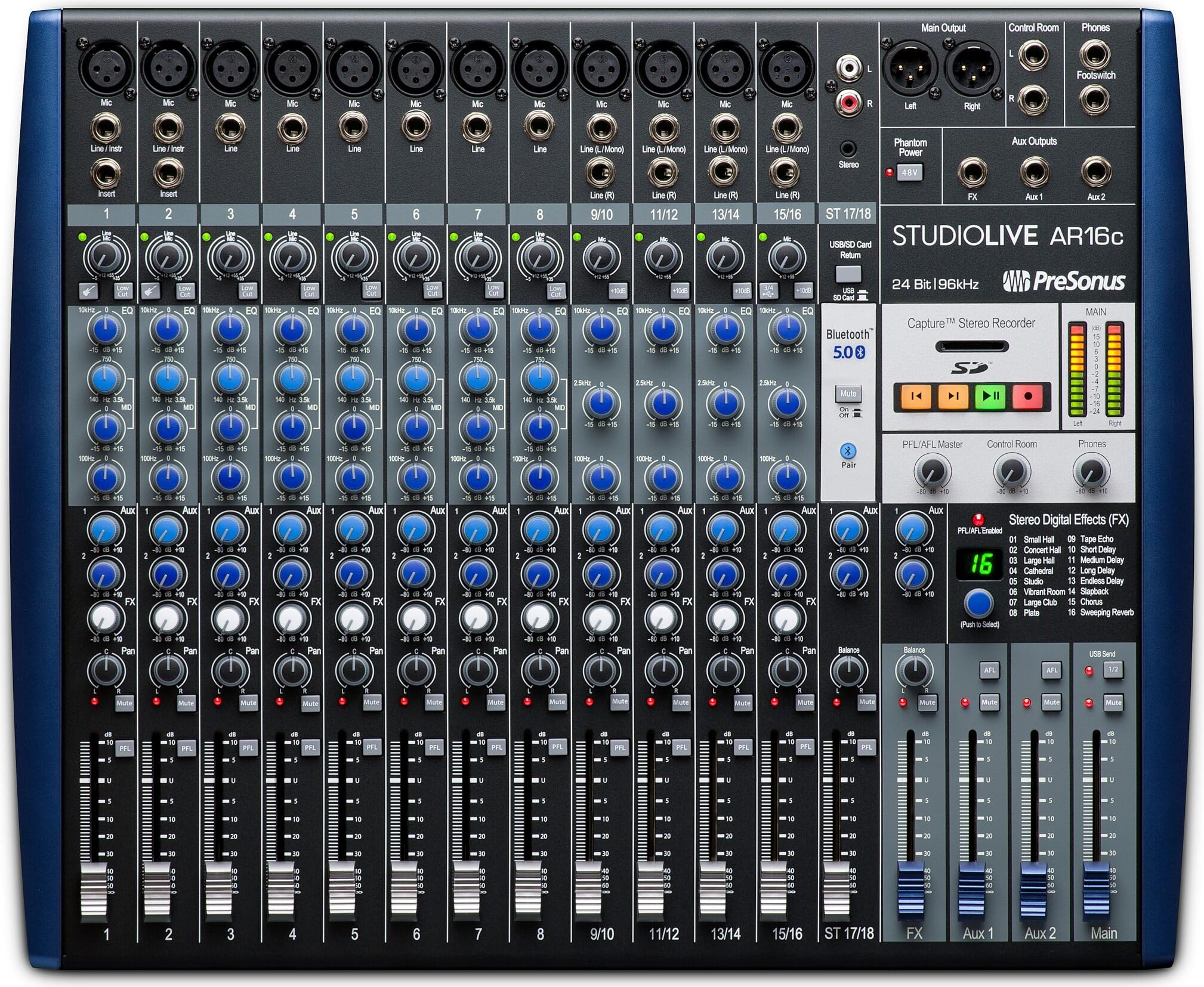
The PreSonus StudioLive AR16c is a hybrid analog mixer and audio interface designed as a complete production hub. It offers 18 channels with 12 XMAX microphone preamps, a stereo Super Channel with Bluetooth 5.0 and RCA inputs, and a 2×2 SD recorder for standalone capture. The 18×4 USB-C interface records every channel plus the main mix simultaneously, making it ideal for multi-track capture of a full band or complex electronic setup.
The included Studio One Pro DAW and Capture live-recording software represent significant value for producers building a studio from scratch. The stereo effects processor with 16 presets covers reverb, delay, and chorus, and a bypass footswitch jack allows hands-free control. The global +48V phantom power is a single switch, which is a common design choice at this price point but means you cannot selectively power channels.
Reliability reports are mixed — some users report units failing after several months of heavy use, which is a concern for a mixer at this premium level. The learning curve for routing USB audio return through the Super Channel can also be non-trivial. But for those who need maximum channel count, integrated DAW software, and SD card recording in one box, the AR16c is a formidable tool.
Why it’s great
- 18×4 USB-C multi-track recording with SD card backup
- Includes Studio One Pro and Capture software
- Bluetooth 5.0 and versatile Super Channel
Good to know
- Some reliability concerns over extended use
- Global phantom power, not per-channel
4. Behringer X AIR XR18

The Behringer X AIR XR18 redefines what an analog mixer can be by fusing 16 award-winning Midas-designed programmable mic preamps with an iPad/Android tablet control surface. This is an all-analog analog path with digital control — the preamps are fully analog, but every parameter from EQ to compression to FX is digitally recallable. The 18×18 bidirectional USB interface allows multi-track recording directly to a tablet or computer.
The built-in tri-mode Wi-Fi router eliminates the need for an external router, allowing direct wireless control from anywhere in the room. The Dugan-style auto-mixing algorithm automatically manages microphone gain sharing, which is a huge asset for panel discussions or live multitrack recording. Rack-mountable in 3U, the XR18 can sit on a desk, in a rack, or on stage, making it incredibly versatile for studio and live use.
The main limitation is the reliance on a tablet or smartphone for control — there are no physical faders or knobs on the unit itself. The built-in Wi-Fi can be finicky in crowded RF environments, and some users prefer a dedicated external router for reliability. If you are comfortable with digital control, the combination of Midas preamp quality and deep DSP processing is unbeatable at this price tier.
Why it’s great
- 16 Midas preamps with recallable analog circuitry
- Built-in Wi-Fi for direct wireless control
- 18×18 USB multi-track interface with auto-mixing
Good to know
- No physical controls on the unit itself
- Wi-Fi stability can vary by environment
5. Yamaha MG10XU

The Yamaha MG10XU is a 10-channel analog mixer that punches well above its compact size. The D-PRE mic preamps are Yamaha’s signature, delivering clean, transparent, and natural sound with a focus on low noise and high headroom. The 3-band EQ on all mono channels is straightforward and musical, and the one-knob compressors on channels 1-2 provide simple, effective dynamics control for vocals or acoustic instruments.
The built-in SPX effect processor offers 24 digital effects including reverb, delay, and chorus, all selectable with a single knob. Class-compliant USB 2.0 connectivity enables plug-and-play recording and playback with computers and tablets without needing drivers. The compact dimensions — approximately 11.6 inches deep by 9.6 inches wide — make it one of the smallest fully-featured analog mixers on this list, perfect for a cramped desk setup.
Users consistently praise the build quality and the fact that it serves as both a mixer and a simple audio interface without external boxes. The lack of sweepable mid EQ and limited routing options are minor trade-offs given the price and size. For podcasters, solo musicians, or small electronic rigs, the MG10XU is a remarkably clean and reliable workhorse.
Why it’s great
- Clean, transparent D-PRE preamps with low noise
- Compact desktop footprint saves valuable desk space
- Plug-and-play USB with class-compliant driverless operation
Good to know
- Fixed 3-band EQ, no sweepable mid option
- Limited routing flexibility compared to larger consoles
6. Behringer Xenyx X1832USB

The Behringer Xenyx X1832USB is an 18-input, 3/2-bus analog mixer that offers an impressive feature set for its tier. The standout feature is the Neo-classic British 3-band EQ with a semi-parametric mid band, allowing you to sweep the mid frequency to cut or boost precisely — a rare feature at this price point. The six XENYX mic preamps deliver a usable noise floor, and the six one-knob compressors with control LEDs make setting up vocal or instrumental channels quick.
The built-in effects processor includes 16 editable presets (reverb, chorus, flanger, delay, pitch shifter) with tap tempo and user parameter storage. The FBQ feedback detection system on the graphic EQ is a practical tool for live sound. With 6 mono mic/line channels, 4 stereo line channels, and 2 aux sends, there is enough routing for a small band or a multi-instrument home studio.
The main caveats are the USB interface, which outputs only the stereo master bus (no multi-track), and the build quality, which some users report can suffer from scratchy sliders over time. The manual is notoriously poor, and you will need to download the block diagram separately. For users who value sweepable mid EQ and do not need multi-track USB recording, the X1832USB offers tremendous flexibility.
Why it’s great
- Semi-parametric mid-band EQ for surgical tone shaping
- 16 editable effects with tap tempo and user storage
- 6 compressors with visual control LEDs
Good to know
- USB interface outputs stereo mix only, not multi-track
- Manual is poorly written; requires downloading separate block diagram
7. Mackie 802VLZ4
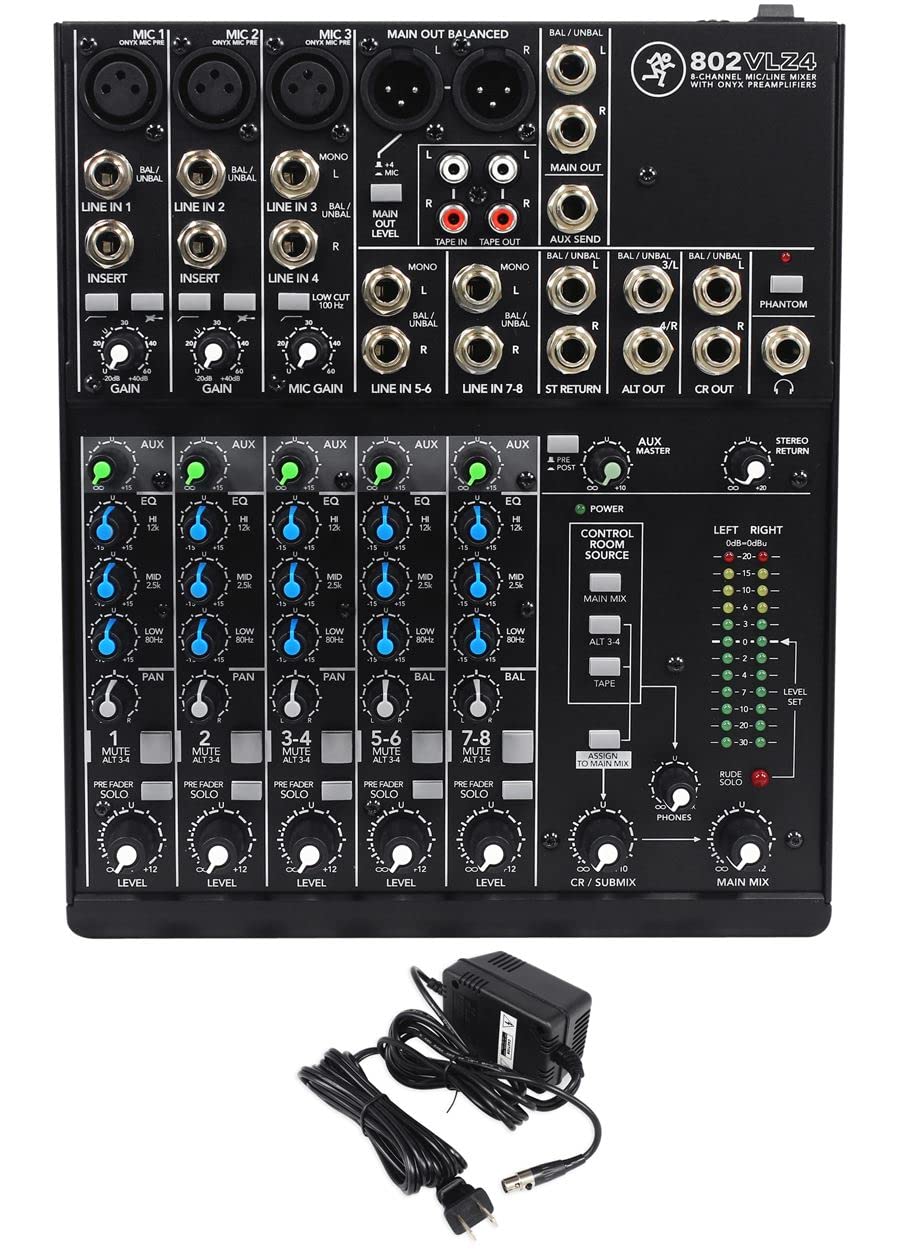
The Mackie 802VLZ4 is the definition of a reliable, no-nonsense analog mixer. It features three boutique-quality Onyx mic preamps in an 8-channel frame that is only 4.3 inches tall and 12.1 inches wide. The high-headroom/low-noise design keeps the signal path clean, and the improved RF rejection makes it suitable for broadcast or livestreaming applications. Phantom power for condenser mics is accessible with a single switch.
Each mono channel offers a 3-band EQ and two aux sends (one pre-fader for monitoring, one post-fader for effects). The channel inserts on channels 1-2 allow you to patch in external compressors or use them as effects loops. The XLR balanced outputs and the compact form factor make this an ideal submixer or a simple studio mixer for a small recording setup. Build quality is excellent, with a thick steel chassis and metal jacks.
The lack of built-in effects, USB connectivity, or Bluetooth means you will need external gear for reverb or computer recording. The EQ knobs lack a center detent, which can make flat settings slightly less intuitive. For users who want a pure, transparent analog path without digital extras, the 802VLZ4 is a legendary compact workhorse.
Why it’s great
- Classic Onyx preamps with very low noise floor
- Ultra-compact and rugged metal chassis
- Improved RF rejection for broadcast use
Good to know
- No built-in effects, USB, or Bluetooth
- EQ knobs lack center detent
8. Allen & Heath ZED6FX

The Allen & Heath ZED6FX is the smallest console from the legendary ZED line, but it packs GS-Pre mic preamps and a 61-effect multi-FX processor in a portable chassis weighing just 3 pounds. The two mic/line inputs with Hi-Z options allow direct connection of electric guitars and basses, and the 100 Hz high-pass filter on every mono channel removes low-end rumble before it hits the preamp. The 3-band MusiQ EQ is the same musical circuit found on larger A&H consoles.
The effects unit is genuinely impressive for a mixer this small, offering reverb, delay, modulation, and tap tempo derived from Allen & Heath’s flagship digital series. The 60mm main fader provides smooth master level control. The build quality is good, with Neutrik connectors and a chassis-mounted potentiometer design, though the overall feel is lighter than the larger ZED 10FX.
The primary limitations are the low channel count (2 mono, 2 stereo) and the lack of a USB audio interface — you will need an external audio interface for computer recording. The headphone output quality has been noted as subpar by some users. For a very compact recording setup or as a portable sub-mixer for a home studio, the ZED6FX offers excellent preamp and effects quality in a travel-friendly form.
Why it’s great
- GS-Pre preamps with excellent headroom for the size
- 61 high-quality studio effects with tap tempo
- Highly portable at only 3 pounds
Good to know
- No USB audio interface for computer recording
- Headphone output quality may disappoint some users
9. Pyle PMXU128BT

The Pyle PMXU128BT is a 12-channel console-style mixer that brings a surprising number of inputs at a very accessible price point. It offers 12 XLR combo inputs, a 7-band graphic EQ, 16 DSP effects, and Bluetooth wireless streaming for backing tracks. The USB soundcard function allows direct connection to a PC or Mac for basic recording, making it a true all-in-one solution for the budget-conscious home studio builder.
The LED indicator lights and independent channel balance controls make it simple to use, even for beginners. The Bluetooth input can be mixed with all other channels, allowing you to blend wireless audio from a phone with live microphones. With 2 mono inputs and 5 stereo line inputs, there is enough room for a multi-mic podcast setup, a small band practice, or an electronic instrument rig.
The trade-offs for the low cost are noticeable: the preamps exhibit a higher noise floor than premium competitors, the build quality is not as robust, and some users report minor USB connectivity glitches. The effects processor is basic compared to the Yamaha SPX or Allen & Heath units. For an entry-level user who needs many channels and is willing to accept some compromises in preamp clarity and build durability, the Pyle is a functional and affordable starting point.
Why it’s great
- 12 XLR combo inputs for multi-mic setups
- Built-in Bluetooth for wireless streaming
- USB soundcard for direct PC recording
Good to know
- Preamp noise floor is higher than competitors
- Build quality is not as durable for heavy touring
FAQ
Can I use an analog mixer as my primary audio interface?
Do I need a mixer with built-in effects for a home studio?
What does a Hi-Z input do and why does it matter?
What is the difference between a fixed EQ and a sweepable mid-band EQ?
Final Thoughts: The Verdict
For most users, the analog mixer for home studio winner is the Mackie ProFX10v3+ because it offers the best mix of premium Onyx preamps, editable GigFX+ effects, and flexible USB-C connectivity with loopback and Bluetooth Mix Minus — all in a compact desktop form factor. If you want the lowest noise floor and widest preamp headroom for critical recording, grab the Allen & Heath ZEDi-10FX and take advantage of its 4×4 USB interface and studio-quality effects. And for the budget-conscious beginner who needs maximum channels and Bluetooth streaming, nothing beats the Pyle PMXU128BT at its accessible entry point.