
Our readers keep the lights on and the weekend projects moving. As an Amazon Associate, I earn from qualifying purchases.
An analog multimeter doesn’t just give you a number; it tells a story. The sweep of the needle across the scale reveals trends, peaks, and fluctuations that a bouncing digital display often misses, making it the preferred tool for anyone tuning a vintage radio, troubleshooting a capacitor, or dialing in a live circuit.
I’m Rikta — the co-founder and writer behind FitlyFast. After analyzing hundreds of multimeter listings and customer reports, I know exactly which specs separate a precision instrument from a fragile toy.
This guide cuts through the noise to highlight the best analog multimeter options on the market, focusing on real-world performance, safety features, and build quality that matters for both hobbyists and seasoned technicians.
How To Choose The Best Analog Multimeter
Choosing an analog multimeter is a different process than picking a digital one. You are buying a tool for its responsiveness and visual feedback, not its raw decimal count. Focus on three core areas: sensitivity, safety, and scale readability.
Sensitivity: The 20kΩ/V Rule
Sensitivity is measured in ohms per volt (Ω/V). A meter with higher sensitivity (20,000 Ω/V for DC) loads the circuit less, giving you a more accurate voltage reading on high-impedance circuits common in tube radios and industrial controls. Budget meters often use 2kΩ/V or 5kΩ/V, which can drain the circuit and show artificially low voltages.
Safety: Fuses and CAT Ratings
An analog meter is not safe just because it’s cheap. Look for a unit that includes a fuse on the current inputs, preferably a high-energy or fast-acting fuse like the ones in the premium Sanwa and Hioki meters. A CAT II rating is standard for household electronics; CAT III is better for industrial or distribution-level work. Never use an unfused meter on mains voltage.
Readability: Mirrors and Scales
Parallax error is the enemy of precision. A mirrored scale lets you align the needle with its reflection for a distortion-free reading. Wide arc scales and bold color-coded ranges (like the Gardner Bender’s red/yellow zones) reduce eye strain. A mechanical zero adjuster and a zero-ohm potentiometer are must-haves for consistent resistance measurements.
Quick Comparison
On smaller screens, swipe sideways to see the full table.
| Model | Category | Best For | Key Spec | Amazon |
|---|---|---|---|---|
| Hioki 3030-10 | Premium | Precision DC microamps | 60 µA, 300 mV DC range | Amazon |
| Sanwa YX-360TRF | Premium | Vintage radio restoration | Linear scale, captive leads | Amazon |
| Sanwa AP-33 | Premium | Industrial field use | Compact, hard-wired leads | Amazon |
| Tekpower TP8260L | Mid-Range | Low-light work | Built-in backlight | Amazon |
| Aicevoos AS-7199A | Mid-Range | Remote control testing | 24 ranges, 11 functions | Amazon |
| NJTY S471 | Value | Audio dB alignment | Rechargeable, dB scale | Amazon |
| Gardner Bender GMT-318 | Budget | Everyday low-stakes checks | 6 functions, 14 ranges | Amazon |
In‑Depth Reviews
1. Hioki 3030-10 HiTester
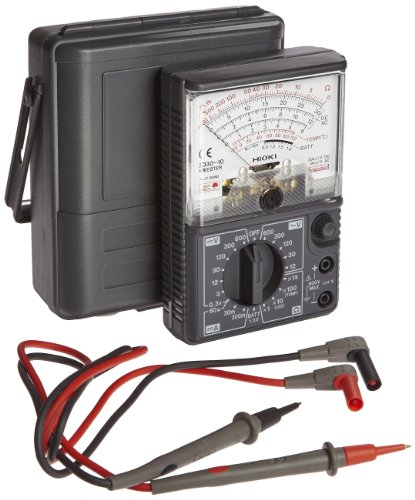
The Hioki 3030-10 is the reference standard for anyone who needs a sensitive, highly accurate analog meter. Its 60 µA and 300 mV DC ranges allow you to measure tiny signal-level currents that cheaper meters cannot resolve, making it ideal for instrumentation, calibration checks, and delicate electronics work.
The build is robust, with a protective carrying case that doubles as a stand with a lockable viewing angle. Users consistently report that its readings track perfectly alongside professional-grade digital meters, but with the needle response that reveals signal drift and noise. It meets IEC 61010 safety standards and is CAT III rated up to 600V.
Minor trade-offs: the stock test leads are basic and don’t accept standard Fluke-style accessories, and the scale lacks a mirror backing for parallax elimination. For the price, however, it delivers laboratory-level performance in a field-ready package.
Why it’s great
- Exceptional 60 µA and 300 mV DC sensitivity for low-level signals
- CAT III 600V safety certification with robust fuse protection
- Sturdy carry case with lockable tilt stand
Good to know
- Proprietary test leads limit accessory compatibility
- No mirrored scale for parallax correction
2. Sanwa YX-360TRF
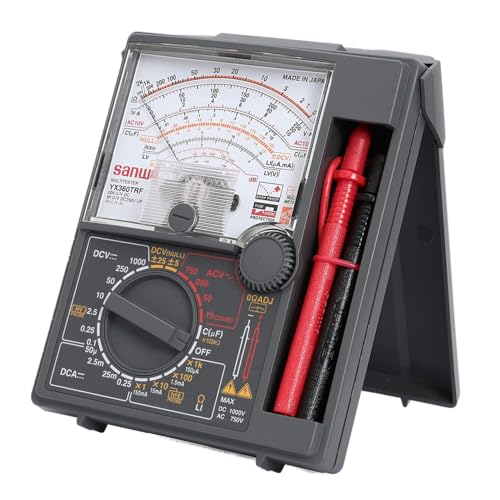
The Sanwa YX-360TRF is a purpose-built tool for the vintage electronics restorer. Its large, linear scale is exceptionally easy to read, and the clever all-in-one case design stores the test leads internally while deploying them through captive slots, meaning you never lose or tangle a lead on a busy bench.
Users who restore antique tube radios and amplifiers praise its predictable needle behavior and direct-reading scales that match the ranges they need most. The meter feels solid, with positive detents on the rotary switch and a smooth zero-ohm adjustment. It is large enough to read comfortably but still portable enough to carry between workstations.
This is not a pocket meter; it is a bench companion. The trade-off is that it lacks a backlight and a mirrored scale, but for the user who values tactile feedback and classic design over digital gimmicks, the YX-360TRF is unbeatable in its class.
Why it’s great
- Large, highly readable linear scale for precision work
- Captive test lead storage prevents loss and tangling
- Excellent build quality with positive switch detents
Good to know
- Not a compact meter; designed for bench use
- No backlight or mirrored scale
3. Sanwa AP-33

The Sanwa AP-33 is a compact industrial-grade meter that prioritizes portability without sacrificing core accuracy. Its hard-wired test leads are permanently attached, eliminating the risk of a loose connection or a lost probe mid-job. The body is small enough to fit in a shirt pocket, yet the scale is clearly marked and reads accurately.
Built with a focus on field reliability, the AP-33 uses a fast-acting fuse (per the manual) to protect the user and the meter during high-energy faults. Users note that the lead retraction system is tidy, though some caution that the wires can be damaged if pulled too hard against the internal strain relief. Soldering a replacement requires disassembly.
This meter excels in tight electrical panels, on-site HVAC checks, and any environment where a dropped meter is a real risk. Its compact size and durable construction make it a favorite among electricians who need a single-purpose, reliable analog tool that won’t get in the way.
Why it’s great
- Extremely compact and portable for field work
- Hard-wired leads eliminate loose connections
- Uses designated fast-acting fuse for safety
Good to know
- Hard-wired leads cannot be easily replaced in the field
- Scale text may be small for users with vision issues
4. Tekpower TP8260L
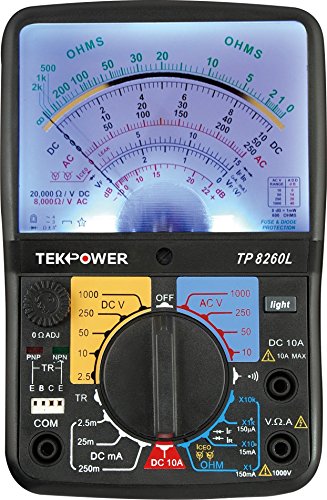
The Tekpower TP8260L addresses one of the biggest pain points of analog meters: visibility in low light. Its white LED backlight illuminates the scale, making it usable in dark basements, attics, and under dashboards where a flashlight is awkward. This feature alone makes it a standout in the mid-range category.
Beyond the backlight, the meter offers a full suite of functions including AC/DC voltage, DC current up to 10A (unfused, so caution is needed), resistance, decibel measurement, and a transistor checker for PNP and NPN types. Users report its DC accuracy is within 3% right out of the box, though the 1000V AC range can show a significant error at low voltages.
The build is solid with a lubricated switch feel, but the bundled test leads are cheap and the backlight can pull down the voltage on the x10K resistance range, throwing off readings. For the price, these are manageable quirks for a meter that solves a real usability problem.
Why it’s great
- Useful white LED backlight for dark environments
- Includes transistor hFE test socket and decibel scale
- Good DC voltage accuracy (3%) for the price
Good to know
- 10A current input is unprotected (no fuse)
- Backlight affects voltage on x10K resistance range
5. Aicevoos AS-7199A
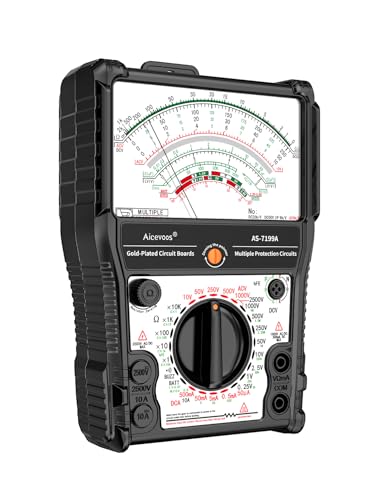
The Aicevoos AS-7199A packs an unusually wide feature set into a mid-range analog meter. With 11 functions and 24 ranges, it covers everything from standard voltage and current to specialized modes like LED testing, LV detection, and remote control IR emitter testing. The built-in stand and magnets on the back allow hands-free operation on a workbench or metal surface.
User feedback highlights its good continuity beeper (a rarity on analog meters), accurate DC voltage readings, and the utility of the regulator/LED test function for quick diode checks. The scale is color-coded and reasonably clear, though the jack inputs lack color coding to prevent reversed probe insertion.
The plastic shell feels lighter than the Sanwa or Hioki options, but the sheer number of functions for the price point is compelling for a DIY enthusiast who wants a single tool for multiple troubleshooting scenarios. Just be careful with the jack orientation on DC current measurements.
Why it’s great
- Extensive 11-function and 24-range versatility
- Magnetic back and stand for convenient hands-free use
- Continuity beeper is responsive and loud
Good to know
- Jack inputs are not color-coded for polarity
- Build uses lighter plastic compared to premium meters
6. NJTY S471

The NJTY S471 is a value-driven analog meter that stands out with its built-in rechargeable battery, eliminating the hunt for 9V or AA cells. Its dB measurement scale is a genuine feature for audio technicians aligning speaker crossovers or stage amplifiers, where the needle’s sweep reveals coupling tightness that a digital meter cannot show.
Users appreciate its compact size and light weight. The triple fuse tube design includes two spares stored inside the casing, a thoughtful touch for field repairs. However, the USB-C charging implementation on early units was non-standard (missing CC resistors), requiring an A-to-C cable for reliable charging. The seller claims this has been corrected.
A notable omission: the S471 cannot indicate DC polarity, meaning you will need a second meter for tasks requiring positive/negative identification. For its intended use—audio alignment, battery checks, and general trend monitoring—it is an excellent budget-friendly companion.
Why it’s great
- Built-in rechargeable battery with USB-C charging
- Useful dB scale for audio and stage work
- Includes spare fuses inside the casing
Good to know
- Cannot indicate DC polarity
- USB-C charging may have compatibility issues on early units
7. Gardner Bender GMT-318

The Gardner Bender GMT-318 is the quintessential budget analog meter for the toolbox drawer. It offers 6 functions and 14 ranges covering AC/DC voltage, resistance, and continuity, with a simple color-coded dial that makes it accessible even for first-time users. The meter is agency-approved and includes fuse overload protection, which is rare at this price point.
Users consistently call it a solid performer for its low cost. It is smaller than most people expect, so check the dimensions before buying. The battery compartment is snug, and some users report that standard rechargeable AA batteries need their positive dimple flattened to fit. The included test leads have very small plugs, which can feel flimsy during heavy use.
For quick checks like verifying wall outlet voltage, testing fuses, or checking car battery charge, the GMT-318 is perfectly adequate. Do not rely on it for precision or professional work, but as a sacrificial meter for dirty jobs, it is hard to beat.
Why it’s great
- Very budget-friendly with fuse protection included
- Color-coded scale makes it beginner-friendly
- Lightweight and easy to store in multiple locations
Good to know
- Smaller than expected; compact form factor
- Battery compartment is tight for some rechargeable cells
FAQ
Why would I choose an analog multimeter over a digital one?
What does 20kΩ/V sensitivity mean in practice?
How do I properly zero an analog multimeter before use?
Are cheap analog multimeters safe for home electrical work?
Final Thoughts: The Verdict
For most users, the best analog multimeter winner is the Hioki 3030-10 because it combines professional-grade sensitivity with CAT III safety and a rock-solid build. If you want a meter specialized for vintage audio restoration, grab the Sanwa YX-360TRF. And for a compact field tool that disappears in your pocket, nothing beats the Sanwa AP-33.