
Our readers keep the lights on and the weekend projects moving. As an Amazon Associate, I earn from qualifying purchases.
Walking a job site with a vane that barely spins on low-speed registers or a thermometer that takes twenty minutes to stabilize costs you billable hours and trust with clients. The difference between a guess and a real air balance reading comes down to the sensor design, the impeller friction, and how the meter handles duct area entry for live CFM calculation.
I’m Rikta — the co-founder and writer behind FitlyFast. Over the last decade I’ve analyzed hundreds of diagnostic tools, mapped sensor accuracy claims against field-test data, and watched which anemometer features actually survive a season of duct work, dust collection, and drop tests.
This guide breaks down seven models built for HVAC work so you can pick a wind speed meter that delivers repeatable readings and won’t fail mid-season. We focus on what matters: sensor type, CFM computation method, and data logging. This is the definitive guide to choosing the best anemometer for hvac.
How To Choose The Best Anemometer for HVAC
Picking the right airflow meter means matching the sensor type to your typical ductwork, understanding how the meter calculates CFM, and deciding whether you need wireless data export or just a solid instant reading. These three areas separate tools that save time from tools that create confusion.
Vane vs. Hot-Wire: The Sensor Showdown
Vane anemometers use a physical impeller that spins with the air stream. They are rugged, affordable, and excellent for medium-to-high velocity ducts. However, the impeller’s bearing friction makes them less reliable below 100 FPM. Hot-wire sensors have no moving parts and respond to the air’s cooling effect on a heated element, making them far more sensitive at low velocities — ideal for diffusers, VAV boxes, and residential grilles. If you regularly balance low-flow systems, a hot-wire probe like the Testo 405i will give you data a vane simply cannot capture.
CFM Calculation: Manual vs. On-Device Entry
The whole point of an HVAC anemometer is to convert air speed (FPM) into volumetric flow (CFM). Some meters require you to multiply FPM by duct area yourself. Better models let you punch in the duct’s cross-sectional area in square feet, then display live CFM as you move the probe. This auto-CFM feature — present on the BTMETER BT-846A and the AOPUTTRIVER AP-856A — dramatically reduces calculation errors and speeds up balancing work.
Data Logging and Reporting
If you need to document readings for commissioning reports or filter change logs, look for a meter that stores data onboard or transmits it via USB or Bluetooth. The BTMETER BT-100APP streams to a phone app and exports .xls files. The AOPUTTRIVER AP-856A includes USB-to-PC export. For pro-grade reporting, the Testo 405i pairs with the testo Smart Probe App to generate graphs and tables on the spot. Onboard memory without a way to get the data off the device is a dead end.
Quick Comparison
On smaller screens, swipe sideways to see the full table.
| Model | Category | Best For | Key Spec | Amazon |
|---|---|---|---|---|
| Testo 405i | Hot-Wire Probe | Low-flow ducts & VAV boxes | ±3 FPM accuracy; 15″ telescopic shaft | Amazon |
| AOPUTTRIVER AP-846A | Vane Anemometer | Pro balancing with data export | 0.001–100 mph; USB data port | Amazon |
| AOPUTTRIVER AP-856A | Vane Anemometer | USB data logging & CFM calc | 0.001–100 mph; USB + disc | Amazon |
| BTMETER BT-846A | Vane Anemometer | On-device CFM & 600-group log | 0.001–100 mph; separated vane | Amazon |
| BTMETER BT-100APP | Bluetooth Vane | Phone-based data logging | 0.67–67.1 mph; Bluetooth APP | Amazon |
| H12 Digital Anemometer | Vane + Humidity | Value-balanced HVAC & hobby use | 0–45 m/s; humidity + temp | Amazon |
| HoldPeak 866B | Budget Vane | Entry-level duct checks & outdoor | 0.67–67.1 mph; ±2% accuracy | Amazon |
In‑Depth Reviews
1. Testo 405i

The Testo 405i uses a hot-wire sensor instead of a spinning vane, which gives it genuine sensitivity in low-velocity ducts — it measures down to zero FPM with no bearing friction to overcome. The telescopic shaft extends 15 inches, letting you reach deep into supply registers and VAV box inlets without contorting your wrist. Accuracy sits at ±3 FPM plus ±0.9°F, which matches what many pro-grade hoods deliver in the field.
Bluetooth 4.0 links to the testo Smart Probe App, where you set duct dimensions and watch live CFM, temperature, and velocity graphs. The app stores data for reports, and the probe itself runs on three AAA batteries. The build is compact — about the size of a thick marker — and the metal-tipped probe resists the mild bends that come from daily toolbag life.
This is not a vane meter for high-volume duct mains. The maximum velocity reads around 6,000 FPM, so check that ceiling against your needs. The sensor bulb is exposed and can collect dust buildup over time, though cleaning it restores accuracy. For residential balancing, fume hood verification, and any low-speed work, the 405i is the reference tool in this lineup.
Why it’s great
- Hot-wire sensor captures low flows vanes miss
- Bluetooth app provides live graphs and data export
- 15-inch telescopic shaft reaches deep ducts
Good to know
- Max velocity capped at 6,000 FPM
- Exposed sensor bulb requires periodic cleaning
- Premium price tier
2. AOPUTTRIVER AP-846A

The AP-846A packs the wide-range vane sensor (0.001–100 mph) that HVAC pros need for both low-speed diffusers and high-volume duct mains. Accuracy is rated at ±3% plus 0.2 mph, and field comparisons against airflow hoods show readings within about 4 percent — solid for a handheld vane meter at this level. The large backlit LCD (1.69 x 2.3 inches) is readable in dim mechanical rooms.
You enter duct area directly on the keypad, and the meter calculates CFM in real time. The data hold, min/max/avg logging, and 2/3 max function give you the three pillars of traverse balancing. A 9V battery ships in the box, and the auto-off timer is adjustable. The extendable vane arm lets you position the impeller inside a register while keeping the display visible outside.
Users consistently report that the manual is poorly translated and lacks depth. The USB port is present but the software has compatibility issues with modern Windows versions. If you plan to use the data export, test it early. The vane itself is replaceable, which extends the tool’s life. For straight field CFM work without relying on the software, this is the most balanced vane option.
Why it’s great
- Wide 0.001–100 mph range covers all duct work
- On-device CFM calculation with area entry
- Replaceable vane sensor extends service life
Good to know
- USB software incompatible with some Windows versions
- Poor manual makes initial setup confusing
- 9V battery not rechargeable
3. AOPUTTRIVER AP-856A

The AP-856A is the sibling to the AP-846A with one critical addition: a USB port that, together with the included disc, connects to a PC for data export. The same 0.001–100 mph vane, same ±3% plus 0.2 mph accuracy, and same keypad CFM area entry apply. The extra export capability makes this model the choice for techs who need to attach logged readings to commissioning paperwork.
Wind flow range covers CFM from 0 to 999,900 ft³/min with a resolution of 0.001–100, and the area setting accepts values from 0.001 to 9,999 ft² — plenty of headroom for anything from a 4-inch round duct to a massive return plenum. The large display with backlight and data hold function are identical to the AP-846A. The vane arm extends and swivels for awkward register angles.
User feedback mirrors the AP-846A: readings agree with professional hoods within a few percent, but the software is finicky. One reviewer reported the data recording feature didn’t function correctly, and the disc software failed on both Windows 10 and XP. If you rely on the USB export, test the workflow before a deadline. The hardware itself is reliable and sensitive enough for balancing work.
Why it’s great
- USB data export for commissioning reports
- High accuracy within 4% of hood readings
- CFM calculation with adjustable duct area
Good to know
- Software compatibility issues with modern Windows
- Manual lacks clear instructions
- USB functionality inconsistent per user reports
4. BTMETER BT-846A
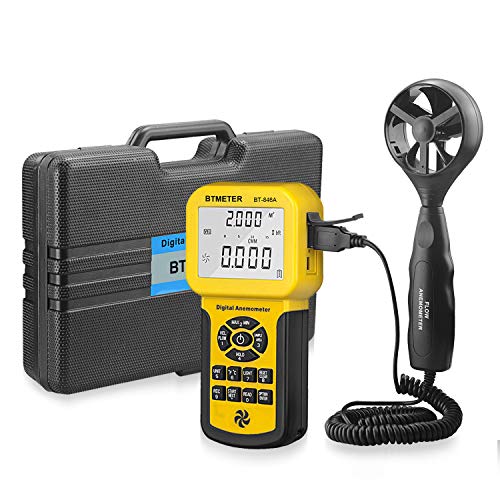
The BT-846A uses a physically separated vane head connected by a cable, which gives you the flexibility to place the impeller deep inside a duct while the main body stays in your hand or clipped to your belt. The vane is also replaceable individually, saving you from tossing the whole meter if the impeller gets damaged. Speed range extends from 0.001 mph up to 100 mph, making it suitable for both slow residential grilles and high-velocity commercial mains.
Onboard memory holds up to 600 groups of wind data — each group logs velocity, temperature, and CFM. You enter the duct cross-sectional area through the keypad, and the meter computes CFM and CMM live. The backlit LCD is large at 1.69 x 2.36 inches. The sealed battery compartment uses an O-ring and screws to keep dust and moisture out, a thoughtful detail for bag storage.
Some users mention the CFM reading resets to CMM unexpectedly, and the backlight has a short auto-off timer that can’t be disabled. The manual is thin, so plan to experiment with the area setting and data recall before heading to a job. The impeller spins on low-friction bearings, registering even light drafts. For the price, the separated sensor and memory capacity are hard to beat.
Why it’s great
- Separated vane head for awkward duct access
- 600-group onboard data logging
- Replaceable vane extends tool life
Good to know
- CFM display can revert to CMM without warning
- Backlight auto-off cannot be overridden
- Manual provides minimal setup guidance
5. BTMETER BT-100APP

The BT-100APP brings Bluetooth connectivity to the affordable vane segment, letting you pair it with a smartphone or tablet for remote readings and data export. The app auto-pairs at power-on, streams live wind speed and temperature, and can export logs as .xls or .txt files. Range sits at 0.67–67.1 mph with ±5% accuracy — adequate for standard duct balancing but less precise than the AOPUTTRIVER meters for critical low-speed work.
Two temperature sensors and an 8-vane impeller give it decent sensitivity for HVAC duct vent checks. The 1/4-inch threaded tripod mount at the bottom allows continuous hands-free monitoring. The battery is USB rechargeable, so you skip the disposable 9V hassle. The backlight is adjustable, and the data hold and min/max/avg functions are standard.
The app is functional but not polished. Some users report that data doesn’t save automatically and the average function only works for temperature. Bluetooth range through walls is about 30 feet, which is fine for most mechanical rooms. The rechargeable battery, Bluetooth export, and tripod mount make this a solid mid-range option if you want wireless data logging without stepping up to the Testo price tier.
Why it’s great
- Bluetooth pairs with phone for data export
- USB rechargeable battery saves on disposables
- Tripod mount for hands-free monitoring
Good to know
- ±5% accuracy less precise than competition
- App requires manual triggering for data saves
- No dedicated CFM area entry — manual calculation needed
6. H12 Digital Anemometer

The H12 includes a separated extendable wind sensor much like the BTMETER BT-846A, but at a lower entry point. The probe extends up to 2.3 meters, letting you reach into ceiling diffusers and deep duct runs while keeping the main body in view. It measures wind speed in five units, temperature in °C/°F, and relative humidity from 0.0 to 99.9% RH — a feature absent from most competitors in this range.
The large backlit LCD makes outdoor and dim mechanical room readings easy. CFM is displayed live, with no manual calculation required. Reviewers report readings that compare favorably with professional gauges during annual AC inspections. The kit includes three AAA batteries and a carry pouch. Build quality is ABS plastic with a solid feel for the weight.
The manual is sparse, and the clock-icon timing function lacks explanation. The humidity sensor adds diagnostic value for checking evaporator coil performance or duct leakage indicators. For a homeowner who wants to verify HVAC output or a tech on a tight budget, this meter handles 90% of common duct checks. The extendable probe alone justifies the price over cheaper fixed-head units.
Why it’s great
- Extendable probe reaches 2.3 meters into ducts
- Includes relative humidity measurement
- Live CFM display simplifies balancing
Good to know
- Manual lacks explanations for all features
- No data logging or export capability
- Uses AAA batteries, not rechargeable
7. HoldPeak 866B

The HoldPeak 866B is a budget-friendly entry point that still delivers the essential functions: wind speed from 0.67 to 67.1 mph with ±2% vane accuracy, dual temperature sensors, and wind chill calculation. The 8-vane impeller is sensitive enough for HVAC duct checks, and the meter switches between m/s, km/h, knots, mph, °C, and °F. A built-in stand and a standard tripod mount let you set it up for continuous readings.
The kit includes the meter, a small tripod, battery, wrist strap, and a protective carrying case — everything you need out of the box. Users running industrial wind turbines and residential duct checks alike report that the anemometer portion is accurate when tested against known speeds. The backlight and auto shut-off help conserve the included battery.
The tripod threads are known to be undersized on some units, causing the meter to not seat properly. The thermometer requires up to 30 minutes to normalize if the unit was stored in a pocket or direct sun, which limits its usefulness for quick temperature checks. One unit reportedly failed after exposure to an electromagnetic field from a power meter box. For basic wind speed measurement and casual HVAC use, the 866B works, but the temperature sensor lag and build inconsistencies push it to the end of the list for pro work.
Why it’s great
- ±2% vane accuracy good for basic duct checks
- Comes with tripod and carrying case
- Dual temp sensors and wind chill reading
Good to know
- Thermometer requires 30 min to stabilize
- Tripod threading inconsistent on some units
- EMF sensitivity reported in one failure case
FAQ
Can I use a vane anemometer for low-flow VAV box balancing?
What does CFM mean and why is it critical for HVAC work?
How often should I calibrate my HVAC anemometer?
Final Thoughts: The Verdict
For most users, the best anemometer for hvac is the AOPUTTRIVER AP-846A because it combines a wide 0.001–100 mph vane range with on-device CFM calculation and reliable field accuracy within 4% of hood readings. If you spend most of your time on low-flow residential systems and want zero dead-band at low speeds, grab the Testo 405i. And for budget-conscious buyers who need a separated probe and live CFM without breaking the bank, the H12 Digital Anemometer delivers surprisingly capable performance for common duct checks.