
Our readers keep the lights on and the weekend projects moving. As an Amazon Associate, I earn from qualifying purchases.
A miter saw cut that’s off by half a degree can leave a crown molding gap you’ll spend an hour trying to fill. That’s the real cost of a cheap or worn-out angle finder—wasted material, scrapped workpieces, and endless test fits. Whether you’re dialing in a table saw blade, laying out a rafter, or leveling a piece of machinery, the ability to capture and transfer an angle with repeatable accuracy determines whether your project lands tight or gets re-cut.
I’m Rikta — the co-founder and writer behind FitlyFast. I’ve combed through hundreds of hours of buyer feedback and manufacturer spec sheets to separate the tools that deliver honest, repeatable readings from the ones that drift or break mid-project.
This guide breaks down seven top-rated models across digital and mechanical formats so you can buy with confidence. Whether you need a compact digital inclinometer for quick site checks or a precision miter protractor for finish carpentry, the best angle finder for your shop depends on how you intend to use it and the margin of error you can tolerate.
How To Choose The Best Angle Finder
Picking the right angle finder starts with understanding the two main form factors: digital electronic inclinometers and mechanical miter protractors. Digital models give you a numeric readout and can be reset to zero at any position, which makes them ideal for transferring compound angles and checking relative tilt. Mechanical protractors rely on a physical dial and a locking arm — no batteries, no electronics, and often more durable on a heavy framing crew. Your choice comes down to whether you want a fast digital number or a robust tool that works in the rain.
Accuracy and Repeatability
The spec that separates a serious tool from a toy is its stated accuracy — usually listed as ±0.1°, ±0.2°, or ±0.3°. For setting a table saw blade to 90°, a ±0.1° margin is tight enough that you won’t see a visible kerf error. For general framing or layout, ±0.3° is perfectly acceptable. More important than the single-point accuracy is repeatability: the tool should return to the same reading when you check the same angle twice. Read reviews that mention “repeatable” before you trust a single accuracy claim.
Display and Readability
A backlit, high-contrast LCD screen makes the difference between a tool you reach for daily and one you leave in the drawer. Digital inclinometers with large fonts and auto-rotating screens let you read the number upside down — critical when you’re working above eye level or inside a cabinet. If you work outdoors, pay close attention to user reports about screen washout in direct sunlight; some budget models become essentially illegible in bright conditions.
Build Quality and Magnetic Strength
Aluminum and stainless steel bodies resist corrosion and hold up to job-site drops better than plastic. A strong magnetic base allows hands-free attachment to steel saw tables, fence rails, and conduit, freeing your hands for marking or adjusting. Check whether the magnet covers the full bottom face or just a small strip — a full-face magnet provides much more stability against accidental knocks.
Quick Comparison
On smaller screens, swipe sideways to see the full table.
| Model | Category | Best For | Key Spec | Amazon |
|---|---|---|---|---|
| Mecurate 10-Inch Digital Level | Digital Inclinometer | Multi-purpose leveling & angle measurement | ±0.1° accuracy, 10-inch length | Amazon |
| Klein Tools 935DAGL Digital Level | Digital Level | Programmable pitch & conduit alignment | 0.1° precision, dual-axis bullseye | Amazon |
| LEXIVON Aluminum Digital Angle Finder (LX-DAF7) | Digital Protractor | Hobbyist woodworking & 3D printing | ±0.3° accuracy, 7-inch aluminum rule | Amazon |
| S&F STEAD & FAST Digital Angle Finder (7-inch) | Digital Protractor | Cabinet & miter saw setup | ±0.3° accuracy, 200mm stainless steel | Amazon |
| VOLCANOES CLUB Magnetic Digital Angle Finder | Digital Inclinometer | Knife sharpening & small-scale projects | ±0.1° at 0°/90°, 0.05° resolution | Amazon |
| S&F STEAD & FAST Digital Protractor (DPRAF-7-B) | Digital Protractor | General woodworking & wall angles | 0.05° resolution, 7-inch stainless steel | Amazon |
| Starrett ProSite Miter Protractor 505A-7 | Mechanical Protractor | Finish carpentry & miter saw transfer | Laser-engraved scale, 7-inch aluminum | Amazon |
In‑Depth Reviews
1. Mecurate 10-Inch Digital Level
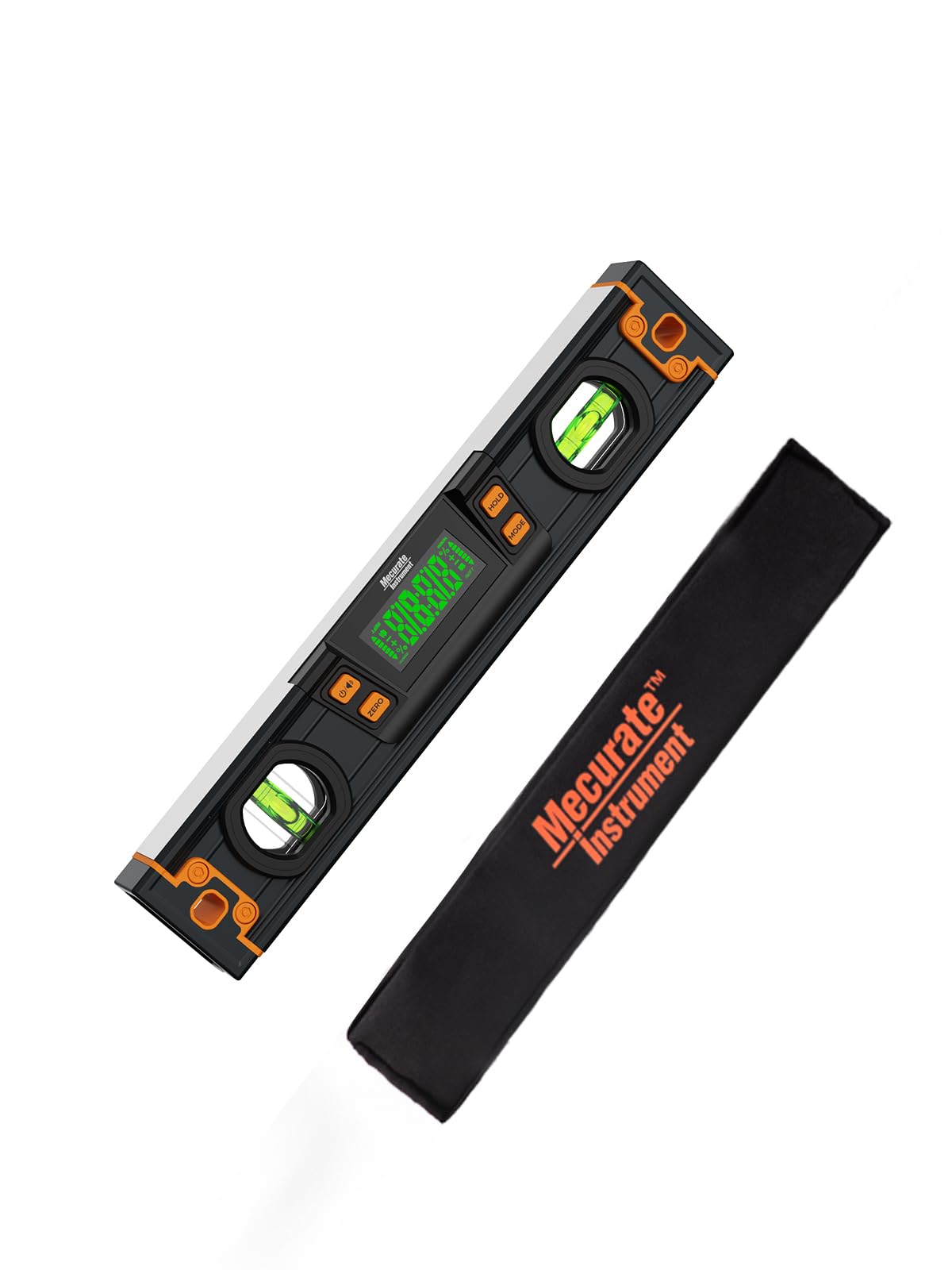
The Mecurate 10-inch digital level blends the utility of a torpedo level with the precision of an electronic inclinometer. Its large backlit LCD and ±0.1° accuracy at 0° and 90° make it a serious contender for table saw blade alignment and miter gauge setup. The audible beeper at level and plumb adds convenience when you’re working alone and can’t take your eyes off the workpiece.
The aluminum alloy body feels solid in the hand, and the full-length magnetic base grips steel surfaces tightly — a real advantage when attaching to saw tables or metal studs. It runs on a single included AAA battery and ships with a protective carrying case, so it’s ready for both shop and job-site use out of the box.
A few users noted that the screen orientation auto-flip is reliable, but the unit is slightly longer than a traditional pocket-level, which may feel bulky in very tight spaces. For the price, you get accuracy that competes with tools costing significantly more, making this a smart choice for anyone who needs a dual-purpose leveling and angle-finding tool.
Why it’s great
- High ±0.1° accuracy at critical angles
- Bright backlit screen with auto-flip
- Strong magnetic base holds securely to steel
Good to know
- 10-inch length may be cumbersome in cramped spaces
- Not designed for extreme high-precision calibration work
2. Klein Tools 935DAGL Digital Level Angle Finder

Klein Tools brings its pro-grade reputation to the 935DAGL, a compact digital level that goes beyond simple angle display by letting you program target pitches — 1/8-inch, 1/4-inch, 3/8-inch, and 1/2-inch per foot — making it ideal for plumbing and conduit runs. The color-changing LCD turns green when you hit your target, eliminating the need to squint at a number while holding the tool in place.
The dual-axis bullseye feature simultaneously reads X and Y orientation, so you can level a surface in both planes without flipping the tool. The auto-rotating display works in any orientation, and the high-contrast screen is one of the best in this category for dimly lit basements or attics. At under 6 ounces with batteries included, it disappears into a tool pouch.
The trade-offs are minor: the screw-type battery cover is a bit fiddly, and the included soft case lacks a belt loop. But for electricians, plumbers, and anyone who regularly sets pipe slopes or levels machinery, the programmability and dual-axis visibility make this a uniquely capable tool in a small package.
Why it’s great
- Programmable pitch targets for quick pipe slope setup
- Dual-axis bullseye reads X and Y simultaneously
- Color-changing LCD provides instant visual confirmation
Good to know
- Battery compartment screw can be tedious to remove
- Case design lacks a belt loop for carry
3. LEXIVON Aluminum Digital Angle Finder (LX-DAF7)

LEXIVON’s LX-DAF7 is a well-executed digital protractor aimed squarely at the hobbyist and home-shop woodworker. The 7-inch anodized aluminum rule includes laser-etched inch and millimeter markings, so you can use it as a ruler and an angle gauge without switching tools. The four-button interface — ZERO, HOLD/FLIP, REV, and ON/OFF — is intuitive enough that you won’t need the manual after the first use.
The 0.05° resolution is standard at this price, but the build quality stands out: the aluminum arms feel rigid, and the hinge operates with smooth, consistent resistance. The heavy-duty zippered pouch provides real protection, not just dust cover. Users in the 3D printing and CNC community have praised it for bed leveling and gantry alignment, where repeatability matters more than absolute calibrated accuracy.
A few accuracy tests have shown the unit stays within ±0.3° under 90° but can drift up to 1.8° beyond 90 degrees. That’s a meaningful limitation for crown molding or compound miter work, but for the vast majority of hobbyist cuts and general layout, it’s more than adequate. If your work stays under 90°, this is a fantastic value proposition.
Why it’s great
- High-quality aluminum build with etched markings
- Simple, responsive button interface
- Includes a rugged carrying case
Good to know
- Accuracy may degrade beyond 90 degrees
- Not intended for heavy construction or job-site abuse
4. S&F STEAD & FAST Digital Angle Finder (7-inch Stainless Steel)

S&F STEAD & FAST delivers a no-nonsense digital protractor that prioritizes corrosion resistance and rugged daily use. The stainless steel body with etched measurement scales won’t wear off like printed markings, and the continuous scale across both arms lets you measure lengths up to 400mm — a thoughtful detail for layout work that many competitors overlook.
The large LCD can toggle between decimal degrees and degrees/minutes, a feature appreciated by users who prefer traditional angle notation. Each unit carries a unique serial number and is tested to ±0.3° accuracy, which is consistent with the mid-range standard. The zero and hold functions work as expected, and the automatic power-off after five minutes preserves the included CR2032 battery.
Cabinet makers and trim carpenters will appreciate the tool’s ability to hold a reading while you transfer the angle to a saw. The stainless steel is noticeably heavier than aluminum, which adds a sense of durability but also a bit of weight. The sharp corners are intentional for precise measurement but require a bit of care during handling and storage.
Why it’s great
- Stainless steel construction resists corrosion
- Continuous scale measures up to 400mm
- Unique serial number for quality traceability
Good to know
- Heavier than aluminum alternatives
- Sharp edges require careful handling
5. VOLCANOES CLUB Magnetic Digital Angle Finder

The VOLCANOES CLUB digital angle finder packs high accuracy (±0.1° at 0° and 90°) into a compact, pocket-friendly package that weighs just five ounces with batteries. It’s been widely adopted by the knife-sharpening community for setting consistent bevel angles on guided systems, and its strong magnetic base makes it easy to attach to steel sharpening jigs and work surfaces.
The large LED backlit display is genuinely bright and easy to read indoors, though several users report that the screen washes out in direct sunlight — a limitation shared by many budget digital inclinometers. The V-groove edges let it sit securely on pipes and curved surfaces, and the included carrying bag with a belt loop adds portability that professionals will appreciate.
It supports four measurement units, absolute and relative angle modes, an audible beeper at level, and a hold function. The build is adequate for light-duty shop use but isn’t rated for drops, so treat it carefully. For the price, especially for sharpening and small-scale woodworking, this is a remarkably capable tool that outperforms its price tier.
Why it’s great
- High ±0.1° accuracy at key reference angles
- Compact size with V-groove for pipes
- Bright backlit display with auto-reverse
Good to know
- Screen hard to read in bright outdoor light
- Not built for drops or heavy job-site use
6. S&F STEAD & FAST Digital Protractor (DPRAF-7-B)
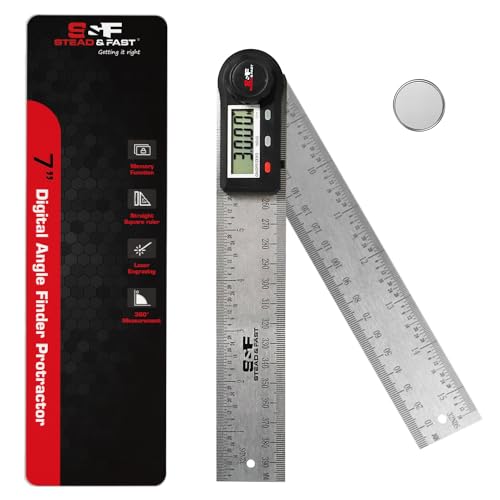
This 7-inch digital protractor from S&F STEAD & FAST comes at a slightly lower price point than the stainless steel version above, offering a similar feature set with a few trade-offs. It functions as both a digital angle finder and a ruler with a continuous scale on both sides, measuring up to 400mm for inside and outside dimensions. The LCD displays angles in degrees and minutes or to two decimal places, with a resolution of 0.05°.
The hold function lets you freeze a reading before moving the tool away from the workpiece, which is particularly useful for transferring angles from a corner to a saw. The zeroing button resets at any position for relative angle measurement. It’s powered by a single included CR2032 battery and shuts off automatically after five minutes.
User feedback is consistently positive from cabinet makers and trim carpenters, who note that the tool’s accuracy is sufficient for most woodworking tasks when tested against a known square. The main caveat is that some units require adjusting the hinge tension screw for consistent sensor repeatability. It’s a capable entry-level digital protractor that doesn’t break the bank.
Why it’s great
- 2-in-1 function as ruler and protractor
- Degrees/minutes display for traditional users
- Hold function freezes reading for transfer
Good to know
- Hinge tension may need adjustment for reliable readings
- Sharp corners require careful handling
7. Starrett ProSite Miter Protractor 505A-7

Starrett’s ProSite 505A-7 is a mechanical miter protractor engineered for the professional finish carpenter who refuses to trust batteries. The 7-inch aluminum body is 1/4-inch thick — noticeably heavier and more rigid than any plastic or stamped-metal alternative — and the Teflon O-ring at the pivot delivers smooth, backlash-free movement. The laser-engraved scale won’t wear off, and the dial reads directly in miter cut angles, not absolute wall angles.
This tool is specifically designed for one job: measuring an inside or outside corner and transferring that angle directly to your miter saw. It gives you the single cut and dual cut (miter) angles, so you can set the saw without doing any additional math. The firm hinge holds the setting securely, though it lacks a locking mechanism, so a hard bump can shift the readout.
Experienced users report that the tool is dead-on accurate when compared to a precision protractor, and the solid feel inspires confidence on the job site. The main limitation is that it doesn’t read absolute angles — it’s not a substitute for a digital inclinometer if you need a numeric degree readout for table saw blade setup. But if you cut crown molding or chair rail for a living, this is a time-saving tool that will last decades.
Why it’s great
- Laser-engraved scale for permanent readability
- Sturdy aluminum construction with Teflon pivot
- Direct miter cut readout eliminates math
Good to know
- No lock mechanism — setting can shift if bumped
- Does not provide absolute angle readings
FAQ
How do I calibrate a digital angle finder after receiving it?
Can a digital angle finder replace a traditional bubble level for framing?
What is the practical difference between 0.05° resolution and ±0.1° accuracy?
How important is the magnetic base strength when choosing an angle finder?
Final Thoughts: The Verdict
For most users, the best angle finder winner is the Mecurate 10-Inch Digital Level because it combines high accuracy, a strong magnetic base, and excellent screen visibility into a package that handles both leveling and angle measurement without compromise. If you want a dedicated digital protractor for your home shop, the LEXIVON LX-DAF7 offers great build quality at a reasonable price. And for professional finish carpenters who need a battery-free, direct-read miter transfer tool, nothing beats the Starrett ProSite 505A-7.