
Our readers keep the lights on and the weekend projects moving. As an Amazon Associate, I earn from qualifying purchases.
Specs are compiled from manufacturer listings and verified buyer reviews and can change over time — please confirm the key details on the product page before buying.
That cold jolt when you look up and your dog is gone — every owner knows it. The right animal tracking bracelet turns panic into a quick glance at your phone. This guide cuts through the noise to the tracking gadgets owners actually trust., from rugged hunting-grade collars to featherweight tags for cats.
I’m Rikta — the founder and writer behind FitlyFast. This guide is built by comparing the manufacturers’ published specifications and the patterns across verified customer reviews, so you get each pick’s real strengths and trade-offs instead of marketing spin.
Whether you have a sneaky escape artist or a cat on a long roam, here is a direct comparison of the best animal tracking bracelet options on the market today — from Garmin to Dogtra and beyond.
Our Picks at a Glance


How To Choose The Best Animal Tracking Bracelet
Picking the right tracker starts with your pet’s size, your property’s terrain, and your tolerance for subscription fees. The biggest mistake is buying a Bluetooth-only tag when you need cellular-based GPS for real range. Here are the three factors that matter most.
Range and Network Type
A tracker that uses cellular networks (4G/LTE) works anywhere there is signal — no distance limit. Pure Bluetooth tags (like an AirTag) only work within roughly 30–100 feet before you need another device nearby. For a roaming cat or a dog on a large property, cellular GPS is the only real answer.
Battery Life Trade-Offs
Trackers that send a live location every few seconds drain the battery fast — often needing a daily charge. Devices with power-saving modes can stretch to weeks. Figure out how often you need a fix: continuous for a hound in thick woods, or a check-every-few-hours for a barn cat.
Subscription Costs
Most cellular GPS trackers require a monthly or yearly subscription to keep the SIM card active. Some brands include the first 30 days or six months, then charge around – per month. Factor that into the total cost of ownership over two years.
Quick Comparison
| Model | Best For | Range | Battery Life | Weight | Amazon |
|---|---|---|---|---|---|
| Dogtra Pathfinder 2★ Best Overall | Serious tracking + training | 9 miles | Multiple days | Collar unit | Amazon |
| Garmin Alpha T 20Premium Pick | Hunting / extreme range | 9 miles | Up to 136 hours (expanded pack) | 262.7 g | Amazon |
| Garmin TT 15 MiniTop Performer | Small breed training | ~1.8 miles (town) | 16–30 hours | 7.5 oz | Amazon |
| Weenect Cat XS | Budget cat tracking | Unlimited (cellular) | Up to 7 days (claimed) | 27 g | Amazon |
| petivity by Purina | Health + location combo | Cellular (nationwide) | Up to 30 days | 1.07 oz | Amazon |
| DBDD AI Tracker | Escape artists | Cellular (nationwide) | Several days | 0.1 lb | Amazon |
| Pawfit Lite for Cats | Ultra-light cat tracking | Unlimited (4G) | ~1 day (GPS on) | <18 g | Amazon |
| Fi Series 3+ | AI health + escape alerts | Nationwide | ~1 week | 77 g | Amazon |
| Fi Mini GPS | Small dogs / cat | Nationwide (LTE) | ~1 week | 16 g | Amazon |
In‑Depth Reviews
1. Dogtra Pathfinder 2 GPS Dog Tracker e Collar
Our pick — over 4.5★ from 600+ verified ratings; the strongest balance of quality and price.
The collar that tracks your dog across 9 miles without charging you a single monthly fee.
This is the complete package for owners who want GPS tracking and an e-collar in one device. The Pathfinder 2 offers a 9-mile range with updates that let you see exactly where your dog is, even in dense terrain. What wins people over is the no-subscription model — you buy the hardware and the free app, powered by Map Box, gives you general, satellite, and terrain views with offline maps you can download ahead of time.
You get e-collar commands (Nick, Constant, Audible tone, LED Locate Light, and Pager Vibration) available both from the GPS Connector remote and from your smartphone or Apple Watch Series 5 / Galaxy Watch4. The crowd favorite — 4.6 stars from 600+ owners — reliably roots out durability that survives lake jumps and wet weather. The consensus is clear: this is a premium tool that justifies its cost in durability alone.
The recurring trade-off is the lack of a physical stimulation dial — owners find themselves fumbling with the phone screen when a distraction sneaks up fast. The e-fence also has some angle and size limits. If you want simple, subscription-free confidence on a single dog, this collar is a straightforward pick.
What owners trust most
- Zero monthly fees — buy once, use forever
- GPS accuracy at 9 miles with offline map support
- Saltwater-proof build handles any weather
The one shortcoming
- No physical dial for quick stimulation adjustment
Reach for it if: you want the strongest no-subscription GPS tracker that doubles as a training e-collar — ideal for active dogs and outdoor adventures.
Think twice if: you need a cheap tracker for a small cat; this is a substantial collar built for medium to large dogs.
2. Garmin Alpha T 20 GPS Dog Tracking Collar
The hunting-grade tracker that refreshes your dog’s location every 2.5 seconds.
Paired with a compatible Garmin handheld (Alpha series or Pro 550 Plus, sold separately), the Alpha T 20 delivers updates as often as every 2.5 seconds at up to 9 miles. That means you can watch your dog’s path in near-real time through thick forest. Owners say it never loses signal, and the rugged slim design fits both large and small breeds.
Battery life is a standout here — with dynamic tracking, a standard pack lasts up to 68 hours, and the expanded battery pack pushes that to 136 hours. The multicolor LED (choose from white, green, red, or blue — among others) lights up so you can spot your dog in the dark. Wi-Fi connectivity during charging keeps the collar updated automatically. The size is the trade-off: at 262.7 grams it is noticeably heavier than other options, and the handheld is an extra purchase.
What serious hunters love
- 2.5-second update interval for real-time tracking
- Up to 136 hours with expanded battery pack
- Multicolor LED for low-light identification
What to consider
- Requires a separate Garmin handheld — not a standalone device
Best for: hunters and backcountry users who need the fastest, longest-range GPS feed on a rugged collar.
Look elsewhere if: you want an all-in-one tracker that works with your phone — this needs a dedicated Garmin remote.
3. Garmin TT 15 Mini Dog Device
A 7.5-ounce tracker built for dogs as small as 9.5 inches around the neck.
Compared to the standard TT 15 (10.0 oz), the Mini shaves 2.5 ounces while keeping the GPS and GLONASS satellite reception that Garmin is known for. It pairs with Alpha and Astro handhelds, making it an excellent choice for training puppies or smaller hunting breeds. The 3/4-inch polyurethane-coated nylon collar straps are more durable than the regular version, and the included long and short stainless steel contact points work even in wet conditions.
The honest trade-off is battery life and range: you get 16–30 hours depending on use, and in town the range is about 1.8 miles — though in open country buyers report 6–8 miles. An occasional quirk is the GPS position jumping roughly 20 feet, which can create a noisy tracking line on the map. One owner described the regular TT 15 as flawless but noted the Mini is slightly inferior in these two areas.
What wins owners over: the smaller size makes it the go-to for dogs under 60 pounds, and the ability to put the collar into sleep mode from the handheld saves battery when changing hunting spots.
Grab it if: you already have a Garmin handheld and need a lighter, smaller collar for a young or small dog.
skip it if: you need maximum range and battery — the standard TT 15 outperforms it in both.
4. Fi New Series 3+ Smart Dog Tracker Collar

The collar that tracks not just where your dog is, but how much it licks and scratches.
Fi claims 2x improved GPS performance over its past devices, and owners confirm it tracks well in rural areas with a battery that lasts about a week. The real differentiator is the AI-powered health and behavior tracking: it detects activity, rest, barking, licking, scratching, eating, and drinking — giving you a complete picture of your dog’s well-being. You get escape alerts through custom virtual fences, and the Lost Dog mode feeds exact location data every few seconds.
On the downside, initial setup can be frustrating — the base station sometimes fails to connect to Wi-Fi, and the proprietary collar means you cannot swap in a custom collar without buying a whole new set. The subscription is required after the included 6-month membership expires, and value-for-money gets mixed votes in owner feedback. Still, for someone who wants a smart collar that also stores vet records and medication reminders, this is the most complete all-in-one.
The key difference: it integrates with Apple Watch for live location, activity, and Lost Mode right from your wrist — no need to pull out your phone.
Best for: owners who want health metrics (barking, scratching, eating patterns) alongside reliable GPS — and already plan to pay a subscription.
Not for: anyone who wants a no-fuss, simple tracker or prefers to use their own collar.
5. Fi Mini GPS Tracker for Dogs
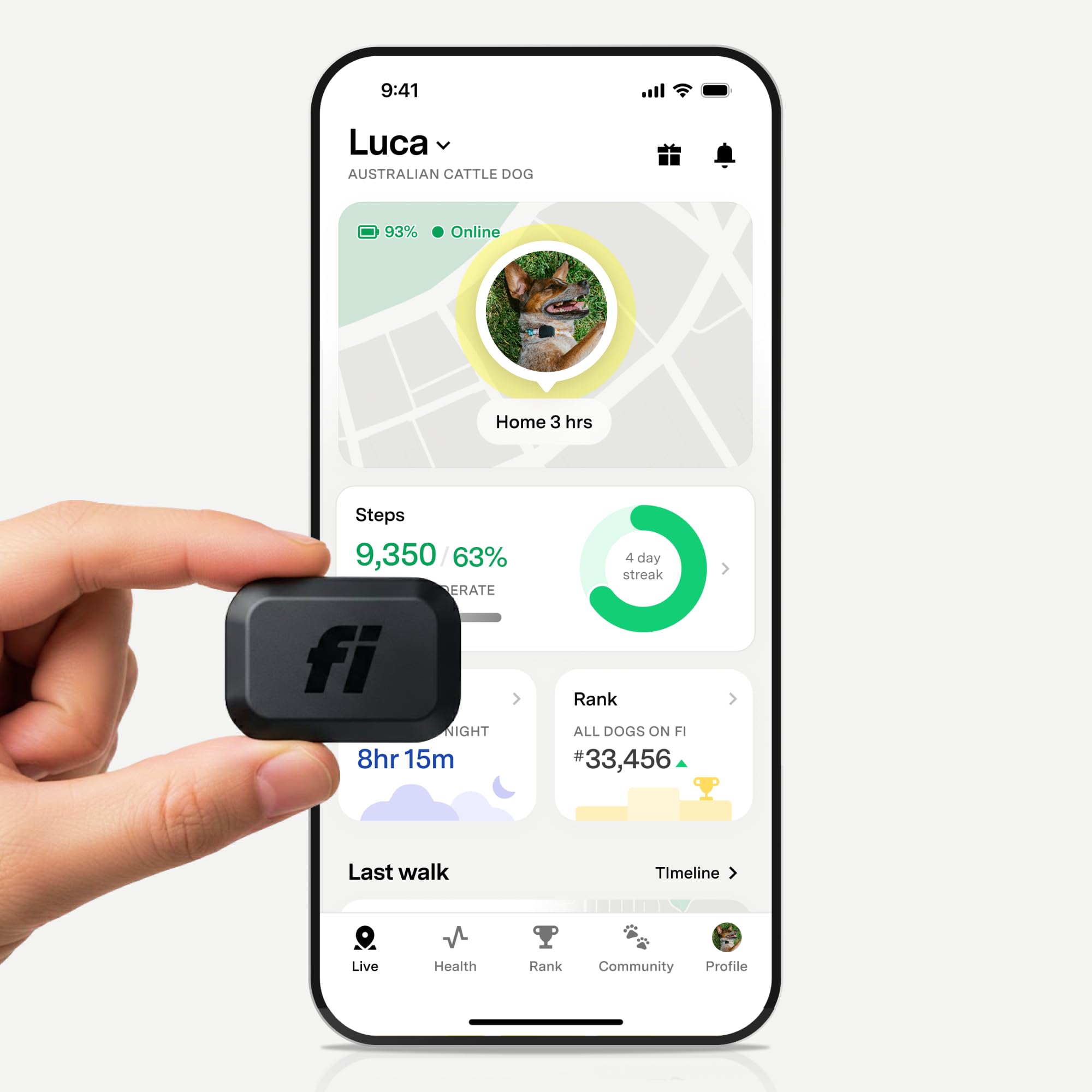
80 percent lighter than the Fi Series 3+, this 16-gram module fits even tiny collars.
If you have a small dog (or a cat) and need the Fi ecosystem, the Mini is the answer. It attaches to any collar or harness up to 1.25 inches wide and is rated IP68 — fully waterproof for rain, mud, or a dip in the creek. The battery lasts about a week, and the escape alerts are accurate enough that owners mention catching a bolting dog in real time via Lost Mode. The 6-month included membership helps offset the subscription cost.
The major complaint is the geofence accuracy: owners say the Mini does not reliably trigger an alert if the pet leaves a small yard — they reported a cat leaving by 30–40 yards without notification. False “on the move” alerts also pop up when the tracker stays indoors. This makes it less suitable for keeping a pet strictly within a tiny safe zone, though it works excellently for general location awareness over larger areas.
Bottom line: excellent battery life and a truly tiny footprint, but the geofence needs improvement for tight boundaries.
Reach for it if: you want the lightest possible Fi tracker for a small pet and care more about live location than perfect virtual-fence notifications.
Think twice if: you need precise in/out-of-yard alerts — the Series 3+ or a Garmin may serve you better.
6. petivity Dog GPS Tracker Powered by Purina
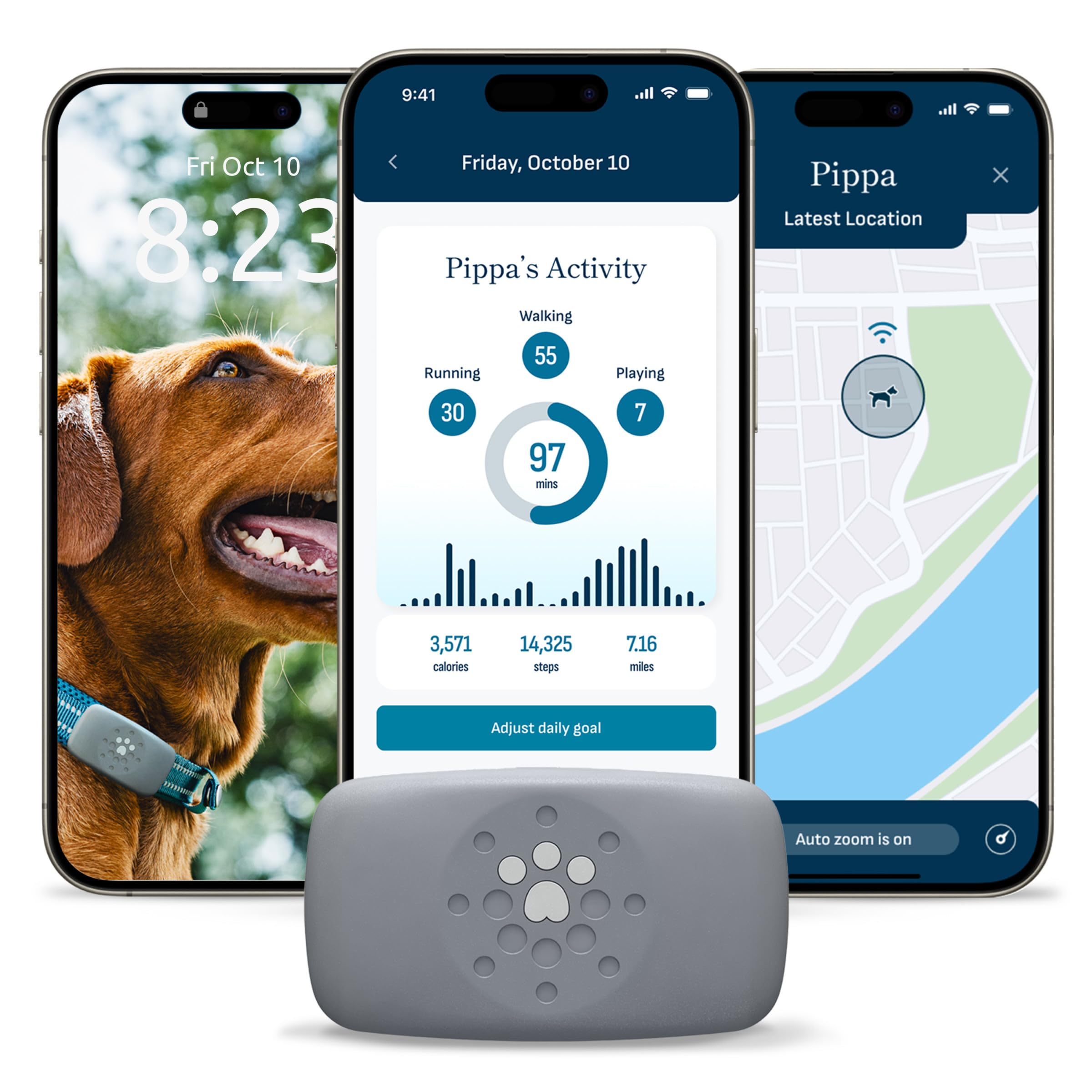
A lightweight GPS and activity tracker that lasts up to 30 days on a single charge.
This is a solid mid-range pick that focuses on health as much as location. The device uses a Velcro attachment that fits any collar or harness, and the wireless charging works right through the Velcro — a clean design touch. Accuracy is what owners praise most, with the app providing personalized activity goals and detecting rest, movement, and energy levels.
The catch is the GPS loading speed: it can take up to a minute to get a fix, and there is no live location view — you have to manually activate GPS for walks. Indoor connection drops quickly, which reduces battery life if the tracker sits in a poor signal area. The /month subscription is required after purchase, but for an affordable tracker that also watches your dog’s daily health patterns, it is a strong value.
What wins owners over: the battery life is the most consistent “30 days” claim in this category — fewer charges mean less hassle.
Best for: owners who want to monitor their dog’s daily activity trends and are okay with a slight delay in GPS loading.
Not for: anyone who needs instant, real-time location updates — the Fi or Garmin models are faster.
7. DBDD Dog GPS Tracker with AI Health
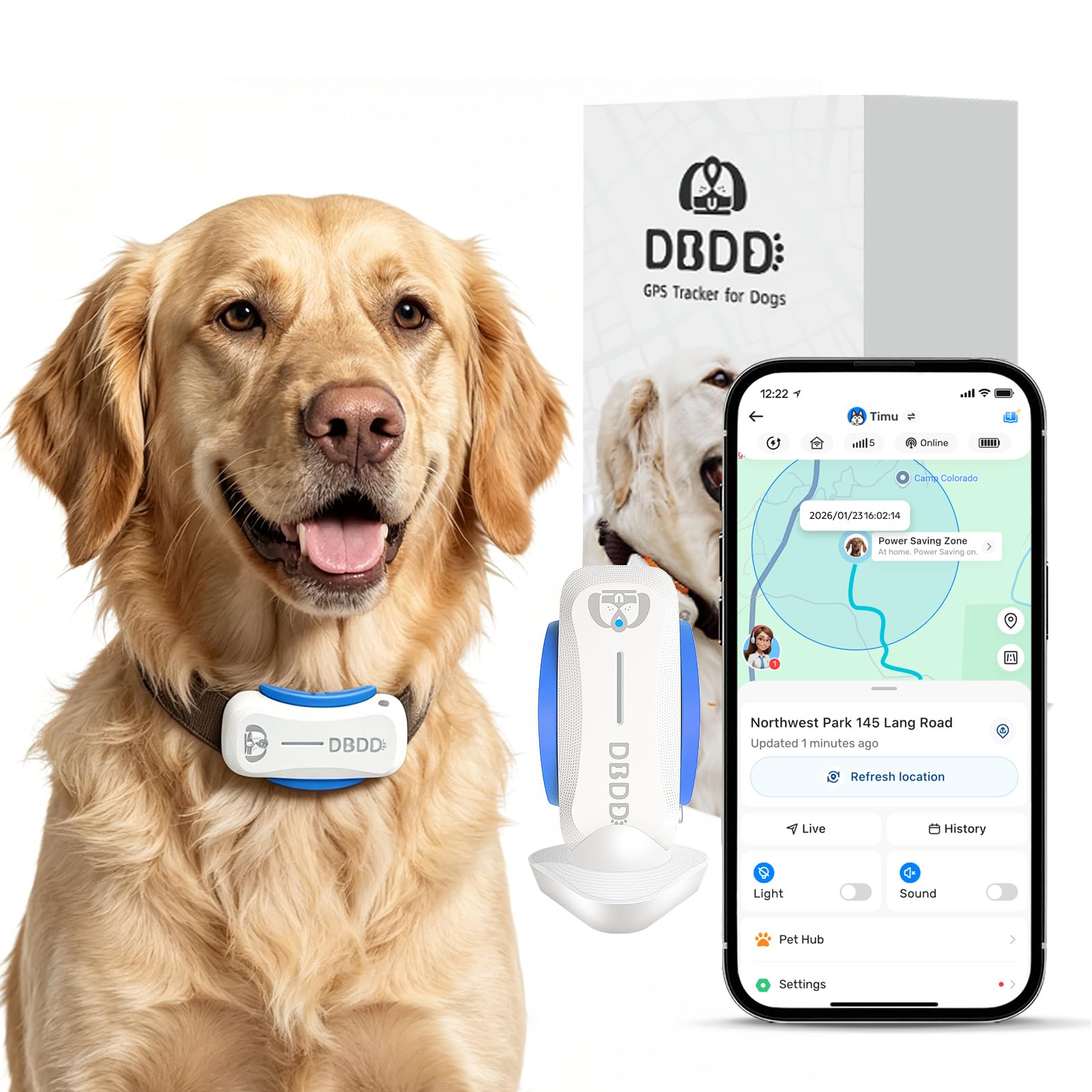
An AI-powered tracker that monitors your pet’s health and alerts you the moment they break the virtual fence.
For under (before subscription), the DBDD offers features often reserved for more expensive collars: real-time location, a custom virtual fence with instant escape alerts, and an AI “Pet Care Consultant” that provides personalized activity goals and health advice. It is rated IP67, meaning it handles rain, snow, and puddles without issue. At just 0.1 lb (45 grams), it is light enough for a medium to large dog and attaches easily via a rubber clip.
The /year subscription is required, and some customers note the device stopped working after a few months — though the 1-year warranty covers that. Rural and wooded area performance is spotty, so check cellular coverage in your area before buying. The rubber strap is also described as weak by a few owners. For the price, though, you get a surprising amount of functionality including daily activity stats and a responsive app.
The standout feature: the AI health advice built right into the app — it answers common pet-raising questions based on your dog’s tracked activity data.
Reach for it if: you want an inexpensive entry into GPS tracking paired with health monitoring for a suburban or city dog.
pass on it if: you live in a rural or heavily wooded area where cellular signal is weak — a Garmin or Dogtra will perform better.
8. Pawfit Lite for Cats 4G GPS Tracker
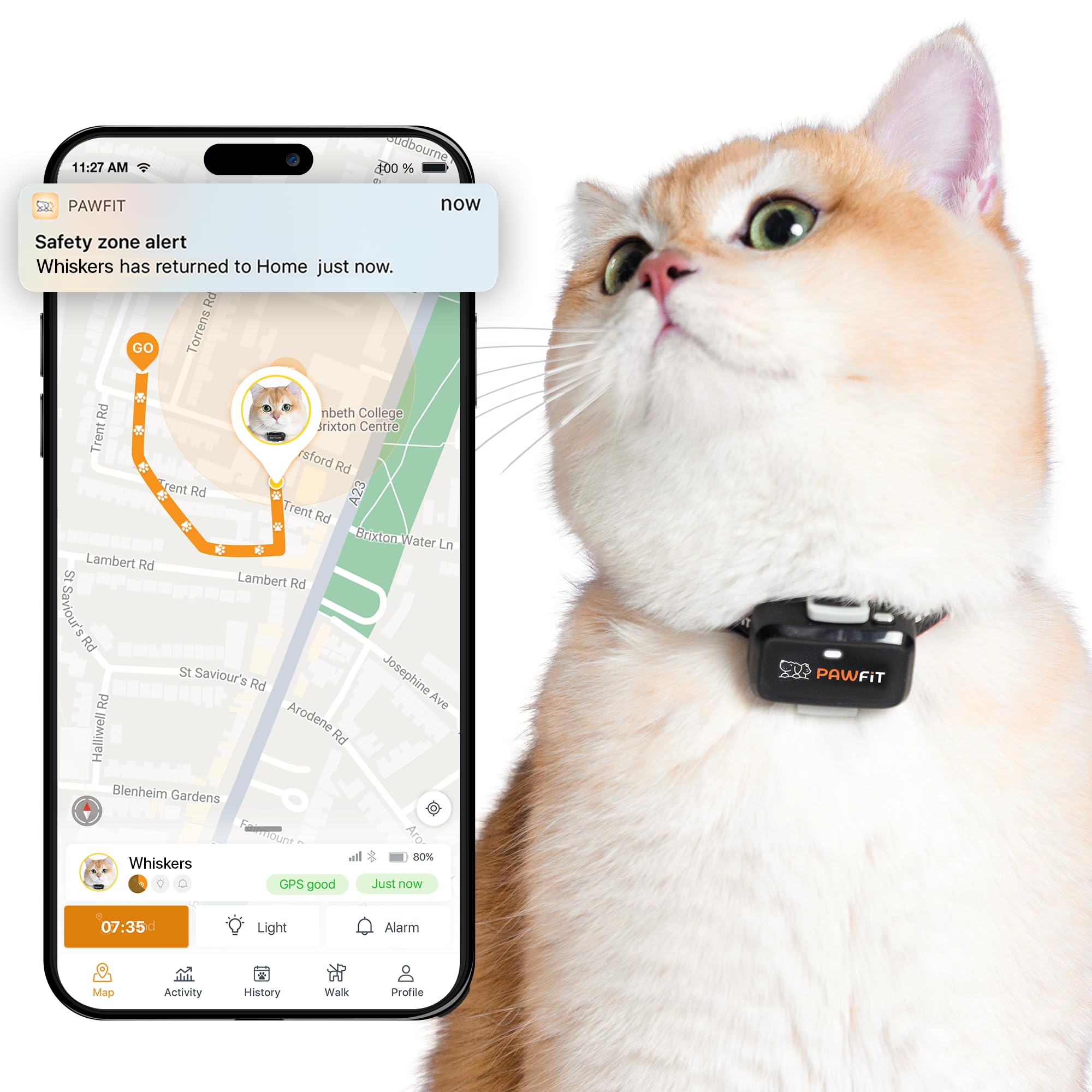
Weighing less than 18 grams, this tracker is light enough for cats as small as 3 kg.
The Pawfit Lite is a dedicated cat GPS tracker that uses 4G multi-network technology for unlimited range across the US and Canada. It comes with a breakaway safety collar designed to release if snagged, and a built-in LED light for low-light spotting. Reviewers point out it pinpoints their cat’s location well, with one tracking their cat’s 8-hour, 9-mile adventure through woods with 80% battery remaining at the end.
The battery life is the main trade-off: with GPS active, you need to charge nightly — a few owners found the charge lasted only about one day. Accuracy is off by 20–80 feet in some situations, and the magnetic charger can be finicky. The subscription is required after the 30-day free trial. Still, for a pure cat tracker that logs location history and activity monitoring, this is one of the lightest and most capable options available.
What wins owners over: the combination of a breakaway safety collar and a weekday-long battery for a device that barely dents your cat’s collar.
Best for: cat owners who need true nationwide GPS tracking on a collar that will not choke or weigh down their pet.
Not for: anyone who dislikes nightly charging — if you forget, the tracker goes dark the next day.
9. Weenect Cat XS GPS Tracker

The only 5G-ready tracker here, with a subscription that starts at per month.
The Weenect Cat XS is the budget entry for cat tracking. It uses multi-network support (AT&T, T-Mobile, Verizon, and rural providers like Commnet) to work across over 100 countries. The Superlive mode sends a new GPS position every second, and the built-in flashlight helps you spot your cat in the dark. The elastic anti-strangulation collar is a thoughtful safety feature included in the box.
Real-world battery life is the biggest disappointment: what owners see is roughly one day of continuous tracking, not the claimed 7 days. The 27-gram, 60.5mm-long unit can press against a cat’s neck, and one owner described the app as having poor French translations with constant premium ads. Rural coverage drops off sharply — “only pings 2x/day” was a common refrain. The subscription is mandatory. It is cheap to try, but a more reliable option like the Pawfit Lite is likely worth the extra cost.
The honest trade-off: you get a 5G-ready, worldwide tracker for a low entry price, but the battery life and app experience reflect that saving.
Reach for it if: your budget is tight and you live in a strong cellular coverage area — it works well enough for basic suburban monitoring.
Look elsewhere if: you need reliable battery life that matches the claim, or you live in a rural area with marginal signal.
Understanding the Specs
Tracking Range
This is the maximum distance between the tracker and the receiver (handheld or phone) before the signal drops. For Bluetooth-based tags the range is roughly 30–100 feet. For cellular GPS trackers there is technically no distance limit — they work as long as both the device and your phone have a network connection. Dedicated radio-frequency collars like the Dogtra and Garmin Alpha offer fixed ranges up to 9 miles in open terrain, which drops in dense forests or hilly areas.
Battery Life and Real-Time Updates
Trackers that push live GPS every few seconds drain the battery fast — often needing a daily charge. Those with power-saving modes that only ping every 10 minutes or when the pet moves can stretch to weeks. A longer battery life usually means you get less-frequent location updates, so decide which trade-off matters more for your specific pet routine.
Geofence and Escape Alerts
A geofence (or virtual fence) lets you draw a safe zone around your yard on the app map. When the tracker leaves this zone, you get an instant notification. The accuracy of these alerts varies widely — some collars trigger reliably within a few feet, while others miss a 30-yard departure. Lower-priced models tend to have coarser geofence resolution.
Subscription Costs
Most cellular GPS trackers require a monthly or yearly subscription to keep the SIM card active. Prices range from roughly to per month. Some brands include the first 30 days or six months free. When comparing options, calculate the total cost over two years — hardware plus subscription — to see the real expense.
FAQ
Do these trackers work without a cellular signal?
Can I use a dog tracker on a cat?
How long does the battery last on a typical animal tracking bracelet?
What is the difference between a GPS tracker and a Bluetooth tracker?
Do all GPS trackers require a monthly subscription?
Will a tracker work in remote wooded areas?
How do I attach a tracker to a collar that is already being worn?
What happens if the tracker falls off or gets lost?
Is a training e-collar the same as a GPS tracker?
How important is water resistance in a tracker?
Final Thoughts: The Verdict
For most owners, the animal tracking bracelet that hits the best balance of performance and value is the Dogtra Pathfinder 2 — a rugged, subscription-free collar trusted by over 600 owners for its 9-mile range and e-collar training. If you want the deepest dive into health data with a week-long battery, the Fi Series 3+ leads on behavior tracking. And for your cat, the Pawfit Lite remains the lightest truly capable GPS tracker on the market.
How We Picked
We do not accept paid placement. Every pick is matched to a real buyer and a real use-case; we do not hands-on test units.
Sources & Methodology
Specifications: manufacturer listings and product documentation. Review insights: verified customer reviews, as of July 2026. Pricing: not shown on this page (it changes often); check the current price via the retailer link.
As an Amazon Associate, FitlyFast earns from qualifying purchases. This does not affect which products we feature.