
Our readers keep the lights on and the weekend projects moving. As an Amazon Associate, I earn from qualifying purchases.
If you have a water softener, your standard magnesium anode rod is creating hydrogen sulfide gas — that’s the rotten egg smell. You need a rod formulated with aluminum, zinc, or titanium to stop the reaction before it starts. The right anode rod for softened water prevents odors and extends your tank’s life.
I’m Rikta — the co-founder and writer behind FitlyFast. I’ve spent hundreds of hours analyzing water heater corrosion protection, decoding the chemistry behind different rod alloys, and filtering through Amazon reviews to find the rods that actually solve softened water problems.
Whether you are tired of the sulfur stench or simply want to keep your tank from rusting out early, this guide breaks down the best options by material, installation method, and odor control performance. Finding the best anode rod for softened water means matching the alloy to your water chemistry and clearance above the tank.
How To Choose The Best Anode Rod For Softened Water
Softened water is more chemically aggressive. It strips the anode rod faster, and if you use a standard magnesium rod, it releases sulfur gas as a byproduct. Choosing the right rod means looking beyond just fit — you need to match the alloy or technology to your system.
Match the Alloy to Your Water Chemistry
Magnesium rods are the default in most water heaters, but they react with softened water to produce hydrogen sulfide — the rotten egg smell. Aluminum-zinc alloy rods stop this reaction because the zinc binds with sulfur before it becomes gas. For total immunity, powered titanium rods use a mild electrical current to protect the tank without any sacrificial metal dissolving into your water.
Measure Overhead Clearance First
Solid rods run 30 to 44 inches. If your water heater sits under a low ceiling, you cannot remove a solid rod without tipping the entire tank. Flexible or segmented rods allow installation with as little as 12 inches of clearance above the heater. Powered titanium rods are typically short — under 10 inches — and fit even tight mechanical rooms.
Factor in Your Tank Size and Thread Type
Almost all residential water heaters use a 3/4-inch NPT connection, but Bradford White tanks often lack a dedicated anode port and require installation in the hot water outlet using a Y-fitting. Larger tanks — 50, 75, or 100 gallons — need longer rods or higher current in powered options to ensure even protection.
Quick Comparison
On smaller screens, swipe sideways to see the full table.
| Model | Category | Best For | Key Spec | Amazon |
|---|---|---|---|---|
| Kelaro Flexible | Mid-range | Sulfur odor elimination | 44-inch aluminum-zinc | Amazon |
| Eau Aluminum Zinc | Mid-range | Complete kit with socket | 44-inch aluminum-zinc | Amazon |
| Water Connection AR136 | Premium | Maximum sacrificial metal | 3/4-inch thick aluminum-zinc | Amazon |
| Suburban 232768 | Budget | RV water heaters | 9-inch aluminum | Amazon |
| Podoy Powered | Premium | Medium tanks with low clearance | 9.4-inch titanium powered | Amazon |
| Briidea Powered | Premium | 40-89 gallon tanks | 12.3-inch titanium powered | Amazon |
| Corro-Protec Powered | Premium | Bradford White tanks | Titanium powered + Y-fitting | Amazon |
In‑Depth Reviews
1. Kelaro Aluminum Zinc Flexible Anode Rod

The Kelaro 44-inch flexible rod uses a specially formulated aluminum-zinc alloy that directly addresses the rotten egg smell caused by soft water reacting with a magnesium anode. Its hinged four-part design makes installation possible in spaces with just over 12 inches of overhead clearance — eliminating the need to tip or remove the water heater.
Customer feedback confirms near-immediate odor relief, with many well-water users reporting the sulfur smell disappeared within 24 hours. The rod fits most major brands including AO Smith, Rheem, Kenmore, and GE, and the instructions recommend a 1 1/16-inch deep socket and impact gun for removing the old rod.
Kelaro recommends replacement every two to three years depending on water quality. The flexible body does trade some surface area compared to a solid rod, but for anyone dealing with clearance constraints or sulfur gas, this is the most practical mid-range solution available.
Why it’s great
- Eliminates rotten egg odor from soft water
- Flexible segments install in tight spaces
- Universal 3/4 NPT thread fits most heaters
Good to know
- Flexible design has less surface area than a solid rod
- Impact gun recommended for removal
2. Eau Aluminum Zinc Anode Rod Kit

The Eau kit is built around the same core principle — an aluminum-zinc alloy that stops the hydrogen sulfide reaction at the source. What sets it apart is the complete package: the rod comes with a 27mm chrome socket and Teflon sealing tape, saving a separate trip to the hardware store for installation tools.
Users consistently rate it highly for value, noting it costs significantly less than local plumbing supply stores while delivering identical results. The segmented design lets you cut the rod shorter with a hacksaw if your tank has limited headroom, and the 6-point socket prevents stripping the hex head during removal.
Several reviews mention the smell disappeared permanently within days after installation, even in cases where shocking the well with bleach had failed. The kit also includes clear instructions for proper torque and sealant use, making this a strong choice for first-time DIY installers.
Why it’s great
- All-in-one kit with socket and thread tape
- Segmented rod can be cut for tight ceilings
- Reliable odor elimination for soft and well water
Good to know
- Teflon tape quality is average; upgrade recommended
- Labelled for standard 3/4 NPT only
3. Water Connection AR136 Aluminum Zinc Anode Rod

The Water Connection AR136 uses a thicker 3/4-inch diameter solid rod compared to the 5/8-inch rods many competitors offer. This extra metal means more sacrificial material protecting the tank and longer intervals between replacements. The aluminum-zinc alloy meets U.S. Mil-A-18001K/W specification, confirming its corrosion-fighting pedigree.
It has a standard 1-1/16-inch hex head and requires 4 feet of overhead clearance for installation. Users report that it completely eliminated metallic and sulfur odors within two days of installation, though the rod may need to be cut shorter for low-profile tanks. The lifetime warranty backs the investment.
This rod does not fit most Bradford White tanks because those models lack a dedicated anode port. For homeowners with standard Rheem, AO Smith, or State heaters and at least four feet above the tank, this solid rod delivers the highest sacrificial density in this guide.
Why it’s great
- Thicker 3/4-inch diameter provides more sacrificial metal
- Military-grade aluminum-zinc alloy
- Lifetime warranty included
Good to know
- Requires 4 feet overhead clearance
- Does not fit Bradford White tanks

The Suburban 232768 is a short 9-inch aluminum rod designed primarily for RV water heaters. It uses a standard 3/4-inch NPT thread and fits models like the SW10DE. While aluminum alone does not contain zinc for odor control, the absence of magnesium prevents new sulfur smells from forming.
Reviews highlight its straightforward fitment and the importance of using Teflon tape or pipe dope on the threads to prevent galling. Several users keep spare rods on hand, noting that replacing the anode at 50 to 75 percent depletion is the cheapest way to extend tank life. A 1-1/16-inch socket and long ratchet are needed for installation.
For home water heaters, this rod is too short to provide full tank protection. But for RV owners or small point-of-use tanks where clearance is nearly zero and the tank volume is under 12 gallons, the Suburban is a reliable direct OEM replacement.
Why it’s great
- Direct OEM fit for Suburban RV water heaters
- Prevents magnesium-related sulfur odor
- Lightweight at half a pound
Good to know
- Too short for residential water heaters
- Made in China; quality control varies by batch
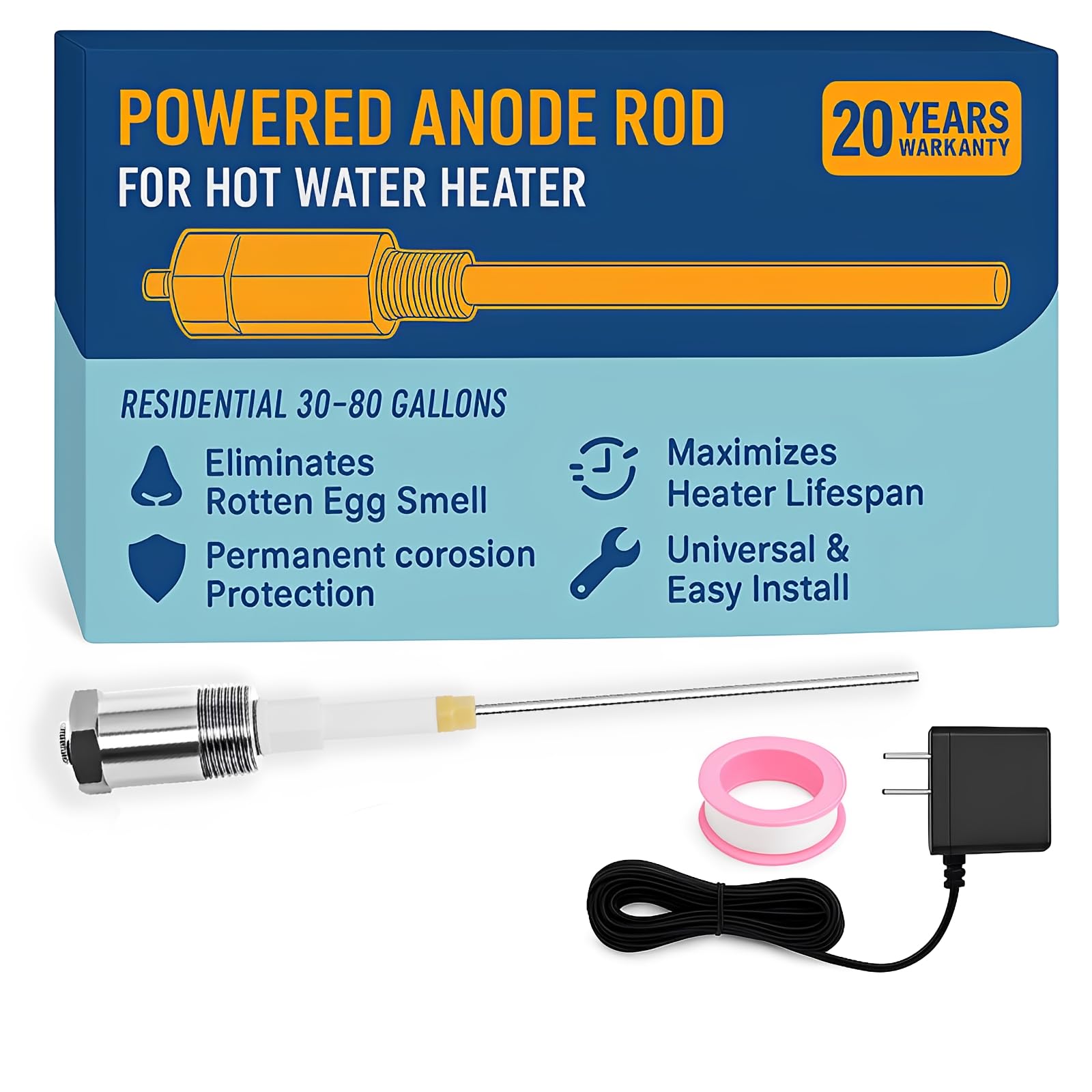
The Podoy powered anode rod swaps sacrificial metal for titanium and a low-voltage electrical current. Because nothing dissolves into the water, there is no chemical reaction with softened water — hydrogen sulfide gas never forms. The rod is only 9.4 inches long, making it ideal for tanks with limited overhead clearance.
It comes with an AC/DC power adapter inputting 100-240V AC and outputting DC 3V at 1 amp. Users report odor elimination within 24 hours and reduced scale buildup. The kit includes Teflon tape but does not include installation tools; a 1-1/16-inch socket is required. Compatible with 30 to 80 gallon tanks.
One limitation: there is no working indicator light on the rod itself — only on the power supply — so verifying operation at a glance is less intuitive. Still, for homeowners who want zero maintenance and zero smell, the Podoy is a strong entry into the powered category.
Why it’s great
- No sacrificial metal means no sulfur smell
- Short rod fits tight spaces
- Reduces scale accumulation
Good to know
- Requires nearby electrical outlet
- No LED on rod to confirm function

The Briidea powered anode rod uses a titanium electrode coated with ruthenium and iridium, which the manufacturer states can last up to 20 years. Like other powered rods, it uses a mild electrical current to protect the tank rather than relying on a dissolving metal. It supports tanks from 40 to 89 gallons.
Installation requires a 1-3/8-inch wrench for the stainless steel nut and a nearby electrical outlet. The green LED on the adapter confirms the unit is receiving power. Customer reviews note that the sulfur smell disappeared within an hour of installation, though some found the 5-foot power cord too short for distant outlets.
The HDPE plastic body reduces scale accumulation, keeping the tank interior cleaner over time. Briidea explicitly markets this rod for softened water, making it a direct answer to the aggressive chemistry that destroys traditional rods.
Why it’s great
- 20-year expected service life
- Ruthenium-iridium coating resists corrosion
- Eliminates odor within hours
Good to know
- Short power cord limits placement
- No printed instructions in some units
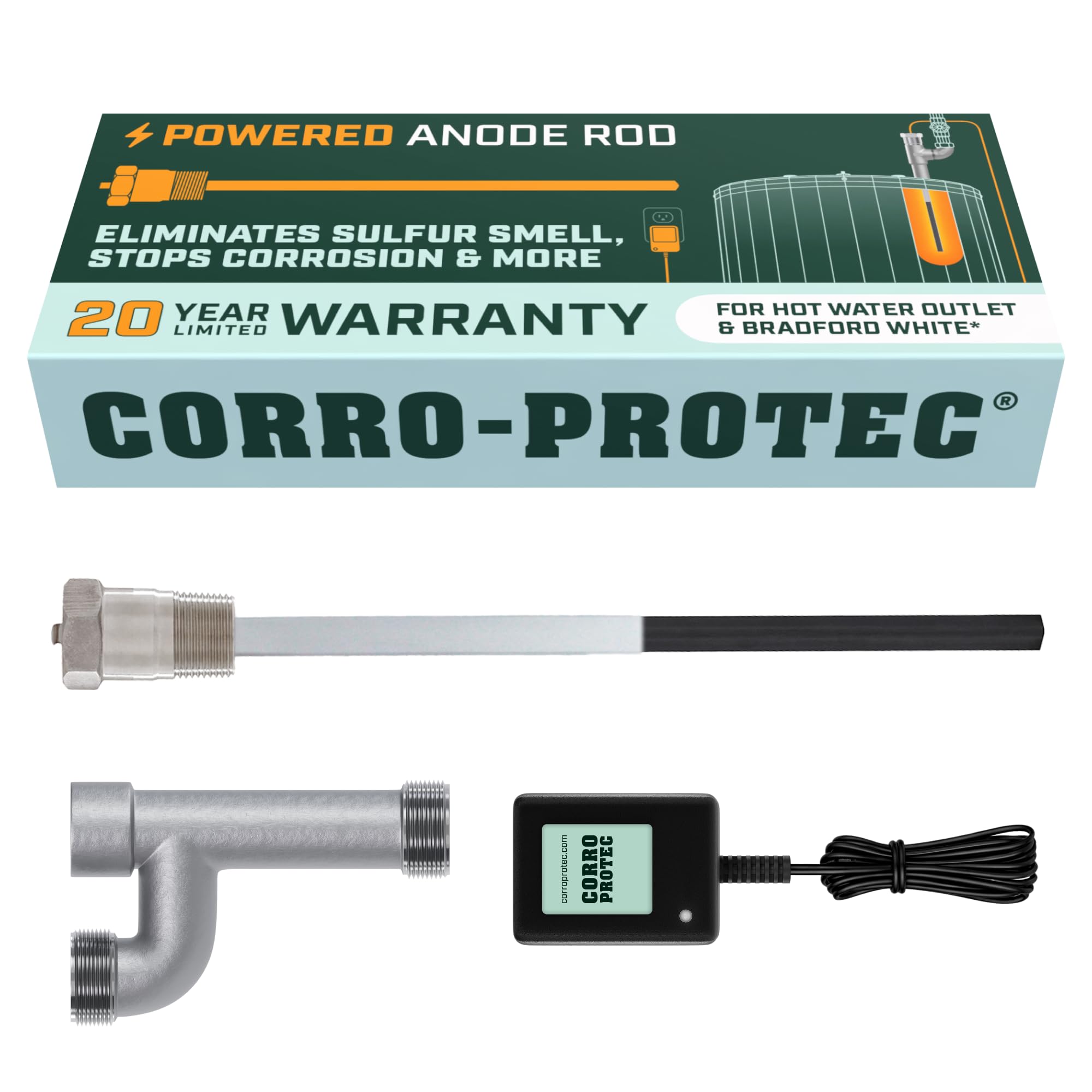
The Corro-Protec is the only rod in this guide designed specifically for hot water outlet installation, making it the definitive solution for Bradford White tanks that lack a dedicated anode port. The kit includes a Y-shaped stainless steel fitting that redirects the hot water outlet, allowing the rod to sit in line with the plumbing.
It supports 10 to 120 gallon tanks and carries a 20-year warranty. The titanium electrode is maintenance-free and works with all water sources including softened, well, and city water. Users report complete odor elimination within three days, even on tanks where the old magnesium rod created persistent sulfur smells.
Installation is more involved than a standard swap — you must cut and redirect copper pipe for the Y-fitting — and the stainless steel threads require firm torque and gray Teflon tape for a proper seal. Despite the higher cost and effort, Corro-Protec is the only reliable option for Bradford White owners who want powered protection.
Why it’s great
- Only rod designed for hot water outlet installation
- 20-year warranty from Canadian manufacturer
- Works with all water types, including softened
Good to know
- Requires plumbing reconfiguration for Y-fitting
- Stainless steel threads are hard to tighten
FAQ
Why does softened water cause a rotten egg smell in my water heater?
Can I use a standard magnesium rod with a water softener?
How often should I replace an aluminum-zinc anode rod in soft water?
Do powered anode rods work with Bradford White water heaters?
What size socket do I need to remove an old anode rod?
Final Thoughts: The Verdict
For most users, the best anode rod for softened water winner is the Kelaro Aluminum Zinc Flexible because it combines effective odor elimination with a flexible design that fits tight spaces at a fair mid-range price. If you want maximum sacrificial density and have enough overhead clearance, grab the Water Connection AR136 for its thicker military-grade aluminum-zinc build. And for zero-maintenance, no-smell protection, the Briidea Powered Anode Rod delivers 20 years of corrosion defense with ruthenium-iridium coated titanium.