7 Best Antenna Amplifier | Up to 118 Channels? Read This First

Our readers keep the lights on and the weekend projects moving. As an Amazon Associate, I earn from qualifying purchases.

Specs are compiled from manufacturer listings and verified buyer reviews and can change over time — please confirm the key details on the product page before buying.

You picked out a great antenna, but your TV still cuts out or pixelates every time a truck rolls by. The problem is almost never the antenna — it is the weak signal arriving at your tuner after being split between multiple TVs or buried under interference from cell towers. An antenna amplifier boosts that signal so every set in your house gets a clean, watchable picture.

I’m Rikta — the founder and writer behind FitlyFast. This guide is built by comparing the manufacturers’ published specifications and the patterns across verified customer reviews, so you get each pick’s real strengths and trade-offs instead of marketing spin.

The top pick overall is the Televes 560383 TForce. Its automatic gain control (a circuit that adjusts power up and down on its own) and strong 31 dB UHF gain (about 31 decibels of power on the ultra-high-frequency band, the one used by most TV stations) mean it delivers clean, stable reception even in tough locations.
Quick Picks

How To Choose The Best Antenna Amplifier

Picking the wrong amplifier can leave you with no improvement — or even a worse picture. Here are the three factors that make or break your setup.

Gain per Port vs. Total Gain

An amplifier that claims “high gain” on the box means nothing if that power gets split six ways. The real spec is gain per port (measured in dB, or decibels — the unit of power change). A 4-port unit with +7.5 dB per port delivers more usable signal to each TV than an 8-port unit with +4 dB per port. Match the port count to your home, not your daydreams.

Distribution Amp vs. Mast Preamp

A distribution amplifier sits inside your house and splits a decent signal to multiple TVs. A mast preamplifier mounts up near the antenna and amplifies the whisper-weak signal before it travels down the long coax cable (the standard round TV cable). If you have a long cable run (over 50 feet) or live far from broadcast towers, you want a mast preamp.

Filtering Matters More Than You Think

Modern amplifiers include built-in filters that block FM radio, LTE (the frequencies used by cellular data networks), and 5G cell signals. Without those filters, a nearby cell tower can overwhelm your amplifier’s circuitry and turn a perfect signal into digital garbage on every channel. Look for “LTE filter” or “5G filter” in the specs.

Quick Comparison

Model Best For Gain per Port Ports Type Amazon
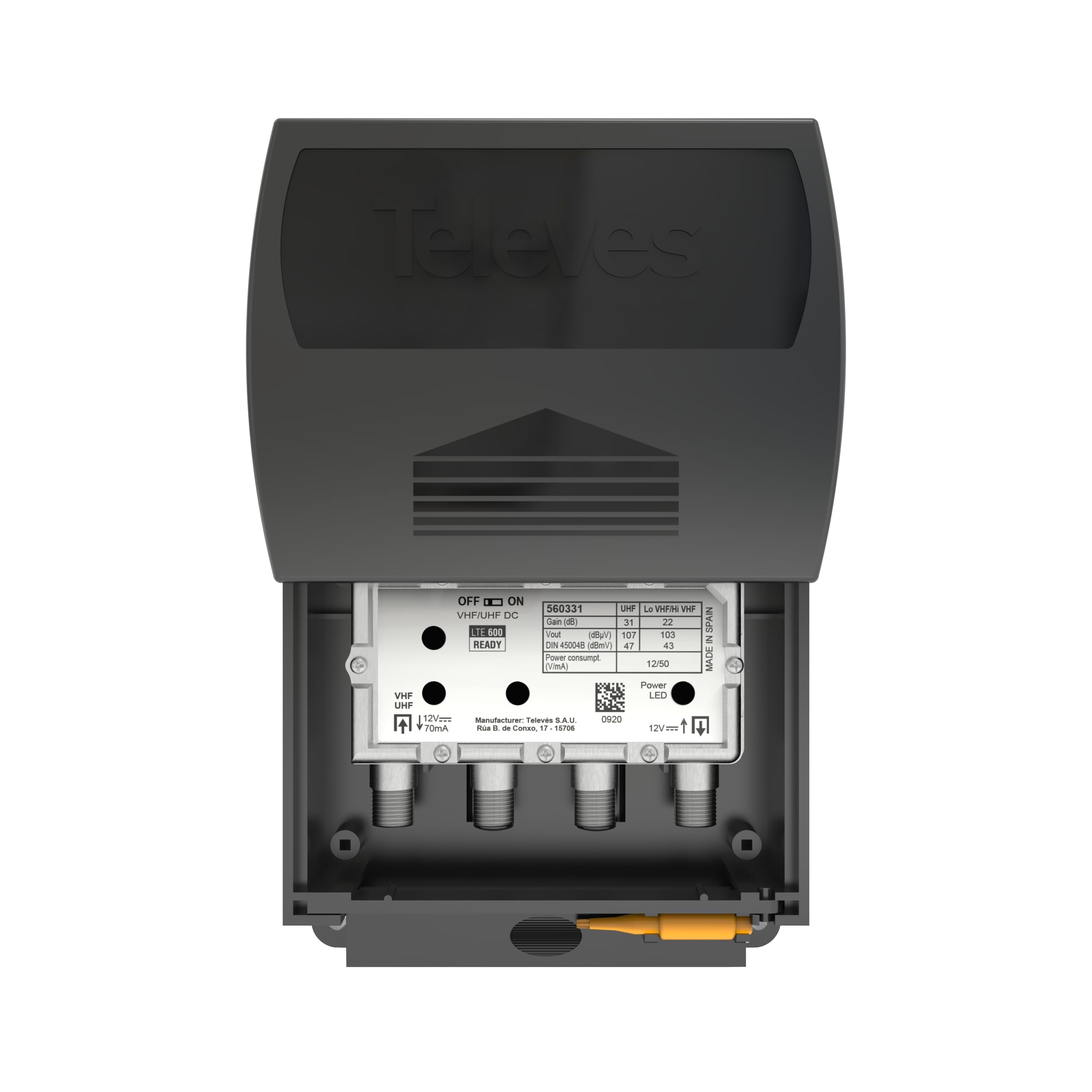
Televes 560383 TForce Weak distant signals 31 dB UHF / 22 dB VHF 1 (preamp) Mast Preamp $79.95Amazon
Channel Master PreAmp 1 Long cable runs 17-30 dB (adjustable) 1 (preamp) Mast Preamp $99.00Amazon
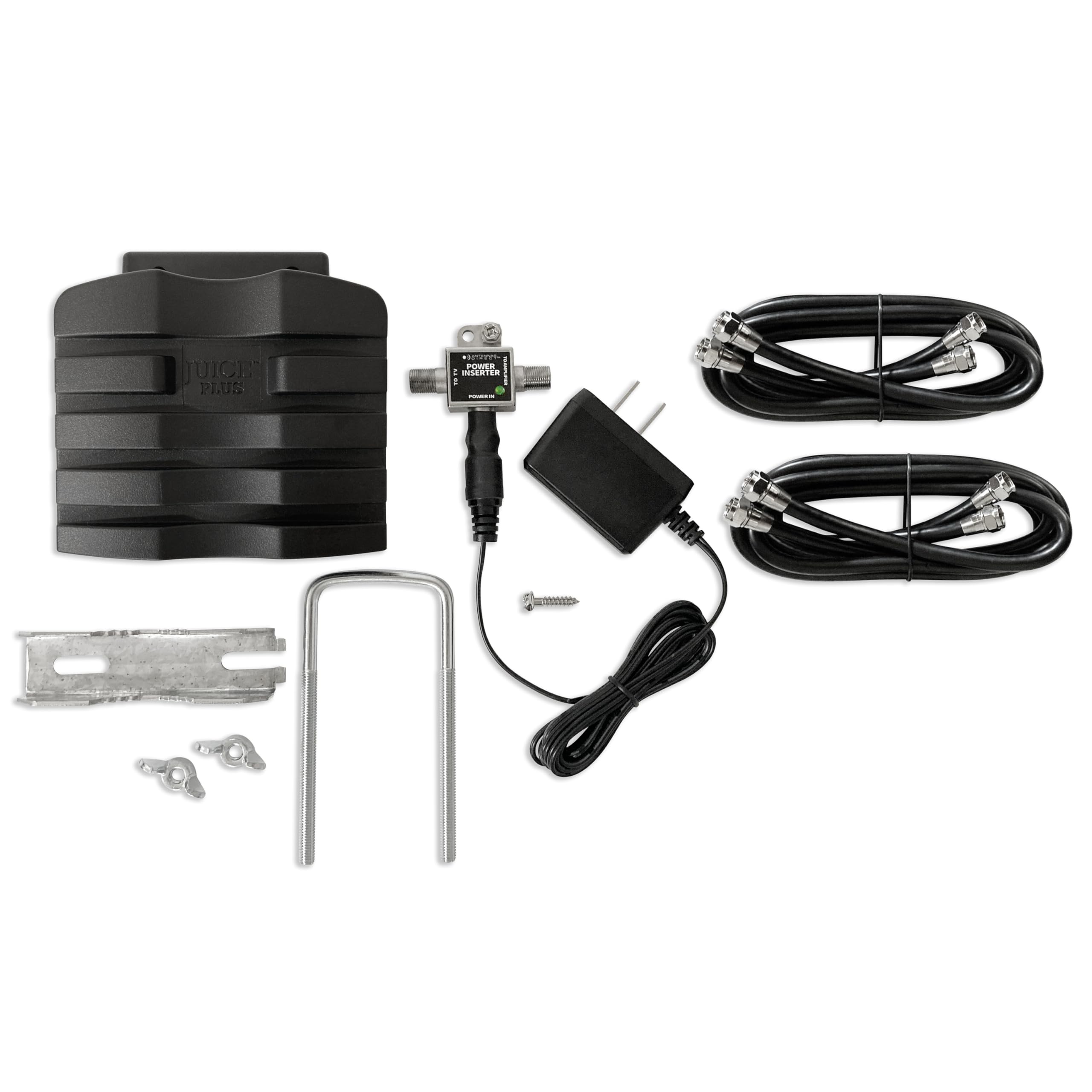
Antennas Direct Juice Plus All-weather reliability 1 (preamp) Mast Preamp $79.99Amazon
Antronix MRA4-8 Cable customer upgrade +7.5 dB 4 Distribution Amp $51.86Amazon
Lindsay LSA84 OTA antenna splitting +8 dB 4 Distribution Amp $51.87Amazon
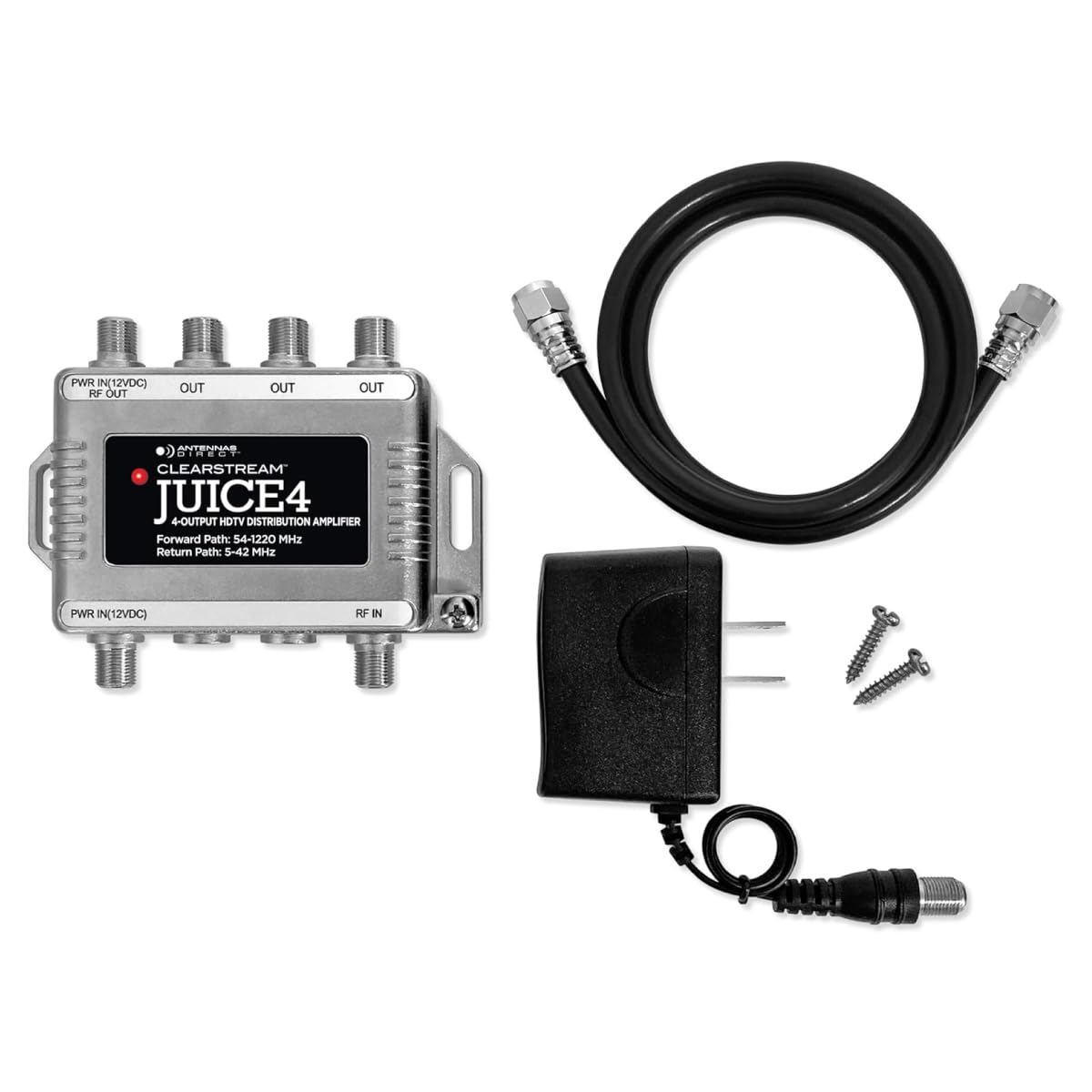
Antennas Direct JUICE4 4K 8K distribution 4 Distribution Amp $59.99Amazon
Reliable 8-Port LSA48 Many rooms / 8 TVs +4 dB 8 Distribution Amp $65.87Amazon
↻ Live Amazon prices — as of Jul 14, 2026 7:50 PM. Product prices and availability are accurate as of the date/time indicated and are subject to change. Any price and availability information displayed on Amazon at the time of purchase will apply to the purchase of this product. As an Amazon Associate I earn from qualifying purchases. CERTAIN CONTENT THAT APPEARS ON THIS SITE COMES FROM AMAZON. THIS CONTENT IS PROVIDED "AS IS" AND IS SUBJECT TO CHANGE OR REMOVAL AT ANY TIME. Amazon and the Amazon logo are trademarks of Amazon.com, Inc. or its affiliates.

In‑Depth Reviews

Best Overall

1. Televes 560383 TForce Mast Preamplifier

31 dB UHF GainAuto Gain Control
Televes 560383 TForce Mast Preamplifier$79.95as of Jul 14, 7:50 PM

Get It On Amazon

This preamp self-adjusts its gain as conditions change, so you never overdrive a strong signal or underpower a weak one.

The Televes TForce is the closest thing to a low-maintenance preamplifier. Its automatic gain control (a circuit that self-balances VHF and UHF amplification independently) keeps the output level steady even when weather, interference, or tower distance shifts your signal. Where most preamps apply brute force, this one constantly fine-tunes itself. Buyers report it took reception from “barely watchable to crisp HD” and one owner increased their channel count from 93 to 118 after swapping out a Winegard unit.

It also tackles interference at the source. Precision-tuned filters block FM radio, LTE (cellular data frequencies), and 5G cell signals above 608 MHz before they reach your system — so a nearby cell tower won’t corrupt your picture. It delivers up to 31 dB of gain on UHF bands and 22 dB on VHF, enough to pull stations from three counties over. The IP23-rated (splash-proof) metal housing survives mast mounting, and the UL-listed (safety certified) power supply includes two outputs for whole-home distribution. That said, one reviewer warned that the printed instructions are tiny and confusing, and the unit needs patch cords sold separately.

Why You Want This

  • Auto gain control means you don’t adjust seasonally
  • Built-in 5G/LTE filter stops cell tower noise cold
  • 31 dB UHF gain pulls distant stations reliably

Watch Out For

  • Single input only — not for multiple antennas
  • Tiny, confusing manual; no patch cords included

Who it suits: Anyone in a weak-signal area who wants maximum reach without fiddling with settings — especially owners who live 40+ miles from broadcast towers.

One real trade-off: The instructions are a genuine headache on first install, so budget extra setup time, especially if you are not used to mast-mount gear.

Top Performer

2. Channel Master TV Antenna PreAmp 1 (CM-7779HD)

17-30 dB GainAdjustable
Channel Master TV Antenna PreAmp 1$99.00as of Jul 14, 7:50 PM

Get It On Amazon

Adjustable gain from 17 to 30 dB lets you dial in exactly the power your signal needs without overloading.

Unlike many preamps that lock you into a fixed amplification level, the Channel Master PreAmp 1 lets you choose between 17 dB and 30 dB gain depending on your situation. Buyers in rural areas report it “more than doubled” their channel count — one reviewer in northeast Ohio with an attic antenna jumped from 3 channels to 72. The lower gain setting (17 dB) works best when your signal is decent but just needs a gentle push, while the higher setting reaches for stations farther away.

A built-in LTE filter blocks interference from 3G, 4G, and 5G smartphones and transmitters, plus FM radio, so cell towers don’t ruin your reception. Power travels over the coax cable via the included power inserter (a device that sends electricity from indoors up to the amplifier through the same wire that carries the TV signal), meaning you don’t need an outdoor outlet near the antenna. It is compatible with Channel Master power-passing splitters if you want to distribute to multiple TVs. One caveat: a reviewer 40 miles from towers found the gain improvement “smaller than expected” (signal went from ~36 to ~42), so if your signal is extremely weak this might not be the magic bullet.

What Stands Out

  • Adjustable gain (17-30 dB) fits both moderate and weak signal scenarios
  • Power over coax means no extra outdoor wiring
  • Built-in 5G/LTE filter protects against phone tower noise

Before You Buy

  • Not compatible with antennas that have a built-in amplifier already
  • Signal improvement may feel modest for very distant stations

Great for: Rural homeowners with a long coax run (50+ feet) who want the flexibility to adjust gain up or down after installation.

Skip if: You have an amplified antenna already — this preamp only works with passive (non-amplified) antennas.

Premium Pick

3. Antennas Direct ClearStream Juice Plus Preamplifier

5G/LTE FilterWeatherproof Housing
Antennas Direct ClearStream Juice Plus Preamplifier$79.99as of Jul 14, 7:50 PM

Get It On Amazon

A weather-tough preamp that lifts UHF, VHF, and FM signals while blocking LTE and 5G interference at the circuit.

Antennas Direct engineered the Juice Plus to survive on a mast full-time. Its innovative weatherproof housing tilts open for easy coax cable connection and closes securely, and reviewers report “excellent reception in all weather” including snow, rain, and high winds — one owner runs a large attic antenna 15 feet above ground 50 miles from towers and gets reliable HD. Another reviewer increased their channels from 35 to 80-plus after installing this unit 35 miles from the broadcast towers.

The true 5G filter (positioned before the amplification circuit itself) prevents LTE and 5G cell signals from overloading the amplifier before it even touches your TV signal. That means if you live near a cell tower, this preamp cleans up interference that cheaper models can’t touch. The kit includes the preamp, housing, two 3-foot coaxial cables, a low-loss power inserter, a DC power supply, and mounting hardware. It supports ATSC 3.0 (NextGen TV — the new standard for 4K over-the-air broadcasts), so it is ready for future broadcasts. On the downside, one buyer’s professional installer could not get it to work at all (the green power light never came on), so quality control appears to have a rare gap.

Why It Matters

  • 5G/LTE filter sits before the amp, stopping interference at the first stage
  • Weatherproof housing with tool-free tilt-open design simplifies setup
  • Survives snow and high-wind conditions with consistent performance

The Risk

  • A small number of units may arrive DOA with no green power light
  • 90-day warranty is shorter than the Channel Master and Televes coverage

Reach for this if: You need a mast-mount preamp that handles extreme weather and blocks strong cell tower interference.

Look elsewhere if: You want a longer warranty period — the 90-day coverage is noticeably tighter than the competition’s.

Best Value

4. Antronix MRA4-8 Reliable Cable 4-Port Amplifier

+7.5 dB per Port6 kV Surge Protection
Antronix MRA4-8 Reliable Cable 4-Port Amplifier$51.86as of Jul 14, 7:50 PM

Get It On Amazon

A +7.5 dB per port distribution amp that one buyer living just 75 yards from the cable drop calls better than what the cable company installs.

The Antronix MRA4-8 delivers more gain per port than typical distribution amplifiers — +7.5 dB on each of its four outputs. Compare that to the 8-port Reliable LSA48 which only gives +4 dB per port, meaning each TV in a four-TV home gets a noticeably stronger signal. The amplifier includes a passive return path, so your cable modem’s upstream signal still gets through. It is compatible with all standard cable TV and OTA antenna setups, and one reviewer noted it “works a lot better than the ones the cable company installs.”

Protection features are built-in: 6 kV (6,000-volt) surge protection guards against lightning strikes, and the nickel-plated housing resists corrosion from salt fog and rust. The UL-listed (safety certified) power adapter includes self-resetting circuit protection so a short won’t knock your whole system offline. One buyer mentioned they didn’t get extra channels, but the signals became “clearer and more reliable even with bad weather.” The unit ships with the amplifier, power supply, a 36-inch coax cable, and two 75-ohm port terminators (small caps that seal unused outputs) to cap unused outputs.

What Works

  • +7.5 dB per port beats most 4-port splitters on raw gain
  • 6 kV surge protection gives confidence during storms
  • Passive return path keeps cable modem upload intact

Know Before You Buy

  • Not compatible on systems that already have an amplifier or pre-amplifier
  • A buyer reported no extra channels, just clearer existing ones

Ideal for: Cable TV subscribers with pixelation issues who want a sturdy 4-port distribution amp with surge protection and corrosion resistance.

One honest catch: If you hope to discover new over-the-air channels, this amp may only clean up what you already get rather than adding new ones.

Smart Value

5. Lindsay LSA84 4-Port Cable TV/Antenna Amplifier

+8 dB Gain4 RF Outputs
Lindsay LSA84 4-Port Amplifier$51.87as of Jul 14, 7:50 PM

Get It On Amazon

Claimed to “solve Comcast pixelation on 3 TVs and internet for ~” — a direct-to-consumer replacement for cable-grade distribution gear.

The Lindsay LSA84 is the amplifier that one buyer used to fix Comcast pixelation across three TVs and their internet, saving what they estimated as in rewiring costs. It pushes +8 dB of gain across four RF outputs (the coax connectors) and uses an RG6 power cable. The amplifier is compatible with both cable TV and OTA antenna systems, but the manufacturer is blunt: this is NOT intended to fix a weak signal, only to boost a good one. If your signal is already weak, a preamplifier at the antenna is the right tool.

It includes 6 kV ring wave surge protection for voltage spikes and a PTC short-circuit-protected UL-listed power adapter. The operating temperature range of -40°F to +140°F covers extreme climates. One reviewer using an OTA antenna said it “increased antenna signal ~5% to TV and DVR” and noted the power cable is not included (you need an RG6 cable separately). Another buyer replaced a 2-way unpowered splitter with this powered 4-way unit and jumped from 60 to 140 OTA channels. The two 75-ohm terminators must be installed on unused ports to prevent signal reflection.

Key Perks

  • +8 dB gain per output is higher than many 4-port competitors
  • Wide temperature range (-40°F to +140°F) for unconditioned spaces
  • One owner saw 140 OTA channels after upgrading from a passive splitter

Things to Know

  • Power cable not included — you must supply an RG6 jumper
  • The manufacturer says it cannot fix an already-weak signal

Pick this if: You need a straightforward 4-port replacement for a cable TV or OTA distribution amp and want +8 dB of clean gain per line.

Not for: Anyone working with a fundamentally weak incoming signal — you need a mast preamp instead.

4K 8K Ready

6. Antennas Direct ClearStream JUICE4 Distribution Amplifier

ATSC 3.0 Ready1.2 GHz Operating Freq
Antennas Direct ClearStream JUICE4 Distribution Amplifier$59.99as of Jul 14, 7:50 PM

Get It On Amazon

A compact 4-output distribution amplifier explicitly rated for ATSC 3.0, 4K, and 8K UHD — so tomorrow’s broadcast standards work today.

The JUICE4 is built for the future. It supports ATSC 3.0 (the NextGen TV standard that delivers 4K over-the-air), 4K, and 8K UHD resolutions, and its operating frequency extends to 1.2 GHz (gigahertz — a measure of how high a frequency the amplifier can handle) to cover CATV and cable broadband applications. At just 3.5 inches tall and 0.6 pounds, it fits in tight spaces behind your entertainment center or inside a structured wiring panel. One owner reported the amplifier “solved skipping and spidering on uncertain channels” and pushed a clear signal through at least 50 feet of coax.

The zinc diecast housing is precision machine-sealed to protect against dust and water droplets, and it offers strong surge protection on all ports. It can be used outdoors with the included termination caps, watertight F-connectors, and weather boots. That said, a buyer reported their unit stopped working after five days and became glitchy — and contacting the vendor was complicated because Amazon was the intermediary. Also, the power supply requires an indoor 12V plug, and one reviewer warned that outdoor use can “destroy it” if not properly weather-proofed.

Pros

  • Rated for ATSC 3.0 / 4K / 8K so you don’t need to upgrade later
  • Compact 0.6 lb design fits in tight panels and cabinets
  • Surge protection on every port for confidence

Cons

  • Outdoor use needs careful sealing — the 12V power supply is indoor-rated
  • A small number of units reportedly failed within a week

Best for: Tech-forward buyers who want 4K 8K and NextGen TV compatibility in a small, neatly packaged 4-output distribution amp.

Consider alternatives if: You plan a permanent outdoor installation — the indoor-rated power supply demands careful weather sealing.

Eight-Output Power

7. Reliable 8-Port TV Antenna Signal Splitter / Distribution Amplifier LSA48

+4 dB per Port8 Ports
Reliable 8-Port TV Antenna Signal Splitter Distribution Amplifier LSA48$65.87as of Jul 14, 7:50 PM

Get It On Amazon

An 8-port amplifier that gives each line a +4 dB boost — one radio studio uses it to share a rooftop FM antenna across multiple receivers with zero issues.

The LSA48 is the answer when you need to feed many rooms from one antenna or cable line. It provides +4 dB of gain on each of its eight ports, which is enough to offset typical splitter losses so each TV sees roughly unity gain (the signal arrives at the tuner at about the same strength as it entered the amplifier). One reviewer who runs a radio studio facility wrote that it “works very nicely and provides roughly unity gain (0dB) to all outputs,” sharing a single rooftop FM antenna with multiple receivers for two months without any hiccups.

A former satellite TV customer reported that after cutting the cord and installing this amplifier with a new antenna, they now pick up 125 channels across all their TVs. Another buyer connected six televisions to one antenna and said the setup “works like magic” for pulling in stations that were previously unavailable. The ultra-small form factor fits into confined spaces, and it can even be used outdoors inside an approved enclosure (the power supply itself is for indoor use only). Just be careful — it is NOT compatible with amplified antennas or installations that already have a pre-amp, and you must supply your own coax cables.

Why You’d Want This

  • Eight ports handle large homes or multi-unit setups on one antenna
  • One owner went from satellite to 125 OTA channels with this amp
  • Compact design fits in small utility panels and enclosures

Drawbacks

  • +4 dB per port is noticeably lower than a 4-port amp’s +7.5 dB
  • Connection cables are sold separately — no coax in the box

Choose this one for: A house with six to eight TV locations where you need to split one antenna or cable feed to every room without losing signal.

Pass on it if: You only have three or four TVs — a 4-port amplifier gives each TV about twice the gain per port.

Understanding the Specs

Gain per Port (dB)

This is the single most important number on any distribution amplifier. It tells you how much signal boost each individual TV output gets. A “+7.5 dB per port” amplifier delivers more usable power to each TV than a “+4 dB per port” unit, even if the latter has more ports. If you have four TVs, a 4-port amp with strong gain is usually better than an 8-port amp with weak gain.

Distribution Amp vs. Preamplifier

A distribution amplifier sits indoors and splits an already-decent signal to multiple rooms. A preamplifier mounts up at the antenna (called “mast mounting”) and amplifies the signal before it travels down the long coax cable into your house. The general rule: if your antenna cable run is over 50 feet, or if you live 40+ miles from broadcast towers, you want a preamplifier.

LTE / 5G Filter

Cellular transmitters — especially the 5G towers popping up everywhere — can overwhelm an amplifier’s circuitry and cause digital breakup on every channel. A built-in LTE and 5G filter blocks those frequencies (typically above 608 MHz) before they enter the amplification stage, keeping your TV picture clean. If you live near a cell tower, this filter is non-negotiable.

ATSC 3.0 / NextGen TV Ready

This label means the amplifier can handle the newer, higher-quality digital broadcast standard that supports 4K over-the-air TV. If you plan to keep your antenna setup for several years, an ATSC 3.0-ready amplifier ensures you won’t need to swap hardware when broadcasters eventually upgrade their signals.

FAQ

Will an antenna amplifier work with a cable TV subscription?
Yes, most distribution amplifiers are compatible with both cable TV and over-the-air antenna signals. Check the product description — the models listed here specifically say “compatible with all standard and digital cable TV services and OTA antenna reception.” If you have both cable and an antenna, some amplifiers like the Antronix MRA4-8 include a passive return path so your cable modem’s upstream data still gets through.
Can I use a distribution amp with an already-amplified antenna?
No. Most manufacturers explicitly warn against using a distribution amplifier or preamplifier with an antenna that already has a built-in amplifier. Stacking two amplifiers on the same signal will overload the circuit and cause digital glitches or total signal loss. If you own an amplified antenna and still need more signal, you should replace the antenna with a passive (non-amplified) model first.
What is the difference between +4 dB per port and +7.5 dB per port?
Gain per port tells you how much signal boost each individual TV output receives. A +7.5 dB per port amplifier (like the Antronix MRA4-8) delivers a higher gain to each connected TV compared to a +4 dB per port model (like the Reliable 8-Port LSA48). For a four-TV home, the higher-gain 4-port amp will likely give a cleaner picture because it is not splitting its total power across as many outputs.
How far from the antenna should I mount a preamplifier?
A mast preamplifier should mount as close to the antenna as physically possible — ideally right on the mast within a few feet of where the coax cable exits the antenna. The purpose of a preamp is to boost the signal before it travels through a long cable run, where it would otherwise lose strength. Mounting it indoors defeats the purpose.
Will a preamplifier help me receive channels from farther away?
Yes, but only if the signal from those distant towers is above the tuner’s minimum threshold. A preamplifier lifts a that is present but weak — it cannot create a signal out of nothing. Buyers using the Televes TForce (with its 31 dB UHF gain) report pulling stations from “three counties over,” one reviewer with the Channel Master PreAmp 1 in rural Ohio went from 3 to 72 channels, and a Juice Plus user 120 miles from towers got 18 clear HD channels. If the signal physically does not reach your location, no amplifier can help.
Why do some amplifiers need terminators on unused ports?
An unused output port acts like an open pipe — it lets signal escape and reflect back into the amplifier, causing interference called “ghosting” or signal ripple. The included 75-ohm terminators (small caps that screw onto unused coax ports) seal those outputs so every bit of signal travels forward to your TVs instead of bouncing around inside the amp.
Can I use a distribution amplifier outdoors?
It depends on the model. Some amplifiers, like the Antennas Direct JUICE4, include weather boots and watertight F-connectors for limited outdoor use. Others, like the Reliable 8-Port LSA48, can be placed in an outdoor-approved enclosure, but the power supply itself stays indoors. The Televes TForce and Antennas Direct Juice Plus are designed for mast-mounted outdoor installation. Check the weatherproofing rating — IP23 means splash-proof, IP65 or higher means rain-safe.
What does ATSC 3.0 or NextGen TV compatibility mean for my antenna amp?
ATSC 3.0 is the newer digital broadcast standard that allows TV stations to transmit 4K resolution, improved audio, and more data alongside the current ATSC 1.0 signals. An amplifier labeled “ATSC 3.0 ready” (like the Antennas Direct JUICE4) supports the wider frequency range and signal characteristics of the new standard, so when your local stations eventually upgrade, your amplifier will still work without replacement. Most stations currently broadcast both old and new signals.
Why did my amplifier stop working after a lightning storm?
A direct or nearby lightning strike can send a voltage surge through your coax cable that overloads even basic surge protection circuits. The Antronix MRA4-8 includes 6 kV combination wave surge protection designed to absorb a limited number of such events, but a massive surge can still damage the unit. Unplugging the amplifier’s power supply and disconnecting the coax during severe storms is the only guaranteed protection. Self-resetting PTC protection (as found on several models) helps if the damage is from a short circuit rather than a lighting hit.
How do I know if I need a 4-port or 8-port amplifier?
Count the number of TVs or devices you want to feed from one antenna or cable drop. Add one port for a modem if you also need internet. If you have 4 or fewer devices, a 4-port amplifier (like the Antronix MRA4-8 or Lindsay LSA84) gives you higher gain per port. If you have 5 to 8 devices, the Reliable 8-Port LSA48 is the right fit, but expect lower per-port gain (+4 dB versus +7.5 dB). Never buy more ports than you need — extra unused ports require terminators and still eat into the total available gain.

Final Thoughts: The Verdict

If you want one dependable pick, the best antenna amplifier is the Televes 560383 TForce Mast Preamplifier because its automatic gain control and built-in 5G/LTE filter deliver clean, stable reception even in challenging environments without constant tweaking. If you need a straightforward 4-port distribution amplifier for a cable or OTA setup, grab the Antronix MRA4-8 for its strong +7.5 dB per port. And for large homes feeding six to eight TVs from one antenna, the Reliable 8-Port LSA48 is the only option that keeps every screen watchable without signal loss.

How We Picked

We do not accept paid placement. Every pick is matched to a real buyer and a real use-case; we do not hands-on test units.

Sources & Methodology

Specifications: manufacturer listings and product documentation. Review insights: verified customer reviews, as of July 2026. Pricing: not shown on this page (it changes often); check the current price via the retailer link.

As an Amazon Associate, FitlyFast earns from qualifying purchases. This does not affect which products we feature.

Related Guides

Please use a real email you check. If it's fake or mistyped, your message won't reach us and we can't reply — wrong addresses are rejected automatically.

Product prices and availability are accurate as of the date/time indicated and are subject to change. Any price and availability information displayed on Amazon at the time of purchase will apply to the purchase of this product. As an Amazon Associate I earn from qualifying purchases.

CERTAIN CONTENT THAT APPEARS ON THIS SITE COMES FROM AMAZON. THIS CONTENT IS PROVIDED "AS IS" AND IS SUBJECT TO CHANGE OR REMOVAL AT ANY TIME.

Amazon and the Amazon logo are trademarks of Amazon.com, Inc. or its affiliates.