
Our readers keep the lights on and the weekend projects moving. As an Amazon Associate, I earn from qualifying purchases.
An antenna analyzer is the single most important tool for any ham radio operator, RF engineer, or antenna builder. Without one, you are tuning your system by guesswork—tweaking a coil, trimming a wire, or crossing your fingers on SWR. A quality analyzer replaces that frustration with concrete data: the exact resonant frequency, the standing wave ratio at every band segment, and the impedance match of your feedline and antenna together. That data turns a good antenna into a perfect antenna, saving time, power, and signal quality on every transmission.
I’m Rikta — the co-founder and writer behind FitlyFast. My approach to this guide comes from dozens of hours comparing datasheets, user reports, and real-world calibration behavior across the most popular antenna analyzers in the amateur radio and RF testing space.
Whether you are tuning a multiband dipole in the backyard, verifying a 70cm collinear on a tower, or troubleshooting a duplexer for your repeater, the best antenna analyzer gives you the confidence to know your system is working at its peak before the PTT button is pressed.
How To Choose The Best Antenna Analyzer
Selecting the right antenna analyzer comes down to matching the device’s frequency coverage, calibration architecture, and portability to the types of antennas and bands you actually use. A 1.5GHz NanoVNA is overkill if you only operate 80 meters, and a 230MHz dedicated unit will frustrate you the day you build a 70cm yagi. The following factors define which tool serves you best.
Frequency Range and Band Coverage
Every analyzer has a maximum frequency it can measure. Entry-level models stop at 1.5GHz, mid-range options reach 3GHz, and premium units go up to 6GHz. For most ham radio operators working HF, 6M, 2M, and 70cm, a 1.5GHz ceiling is sufficient. If you work with 1.2GHz ATV, 2.4GHz WiFi antennas, or 5GHz point-to-point links, step up to a 3GHz or 6GHz model to avoid needing a second tool.
Scan Points and Calibration Memory
Scan points determine the resolution of your sweep — more points means finer detail across your selected frequency span. Entry-level analyzers often use 101 scan points. Mid-range units jump to 201 points, and premium devices offer 401 or 801 points. For narrow-band sweeps (a single band segment), 101 points may suffice. For wide-band analysis or filter tuning, 201 or more points prevent missing sharp nulls or peaks. Equally important is calibration memory: devices that store 10 or more calibration sets let you switch between different cables, antennas, or environments without re-calibrating every time.
Connector Type and Build Quality
SMA connectors are standard on most NanoVNA-class analyzers but are fragile after repeated connect-disconnect cycles in the field. Units with N-Type connectors offer more mechanical durability and better performance at higher frequencies. Metal cases (aluminum or steel) provide RF shielding and drop protection that plastic housings cannot match. If you work in the field frequently, prioritize a metal chassis with N-Type ports and a protective carrying case.
Battery Life and PC Connectivity
Field antenna work demands reliable battery life. Battery capacities range from roughly 2000mAh to 5000mAh. A unit with 3000mAh or higher will typically last an afternoon of intermittent testing. USB-C charging is far more convenient than Micro-USB for modern users. PC connectivity via NanoVNA-Saver or VNA-QT software allows you to export Touchstone files (S1P/S2P), graph data on a larger screen, and share antenna profiles with modeling software like EZNEC or MMANA-GAL.
Quick Comparison
On smaller screens, swipe sideways to see the full table.
| Model | Category | Best For | Key Spec | Amazon |
|---|---|---|---|---|
| NanoVNA-F V3 | Premium VNA | High-resolution 6GHz analysis | 801 scan points, 65dB dynamic range | Amazon |
| RigExpert Stick 230 | Field HF Tool | Portable HF antenna tuning | 100kHz – 230MHz, e-ink display | Amazon |
| Comet CAA-500 Mark II | Analog+Digital Combo | Real-time cross-needle SWR/impedance | 1.8–500MHz, band sweep graphing | Amazon |
| TinySA Ultra+ ZS406 | Spectrum Analyzer | RF environment and harmonic checking | 100kHz – 5.4GHz, 200Hz RBW | Amazon |
| NanoVNA-F V2 | Large-Screen VNA | Portability with big display | 5000mAh battery, 4.3″ screen | Amazon |
| AURSINC SAA-2N | 3GHz VNA | Durable N-Type connector work | 50kHz–3GHz, steel enclosure | Amazon |
| MINI1300 | Dedicated HF/VHF/UHF | Easy dedicated antenna sweeper | 0.1–1300MHz, TDR mode | Amazon |
| SEESII NanoVNA-H4 | Entry-Level VNA | Budget-friendly SWR analysis | 9kHz–1.5GHz, 4″ touchscreen | Amazon |
| Xiegu G90 | Radio + Analyzer | Built-in tuner and SWR sweep | 20W output, wide-range ATU | Amazon |
In‑Depth Reviews
1. Seesii NanoVNA-F V3
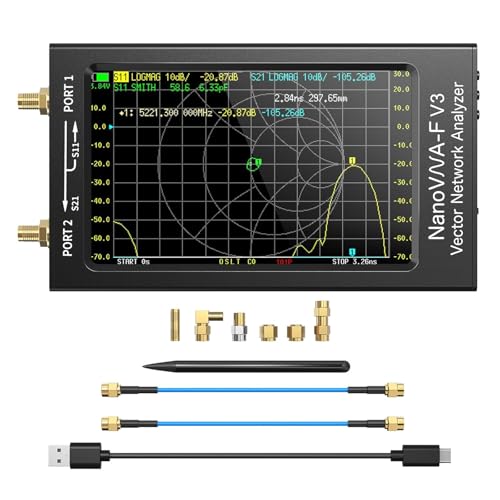
The NanoVNA-F V3 is a significant generational leap over its predecessors. It covers 1MHz to 6GHz without relying on harmonic extension, meaning the S21 dynamic range stays at a solid 65dB across the full spectrum. The 801 scan points deliver the finest resolution in this comparison, allowing you to see sharp impedance transitions that lower-point-count units would smooth over. The metal chassis and SMA direct-connect design help maintain signal integrity during critical measurements like filter passband ripple or duplexer notch depth.
The 4.3-inch touchscreen runs a responsive firmware interface with RTC real-time clock for timestamping calibration sets. The unit stores up to 12 calibration states, which is generous for those who juggle multiple antennas or test fixtures. USB-C charging for the 4500mAh battery is a welcome upgrade from Micro-USB. The included gold-plated SMA calibration kit and RG405 cables reduce connector variables right out of the box.
Some users report battery life falling short of advertised claims — expect around 3 to 4 hours of active use rather than the optimistic estimates. The overall build quality is solid, but the SMA connectors remain the physical weak point for heavy field use. For the serious home-station operator or RF enthusiast who needs 6GHz capability and high point density, this V3 kit is the clear performance leader in its segment.
Why it’s great
- 801 scan points for extremely fine sweeps
- 6GHz range without harmonic harmonics
- 12 calibration memory slots with RTC timestamp
Good to know
- Battery life is shorter than stated
- SMA connectors are fragile for frequent outdoor use
2. RigExpert Stick 230

The RigExpert Stick 230 is purpose-built for the portable HF operator. Its frequency range of 100kHz to 230MHz covers all HF bands plus 6 meters and the 2-meter band, making it an ideal pairing for a field-deployed 20-meter dipole or a Wolf River Coil vertical. The e-ink display is a standout feature — it remains fully readable in direct sunlight where a conventional LCD washes out entirely. The sensor form factor (roughly the size of a thick marker) attaches directly to the antenna feedpoint, eliminating the need for a long coax jumper that could introduce measurement error.
It measures SWR, return loss, cable loss, capacitance, and inductance. The UHF (SO-239) connector matches the standard found on most HF radios and antenna bases without needing an adapter. The square-wave output signal from 0.1 to 230 MHz is adequate for SWR sweeps but not as clean as a true sine-wave VNA for detailed impedance analysis. The device runs on an internal rechargeable battery that charges quickly but some users report the charge depletes noticeably after only two field sessions.
The Stick 230 is expensive relative to its narrow frequency range, but its size, ruggedness, and sunlight-readable screen make it indispensable for the QRPer or the portable specialist. If your work stays below 230MHz and you value a tool that slips into your go-kit pocket, this is the premium option for real field resilience. It is not a general-purpose VNA, but it does its specific job better than anything else in this list at its size.
Why it’s great
- E-ink display is perfectly readable in bright sunlight
- Ultra-compact form fits directly at the feedpoint
- Rugged build for outdoor portable ops
Good to know
- Battery life can be short after a few charging cycles
- Narrow 230MHz ceiling limits its use for VHF/UHF
3. Comet CAA-500 Mark II

The Comet CAA-500 Mark II pairs a classic analog cross-needle meter with a color LCD for band sweep graphing — a rare combination that appeals to operators who trust the immediate visual feedback of a moving needle. The unit covers 1.8 to 500MHz, which includes all ham bands through 70cm. The auto band sweep function selects the amateur band for you and produces a SWR graph across that band in seconds. Up to 5 sweep graphs can be overlaid on the LCD, making it easy to compare adjustments side-by-side.
Connector versatility is excellent: an SO-239 for use up to 300MHz and a Type-N connector for 300 to 500MHz. The unit runs on 6 AA batteries (alkaline or NiMH) with a built-in trickle charger for rechargeables, or an external 8-16VDC source. The construction is noticeably heavy and solid, weighing over two pounds without batteries. The analog meter movement is mechanical — it requires no power to hold a reading, which is an advantage during prolonged tuning sessions in the field.
The CAA-500 Mark II does not offer USB data export or PC control, so all graph capture is done by eye or camera. The LCD graphic display is small and low-resolution compared to modern VNAs. For the operator who wants a rugged, no-fuss analyzer that provides simultaneous SWR and impedance readings at a glance, and does not need computer integration, this Comet is a time-tested professional choice that will last for years.
Why it’s great
- Cross-needle meter shows SWR and impedance simultaneously
- Dual SO-239 and N-Type connectors for broad compatibility
- Auto band sweep with graph overlay function
Good to know
- No USB or PC connectivity for data export
- Heavy unit; 6 AA batteries add significant weight
4. AURSINC TinySA Ultra+ ZS406
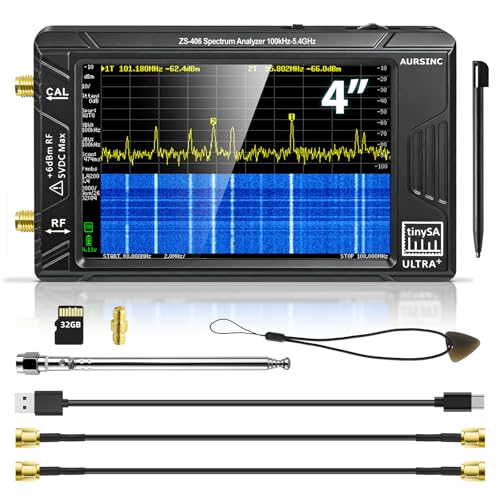
The TinySA Ultra+ is technically a spectrum analyzer with a signal generator, not a dedicated antenna analyzer. However, it earns its place in this guide because its ability to perform broad spectrum sweeps from 100kHz to 5.4GHz and its built-in 5000mAh battery make it a powerful companion for checking antenna harmonics, identifying spurious emissions, and verifying multiband resonance. The 4-inch 480×320 touchscreen is bright and responsive, and the unit ships with a 32GB micro SD card pre-installed for saving traces.
Key specifications include a resolution bandwidth as low as 200Hz, phase noise of -108dBc/Hz at 100kHz offset, and a DANL of -166dBm/Hz. The signal generator outputs MF/HF/VHF sine waves from 100kHz to 900MHz and square waves from 800MHz to 4.4GHz. The unit can be controlled via PC over USB using the TinySA APP. The included SMA cables, barrel connector, and antenna get you started immediately. The step attenuator (0-31dB) and LNA (effective up to 3.5GHz) give you flexibility for strong and weak signals alike.
This is not the tool for a quick SWR sweep at the feedpoint. It is a diagnostic instrument for understanding the full RF picture around your antenna — harmonic content, noise floor, nearby interference. The interface has a learning curve and documentation is sparse. For the advanced operator who already owns a dedicated VNA for SWR work and wants a complementary tool for spectrum analysis, the TinySA Ultra+ is the most capable option in this class at its price point.
Why it’s great
- Up to 5.4GHz spectrum analysis in a portable form
- Built-in signal generator for receiver testing
- Large 5000mAh battery and included 32GB storage
Good to know
- Not a direct SWR analyzer; requires interpretation of spectrum data
- Documentation is limited; users rely on community support
5. Upgraded NanoVNA-F V2

The NanoVNA-F V2 from Seesii is an upgrade that prioritizes three things: screen size, battery endurance, and an all-metal housing. The 4.3-inch IPS TFT LCD is significantly larger than the 4-inch panels on competing NanoVNA models, and it remains legible in outdoor conditions. The measurement range of 50kHz to 3GHz covers all amateur bands up to 70cm, with firmware expandable to a 10kHz-1.5GHz range for extended LF and MF work if desired.
The 5000mAh battery is the largest capacity in this comparison. Under typical field use — intermittent sweeps with periods of idle — the V2 can last an entire weekend of portable operations. The aluminum housing provides RF shielding against external electromagnetic interference, which is important when working near power lines or other broadcast sources. It supports PC connection via NanoVNA-Saver for saving Touchstone files and producing exportable graphs. The unit also includes a USB power bank function for charging other devices in a pinch.
The V2 uses the older SI5351 clock chip for frequency generation, which means its harmonic-based extension above 1.5GHz has less dynamic range than direct-synthesis designs. The 101 scan points (default) feel limited for wide-span sweeps, though firmware updates can increase this. The SMA connector is still the physical bottleneck for heavy coupling. For the operator who values a big screen and all-day battery above all else, the V2 delivers exactly that experience without breaking the bank.
Why it’s great
- 4.3-inch IPS display is excellent for older eyes or field glare
- 5000mAh battery provides exceptional field runtime
- Aluminum chassis with good RF shielding
Good to know
- Limited to 101 scan points at default settings
- Harmonic-based extension above 1.5GHz reduces dynamic range
6. AURSINC NanoVNA SAA-2N V2.2

The SAA-2N V2.2 from AURSINC breaks from the SMA-connector standard that defines most NanoVNA clones. N-Type connectors are mechanically superior — they handle more mating cycles, are less prone to bending, and offer better shielding at higher frequencies. The unit is housed in a heavy steel enclosure that feels substantial in the hand and provides excellent RF shielding. The frequency range spans 50kHz to 3GHz, with calibrated dynamic range at the ports: 70dB up to 1.5GHz and 60dB up to 3GHz.
The steel case adds noticeable weight — this is not a tool for ultralight go-kits. The 4-inch touchscreen is bright and responsive. The unit supports up to 201 scan points per frequency range sweep, providing smoother plots than the 101-point standard on many entry-level VNAs. It includes ten calibration memory slots. The included N-Type calibration kit (OPEN, SHORT, LOAD) and N-Type to N-Type barrel connector mean you do not need adapters to get started, which eliminates an impedance discontinuity at the start of your test.
The major drawback is the Micro-USB charging port. In an era where USB-C is standard, having to carry a dedicated cable for the analyzer is a real inconvenience. The steel case is prone to surface rust in humid environments. The user interface, while similar to other NanoVNA firmware, does not auto-interpolate calibration data after frequency changes — you must manually recalibrate or recall a saved calibration set. For operators who prioritize connector longevity and solid metal construction, the SAA-2N is a reliable mid-range workhorse.
Why it’s great
- N-Type connectors are far more durable than SMA
- Steel chassis with strong RF shielding
- 70dB dynamic range up to 1.5GHz
Good to know
- Uses Micro-USB instead of USB-C
- Heavy unit at over 1.3 pounds
7. MINI1300 Antenna Analyzer

The MINI1300 is a dedicated antenna analyzer that forgoes the general VNA architecture of the NanoVNA line in favor of a simpler, more focused user experience. Its frequency range of 0.1 to 1300MHz covers HF, VHF, and UHF without needing to switch modes or firmware. The large 4.3-inch touchscreen displays SWR sweeps, single-point measurements, and TDR (Time Domain Reflectometry) traces for locating faults in feedlines. The SWR measurement is split into two modes: single-point mode (1.0-1999) and scan mode (1.0-20.0).
The build quality is excellent — a metal case with a solid feel. The calibration process is straightforward with the included SMA OPEN/SHORT/LOAD kit. Users report that the SWR readings match known reference antennas very closely, suggesting good internal calibration stability. The unit does not support remote USB control, so all data must be read directly from the screen. The included manual is nearly unusable — a mixture of Chinese, German, and broken English — but the on-screen menu is intuitive enough for anyone comfortable with RF test gear.
The firmware cannot be updated, which means the unit is locked to whatever features and bug fixes it shipped with. Some early units had defects (missing screws, dead batteries), but current stock from this seller appears to have corrected those issues. The SMA connectors are the standard weak point. For the operator who wants a standalone, no-PC-required antenna sweeper with a large screen and excellent value, the MINI1300 is a very strong dedicated option that is simpler to operate than a full VNA.
Why it’s great
- TDR mode for cable fault location is a useful bonus
- Large 4.3-inch touchscreen with intuitive menu system
- Solid metal build with accurate SWR readings
Good to know
- Firmware is locked and cannot be updated
- No PC connectivity for data export or screen capture
8. SEESII NanoVNA-H4

The SEESII NanoVNA-H4 is the classic entry point into vector network analysis for ham radio operators. Based on Hugen’s original design, this V4.4 version offers a 9kHz to 1.5GHz frequency range with a 4-inch LCD touchscreen. The unit measures S11/S21 parameters, VSWR, phase, delay, and Smith chart data. The 1950mAh internal battery is modest but sufficient for a day of field work if you keep the screen brightness low. The package includes the full SMA calibration kit (OPEN, SHORT, LOAD) and two RG316 RF cables.
Its standout feature is the built-in MicroSD card slot. Saving field measurement screenshots or calibration data directly to a 32GB card (not included) allows you to archive your antenna work without needing a laptop. The firmware supports a date/time custom setting for organizing saved traces. PC connection via NanoVNA-Saver works well for exporting Touchstone files to antenna modeling software. The 101 default scan points are standard for this class of analyzer and adequate for most single-band HF sweeps.
The H4 uses the older SI5351 clock generation, which means its dynamic range drops to 40dB above 900MHz. The learning curve is real — the one-page instruction sheet is useless, and mastering the device requires watching several YouTube tutorials. The SMA connectors are delicate. For the beginner or budget-conscious operator who wants to measure SWR, resonance, and cable loss without spending on premium gear, the NanoVNA-H4 is the proven starting point that delivers 90% of the capability at a fraction of the cost.
Why it’s great
- MicroSD slot for saving screenshots and calibration data
- Complete SMA calibration kit and RF cables included
- Proven VNA platform with huge community support
Good to know
- Steep learning curve; YouTube is required
- Dynamic range drops above 900MHz
9. Xiegu G90 HF Transceiver

The Xiegu G90 is a 20W HF SDR transceiver, not a standalone antenna analyzer. It earns a spot on this list because its built-in automatic antenna tuner (ATU) doubles as a capable antenna analysis system for HF bands. The ATU can match an extremely wide range of impedances (typically tuning almost any random wire or end-fed) and provides an SWR sweep display on its 48kHz-wide waterfall spectrum screen. For the portable operator who already needs a radio, the G90 removes the need to carry a separate analyzer for basic HF antenna work.
The detachable display head allows for flexible field placement — mount the radio body in your pack and run the display panel where you can see it. The 20W output is enough for QRP and digital modes (FT8, JS8Call) and, with a good antenna, can make solid DX contacts. The spectrum/waterfall display gives you real-time RF awareness of the band conditions around you. The quick-mode function buttons reduce the need to dig through menus for common adjustments like power level and filter width.
The G90 is not a replacement for a proper VNA. Its antenna analysis is limited to basic SWR detection within the radio’s HF range; you cannot measure cable loss, impedance plots, or phase. The 20W power ceiling makes SSB contacts challenging under poor band conditions. Some units have reported manufacturing inconsistencies. For the portable HF enthusiast who wants a single-box solution that offers both transmission and antenna tuning capability, the G90 is a clever workaround that reduces pack weight and setup complexity.
Why it’s great
- Built-in ATU tunes nearly any HF antenna
- Spectrum/waterfall display for band awareness
- Detachable display for flexible field placement
Good to know
- Not a dedicated analyzer; lacks cable loss and impedance measurement
- 20W power is limited for SSB in marginal conditions
FAQ
Why does my NanoVNA show different SWR than my radio’s built-in meter?
Can I use an antenna analyzer to measure cable loss?
Do I need to calibrate every time I turn on the analyzer?
What is TDR mode and when would I use it?
Can the TinySA Ultra+ replace a VNA for antenna work?
Final Thoughts: The Verdict
For most users, the best antenna analyzer winner is the Seesii NanoVNA-F V3 because its 801 scan points and 6GHz native range provide the finest resolution and widest coverage without relying on harmonic extension. If you want a dedicated field tool with an e-ink display that slips into your pocket, grab the RigExpert Stick 230. And for a premium hybrid experience with analog cross-needle feedback and band sweep graphing, nothing beats the Comet CAA-500 Mark II.