
Our readers keep the lights on and the weekend projects moving. As an Amazon Associate, I earn from qualifying purchases.
Cutting the cord doesn’t have to mean losing access to live local broadcasts — but the wrong antenna will leave you staring at a pixelated mess or missing your favorite network altogether. Whether you are chasing ABC’s prime-time lineup or the evening news, a well-designed outdoor unit pulls in crisp HD without the recurring subscription price.
I’m Rikta — the co-founder and writer behind FitlyFast. After combing through real customer feedback, signal-range claims, and amplifier specs across dozens of models, I’ve narrowed down the units that actually deliver on their reception promises for free over-the-air television.
This guide cuts through the marketing noise to show you which hardware reliably grabs antenna for abc broadcasts — ranking options by build quality, real-world range, and the technical details that matter for a stable, clear picture.
How To Choose The Best Antenna For ABC
Finding the right unit for your home starts with understanding the specific broadcast frequencies used by ABC in your area and how the physical placement of the antenna interacts with obstacles like trees, hills, and building materials. A few key specs and design choices separate a reliable performer from a frustrating dud.
Know Your Broadcast Band: VHF vs. UHF
ABC is broadcast on both VHF (channels 2–13) and UHF (channels 14–51) depending on your local market and the station’s post-2009 frequency assignment. Some antennas only capture UHF signals well, meaning you could miss ABC if it is on VHF-Hi or VHF-Lo in your region. Always check the antenna’s spec sheet for explicit VHF support, especially if your station uses a low-VHF channel like 6 or 7.
Amplifier or No Amplifier
A built-in pre-amplifier boosts weak signals and helps overcome signal loss from long coaxial cable runs. However, if you live within 20–30 miles of the broadcast towers, an amplifier can actually overload the TV tuner, causing dropouts. For reliable ABC reception at moderate range, a passive antenna or one with an integrated 4G/5G LTE filter is often the smarter choice.
Mounting Location and Weather Resistance
Outdoor placement on the roof or in the attic typically delivers the strongest signal because it clears ground-level obstructions and building materials like metal siding or foil-backed insulation. If you opt for outdoor mounting, look for UV-resistant plastic or powder-coated metal construction that can withstand rain, snow, and direct sun. A 16-foot or longer RG6 coaxial cable gives you placement flexibility to find the sweet spot for ABC reception.
Quick Comparison
On smaller screens, swipe sideways to see the full table.
| Model | Category | Best For | Key Spec | Amazon |
|---|---|---|---|---|
| RCA ANT751Z | Yagi | Multi-directional attic installation | 75-mile range (VHF/UHF) | Amazon |
| Antennas Direct ClearStream 2V | Multi-Directional | Suburban homes with obstructions | 60+ mile range with reflector | Amazon |
| 1byone Omni-Directional | Omni-Directional | No-adjustment outdoor setup | 100+ mile range, built-in pre-amp | Amazon |
| PBD WA-2608 | Motorized | Remote-controlled direction adjustment | 150-mile range, dual TV outputs | Amazon |
| Aimto-Pro WA-2608+POLE | Motorized | Rural long-distance reception | 150-mile range, ground block safety | Amazon |
| GE 29884 | Outdoor Yagi | Budget-friendly attic mounting | 70-mile range, J-mount included | Amazon |
| VinixCruzr 2800+ Miles | Omni-Directional | Entry-level indoor/outdoor use | 2800+ mile range, 16-ft cable | Amazon |
In‑Depth Reviews
1. RCA ANT751Z

The RCA ANT751Z is a compact Yagi-style antenna that punches well above its size class. Its pre-assembled design includes a snap-lock UHF reflector and a 75-ohm matching transformer, making attic installation nearly tool-free. Real-world users report pulling in 70+ channels from 60 miles away with signal strengths of 80% or higher on ABC, CBS, NBC, and FOX — often without needing an additional amplifier.
This unit handles both VHF and UHF bands, which is critical for ABC reception since the network is scattered across low and high VHF frequencies depending on the market. The included mast and locking clamp allow it to be mounted on horizontal or vertical surfaces indoors, in the attic, or outdoors. Its silver metal construction holds up well against the elements, though some users add a separate grounding block for extra safety.
The only real catch is that the coaxial cable is not included — you will need to purchase an RG6 cable separately. The free RCA Signal Finder app helps you aim the antenna properly without climbing the roof multiple times. For a mid-range price, this antenna delivers consistent, reliable reception that rivals premium units.
Why it’s great
- Excellent VHF/UHF reception in a compact form factor
- Pre-assembled design for quick attic or outdoor mounting
- Strong signal on ABC even without an amplifier
Good to know
- Coaxial cable must be purchased separately
- Outdoor durability concerns over several years of direct sun and rain
2. Antennas Direct ClearStream 2V
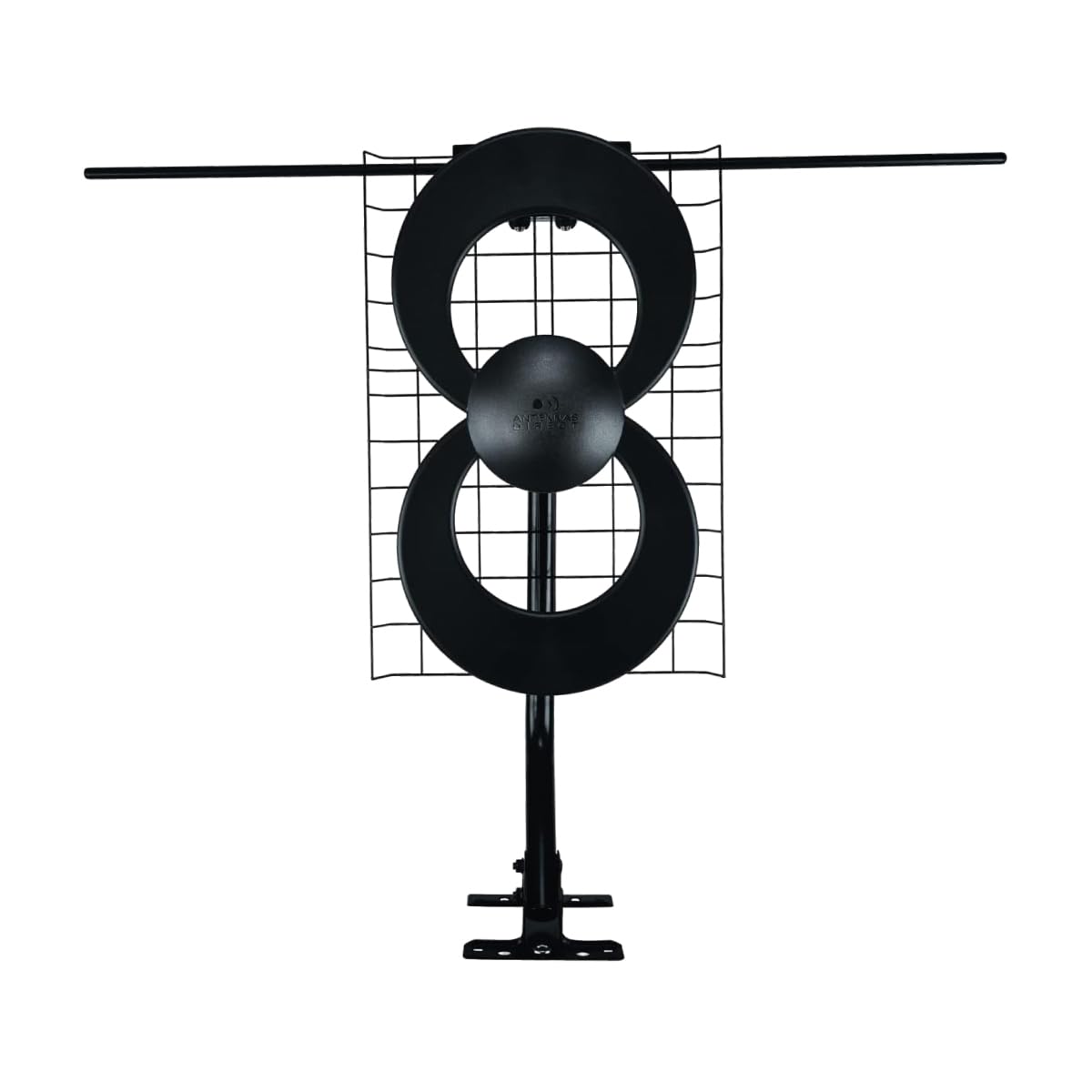
The ClearStream 2V uses a dual-loop design with a rear reflector to focus the antenna’s power forward, providing a 60+ mile range that excels in suburban and rural environments. Its double-loop elements are specifically engineered for UHF and high-VHF bands — the frequencies where ABC often lives. Users in hilly, wooded areas report pulling in 70 channels with 65 of them crystal clear, a testament to the reflector’s ability to reject multipath interference.
Assembly is straightforward, with a 20-inch mast and pivoting base that mounts on vertical or horizontal surfaces. The all-weather hardware is corrosion-resistant, and the antenna carries a lifetime manufacturer warranty — a confidence marker from a US-based company. It supports 4K, 8K, and NEXTGEN TV (ATSC 3.0), so you are future-proofed as broadcast standards evolve.
One common complaint is that the coaxial cable is not included in the box, adding a small extra expense. Additionally, the antenna is directional with a wide beam of about 70 degrees, meaning careful aiming is required for best results. An optional pre-amplifier is recommended if you are in a fringe reception area or splitting the signal to multiple TVs.
Why it’s great
- Reflector provides strong forward gain and interference rejection
- Lifetime antenna warranty from a reputable US manufacturer
- Compatible with 4K, 8K, and ATSC 3.0 broadcasts
Good to know
- Coax cable sold separately
- Directional design requires careful aiming for optimal signal
3. 1byone Omni-Directional

The 1byone omni-directional antenna is a white, low-profile dome that picks up signals from all directions simultaneously — no rotator or re-aiming needed. With a claimed 100+ mile range and a built-in pre-amplifier with a 4G/LTE filter, this unit is designed to cut through cellular interference that can plague outdoor antennas. Users in Manhattan report snagging 60 channels after a 15-minute scan, including sharp, crisp local feeds.
The included 32-foot RG6U coaxial cable gives you plenty of slack to position the antenna high on a roof or in an attic. Its moisture-proof and flame-retardant construction means it can handle rain, snow, and direct sun without degrading. The Smart pass amplifier technology adjusts gain based on incoming signal strength, preventing overload near strong tower clusters.
There is one notable caveat: the antenna only supports a single TV output. If you want to split the signal to multiple televisions, you will lose some signal strength. Also, some users have reported that after several years of outdoor exposure, water can seep into the dome and corrode the pre-amp, so sealing the seam with silicone is a common owner hack.
Why it’s great
- Omni-directional reception means no manual aiming or rotator needed
- Built-in 4G/LTE filter blocks cellular interference
- Long 32-foot RG6 cable for flexible placement
Good to know
- Single TV output only (no splitter-friendly design)
- Outdoor dome may need seam sealing for long-term weatherproofing
4. PBD WA-2608

The PBD WA-2608 stands out with its motorized 360-degree rotation system, which lets you adjust the antenna’s direction with a wireless remote — no more climbing on the roof when you want to switch from ABC to FOX. It boasts a 150-mile range and can feed two televisions simultaneously without requiring an external splitter. Reviews from Detroit-area users mention picking up 80 channels from 25 miles away with a rock-solid picture.
Weatherproof construction and a 40-foot RG6 coaxial cable are included in the box, making installation easier than most. The unit supports 4K and 1080p signals, and it is NEXTGEN TV (ATSC 3.0) ready. One user reported that the motorized remote only rotates in one direction and then reverses, so you cannot continuously spin it, but for most setups that is not a limitation.
Some buyers found the included 40-foot coax to be missing from their shipment, although customer service was quick to resolve the issue. A few users also noted the plastic connection points can be fragile if over-tightened. Overall, the PBD is a strong mid-range option for households that need flexibility in aiming without physical effort.
Why it’s great
- Motorized rotation with remote control eliminates rooftop adjustments
- Dual TV outputs reduce the need for an external splitter
- 40-foot coax cable included for flexible installation
Good to know
- Motor rotation is one-directional then reverses (no continuous spin)
- Some users reported missing coax cable in the box
5. Aimto-Pro WA-2608+POLE

The Aimto-Pro WA-2608+POLE is a close cousin to the PBD but adds a built-in ground block for electrical surge protection — a safety feature often overlooked in consumer antennas. It also includes the mounting pole and bracket directly in the box, saving you a trip to the hardware store. With a 150-mile range and support for 8K HDR and ATSC 3.0, this unit is built for the long haul, especially in rural areas far from broadcast towers.
Real-world performance reports are strong: one user living 70 miles from the nearest tower described reception as “great” after raising the antenna high enough to clear tree lines. The snap-on assembly structure means you can set it up in minutes without tools, and the integrated 4G/5G LTE filter blocks cellular noise that can cause pixelation. The motorized rotation function works via a control box or remote, letting you fine-tune direction from inside.
Not every experience is perfect — a handful of users reported receiving zero channels when only 21 miles from towers, which may point to a defective unit or an extreme local obstruction. The warranty is a solid one year, and the included pole makes this a complete package for those who want a single-box solution with added electrical safety.
Why it’s great
- Integrated ground block for surge protection
- Complete install kit includes mounting pole and bracket
- Supports 8K HDR and ATSC 3.0 out of the box
Good to know
- Mixed reception reports from users within 21 miles of towers
- 1-year warranty only (shorter than some competitors)
6. GE 29884
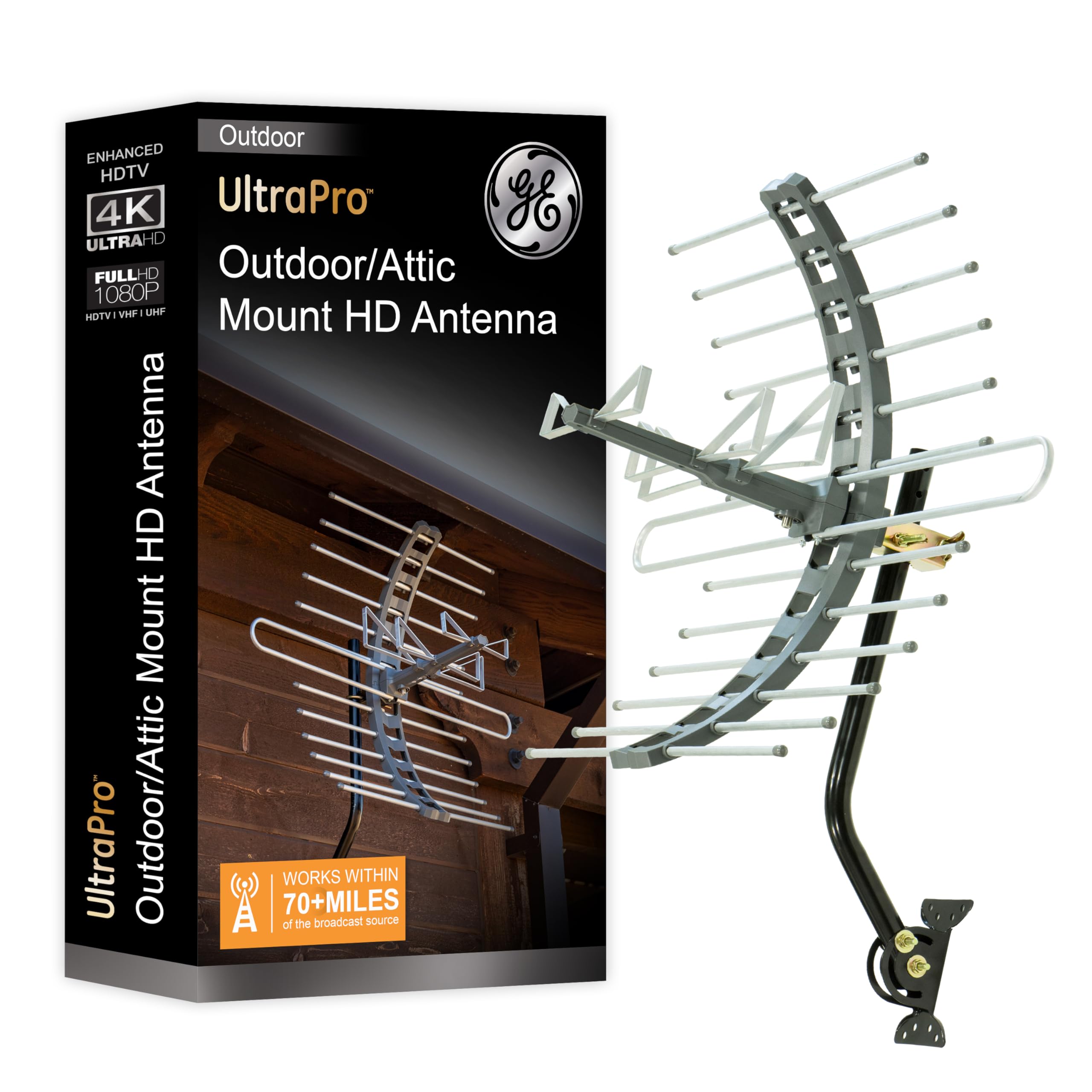
The GE 29884 is a traditional Yagi-style outdoor antenna that appeals to budget-conscious cord-cutters who don’t want to sacrifice quality. Its long, 29-inch elements are designed for both VHF and UHF reception, and the included J-mount makes rooftop or attic installation straightforward. Real-world tests from users 60 miles from towers show it pulling in 106 channels — mostly crystal clear — after pairing with a simple amplifier.
This model is lightweight at just 3 pounds, so it can be mounted on an existing satellite mast or in an attic without heavy reinforcement. The grey and white plastic body resists UV rays, though some owners recommend sealing the entry points with silicone if installing outdoors, as the plastic housing may not be as rugged as metal alternatives. Many users report replacing expensive failed antennas with this GE unit and seeing an immediate improvement in reception of ABC, CBS, NBC, and FOX.
One limitation is that the assembly instructions are sparse; watching a YouTube installation video is strongly recommended. Additionally, the antenna works best with RG6 coaxial cable — using RG59 can degrade performance noticeably. For a budget-friendly entry point into over-the-air TV, the GE 29884 offers remarkable channel counts for the price.
Why it’s great
- Excellent channel count for a budget-friendly Yagi design
- Lightweight 3-pound build for easy attic or mast installation
- Included J-mount and mast clamp for immediate mounting
Good to know
- Assembly instructions are poor — seek video guides
- Plastic housing may not be as durable as metal alternatives outdoors
7. VinixCruzr 2800+ Miles
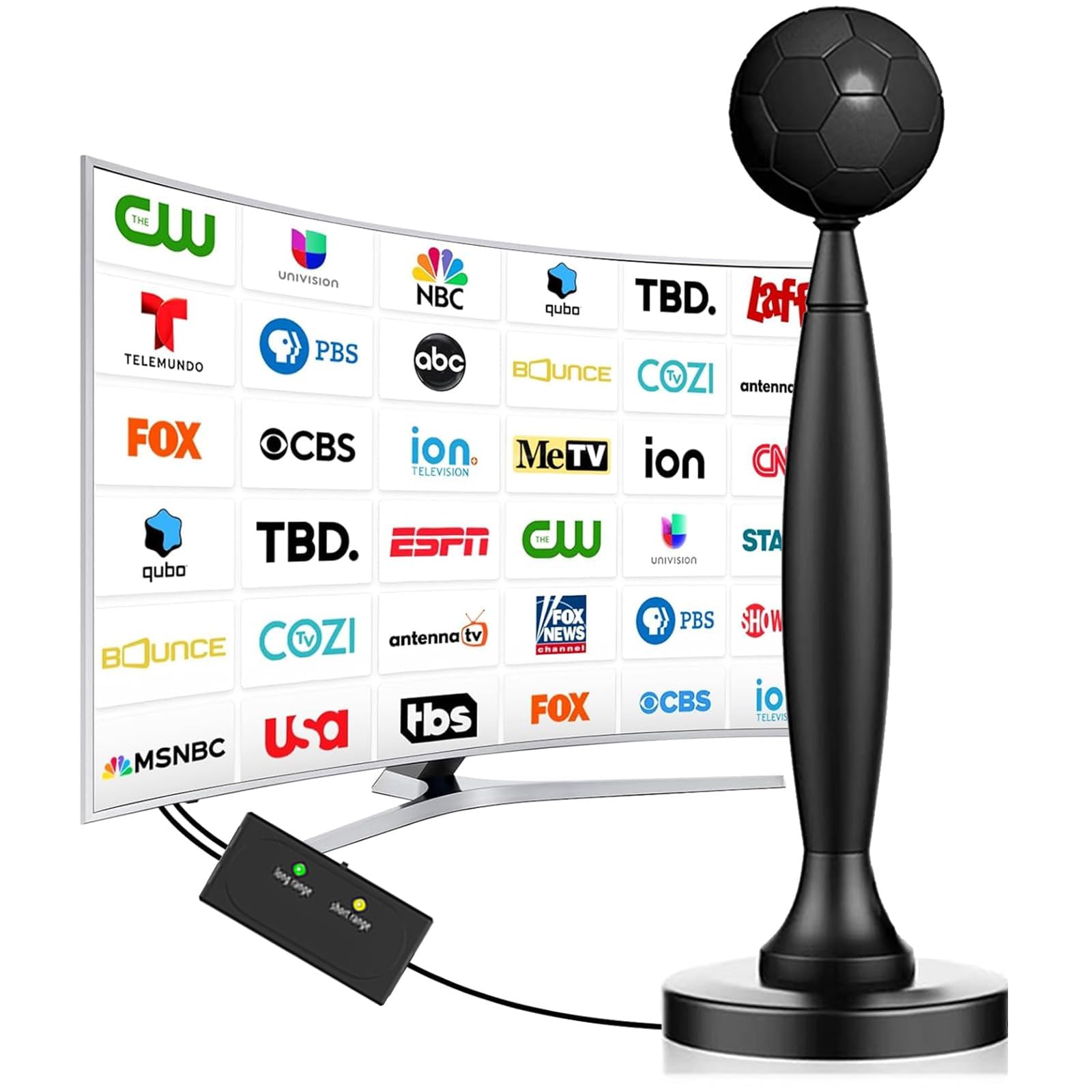
The VinixCruzr antenna makes a bold 2800+ mile range claim, but its real strength lies in its affordability and flexible placement options for entry-level users. It uses an omnidirectional design with a smart amplifier chip that filters out cellular and FM interference. In practice, users report picking up 31 local channels with a clear, stable HD picture — a solid result for the price.
The 16-foot coaxial cable and adhesive backing allow you to stick it on a wall or window without drilling, making it a great pick for apartments or RVs where permanent mounting is not possible. It supports 4K and 1080p signals, and the weather-resistant design means it can handle indoor or sheltered outdoor use. The compact black body is unobtrusive and blends into most home setups.
The high range claim should be taken with skepticism — real-world reception depends heavily on local terrain and tower distance. Some users may need to experiment with placement to get the best signal. Also, there is no 4G/5G filter on this model, so if you live near a cellular tower you might experience occasional interference. For the cost, it is a low-risk starting point for cord-cutting beginners.
Why it’s great
- Affordable entry point with adhesive backing for no-drill installation
- Compact and unobtrusive design suitable for apartments and RVs
- Smart amplifier chip reduces FM and cellular interference
Good to know
- No built-in 4G/5G LTE filter for strong cellular environments
- 2800+ mile range is highly optimistic for most real-world scenarios
FAQ
Why does my ABC station not come in clearly with a UHF-only antenna?
Does an amplifier always improve reception for ABC?
Can I use a splitter to connect two TVs to one antenna?
What does ATSC 3.0 compatibility mean for my antenna?
Final Thoughts: The Verdict
For most users, the antenna for abc winner is the RCA ANT751Z because its Yagi design delivers reliable VHF and UHF reception across a wide range of distances, and its pre-assembled build makes attic installation simple. If you want the convenience of no manual aiming and a built-in pre-amp, grab the 1byone Omni-Directional. And for remote-controlled direction adjustment with dual TV support, nothing beats the PBD WA-2608.