
Our readers keep the lights on and the weekend projects moving. As an Amazon Associate, I earn from qualifying purchases.
Mounting an antenna in the attic solves the two biggest cord-cutting headaches: it keeps the hardware out of sight and protects it from direct weather exposure, but it introduces unique signal challenges as your roof, siding, and insulation act as a natural signal sponge. Choosing the wrong model here means pixelated football games and constant re-scanning for channels your neighbors pull in effortlessly from a rooftop mount.
I’m Rikta — the founder and writer behind FitlyFast. I spend my time comparing the electrical design, gain figures, and real-world filtering capabilities of OTA antennas to find which models actually overcome the structural barriers of attic placement.
This guide breaks down the models that handle VHF and UHF attenuation from roofing materials, so you can find the right antenna for attic mounting that delivers reliable reception without drilling holes in your shingles.
How To Choose The Best Antenna For Attic
Attic-mounted antennas face a unique trade-off: a roof blocks roughly 30–50% of signal energy depending on material (asphalt shingles have mild attenuation, while standing-seam metal or radiant barrier foil can completely kill reception). You need an antenna with enough raw gain to punch through that loss without being so electrically noisy that it overloads your TV’s tuner. The three factors below separate the performers from the paperweights.
UHF versus High-VHF Element Design
Most broadcast channels today live in the UHF band (channels 14–36), but many regions still have important stations — like ABC or PBS — broadcasting on High-VHF (channels 7–13). A good all-around attic antenna must have dedicated, correctly sized elements for both bands. Pure UHF designs (short dipole elements) will miss your local VHF affiliate entirely. Check the product’s stated frequency coverage: VHF acceptance from 170–230 MHz and UHF from 470–860 MHz is the minimum range for a true full-spectrum antenna.
Built-In Filtering for LTE and 5G Interference
Attics are often located directly under roofs with mounted cell antennas or near cellular towers that broadcast in frequencies close to the UHF TV band (around 600–700 MHz). Without a high-pass filter that blocks signals above 608 MHz, your TV’s tuner can get overwhelmed by LTE/5G noise, resulting in dropouts on clear days. Premium models like those from Televes integrate band-specific filtering directly into the preamplifier stage, while budget options require an external filter to achieve the same effect.
Preamp Output Capability and Gain Control
An attic antenna that feeds a 50-foot cable run to a basement or living room splitter needs a preamp with enough output level (measured in dBµV) to overcome cable loss without distorting. Look for units that specify TForce or similar intelligent gain control — these automatically adjust amplification per band to prevent overload from strong local stations while still boosting weak fringe signals. A fixed-gain preamp can work if you live 30+ miles from towers, but closer to transmitters it risks overloading your tuner with excessive signal strength, causing exactly the pixelation you tried to fix.
Quick Comparison
On smaller screens, swipe sideways to see the full table.
| Model | Category | Best For | Key Spec | Amazon |
|---|---|---|---|---|
| RCA ANT751Z | Compact Yagi | Small attic spaces | 75-mile range, 15-element design | Amazon |
| Televes Dinova Boss Mix | Smart Amplified | Troublesome interference | Built-in LTE/5G filtering | Amazon |
| GE Pro Outdoor Yagi | Mid-Range Workhorse | Reliable 80-mile reach | 80-mile range, J-mount included | Amazon |
| Five Star Long Range | Multi-Directional | Dual-tower orientations | 200-mile claim, 46-inch boom | Amazon |
| Televes DAT BOSS Mix LR | Premium Fringe | Extreme rural distances | 100-mile range, stacked triple-boom | Amazon |
| McDuory UHD-3968 Yagi | Budget Passive | Budget-first buyers | 150-mile claim, 75-ohm impedance | Amazon |
| CeKay Yagi HDTV | Value Bundle | Entry-level attic setup | 70-mile range, 40ft RG6 included | Amazon |
In‑Depth Reviews
1. RCA ANT751Z Compact Outdoor Yagi

The RCA ANT751Z packs a 15-element Yagi design into one of the most space-efficient footprints in this class, making it a top choice for tight attic rafters where boom length is a constraint. Real-world owners consistently report picking up 28–79 channels from 25–50 mile ranges with no external amplifier, using it with TiVo and HDHomeRun setups for whole-home DVR. The snap-lock UHF reflector and pre-assembled elements reduce attic assembly time to under 20 minutes.
Its compact size means the VHF dipole element is shorter than full-length designs, which slightly limits High-VHF gain on channels 7–13 compared to larger Yagis. At distances beyond 50 miles with tree obstruction, you may need the optional RCA preamp to maintain solid lock. The included mounting mast is functional but basic — for permanent attic placement, consider upgrading to a sturdier J-mount or using a strut channel for precise aiming.
Owners in suburban environments (15–35 miles from towers) report nearly universal success, with strong signal strengths in the 80–100% range on all major networks after a single aiming session using the free RCA Signal Finder app. The weather-resistant construction is adequate for attic humidity, and the 2-pound weight makes it easy to hang from roof trusses without additional support brackets.
Why it’s great
- Snap-lock assembly eliminates tools for reflector installation
- Strong UHF performance without needing an external preamp
- Works with existing coax wiring for simple attic-to-TV routing
Good to know
- VHF dipole is shortened; may miss weak VHF stations
- Includes mast but no mounting fasteners for wooden joists
2. Televes DiNova Boss Mix 144286

The Televes DiNova Boss Mix addresses the single biggest headache of attic mounting: interference from nearby cellular towers and FM radio transmitters that bleed into the UHF band. Its integrated FM/LTE/4G/5G filtering chip cleans the spectral environment before amplification, which is critical when your attic sits directly between two cellular poles. The TForce intelligent gain control adjusts amplification per band (29 dBi High-VHF, 34 dBi UHF) to avoid overload from strong local stations while pulling in weak distant ones.
The radome housing seals the electronics from attic dust and humidity fluctuations, and the unit ships fully assembled — no elements to snap together. Owners report picking up 42–53 channels in areas where previous amplified antennas failed, with one user pulling a CBS affiliate from 90 miles away. The 12V dual-output power inserter is included, so you don’t need to buy a separate preamp power supply.
The 50-mile range rating is conservative; the built-in amplifier’s noise figure is low enough that fringe reception stretches beyond that, especially with a clear line of sight from the attic gable end. The white ABS housing blends into a truss line better than bare metal antennas, making it a cleaner installation in finished attic spaces. It also supports dual-mode operation — if the amplifier loses power, the passive signal path remains active, so your TV continues working at reduced range.
Why it’s great
- Integrated LTE/5G filtering eliminates the need for an external trap
- Fully assembled in a weather-resistant radome for zero-hassle install
- TForce auto-gain prevents amplifier overload in mixed-signal zones
Good to know
- Range listed at 50 miles; real-world fringe performance may vary
- Mounting fasteners not included, varies by attic joist type
3. GE Pro Outdoor Yagi 33685

The GE Pro Outdoor Yagi has stood as a mid-range benchmark for years, and its track record in attic installations is strong thanks to a straightforward Yagi element layout that delivers consistent VHF and UHF gain up to 80 miles. Owners report success under concrete tile roofs at 35-mile distances, pulling 93 channels in one Colorado installation that included stations from Nebraska. The included J-mount and mast clamp are robust enough for permanent attic beams, and the weather-resistant bracket holds up in unconditioned attic environments.
Assembly is the most common gripe — the instructions are sparse, and the element rods require firm insertion into the plastic holders, often needing a rubber mallet to fully seat. Once together, the 37-by-26.5-inch frame fits most attic spaces, though you should measure your truss spacing before purchasing, as it’s larger than the RCA compact. GE backs it with a limited-lifetime replacement pledge, which adds peace of mind for a long-term install.
In strong-signal areas (within 15–20 miles), users report excellent results even without a preamp, and the antenna handles 3-way splitters for whole-house distribution when paired with a distribution amplifier like the Winegard LNA-200. For attic mounting, the key is to aim the Yagi elements perpendicular to the roof ridge (not parallel) to minimize signal blocking from truss nails and radiant barrier foil. The ATSC 3.0 compatibility also future-proofs the installation for next-gen broadcast standards.
Why it’s great
- Proven track record in concrete tile roof attics at 35+ miles
- Lifetime replacement pledge from GE for long-term ownership
- Included J-mount and mast clamp suitable for beam mounting
Good to know
- Assembly instructions are minimal; YouTube videos help
- Larger physical footprint requires careful attic space planning
4. CeKay Outdoor Yagi HDTV

The CeKay Yagi stands out in the budget-mid range by bundling a 40-foot RG6 coaxial cable and J-mount in the box, eliminating the extra trip to the hardware store for attic installations. Its all-metal Yagi design picks up 30+ stations at 20 miles with 100% signal metrics from attic placement, according to owners using HDHomeRun and Plex setups. The pre-assembled elements require only the UHF directors to be attached, keeping attic assembly time low.
The metal construction is noticeably lighter and more flexible than premium Yagis, which can matter in attics where you’re working on a stepladder — but that thin metal also means the element rods are prone to bending if stored incorrectly. Owners emphasize that the rod-to-hub friction fit is extremely tight and requires a hammer to fully seat, similar to the GE unit but with softer aluminum that warns against over-force. The 1-year warranty covers manufacturing defects, though the light build may not survive a direct hit from a falling roof brace during installation.
Signal performance is solid for the price point in suburban and urban fringe zones within 30 miles of towers. Beyond that, the lack of built-in amplification means you’ll need an external preamp to overcome the 3–4 dB of cable loss in a 40-foot attic-to-TV run. The included coax is a standard RG6 with compression connectors, which is a genuine convenience for avoiding barrel splices in the crawlspace. ATSC 3.0 compatibility adds future value as broadcasters migrate.
Why it’s great
- 40ft RG6 coax and J-mount included for all-in-one attic setup
- All-metal Yagi design delivers clean UHF reception in suburban zones
- ATSC 3.0 compatible for next-gen broadcast transition
Good to know
- Thin aluminum elements bend easily during assembly
- Rod-to-hub friction fit is extremely tight; hammer required
5. Televes DAT BOSS Mix LR 149884
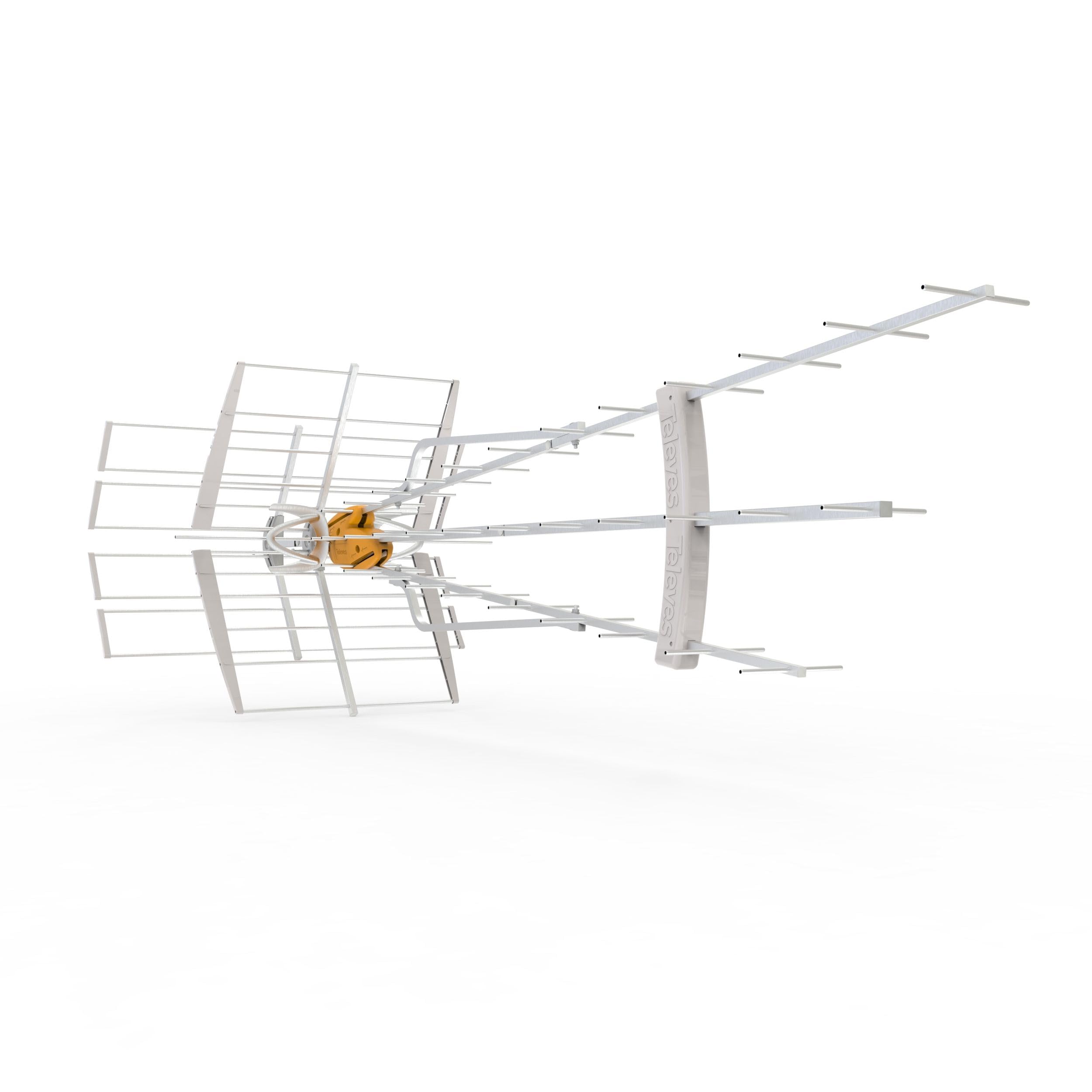
The Televes DAT BOSS Mix LR is the most powerful antenna in this lineup, designed for homeowners who live in extreme rural fringe areas (60–100 miles from towers) where a standard Yagi struggles to hold a lock. Its proprietary stacked triple-boom design delivers 38 dBi High-VHF and 46 dBi UHF gain — figures that dwarf most passive antennas — while the TForce intelligent amplifier automatically adjusts output to avoid overloading your tuner with strong signals when a distant storm brings a local station into view. The integrated FM/LTE/4G/5G filtering is identical to the DiNova Boss but applied to a much higher-gain front end.
The physical size is significant — 84 inches wide by 34 inches deep — so this is for attics with ample gable-end clearance, not cramped crawlspaces. Owners in rural Wisconsin (70 miles from stations) reported replacing a Dish Network installation with 37 usable channels after years of failed attempts with smaller antennas. Seattle-area fringe users noted the DAT BOSS eliminated pixelation on high-UHF channels that previous top-tier antennas could not resolve.
Assembly involves attaching multiple director elements to the triple-boom, and the instructions are detailed but not intuitive — the Televes website has assembly videos that are essential watching. The included UL-listed power inserter and weather boot cover the connection, and the mast clamps accept poles from 0.78 to 2.4 inches in diameter. For cord-cutters committed to a one-and-done attic install in a challenging signal environment, this is the category-defining option.
Why it’s great
- Highest VHF and UHF gain figures available for fringe reception
- Triple-boom design provides extreme front-to-back ratio for multipath rejection
- Integrated LTE/5G filter prevents interference from nearby cell towers
Good to know
- 84-inch width requires significant attic gable-end clearance
- Assembly is complex; watch video instructions before beginning
6. McDuory UHD-3968 Yagi

The McDuory UHD-3968 is a budget-priced passive Yagi that punches above its weight class in High-VHF reception, where many similarly priced antennas fail. Owners consistently report excellent high VHF performance on channels 8 and 19 after other antennas could not lock them, making it a strong choice for attics in areas with mixed-band broadcast towers. The 150-mile range claim is marketing hyperbole — real-world performance peaks around 50 miles with a clear path, but at distances under 30 miles, it delivers full signal bars on major networks when mounted in an attic with standard asphalt shingles.
The build quality is a mixed bag: the LPDA (log-periodic dipole array) design is solid electrically, but the aluminum elements require careful assembly with a rubber mallet to ensure metal-to-metal contact for reliable grounding. One owner noted the hardware can rust over time in humid attics, recommending a dielectric grease (Penetrox) on all electrical joins and a sealed coax connector to prevent corrosion. The included mounting bracket works for basic installations but feels less robust than the GE or Televes options.
For a first-time cord-cutter on a strict budget who lives within 30 miles of broadcast towers and wants to test the attic mounting approach before committing to a premium install, this antenna is the ideal proof-of-concept. It weighs very little, ships mostly assembled, and the passive design means no power supply needed in the attic — just connect the coax and run a channel scan. If the reception works, you can later upgrade to an amplified model without feeling you wasted money on a complex install.
Why it’s great
- Excellent High-VHF reception for channels 7–13
- Passive design requires no attic power outlet or preamp
- Very light weight; easy to hang from single truss beam
Good to know
- Rust-prone hardware; dielectric grease recommended on contacts
- Range claim is exaggerated; expect reliable reception under 30 miles
7. Five Star Long Range HDTV Antenna

The Five Star antenna is positioned as a multi-directional option for homeowners who have towers in different directions and don’t want to motorize their attic mount. The extended 46-inch boom and larger receiving elements provide a wide acceptance angle, allowing it to pick up stations from two clusters separated by 45 degrees without rotating the antenna between scans. Owners 45 miles from Houston towers reported picking up 128 channels, while another user at 7,300 feet elevation in the mountains pulled 90 channels from 46 miles away, demonstrating solid UHF capture capability.
The 200-mile range claim is pure marketing theater — in attic conditions with roof attenuation, expect reliable reception up to about 40–50 miles with a preamp. The antenna ships with a mounting bracket, J-pole, and a TV splitter for feeding up to four TVs, which is a useful inclusion for whole-home distribution. The instructions miss important details like VHF vibrator alignment, and owners note that satellite splitters in the existing coax must be bypassed or removed for the antenna to work, a common pitfall in houses that previously had satellite TV.
Assembly is straightforward but the element rods require a firm push to lock into the holders. The antenna is physically large (46 by 28 by 25 inches), so measure your attic truss clearance before ordering — it will not fit in a low-pitch roof space. For budget-minded buyers who need a wide capture angle and plan to feed multiple TVs from a single attic mount, the Five Star delivers an attractive feature-to-cost ratio if your expectations about real-world range stay grounded.
Why it’s great
- Wide capture angle accepts signals from two tower clusters
- Included TV splitter supports up to four televisions
- Larger boom provides more surface area for UHF element capture
Good to know
- Physical size is large; won’t fit low-profile attic spaces
- Range claim of 200 miles is unrealistic for attic installation
FAQ
Does a metal roof completely prevent attic antenna reception?
Should I point my attic antenna at the TV tower or perpendicular to the roof ridge?
Does running a channel scan monthly improve reception from my attic antenna?
Can I use satellite dish coax cable for my attic antenna?
Why did my attic antenna work in summer but lose channels in winter?
Final Thoughts: The Verdict
For most users, the right antenna for attic mounting comes down to whether you need interference filtering or sheer gain. For suburban buyers within 35 miles of towers with minimal cellular interference, the GE Pro Outdoor Yagi delivers proven performance at a mid-range investment. If you struggle with pixelation from nearby cell towers, the Televes DiNova Boss Mix is the smartest choice with its integrated LTE/5G filter. And for rural fringe reception beyond 50 miles, nothing in this category competes with the Televes DAT BOSS Mix LR and its triple-boom gain architecture.