
Our readers keep the lights on and the weekend projects moving. As an Amazon Associate, I earn from qualifying purchases.
Finding a reliable antenna for HDTV can feel like a game of inches—one wrong angle, one obstructed window, and your Sunday football game dissolves into pixelated snow. The disconnect between manufacturer claims and real-world performance is the biggest headache for cord-cutters today.
I’m Rikta — the co-founder and writer behind FitlyFast. I’ve spent years analyzing antenna specs, combing through user reception reports, and tracking the real factors that determine whether a panel will deliver the local networks you actually watch or sit dead in your attic.
After comparing range, amplification, build quality, and real-world reception patterns across seven top contenders, here is everything you need to know to select the right antenna for hdtv for your specific signal environment.
How To Choose The Best Antenna For HDTV
Every home’s signal environment is different, and the best antenna for your neighbor may fail completely three houses down. The key is to match the antenna’s type, range, and amplification to your specific geography and tower layout, not just the longest advertised mile number.
Directional vs. Multi-Directional vs. Motorized
A directional antenna focuses its receiving power in one direction, which maximizes gain and is best when all broadcast towers are clustered in the same area. Multi-directional models pick up signals from a wide arc but trade raw gain for convenience. Motorized antennas offer the best of both worlds by rotating to lock onto distant stations in different directions, ideal when towers are scattered across your skyline.
VHF vs. UHF Frequency Support
Many low-cost antennas only cover UHF channels, leaving you unable to receive local VHF stations that often carry major networks. A true antenna for HDTV must include high-VHF elements (170–230 MHz) alongside UHF support (470–860 MHz) to deliver every available channel in your market. Check your target stations on RabbitEars or AntennaWeb before buying.
Built-in Amplification and Interference Filtering
A preamplifier can overcome signal loss from long cable runs and splitters, but an amplifier is not a cure-all. In urban areas with strong signals, too much amplification can overload the tuner and degrade reception. Look for models with integrated LTE/4G/5G filtering to block interference from cell towers and FM radio signals that commonly wash out weaker stations.
Quick Comparison
On smaller screens, swipe sideways to see the full table.
| Model | Category | Best For | Key Spec | Amazon |
|---|---|---|---|---|
| Televes DAT BOSS Mix LR | Premium Outdoor | Extreme fringe / Rural | 100 mi range; 46 dBi UHF gain | Amazon |
| Antennas Direct DB8e | Premium Multi-Dir | Suburban / Heavy foliage | 8-element UHF; 70+ mi | Amazon |
| PBD Motorized Outdoor | Motorized Mid-Range | Scattered towers | 360° motorized rotation; 150 mi | Amazon |
| Antennas Direct ClearStream 2V | Indoor/Outdoor Hybrid | Versatile placement | Multi-directional UHF/VHF; 60+ mi | Amazon |
| PIBIDI UHD-8903 | Budget Outdoor | Clear line-of-sight | Extended elements; VHF+UHF | Amazon |
| Winegard FL5500A FlatWave | Indoor Amplified | Urban / Suburban | 50 mi range; 75 ohm | Amazon |
| 1byone Omni-Directional | Omni Mid-Range | No-aim convenience | 360° omni; built-in pre-amp | Amazon |
In‑Depth Reviews
1. Televes DAT BOSS Mix LR 149884
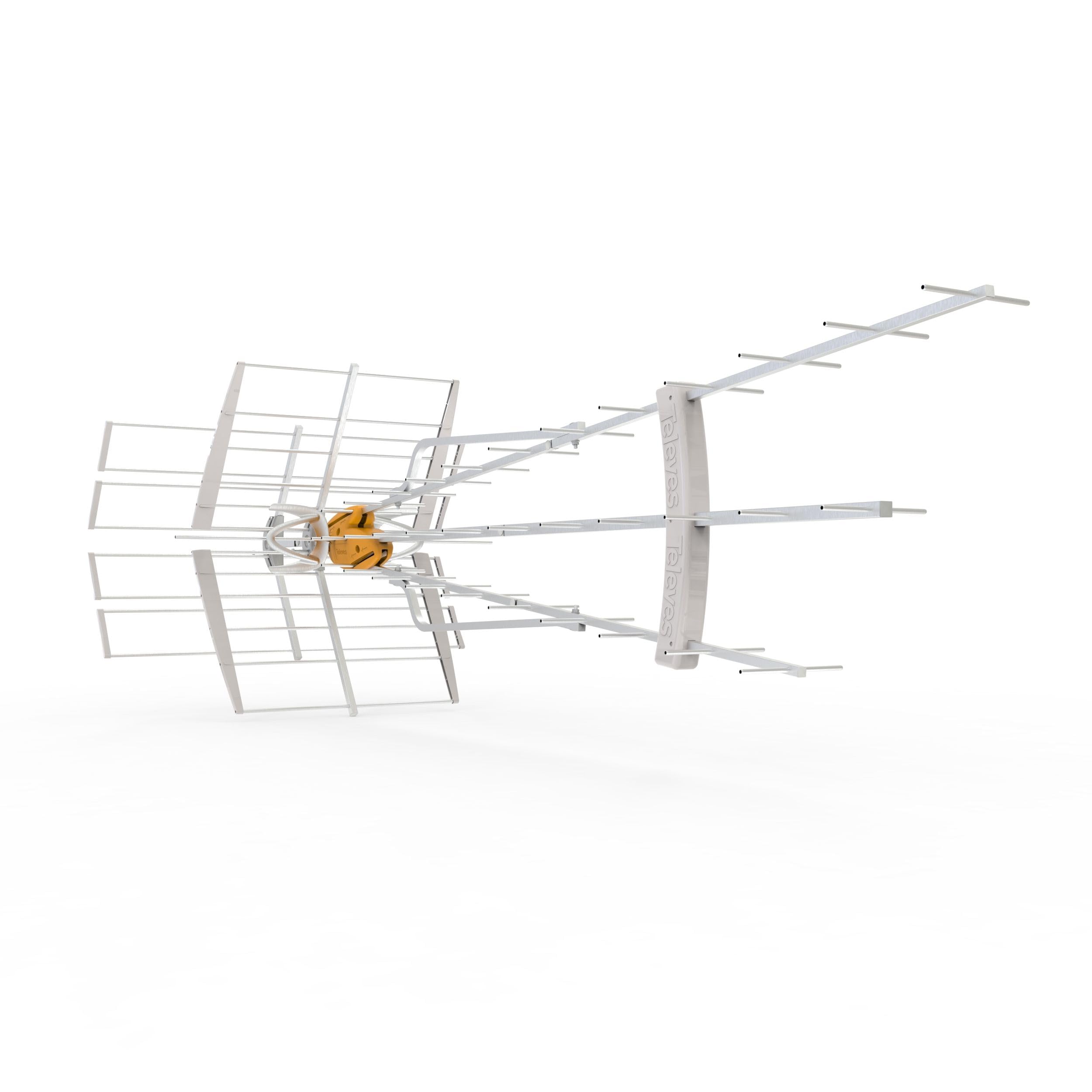
The Televes DAT BOSS Mix LR is the heavy artillery of the HDTV antenna world, engineered specifically for fringe reception where most antennas fail. Its stacked triple-boom design and TForce intelligent preamplifier deliver 46 dBi of UHF gain, automatically adjusting amplification per band to prevent both weak signals and overload. The built-in FM, LTE, 4G, and 5G filtering is a real-world lifesaver in suburban and rural areas where cell tower interference kills reception on weaker stations.
Users in extreme fringe locations—60 to 70 miles from towers, often with heavy tree cover—report picking up 80 to 114 channels with zero pixelation after switching to this unit. The build quality is professional-grade: aluminum elements, stainless steel hardware, and a weather-resistant ABS housing designed for years of outdoor exposure. Assembly requires a bit more effort than a flat panel, but YouTube videos simplify the process.
The primary trade-offs are size and cost. At roughly 84 inches long, this is a large antenna that demands a sturdy mast and clear line-of-sight. The premium price places it well above entry-level units, but for cord-cutters in challenging signal environments where nothing else works, the Televes DAT BOSS is the definitive solution.
Why it’s great
- Industry-leading 46 dBi UHF gain from TForce intelligent amplifier
- Integrated FM/LTE/4G/5G filtering eliminates interference
- Professional-grade metal and ABS construction built to last outdoors
Good to know
- Large footprint (84 inches) requires sturdy mast and space
- Premium price significantly above budget options
2. Antennas Direct DB8e Bowtie
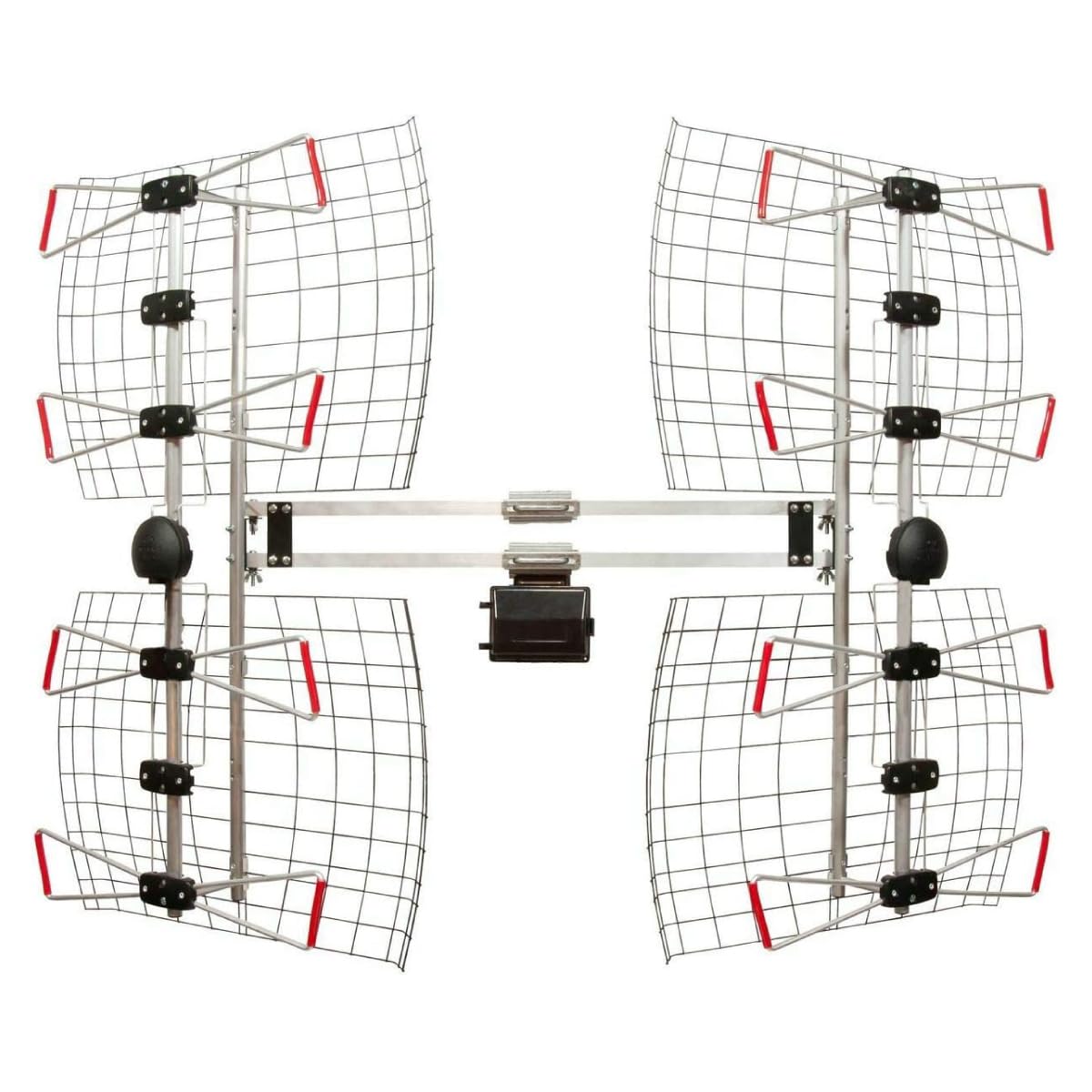
The Antennas Direct DB8e uses eight bowtie UHF elements stacked on a multi-directional frame to combine high gain with the flexibility of aiming at towers in different directions. Its patented bracket system allows each side to pivot independently, making it possible to pull stations from two widely separated tower clusters without a motorized rotator. The large reflector adds forward gain and shields the antenna from rear interference that causes pixelation.
Real-world owners in wooded suburban and rural settings report going from just 3 to 6 usable channels up to 22, with stations reliably received at 40 to 60 miles. The antenna requires precise aiming using a signal meter—small adjustments make a significant difference—and works best when all local towers are in front of it. Adding a quality pre-amp and a powered multi-tap distribution amplifier is a common upgrade path for users who want to serve multiple TVs.
This is a UHF-only antenna, so if your market has important high-VHF channels (like some ABC and CBS affiliates), you will need to add a separate VHF combiner. The build is solid aluminum and stainless steel, though some users note the mounting clamps can struggle with wind; a stronger mast clamp may be needed. It is an excellent choice for UHF-dominant markets where raw element count matters.
Why it’s great
- 8 bowtie elements stack signal for strong UHF gain in fringe areas
- Multi-directional panels can target towers in different locations
- Large reflector reduces rear and side interference effectively
Good to know
- UHF only; requires VHF combiner for high-VHF channels
- Large 50-inch width needs stable mounting; wind can rotate it
3. PBD Amplified Outdoor TV Antenna

The PBD Amplified Outdoor TV Antenna hits the sweet spot of convenience and performance with its 360° motorized rotation controlled by a wireless remote. Instead of climbing onto your roof to manually adjust the antenna when you want a different set of channels, you simply press a button. This is invaluable in markets where broadcast towers are spread across different compass points. Its built-in high-gain amplifier and 40-foot RG6 cable provide a clean signal path up to 150 miles.
User reports consistently highlight how this antenna outperforms older passive antennas in difficult OTA areas. One user replaced a Mohu Sky 60 and immediately picked up more channels without pixelation, even when mounted in a challenging attic location only 7 feet high. The dual TV output is a practical bonus, allowing two televisions to receive the signal without an external splitter that would degrade signal strength. The unit is also NextGen TV (ATSC 3.0) ready, future-proofing your setup as broadcasters upgrade.
Some users note that snapping the lag bolts during install is possible if you do not use the correct drill bit, and the motorized rotator adds a moving part that could wear over time. However, the lifetime warranty and responsive customer service provide peace of mind. For most households that want to cut the cord without spending on the highest-tier fringe gear, this is the best balance of features and reliability.
Why it’s great
- Motorized 360° rotation lets you target towers from any direction remotely
- Dual TV output eliminates need for a signal-sapping splitter
- Built-in amplifier boosts weak signals; ATSC 3.0 ready
Good to know
- Installation requires careful drilling to avoid stripping lag bolts
- Motorized rotator has moving parts that may eventually need service
4. Antennas Direct ClearStream 2V
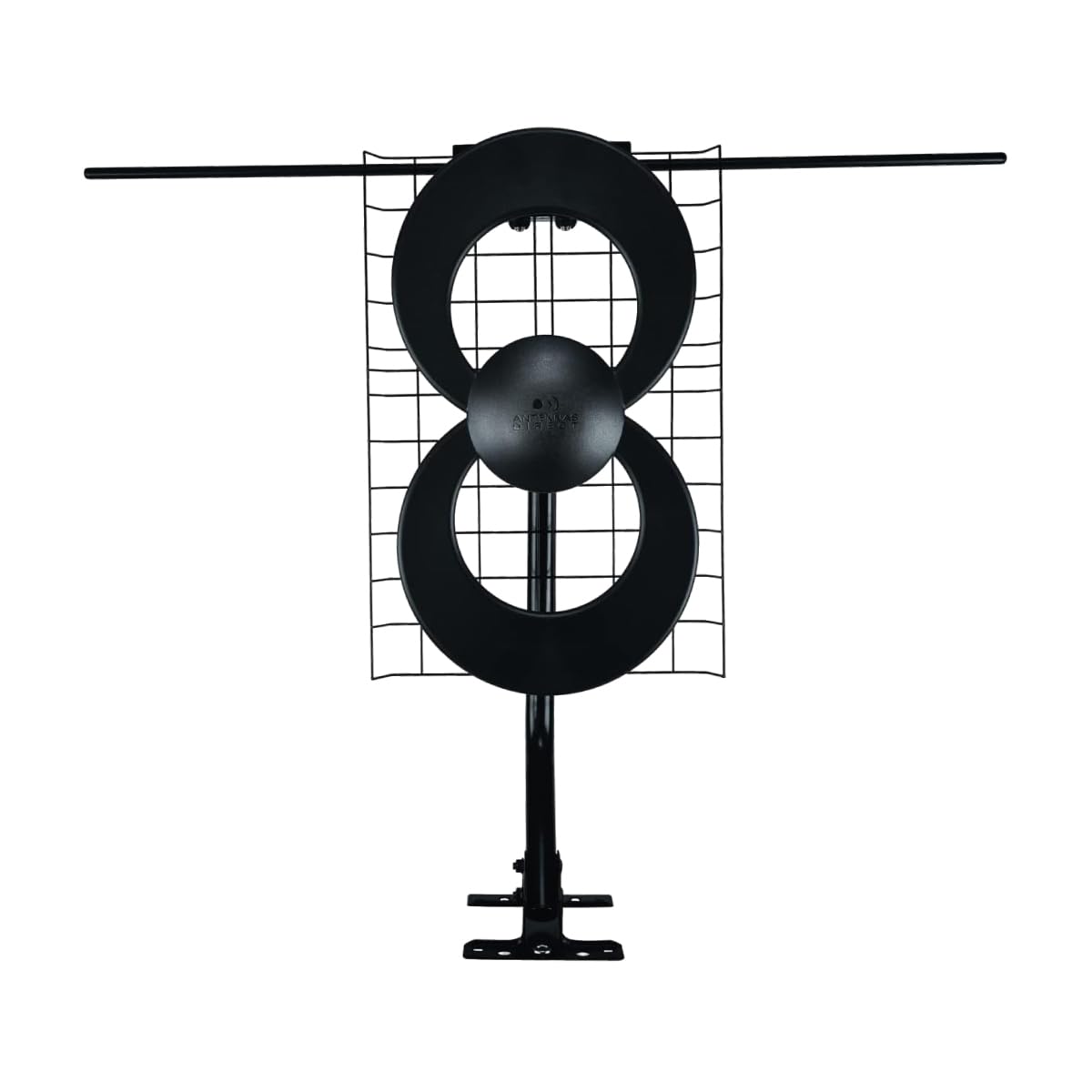
The ClearStream 2V is a versatile hybrid that performs well indoors, in an attic, or mounted outdoors, thanks to its 60+ mile range and multi-directional UHF plus high-VHF elements. Its compact, open-loop design with a signal reflector provides focused forward gain while remaining small enough to hide behind a cabinet or mount on a wall. The included 20-inch mast with a pivoting base gives you flexible aiming options on vertical or horizontal surfaces.
Owners in hilly, tree-filled suburban areas report pulling in 65 crystal-clear channels out of 70 from 38 miles away. The picture quality matches cable, and the assembly is straightforward—no tools required for basic setup. Some users find it works even when placed on the floor behind a TV cabinet, though performance naturally improves with elevation and line-of-sight. The lifetime manufacturer warranty on the antenna itself adds long-term confidence.
The main drawback is that the coaxial cable is not included, so you will need to purchase a high-quality RG6 cable separately. Additionally, the reflector panel adds some wind load when mounted outdoors, so ensure your mast is properly secured. For buyers seeking a single antenna that can be tested indoors and then moved to an attic or roof without buying a second unit, the ClearStream 2V is a smart choice.
Why it’s great
- Multi-directional design with VHF and UHF support in a compact form
- Can be used indoors, attic, or outdoors for flexible placement
- Lifetime warranty on the antenna; easy no-tool assembly
Good to know
- Coaxial cable not included; must be purchased separately
- Reflector adds wind load; extra mast support may be needed outdoors
5. PIBIDI UHD-8903 Outdoor TV Antenna

The PIBIDI UHD-8903 is a value-driven outdoor antenna that uses extended-length receiving elements to capture both VHF and UHF signals from a wide area. Its longer and larger elements are designed to deliver more stable signal pull than shorter budget designs, making it a strong contender for buyers who want outdoor performance without paying for premium features like a rotator or smart amplifier. Pre-assembled components allow a no-tools setup in under 30 minutes.
Real-world performance is impressive for the price tier. Users in Oregon report receiving 64 to 86 channels from stations 15 to 65 miles away, outperforming three prior antennas in the same location. Owners in upstate South Carolina and rural areas similarly describe sharp, clear reception from stations 40 to 100 miles away. The weather-resistant build includes lightning protection, and the grounding design handles tough outdoor conditions.
The main limitation is that this is a fixed directional antenna—it does not include a built-in rotator, so you must manually aim it toward your broadcast towers. The advertised 200-mile range is optimistic for most real-world conditions; realistic expectations are closer to 40–70 miles depending on terrain. It also lacks the interference filtering found on pricier models, so urban users with nearby cell towers may experience occasional dropouts.
Why it’s great
- Extended-length elements improve VHF and UHF signal capture
- Budget-friendly price with solid real-world reception up to 70 miles
- Quick no-tools assembly; weather-resistant with lightning protection
Good to know
- Fixed directional design; no motorized rotator for multi-directional use
- Advertised 200-mile range is unrealistic for most locations
6. Winegard FL5500A FlatWave
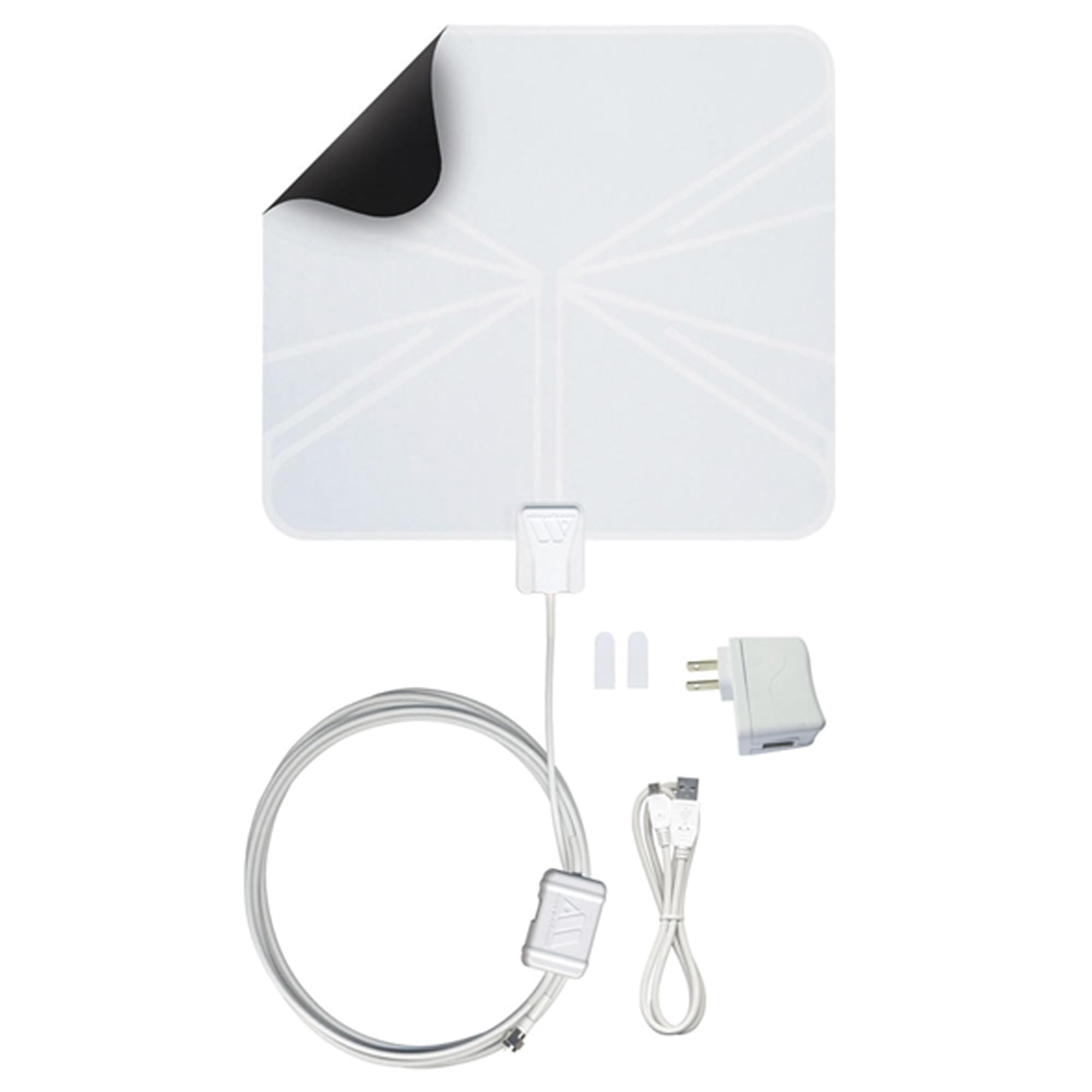
The Winegard FL5500A FlatWave brings a refined indoor aesthetic with its ultra-thin dual-color panel that blends into home interiors. Designed for urban and suburban environments with a 50-mile range, it amplifies both VHF and UHF signals and connects directly to most smart TVs and NextGen TV tuners. The Winegard app helps guide placement by showing where local broadcast towers are located relative to your home.
Performance is respectable when placed correctly—users 30 to 40 miles from Chicago get 40 channels upstairs with a 1080p TV, though a 780p TV in the same home receives fewer. The amplifier improves weak signals but can cause overload if you are very close to broadcast towers. The 15-inch coax cable is permanently attached, which limits the ability to use a 90-degree adapter for tight spaces behind wall-mounted TVs.
Some reviews note that the FlatWave was outperformed by other antennas in the same price band when tested side-by-side, particularly on weaker VHF stations. It is best suited for users within 30 miles of towers who prioritize a clean, low-profile look over maximum channel count. If you need every possible channel in a fringe area, look elsewhere, but for simple urban cord-cutting, this is a fine choice.
Why it’s great
- Ultra-thin dual-color panel blends into any room decor
- Built-in amplifier with Winegard app for optimized placement
- Compatible with NextGen TV and smart TVs; easy plug-and-play setup
Good to know
- Permanently attached coax cable; no 90-degree adapter possible
- May be outperformed by other antennas in the same price tier
7. 1byone Omni-Directional Outdoor Antenna

The 1byone Omni-Directional Antenna offers the ultimate convenience: no aiming required. Its 360° reception pattern pulls in UHF and VHF signals from all directions simultaneously, making it ideal for homes where broadcast towers surround the property. The built-in Smart Pass amplifier technology boosts signal reliability on windy or rainy days, and the 4GLTE filter removes interference from nearby cell towers. The compact white disc design is less obtrusive than traditional yagi-style antennas.
User experiences are mixed but location-dependent. Some owners report excellent results—receiving all desired channels easily when mounted 10 feet off the ground outside. Others find the reception finicky, with one user receiving 124 to 149 channels but mostly non-English programming due to the omni-directional nature picking up weak distant signals alongside strong locals. A more common complaint is water ingress after two years outdoors, as the housing is not fully sealed against rain, which can corrode the preamp and RF connector.
The omission of a second TV output means you will need a separate splitter if you want to feed multiple televisions, which introduces signal loss. For its target use case—casual cord-cutters in urban or suburban areas where towers are spread out and aiming is a hassle—this antenna works well. If you are in a rural or fringe area requiring maximum gain, a directional design will almost always deliver more reliable results.
Why it’s great
- True 360° omni-directional reception eliminates aiming entirely
- Smart Pass amplifier with 4GLTE filter improves signal reliability
- Compact white disc design is less visually intrusive than yagi antennas
Good to know
- Housing is not fully waterproof; water ingress can damage preamp over time
- Omni-directional design inherently has lower gain than directional models
FAQ
Why does my amplified antenna perform worse than a non-amplified one in the city?
Should I mount my antenna indoors, in the attic, or outdoors?
Do I need a preamplifier if I already have a powered antenna?
Final Thoughts: The Verdict
For most users, the clear winner in the antenna for hdtv category is the PBD Amplified Outdoor Antenna because its motorized rotation, dual TV output, and ATSC 3.0 compatibility deliver the best all-around experience without requiring you to buy separate gear for different signal directions. If you live in a fringe or rural area needing maximum range and interference rejection, the Televes DAT BOSS Mix LR is the professional-grade pick that eliminates pixelation from distant and obstructed signals. And for an indoor-only, no-fuss urban setup, the Winegard FL5500A FlatWave keeps things neat while still pulling in the major networks.