
The single biggest lie in over-the-air TV is the mileage claim printed on the box. A sticker boasting “200-mile range” means nothing if the antenna can’t lock onto a Low-VHF channel 35 miles away behind a hill. Real reception depends on raw metal mass, correct element design for the frequency band, and an installation height that clears roof lines and tree canopies. This guide cuts through the marketing and measures each antenna by its actual Yagi geometry, gain per band, and build quality.
I’m Rikta — the co-founder and writer behind FitlyFast. My approach to this guide involved cross-referencing customer signal reports from real installations at varying distances, dissecting each antenna’s element configuration, and verifying usable VHF and UHF gain figures to identify the models that actually deliver stable, pixel-free channels.
Whether you live ten miles from the broadcast towers or sixty miles out in rolling terrain, finding a reliable antenna for uhf and vhf means understanding that a flat amplified panel won’t match the focused capture area of a properly sized Yagi or bow-tie array.
How To Choose The Best Antenna For UHF And VHF
Before you buy, map your local broadcast towers — their direction, distance, and whether they transmit in VHF-Lo (channels 2-6), VHF-Hi (channels 7-13), or UHF (channels 14-36). That triad dictates every design decision. An antenna optimized for UHF alone will miss VHF stations, and a weak-signal area demands longer elements and higher gain than a suburban attic setup.
Element Design and Band Coverage
A true combination UHF/VHF antenna uses physically longer elements for VHF (lower frequencies need longer radiators) and shorter, more numerous elements for UHF. Check the product photos: if the antenna has only stubby rods, it likely skips VHF entirely or handles it poorly. Yagi-style antennas with a mix of long reflector elements and short director elements indicate genuine dual-band engineering.
Gain and Range Realism
Manufacturers list “maximum range” in ideal line-of-sight conditions without trees, hills, or buildings. Subtract 30-50% for real-world performance. A 70-mile-rated antenna in a wooded valley will struggle past 25 miles. Focus on dBi gain figures (UHF: 8-12 dBi is solid; VHF: 5-8 dBi is typical) and use a signal-finder app to confirm actual distance to your nearest towers.
Built-in Amplification and Filtering
Amplifiers boost weak signals but also amplify noise. In areas with strong local signals, an unamplified antenna often outperforms an amplified one. If you need an amplifier, look for models with LTE and 4G filtering — a “filter trap” built into the preamp prevents cell tower interference from knocking out UHF channels. The Televes DiNova Boss Mix excels here with band-specific gain control.
Installation Environment
Outdoor roof mounting delivers maximum range and reliability. Attic installation cuts signal by 30-50% (metal roofs kill it entirely). If you must mount indoors, choose a multidirectional design like the ClearStream MAX-V that doesn’t require precise aiming. Outdoor antennas should include weatherproof UV-stable materials, sealed connections, and included J-mount hardware.
Quick Comparison
On smaller screens, swipe sideways to see the full table.
| Model | Category | Best For | Key Spec | Amazon |
|---|---|---|---|---|
| Televes DiNova Boss Mix | Premium | Weak signal areas needing self-adjusting gain | 34 dBi UHF / 29 dBi VHF with LTE filter | Amazon |
| Antennas Direct Element | Premium | Long-range precise directional aiming | 44.5″ boom length, 60+ mi range | Amazon |
| Five Star Outdoor HDTV Antenna | Value | Budget multi-TV setup with long coax runs | Claims 200 mi, 46″ element span | Amazon |
| ClearStream MAX-V | Mid-Range | Multi-directional suburban attic or wall mount | 60+ mi, dual-loop UHF + VHF rods | Amazon |
| RCA Compact Outdoor Yagi | Mid-Range | All-metal attic install under concrete tile | 75 mi range, pre-assembled UHF reflector | Amazon |
| GE Outdoor Yagi 33685 | Mid-Range | Easy outdoor setup with reliable brand support | 80 mi range, 37″ boom, J-mount included | Amazon |
| CeKay Outdoor Yagi HD | Entry | Budget attic install under 20 miles range | 70 mi claimed, 40ft RG6 coax, 75 Ohm | Amazon |
In‑Depth Reviews
1. Televes DiNova Boss Mix 144286

The Televes DiNova Boss Mix is engineered for unstable signal environments. Its TForce intelligent gain control independently adjusts amplification for UHF (34 dBi) and High VHF (29 dBi), preventing overload from strong signals while boosting weak ones — a trick no passive Yagi can match. The integrated FM and LTE/4G/5G filtering cleans up interference that causes pixelation on UHF channels, a common headache in urban areas with heavy cellular traffic.
Built into a weather-resistant ABS radome with Zamak metal mounts, this antenna requires zero assembly. Users report pulling in 42-120 channels at distances from 30 to 90 miles, including a CBS affiliate at 90 miles — remarkable for a 50-mile rated unit. The 12V dual-output power inserter is included, and the antenna passes signal passively if power is cut, maintaining basic reception during outages.
At roughly 31 inches long and 16 inches wide, the low-profile white housing blends with most exteriors and fits attics where larger Yagis won’t. The premium price reflects the proprietary preamp and build quality — this is not a budget option, but for fringe-area reception or HOA-restricted homes, it’s the most capable single-box solution available.
Why it’s great
- Band-specific automatic gain control prevents overload and weak signal dropouts
- Built-in LTE/4G/5G filter eliminates cellular interference without external trap
- No assembly required, weather-sealed radome, passive failover mode
Good to know
- Mounting fasteners not included due to surface variability
- Higher price point limits appeal for close-range suburban buyers
2. Antennas Direct Element Uni-Directional

The Antennas Direct Element is a serious Yagi for directional fringe-area reception. Its 44.5-inch boom and 35.5-inch wingspan provide the metal mass needed to capture VHF-Lo signals (channels 2-6) that shorter antennas miss entirely. Users in weak-signal areas 70-80 miles out report pixel-free reception with a preamplifier, and the wide beam angle pulls stations up to 55 degrees off-axis, reducing the need for perfect aiming.
Assembly is straightforward snap-together construction — no tools required — and the all-weather mounting hardware includes a mast clamp and J-pole. The unidirectional design concentrates gain in one direction, so if your broadcast towers are scattered in multiple locations, you may need a rotor or a second antenna. Reviews confirm excellent VHF-Lo performance at 50 miles, a feat most combo antennas cannot match.
The Element sits at a mid-to-premium price point, but the build quality justifies it. Customers who replaced amplified flat antennas saw immediate improvement in signal strength on previously unwatchable channels. If you have a clear line of sight to a single tower cluster and need reliable long-range reception, this is the top performer.
Why it’s great
- Exceptional VHF-Lo gain from long boom and large reflector elements
- Wide beam angle captures stations off-axis without a rotor
- Sturdy all-metal build with weatherproof mounting hardware
Good to know
- Large footprint may overwhelm tight attic spaces
- Requires precise directional aiming toward tower cluster
3. Five Star Outdoor HDTV Antenna

Five Star takes an aggressive value approach: a massive 46-inch element span designed to catch signals from every direction, bundled with a J-pole, splitter for four TVs, and 40 feet of coax — all for a price that undercuts most premium models. Real-world reviews show 60-128 channels at 45 miles from Houston, and even 90 channels at 46 miles from 7300 feet elevation, confirming the long element array does extend usable range past budget Yagis.
The 11 dBi VHF gain is respectable, and the multi-directional design means you don’t need perfect aiming for scattered towers. However, the “200-mile” claim is marketing fiction; expect reliable reception within 40-60 miles in clear terrain. Users note the instructions miss critical VHF vibrator alignment details, and the supplied coax is thinner than ideal for long runs. The antenna is large — prepare for a prominent roof presence.
For the price, you get a functional long-range antenna that outperforms similarly priced amplified flat panels. The inclusion of a splitter makes it ideal for households feeding multiple TVs. If you’re on a budget and need extra range for VHF-Hi and UHF, this is a solid workhorse, though the build quality is noticeably less refined than Antennas Direct or Televes options.
Why it’s great
- Low entry cost with full multi-TV installation kit included
- Extended element length improves VHF capture over budget competition
- Multi-directional design simplifies placement in scattered tower markets
Good to know
- Mileage claims grossly overstate realistic performance
- Assembly instructions are incomplete — research alignment online
4. Antennas Direct ClearStream MAX-V
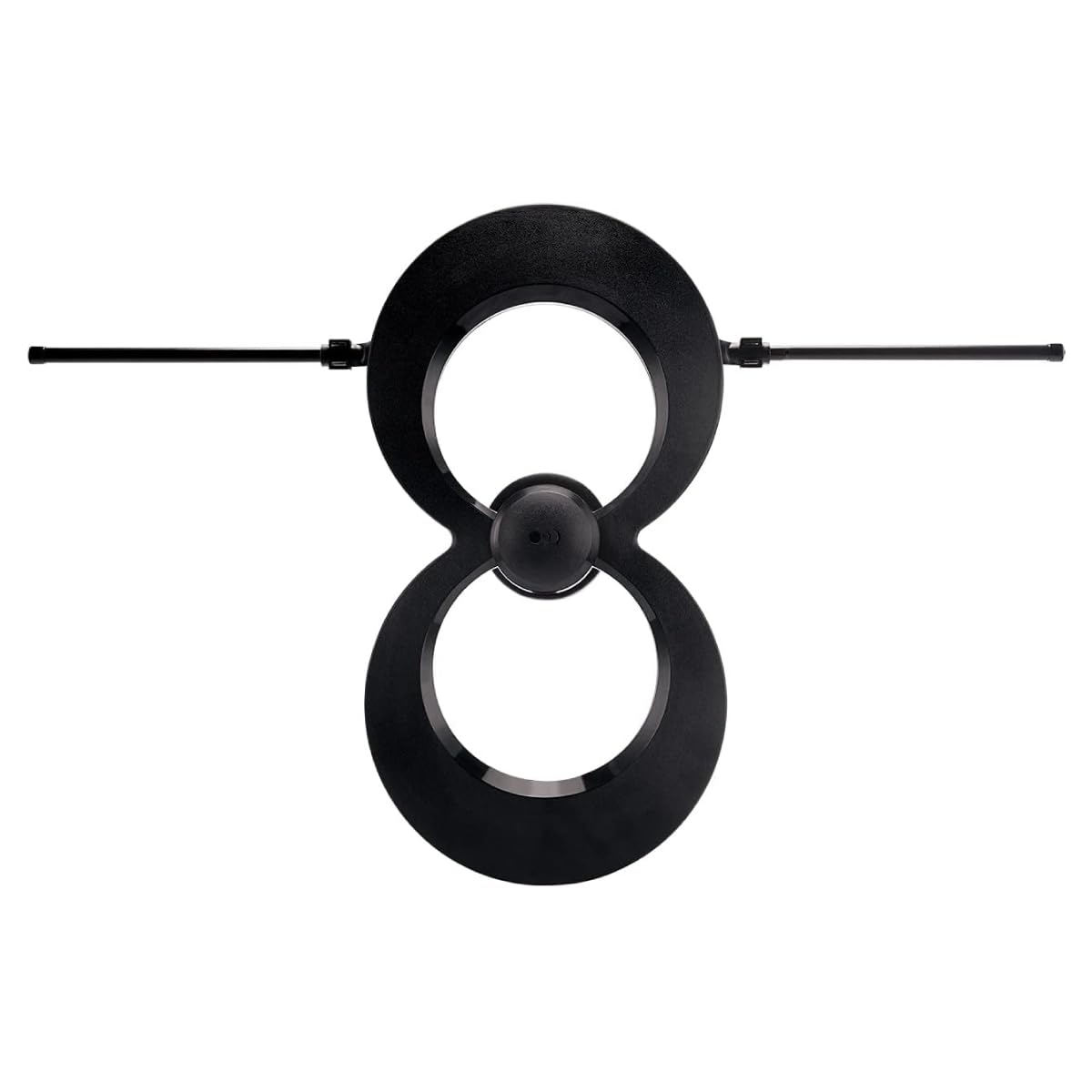
The ClearStream MAX-V uses a double-loop UHF design paired with VHF rods, giving it a 65-degree beam angle that picks up signals from multiple directions without needing constant re-aiming. At 27 inches wide and only 3.5 inches deep, it’s one of the most compact dual-band antennas available, with a unique steel wall bracket for low-profile indoor or outdoor mounting.
Users in suburban areas (20-30 miles from towers) report 20-70 channels with stable reception, even when mounted inside an entertainment center. The manufacturer provides a free Signal Finder app that helps align the antenna for optimal reception. For best results, use RG-6 coax and add an amplifier if your coax run exceeds 30 feet or if signals are weak. The lifetime manufacturer warranty adds peace of mind.
The trade-off for the compact multi-directional design is reduced gain compared to a full Yagi — expect 8-10 dBi on UHF, which is adequate for suburban use but insufficient for fringe areas beyond 40 miles. The MAX-V excels as an unobtrusive attic or wall-mounted option where aesthetics matter and towers are clustered within 25-40 miles. It’s the best choice for cord-cutters who want ease of installation over raw range.
Why it’s great
- Slim profile fits wall or attic with included steel bracket
- Multi-directional beam reduces aiming precision needed
- Lifetime manufacturer warranty from a trusted antenna brand
Good to know
- VHF rods are smaller — may miss weaker VHF-Lo channels
- Best performance requires amplifier for runs over 30 feet
5. RCA Compact Outdoor Yagi

RCA’s Compact Outdoor Yagi brings proven Yagi geometry in a pre-assembled package with a snap-lock UHF reflector and fold-out elements. The design prioritizes UHF and Hi-VHF reception — reviews consistently show strong 80-92% signal levels on major networks (PBS, ABC, NBC, CBS, FOX) from attic installations 25-35 miles out, with no amplifier needed.
The included mast, locking mast clamp, and mounting hardware simplify installation, though coax is sold separately. Users report successful installation under concrete tile roofs (a notorious signal killer) and praise the stable performance with HDHomeRun and PLEX DVR setups. The free RCA Signal Finder app guides alignment, and the ACTIVE filtering aids LTE rejection for clearer UHF reception.
At roughly 75 miles claimed range, expect realistic performance around 30-45 miles in open terrain. The compact size (about 22 inches wide) makes it attic-friendly. One noted limitation: the antenna may skip ABC on VHF-Lo in some markets where that channel broadcasts on a lower frequency. Overall, this is a reliable mid-range Yagi that balances ease of installation with solid reception for most suburban homes.
Why it’s great
- Pre-assembled design with snap-lock elements for rapid setup
- Strong VHF-Hi and UHF performance without external amplifier
- Proven Yagi geometry suitable for attic installations under dense roofing
Good to know
- Coax cable not included in the box
- May miss ABC on VHF-Lo in certain broadcast markets
6. GE Outdoor Yagi 33685

GE’s 33685 is America’s best-selling antenna brand for good reason: the 37-inch Yagi delivers consistent 4K/1080p reception at distances up to 80 miles (realistic: 35-50 miles) with a durable all-metal build that survives harsh weather. The included J-mount, mast clamp, and weather-resistant bracket make roof installation straightforward, and GE backs it with a limited-lifetime replacement pledge plus free US-based technical support.
Users in the Seattle area report solid reception 15 miles from towers at only 10 feet high, while a customer 35 miles away under a concrete tile roof achieved excellent results with a Winegard preamplifier. The antenna supports ATSC 3.0 (NextGen TV), ensuring compatibility with future broadcasts. The 75-ohm impedance matches standard coax, and the 37-inch boom length provides adequate VHF element separation for Hi-VHF channels.
The main downside: assembly instructions are famously poor — rely on online videos for element alignment. The mounting hardware is functional but basic, and the lack of built-in LTE filtering means you may need an external filter in dense urban areas. However, for the price, you get a proven Yagi design from a company that will replace it if it fails, making it the safest mid-range choice for first-time cord-cutters.
Why it’s great
- Limited-lifetime replacement pledge from #1 antenna brand
- ATSC 3.0 ready for next-gen broadcast compatibility
- Reliable VHF-Hi and UHF performance at mid-range distances
Good to know
- Assembly instructions are vague — online guides helpful
- No built-in LTE filtering; an external filter may be needed
7. CeKay Outdoor Yagi HD

CeKay’s Yagi HD delivers surprising value for its entry-level price: a full all-metal Yagi structure that covers 170-860 MHz (UHF and VHF), includes a 40-foot RG6 coax cable and J-mount, and requires minimal assembly with no tools. Users with towers 20 miles away report 100% signal metrics from attic installations, picking up 51-51+ channels even through a concrete tile roof.
The 70-mile claimed range is optimistic — expect reliable performance within 10-25 miles, where it outperforms amplified flat-panel antennas. Reviewers note the thin metal construction feels less robust than premium Yagis, and the arms require significant force to insert into rubber holders. However, for a backyard or attic install in suburban areas with strong signals, it pulls in 4K/1080P reception without the need for an external amplifier.
The included 40-foot RG6 cable is decent quality, though some arrive with kinks. ATSC 3.0 compatibility ensures future readiness. If you’re a cord-cutter on a tight budget with towers within 25 miles, this is the most affordable true Yagi that actually handles both bands. Skip it for fringe areas or harsh outdoor exposure — the build isn’t rated for high winds or extreme weather over multiple seasons.
Why it’s great
- Low entry cost for a true Yagi with both UHF and VHF coverage
- Includes 40ft RG6 coax and J-mount — no extra purchase needed
- Excellent close-range (10-25 mile) reception without an amplifier
Good to know
- Thin metal arms and rubber mounts not suited for long-term outdoor use
- Flimsy construction compared to mid-range and premium Yagis
FAQ
Why does my antenna pick up UHF but not VHF channels?
Is a 200-mile range antenna worth the extra cost?
What does LTE filtering do, and do I need it?
Should I install the antenna in my attic or on the roof?
Final Thoughts: The Verdict
For most users, the antenna for uhf and vhf winner is the Televes DiNova Boss Mix because its intelligent gain control and built-in LTE filtering solve the two biggest real-world headaches — signal fluctuation and cellular interference — without external components. If you want maximum raw range for a specific tower direction, grab the Antennas Direct Element. And for budget suburban installations under 25 miles, nothing beats the value of the CeKay Outdoor Yagi HD.