
Our readers keep the lights on and the weekend projects moving. As an Amazon Associate, I earn from qualifying purchases.
Your dog’s relentless scratching, licking, and chewing on a raw hot spot is not just annoying — it’s a cycle that can turn a minor scrape into a deep infected wound if you use the wrong treatment. Most owners grab their own triple-antibiotic ointment without realizing ingredients like Neomycin or the active carrier base can cause painful burning, allergic reactions, and even toxicity when ingested during grooming. The answer lies in a formulation specifically pH-balanced for canine skin and proven safe if licked, without the steroids that suppress symptoms without addressing the underlying bacterial or fungal cause.
I’m Rikta — the co-founder and writer behind FitlyFast. After analyzing hundreds of customer experiences across seven leading formulations, I’ve isolated the specific active ingredients, delivery methods (spray vs. ointment vs. wipe), and microbial coverage spectra that actually stop infections and speed tissue repair in real-world canine wounds.
Whether your dog suffers from seasonal hot spots, paw pad abrasions from rough terrain, or post-surgical stitch sites needing protection, this guide identifies the single formula that delivers the fastest observable healing against the widest range of pathogens. This is your complete manual to finding the best antibiotic ointment for dogs based on real spec data, not marketing claims.
How To Choose The Best Antibiotic Ointment For Dogs
Selecting a topical antibiotic for your dog requires matching the formulation to the wound type, the dog’s licking behavior, and the specific microbes present. Unlike human skin (pH 5.5), canine skin sits closer to neutral (pH 7.0–7.5), meaning human products can disrupt the natural microbiome and delay healing. Below are the three decisive filters to apply before purchasing.
Active Ingredient Spectrum: Bacteria, Fungus, or Both
The most effective canine antibiotics pair a bactericidal agent (kills bacteria outright, like Chlorhexidine or Hypochlorous acid) with a fungistatic component (Ketoconazole or micronazole) if the wound has a yeasty smell or is moist. Products relying solely on synthetic antibiotics (Neomycin) can cause allergic contact dermatitis in up to 30% of dogs after repeated use. Hypochlorous acid (HOCl) technology — used in premium options like Vetericyn — is non-toxic if licked and kills bacteria, viruses, and fungal spores on contact without creating resistance, making it the gold standard for wounds near the mouth or paw pads that dogs will inevitably groom.
Delivery Method: Ointment Adhesion vs. Spray Reach vs. Wipe Precision
Dense, greasy ointments like those containing petroleum jelly stay on deep fissures and paw pads but trap heat and moisture against weeping hot spots, potentially worsening infection. Sprays (non-aerosol pump) are superior for large body-surface wounds, matted fur areas, and hard-to-reach spots like the back or groin because they require zero contact and reduce pain response. Wipes are ideal for facial acne, ear flaps, and interdigital cysts where precise, no-drip application is needed and the dog is likely to shake off a spray. Your choice should reflect the wound’s location: ointment for stationary wounds on non-weight-bearing skin, spray for mobile or covered areas, wipes for high-precision facial and paw work.
Safety Profile: Lick-Toxicity vs. Steroid Content
Any topical applied to a dog’s skin will be ingested to some degree. Avoid products containing Hydrocortisone (a steroid) unless prescribed for short-term inflammation, as chronic use thins the skin and suppresses local immunity. Similarly, avoid Bacitracin, which is nephrotoxic when ingested in meaningful amounts. The safest actives for canine use are Hypochlorous acid (HOCl), Chlorhexidine gluconate (0.5%–2%), and organic plant compounds (Pau d’Arco, Goldenseal, Oregano oil) that have documented antimicrobial action without systemic toxicity. Always check if the product is labeled “safe if licked” or “non-toxic” — if the label is silent, assume it contains ingredients unsuitable for dogs.
Quick Comparison
On smaller screens, swipe sideways to see the full table.
| Model | Category | Best For | Key Spec | Amazon |
|---|---|---|---|---|
| Vetericyn Plus Wound Care Spray | Spray | Hypochlorous acid, non-toxic if licked | 3 oz bottle | Amazon |
| Sulfodene 3 Way Ointment | Ointment | Hot spots with fungal basis | 4 oz total | Amazon |
| Paw Science Medicated Wipes | Wipe | Chlorhexidine + Ketoconazole for acne and yeast | 100 wipes | Amazon |
| Forticept Hot Spot Spray | Spray | With Aloe, non-sting formula | 8 oz bottle | Amazon |
| Dr. Pol Incredi-Pol Wound Spray | Spray | Safe for mouth, nose, ears, eyes | 3 oz bottle | Amazon |
| ALIVO Natural Antibiotics Liquid | Oral Drops | Internal support, Apple Cider Vinegar | 2.02 oz dropper | Amazon |
| Clear Max Natural Antibiotics | Oral Drops | UTI and kidney support, Cranberry | 2 oz dropper | Amazon |
In‑Depth Reviews
1. Vetericyn Plus Dog Wound Care Spray

Vetericyn Plus leverages hypochlorous acid (HOCl) technology — the same active used in advanced human wound care — to deliver broad-spectrum antimicrobial action that is pH-balanced to match canine skin at 7.0. Unlike traditional antibiotic ointments that coat the wound in a greasy base, this spray flushes debris while creating a moist healing environment that accelerates epithelialization. Multiple verified customers report paw pad injuries healing visibly within three days, with no stinging or irritation even on open tissue.
The non-toxic formulation is explicitly safe if licked, making it the only premium option suitable for wounds on the face, mouth, or paws where grooming is unavoidable. The spray mechanism delivers a directed stream that reaches deep into matted fur and hard-to-see wounds without requiring contact, which is critical for dogs that growl when touched near a painful area. The absence of steroids, antibiotics, and alcohol means it supports the dog’s own immune response rather than suppressing it.
One downside reported by users: the spray nozzle produces a strong, loud stream that can spook nervous animals, and some owners prefer to pour the liquid onto a cotton ball for quieter application. The 3-ounce bottle is small for multi-pet households or large body-surface wounds, requiring more frequent repurchase during extended treatments. However, for speed of healing and absolute safety around sensitive areas, this product defines the gold standard in canine topical antibiotics.
Why it’s great
- Vet-recommended HOCl technology kills bacteria, viruses, and fungus without resistance
- Non-toxic and safe if licked, ideal for facial and paw pad wounds
- Starts healing within 24–72 hours on paw pad injuries and hot spots
Good to know
- Spray nozzle is loud and may frighten sensitive dogs
- 3 oz bottle runs out quickly on large or multiple wounds
2. Sulfodene 3 Way Ointment

Sulfodene is a dense, petroleum-jelly-based ointment specifically formulated to treat hot spots with a suspected fungal component — a common comorbidity in moist dermatitis cases. Unlike simple antibiotic-only creams, this 3-way formula targets bacteria, fungus, and inflammation simultaneously, which explains its strong reputation among owners dealing with recurrent hot spots that smell yeasty or appear as weepy, crusty patches. Users report that application stops licking and scratching within hours, allowing the dog to rest through the night.
The thick base adheres well to deep fissures on paw pads and elbows, but this same occlusive property poses a risk: it traps moisture and heat against the skin, potentially worsening a weeping hot spot if the wound is not first dried and cleaned thoroughly. Several customers note a strong medicinal odor that some dogs find unpleasant, leading to avoidance of belly rubs during treatment. The 4-ounce total (two 2-ounce tubes) offers good value for multi-dog households or recurrent-season allergy dogs.
A key concern: the product does not explicitly state it is safe if licked, and the petroleum base combined with antifungal agents may cause gastrointestinal upset if ingested in quantity. Owners of determined lickers should pair this with a cone or wound dressing. When used correctly on dry or crusting hot spots, Sulfodene reliably stops the itch-scratch cycle faster than any spray, but it is not the right choice for wet, supurating wounds or facial application.
Why it’s great
- Triple action (antibacterial, antifungal, anti-inflammatory) matches real-world hot spot microbiology
- Thick ointment stays on deep paw cracks and elbows without rubbing off
- Stops scratching and licking within hours; many users report immediate dog relief
Good to know
- Strong medicinal smell may deter some dogs from belly rubs
- Not safe for open weeping wounds where occlusion traps moisture
3. Paw Science Antibacterial & Antifungal Medicated Wipes
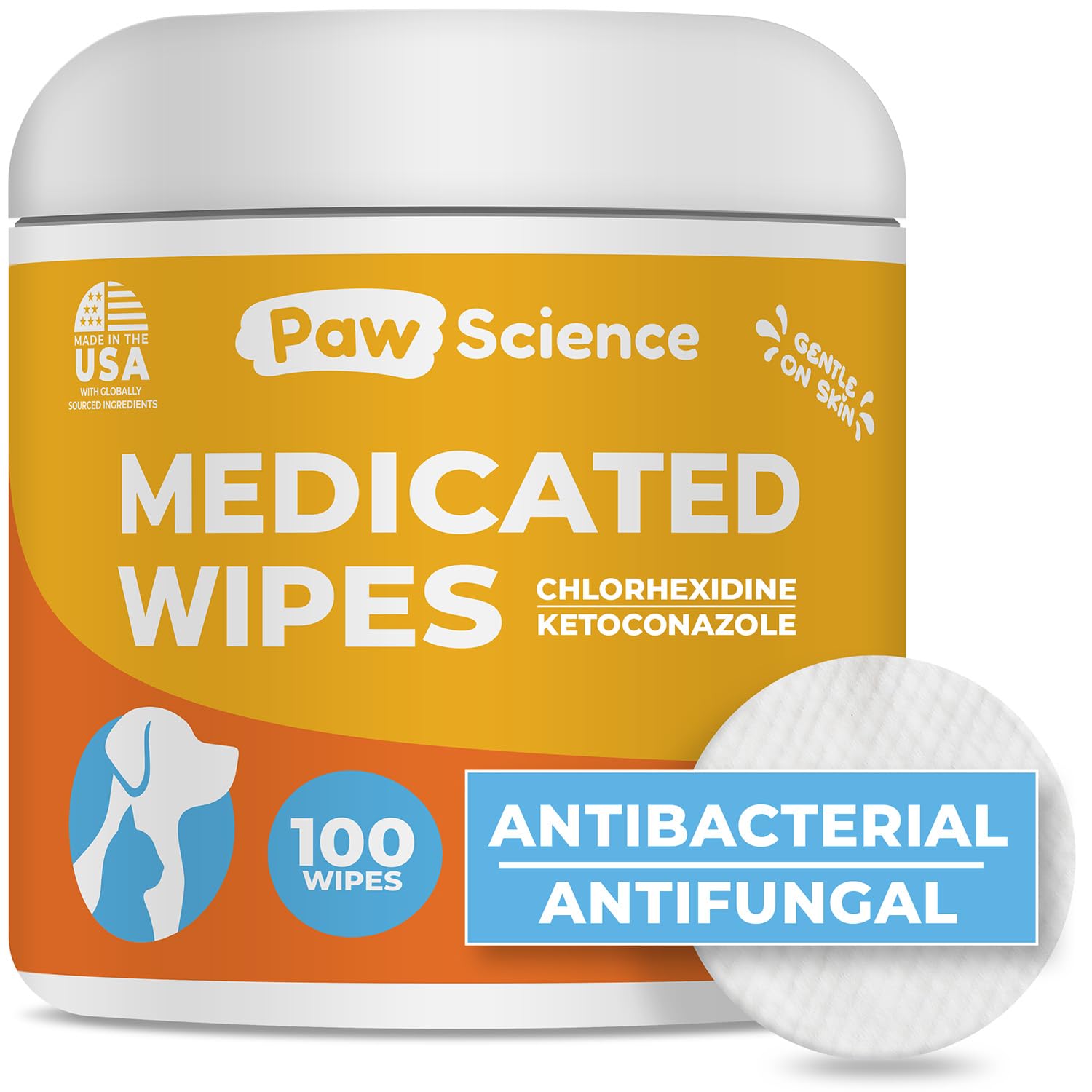
Paw Science delivers a vet-strength combination of Chlorhexidine gluconate (the standard presurgical antiseptic in veterinary clinics) and Ketoconazole (a broad-spectrum antifungal) in a convenient pre-saturated wipe format. This pairing offers unmatched coverage against the most common canine skin pathogens: Staphylococcus pseudintermedius (bacteria) and Malassezia pachydermatis (yeast). Owners report visible reduction in dog acne within two days and near-complete resolution of interdigital cysts and facial fold infections within six days of daily wiping.
The wipe format is ideal for small, precise areas that are difficult to treat with spray (which the dog may shake off) or ointment (which smears and collects dirt). The non-stinging, aloe-enriched formula is safe for use around eyes, nose, and mouth, making it the top choice for brachycephalic breeds like Bulldogs and Pugs with deep facial skin folds. At 100 wipes per canister, it offers strong value for maintenance care during allergy seasons or for dogs with chronic skin conditions requiring daily wiping between baths.
One trade-off: the wipes leave a light pink residue on light-colored fur, which can make it difficult to visually assess whether the infection is clearing or worsening. The cucumber-melon scent, while pleasant to humans, has caused some sensitive dogs to sneeze during facial application. For whole-body wounds or large hot spots covering the back or flank, a spray format remains more practical due to the cost per application of single-use wipes.
Why it’s great
- Chlorhexidine + Ketoconazole provides complete bacterial and fungal coverage in one wipe
- Precise, no-drip application perfect for facial folds, ear flaps, and paw interdigital cysts
- Large 100-count pack lasts through multi-week treatment cycles for chronic conditions
Good to know
- Pink residue on fur makes visual infection monitoring harder
- Scent may cause sneezing in sensitive dogs during facial application
4. Forticept Hot Spot Spray for Dogs

Forticept Hot Spot Spray distinguishes itself with a pH-balanced, non-alcohol, non-iodine formula enriched with Aloe Vera, designed to soothe inflamed skin while keeping the wound clean. Unlike harsher antiseptics that cause a burning sensation on contact, this spray has a verified non-sting profile — multiple owners of XL bully breeds with raw, exudative hot spots report that their dogs tolerate application without flinching, which dramatically improves compliance during the critical first three days of treatment.
The 8-ounce bottle represents the largest volume in this comparison, providing sufficient supply for extended treatment of large-surface hot spots or for multi-pet households with cats and horses. The spray pattern is a fine mist rather than a jet stream, which covers broad areas quickly but requires closer proximity to the wound than a stream-based applicator. Users combining this spray with the Forticept blue gel report significantly faster resolution of hot spots and yeast-related paw infections than with either product alone.
One limitation: the formula is primarily a wound cleanser with mild antimicrobial action rather than a dedicated broad-spectrum antibiotic. For deep puncture wounds or wounds with visible pus, a product containing Chlorhexidine or Hypochlorous acid (like Vetericyn) may be necessary to fully eliminate bacterial load. Forticept works best as a maintenance spray for mild to moderate hot spots and as a pre-cleanser before applying a heavier ointment, rather than as a standalone treatment for infected wounds.
Why it’s great
- Largest bottle (8 oz) provides excellent value for multi-pet households
- Completely non-sting, well-tolerated even on raw, inflamed hot spots
- Aloe-enriched formula soothes itching while cleaning the wound bed
Good to know
- Mild antimicrobial action not sufficient for deep or purulent wounds
- Works best as a pre-cleanser in combination with a stronger topical treatment
5. Dr. Pol Incredi-Pol Wound Spray

Dr. Pol’s Incredi-Pol Wound Spray is a steroid-free, antibiotic-free, non-toxic formula built around hypochlorous technology (similar to Vetericyn) but specifically marketed as safe for use around the mouth, nose, ears, and eyes — making it the most versatile spray for head and facial wounds. Users report noticeable healing of cat-fight puncture wounds and dog tearing injuries within 3–5 days of twice-daily application, with no burning sensation and no odor that would deter the animal from allowing subsequent sprays.
The sprayer produces a fine, even mist that saturates wounds without the forceful jet that spooks animals, a meaningful design advantage over Vetericyn’s stream. The 3-ounce bottle is compact enough for first-aid kits and travel, though large-wound users may need to repurchase mid-treatment. The clear, colorless liquid leaves no residue, making it easy to monitor wound progression without staining interference.
Because the formula contains no active antibiotics or antifungals, its antimicrobial action relies entirely on the oxidative effect of hypochlorous acid, which breaks down quickly in organic debris. For wounds with heavy necrotic tissue or thick biofilm, pre-cleaning with saline or a dedicated wound scrub is necessary for the spray to reach viable tissue. For routine maintenance of clean wounds and prevention of secondary infection, this spray performs identically to the more expensive Vetericyn at a lower entry cost point.
Why it’s great
- Safe for sensitive areas — mouth, nose, ears, and eyes — with zero sting
- Hypochlorous acid technology kills microbes without creating resistance
- Clear, residue-free spray allows easy wound monitoring
Good to know
- Requires pre-cleaning for wounds with heavy debris or thick biofilm
- 3 oz bottle may require a second purchase for large surface-area wounds
6. ALIVO Natural Antibiotics for Dogs

ALIVO takes a fundamentally different approach from topical treatments — this is an oral liquid supplement combining Apple Cider Vinegar, Garlic Powder, Pau d’Arco, and Goldenseal, designed to support the immune system from within against bacterial and fungal overgrowth. Common use cases include chronic kennel cough, seasonal allergies manifesting as skin issues, ear infections, and UTI support. Owners of Bichons and small breeds report their dogs returning to normal activity levels within three doses, suggesting rapid systemic absorption of the herbal compounds.
The bacon flavor is a critical feature for picky dogs — multiple users confirm that even dogs that refuse other liquid supplements will lick this directly from a spoon or bowl. The graduated dropper allows precise dosing by weight (1 mL under 35 lbs, 2 mL for 35–75 lbs, 3 mL over 75 lbs), which is important because Goldenseal can cause gastrointestinal upset if significantly overdosed. The liquid form enters circulation faster than tablet or powder alternatives, making it suitable for acute flare-ups.
A significant quality-control concern emerged from user reviews: the second bottle purchased by some customers differed markedly from the first — a clear, fat-based liquid replaced the brown herbal solution originally received. This batch inconsistency undermines trust, as the active compound concentration may vary between production runs. Additionally, Garlic in high doses can cause oxidative damage to canine red blood cells (Heinz body formation), so owners of breeds predisposed to anemia (Pit Bulls, Akitas) should consult a veterinarian before long-term use. This product functions as an adjunct to proper topical wound care, not a replacement.
Why it’s great
- Bacon flavor ensures high palatability even for picky eaters
- Liquid drops provide rapid systemic absorption for acute infections
- Blend of Pau d’Arco, Goldenseal, and ACV supports broad microbial defense
Good to know
- Batch inconsistency reported — product appearance varies between bottles
- Garlic content requires caution in dogs with anemia predisposition
7. Clear Max Natural Antibiotics for Dogs

Clear Max positions itself as a natural antibiotic supplement with a specific focus on urinary tract and kidney support, using a targeted blend of Cranberry (prevents bacterial adhesion to bladder walls), Olive Leaf (anti-viral and anti-bacterial via oleuropein), Thyme, Oregano (carvacrol and thymol — potent against antibiotic-resistant bacteria), and Echinacea Purpurea (immune modulation). An 18-year-old senior Dachshund with kidney issues showed marked improvement in activity level and urine color after starting this supplement, indicating effective renal and urinary support.
The beef flavor is well-received across breed sizes, and the liquid dropper format integrates easily into food or water without causing rejection — critical for senior dogs with reduced appetite or dental pain that prevents chewing tablets. The organic composition (GMO-free, no artificial additives) appeals to owners who prefer to avoid synthetic antibiotics when managing mild infections or supporting post-surgical recovery. Multiple users report that this supplement helped their dogs recover from chocolate toxicity and post-surgical stitch infections without a vet visit, though these outcomes likely combine the product with the dog’s natural immune response.
One caution: like ALIVO, this is an oral dietary supplement, not a regulated veterinary antibiotic. The FDA does not evaluate these products for efficacy against specific pathogens, and the active compounds (especially Oregano oil and Thyme oil) can cause gastric irritation in sensitive dogs if given on an empty stomach. The product also failed with one picky dog that refused to eat food containing the drops, and the manufacturer’s consistency between batches has not been independently verified. For urinary-specific issues or as a post-antibiotic gut-support supplement, Clear Max provides a targeted herbal approach that may reduce recurrence of mild UTIs, but it should not replace topical wound care for active skin infections.
Why it’s great
- Cranberry and Olive Leaf specifically target urinary tract infections and kidney health
- Beef flavor accepted well by seniors and picky eaters
- Organic, GMO-free composition supports owners seeking natural alternatives
Good to know
- Oregano and Thyme oils may cause gastric irritation on empty stomach
- Not FDA-evaluated; batch consistency and dosing accuracy unknown
FAQ
Can I use human Neosporin on my dog?
How do I apply ointment to a dog that won’t stop licking?
How long does it take for a dog hot spot to heal with ointment?
Are sprays better than ointments for dog wounds?
What ingredients treat both bacterial and fungal dog skin infections?
Final Thoughts: The Verdict
For most users, the antibiotic ointment for dogs winner is the Vetericyn Plus Wound Care Spray because it combines vet-recommended hypochlorous acid technology with a non-toxic, non-sting profile that is safe on all body areas including the mouth and paws, and it starts healing most wounds within three days without requiring a cone. If you want a precision wipe for facial acne and dog chin pyoderma, grab the Paw Science Medicated Wipes. And for fungal-associated hot spots that need a thick, adherent ointment that stops the scratch cycle within hours, nothing beats the Sulfodene 3 Way Ointment.