
Our readers keep the lights on and the weekend projects moving. As an Amazon Associate, I earn from qualifying purchases.
The moment your anvil lopper chokes halfway through a dry branch or leaves a frayed, crushed stub on a living limb, the afternoon’s pruning stops being therapeutic and starts being a tug-of-war with a reluctant tool. Anvil-style loppers—with their one-piece blade meeting a flat metal surface—are built for raw power and dead wood, but the specific gear systems, handle lengths, and steel grades between competing models create wildly different outcomes in your hands. The right carbon-steel bite and compound-action multiplier mean the difference between a clean, plant-healthy cut and a mashed wound that invites disease.
I’m Rikta — the founder and writer behind FitlyFast. I spend my time in the workshop cross-referencing steel grades against real-world customer fatigue points, comparing gear ratios and blade coatings to separate genuine cutting power from marketing torque claims.
Whether you need to limb up a fruit tree or clear thicket overgrowth, the best anvil loppers must balance leverage, blade sharpness, and a replaceable edge so that old wood yields before your hands ever do.
How To Choose The Best Anvil Loppers
Anvil loppers differ fundamentally from bypass models because the blade flattens the branch against a broad metal anvil rather than scissoring past it. That geometry crushes fibrous cells on removal but delivers massive force for thick, non-living wood. Choosing the right anvil lopper means optimizing for leverage systems, steel durability, handle architecture, and replaceable-part availability. Here are the critical decision points.
Gear, Ratchet, and Compound-Action Systems
The mechanical multiplier is the single biggest differentiator among anvil loppers. A basic single-pivot design requires you to generate all the force with your grip. A compound-action (or geared) mechanism stages that force across multiple pivot points, effectively doubling or tripling your input. Ratchet loppers—ideal for heavily arthritic hands—bite into the branch over several squeezes, gaining depth each time. If you regularly cut branches over an inch thick, invest in a compound-action or ratchet lopper to avoid hand fatigue that worsens into bruised palms over a long session.
Blade Steel and Coatings
Look for hardened carbon steel (SK-5 variants are the gold standard in this price tier) because it holds a keen edge through repeated dead-wood abuse. A low-friction coating—teflon or PTFE—reduces sap build-up and rust while letting the blade glide through the cut rather than sticking halfway. Replaceable blades add significant lifespan value; once the edge rolls or chips from hitting soil or hidden wire, you swap the blade instead of tossing the whole lopper. Chrome plating, when added over carbon steel, provides supplementary rust protection for high-humidity environments.
Handle Material and Extensibility
Tubular steel handles offer raw strength but add heft. Aluminum handles reduce carry weight dramatically, a factor when you are moving through a large property. Extendable handles (25 to 37 inches or more) let you double the lopper as a pole pruner for overhead limbs but introduce a bending risk at full extension if the steel is thin-gauge. Look for positive locking clamps rather than twist collars for security at long reach. Soft TPR or foam grips with a shock absorber dampen the impact when the cut finishes, sparing your wrists from cumulative jarring.
Cutting Capacity and Real-World Branch Limits
Manufacturers advertise a 2-inch capacity, but that spec typically assumes green, unsupported wood under ideal angle cuts. Dry or knotty wood halves that effective capacity. Choose a lopper rated for 1.5 to 2 inches, then mentally dial that down by 25 percent for old, dead growth. An anvil lopper with a larger jaw (like the Jardinier’s giant beak) handles physical branch volume better, but a longer jaw can become misaligned if the branch is off-center. Reliable cutting at the rated spec depends more on the gear system than on blade width alone.
Quick Comparison
On smaller screens, swipe sideways to see the full table.
| Model | Category | Best For | Key Spec | Amazon |
|---|---|---|---|---|
| Kimura Pro Telescopic Loppers | Premium | High-reach, heavy-duty pruning with minimal effort | Japanese SK5 steel, 25-37″ telescoping | Amazon |
| Spear & Jackson Razorsharp Anvil Lopper | Premium | Traditional design with a shock absorber | Hardened carbon steel, PTFE coated | Amazon |
| Original LÖWE Professional Anvil Pruner | Premium | Handheld precision cuts on dense, dry wood | German carbon steel, 22 mm cut | Amazon |
| WORKPRO Extendable Anvil Lopper | Mid-Range | Variable-reach cutting on medium branches | SK-5 steel, 25-37″ extendable | Amazon |
| JARDINEER Giant Jaw Anvil Lopper | Mid-Range | Max brute-force cutting with ratchet assist | Carbon steel, 2″ capacity, SK5 blade | Amazon |
| YRTSH Compound Action Tree Trimmer | Mid-Range | Overhead pruning with lightweight aluminum handles | Alloy steel, 28-41″ extension | Amazon |
| WORKPRO 28″ Gear Anvil Lopper | Budget | Entry-level, fixed-handle anvil cutting | SK-5 steel, 1.6″ capacity | Amazon |
In‑Depth Reviews
1. Kimura Pro Heavy Duty Garden Loppers (25-37″)

The Kimura Pro sets itself apart with a compound-action mechanism that multiplies cutting force up to three times, making it the most effortless anvil lopper in this review when dealing with branches near the 1.75-inch mark. The blade is Japanese SK5 carbon steel—a notoriously hard alloy that holds a fine edge longer than standard carbon steel—and the PTFE coating prevents sap build-up and corrosion during wet-season pruning. The weight distribution is clever: the 1.26-kilogram mass is balanced between the head and the telescoping aluminum handles, so the tool feels lighter in hand than the number suggests.
The telescoping adjustment is handled by twist-action locking collars that lock positively across the full 25-to-37-inch range. Early reports in the field note the collar can feel stiff out of the box, but it loosens with use. The anvil itself is broad enough to support the branch without crushing it sideways, which matters when you are making a clean flush cut on a living limb. Several users with arthritis-reportedly using Kimura products across multiple tool categories—comment that the compound action is truly effortless even for weakened grip strength.
The lifetime warranty backs up the construction, which includes riveted handles rather than pinned joints that can loosen. The TPR grips are molded directly onto the aluminum hafts, so they won’t slide or rotate. This is the one anvil lopper in the lineup that balances overhead reach, blade quality, and mechanical advantage without tipping into excessive weight. The only compromise is a 35-millimeter (roughly 1.4-inch) advertised cutting width, which is slightly conservative compared to some competitors.
Why it’s great
- Triple-force compound action cuts thick wood with minimal hand effort.
- Japanese SK5 steel blade stays sharper far longer than standard carbon.
- Lightweight aluminum handles with secure twist locks.
- Lifetime warranty and riveted construction prevent joint failure.
Good to know
- Twist collar can be stiff for the first few extensions.
- 35mm cutting spec is slightly smaller than some 2-inch-rated rivals.
2. Spear & Jackson 4826RSA Razorsharp Active Anvil Lopper
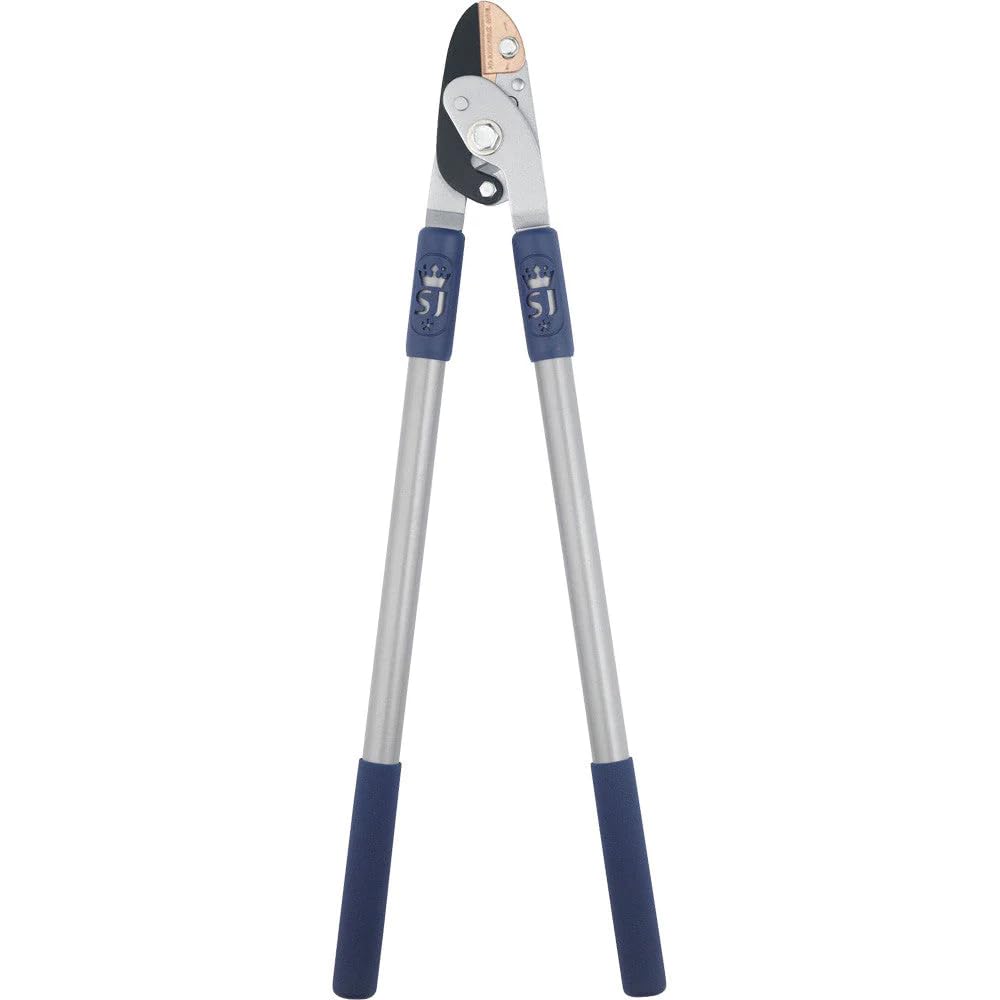
Spear & Jackson has a long history with traditional anvil lopper design, and this Razorsharp model delivers a compound-action cut without the complexity of a multi-step gear system. The hardened carbon steel blade is chrome-plated for rust resistance and overlaid with PTFE so that resinous pine and sap-heavy oak branches pass through without gumming up the cut path. The shock absorber built into the head dampens the branch-snap impact, which reduces the jarring sensation that can travel up to the elbow after dozens of cuts.
The tubular steel handles are vinyl-coated and resist surface rust well, though they are fixed at a 26-inch length—no extension is available. This makes the Razorsharp a dedicated ground-level lopper; it is not suitable for overhead work. The compound action means the pivot point moves during the cut, providing additional leverage as the blade engages thicker wood, though the maximum effective cutting width is around 1.25 inches for dead wood. Users describe the blade as extremely sharp out of the box, with some noting mild difficulty on branches at or beyond the rated 32-millimeter capacity.
One advantage is the blade’s resharpenability: hardened carbon steel takes a file or stone well, so the tool can be refreshed indefinitely. The soft-feel grips are cushioned but not slip-resistant in wet conditions. This lopper is best for someone who wants a simple, high-quality anvil cutter without ratchets or telescoping parts—a reliable shop partner for cleanup around the base of shrubs and trees.
Why it’s great
- Chrome-plated PTFE blade resists rust and sap adhesion.
- Built-in shock absorber reduces arm fatigue on repetitive cuts.
- Blade is easily resharpened with a standard file.
Good to know
- Fixed 26-inch handles limit use to ground-level pruning.
- Struggles with branches over 1.25 inches, especially dry wood.
3. Original LÖWE Professional Anvil Pruner

The LÖWE is a compact anvil pruner, not a long-handled lopper. It earns a place on this list because its cutting geometry and blade steel are identical to the anvil principle used in full-size loppers, but in a hand-held form factor for dense, precise cuts. The carbon steel blade is coated with a sliding lacquer that provides corrosion protection and reduces friction, and the cutting power is optimized through a lever-action system that feels solid and precise rather than clunky. The serrated blade edge grips the branch during the cut to prevent slipping.
With a rated cutting width of just 22 millimeters (under 1 inch), the LÖWE is not a thick-branch solution. It works best on dry, stubborn twigs and old wood where a bypass pruner would crushes the fibers. The German construction is immediately apparent in the fit of the blade to the anvil—there is zero play when the tool is closed, and the single-hand safety lock is a simple thumb slide. The handles are plastic but reinforced with a steel core, keeping weight to only 290 grams, which eliminates hand fatigue during extended use.
All components are replaceable, including the blade and pivot pin, making this a near-permanent tool if maintained. Several long-term users report using theirs for a decade without needing parts. The primary limitation is the 3-centimeter blade length; it cannot tackle branches thicker than your thumb. For clearing heavy dead wood in tight spaces—like rose canes or thick vine stems—this German anvil pruner is sharper and more durable than any Japanese or Chinese alternative at a similar price.
Why it’s great
- German-machined carbon steel blade with durable lacquer coating.
- Fully user-serviceable with replaceable parts.
- Extremely lightweight and comfortable for one-handed pruning.
Good to know
- 22mm cutting capacity is too small for branches over 0.75 inches.
- Handle material is plastic rather than aluminum or steel.
4. WORKPRO Extendable Anvil Lopper (25-37″)
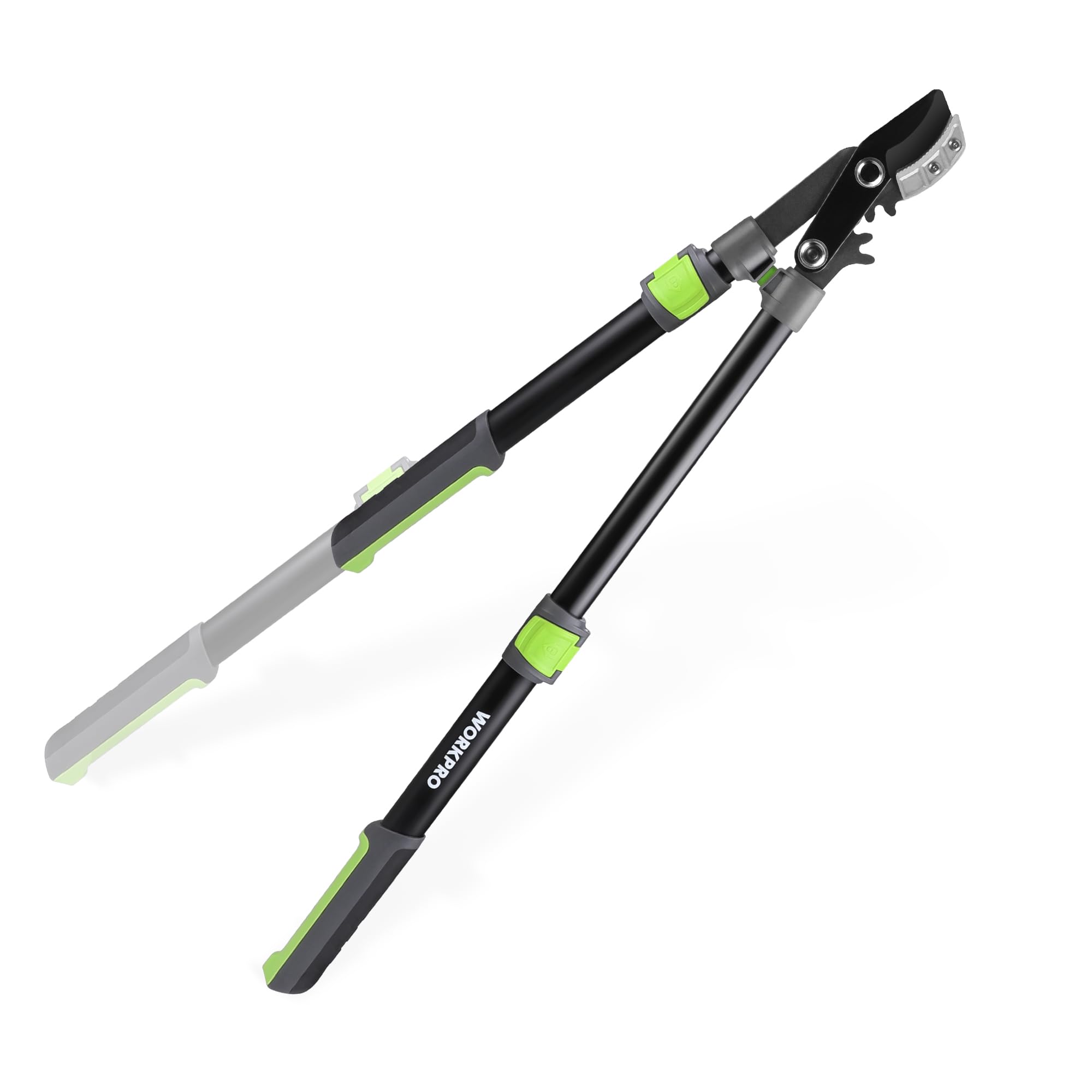
The WORKPRO Extendable model solves a common pain point in the anvil category: matching handle length to branch height without buying separate tools. The handles telescope from 25 to 37 inches using a clamp-lock mechanism that feels more secure than twist collars, and the advanced gear system delivers a mechanical advantage that turns a moderate squeeze into a clean cut through 1.6-inch green wood. The SK-5 steel blade is replaceable—a feature usually found only on premium units—so when the edge wears down from dirt contact, a new blade restores full performance.
The serrated blade edge holds branches in place during the cut, preventing the pop-out that can happen with smooth-edge anvil blades on rounded wood. The sawtooth design also helps peel through bark, though it creates a slightly rougher cut face than a straight edge. The low-friction coating reduces gumming, and the PP+TPR handle material provides a soft, non-slip grip even when wet. Users report that the extendable feature works smoothly and locks securely, allowing overhead cuts on branches that would normally require a ladder.
At a modest price within the mid-range tier, this lopper beats budget options on the replaceable blade and gear system. The main drawback is the polypropylene handle tube rather than aluminum or steel—it keeps weight down but flexes noticeably when fully extended and under heavy load on thick dead wood. The flex does not cause breakage in normal use, but it does rob some cutting force. For regular overhead pruning of live branches under 1.5 inches, this is a strong value choice.
Why it’s great
- Extendable handles allow pruning high branches without a ladder.
- Replaceable SK-5 steel blade extends tool life significantly.
- Serrated edge holds slippery bark during the cut.
Good to know
- Polypropylene handle flexes at full extension on thick wood.
- Cutting capacity (1.6 inches) is below the 2-inch rating of some rivals.
5. JARDINEER Loppers for Tree Trimming Heavy Duty (30″)

JARDINEER’s anvil lopper is built around a giant ratchet jaw—a multi-step mechanism that allows you to cut through a 2-inch branch by squeezing the handles multiple times, with the blade teeth advancing deeper into the wood on each squeeze. This design is ideal for anyone with reduced hand strength, including those managing arthritis or recovering from hand injuries. The ratchet clicks audibly with each cycle, giving the user positive feedback that the blade is still making progress even when the wood is stubborn.
The blade is SK-5 carbon steel with a non-stick coating, and the lopper comes with a spare SK-5 blade in the box. The steel handles are solid but heavy—weighing around 5 pounds—making this one of the heavier models in the review. The weight is well-distributed and contributes to cutting inertia, but overhead use would fatigue the arms quickly. The jaw size is genuinely large, accommodating branches that would physically not fit into a standard anvil lopper’s mouth.
Field feedback from users in heavy brush conditions (Florida Keys, large wooded lots) indicates that this lopper performs for years with simple blade sharpening and maintenance. The ratchet mechanism is subject to bolt loosening if not periodically tightened; a few owners reported returning the first unit due to a bolt that backed out during use. The included smaller pruner is a basic tool, but the primary lopper delivers on its promise: clean, progressive cuts through the thickest wood a household property can generate.
Why it’s great
- Giant ratchet jaw handles branches up to 2 inches with progressive cuts.
- Includes spare SK-5 blade for extended service life.
- Excellent for users with low grip strength or arthritis.
Good to know
- Heavy (5 lbs) design causes arm fatigue during prolonged overhead use.
- Ratchet pivot bolts may loosen; periodic tightening is required.
6. YRTSH Loppers Branch Cutter (28-41″)
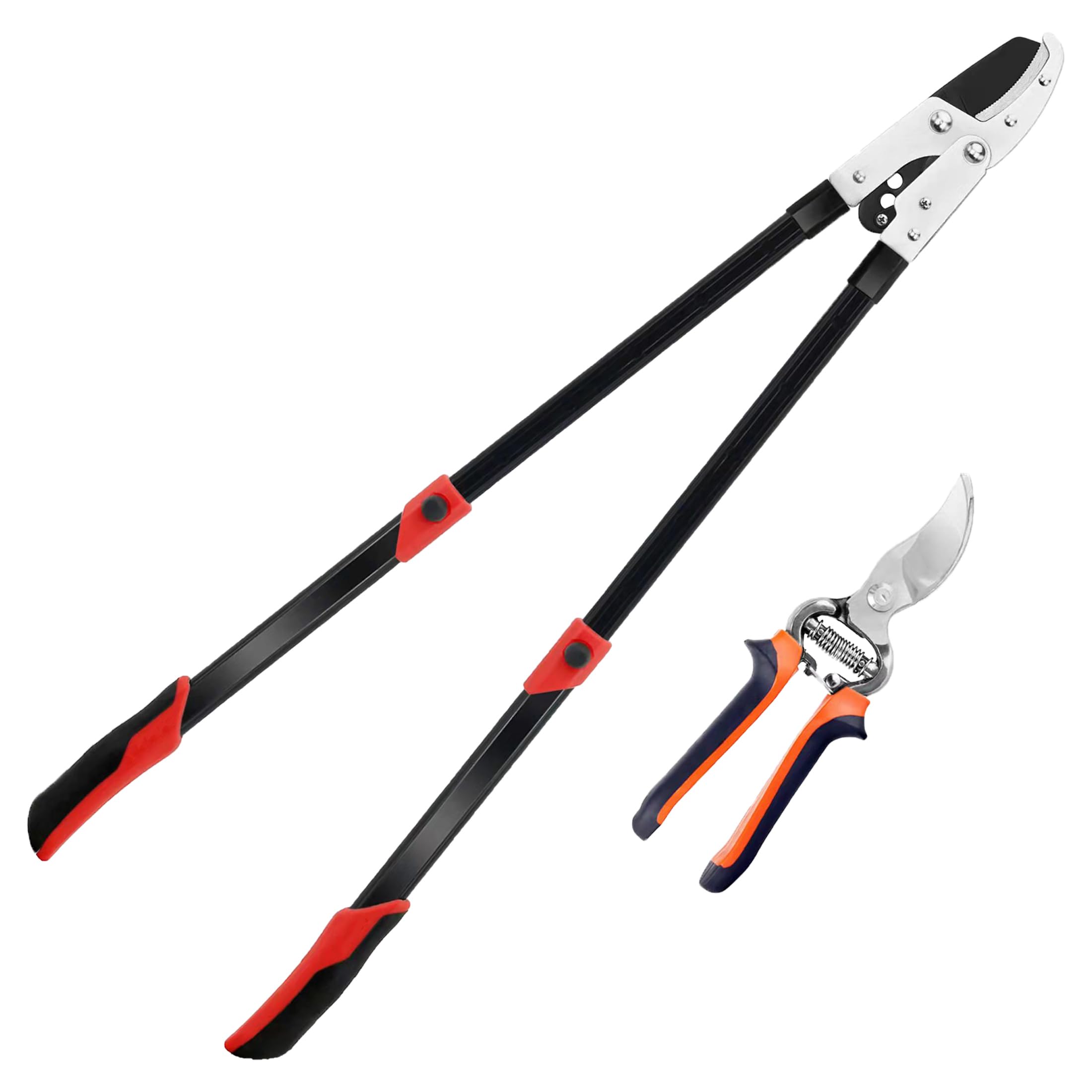
The YRTSH focuses on reach and leverage. Its handles extend from 28 to 41 inches across six click-stop positions, making it the longest-reach anvil lopper in this lineup. The alloy steel blade has a Teflon low-friction coating to resist rust and gumming, and compound-action technology provides a mechanical advantage on every cut. The anvil-style head can handle up to a 2-inch advertised capacity, though real-world performance on dry wood sits closer to 1.25 inches before handle flex becomes noticeable.
The aluminum handle material keeps the overall weight manageable—important when working overhead. The soft rubber non-slip grip is contoured and wide, providing stable purchase even when wet. Users in tropical environments (Hawaii, Florida) report the lopper cuts through hibiscus, banana leaves, and live oak branches with little effort. The extension lock is a push-button system that engages positively, though the mechanism can be stiff to release until broken in.
Bundled with a pair of standard hand pruners, the YRTSH set offers good value. The hand pruners have a latch that re-engages after each cut, which some users find annoying, but the primary lopper is the focus. The main structural caveat is that the aluminum handles, while lightweight, can flex when fully extended on dense knotty branches. This flex reduces the effective cutting force. If your primary need is reaching high limbs with moderate thickness, the YRTSH delivers impressive range without breaking your budget.
Why it’s great
- Longest extension range (28 to 41 inches) for high overhead pruning.
- Teflon-coated alloy steel blade resists gumming and rust.
- Lightweight aluminum handles reduce fatigue during overhead work.
Good to know
- Aluminum handle flexes at full extension on thick, dry wood.
- Included hand pruners have an annoying auto-locking latch.
7. WORKPRO 28″ Anvil Lopper

The WORKPRO 28-inch fixed-handle lopper is the entry-level gate into anvil-style cutting with a gear-assist system. The advanced gear mechanism and sawtooth blade design provide enough mechanical advantage to cut through 1.6-inch branches without requiring a heavy grip. The blade is replaceable SK-5 carbon steel with a low-friction coating, which is a surprising inclusion at the budget tier. The soft-grip PP+TPR handles are comfortable for extended sessions and easy to clean.
The fixed 28-inch length limits this tool to ground-level and waist-high trimming. It cannot reach overhead limbs without a ladder. The sawtooth edge is effective at holding the branch centered on the anvil, but it leaves a slightly abraded cut surface compared to a straight edge. The build quality is solid for the price point, with no reports of hinge loosening or handle breakage after moderate use. One user noted that the lopper comes out of the box sharp enough to tackle 1-inch branches on the first squeeze.
For light property maintenance—clearing saplings, shrub thinning, and deadwood removal—the WORKPRO offers the same gear system and replaceable blade technology as the mid-range models at a lower entry cost. The compromise is the fixed handle length and the polypropylene construction, which lacks the rigidity of steel. This is a sensible first anvil lopper for the homeowner who prunes only a few times per season and wants reliable performance at a frugal price. It will struggle where a longer reach or higher leverage is required.
Why it’s great
- Gear-assist system provides good cutting power at a budget price.
- Replaceable SK-5 steel blade extends usable lifespan.
- Sawtooth edge holds branches steady without slipping.
Good to know
- Fixed 28-inch handle cannot reach overhead branches.
- Polypropylene handle material lacks rigidity for heavy dead wood.
FAQ
Can anvil loppers cut green living wood without damaging the plant?
What does cutting capacity actually mean in anvil loppers?
How often should I sharpen an anvil lopper blade?
Final Thoughts: The Verdict
For most users, the best anvil loppers winner is the Kimura Pro Telescopic Loppers because its Japanese SK-5 steel, triple-force compound action, and lightweight aluminum extendable handles deliver maximum cutting power with the least fatigue across the widest variety of branch sizes and heights. If you want a straightforward ground-level cutter with a shock absorber and a decades-long track record, grab the Spear & Jackson Razorsharp. And for those with arthritic hands or who routinely face 2-inch dead limbs, nothing beats the progressive-cutting JARDINEER Giant Ratchet Lopper.