
Our readers keep the lights on and the weekend projects moving. As an Amazon Associate, I earn from qualifying purchases.
Stepping up from a kit zoom to a dedicated prime or premium zoom is the single most impactful move you can make for APS-C image quality. The right lens determines not just sharpness and bokeh, but whether you can actually capture that low-light scene or distant subject without noise or motion blur.
I’m Rikta — the co-founder and writer behind FitlyFast. My process involves cross-referencing MTF charts, decoding STM/RXD motor specs, and comparing real-world corner-to-corner sharpness data across brands to isolate which aps-c lenses deliver on their marketing promises.
This guide separates wide-angle primes for vlogging from telephoto zooms for wildlife, and high-aperture standard primes from versatile all-in-one travel zooms.
How To Choose The Best APS-C Lenses
The APS-C sensor captures a smaller image circle than full-frame, so lenses designed specifically for the format are typically lighter, more compact, and more affordable. The key is balancing focal length coverage with the aperture you need for your shooting style.
Focal Length and Equivalent Reach
On an APS-C camera, the sensor’s crop factor (1.5x for Sony/Nikon/Fuji, 1.6x for Canon) means a 35mm lens delivers the field of view of a ~50mm lens. A 15mm ultra-wide becomes a ~22.5mm equivalent, useful for vlogging and tight interiors. A 70-350mm telephoto becomes a 105-525mm super-telephoto, perfect for wildlife. Think in terms of the scene you want to capture, not the millimeter number on the barrel.
Aperture and Low-Light Performance
A lens with a maximum aperture of F1.4 or F1.7 lets in roughly four times more light than a typical F3.5-5.6 kit zoom. This allows faster shutter speeds in dim conditions and produces shallower depth of field for subject separation. For APS-C, an F1.8 prime or F2.8 zoom is the standard for serious low-light work; F1.2 and F1.4 lenses offer a visible step up in background blur and light gathering.
Autofocus Motor and Stabilization
STM (Stepping Motor) and RXD (Rapid eXtra-silent stepping Drive) motors provide near-silent, smooth autofocus that won’t be picked up by a camera’s internal microphone during video. Linear motors (XD, VXD) are even faster for tracking moving subjects. Image stabilization inside the lens (OSS, VR, IS) works in tandem with in-body stabilization (IBIS) on many modern cameras, giving you up to 5-6 stops of hand-held stability for sharp shots at slower shutter speeds.
Quick Comparison
On smaller screens, swipe sideways to see the full table.
| Model | Category | Best For | Key Spec | Amazon |
|---|---|---|---|---|
| VILTROX 27mm F1.2 Pro | Premium Prime | Portraits & low-light | F1.2 Max Aperture | Amazon |
| Sony 70-350mm F4.5-6.3 G OSS | Super-Tele Zoom | Wildlife & sports | 525mm Equivalent Reach | Amazon |
| Tamron 17-28mm F2.8 | Wide-Angle Zoom | Landscapes & real estate | 25.5-42mm Equivalent | Amazon |
| Tamron 28-200mm F2.8-5.6 | All-in-One Zoom | Travel & adventure | 7.1x Zoom Range | Amazon |
| Sony 18-135mm F3.5-5.6 OSS | Standard Zoom | Daily walkaround | 7.5x Zoom Range | Amazon |
| Nikon Z DX 18-140mm VR | Travel Zoom | Nikon Z-series users | 7.8x Zoom Range | Amazon |
| Canon RF-S10-18mm IS STM | Ultra-Wide Zoom | Vlogging & selfies | 4.0 Stop Stabilization | Amazon |
| VILTROX 15mm F1.7 (Sony E) | Wide Prime | Vlog & architecture | F1.7 Max Aperture | Amazon |
| Canon EOS R100 Kit (18-45mm) | Beginner Kit | Entry-level learning | 24.1MP APS-C Sensor | Amazon |
In‑Depth Reviews
1. VILTROX AF 27mm F1.2 Pro (Fuji X-Mount)
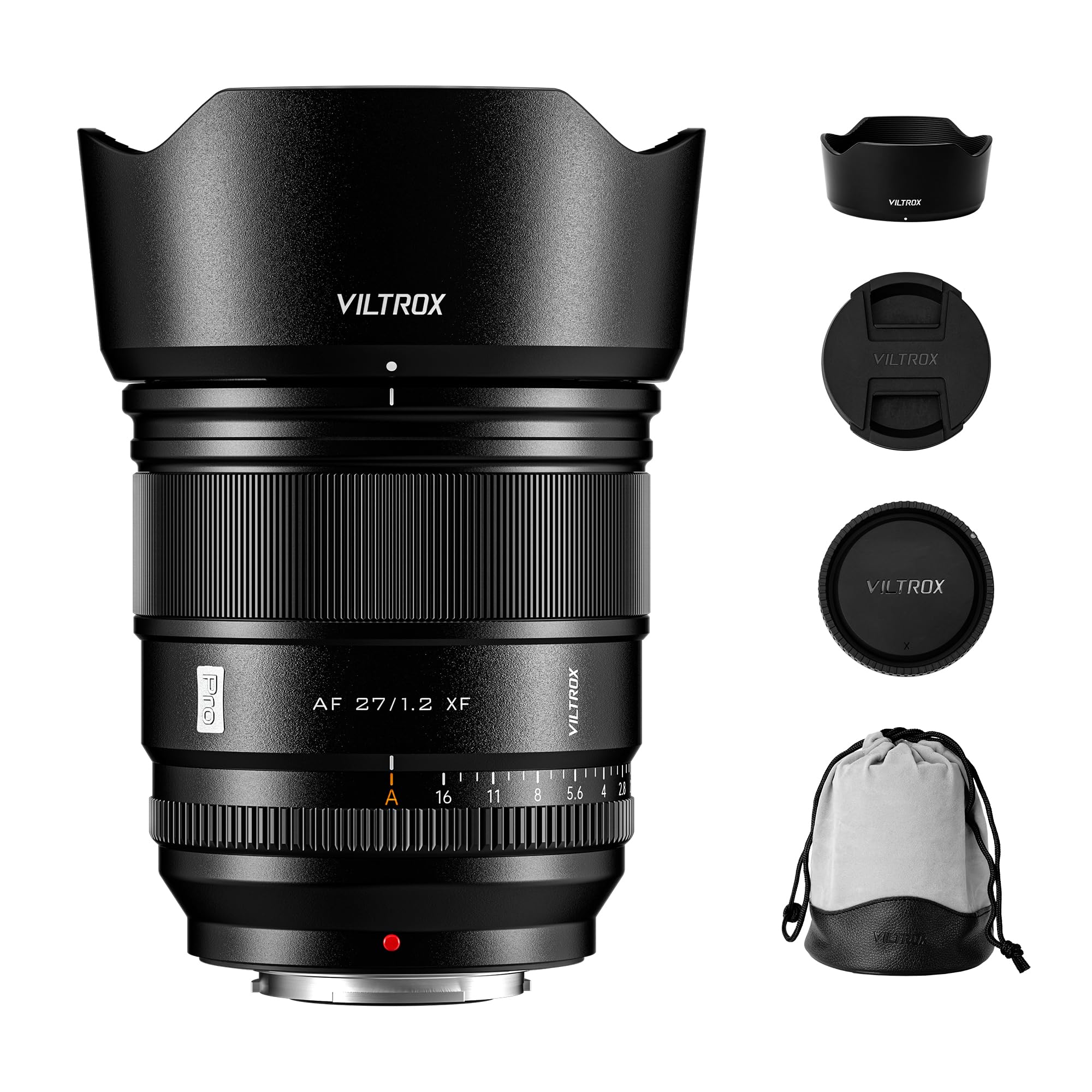
This 27mm prime (40.5mm full-frame equivalent) is built around an F1.2 maximum aperture that delivers shallow depth-of-field and dreamy bokeh on Fuji X-series bodies. The optical stack uses 15 elements in 11 groups, including 2 ED elements and aspherical glass, controlling chromatic aberration and ghosting even when shooting into light. The STM motor provides quiet, snappy autofocus with eye/face tracking support, and the 0.28m minimum focus distance lets you get close for detail shots.
Build quality stands out with a full metal barrel, a clicked aperture ring, a USB-C port for firmware updates, and a dust-protected structure. Weighing 560g, it balances well on larger bodies like the X-H2 and X-T5 but feels substantial on smaller cameras. The HD nano multilayer coating resists flares effectively, though real-world tests report mild vignetting wide open that clears by F2.
For Fuji shooters seeking a primary lens that splits the difference between a 23mm and 35mm field of view, this lens offers sharpness and light-gathering that rivals native Fuji glass at a lower cost. It is not a compact travel lens, but the image quality per dollar is exceptional for the system.
Why it’s great
- F1.2 aperture creates strong subject-background separation
- Excellent center-to-corner sharpness from F1.6
- Dust-protected metal barrel with aperture ring
Good to know
- Heavier than Fuji’s own XF 27mm pancake
- Mild vignetting at F1.2 in extreme corners
2. Sony E 70-350mm F4.5-6.3 G OSS

The 70-350mm G OSS is the only native Sony APS-C lens offering 525mm full-frame equivalent reach in a 22-ounce body. Its 19-element, 13-group optical design includes aspherical and ED glass elements that maintain strong contrast and resolution from center to edge across the entire zoom range. The XD linear motor locks focus quickly on birds, sports players, and distant subjects, while the Optical SteadyShot system delivers sharp handheld images at shutter speeds well below the reciprocal rule.
Real-world use shows the lens pairs superbly with the A6600’s IBIS for a combined stabilization effect. The zoom ring is smooth with just the right dampening, and the lens hood locks securely. Low-light performance is the limiting factor — the F6.3 aperture at the long end pushes ISO higher in overcast conditions — but this is a daytime and bright-light specialist that outperforms adapted full-frame telezooms in portability and autofocus speed.
For Sony APS-C shooters who need reach without stepping up to full-frame bodies and giant telephoto glass, this is the definitive super-telephoto option. The trade-off is a plastic barrel construction that feels less premium than G Master lenses, but the weight savings are worth it for long hikes.
Why it’s great
- 525mm FF-equivalent reach in a compact, lightweight body
- Fast XD linear motor for reliable tracking
- OSS stabilization works well with IBIS
Good to know
- F6.3 at the long end limits low-light capability
- Plastic build, no weather-sealing gasket on mount
3. Tamron 17-28mm F2.8 Di III RXD (Sony E)

Tamron’s 17-28mm F2.8 is an ultra-wide zoom that maintains a constant F2.8 aperture across its range, making it a staple for real estate, architecture, and landscape photographers on Sony APS-C and full-frame bodies. On an APS-C camera, the 17-28mm delivers a 25.5-42mm equivalent field of view, which covers wide-angle scenes while still functioning as a standard zoom. The RXD stepping motor provides near-silent and precise autofocus that works seamlessly with Sony’s Fast Hybrid AF system.
At only 420g and sharing a 67mm filter thread with Tamron’s 28-75mm and 50-400mm zooms, this lens is a lightweight component of a flexible kit. Optical performance is strong: sharp at F2.8 in the center, with good contrast even into the corners by F5.6. Flare resistance is respectable thanks to Tamron’s BBAR-G2 coating, and the close focus of 0.19m at the wide end allows exaggerated perspective shots. The lack of optical stabilization is mitigated by Sony bodies featuring IBIS.
The plastic barrel and lack of weather sealing are the main compromises. For Sony shooters who want a compact, fast wide-angle zoom that doesn’t break the bank, this Tamron is the natural choice. It pairs well with a standard zoom for complete coverage.
Why it’s great
- Constant F2.8 aperture for low-light wide-angle shooting
- Lightweight and compact at 420g
- Shared 67mm filter thread with other Tamron zooms
Good to know
- No image stabilization built in
- Plastic barrel, no weather-sealing
4. Tamron 28-200mm F2.8-5.6 Di III RXD (Sony E)

The Tamron 28-200mm offers an F2.8 starting aperture — unusually fast for a superzoom — which narrows the gap between a standard zoom and a dedicated telephoto. On Sony APS-C bodies, it provides a 42-300mm equivalent range, covering everything from street scenes to distant wildlife in one lens. The RXD motor is quiet enough for video, and the optical design uses XLD and LD elements to suppress color fringing across the focal range.
Reviewers highlight the sharpness at 28mm F2.8, which rivals many mid-range zooms, though the aperture darkens to F5.6 by 200mm, requiring higher ISO in dim conditions. The lens features moisture-resistant construction and a fluorine coating on the front element for water and oil repellency. At 20.3 ounces and 4.6 inches long, it qualifies as compact for its range, fitting easily into daypacks without dominating carry weight.
The autofocus can hunt on distant, low-contrast subjects, and there is no optical stabilization — relying instead on the camera’s IBIS. For travelers and adventure photographers who want to cover wide, normal, and telephoto with a single lens, this is the best all-in-one option for Sony E-mount.
Why it’s great
- F2.8 at the wide end for low-light versatility
- Covers 42-300mm on APS-C without lens swaps
- Moisture-resistant build with fluorine coating
Good to know
- No image stabilization; relies on IBIS
- AF can hunt on distant low-contrast subjects
5. Sony 18-135mm F3.5-5.6 OSS (E-Mount)

The Sony 18-135mm (27-202.5mm FF-equiv.) packs a 7.5x zoom range with built-in Optical SteadyShot image stabilization, making it a strong contender for the single-lens walkaround kit. Its optical formula includes one aspherical and two ED glass elements that deliver noticeably sharper images than Sony’s older 18-55mm and 55-210mm kit pairings. The 7-blade circular aperture produces smoother bokeh than typical kit zooms, and the autofocus is fast and quiet for both stills and video.
Build quality is better than entry-level zooms, with a metal mount and a focus-mode switch, though the barrel is predominantly plastic. The lens is lightweight enough for all-day carry on an A6000-series body. Real-world tests show it excels in daylight; in low light, the F5.6 aperture at the telephoto end pushes sensitivity up, but the OSS compensates with approximately 4 stops of shake reduction, enabling sharp shots at 1/15 second.
Vignetting is present at 18mm wide open but corrects easily in post. For Sony APS-C users wanting a single lens that out-resolves the kit zooms without the bulk of full-frame glass, this is the most practical upgrade. The range sacrifices the super-wide end but covers everyday photography well.
Why it’s great
- Excellent range from wide to telephoto (27-202mm equiv.)
- OSS image stabilization sharpens handheld shots
- Noticeably better image quality than dual kit lens setups
Good to know
- F5.6 at 135mm requires higher ISO in dim light
- Vignetting at the wide end in uncorrected RAW files
6. Nikon NIKKOR Z DX 18-140mm VR

Nikon’s Z DX 18-140mm VR provides a 7.8x zoom range (27-210mm FF-equiv.) that covers wide-angle to telephoto, making it the most versatile native zoom for Nikon’s APS-C Z-series cameras like the Z50 and Zfc. The optical design is optimized for the shorter flange distance of the Z mount, delivering even sharpness from center to corner at mid-apertures. VR image stabilization provides up to 4.5 stops of shake compensation, enabling handheld shots in low light without a tripod.
The stepping motor autofocus is quiet and quick, performing well for both photo and video. Manual focus-by-wire is smooth, and the custom control ring can be assigned to aperture, ISO, or exposure compensation. At just 11 ounces, it is lighter than many full-frame equivalents, though the all-plastic construction requires careful handling. The minimum focus distance of 7.9 inches at the wide end allows near-macro close-ups of small subjects.
Users who stepped up from older Nikon DSLR zooms report that this lens is significantly sharper, especially in the corners. On Z50 and Zfc bodies, the balance is perfect. For Nikon Z DX users looking for a do-everything travel lens, this is the clear top choice, though the plastic build and slower telephoto aperture are the main compromises.
Why it’s great
- Wide 18-140mm range covers 90% of typical shooting needs
- VR stabilization enables handheld shots down to 1/10 sec
- Lightweight and compact on Z50/Zfc bodies
Good to know
- Plastic barrel is not as robust as metal alternatives
- Telephoto end is F6.3, limiting low-light reach
7. Canon RF-S10-18mm F4.5-6.3 IS STM

Canon’s RF-S10-18mm IS STM is a compact ultra-wide-angle zoom built specifically for APS-C RF-mount cameras. The 10-18mm range translates to a 16-29mm full-frame equivalent, making it the go-to lens for real estate interiors, tight vlogs, and group selfies without needing a long selfie stick. Image stabilization rated at 4.0 stops keeps handheld wide-angle video smooth, and the STM motor provides quiet, smooth autofocus transitions ideal for video capture.
The optical design is completely new for mirrorless, using aspherical elements to maintain sharpness from center to periphery. Maximum magnification reaches 0.5x in manual focus mode at 10mm, allowing impressive close-ups of small objects while retaining the environmental context. The lens is compact and lightweight at 0.33 pounds, making it unobtrusive on smaller bodies like the R50 and R100.
The variable aperture of F4.5-6.3 means low-light performance is limited compared to primes, but the IS compensates for hand shake in dimmer environments. Build quality is good for its price tier. For Canon RF-S users who need to capture wide perspectives without the cost and bulk of full-frame RF ultra-wides, this lens fills the gap perfectly.
Why it’s great
- Expansive 16-29mm equivalent field of view
- 4-stop image stabilization for smooth video
- 0.5x magnification for creative close-up wide shots
Good to know
- Variable aperture limits low-light performance
- Plastic construction, no weather sealing
8. VILTROX 15mm F1.7 (Sony E-Mount)
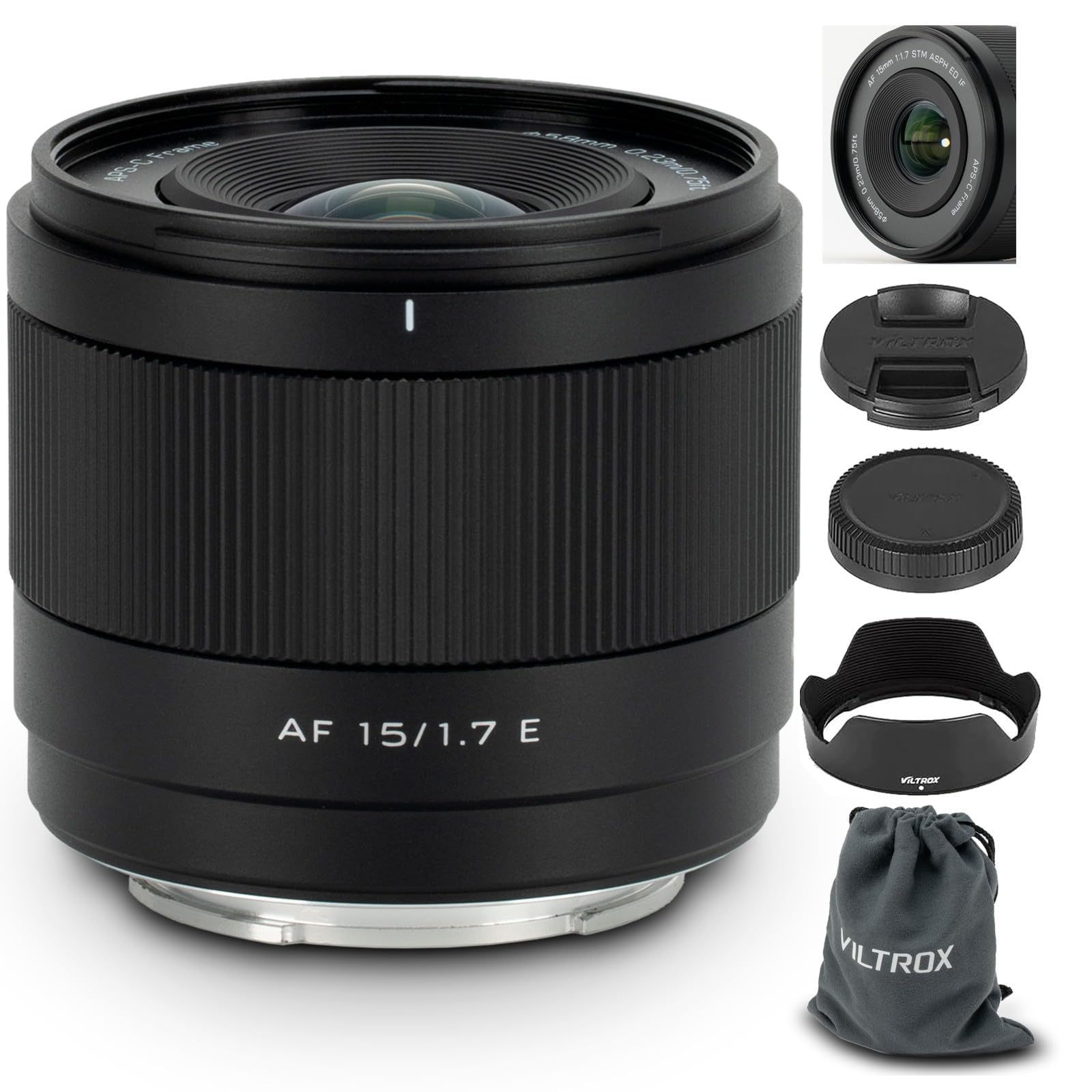
The Viltrox 15mm F1.7 is a prime ultra-wide lens designed for Sony APS-C E-mount cameras, offering an 84.9° angle of view that translates to a 22.5mm full-frame equivalent. The F1.7 maximum aperture is rare for an ultra-wide prime at this price, and the 9-blade aperture produces smooth, aesthetic bokeh for environmental portraits and video. The STM stepping motor locks autofocus quickly on faces and eyes, supporting tracking on recent Sony bodies like the ZV-E10 and A6700.
At just 180g and with a 58mm filter thread, this lens is incredibly lightweight and suitable for gimbal-mounted vlogging. The minimum focus distance of 0.23m allows creative perspectives with exaggerated depth. Optical performance is sharp in the center from F1.7, with acceptable edge sharpness by F2.8. Some minor chromatic aberration appears at the edges in high-contrast scenes, and the autofocus motor is audible in quiet environments — but these are fair trade-offs given the price point.
The lens is not weather-sealed, and the supplied lens hood is plastic. For Sony APS-C vloggers and content creators who want an ultra-wide field of view with low-light capability and a lightweight build, this Viltrox delivers exceptional value. It is best suited for well-lit outdoor use or controlled indoor shoots where its limitations are easily managed.
Why it’s great
- F1.7 aperture for wide-angle low-light and bokeh
- Ultra-light 180g design perfect for gimbals
- Smooth, reliable eye/face autofocus
Good to know
- AF motor audibly louder than premium primes
- No weather-sealing on the mount
9. Canon EOS R100 Kit (RF-S18-45mm F4.5-6.3 IS STM)

The Canon EOS R100 kit pairs a 24.1-megapixel APS-C body with the RF-S18-45mm F4.5-6.3 IS STM zoom, making it the most affordable entry point into Canon’s RF mirrorless ecosystem. The kit lens offers a 29-72mm full-frame equivalent range, optical image stabilization rated at 4 stops, and an STM motor for smooth autofocus during video. The DIGIC 8 processor enables 4K video at 24fps, and Dual Pixel CMOS AF covers the frame with face/eye detection for both people and animals.
The lens construction uses two aspherical elements with Canon Super Spectra Coating for good contrast and color, outperforming typical entry-level kit lenses from the DSLR era. The electronic ring system allows manual focus and control over camera settings. As a kit, the R100 with the 18-45mm is designed for beginners learning exposure and composition without investing heavily. The variable aperture means indoor shots benefit from good lighting or higher ISO, but the IS makes the most of available light.
The camera body does not include a battery charger, and the lens is primarily plastic. For those starting fresh with Canon mirrorless, this kit provides a functional foundation. The lens itself is a capable starter optic, but most users will eventually want something faster or longer — which is exactly the point of an entry-level APS-C system.
Why it’s great
- Complete camera + lens starter system at a low cost
- 4-stop optical stabilization for sharper handheld photos
- Dual Pixel AF with face/eye detection
Good to know
- Variable F4.5-6.3 aperture struggles indoors
- No battery charger included in the box
FAQ
What is the best all-around focal length for APS-C Lenses?
Can I use full-frame lenses on an APS-C camera?
Does image stabilization matter for APS-C Lenses?
Why choose a prime lens over a zoom for APS-C?
Final Thoughts: The Verdict
For most users, the aps-c lenses winner is the VILTROX AF 27mm F1.2 Pro because it combines an extraordinary F1.2 aperture with pro-level build quality and sharpness that rivals lenses costing twice as much. If you want the longest reach in a compact package, grab the Sony E 70-350mm F4.5-6.3 G OSS. And for a single-lens travel solution on Sony systems, nothing beats the Tamron 28-200mm F2.8-5.6.