
Our readers keep the lights on and the weekend projects moving. As an Amazon Associate, I earn from qualifying purchases.
Choosing between sensor sizes often ends with a single decision: do you pay more for a full-frame body, or do you invest in a lighter, more affordable system that still delivers professional-grade images? For many photographers and videographers, the sweet spot lives in the APS-C format, where lens selection is deep, and bodies offer advanced features without the weight penalty. The hunt for the right model requires sorting through sensor resolution, autofocus systems, video codecs, and lens ecosystems — each decision locking you into a path for years.
I’m Rikta — the co-founder and writer behind FitlyFast. This guide came together after hundreds of hours spent analyzing sensor specs, comparing autofocus point counts, and reading through real owner feedback to separate marketing claims from actual performance. I focused on the measurable specs that predict real-world results: resolution in megapixels, video bit depth, autofocus detection points, and stabilization systems.
Whether you shoot fast action, street photography, or 4K video, the right body balances resolution, speed, and portability without forcing you into the full-frame price bracket. This guide breaks down the top choices to help you find the best aps-c mirrorless camera for your specific needs.
How To Choose The Best APS-C Mirrorless Camera
Buying an APS-C body means thinking ahead about lens compatibility, video specifications, and ergonomics. The best camera for you depends on whether you prioritize stills resolution, high frame rate 4K video, or hybrid versatility. Understanding a few key specs will prevent buyer’s regret.
Autofocus Performance and Subject Detection
Modern autofocus systems rely on phase-detection points spread across the sensor. More points generally mean better subject coverage, but the real performance comes from the algorithm. Look for Real-time Eye AF on Sony bodies or Dual Pixel CMOS AF on Canon models — both track human, animal, and bird eyes with high precision. AI-based processors, like the one in the Sony a6700, estimate human poses for reliable tracking even when faces are obscured.
Video Capabilities and Bit Depth
If you plan to color grade footage, 4:2:2 10-bit internal recording is essential for banding-free gradients and flexibility in post. Some bodies also offer 4K 120p for slow motion. Oversampled 4K (read from 5K or 6K) produces sharper detail with less moiré than pixel-binned footage. Check whether the camera has a recording limit — older models may cap clips at 30 minutes.
In-Body Image Stabilization (IBIS)
IBIS shifts the sensor to counteract hand shake, letting you shoot at slower shutter speeds without blur. A 5-axis IBIS with 5 stops of compensation is useful for handheld video and low-light stills. Not all APS-C bodies include IBIS — the Sony ZV-E10 lacks it, while the Canon EOS R7 and Fujifilm X100VI include effective systems that work with unstabilized lenses.
Quick Comparison
On smaller screens, swipe sideways to see the full table.
| Model | Category | Best For | Key Spec | Amazon |
|---|---|---|---|---|
| Sony a6700 (Body) | Premium Hybrid | All-round video + photo | 26MP, 4K 120p, 759 AF points | Amazon |
| Canon EOS R7 | Action & Wildlife | Sports and wildlife | 32.5MP, 30fps e-shutter, IBIS | Amazon |
| Sony a6700 Kit | Vlogging Hybrid | Content creation | 26MP, AI AF, 4K 60p | Amazon |
| Canon EOS R10 | Mid-Range Travel | Day trips and vlogs | 24.2MP, 15fps, DIGIC X | Amazon |
| Sony a6400 Body | Compact Stills | Street and travel | 24.2MP, 0.02s AF, 11fps | Amazon |
| Sony ZV-E10 II | Creator Focused | Streaming / podcast | 26MP, 4K 60fps, AI AF | Amazon |
| Sony a6400 Kit | Budget Hybrid | First mirrorless | 24.2MP, 4K 30p, flip screen | Amazon |
| Canon EOS R50 | Beginner Kit | New vloggers | 24.2MP, 4K oversampled, Dual Pixel AF | Amazon |
| Sony ZV-E10 (Original) | Vlog Starter | Entry-level video | 24.2MP, 4K from 6K, side flip | Amazon |
| Sony a6700 2-Lens Kit | All-In-One Bundle | Travel + reach | 26MP, 16-50mm + 55-210mm | Amazon |
| Fujifilm X100VI | Fixed Lens Premium | Street photography | 40.2MP, hybrid VF, IBIS | Amazon |
In‑Depth Reviews
1. Sony a6700 (Body)

The Sony a6700 currently represents the peak of APS-C engineering for hybrid shooters. Its 26MP back-illuminated sensor pairs with the BIONZ XR processor and a dedicated AI chip to deliver subject recognition that estimates human poses, tracks animal and bird eyes, and maintains lock during erratic movement. The 759 phase-detection points cover 93% of the sensor, making missed focus a rare event. For video, the a6700 records 4K 60p oversampled from 6K in 4:2:2 10-bit internally, and it offers 4K 120p for high-quality slow motion — features usually reserved for full-frame flagships.
The body feels denser than previous a6000-series cameras, with a deeper grip that balances longer lenses. The vari-angle touchscreen is responsive, and the electronic viewfinder is bright enough for manual focus in sunlight. In-body stabilization provides up to 5 stops of compensation, which works competently for handheld static shots but still benefits from a gimbal for walking footage. The menu system remains Sony’s familiar nested layout — you will want to customize the function menu immediately.
Battery life is excellent, rated for over 500 shots per charge in standard use. The single UHS-II SD card slot is a limitation for backup-hungry event photographers, but for most creators, the a6700’s combination of speed, resolution, and color science (including S-Cinetone and S-Log3) makes it the most capable all-around APS-C body available.
Why it’s great
- AI-based autofocus with human pose estimation
- 4K 120p and 4:2:2 10-bit internal recording
- Excellent battery life and compact form factor
Good to know
- Single UHS-II card slot only
- Complex menu system requires customization
- IBIS is decent but not gimbal-grade for walking video
2. Canon EOS R7

The Canon EOS R7 is built for speed. With a 32.5MP APS-C sensor, it offers the highest resolution in the Canon APS-C lineup and a mechanical shutter that fires at 15 fps — 30 fps with the electronic shutter. The Dual Pixel CMOS AF II system covers the entire frame with 651 zones, and subject detection handles people, animals, and vehicles with the reliability Canon users expect. The 5-axis in-body stabilization gives up to 7 stops of compensation, which is class-leading for APS-C.
Video capabilities include 4K 60p oversampled from 7K, and 4K 30p with no crop. The R7 records 4:2:2 10-bit internally via Canon Log 3, offering solid latitude for color grading. The body is compact but ergonomic, with deep grips and well-placed controls that feel natural during long shooting sessions. Battery life exceeds official ratings — many users report well over 500 shots per charge in mixed use.
The main trade-off is the lens ecosystem. RF-S native lenses are still limited compared to Sony’s E-mount library, though adapting EF lenses via the official adapter works seamlessly. The R7 also uses UHS-II SD cards and includes a single slot, which matches the Sony a6700 in that regard. For wildlife, sports, and action photography where crop-factor reach matters, the R7 is arguably the best dedicated stills performer in the APS-C segment.
Why it’s great
- 32.5MP resolution with 15fps mechanical / 30fps e-shutter
- Excellent 7-stop IBIS for handheld shooting
- Dual Pixel AF II covers 100% of sensor width
Good to know
- Limited native RF-S lens selection
- Single card slot in 2024 is behind the curve
- No built-in flash
3. Sony a6700 Kit (with 16-50mm)

This kit pairs the a6700 with the E PZ 16-50mm f/3.5-5.6 OSS II lens, offering a compact all-in-one package for travel and daily content creation. The body itself matches the standalone a6700 — same 26MP sensor, same BIONZ XR and AI processor, same 759-point AF system, and the same 4K 60p oversampled from 6K. The kit lens is power-zoom, meaning you can zoom smoothly via the rocker lever on the lens barrel, which is handy for video transitions and vlogging.
Real-world image quality from the 16-50mm is acceptable in good light but shows its limits in low-light conditions due to the narrow f/3.5-5.6 aperture. Most users eventually replace or supplement it with a prime lens like the Sony 15mm f/1.4 or a Sigma f/1.4 for low-light performance. The camera’s AI autofocus shines for vloggers who move in frame — the product showcase mode and background defocus button are carried over from the ZV series.
The vari-angle LCD tilts fully forward for self-recording, but the lack of a headphone jack is a notable omission for serious audio monitoring. For a beginner who wants the best sensor and autofocus in the segment and a lens to get started, this kit saves the hassle of buying glass separately.
Why it’s great
- Same top-tier AI autofocus as the body alone
- Power zoom lens smooth for video
- Full 4K 60p 10-bit in a compact package
Good to know
- Kit lens is slow in low light
- No headphone jack for audio monitoring
- No built-in flash
4. Canon EOS R10 (with 18-150mm)

The Canon EOS R10 strikes a strong balance between price and performance. Its 24.2MP APS-C sensor combined with the DIGIC X processor — borrowed from Canon’s full-frame R-series — enables 15 fps mechanical shooting and 23 fps with the electronic shutter. The Dual Pixel CMOS AF II system uses 651 zones and detects people, animals, and vehicles. For a mid-range body, the autofocus reliability punches well above its weight.
The kit lens, an RF-S 18-150mm f/3.5-6.3 IS STM, provides a 8.3x zoom range equivalent to about 29-240mm in full-frame terms, making it ideal for travel, landscapes, and casual wildlife. The optical image stabilization in the lens works with the camera’s digital IS for video, though the R10 lacks in-body stabilization. 4K video is oversampled from 6K and looks sharp, but the maximum frame rate is 30p with a crop — a limitation if you need wide-angle 4K.
The body is compact and lightweight, with a deep grip that still feels secure. The screen is vari-angle and anti-smudge, useful for overhead shots. The single UHS-II SD card slot is acceptable at this tier, and battery life runs about a day of moderate use. For travelers wanting a single-lens solution with strong autofocus and solid 4K, the R10 kit is a logical choice.
Why it’s great
- Versatile 18-150mm kit lens covers wide to telephoto
- DIGIC X processor enables fast burst rates
- Reliable Dual Pixel AF II with subject detection
Good to know
- No in-body image stabilization
- 4K 60p has a crop factor
- Single card slot only
5. Sony a6400 (Body)

The Sony a6400 remains a relevant and capable body years after its release, primarily because of its 0.02-second autofocus speed and Real-time Eye AF for humans and animals. The 24.2MP Exmor sensor captures sharp stills with natural colors, and the 425 phase-detection points cover 84% of the sensor. For street and travel photography, the a6400’s compact magnesium-alloy body is nearly pocketable with a pancake lens attached.
Video output is 4K 30p oversampled from the full sensor width, with no pixel binning and no crop — a rarity in this price tier when it launched. The 180-degree flip screen faces forward for vlogging, though the lack of a headphone jack and the presence of a micro USB port (rather than USB-C) show its age. The rolling shutter in 4K is noticeable for panning shots but acceptable for stationary talking-head content.
Battery life is rated at 410 shots, which is decent for a compact body. The a6400 lacks in-body stabilization, so all stabilization comes from your lens or a gimbal. For the price, the a6400 offers one of the best autofocus systems available, making it a strong entry point for stills shooters who want access to Sony’s vast E-mount lens lineup without the cost of newer bodies.
Why it’s great
- Blazing 0.02s autofocus with Real-time Eye AF
- No-crop 4K 30p from full sensor readout
- Compact and durable magnesium-alloy build
Good to know
- No in-body image stabilization
- Micro USB charging rather than USB-C
- Noticeable rolling shutter in 4K
6. Sony ZV-E10 II

The ZV-E10 II is Sony’s second-generation vlog-centric camera, updating the original ZV-E10 with a 26MP back-illuminated Exmor R sensor, AI-based subject recognition, and 4K 60p recording. The camera is designed for content creators who prioritize ease of use: the product showcase button transitions focus from face to object, the background defocus toggle instantly adjusts depth of field, and the Creative Look presets allow in-camera color grading without entering complex menus.
The 759 autofocus points use the same AI processor found in the a6700, delivering reliable human, animal, and bird eye tracking. The kit lens is the E PZ 16-50mm F3.5-5.6 OSS II, an improved version with smoother power zoom for video. The camera records 4K 60fps with no crop in most modes, and slow-motion capture is available in Full HD at 120fps. The directional 3-capsule mic on top captures clearer audio than typical internal mics, and the windscreen included in the box helps reduce outdoor noise.
The biggest omission is the lack of an electronic viewfinder — you compose entirely with the vari-angle LCD. For studio streaming or desk-based recording, this is rarely an issue, but for outdoor shooting in bright light, the screen can be hard to see. Overheating during extended 4K recording in warm environments has been reported, though Sony has improved thermal management compared to the original ZV-E10. For pure content creation and live streaming, the ZV-E10 II is purpose-built and effective.
Why it’s great
- AI-based Real-time Eye AF for human/animal/bird
- Product showcase and background defocus buttons
- Improved 3-capsule mic with windscreen
Good to know
- No electronic viewfinder
- Can overheat in 4K in warm rooms
- Battery life is average for video use
7. Sony a6400 Kit (with 16-50mm)

This kit bundles the proven a6400 body with the updated E PZ 16-50mm f/3.5-5.6 OSS II lens. The lens features improved optical stabilization compared to the original, which helps reduce handheld shake in video. The a6400 itself remains a strong performer: Real-time Eye AF locks onto subjects quickly, the 24.2MP sensor produces detailed stills, and the 4K video oversampled from 6K delivers sharp footage with good color.
The 16-50mm power zoom is compact enough that the entire kit fits in a small sling bag, making it a convenient everyday carry for hybrid shooters who want a single lens for general use. The zoom rocker on the lens barrel allows smooth focal length transitions during video, and the optical SteadyShot works alongside the camera’s electronic stabilization to smooth out minor shake. The kit lens is not fast, but for outdoor and well-lit indoor shooting, it covers the standard focal range adequately.
The a6400’s 180-degree flip screen supports vlogging, and the 11 fps burst shooting with AF tracking is useful for action. Battery life remains around 400 shots per charge, and the Sony E-mount ecosystem offers hundreds of native and third-party lenses. For someone entering the Sony system, this kit provides a capable body and a solid starter lens at a reasonable entry point.
Why it’s great
- 0.02s AF with Real-time Eye AF for stills and video
- Updated OSS II lens with better stabilization
- Compact enough for everyday carry
Good to know
- Kit lens aperture is narrow in low light
- No USB-C charging
- No in-body stabilization
8. Canon EOS R50 Kit
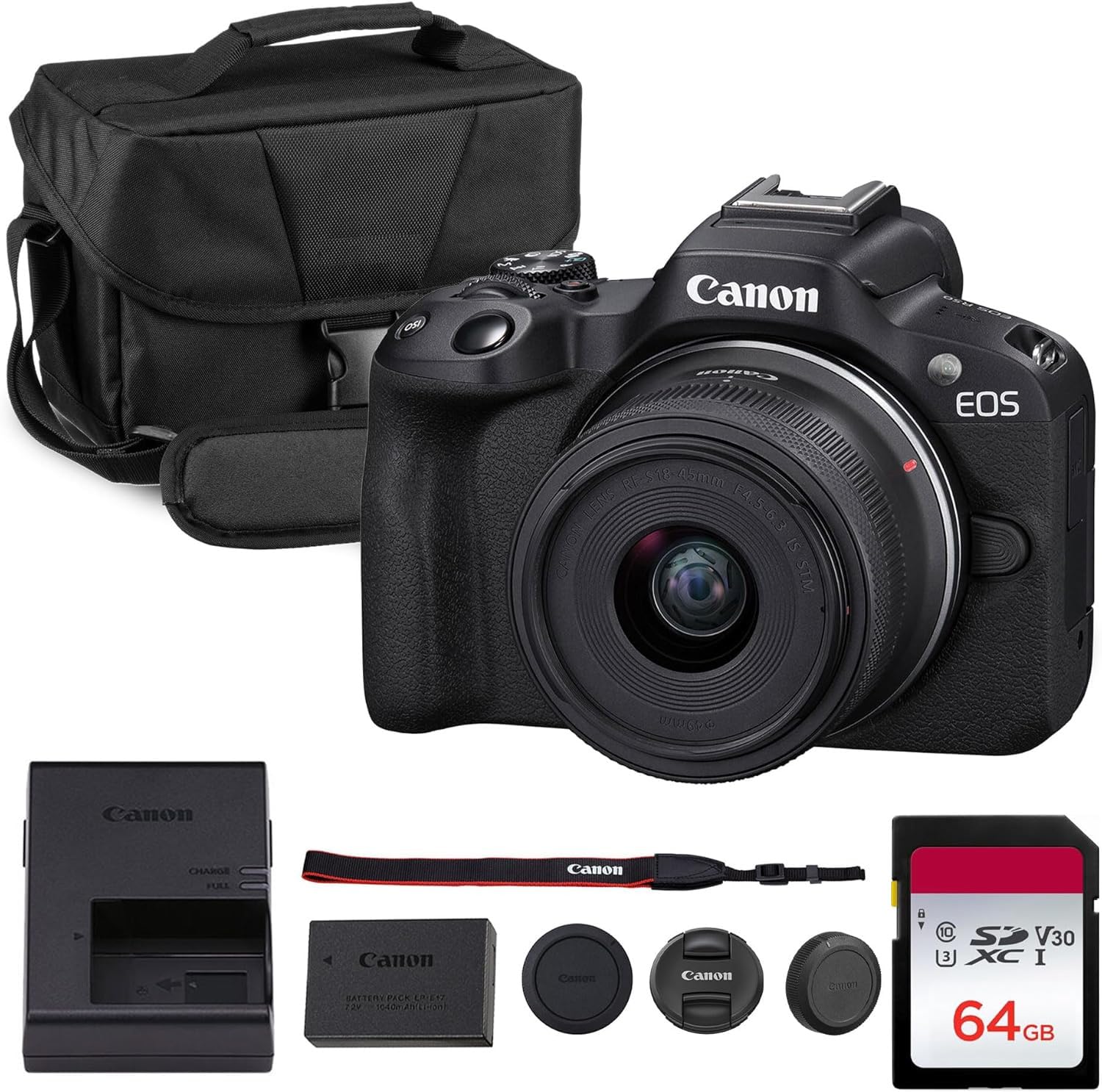
The Canon EOS R50 is designed as an entry point into the RF mirrorless system, targeting new creators and vloggers. The 24.2MP APS-C sensor and DIGIC X processor deliver oversampled 4K video from a 6K readout, producing clean footage with Dual Pixel CMOS AF II for smooth subject tracking. The face and eye detection works well for single subjects, and the Creative Assist mode guides beginners through adjusting depth of field and brightness without understanding manual exposure.
The kit includes the RF-S 18-45mm f/4.5-6.3 IS STM lens, a collapsible zoom that keeps the camera small when not in use. The lens has optical image stabilization and a silent STM motor for quiet autofocus in video. The vari-angle touchscreen tilts fully forward, and the body includes a built-in flash — a feature missing from many higher-end mirrorless bodies. Vertical video recording is supported natively, which helps with social media content.
The autofocus system has 99 points compared to the 651 points in the R10 and R7, and the mechanical burst rate is 15 fps, which is still competitive for its tier. The lack of a headphone jack and the single UHS-I SD slot are compromises at this price. For a first mirrorless camera for family documentation, casual vlogging, and learning photography, the R50 kit provides a friendly experience without overwhelming the user.
Why it’s great
- Oversampled 4K with Dual Pixel AF II
- Built-in flash available when needed
- Collapsible lens keeps body compact
Good to know
- Only 99 autofocus detection points
- Single UHS-I card slot is slow
- No headphone jack for audio monitoring
9. Sony ZV-E10 (Original)
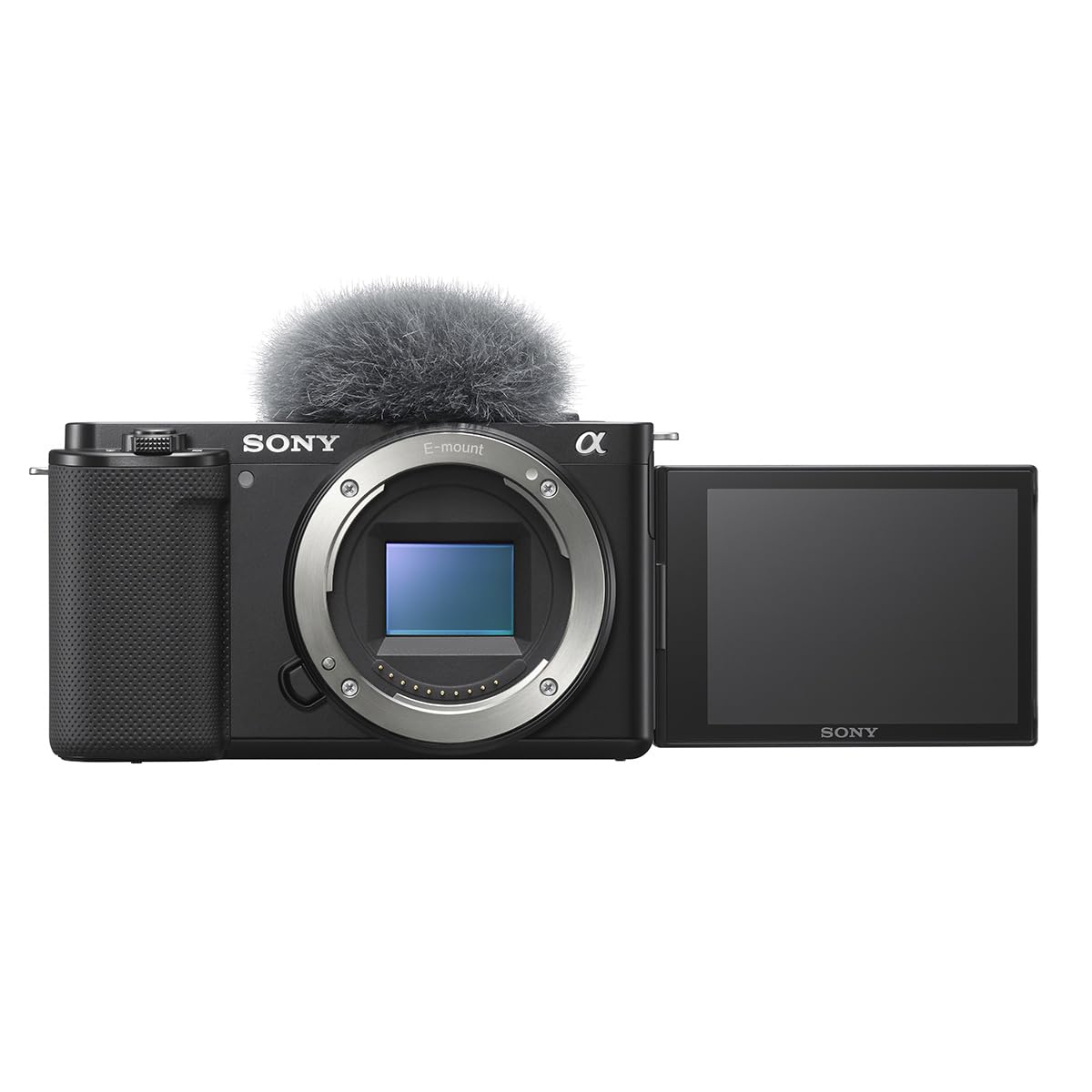
The original ZV-E10 remains a popular choice for budget-conscious content creators who want interchangeable lenses. Its 24.2MP APS-C Exmor sensor and BIONZ X processor provide 4K video oversampled from 6K, and the 425-point phase-detection AF system delivers Real-time Eye AF for humans and animals. The side flip screen is ideal for vlogging because it stays visible even when a microphone is mounted in the hot shoe.
Product Showcase mode transitions focus from the subject’s face to an object held in front of the lens, which is useful for review and unboxing content. The Background Defocus button instantly switches between a shallow and deep depth of field. The camera also supports easy live streaming over a single USB cable, making it a capable webcam replacement without additional hardware. The built-in directional mic is decent for casual use, and the included windscreen reduces wind noise outdoors.
The build quality is compact and lightweight, but the body lacks IBIS and an electronic viewfinder. The rolling shutter in 4K is severe enough that quick pans produce noticeable skew, and battery life in 4K recording is limited to about 25 minutes per charge. For creators who can work within these constraints — using a gimbal, keeping clips short, and monitoring via the LCD — the ZV-E10 is a capable tool at a low entry cost.
Why it’s great
- Side flip screen works with a microphone attached
- Product showcase and background defocus features
- USB streaming without extra hardware
Good to know
- Severe rolling shutter in 4K
- No image stabilization
- Short battery life in video mode
10. Sony a6700 2-Lens Kit
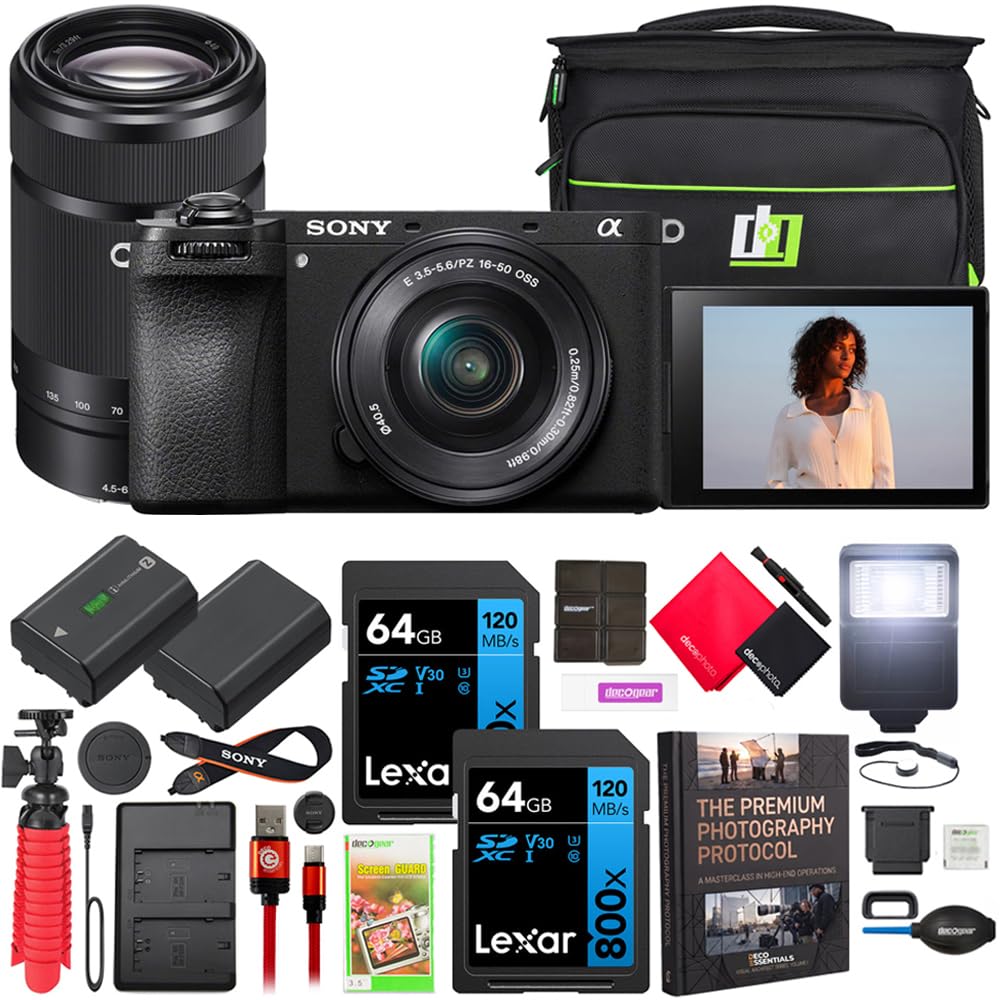
This bundle pairs the Sony a6700 with two zoom lenses — the E PZ 16-50mm f/3.5-5.6 OSS and the SEL55210 55-210mm f/4.5-6.3 OSS — covering a continuous focal range from wide-angle to telephoto. The body itself is the same 26MP AI-equipped powerhouse, but the 55-210mm lens adds reach for wildlife, sports, and compressed portraits that the 16-50mm cannot achieve. The kit also includes a Deco Gear bag, external flash, extra battery, dual charger, tripod, memory cards, and other accessories.
For a photographer starting from scratch, this bundle removes the need for immediate additional purchases. The 55-210mm lens includes Optical SteadyShot, which helps with handheld shots at the long end. The external bounce zoom flash provides fill light for indoor events. The extra battery and dual charger alleviate the a6700’s average video battery life, and the tabletop tripod works for desk vlogs or group shots.
The bundled battery is a third-party replacement, and some users report a compatibility warning on the camera screen. The charger and other accessories are basic but functional. If you prefer to hand-pick each component, buying the body and lenses separately may yield higher quality third-party glass. However, for someone who wants a complete backup-ready kit in one box, this bundle delivers value and convenience.
Why it’s great
- Two lens coverage from 16mm to 210mm
- Includes essential accessories like flash, bag, and cards
- Extra battery and charger for longer shoots
Good to know
- Third-party battery may show a warning
- Kit zooms are not fast aperture lenses
- Accessory quality is entry-level
11. Fujifilm X100VI
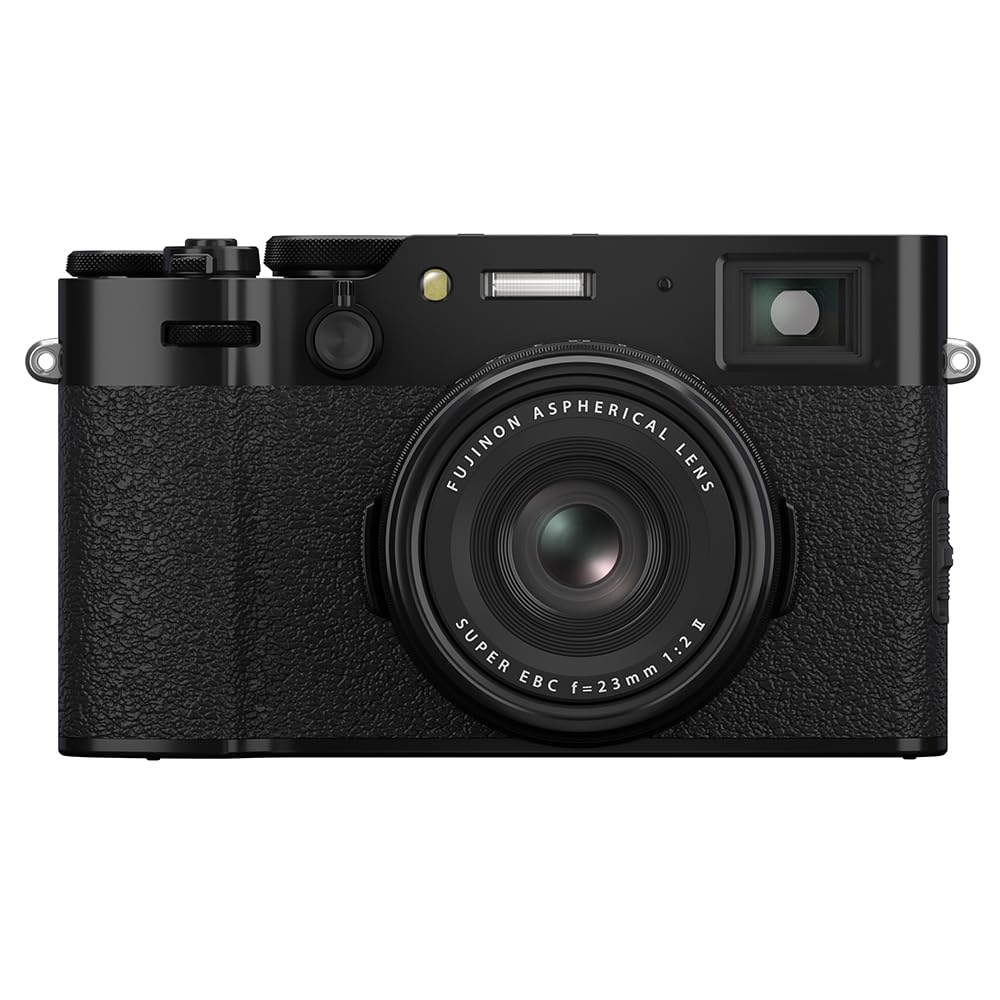
The Fujifilm X100VI is a specialized tool built around a fixed 23mm f/2 lens (35mm full-frame equivalent) and a 40.2MP X-Trans CMOS 5 HR sensor. This is the highest resolution APS-C sensor available in any mirrorless camera, and it delivers exceptional detail for landscape, street, and editorial photography. The X-Processor 5 powers the camera’s 20 Film Simulation modes, which apply in-camera color science that reduces the need for post-processing.
For the first time in the X100 series, a 5-axis in-body stabilization system provides up to 6 stops of compensation, making the camera more usable in low light without raising ISO. The hybrid viewfinder allows switching between an optical viewfinder (OVF) and an electronic viewfinder (EVF), or overlaying EVF information on the OVF frame. The two-way tilting LCD makes waist-level and overhead shooting easier than previous models.
The fixed 23mm f/2 lens is optically refined, but the camera’s autofocus is noticeably slower than Sony or Canon systems — some users describe it as sluggish in low contrast scenes. The fixed focal length also means you cannot zoom or swap lenses, which limits versatility for sports, wildlife, or event photography. For the street photographer who values compactness, image quality, and the tangible experience of a rangefinder-style body, the X100VI is a unique and rewarding camera.
Why it’s great
- 40.2MP sensor produces extremely detailed files
- In-body stabilization with 6 stops of compensation
- Unique hybrid OVF/EVF finder
Good to know
- Autofocus is slower than Sony/Canon competitors
- Fixed 23mm lens limits versatility
- Steep learning curve for new Fujifilm users
FAQ
Is APS-C image quality noticeably worse than full frame?
Which lens mount has the best selection for APS-C bodies?
Do I need a gimbal for video with an APS-C camera?
Can I use full-frame lenses on an APS-C camera?
What memory card speed do I need for 4K video?
Final Thoughts: The Verdict
For most users, the best aps-c mirrorless camera winner is the Sony a6700 because it offers the best combination of high-resolution stills, advanced AI autofocus, and comprehensive 4K video features in a compact body. If you prioritize speed and telephoto reach for wildlife and action, grab the Canon EOS R7. And for street photography where image quality and color science are paramount, nothing beats the Fujifilm X100VI.