
Our readers keep the lights on and the weekend projects moving. As an Amazon Associate, I earn from qualifying purchases.
The battle against aquarium algae is relentless — one day you have pristine glass, the next you’re scraping green film off every surface. Whether you’re maintaining a freshwater community tank, a planted aquascape, or a delicate reef system, the right algae removal tool or treatment can mean the difference between a showpiece aquarium and a clouded mess. Physical scrapers remove what you can see, while biological and chemical treatments address the root causes of the bloom, targeting nutrients like phosphate and nitrate that fuel unwanted growth.
I’m Rikta — the co-founder and writer behind FitlyFast. My research focuses on breaking down the hard specs of aquatic care products, from magnet pull strength in glass cleaners to the molecular mechanisms behind phosphate-reducing supplements, so you can make a confident purchase without the guesswork.
This guide covers the top seven solutions — from magnetic scrapers that glide through green spot algae to biological microbes that restore balance to a mature tank — to help you find the absolute best aquarium algae remover for your specific setup and maintenance habits.
How To Choose The Best Aquarium Algae Remover
The sheer variety of algae removal methods — magnetic scrapers, liquid supplements, bacterial blends — can be overwhelming. The right choice depends on your tank’s size, glass thickness, livestock, and whether you want a quick physical fix or a long-term nutrient solution.
Match the magnet to your glass thickness
Magnetic cleaners rely on rare-earth magnets whose holding strength is directly tied to the thickness of your aquarium glass or acrylic. A cleaner rated for 3/8-inch glass will feel weak or slip on a 1/2-inch tank, while an overly strong magnet on thin glass can be difficult to slide. Always check the manufacturer’s glass thickness range before buying — and remember that tempered glass tanks require extra caution with metal blades.
Chemical vs. biological vs. physical: know your strategy
Physical scrapers and magnetic cleaners remove visible algae instantly but do nothing to prevent regrowth. Liquid algaecides like those for ponds kill existing algae quickly but require careful dosing and aeration. Biological treatments (microbial blends and nutrient reducers) work slowly over days or weeks by starving algae of the food it needs — a safer, more sustainable approach for sensitive reef tanks and planted aquariums.
Quick Comparison
On smaller screens, swipe sideways to see the full table.
| Model | Category | Best For | Key Spec | Amazon |
|---|---|---|---|---|
| fishkeeper Magnetic Glass Cleaner | Magnetic Scraper | Everyday glass tank maintenance | Glass thickness 1/8″–1/4″ | Amazon |
| AQQA Magnetic Aquarium Cleaner | Magnetic Scraper | Thicker glass & heavy algae | Glass thickness 0.2″–0.4″ | Amazon |
| Brightwell MicroBacter Clean | Biological | Reef & saltwater live rock | 8.45 fl oz liquid | Amazon |
| TetraPond Algae Control | Algaecide | Ponds — green water & string algae | Treats up to 3,000 gallons | Amazon |
| Brightwell Phosphat-E | Nutrient Reducer | Marine & reef phosphate control | 125 ml (4.2 fl oz) | Amazon |
| Red Sea NO3:PO4-X NOPOX | Nutrient Reducer | Reef — nitrate & phosphate reduction | 500 ml liquid | Amazon |
| API Pondcare Algaefix | Algaecide | Large ponds — fast algae knockdown | 2 x 32 fl oz jugs | Amazon |
In‑Depth Reviews
1. fishkeeper Magnetic Glass Cleaner

The fishkeeper Magnetic Glass Cleaner punches above its compact size. Rated for glass up to a quarter-inch thick, this small cleaner packs a rare-earth magnet that customers report “slices through coralline algae like a razor.” The floating inner half is a practical touch — if you drop it while scrubbing the bottom, it drifts to the surface instead of sinking out of reach.
It comes with two detachable heads: a stainless steel scraper for glass tanks and a plastic scraper for acrylic, plus a felt pad on the outer brush to wipe away exterior water spots. The ergonomic handle makes long cleaning sessions comfortable, and the self-floating design means you never have to fish the inner piece out with a net. For a mid-range buy, the magnetic grip feels surprisingly strong for the price point.
Some users note that the plastic scraper works well on dried waterline gunk but can nick silicone sealant at the edges if you’re not careful. It’s best suited for standard glass aquariums up to 40 gallons, though owners of larger tanks wish a bigger version existed. Between the solid build, dual-blade versatility, and thoughtful float-up feature, this is the most balanced pick for everyday glass cleaning.
Why it’s great
- Strong magnetic hold for its size; glass stays clean with minimal effort.
- Two removable blades — stainless steel for glass, plastic for acrylic tanks.
- Self-floating inner piece eliminates the need to reach into the tank.
Good to know
- Only rated for glass thickness up to 1/4 inch — not suitable for thick-walled tanks.
- Metal blade can scratch acrylic if used carelessly; stick to the plastic scraper for acrylic.
- Small size best for tanks under 40 gallons; larger tanks may need a bigger model.
2. AQQA Magnetic Aquarium Cleaner (M)

The AQQA Magnetic Aquarium Cleaner in size M is built for thicker glass, accommodating tanks from 0.2 to 0.4 inches. Its rare-earth magnet delivers enough clamp force to handle crusty green spot algae and dried-on mineral deposits in a single pass. Owners of deep planted tanks report cutting cleaning time from an hour down to 15 minutes with this tool.
Like the fishkeeper model, it includes both a stainless steel scraper for glass and a plastic scraper for acrylic, plus a fabric scrubber on the outer side for dust and water stains. The float-up design is similarly effective — the inner piece releases to the surface when the outer handle is pulled away, keeping your hands dry and your fish undisturbed. The handle is ergonomically shaped for comfort during extended scrubbing.
One caveat: the magnet strength can feel inadequate for tanks at the upper limit of the glass thickness range — a customer with a 3/8-inch (0.375″) glass found the hold insufficient despite the spec sheet. Also, the hook-and-loop scrubber pad tends to detach when used vigorously. For standard 0.2 to 0.3-inch glass, however, this cleaner offers a very effective, time-saving experience at a mid-range price point.
Why it’s great
- Strong magnet designed for thicker tank walls (0.2″–0.4″).
- Dual blades plus fabric scrubber tackle both interior algae and exterior grime.
- Floating inner half makes retrieval simple and splash-free.
Good to know
- Magnetic grip may be insufficient for glass at the thick end of the spec range.
- Fabric scrubber detaches easily; some users replace it with a cotton towel.
- Blade can catch on silicone sealant at corners — clean with a straight motion.
3. Brightwell MicroBacter Clean

Brightwell’s MicroBacter Clean shifts the algae-removal strategy from scrubbing to starving. This liquid formulation contains non-pathogenic microbes and natural enzymes that colonize live rock and decoration surfaces, breaking down the organic waste that feeds algae. It’s designed specifically for saltwater and reef aquariums, where chemical algaecides can harm delicate corals and invertebrates.
Users report visible results over one to two weeks — diatoms fade, hair algae retreats, and rock work that looked “milky” returns to a clean, natural appearance. The product also reduces ammonia, nitrite, nitrate, and phosphate, improving overall water clarity. Because it works biologically rather than through direct toxicity, it’s safe for fish, corals, and beneficial bacteria when dosed as directed.
This isn’t a quick fix. You need patience and consistent dosing (every other day for a week to start) to see noticeable changes. It works best as part of a regular maintenance regimen rather than a one-time cure. For reef keepers battling the “ugly stage” after cycling or dealing with persistent film algae on rock work, this premium biological approach offers a long-term, reef-safe solution that scrapers alone cannot provide.
Why it’s great
- Targets the root cause — organic waste — not just the visible algae.
- Safe for reef tanks with corals, inverts, and sensitive fish.
- Improves water clarity while reducing nitrate and phosphate levels.
Good to know
- Works slowly over days to weeks; not a rapid algae killer.
- Requires consistent dosing schedule for best results.
- Best as part of a broader maintenance plan, not a standalone cure.
4. TetraPond Algae Control Treatment

TetraPond Algae Control is a go-to for outdoor pond owners dealing with green water blooms and string algae (blanket weed). Each 33.8-ounce jug treats up to 3,000 gallons, making it one of the most concentrated liquid algaecides in the mid-range segment. It works by disrupting algae cell growth without harming ornamental fish or aquatic plants when used according to the label.
Customer feedback highlights that this treatment is effective but not instantaneous — it typically takes about a month of regular dosing to bring a heavy bloom under control. Diluting the concentrate before adding it to the pond is critical to avoid localized shock to fish. Users report clear water after two or three treatments when combined with good filtration and partial water changes.
Some pond keepers have expressed disappointment when results didn’t appear after a single dose. This product requires patience and consistent application, especially for large or heavily infested ponds. It’s also worth noting that it’s formulated for ponds with plants, unlike some harsher algaecides. For a reliable, plant-safe, and fish-safe pond treatment at a reasonable cost-per-gallon, TetraPond delivers.
Why it’s great
- High concentration treats up to 3,000 gallons per bottle.
- Safe for use in ponds with live plants and ornamental fish.
- Effective against both green water and string/hair algae.
Good to know
- Results can take up to a month — not an overnight solution.
- Must be diluted before adding to avoid harming fish.
- Some users report it underperforms on very heavy, established blooms.
5. Brightwell Phosphat-E

Phosphate is a primary driver of nuisance algae in marine and reef tanks, and Brightwell Phosphat-E is a premium liquid solution designed to bring elevated levels under control. A single 4.2-ounce bottle treats up to 4,000 gallons, and the formula works by immediately binding reactive phosphate upon addition. This makes it an efficient tool for heavily stocked aquaria where nutrient input is high.
Users consistently report that it reduces phosphate from levels above 1.0 ppm down to undetectable within a few doses, though the process can cause temporary cloudiness — a normal chemical reaction, not a sign of failure. The product is safe for all reef inhabitants, including corals and invertebrates, when dosed correctly. A precise measuring tool (like a 1 ml syringe) is essential, as over-dosing can stress fish.
The main drawback is the dosing math. The instructions can be confusing — one line says 5 ml removes 0.6 ppm in 32 gallons, another suggests 1 ppm in 40 gallons. You’ll need to do your own calculation or start low and test frequently. Despite the label confusion, the performance is reliable. For marine aquarists fighting persistent green hair algae or cyanobacteria tied to high phosphate, this is a targeted, effective weapon at a premium price.
Why it’s great
- Immediately binds reactive phosphate upon addition to the tank.
- Highly concentrated — treats up to 4,000 gallons per bottle.
- Safe for corals, inverts, and fish when dosed correctly.
Good to know
- Dosing instructions are confusing and require user calculation.
- Temporary cloudiness after dosing is normal but can be alarming.
- Small bottle requires careful measuring — easy to over-dose.
6. Red Sea NO3:PO4-X NOPOX
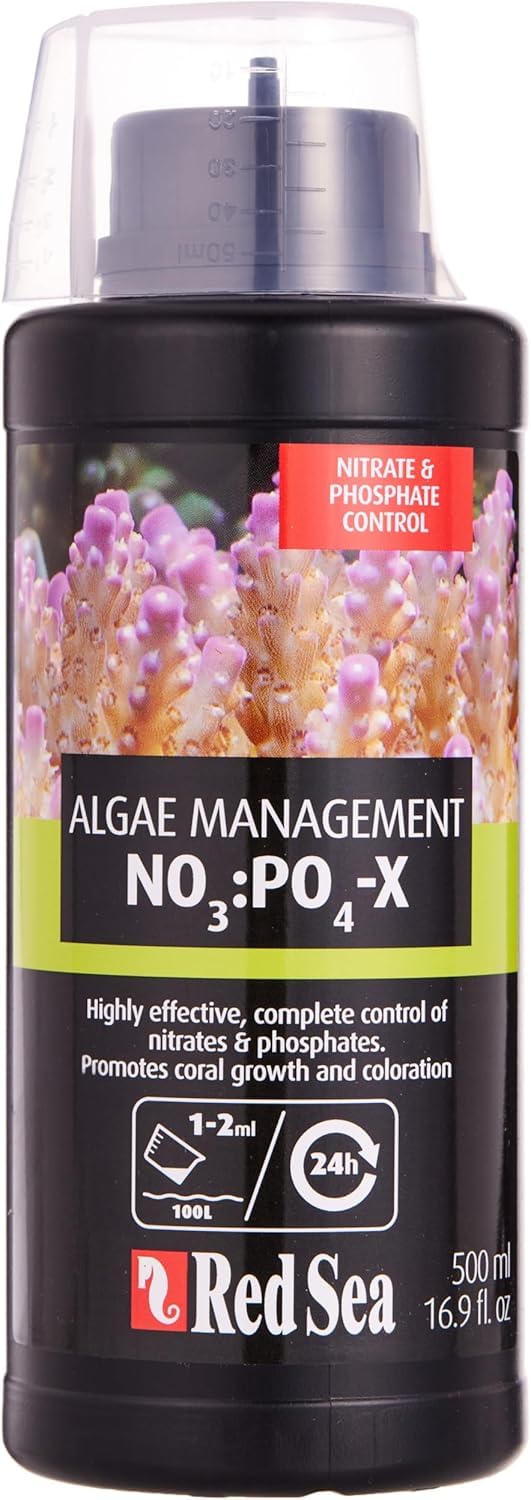
Red Sea’s NO3:PO4-X (often called NOPOX) is a premium carbon-dosing product that reduces both nitrate and phosphate simultaneously. It contains a blend of organic carbon sources (similar to vodka and vinegar) that feed denitrifying bacteria, which in turn consume excess nutrients. The 500 ml bottle is a standard size for reef keepers who want to control algae at the chemical level without using mechanical phosphate media.
User reports are impressive: one customer saw nitrates drop from 100 ppm to 2 ppm over two months when combined with weekly water changes. Another reduced phosphates from 0.18 to 0.02 ppm in a few weeks. The product also noticeably improves water clarity and coral polyp extension. It requires daily dosing — either by hand or via a dosing pump — and careful weaning as nutrient levels stabilize.
The learning curve is real. Beginners can easily overdose, causing bacterial blooms or oxygen depletion. It’s critical to start at half the recommended dose and increase slowly while testing nitrate and phosphate regularly. For experienced reef aquarists who want to achieve ultra-low nutrient levels (ULN) for SPS coral growth, NOPOX is a proven, effective tool. It’s not for casual hobbyists, but for those ready to master nutrient control, it’s a game-changer.
Why it’s great
- Simultaneously reduces both nitrate and phosphate effectively.
- Improves water clarity and coral health in reef systems.
- Large 500 ml bottle provides extended treatment supply.
Good to know
- Requires daily dosing and careful weaning — not beginner-friendly.
- Overdosing can cause bacterial blooms or oxygen depletion.
- Needs consistent testing to dial in the correct dosage.
7. API Pondcare Algaefix (2-Pack)

API Pondcare Algaefix comes in a two-pack of 32-ounce jugs, offering a budget-friendly solution for pond owners who need to cover a large water volume or want a reserve supply on hand. It’s EPA-registered and designed to control green water algae, string algae, and blanketweed in ponds with live plants and fish. The fast-acting formula works within days of the first dose.
Users report clear water after just a few treatments, though frequent filter cleaning is necessary — the dying algae clogs mechanical media quickly. The product requires robust aeration because the breakdown process consumes oxygen; some owners noted fish becoming lethargic when aeration was insufficient. Smaller ponds (under 200 gallons) seem to respond best, especially when the pond receives direct sunlight that fuels algae growth.
While it’s highly effective at knocking down visible algae, it doesn’t address the underlying nutrient imbalance. Regular maintenance — water changes, mechanical filtration, and plant management — is still essential. One user mentioned that after killing off string algae, their koi lost hiding spots among the plants that had died back. For pond keepers seeking a powerful, fast-acting algaecide at an entry-level price, this two-pack delivers, but it must be used with adequate oxygenation.
Why it’s great
- Two-pack provides excellent volume for the price point.
- EPA-registered and safe for fish and live plants when used correctly.
- Fast-acting — visible results within days of the first dose.
Good to know
- Requires strong aeration during treatment to prevent fish stress.
- Can clog filters quickly as algae dies off — clean frequently.
- Does not treat the root nutrient cause; algae may return without maintenance.
FAQ
Can I use a stainless steel scraper on an acrylic aquarium?
How long does a biological algae remover like MicroBacter Clean take to work?
Do I need to remove my fish before using an algaecide in my pond?
What is the difference between a magnetic glass cleaner and a long-handled scraper?
Final Thoughts: The Verdict
For most users, the best aquarium algae remover winner is the fishkeeper Magnetic Glass Cleaner because it balances strong magnetic performance, dual-blade versatility, and a user-friendly floating design at a mid-range price that works for standard home aquariums. If you want to treat the root cause of algae in a reef tank, grab the Brightwell MicroBacter Clean for its safe, biological approach to nutrient control. And for outdoor pond owners with large-scale green water or string algae, nothing beats the sheer volume and fast-acting power of the API Pondcare Algaefix 2-Pack.