
Our readers keep the lights on and the weekend projects moving. As an Amazon Associate, I earn from qualifying purchases.
That persistent green haze or sudden ammonia spike isn’t a mystery—it’s usually the filter rate or media capacity failing to keep up with your bioload. An undersized hang-on-back unit pushing 100 GPH through a single carbon cartridge simply can’t handle the waste from a moderately stocked 40-gallon tank.
I’m Rikta — the co-founder and writer behind FitlyFast. I’ve spent years analyzing filter flow curves, media surface areas, and pump noise data across the full spectrum of hobbyist equipment to isolate what actually moves the needle on water clarity and fish health.
This guide cuts through the marketing to compare canister and hang-on-back filters on real specs like turnover rate, media volume, and self-priming reliability so you can confidently choose the right best aquarium filter system for your setup without wasting money on a model that will fail within weeks.
How To Choose The Best Aquarium Filter System
Matching a filter to your tank requires more than matching the “up to X gallons” badge on the box. A 75-gallon planted tank with a few neon tetras needs far less turnover than a 55-gallon cichlid tank with heavy stocking. You need to align flow rate, media type, and maintenance frequency with your specific bioload and water parameters.
Turnover Rate: The Real Measure of Capacity
Turnover rate is the number of times per hour the filter moves the entire volume of your tank. A rule of thumb: aim for at least 4-6 turnovers per hour for freshwater, and 8-10 for heavily stocked or messy systems like turtle tanks. A filter labelled for “up to 100 gallons” that only pushes 200 GPH only turns over a 50-gallon tank four times per hour—barely adequate for moderate stocking.
Media Types: What Goes Inside Matters More Than the Pump
Biological media (ceramic rings, bio-balls, sintered glass) provides surface area for nitrifying bacteria; mechanical media (sponges, filter floss) traps solid waste; chemical media (activated carbon, Purigen) adsorbs dissolved organics and medications. A filter with generous media volume is more forgiving of irregular cleaning schedules because the bacteria colony can handle ammonia spikes. Filters with proprietary cartridges lock you into ongoing costs; models accepting generic pads or loose media give you flexibility.
Self-Priming vs. Manual Prime
Canister filters trap air after cleaning or power loss. A self-priming model—like those with lever-operated impeller housings or built-in purge valves—recirculates water automatically, preventing the pump from running dry. Filters that require you to manually fill the intake hose or pour water into the canister body risk air locks that stop flow entirely and can starve beneficial bacteria of oxygenated water.
Quick Comparison
On smaller screens, swipe sideways to see the full table.
| Model | Category | Best For | Key Spec | Amazon |
|---|---|---|---|---|
| Fluval FX2 | Canister | High-bioload setups | 475 GPH, 1 gal media capacity | Amazon |
| Aquatop CF-400UV MKII | Canister + UV | Green water control | 370 GPH, 4-stage + 9W UV | Amazon |
| SunSun HW-3000 PRO | Canister + UV | Large tanks under premium budget | 793 GPH, 9W UV, LCD display | Amazon |
| Marineland Penguin 200 | HOB | Reliable mid-range HOB | 200 GPH, rotating Bio-Wheel | Amazon |
| Aqueon QuietFlow Internal | Internal | Silent operation, small tanks | Fully submersible, near-silent | Amazon |
| Atlantis Aqua 55-100 Gal | Internal | No filter pad replacements | 15.3″H, lifetime sponges | Amazon |
| Tararium IX-120 | Internal | Turtle tanks, low water levels | 290 GPH, 3-stage, 2.6″ low water | Amazon |
In‑Depth Reviews
1. Fluval FX2 Canister
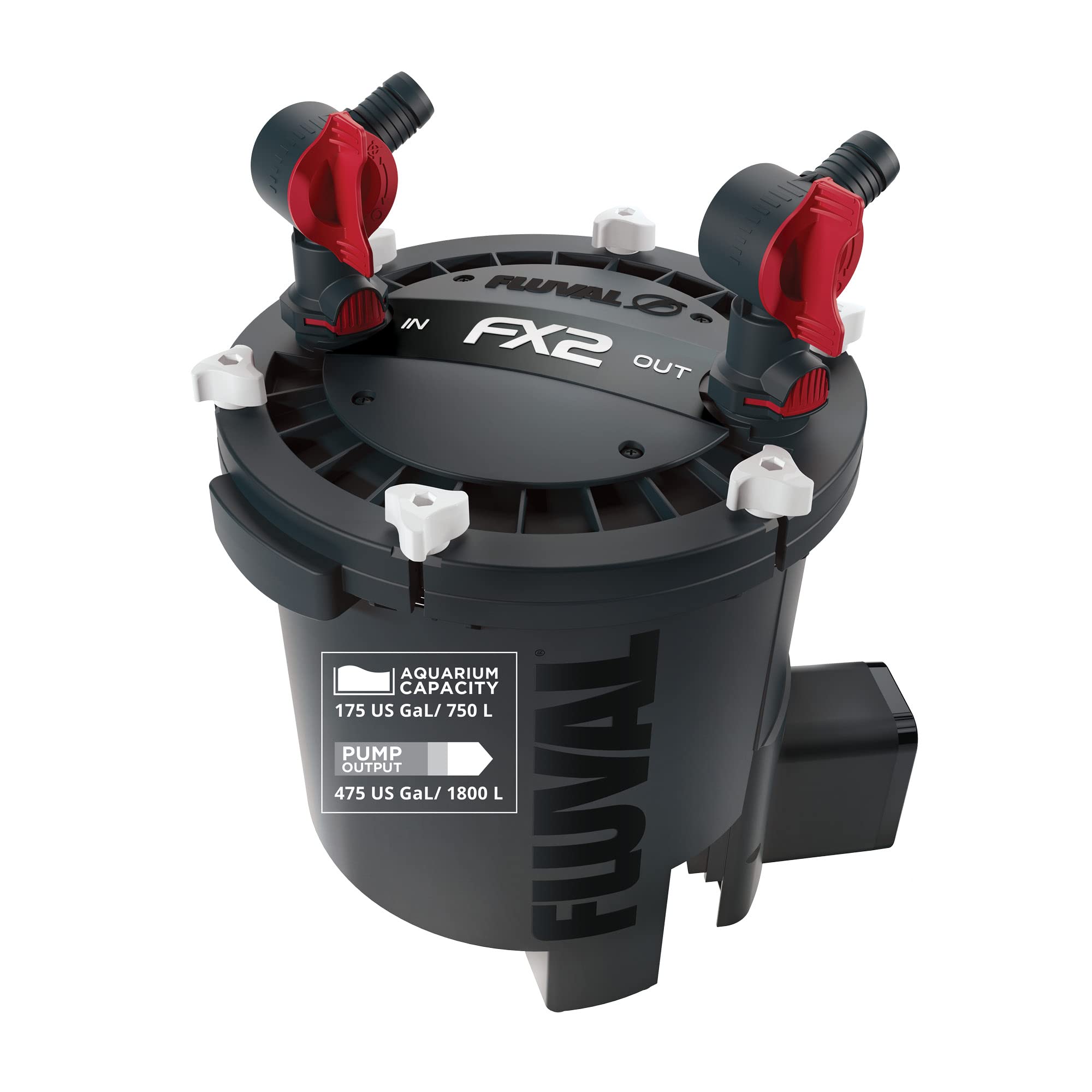
The FX2 packs a Smart Pump that auto-adjusts performance and evacuates trapped air every 12 hours—a key advantage over canisters that need manual priming after maintenance. The four-basket design holds up to a full gallon of media, giving you the flexibility to stack mechanical, chemical, and biological layers in custom order. At 475 GPH, it turns over a 75-gallon tank more than six times per hour, handling heavy cichlid or turtle bioloads with no visible clouding.
Setup is genuinely simple: fill the canister, plug it in, and the self-starting pump takes over. The utility valve at the base lets you drain the canister and perform water changes directly through the filter—no separate syphon needed. The 16.5-inch height and 15% smaller footprint than the FX4 mean it fits under most stands without issues.
Long-term owners report the quiet operation holds up over years, with the periodic air-purge feature preventing the flow stall that plagues cheaper canisters. The basket-in-basket tray design also eliminates the water-bypass problem common in single-basket filters. This is the set-and-forget solution for serious aquarists.
Why it’s great
- Self-starting with automated air evacuation every 12 hours—no manual priming
- Four media baskets hold 1 gallon of media, allowing deep custom filtration stacks
- Built-in water change system saves time on weekly maintenance
Good to know
- Premium investment reflects in the initial purchase price
- Media refills require buying separate filter media bags rather than loose ceramic rings
2. Aquatop CF-400UV MKII
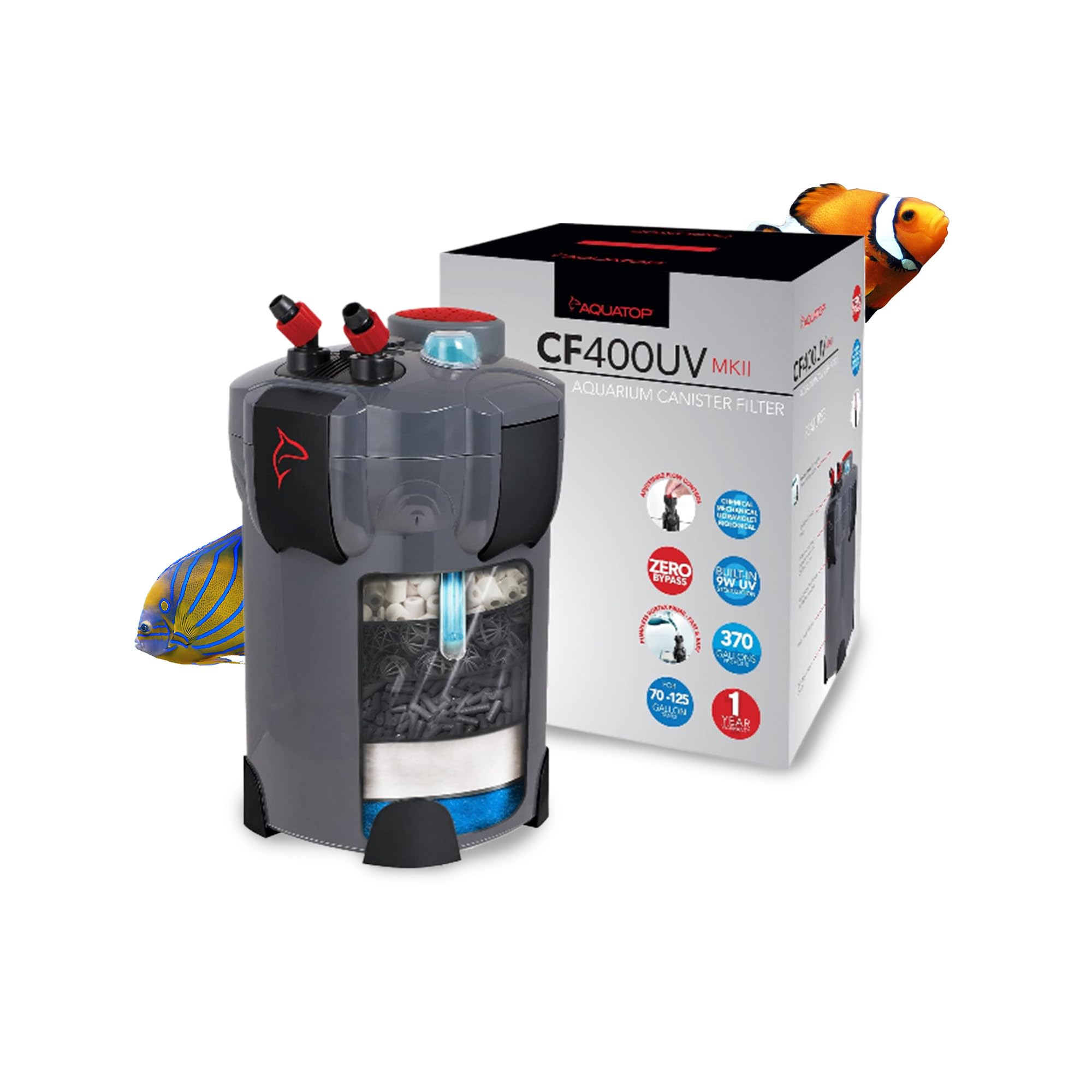
The CF-400UV MKII integrates a 9W UV clarifier directly into the 4-stage filtration loop, making it a direct solution for anyone fighting green water blooms. The 370 GHP flow rate is enough to turn over a 75-gallon tank five times per hour, and the three large media baskets (plus the UV chamber) hold an ample volume of ceramic rings, sponges, and carbon. Users report the UV clears algae-infested water in as little as 48 hours.
The priming system requires a manual 5-second push of the button, and the instructions advise filling the base three-quarters full with water before first start. Setup is straightforward once you understand that the intake hose can be hand-primed by adding water before attaching. The adjustable outflow nozzle lets you direct the return flow across the surface for oxygenation or down for circulation.
A known weak point: the O-ring seal at the head-canister connection can fail if the rim is not perfectly aligned, leading to leaks. A minority of users report this issue even with careful assembly. That said, when sealed correctly, the filter runs silently and the UV bulb is straightforward to replace annually. For the mid-range price point, you get canister-level media capacity plus UV sterilization.
Why it’s great
- Built-in 9W UV sterilizer clears green water and free-floating algae quickly
- Large media baskets with 4-stage setup allow flexible media stacking
- Adjustable outflow nozzle helps control water circulation and surface agitation
Good to know
- Priming requires holding the button for 5 seconds and may need help on first use
- O-ring alignment must be perfect to avoid leaks at the head-canister joint
3. SunSun HW-3000 PRO

The HW-3000 PRO delivers extreme flow—793 GPH adjustable down to 396 GPH—making it suitable for tanks from 75 gallons up to 150 gallons or more. The 5-stage filtration includes coarse and fine sponges, ceramic bio-balls, carbon, and a 9W UV sterilizer. The LCD display shows real-time flow rate, which is a rare convenience for monitoring pump health without opening the canister.
Setup requires careful hose alignment: the intake and outlet must be oriented correctly, and both hoses should be prefilled with water to create a siphon before plugging in. Once running, the pump is very quiet—owners with tanks in living rooms report no noticeable hum. The adjustable flow valve on the outlet hose lets you dial back the current for species that prefer calmer water.
The primary drawback is the post-cleaning reprime. Because the wide tubing traps a large air pocket, restarting the siphon after maintenance can take over an hour if you don’t manually fill the hose. The unit is also tall—handle with care if your stand is low. For the flow rate and UV inclusion, the HW-3000 PRO offers an excellent capacity-to-cost ratio.
Why it’s great
- 793 GHP flow handles extra-large and heavily stocked tanks with ease
- 5-stage filtration with UV gives comprehensive mechanical, chemical, biological, and sterilization coverage
- Adjustable flow valve lets you reduce current for sensitive species
Good to know
- Re-priming after cleaning can take over an hour due to wide tubing trapping air
- Tall canister design may not fit under low stands
4. Marineland Penguin 200
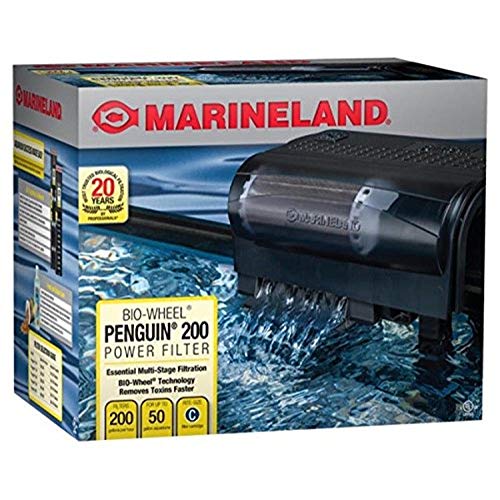
The Penguin 200 is the definitive hang-on-back filter for mid-sized tanks. The patented rotating Bio-Wheel provides wet/dry biological filtration by exposing beneficial bacteria to air during each revolution, which enhances nitrification efficiency compared to fully submerged media. The 200 GPH flow rate gives a 40-gallon tank five turnovers per hour: adequate for community fish and moderate planted setups.
Maintenance is straightforward: you swap the two Rite-Size filter cartridges when they clog, and the Bio-Wheel continues to spin even when the cartridges are removed, preserving the bacteria colony during changes. Users report the filter runs silently when the water level is high, with the only noise occurring if the wheel misaligns (easily corrected). The motor is known to last 10-15 years with basic impeller cleaning.
The downside is low flexibility in media choice. The filter is designed for Marineland’s proprietary cartridges, which generate ongoing cost. Some users mod by inserting homemade green scrubber pads in place of cartridges, but this voids the intended flow path. The lack of flow control means you get the full 200 GPH or nothing—no dialing down for fry or shrimp.
Why it’s great
- Rotating Bio-Wheel provides superior wet/dry biological filtration for robust nitrification
- Reliable motor with a decade-plus lifespan reported by long-term owners
- Very quiet operation when water level is maintained
Good to know
- Requires ongoing purchase of proprietary Rite-Size cartridges
- No flow adjustment—you cannot reduce current for delicate species
5. Aqueon QuietFlow Internal

The Aqueon QuietFlow Internal is the go-to choice when noise is the primary constraint. Fully submersible with a small footprint (about the size of a soda can), this filter produces an almost inaudible hum. It is designed for tanks where a hang-on-back’s waterfall splashing or motor hum would be disruptive—bedroom tanks or office desks. The flow is strong enough for a 29-gallon community tank.
Cleaning requires reaching into the tank to access the foam block, which is the trade-off for the silent operation. The simplicity of the design means fewer points of failure: there is no impeller housing to clog, no cartridges to replace—just a foam sponge that you squeeze out in old tank water. The exhaust flow direction can be rotated by twisting the body, allowing you to aim the output for surface agitation or bottom circulation.
Some users report vibration noise developing after a few months, likely from debris accumulating inside the impeller well. Dismantling and cleaning the impeller shaft with a soft brush usually resolves this. The lack of a flow control valve means output is fixed, and the biological media capacity is limited to the foam sponge itself—adequate for light stocking but insufficient for heavy bioloads.
Why it’s great
- Near-silent operation perfect for bedrooms or office tanks
- Very simple single-sponge design with no proprietary cartridges to buy
- Small footprint takes up minimal space inside the aquarium
Good to know
- Internal placement requires reaching into the tank for all maintenance
- Limited biological media capacity restricts use to lightly stocked setups
6. Atlantis Aqua 55-100 Gal

The Atlantis Aqua filter breaks from the internal filter norm by drawing water through the bottom rather than the sides, forcing a longer path through the media stack. This design prevents water from bypassing the sponge and bio-balls, a common efficiency loss in side-intake internals. The 55-100 gallon unit stands 15.3 inches tall and comes with removable sections that let you shorten it to 11.4 inches for smaller tanks.
The sponges are marketed as lifetime—rinse them out rather than replace. Coupled with the included bio-balls, this gives decent biological capacity for the price point. The built-in aeration spout oxygenates the water, and many users find it eliminates the need for a separate air stone. The filter is quiet during normal operation, though the oxygenation setting can produce a gentle bubbling sound.
Build quality is hit-or-miss. Several users report the propeller unit failing after 4-6 weeks, often after the first cleaning. The sealed plastic chambers can restrict waste suction if organic matter compacts at the intake. Customer service is variable—some owners get quick replacements, others report no response to warranty claims. For the no-replacement-pad promise, this filter works well initially but has inconsistent long-term reliability.
Why it’s great
- Bottom-water-intake design forces water through the full media stack for better filtration
- Lifetime sponges eliminate the recurring cost of filter pads
- Built-in aeration spout often removes the need for a separate bubbler
Good to know
- Some units fail within weeks, often after the first cleaning
- Customer service responsiveness is inconsistent; warranty claims may be ignored
7. Tararium IX-120

The IX-120 is built for the unique demands of turtle tanks, where water levels often run lower than standard aquariums and waste loads are high. It operates at a minimum water level of just 2.6 inches—critical for setups with basking platforms and partial water changes. The 3-stage filtration uses a dual-sided mesh sponge (white/black) for mechanical debris capture and a ceramic bio-ball chamber for biological breakdown, all housed in an adjustable-flow internal unit.
Installation is quick: the suction cups hold the filter securely to the aquarium wall, and the top-lid canister provides easy access to the media for rinsing. The waterfall return creates aeration and a calm trickling sound rather than a loud splash—users report it is quiet enough for a living room. The flow adjustment knob lets you dial back the 290 GPH for smaller tanks or less messy reptiles.
The primary gap is chemical filtration: there is no carbon compartment in the standard media set, so you would need to add a separate chemical media bag if you need to remove tannins or medications. The sponge mesh requires cleaning every few days under heavy turtle bioloads to maintain flow—if left to clog, the waterfall turns into a splashing stream. For the price, it is a competent turtle and amphibian filter but not a full-spectrum replacement for a canister in large fish-only tanks.
Why it’s great
- Operates at very low water levels (2.6 inches), ideal for turtle basking setups
- Adjustable flow lets you reduce current for sensitive animals or smaller tanks
- Dual-sided mesh sponge captures fine and coarse debris efficiently
Good to know
- No built-in chemical filtration media; you must add your own carbon for medication removal
- Sponge requires frequent cleaning under heavy bioloads to maintain flow rate
FAQ
Can I run two filters on the same tank for redundancy?
How often should I clean the biological media in a canister filter?
Why does my hang-on-back filter make a rattling noise?
Final Thoughts: The Verdict
For most users, the best aquifer filter system winner is the Fluval FX2 because its self-starting pump, periodic air-purge, and 1-gallon media capacity provide set-and-forget reliability for heavily stocked tanks. If you want UV sterilization built directly into the flow loop, grab the Aquatop CF-400UV MKII. And for a tuned turtle setup with low water levels, nothing beats the Tararium IX-120.