
Our readers keep the lights on and the weekend projects moving. As an Amazon Associate, I earn from qualifying purchases.
A murky tank with stressed fish is a sure sign your aquarium filter is undersized or inefficient. Whether you’re battling high bioloads from turtles, dealing with a planted community tank, or simply want crystal-clear water without monthly cartridge costs, the right filter makes the difference between a chore and a thriving ecosystem.
I’m Rikta — the co-founder and writer behind FitlyFast. This guide is built on comparing flow rates, filtration stages, media volume, and real user experience data across seven top-performing models to find which unit actually delivers on its promises.
After cross-referencing hundreds of owner reviews against published GPH ratings, media types, and build quality reports, the following analysis identifies the strongest contenders for the aquarium filter market today.
How To Choose The Best Aquarium Filter
Selecting the right filter depends on more than just tank volume. The type of livestock, your maintenance schedule, and the filter’s physical footprint all play into which unit will keep your water parameters stable without becoming a headache.
Flow Rate and Turnover
An ideal turnover rate cycles the entire tank volume 4-6 times per hour. A 55-gallon tank needs a filter rated for at least 220 GPH at the head height of your setup. High-bioload tanks — goldfish, turtles, or heavy plant loads — benefit from rates closer to 8-10 times per hour to keep ammonia and nitrites near zero.
Filtration Stages
A quality unit should offer at least two stages: mechanical (sponge or pad) to trap solids, plus biological media (ceramic rings, bio-balls, or bio-wheels) to house nitrifying bacteria. Chemical filtration with activated carbon is a bonus for removing tannins, odors, and medications, but is not essential long-term for a well-cycled tank.
Ease of Maintenance
Filters with reusable sponges reduce long-term consumable costs but require a consistent rinsing schedule (every 2-4 weeks in tank water). Canister filters offer the largest media volume and best biological capacity but typically take longer to disassemble for cleaning. Hang-on-back (HOB) units strike a balance between convenience and performance for most hobbyists.
Quick Comparison
On smaller screens, swipe sideways to see the full table.
| Model | Category | Best For | Key Spec | Amazon |
|---|---|---|---|---|
| Fluval FX2 Canister | Canister | Large tanks up to 200 gal | 475 GPH / 4 baskets | Amazon |
| Marineland Penguin 200 | HOB | Mid-size freshwater tanks | 200 GPH / Bio-Wheel | Amazon |
| EA Encompass 55 | HOB | Eco-conscious buyers | 220 GPH / 3-stage | Amazon |
| Coospider 400 GPH | Internal | Large tanks/turtle setups | 400 GPH / 3-layer sponge | Amazon |
| TARARIUM IX-120 | Internal | Turtle and reptile tanks | 290 GPH / bio-balls | Amazon |
| Atlantis Aqua 100 | Internal | Value-focused keepers | Bottom-draw intake | Amazon |
| Coospider 300 GPH | Internal | Entry-level budget builds | 300 GPH / dual sponge | Amazon |
In‑Depth Reviews
1. Fluval FX2 High Performance Canister Aquarium Filter
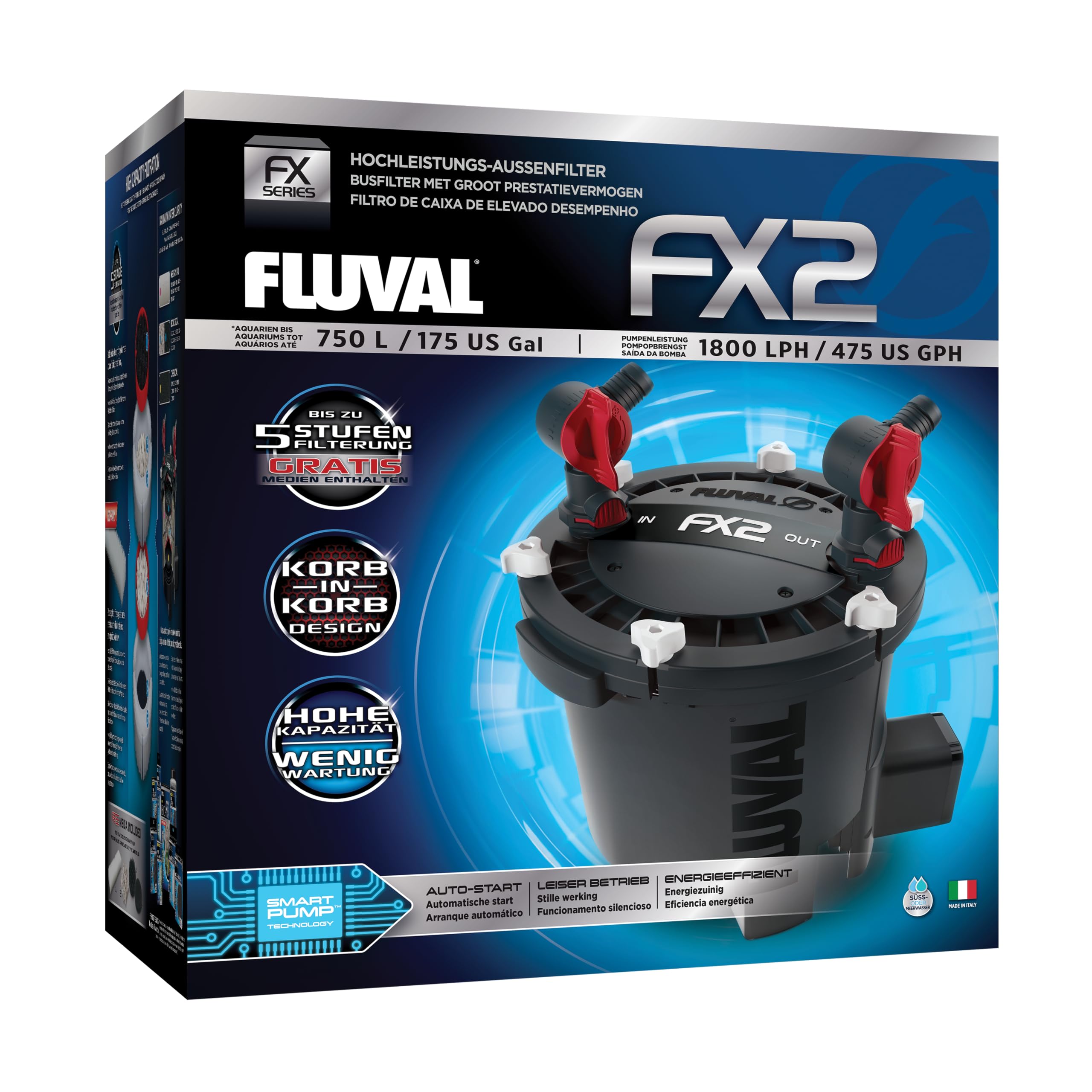
The Fluval FX2 is the undisputed powerhouse of this roundup, pumping 475 GPH through four independent media baskets that hold up to a full gallon of biological, mechanical, and chemical media. The Smart Pump microchip technology auto-evacuates trapped air every 12 hours, which means no manual priming and consistent flow even as media accumulates debris. Its compact 16.5-inch height and vibration-dampening rubber feet make it one of the quietest canister filters available for tanks from 75 to 200 gallons.
What separates the FX2 from HOB and internal filters is its ability to handle massive bioloads without spiking ammonia. The basket-in-basket design eliminates water bypass — every drop of water passes through the full media stack rather than sneaking around the edges. For turtle owners or heavily stocked cichlid tanks, this means months of stable water quality between deep cleans, as confirmed by users running 75-gallon setups that stay crystal clear with reduced maintenance frequency.
The included multi-functional utility valve allows direct water changes from the canister itself, saving significant time during weekly maintenance. While the upfront investment is higher than any HOB or internal option on this list, the long-term cost of ownership is lower due to the ability to buy bulk media rather than proprietary cartridges. The self-starting pump also eliminates the priming hassle common to older canister designs, making it accessible even for hobbyists new to external filtration.
Why it’s great
- Smart Pump self-primes and clears air automatically
- Four removable baskets prevent media bypass for maximum filtration efficiency
- Integrated water change valve reduces maintenance time
Good to know
- Premium upfront cost compared to HOB and internal filters
- Requires under-tank cabinet space for installation
2. Marineland Bio-Wheel Penguin 200 GPH Power Aquarium Filter
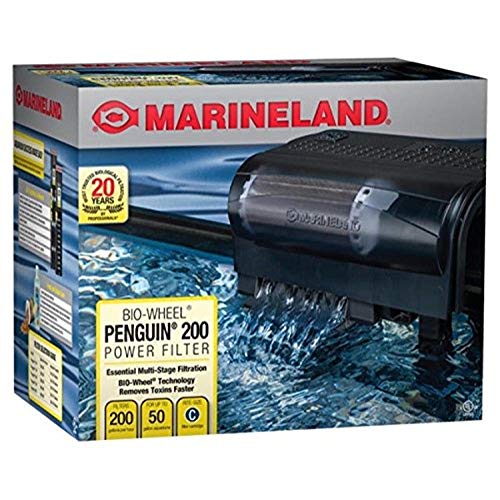
Marineland’s patented rotating Bio-Wheel technology provides excellent wet/dry biological filtration by exposing beneficial bacteria to both water and air, promoting a robust colony that handles moderate bioloads effectively. The multi-stage design delivers mechanical, chemical, and biological filtration in a compact HOB footprint that fits flush against the tank rim. At 200 GPH, this unit is ideal for tanks up to 40 gallons and provides strong surface agitation for gas exchange.
Owners consistently report that the Penguin 200 clears cloudy water within 10 minutes of installation, and the adjustable intake height accommodates varying water levels. The two cartridge slots allow for customization — many experienced hobbyists replace the stock carbon cartridges with bulk filter floss or ceramic media for improved long-term value. When the water level is maintained properly, the unit operates quietly, though a low water level can cause a gurgling sound as the Bio-Wheel skims the surface.
The Penguin series has a reputation for reliability that spans over a decade, with multiple users reporting 10-15 year service lives when maintained properly. It is not self-priming — you must fill the reservoir with water at startup — but once running, it maintains prime reliably. The plastic housing is robust and the Bio-Wheel mechanism is easy to inspect and clean. For a mid-range HOB that balances performance, noise, and cost, this remains a benchmark choice.
Why it’s great
- Patented Bio-Wheel provides superior biological filtration for a HOB
- Very quiet when water level is maintained
- Extremely reliable with decade-long service life reported
Good to know
- Requires manual filling at each startup
- Proprietary cartridges add recurring cost if not modified
3. EA Encompass All Performance Hang-On Power Filter

The EA Encompass delivers a true three-stage filtration system — mechanical polyfiber floss, chemical activated carbon, and biological hi-flow sponge — in a dual-slotted body that effectively doubles its capacity compared to standard HOB designs. The 220 GPH flow rate is calibrated for tanks up to 55 gallons, and the no-mess cartridges keep hands dry during replacement. The manufacturer emphasizes low cost of ownership, and the filter is built to accept standard media pouches rather than forcing proprietary refills.
Experienced owners praise the generous media chamber that allows customization with bulk ceramic rings or additional sponge layers. The flow control valve is simple — high or low — but most users find the low setting suitable for planted tanks and the high setting for high-bioload setups. The unit runs very quietly with only a slight vibration, though some users note that the low setting can still produce too much current for sensitive species like bettas or shrimp without a pre-filter sponge or baffle on the return.
One recurring consideration involves the intake design: the slots are wide enough that small shrimp, fry, and snails can be drawn in, so a fine mesh pre-filter is recommended for community tanks. The filter sits slightly crooked on some rimmed tanks, but an included leveling insert helps stabilize it. Backflow during power outages can cause minor splashing, so ensure the water level is set below the return lip. Overall, this is a solid mid-range HOB that rewards customization.
Why it’s great
- Generous media chamber allows customization with bulk media
- Dual-slotted body doubles filtration capacity
- Very quiet operation with minimal vibration
Good to know
- Intake slots can trap small shrimp, fry, and snails
- Backflow can cause splashing during power interruptions
4. Coospider Internal Aquarium Filter 400 GPH
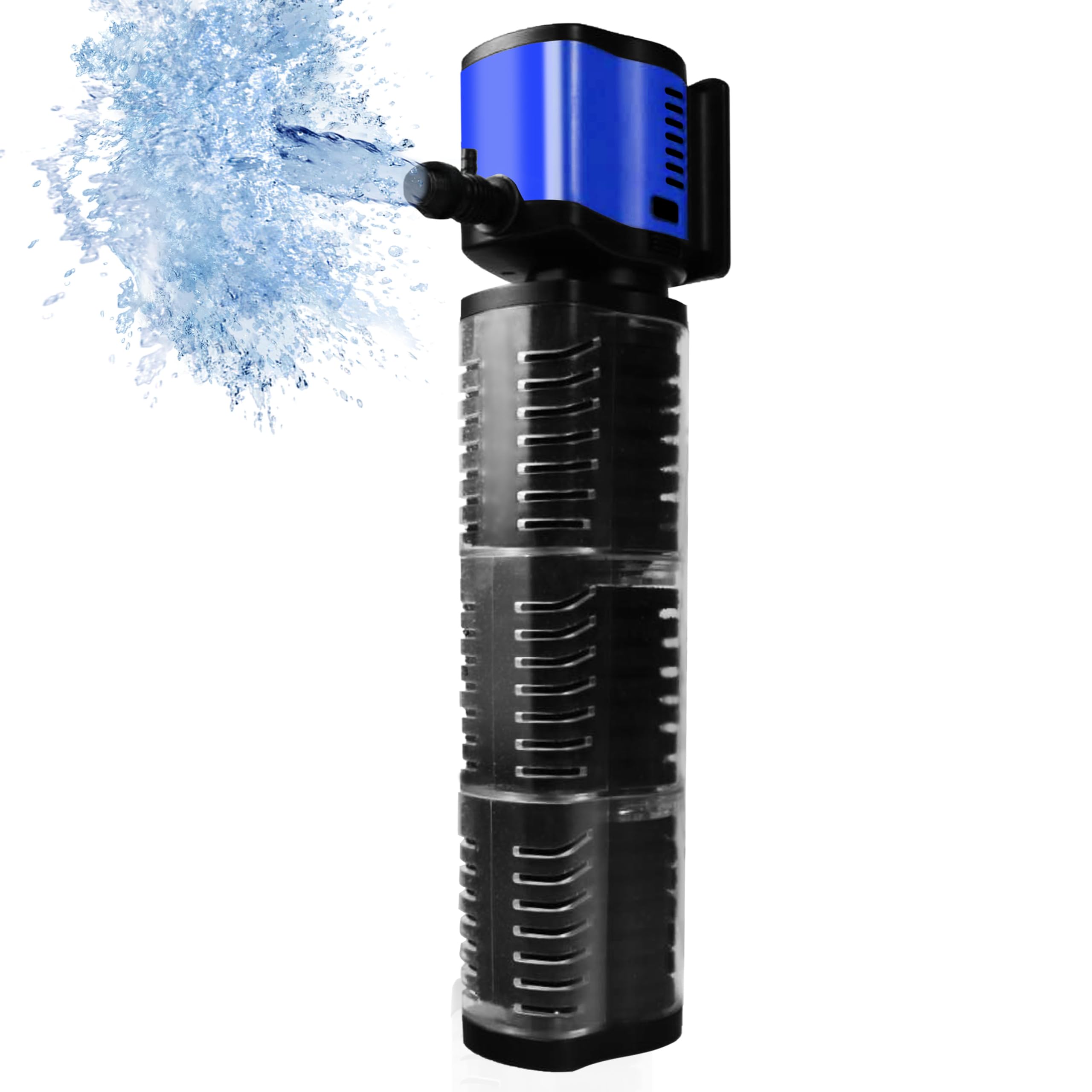
The Coospider 400 GPH internal filter packs serious flow into a fully submersible, detachable body designed for tanks from 75 to 200 gallons. Its three-layer sponge system handles mechanical and biological filtration, while the adjustable valve on the output creates oxygenation through surface agitation. The detachable sections allow you to customize the height — remove the lower section for shallow tanks or add it back for deeper setups, making it versatile across multiple tank configurations.
In real-world use, this filter excels at clearing turtle tanks and high-waste freshwater aquariums. Owners of 40-gallon turtle setups report the water becoming visibly clean within 12-16 hours of installation, and the quiet operation is a consistent highlight — barely a hum even at full flow. The lack of an integrated waterfall or fine-flow adjustment means the output can be quite strong, which some fishkeepers address by adding a PVC pipe with drilled holes to diffuse the current over a wider area.
The reusable sponges eliminate recurring cartridge costs, and the tool-free disassembly makes cleaning straightforward — simply unclip the sections and rinse the sponges in old tank water. For tanks under 15 inches tall, the filter can be laid flat or run with a section removed to fit the water column. The main trade-off is that the flow is effectively constant without a bypass valve, so it is best suited for fish and turtles that appreciate strong water movement rather than still-water species.
Why it’s great
- Detachable body fits multiple tank heights and depths
- Strong flow rapidly clears high-bioload turtle and large fish tanks
- Reusable sponges with no ongoing cartridge costs
Good to know
- No fine flow adjustment — output is continuously forceful
- Intake may require pre-filter sponge for smaller fish
5. TARARIUM IX-120 Internal Filter

The TARARIUM IX-120 is purpose-built for reptile and turtle tanks, with a flow rate of 290 GPH that cleans tanks from 20 to 75 gallons. Its unique three-stage design combines a dual-sided mesh sponge (white and black layers for different particle sizes) with a chamber of ceramic bio-balls that provide massive surface area for nitrifying bacteria. The waterfall output adds surface agitation for natural aeration without the noise of a spray bar, and the steady flow is adjustable via a built-in control valve.
Operates at water levels as low as 2.6 inches, making it one of the best options for shallow reptile setups where evaporation is common. The top-lid canister design allows quick access to the media without removing the entire unit from the tank — simply lift the lid, swap or rinse the sponge, and replace. Owners running 50-gallon tanks report the water stays clear and the gentle flow prevents turtles from being pushed around, while the ceramic bio-balls effectively control odor that often accompanies high-protein reptile diets.
Installation takes just a couple of minutes with the included suction cups, though some large tank setups (75 gallons) find that the weight of the water inside the filter causes the suction cups to fail over time. A simple bridge or support underneath resolves this. The filter is fully submersible and works in both freshwater and saltwater environments, making it versatile for brackish setups. The single-year support with 24-hour response is a nice safety net for a mid-priced specialty filter.
Why it’s great
- Lowest water level operation at 2.6 inches — ideal for shallow reptile tanks
- Quick-access top lid for media changes without removal
- Adjustable flow control valve for gentle or strong current
Good to know
- Suction cups may fail on larger tanks without support
- Not ideal for heavy planted tanks requiring low flow
6. Atlantis Aqua 100 Internal Aquarium Filter

The Atlantis Aqua 100 takes a different approach to internal filtration: instead of drawing water through the sides, it pulls water through the bottom of the unit. This forces the entire water column to travel through the full sponge and bio-ball media stack rather than taking the path of least resistance. The result is more consistent particle capture and a longer contact time with biological media. The filter measures 15.3 inches tall but can be reduced to 11.4 inches by removing a section for smaller tanks.
Owners upgrading from stock hang-on-back filters report a noticeable improvement in water clarity within days, and the built-in oxygenation from the return flow eliminates the need for a separate air stone in many setups. The sponges are designed to last a lifetime with bi-weekly rinsing — no expensive monthly cartridge replacements. The detachable sections unclip for easy cleaning, and the kit includes bio-balls that provide additional surface area for beneficial bacteria colonization.
The sealed plastic chamber design is the main point of contention. While it forces full media contact, some users report that the motor loses performance after a month or two and eventually stops working. Customer service responsiveness appears inconsistent based on owner reports, which is worth noting for such a critical piece of equipment. For the price-conscious hobbyist who wants a low-maintenance internal filter with no replaceable parts, it is a good option if the sealing issues are addressed in the unit you receive.
Why it’s great
- Bottom-draw intake ensures full water contact with all media
- Lifetime sponges eliminate ongoing filter pad costs
- Integrated oxygenation removes need for separate air stone
Good to know
- Sealed chamber design may lead to motor failure in some units
- Not suitable for shrimp or small fry due to intake openings
7. Coospider Internal Filter 300 GPH

The Coospider 300 GPH internal filter offers a straightforward entry point for budget-conscious aquarists with tanks from 55 to 150 gallons. Its dual-stage black biochemical sponge catches debris while an adjustable valve on the output increases oxygen levels through surface agitation. The pump uses a wave-making effect that improves circulation — a feature more commonly found on higher-priced powerheads. The body detaches into sections, and for shallow tanks under 15 inches, you can lay it flat or remove the lower sponge to fit.
Owners upgrading from tired stock filters consistently report it outperforms expectations for the cost, with a 75-gallon tank clearing noticeably within 12-16 hours. The unit is genuinely quiet — described as a low hum rather than the loud vibration of older budget pumps. The reusable sponge means no recurring purchases, and the simple clip design makes disassembly for rinsing easy. For a 20-gallon tank, some users even found it overkill, opting to run it for shorter cycles to avoid too much current for small fish.
The significant omission is the lack of any flow adjustment or waterfall feature. The output is constant and forceful, which can stress fish that prefer calm water. Several owners who returned the unit cited this single issue — the flow was too strong even for their intended tank sizes. Adding a homemade baffle (like a PVC pipe with holes) mitigates this, but it requires an additional step. For turtle keepers and large cichlid tanks where strong current is welcome, this filter delivers excellent value and effective cleaning with minimal maintenance.
Why it’s great
- Excellent budget-friendly price point for large tank filtration
- Wave-making pump improves water circulation effectively
- Very quiet operation with low vibration
Good to know
- No flow adjustment — output is always forceful
- Not suitable for calm-water fish without an external diffuser
FAQ
Can I use a filter rated for a larger tank on my smaller tank?
How often should I clean the filter media?
Final Thoughts: The Verdict
For most users, the aquarium filter winner is the Fluval FX2 Canister because it offers unmatched biological capacity, self-priming convenience, and the quietest operation for large tanks. If you want reliable HOB filtration with a proven Bio-Wheel, grab the Marineland Penguin 200. And for a budget-friendly internal option that handles turtle tanks and high-waste setups, the Coospider 400 GPH delivers surprising power for the cost.