
Our readers keep the lights on and the weekend projects moving. As an Amazon Associate, I earn from qualifying purchases.
Every time you stick a tube into your tank and start a siphon, you are gambling on a chemical imbalance that can stress livestock. A gravel vacuum that fails to pull debris from deep substrate layers leaves rotting organic matter to spike ammonia and nitrate levels, turning a weekly chore into a slow-motion crash. A properly designed unit removes both water and waste simultaneously, preserving the biological filter while exporting nitrogenous compounds before they break down.
I’m Rikta — the co-founder and writer behind FitlyFast. I’ve spent hundreds of hours cross-referencing siphon mechanisms, tubing diameters, and flow regulator designs across dozens of models used in planted tanks, high-flow cichlid setups, and small nano aquariums.
This guide breaks down seven of the most reliable options currently available and explains exactly what separates a tool that actually cleans from one that merely stirs things up. You’ll learn which features matter for your tank volume, substrate type, and fish sensitivity when choosing the best aquarium gravel vacuum for your routine maintenance plan.
How To Choose The Best Aquarium Gravel Vacuum
A gravel vacuum is not a one-size-fits-all purchase. The ideal unit depends on tank size, substrate type, livestock sensitivity, and how much mess you are willing to make. Understanding a few key variables prevents buying a tool that either blasts through the tank in twenty seconds or takes an hour to drain ten gallons.
Tank Volume and Tube Diameter
Larger tubes move more water per minute, which speeds up water changes but also removes more water before you finish cleaning the gravel. A wide-bore intake on a 30-gallon tank can pull out twenty percent of the volume in under two minutes, leaving little margin for error if you need to spot-clean a specific area. Narrow tubes offer slower flow, giving you more control and less wasted water, but they take longer for big tanks. Match the intake diameter to your tank volume — medium bore for tanks between 20 and 55 gallons, small bore for tanks under 20 gallons, and large bore for tanks above 55 gallons.
Priming Mechanism — Squeeze Bulb Versus Pump Versus Mouth
How you start the siphon determines how often you actually use the tool. Squeeze bulbs built into the hose line — like those on the Fluval models — allow one-handed priming without putting your mouth on the tubing. Manual self-priming tubes use a back-and-forth motion in the water to start the flow, which works reliably once you get the rhythm but requires two hands and a bit of practice. Mouth-priming units are cheaper but introduce a hygiene risk and a slight chance of contaminating the tank with mouth bacteria. For frequent weekly use, a squeeze bulb is the clear time-saver.
Flow Regulator and Control
A thumb-operated valve or slide mechanism lets you dial down the suction rate during water changes, which is essential when cleaning around small fish, fry, or delicate plant roots. Without a regulator, the vacuum pulls at full force the entire time, making it harder to spot-clean without pulling out gravel or sucking up baby shrimp. Look for a model that provides a continuous control range rather than just an open-close toggle — a smooth glide valve gives much finer adjustments.
Quick Comparison
On smaller screens, swipe sideways to see the full table.
| Model | Category | Best For | Key Spec | Amazon |
|---|---|---|---|---|
| Python No Spill 10ft Extension | Extension Kit | Connecting to faucet drain systems | 10 feet, vinyl tubing | Amazon |
| Aqueon Large 16-Inch | Self-Priming | Large tanks 40+ gallons | 16-inch intake tube, 6-ft hose | Amazon |
| Fluval GravelVAC Small | Bulb Primed | Planted tanks and fine control | 50 cm tube, thumb regulator | Amazon |
| Python Pro Clean Medium | High Flow | Quick water change on 30-55 gal | Medium for tanks to 20 gal | Amazon |
| Fluval Gravel Cleaner Kit A370 | Canister System | Connecting to FX canister filters | 1.7 lb integrated filter bag | Amazon |
| AREPK Compact Kit | Multi-Head | Small tanks and detail cleaning | Three interchangeable heads | Amazon |
| Seltomer 7ft Hand Pump | Budget | Entry-level users | 7 ft hose, squeeze ball | Amazon |
In‑Depth Reviews
1. Python No Spill Clean and Fill 10-Foot Extension

This is not a standalone vacuum — it is a critical upgrade for anyone already running a Python No Spill system who finds the standard 25-foot hose just short of the sink. The 10-foot extension adds the reach needed to run the drain line across a kitchen floor or up to a utility sink without stretching the tubing taut, which causes kinks and airflow interruptions. Both a male and a female adapter are included, so you can attach it at either end of your existing hose without buying extra fittings.
The vinyl material is the same grade as the original Python hose — flexible enough to bend around cabinet corners but stiff enough to hold its shape when draped over a bucket rim. Several users in larger homes reported that the added length turned a messy bucket-carrying chore into a ten-minute hands-free process, and none reported leaks or separation at the connection point. The clarity of the tubing also lets you see the debris being pulled through, giving visual confirmation that the vacuum is actually working.
Be aware that this is purely a hose extension — it does not include the gravel tube, the faucet adapter, or any siphon-start mechanism. You need an existing Python Clean and Fill kit to make use of it. For those with deep tanks or inconvenient faucet locations, however, the extra length is the difference between a water change that gets done and one that gets skipped.
Why it’s great
- Seamless connection with no leak worries
- Provides critical extra reach for floor-level buckets or distant sinks
- Clear tubing lets you see debris flow
Good to know
- Works only with Python No Spill systems
- No gravel tube or pump included
2. Aqueon Aquarium Siphon Vacuum Gravel Cleaner Large

The Aqueon Large uses a self-priming design that requires no squeeze bulb or mouth contact. You submerge the intake tube and move it up and down rapidly in the water a few times to start the siphon — once flow begins, it pulls water and debris out through the six-foot drain hose with surprising speed. The large 16-inch intake tube is built for tanks of forty gallons and above, and it moves enough water to complete a twenty-percent change on a 55-gallon tank in under ten minutes.
The included hose clip fastens to the inside of a bucket rim, keeping the drain line in place and preventing the hose end from flopping out and spraying water across the floor. Users who have tried both this and a faucet-attached Python generally prefer the Aqueon for its simplicity — no threading connectors onto a sink, no worrying about backflow, just a straight line from tank to bucket. The wide bore also handles heavy mulm and large waste particles without clogging, which is a frequent problem with narrower tubes in cichlid tanks.
The trade-off is that starting the siphon can be tricky at first. Several reviewers noted that it requires a decent lungful of air to get the column moving, and the hose tends to fold over the rim of tall tanks if the distance is not perfectly aligned. Also, the large size is physically unwieldy in tanks under 30 gallons — the tube alone is almost as long as the tank height, making maneuvering around driftwood or plant stems awkward.
Why it’s great
- No bulb or mouth contact for priming
- Fast flow rate for large tanks
- Bucket clip prevents spills
Good to know
- Siphon start can take practice
- Too big for tanks under 30 gallons
3. Fluval GravelVAC Multi Substrate Cleaner Small

The Fluval GravelVAC stands out for its squeeze-bulb priming and variable flow control, making it the most refined manual vacuum in this lineup. The rubber bulb sits inline with the hose — a few squeezes start the siphon without putting your mouth anywhere near the tubing, and the thumb-operated valve on the handle allows you to adjust suction from a gentle trickle up to full flow. This is critical when working in a planted tank where you need to vacuum around carpeting plants or near rooted stems without pulling up the substrate.
The small model has a 50-centimeter tube, which is ideal for tanks between 10 and 30 gallons. It ships with multiple intake tips, including a wider gravel guard that prevents large pebbles from jamming the tube and a slimmer nozzle for sand or fine substrate. The extension tube included lets you reach the bottom of taller tanks without submerging your entire forearm. Several planted-tank owners reported that the adjustable flow let them do precision cleanups in high-tech aquascapes without disturbing moss mats or uprooting dwarf baby tears.
On the downside, the plastic body feels lighter and slightly less robust than the Python units. A few users received units in crushed boxes, but the vacuum itself survived undamaged. The flow regulator requires a bit of finger strength to slide smoothly when your hands are wet and cold — those with smaller hands may find the lever stiff during a long water change. Overall, though, for control and convenience at a fair price, this is hard to beat.
Why it’s great
- Bulb priming avoids mouth contact
- Variable flow control for fine maneuvering
- Suitable for both gravel and sand
Good to know
- Body feels lightweight
- Flow lever can be stiff when wet
4. Python Pro Clean Medium

The Python Pro Clean Medium is a straightforward, no-frills gravel vacuum that relies on manual shake-priming to get the siphon going. You submerge the tube, shake it up and down in the water a few times, and gravity takes over. Once the flow starts, the medium bore pulls water and debris at a rate that drains a 36-gallon tank by about twenty percent in a few minutes, making it a solid choice for routine partial water changes without spending an hour at the tank.
The tube is made from flexible, non-toxic plastic that has no off-gassing smell, and it can be cut shorter if needed — a trick several users employed when using it in smaller tanks where the full tube length was cumbersome. The medium size is officially labeled for tanks up to 20 gallons, but the reviews consistently show it being used effectively in 30, 36, 55, and even 75-gallon tanks. The reason is simple: the tube bore provides strong suction that pulls waste from deep substrate layers, and the high flow rate is welcome in larger volumes.
Where this model falls short is in precision. There is no flow regulator, so the water and debris come out at full speed the entire time. If you are trying to spot-clean a patch of gravel near a cluster of fish eggs or tiny fry, you will almost certainly suck them up. The large tube also makes it difficult to maneuver around decor in heavily planted tanks. It is best suited for bare-bottom quarantine tanks or tanks with simple hardscape where speed is more important than surgical precision.
Why it’s great
- Fast flow rate changes water quickly
- Non-toxic, odorless plastic
- Simple mechanism with few parts
Good to know
- No flow regulator for precise control
- Tube is large for heavily planted tanks
5. Fluval Gravel Cleaner Kit A370

The Fluval A370 is a specialized cleaning system designed to integrate directly with the Fluval FX series canister filters. Instead of draining water to a bucket or sink, this kit attaches to the filter output valve and uses the filter pump to push water through a built-in debris collection bag before returning clean water to the tank. The bag traps waste particles, and the water is sent back to the aquarium immediately — no water removal, no buckets, no floor spills.
Turtle owners and large-cichlid keepers particularly praise this kit because it handles bulky waste like shell fragments and heavy turds that would clog a standard siphon. The debris bag collects the gunk before it can re-enter the filter, preventing the canister from becoming a debris-recirculation loop. Setting it up takes about ten minutes, and once the hoses are connected, you can clean the substrate at any time without having to worry about matching water temperature or dechlorinating replacement water.
The main caveat is compatibility — this kit is not a general-purpose gravel vacuum. It only works with Fluval FX canister filters, and the hose connections require precise alignment to avoid leaking at the utility valve. Several users reported that the suction cups on the filter bag mount dislodged under full flow, causing the bag to hang loose inside the tank. Also, the collection bag must be cleaned and dried thoroughly after each use to prevent mold growth. For Fluval FX owners, it is a premium upgrade; for everyone else, it is an expensive paperweight.
Why it’s great
- No water removal needed — filters and returns
- Handles bulky waste without clogging
- Reduces need for manual water changes
Good to know
- Only works with Fluval FX canisters
- Suction cups may detach under heavy flow
6. AREPK Compact Aquarium Siphon Vacuum

The AREPK kit is designed for small aquariums between 5 and 20 gallons, and its defining advantage is the set of three interchangeable cleaning heads. A narrow straw attachment reaches into crevices between rocks and wood, a fan-shaped spreader distributes suction over a wider area to clean plant leaves without pulling up the plant itself, and a brush-sponge attachment scrubs glass and decor while you drain water. This multi-function approach reduces the number of separate tools you need to maintain a nano tank.
The squeeze-bulb primer works reliably — a couple of pinches and the siphon runs steadily through the clear tubing. The tube material is fish-safe and odorless, and the pipe fixing clamp holds the drain line in place inside a bucket, preventing the inevitable wet-foot moment when the hose flops loose. Owners with tanks as small as 3 gallons confirmed that the kit handles detailed spot cleaning without draining the entire tank, which is essential for maintaining stable water parameters in very small volumes.
Durability is the main concern here. Multiple reviews noted that after about two months of weekly use, the pump bulb lost elasticity and stopped holding a seal, causing the siphon to fail mid-cleaning. The interchangeable heads also use plastic fittings that can crack if over-tightened. For the price, it is a fantastic multi-tool for small tanks, but plan on replacing it annually if you clean weekly. Not a buy-it-for-life piece — more of a reliable season-long companion.
Why it’s great
- Three cleaning heads for different jobs
- Excellent for nano tanks under 10 gallons
- Brush attachment scrubs glass during water change
Good to know
- Pump bulb may fail after a few months
- Plastic fittings can crack under strain
7. Seltomer 7ft Hand Pump Aquarium Gravel Vacuum
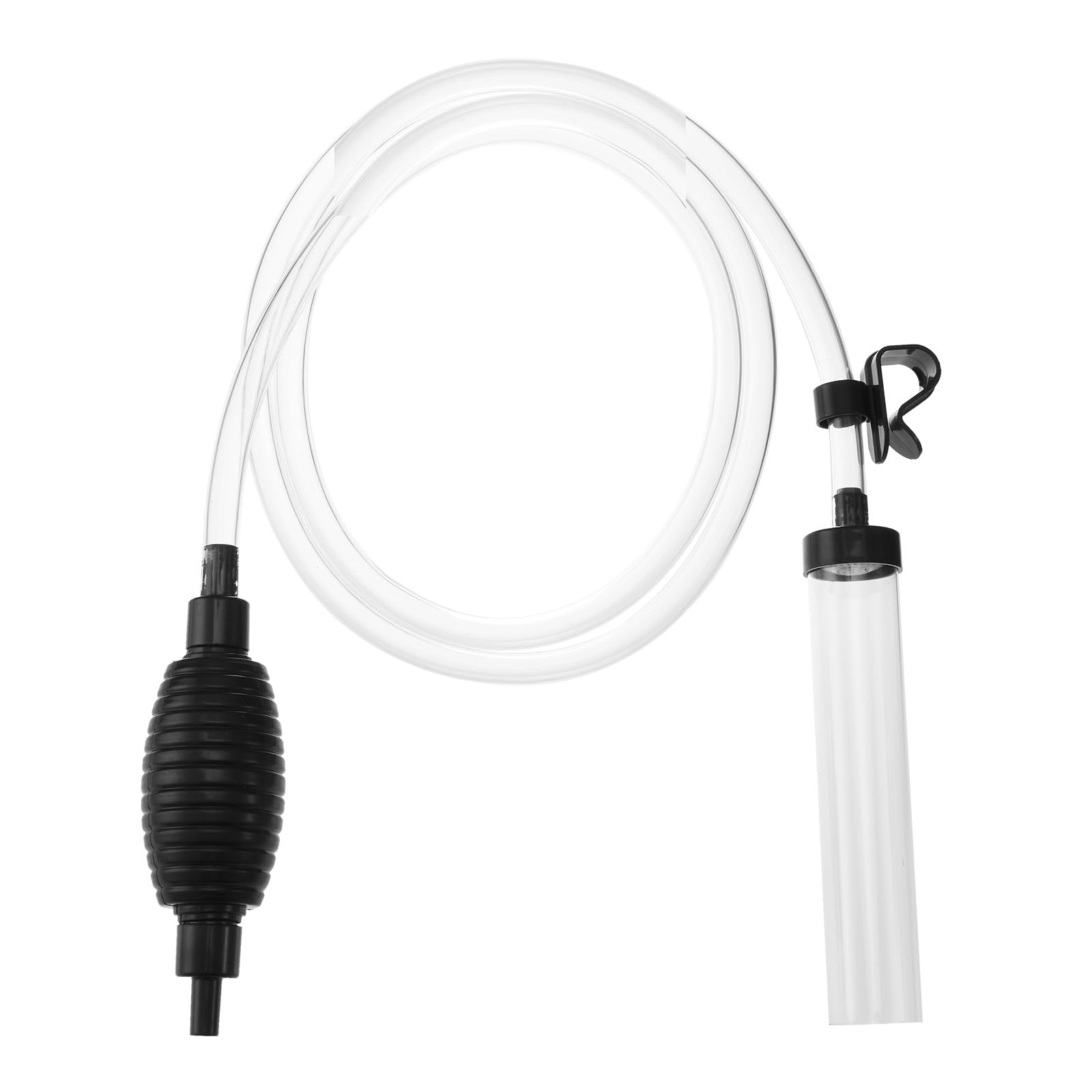
The Seltomer kit is the most entry-level option here, and it is a perfectly functional tool for beginners who want a simple, no-surprise gravel vacuum. The 7-foot hose provides enough reach to go from a standard 10-gallon or 20-gallon tank to a nearby bucket, and the squeeze-ball primer gets the siphon going in three or four quick pinches. The tube is transparent, so you can watch gravel, mulm, and food particles being pulled up as you move the intake around.
A detachable filter screen inside the gravel tube prevents small fish, fry, and shrimp from being sucked into the line — a thoughtful addition that many budget vacuums omit. The screen also prevents large gravel pieces from jamming the tube, though it does reduce the overall suction slightly compared to a screen-less design. Owners of 10-gallon and 29-gallon tanks reported that the kit performed well for routine maintenance, clearing debris efficiently without disturbing the substrate bed.
Build quality matches the price point. The plastic feels thin, and the hose is not as kink-resistant as the more expensive Python or Fluval tubing — if the hose bends sharply around a table leg, the flow can stall. The 3-month warranty is short, and a few users reported the squeeze ball developing cracks after heavy use. For a first gravel vacuum or as a spare for temporary quarantine tanks, it works.
Why it’s great
- Simple squeeze-ball priming
- Screen protects fry and shrimp
- Good value for basic use
Good to know
- Plastic feels thin and fragile
- Hose can kink and stall flow
FAQ
Can I use a gravel vacuum on sand substrate without sucking all the sand out?
How often should I gravel vacuum a planted tank?
Why does my siphon keep stopping mid-cleaning?
Final Thoughts: The Verdict
For most users, the best aquarium gravel vacuum winner is the Fluval GravelVAC Small because the squeeze-bulb priming and thumb-operated flow regulator give you precise control over suction, which is the single most important feature for maintaining a planted or community tank without stressing livestock. If you want a simple, high-flow tool that works on larger tanks with minimal fuss, grab the Aqueon Large Siphon Vacuum. And for nano tanks where every ounce of water counts, nothing beats the multi-head flexibility of the AREPK Compact Kit.