
Our readers keep the lights on and the weekend projects moving. As an Amazon Associate, I earn from qualifying purchases.
Specs are compiled from manufacturer listings and verified buyer reviews and can change over time — please confirm the key details on the product page before buying.
That burning ache in your arch after three miles, the jarring landing that makes your knees wince — those are signs your shoes need help from the inside. An insole that fits your foot’s natural curve does more than soften the blow; it keeps your entire stride aligned so every step forward is stable rather than painful.
I’m Rikta — the founder and writer behind FitlyFast. This guide is built by comparing the manufacturers’ published specifications and the patterns across verified customer reviews, so you get each pick’s real strengths and trade-offs instead of marketing spin.
The right pair of arch supports for running can turn discomfort into momentum — here are the options that actually deliver on that promise.
Quick Picks
- CRUVHEAL Running Insoles Men Women — Best Overall
- Move Game Day Performance Insoles — Pro Grade
- Superfeet Run Cushion Low Arch Insoles — Smart Value
- CURREX RunPro Insoles for Running Shoes — Tailored Fit
- Welnove Running Insoles for Men & Women — Explosive Power
- CRUVHEAL Sport Shock Absorbing Insoles — All-Day Stand
- Running Sports Insoles Plantar Fasciitis — Budget Champion
How To Choose The Best Arch Supports For Running
A running insole needs to do three jobs at once — absorb the shock of each footstrike, hold your arch at its natural height, and keep your heel from sliding inside the shoe. The wrong insole can cause more pain than it fixes, so here is what to look for.
Match the Arch Profile to Your Foot
Low arches (flat feet) need a supportive, firm platform that prevents the arch from collapsing inward. High arches need deeper cushioning to absorb shock, because a rigid arch does not absorb impact naturally. Mid-profile insoles suit most neutral runners. If the data offers a low, medium, and high option — like the CURREX RunPro — that is a sign the maker understands feet vary a lot.
Heel Cup Depth and Lock
A deep, contoured heel cup wraps around your heel bone, which stops your foot from shifting sideways inside the shoe. That reduces friction blisters and keeps the insole where it belongs. Shallow heel cups let your foot slip, and that movement can create new hot spots during long runs.
Quick Comparison
| Model | Best For | Weight | Arch Profile | Key Material | Amazon |
|---|---|---|---|---|---|
| CRUVHEAL Running Insoles | Shock absorption & runner’s knee | 8.78 oz | Medium (TPE support) | Gel + PU | Amazon |
| Move Game Day Performance Insoles | Professional-level arch & shin splints | 3.84 oz | Patented arch | Composite heel | Amazon |
| Superfeet Run Cushion Low Arch | Low arches and daily trainers | 4.83 oz | Low (Adaptive Comfort) | Moisturewick foam | Amazon |
| CURREX RunPro Insoles | Customizable arch height for runners | 4.96 oz | Low/Med/High (3D Dynamic) | PORON foam | Amazon |
| Welnove Running Insoles | Explosive energy return for sprints | 10.58 oz | TPU stabilizer | GEL + PU foam | Amazon |
| CRUVHEAL Sport Shock Absorbing Insoles | All-day standing & wide feet | 5.93 oz | Neutral arch | Gel pads | Amazon |
| Running Sports Insoles Plantar Fasciitis | Lightweight relief for flat feet | 4.16 oz | Ergonomic arch | Soft foam | Amazon |
In‑Depth Reviews
1. CRUVHEAL Running Insoles Men Women
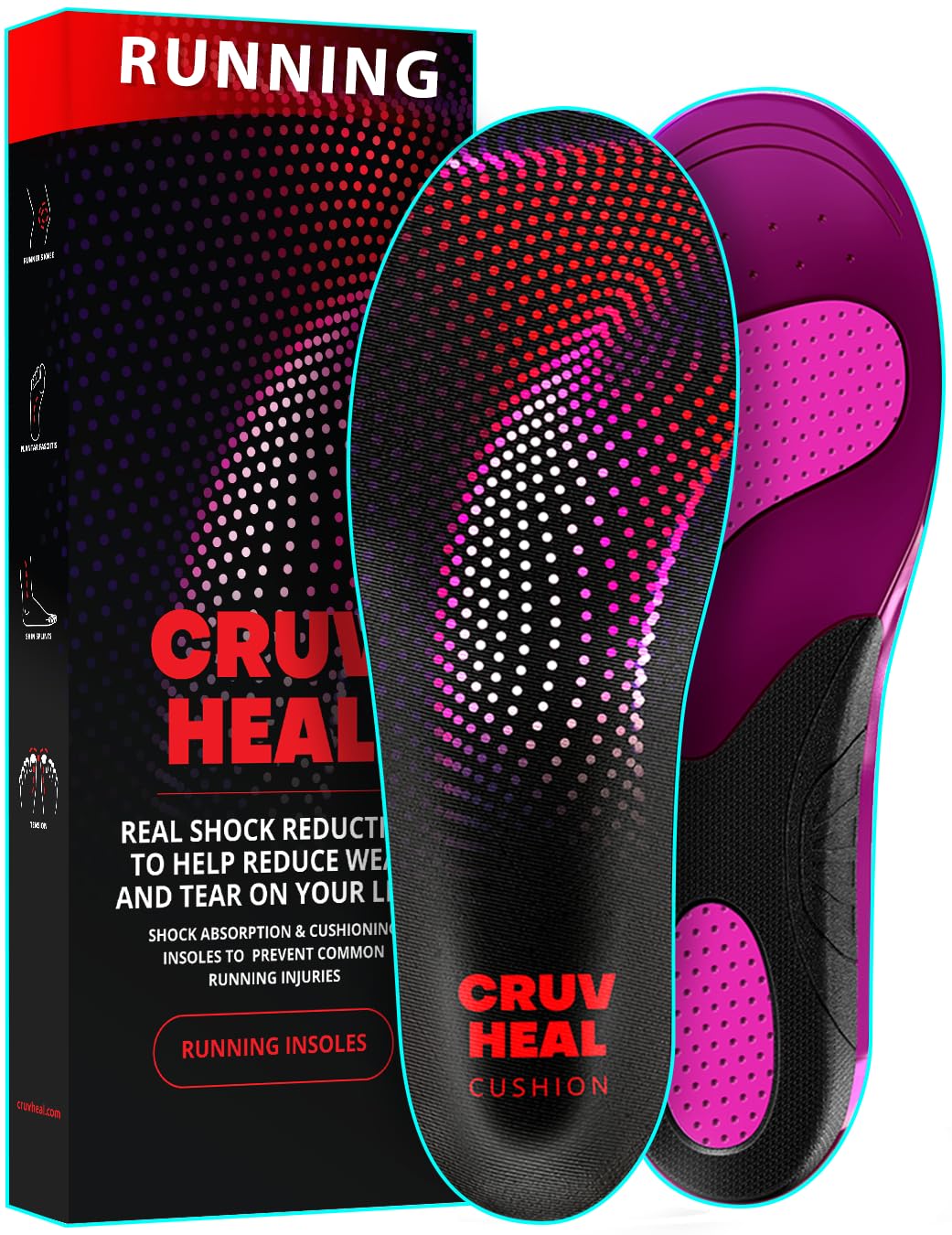
The balanced shock absorber that quiets runner’s knee mile after mile.
Your knees take the heaviest beating on pavement, and this insole targets that specific problem. The U-shaped heel design works with a TPE arch support (a flexible thermoplastic that holds its shape) to provide stability, while the gel cushioning underneath absorbs the jolt of each footstrike so your joints feel less of the rebound. Reviewers report that after a one-week adjustment period, the arch support eliminates foot pain on longer walks — one reviewer noted buying twice and said they “would buy again and recommend.” Make sure to allow 3-7 days for your feet to adapt, starting with 2-5 hours of daily wear.
At 8.78 ounces these are heavier than the lightest insoles in this guide (4.16 ounces), but that added heft comes from the dense gel layer that handles shock absorption well. One catch: a few buyers found the arch too high, which caused hip pain during longer runs — so if you have a naturally low arch, check the fit carefully before committing.
What makes it the overall pick
- U-shaped heel and gel layer reduce runner’s knee and shin splints effectively
- Skin-friendly velvet cover keeps feet odor-free during long runs
- Can be trimmed to fit most sport shoes and casual boots
The trade-off to know
- Arch height may be too aggressive for runners with naturally flat feet
- Heavier than the Running Sports Insoles at 8.78 oz vs 4.16 oz
Best for neutral runners: This is the pick if you want proven protection against runner’s knee and don’t mind a firm arch profile.
Consider alternatives if: You have very low arches or need the lightest possible insole — the Running Sports Insoles are 4.16 oz and much less structured.
2. Move Game Day Performance Insoles

The co-signed insole that beats shin splints without the bulk.
These insoles carry a heavyweight name — co-founded by NBA All-Pro Damian Lillard — but the real draw is a patented arch support that a reviewer says eliminated 5+ years of shin splints during running. The Active Heel protection uses a composite heel piece to minimize shock to sensitive pressure points, and a molded forefoot design conforms to your foot shape. Unlike the CRUVHEAL above, these land at just 3.84 ounces — featherlight compared to the 10.58-ounce Welnove insoles — so you get high-level support without feeling like you strapped bricks to your feet.
For most runners dealing with chronic shin splints though, buyers report the fit is spot-on and the relief is immediate — one person ran a pain-free mile after years of struggle.
What earns the pro-grade badge
- Patented arch support eliminated 5+ years of shin splints for one reviewer
- Lightweight build at 3.84 oz keeps the shoe feeling fast
- No trimming needed — fits most athletic shoes from the start
What it trades away
- Insufficient cushion for runners over 45 with old knee injuries
- Moderate plantar support — not as targeted for heel pain as the Superfeet
Grab these if: Shin splints are your main enemy and you want a pro-level, lightweight solution that fits most shoes instantly.
Skip them if: You are an older runner who needs deep heel cushioning — the Superfeet Run Cushion provides more forgiving material under the heel.
3. Superfeet Run Cushion Low Arch Insoles

The podiatrist alternative that cradles low arches at half the cost.
If you have a low arch (your footprint looks almost complete when wet), this insole is built exactly for you. Superfeet’s proprietary Adaptive Comfort Technology uses a material that flexes with your foot during the heel-to-toe transition, supporting the arch without forcing it into an unnatural curve. One buyer measured their arches and found these matched a custom pair nearly perfectly — now they have them in every pair of sneakers. The Moisturewick top cover helps keep odor down, and the medium heel cup depth offers a secure fit for most running shoes.
Trim-to-fit is required here — you size up and cut along the line if you land between sizes. Owners mention that using your original shoe insole as a template makes this easy. One runner reported that the insole eliminated hip flexor and outer hip pain from day one, though they experienced a slight burning sensation on the sole after 2.5 miles.
Why it punches above its price
- Adaptive arch support closely mimics custom orthotics at a much lower outlay
- Eliminated hip pain from day one for one reviewer with a fallen arch
- Moisturewick top cover reduces odor during sweaty runs
What to watch for
- Slight burning sensation on the sole reported after 2.5 miles in one case
- Requires trimming for a precise fit — not ready to wear straight from the start
Reach for these if: You have a low arch and want near-custom support without the custom price tag — the patented tech works as advertised.
Look elsewhere if: You have a high arch or want a zero-trim insole — the CURREX offers three arch profiles and may fit better without cutting.
4. CURREX RunPro Insoles for Running Shoes

Three arch profiles mean one insole family fits almost any foot.
Most insoles pick one arch height and hope you fit — CURREX gives you a choice of low, medium, or high support. That 3D Dynamic Arch wraps the heel in a deep decoupled cup (a heel pocket separated from the arch so each moves independently), then locks your foot in place for stability. The zero heel drop means your heel sits at the same height as your forefoot, which works well with modern running shoes that have a low drop. Reviewers compare the comfort to custom chiropractor insoles at half the cost, and one runner noted the shoe still fits without crowding the toes.
The catch is you need to measure your arch correctly before buying — picking the wrong profile can leave you with either too much pressure or too little lift. One small-footed reviewer with an extremely high arch found even the high profile wasn’t quite high enough. The manufacturer also recommends replacing these after 500 miles or 12 months, whichever comes first.
The standout feature
- Three arch profiles (low, medium, high) let you dial in the exact support your foot needs
- Deep decoupled heel cup locks the heel without squeezing toes
- PORON foam and mesh top layer manage moisture during hot runs
Where it gets tricky
- Incorrect arch selection can cause discomfort — measure carefully before buying
- Runners with extremely high arches may find even the high profile insufficient
Go with CURREX if: You know your arch type and want a running-specific insole that you can replace after 500 miles for ongoing performance.
Hold back if: You want a one-size-fit-most insole and don’t want to measure your arch — the Superfeet is simpler for low arches specifically.
5. Welnove Running Insoles for Men & Women
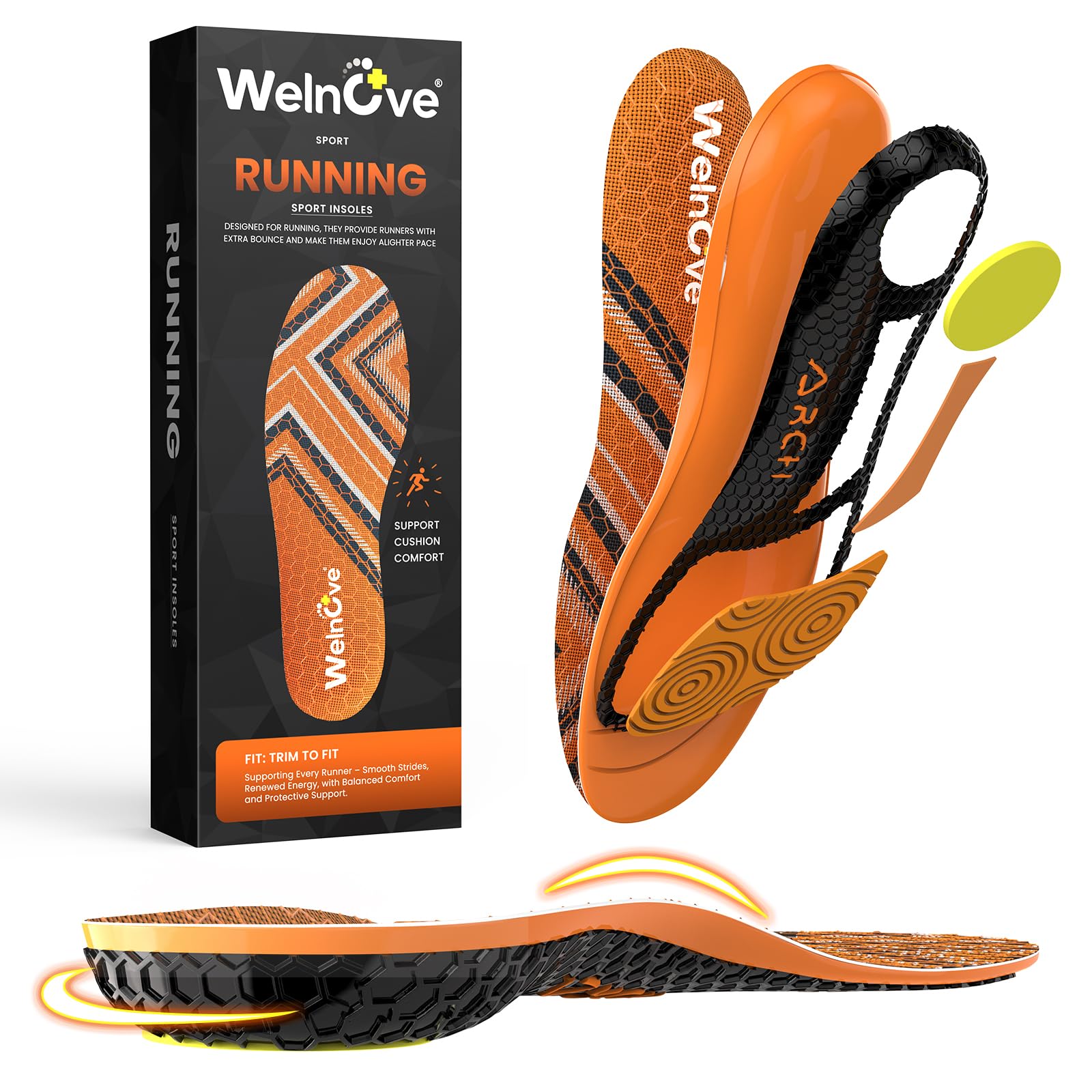
A high-rebound forefoot pad that turns your push-off into a spring.
Sprinters and jumpers will feel the difference immediately from the high-rebound GEL pad under the ball of the foot. That pad returns energy as you push off, while a specialized yellow polymer at the heel absorbs up to 90% of landing shock. The extended TPU stabilizer (a rigid thermoplastic strip) runs from the forefoot to the midfoot to correct overpronation and keep your alignment straight. One buyer mentioned that a size L fits a US men’s 9, and they trimmed about 0.5 inch from the toe area.
The trade-off is weight — at 10.58 ounces these are the heaviest insoles in this guide, compared to the 4.16-ounce Running Sports Insoles from the same brand. That extra weight comes from the dense GEL and PU foam layers, so you trade some shoe lightness for maximum shock absorption and bounce. A few reviewers with narrow feet found them a good fit without side trimming, while one user experienced increasing foot pain during work shifts.
Why sprinters love these
- Forefoot GEL pad provides noticeable bounce and propulsion during sprints
- TPU stabilizer corrects overpronation from forefoot to midfoot
- Hexagonal grip pattern on the velvet surface locks the foot in place
The weight penalty
- At 10.58 oz these are heavier than the lightest competitor at 4.16 oz
- Some users reported foot pain during extended standing shifts
Best for power athletes: If you sprint, jump, or need maximum bounce in the forefoot, this energy-return design is class-leading.
Avoid if: You are a long-distance runner who values a light shoe — the RunPro insoles weigh 4.96 oz versus the Welnove at 10.58 oz.
6. CRUVHEAL Sport Shock Absorbing Insoles

Built for the runner who also spends 14-hour days on concrete.
Not every run starts fresh — sometimes you are on your feet all day before you hit the pavement. These insoles have strategically placed gel pads that absorb impact during the workday and the workout. The deep heel cup stabilizes your foot, and a non-slip gel heel pad keeps the insert in place during lateral movements like basketball or tennis. One buyer who works as a soccer referee and has wide feet reported that after using these on cold cement for 14 hours a day, they “eliminated foot and ankle pain.” The package dimensions at 12.56 x 4.29 x 1.1 inches translate to more surface area for wide shoes.
The catch is the 3-7 day adaptation period — your feet need to get used to the arch support gradually. One owner reported they felt a bit bulky in Hokas but fit fine in Skechers, so check the shoe volume. The neutral arch profile means this works for general support rather than targeted correction for flat feet or high arches.
The all-day advantage
- Gel pads absorb shock even after 14-hour standing shifts on concrete
- Deep heel cup and non-slip gel keep the insole stable during cutting movements
- Slightly larger footprint fits wide shoes better than the slimmer CRUVHEAL running insoles
What to expect
- Bulky fit in low-volume shoes like Hokas
- Neutral arch — not designed for significant overpronation correction
Reach for these if: You work on your feet all day and then run — the dual-use gel cushioning performs in both roles.
Look elsewhere if: You need a specific corrective arch profile — the CURREX or Superfeet offer more targeted support.
7. Running Sports Insoles Plantar Fasciitis – Welnove Athletic Inserts
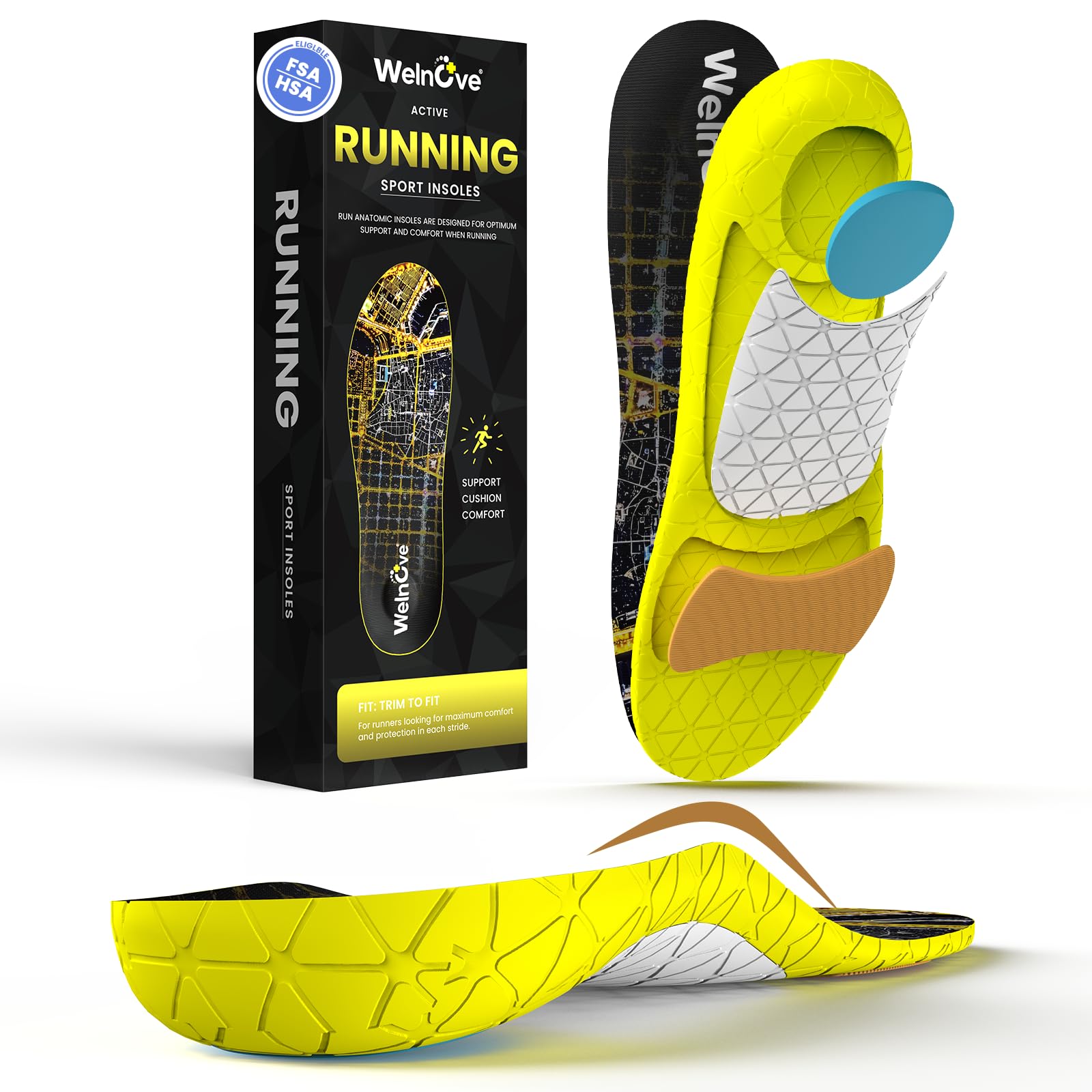
A light, low-cost wedge that surprisingly open up a pain-free mile.
Sometimes the lightest option changes your entire stride. At just 4.16 ounces, these are the most featherlight insoles in this guide — compared to the 10.58-ounce Welnove Running Insoles from the same maker. The soft foam construction is designed for people with flat feet or plantar fasciitis (a heel pain condition), using an ergonomic arch to correct posture during sports. One customer observed the first time they wore these insoles, they ran their fastest mile and felt no pain — after years of struggling with shin splints, sore knees, and physical therapy with no results. That is a powerful story for any runner on a budget.
However, not every runner had that experience. Another buyer found the insoles thin and flimsy, saying the gel sections offered no added comfort and the sizing didn’t match the advertised range. A half-marathon runner reported too much movement inside the shoe, leading to blisters and black toenails. The 2-5 day break-in period is required, and the material may not be durable enough for heavy weekly mileage — one user highlighted a six-month lifespan under heavy use by a teenager in basketball.
Where it wins
- At 4.16 oz, these are the lightest insoles in the guide — you barely feel them inside the shoe
- One runner reported a pain-free fastest mile on first wear after years of shin splints
- Budget-friendly entry point for testing arch support
Where it falls short
- Thin construction — multiple reviewers found it lacked shock absorption and structure
- Movement inside the shoe during longer runs led to blisters for one half-marathon runner
Try these if: You are on a tight budget or want an ultra-light insole to test arch support before investing in a premium option.
Skip if: You log high weekly mileage or need firm structure — the Move or Superfeet insoles provide more reliable support for the long haul.
Understanding the Specs
Weight and Why It Matters
An insole’s weight in ounces tells you how much extra load you are adding to each stride. The lightest insoles here, like the Running Sports Insoles at 4.16 ounces, feel almost invisible inside the shoe. The heaviest, like the Welnove Running Insoles at 10.58 ounces, add noticeable mass but bring dense GEL layers that absorb more shock. For long-distance running, lighter is usually better because your legs lift that weight thousands of times per run.
Arch Profile and Heel Cup
Your arch type (low, medium, or high) determines how much upward support you need. A low arch needs a firm, supportive platform to prevent collapse; a high arch needs deeper cushioning to absorb landing shock. The heel cup depth controls foot slip — a deep cup wraps around the heel bone and keeps the insole in place when you cut or turn. The CURREX RunPro gives you three arch options to choose from, which is the most flexible system in this guide.
FAQ
How do I know if I need arch supports for running?
How long does it take to adjust to running insoles?
Can I use the same insoles for running and everyday walking?
How often should I replace my running insoles?
Are trim-to-fit insoles better than pre-sized ones?
Can arch supports help with shin splints?
What is the difference between a gel insole and a foam insole?
Will these insoles fit my Hoka or ASICS running shoes?
Final Thoughts: The Verdict
For most runners, the best arch supports for running is the CRUVHEAL Running Insoles because its U-shaped heel and TPE arch support target runner’s knee and shin splints without adding excessive weight. If you want pro-level shin splint relief in a 3.84-ounce package, grab the Move Game Day Performance Insoles. And for low arches that need near-custom support without the custom price, the Superfeet Run Cushion Low Arch Insoles deliver the most targeted value for flat-footed runners.
How We Picked
We do not accept paid placement. Every pick is matched to a real buyer and a real use-case; we do not hands-on test units.
Sources & Methodology
Specifications: manufacturer listings and product documentation. Review insights: verified customer reviews, as of July 2026. Pricing: not shown on this page (it changes often); check the current price via the retailer link.
As an Amazon Associate, FitlyFast earns from qualifying purchases. This does not affect which products we feature.