
Our readers keep the lights on and the weekend projects moving. As an Amazon Associate, I earn from qualifying purchases.
An arm blood pressure monitor is your first line of defense against silent cardiovascular issues, but picking one that delivers clinical-grade consistency without the hassle of manual logs can feel like a gamble. The market is flooded with units that sacrifice accuracy for features or skimp on cuff comfort to hit a price point, leaving you with erratic readings and a drawer full of frustration.
I’m Rikta — the co-founder and writer behind FitlyFast. I’ve spent countless hours analyzing upper-arm BP monitor specifications, reading through thousands of real user reviews, and comparing the subtle differences in cuff design, memory storage, and connectivity that separate a reliable tool from a desk ornament.
Whether you need silent Bluetooth tracking for your doctor or a voice-guided unit for low vision, the best arm blood pressure monitor should fit your arm comfortably, store enough data to spot trends, and produce readings you can trust without second-guessing the hardware.
How To Choose The Best Arm Blood Pressure Monitor
Selecting an upper-arm blood pressure monitor goes beyond just checking the price. You need to match the cuff range to your arm, verify clinical validation for accuracy, and decide how much data storage and connectivity actually serve your health routine. Here are the three most critical factors to get right.
Cuff Size and Fit
The single largest source of error in home BP monitoring is an improperly fitting cuff. Most standard adult cuffs accommodate arms between 8.7 and 16.5 inches, but if your arm circumference falls outside that range, you need a monitor that offers separate small or large cuffs. Some premium units include a wide-range cuff that spans a broader circumference without sacrificing sensor alignment, which eliminates the need to buy a separate accessory.
Clinical Validation and Arrhythmia Detection
Not all monitors are created equal for accuracy. Devices rated by the British & Irish Hypertension Society (BIHS) with an AA grade or cleared by the FDA provide a baseline you can trust. If you have a history of irregular heartbeats, look for a model with Atrial Fibrillation (AFib) detection. Be aware that some monitors block all readings during an AFib event, while others simply alert you and still deliver a measurement.
Data Management and Storage
Tracking trends is where home monitoring earns its value. A monitor that stores 99 readings per user for two people lets you spot morning spikes without logging every result manually. If you prefer digital records, Bluetooth or Wi-Fi syncing to a companion app saves time and allows you to email reports directly to your healthcare provider. For users who want zero screen time, voice-guided monitors announce results immediately, which is especially helpful for seniors or those with visual impairments.
Quick Comparison
On smaller screens, swipe sideways to see the full table.
| Model | Category | Best For | Key Spec | Amazon |
|---|---|---|---|---|
| A&D Medical UA-1040TBLE | Voice-Guided | Visually impaired users | TriCheck averaging, 3 languages | Amazon |
| Withings BPM Connect | WiFi Sync | App-centric tracking | Color-coded display, rechargeable | Amazon |
| OMRON Gold BP5360 | AFib Detection | Heart rhythm screening | Morning High indicator | Amazon |
| Withings BPM Vision | Tabletop Design | Large, bright display | 2.8 inch color LCD | Amazon |
| Microlife Series 500 | BIHS AA Rated | Clinically validated legacy | Gentle+ inflation tech | Amazon |
| Urion U80A | Budget-Friendly | Seniors and daily snapshots | 4.5 inch LED display | Amazon |
| Acenis AOJ-30F | Entry-Level | Simple two-user tracking | Color screen, large cuff | Amazon |
In‑Depth Reviews
1. A&D Medical UA-1040TBLE Voice-Guided Blood Pressure Monitor
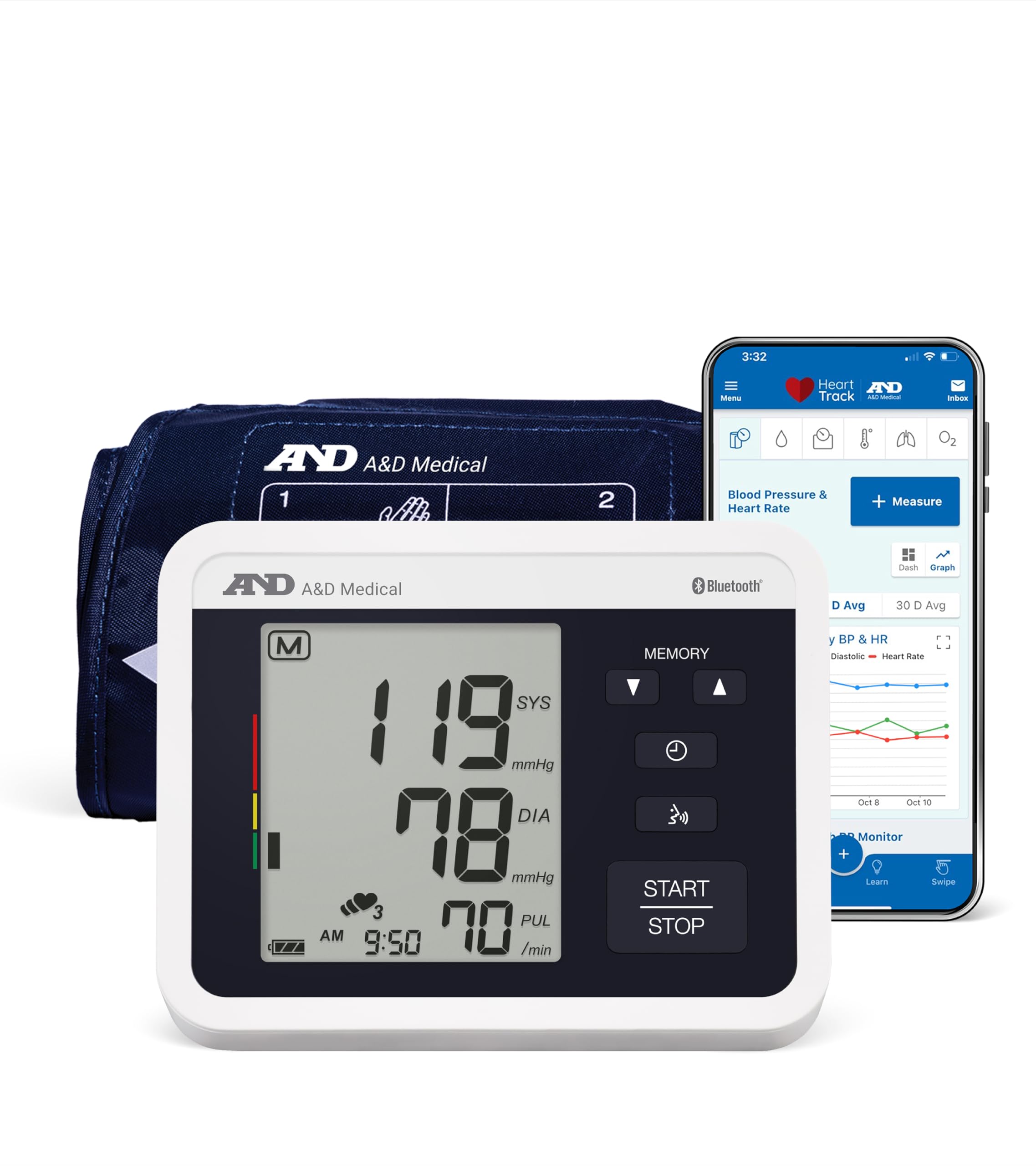
The A&D Medical UA-1040TBLE stands out because it combines clinical-grade accuracy with a feature set that genuinely serves users who need it most. Its voice guidance speaks systolic and diastolic results in English, Spanish, or French, making it a strong choice for seniors and those with visual impairments. The TriCheck function automatically takes three consecutive readings and presents an average, which helps smooth out the normal variability between individual measurements.
The wide-range cuff (22–42 cm) includes advanced fit detection that flags improper placement before the reading starts, eliminating a common source of error. Bluetooth syncing with the A&D Heart Track App lets you store unlimited readings and share reports, though the app experience is more straightforward than flashy. The pre-formed cuff is much easier to self-apply than a standard D-ring design, and the large LCD with oversized digits is legible even across a room.
Included in the box are four AA batteries, a carrying case, and a quick-start guide. The AC adapter is sold separately, but battery life is excellent thanks to the efficient operation. If you want a monitor that prioritizes accurate readings and accessibility without forcing you into a subscription or a flashy app ecosystem, this is the middle-ground winner.
Why it’s great
- Cuff fit detection reduces user error
- TriCheck averages three readings for precision
- Three language voice guidance works immediately
- Compact carrying case included
Good to know
- AC power adapter sold separately
- Bluetooth setup requires initial pairing steps
2. Withings BPM Connect

The Withings BPM Connect is designed for users who want their blood pressure data to flow automatically into a health ecosystem. The cuff connects via Wi-Fi and Bluetooth, syncing each reading directly to the Health Mate app without needing your phone nearby during the measurement. The color-coded feedback on the display case itself tells you at a glance whether your result falls in the green, yellow, or red zone based on American Heart Association guidelines.
The rechargeable battery lasts up to six months on a single charge, which is a significant upgrade over monitors that chew through AAA batteries every few weeks. The unit is lightweight (0.8 pounds) and rolls up compactly for travel, though the cuff itself can feel snug during inflation. Accuracy comparisons with professional-grade WelchAllyn units show systolic readings within 2 mmHg, while diastolic can vary by 4-5 mmHg — solid for home tracking, but not lab-grade.
Setup can be frustrating for some users, with initial Bluetooth pairing issues reported. The screen on the light-colored model can be hard to read in direct light due to low contrast. If you already use Withings scales or other health devices, the integration makes this a natural addition. For standalone users, the app-dependent workflow may feel over-engineered compared to simpler monitors.
Why it’s great
- WiFi sync works without phone present
- Long-lasting rechargeable battery
- Color-coded instant feedback
- Compact and travel-friendly
Good to know
- Setup can be buggy for some users
- Diastolic accuracy slightly less consistent than systolic
3. OMRON Gold Blood Pressure Monitor BP5360
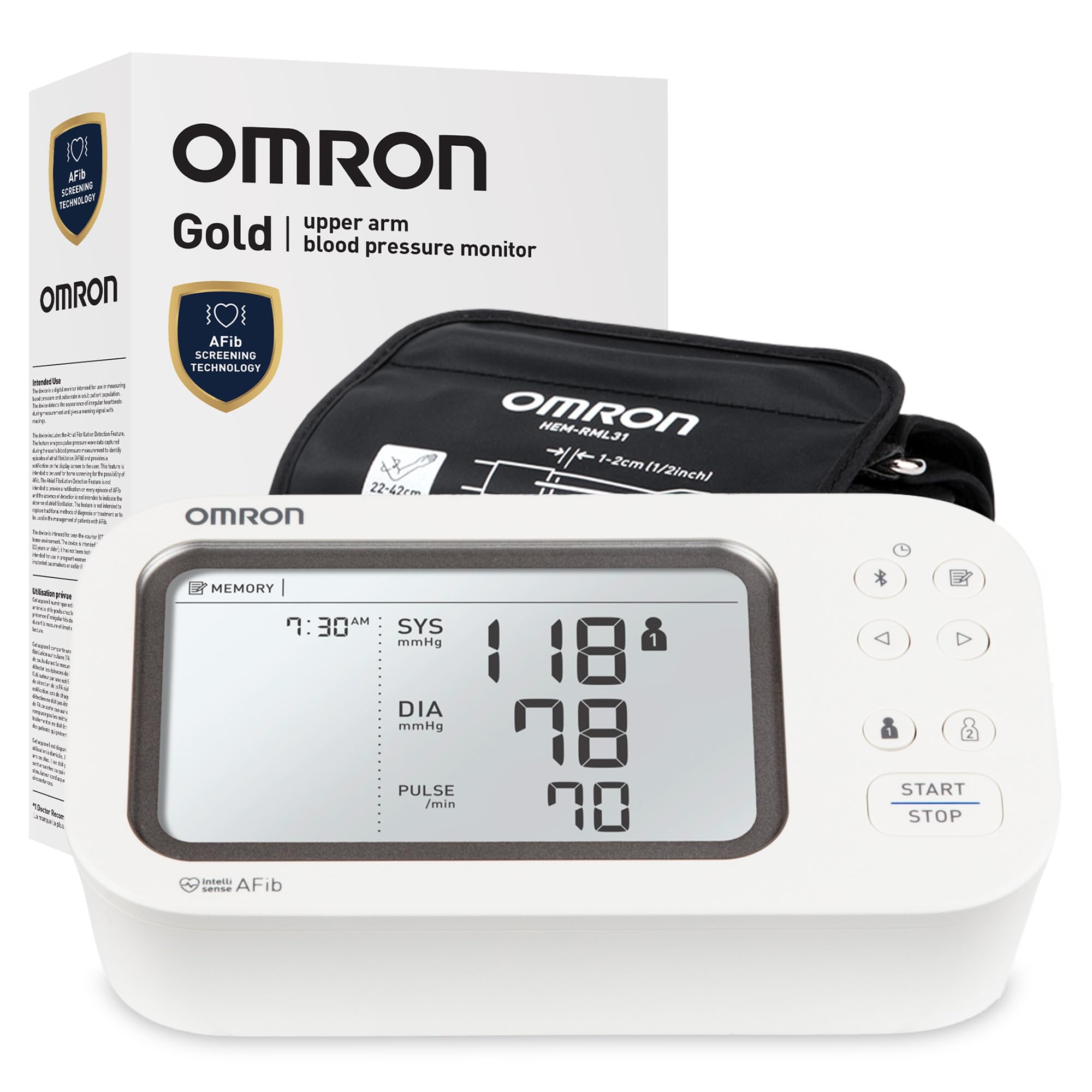
The OMRON Gold BP5360 is the most feature-dense monitor from the brand that doctors and pharmacists recommend most often. Its headline capability is Atrial Fibrillation (AFib) detection during every blood pressure reading, which alerts you to potential irregular heart rhythms. The High Morning Average Indicator flags systolic spikes that occur after waking, a pattern linked to elevated cardiovascular risk.
The wide-range D-ring cuff fits arms 9 to 17 inches and includes OMRON’s proprietary algorithm that adjusts inflation pressure for comfort. Bluetooth syncing with the OMRON connect app stores unlimited readings and supports two separate user profiles, making it practical for a household. The app connects to Apple Health and Google Fit, so your BP data integrates with your broader wellness dashboard.
There is a critical caveat: the AFib detection feature blocks all blood pressure readings if it detects an irregular rhythm, displaying an error message instead of your numbers. This is a safety measure, but it means the monitor is effectively useless for anyone with diagnosed persistent AFib. For users without arrhythmias, the device delivers accurate, repeatable measurements with a reputation for longevity that few competitors match.
Why it’s great
- AFib and morning spike detection built-in
- Dual user with separate data logs
- Doctor-recommended brand reliability
- Ready out of box with batteries and case
Good to know
- AFib detection blocks readings during arrhythmia
- No TriCheck averaging mode
4. Withings BPM Vision
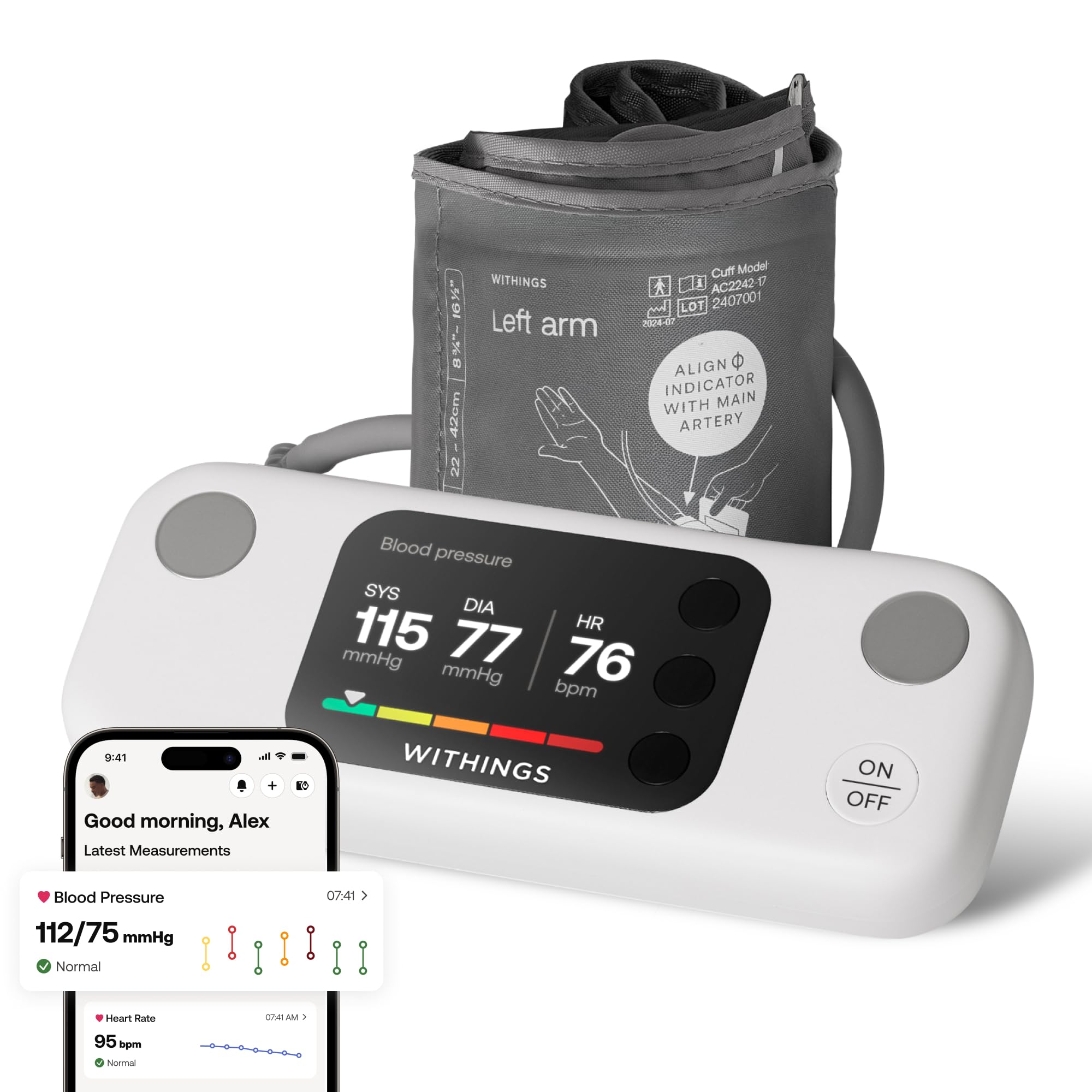
The Withings BPM Vision takes a different design approach by housing the electronics in a tabletop base with a 2.8-inch color LCD that stays upright while you sit still. This eliminates the awkward neck-craning required when the screen faces outward on your bicep. The protective case doubles as a stand, so you can place it on a desk or nightstand and read the results without holding the monitor.
The unit includes built-in step-by-step tutorials that guide you through proper cuff placement and posture, which helps new users avoid common mistakes. Wi-Fi syncing means readings transfer automatically to the Withings app without needing your phone nearby, and the 3-reading average mode provides a more reliable snapshot than a single measurement. The color-coded feedback on the screen mirrors the AHA hypertension zones.
Battery life is rated at one year on a single charge, and the USB-C port makes topping up convenient. The cuff fits standard arms (22–42 cm), and the carry case is well-padded. On the downside, the app and firmware have drawn criticism for buggy Bluetooth syncing and delayed customer support. If you want a monitor that prioritizes screen readability and step-by-step guidance over raw portability, this fits the bill.
Why it’s great
- Easy-to-read upright color screen
- Built-in tutorials for proper technique
- Wi-Fi sync works without phone nearby
- 1-year battery life
Good to know
- Bulky for travel compared to cuff-only units
- App and Bluetooth syncing reported as inconsistent
5. Microlife Series 500 Automatic Upper Arm Monitor
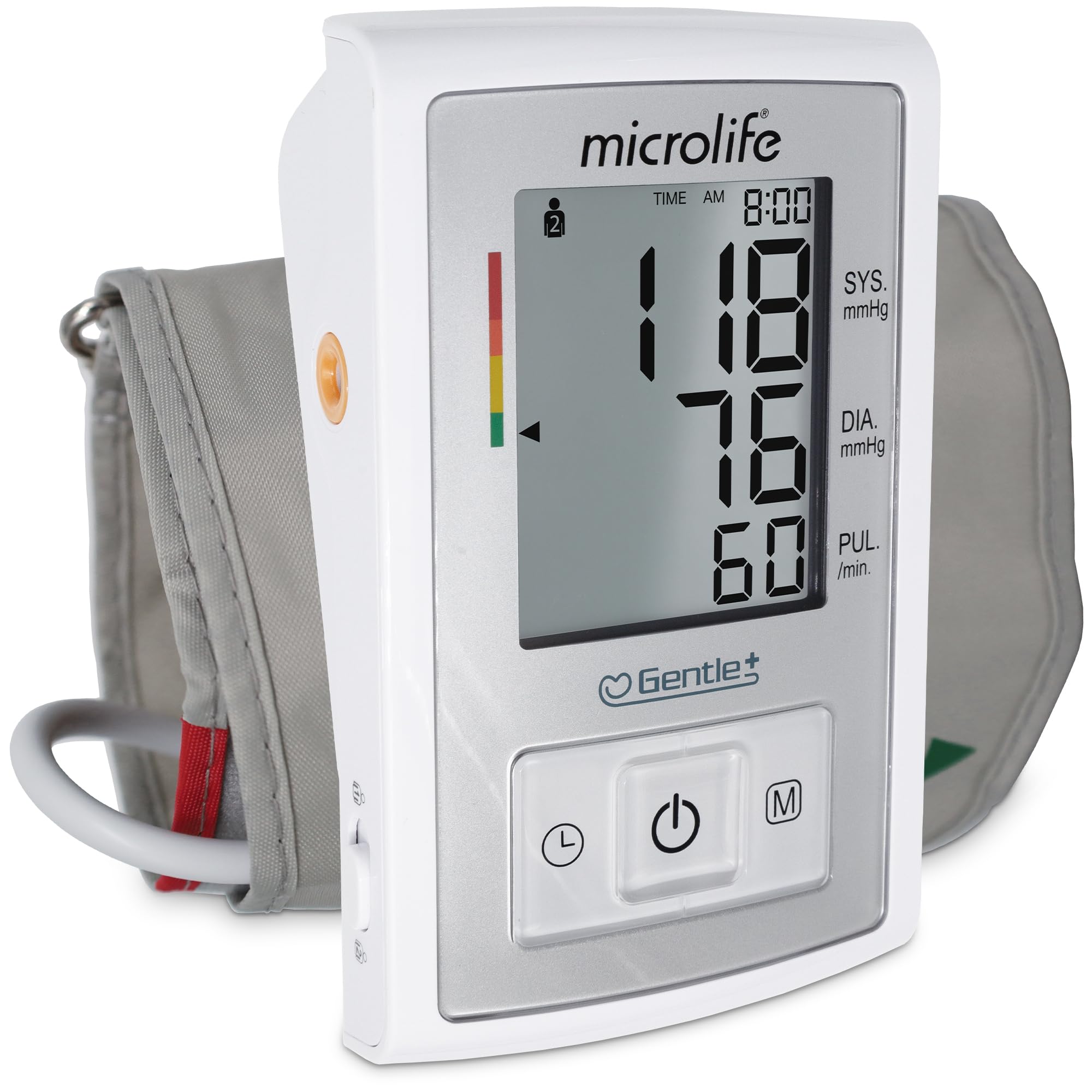
The Microlife Series 500 has been on the market since 2015 and still holds the highest accuracy rating (AA) from the British & Irish Hypertension Society, a testament to its reliable sensor architecture. The monitor uses Gentle+ inflation technology that measures during cuff inflation rather than deflation, which means less overall pressure and a more comfortable experience — especially for users who find standard cuffs uncomfortable.
The wide-range contoured cuff fits 8.7 to 16.5 inch arms and is easier to wrap than a flat D-ring cuff. The monitor stores 99 readings per user for two people (198 total) and includes PC software that lets you transfer data via USB to generate graphs and share with your doctor. The large display is simple to read, and the controls are purely physical buttons with no Bluetooth pairing frustration.
There is no app integration and no Bluetooth, so expect to use the USB cable for data transfer or record manually. The carrying case does not have a dedicated compartment for the USB cord, which can be a minor annoyance. If you want a proven clinical workhorse that does not depend on a smartphone and uses less cuff pressure than most competitors, this is the most practical pick in its class.
Why it’s great
- BIHS AA clinical accuracy rating
- Gentle+ inflation reduces discomfort
- Dual user memory with PC software
- Long battery life with included AA cells
Good to know
- No Bluetooth or app connectivity
- USB cord lacks a dedicated case pocket
6. Urion U80A FDA-Cleared Blood Pressure Monitor
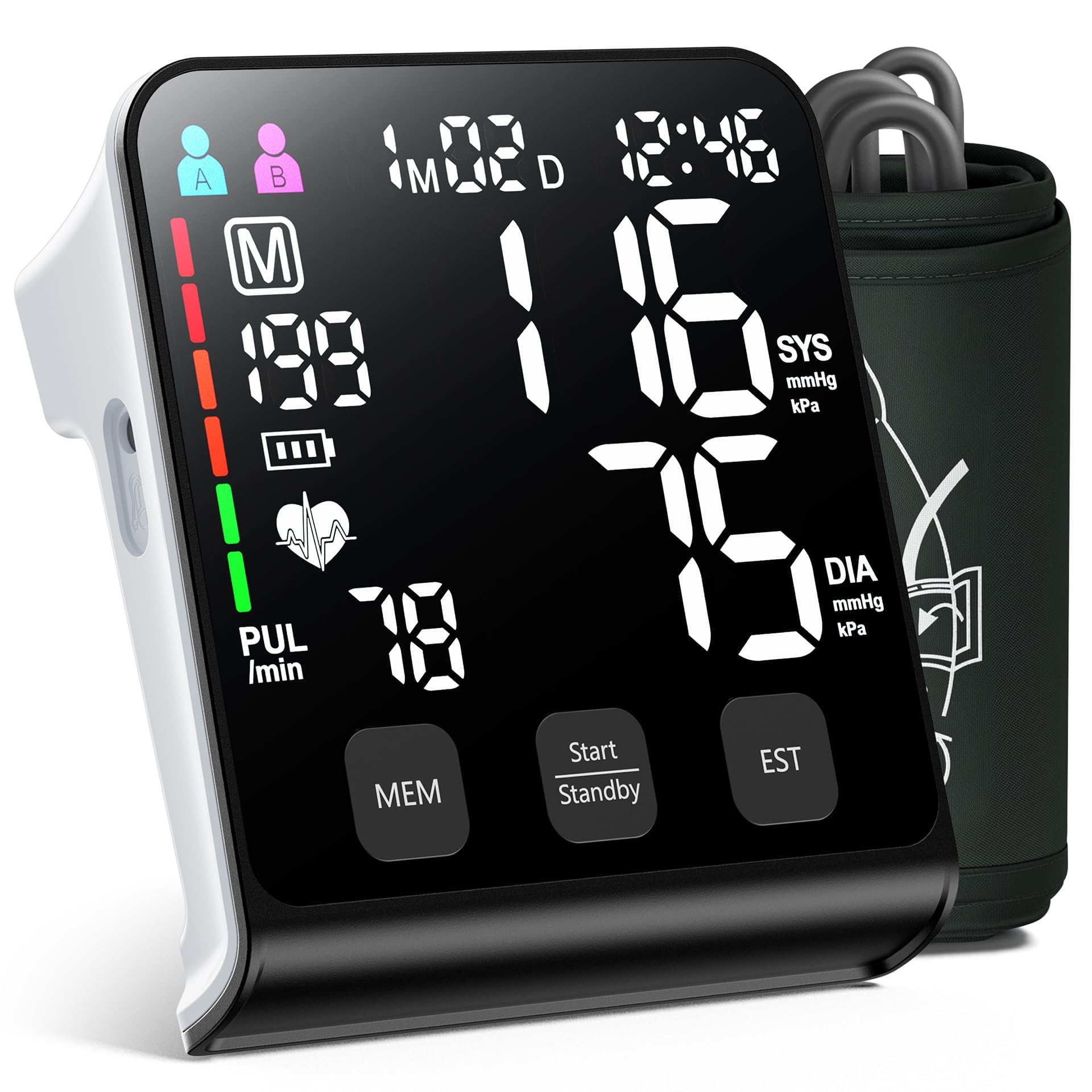
The Urion U80A is a budget-conscious contender that punches above its price tier with a 4.5-inch bright LED screen that is genuinely easy to read in low light. The oversized digits and blood pressure classification color indicator (green, yellow, red) let you interpret results instantly without squinting or cross-referencing a chart. This makes it a strong candidate for seniors or anyone who wants quick visual feedback.
The monitor stores up to 199 readings for two users and offers a single-button operation that is nearly foolproof. The error margin is spec’d at ≤±3 mmHg for both systolic and diastolic, which is consistent with FDA-cleared requirements. The adjustable cuff uses an intelligent pressure algorithm that helps reduce human error from improper wrapping. Power comes from either 4 AAA batteries or a USB cable, giving you flexibility when traveling.
There is no Bluetooth or app syncing, so trending requires manual recording or scrolling through the on-device memory. The build uses a scratch-resistant acrylic panel that holds up well to daily use, but the overall plastic construction feels less dense than premium alternatives. For the price, the combination of a large backlit display, dual-user memory, and FSA/HSA eligibility makes it a practical entry point.
Why it’s great
- Very large, bright LED display
- FSA/HSA eligible purchase
- USB power option for travel
- Single-button ease of use
Good to know
- No Bluetooth or app connectivity
- Plastic build feels less premium
7. Acenis AOJ-30F Automatic Blood Pressure Monitor
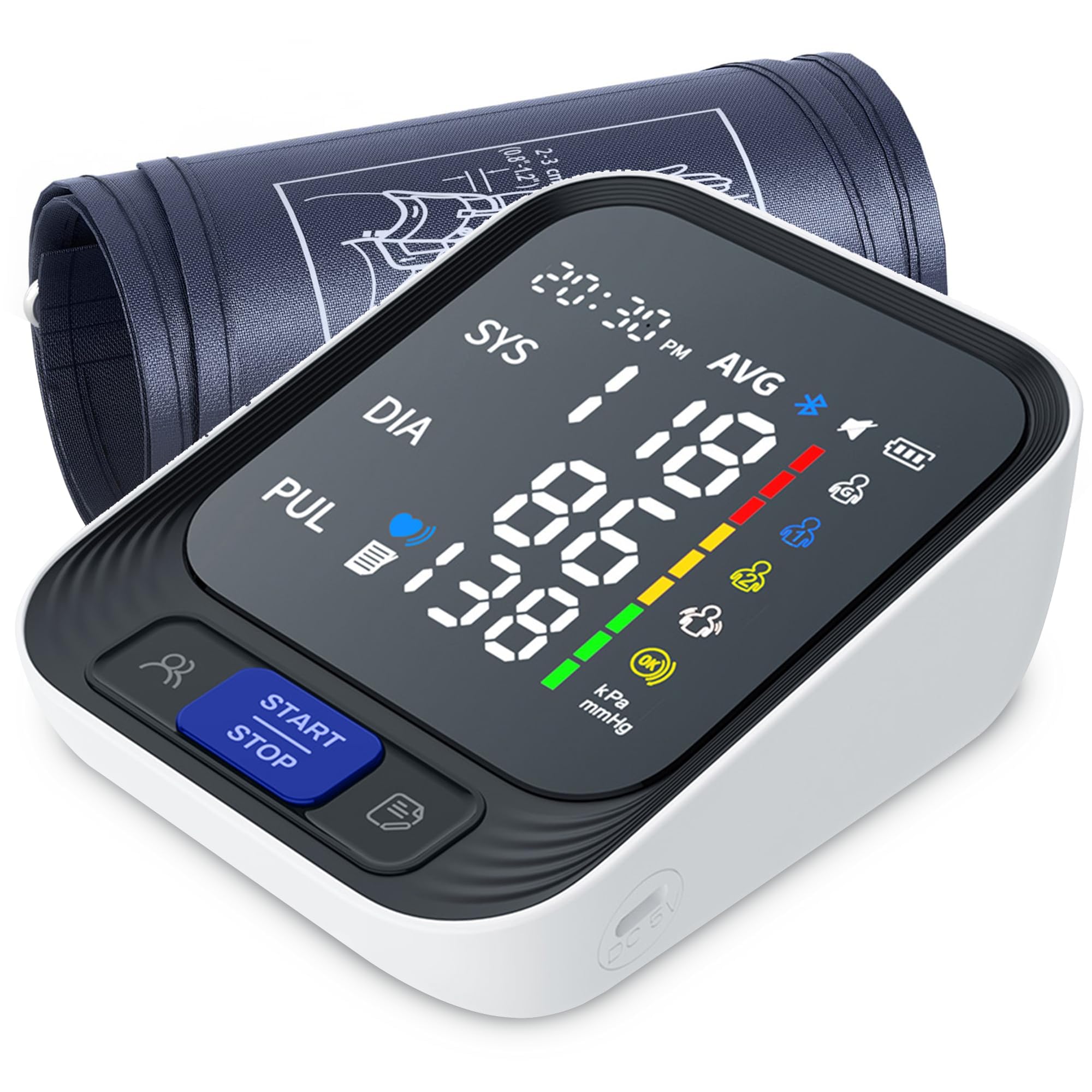
The Acenis AOJ-30F offers a large color screen at a price point that is hard to beat, making it a solid choice for households that need a no-frills monitor with readable visuals. The display shows systolic, diastolic, and pulse readings in clear colored digits, and the device supports up to three user profiles with 2 memory slots each — enough to cover a small family or to separate morning and evening logs for one person.
One-touch operation delivers results in about 40 seconds, and the large adjustable cuff is designed to fit a broad range of arm sizes comfortably. Included in the box are 4 AAA batteries and a power cord, so you can start monitoring immediately. User reviews consistently note that the readings match closely with professional equipment used in doctor’s offices, which is the most important validation for a budget-tier monitor.
The build quality is adequate for home use, though the plastic housing and lightweight construction (1.1 pounds) do not inspire the same confidence as a heavier, denser unit. There is no Bluetooth or app connectivity, so you must manually record trends or rely on the on-device memory. For a low-barrier entry into daily BP tracking that won’t strain your wallet, this gets the job done reliably.
Why it’s great
- Large color screen for easy reading
- Supports three separate user profiles
- Fast 40-second measurement cycle
- Includes batteries and power cord
Good to know
- No Bluetooth or data export
- Lightweight plastic construction
FAQ
Why does my arm blood pressure monitor need a wide-range cuff?
Can I trust a budget monitor under for daily tracking?
How do I clean the cuff without damaging the sensor?
Final Thoughts: The Verdict
For most users, the best arm blood pressure monitor winner is the A&D Medical UA-1040TBLE because it blends FDA-cleared accuracy, voice guidance for accessibility, TriCheck averaging for precision, and Bluetooth syncing — all at a mid-range price that justifies every feature. If you want seamless app integration and rechargeable convenience, grab the Withings BPM Connect. And for heart rhythm screening that goes beyond basic readings, nothing beats the OMRON Gold BP5360.