
Our readers keep the lights on and the weekend projects moving. As an Amazon Associate, I earn from qualifying purchases.
Forgetting arm day isn’t an option when your machine sits in the corner of the living room, but picking the wrong tool means you get fatigue in the wrong places and zero results in the mirror. The market is flooded with gimmicky grippers and flimsy resistance bands that either snap or don’t load the biceps, triceps, and forearms in the way they need to grow. A true arm workout machine must deliver constant tension through a full range of motion, not just a pinch at the top of the rep.
I’m Rikta — the founder and writer behind FitlyFast. I’ve spent months cross-referencing hydraulic resistance curves, cable pulley load ratings, and grip ergonomics to separate machines that actually build density from those that just collect dust.
After evaluating seven distinct models spanning hydraulic twisters, cable pulley systems, and specialty rotator trainers, this guide ranks the top contenders to help you find the most effective arm workout machine for your home gym setup.
How To Choose The Best Arm Workout Machine
Arm workout machines generally fall into three camps: hydraulic press units that mimic a chest press but load the triceps and shoulders, cable pulley systems that offer multi-angle isolation, and rotator-style trainers that focus on grip strength and forearm conditioning. The right choice depends on your space constraints, your injury history, and whether you need progressive overload or high-rep toning.
Resistance Type: Hydraulic vs. Cable vs. Friction
Hydraulic cylinders provide smooth, consistent resistance throughout the entire range of motion without the snap-back that springs create at the end of a rep. Cable systems, by contrast, rely on weight plates or bands and offer a more traditional gym feel with variable angles, but they require a mounting point such as a power rack or door frame. Friction-based rotator trainers use replaceable pads to create isometric tension, which is ideal for rehab but limited for building raw mass.
Load Range and Progression
Look for a machine that offers at least 10 distinct resistance levels if hydraulic, or a weight stack capacity of 300 pounds or more if cable-based. The best arm machines let you add load in small increments so you don’t stall after the first few weeks. Models that top out under 100 pounds may work for toning but will frustrate anyone seeking strength gains.
Build Quality and Portability
All-steel frames and reinforced nylon pulleys indicate a machine that won’t wobble or degrade under daily use. Pay attention to the grip material — PU rubber or knurled metal handles prevent slipping when your palms get sweaty. If you travel or have limited floor space, a unit that folds flat or fits in a carry bag offers the same workout density without the permanent footprint.
Quick Comparison
On smaller screens, swipe sideways to see the full table.
| Model | Category | Best For | Key Spec | Amazon |
|---|---|---|---|---|
| FLYBIRD Twister Arm Trainer | Hydraulic | Full upper body + core | 22-440 lbs across 15 levels | Amazon |
| LifePro ShredForce | Hydraulic | Chest & triceps pressing | 22-440 lbs with rep counter | Amazon |
| SERTT Pulley System | Cable | Multi-angle isolation | 330 lbs load rating | Amazon |
| FitBeast Pulley System | Cable | Budget cable training | 330 lbs max, 3 handles | Amazon |
| Fitarc Rotator Burn Machine | Friction | Rehab & forearm strength | 12 lb rotating mass | Amazon |
| OWLSKY Ab Machine | Track Slide | Core with arm engagement | 400 lb capacity, foldable | Amazon |
| MERACH Ab Machine | Track Slide | Quiet core training | 330 lb steel frame | Amazon |
In‑Depth Reviews
1. FLYBIRD Twister Arm Trainer
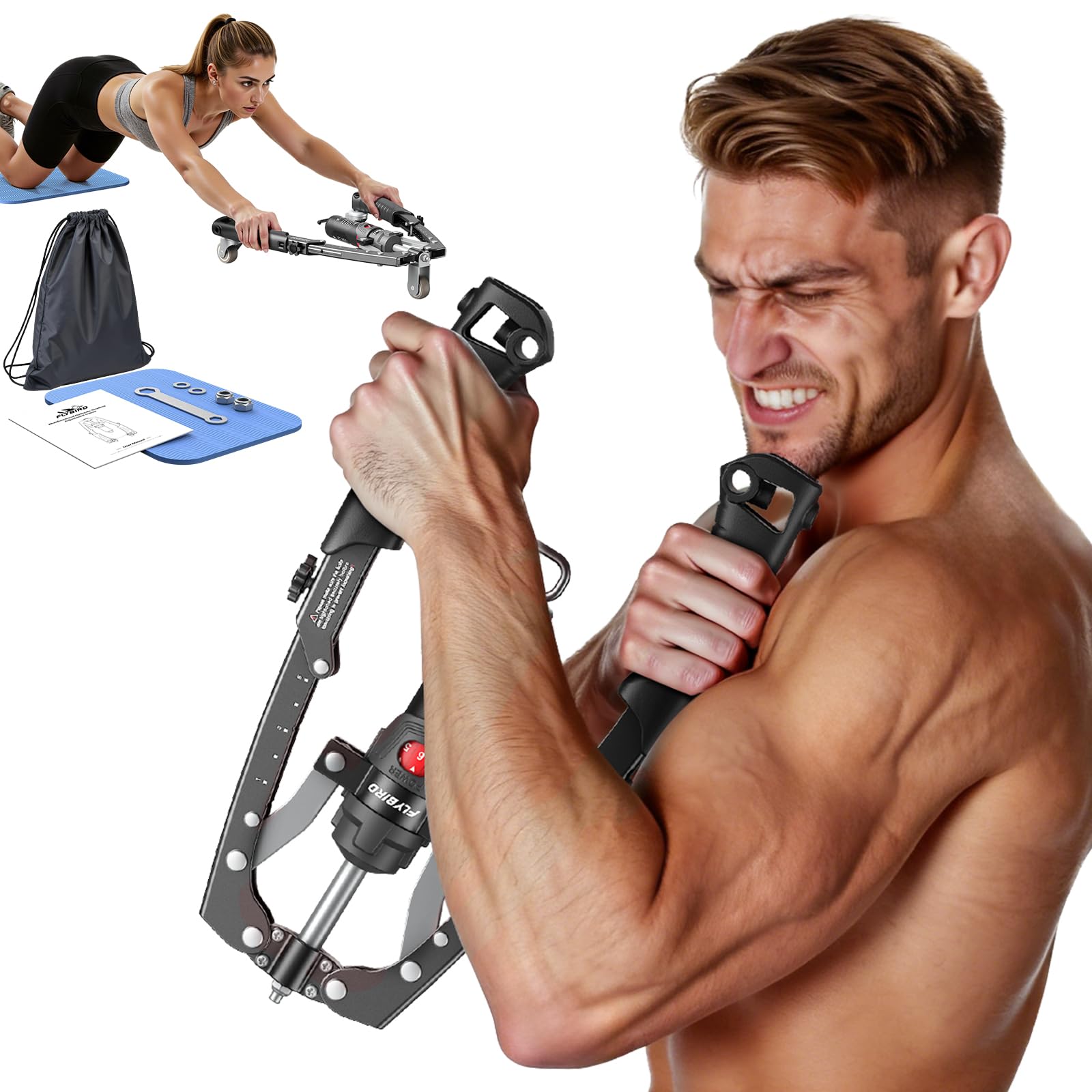
The FLYBIRD Twister Arm Trainer takes the top spot because it solves the biggest complaint about arm machines — limited versatility — by combining a 15-level hydraulic press (22-440 lbs) with a detachable ab wheel, all packed into a unit that stows inside the included backpack. The sliding handle adjusts to 11 positions, which means you can target the chest, triceps, and forearms with a single device without needing a second piece of gear. Real users report visible results within the first week, and the hydraulic mechanism delivers fluid resistance that spares the joints from the jerky feedback of spring-based trainers.
Build quality is excellent for the price point. The carbon steel frame and PU rubber grips feel rugged, and the detachable design requires no tools — you simply snap the ab roller off for core work or leave it attached for pressing movements. The 15 resistance levels let you progress from light rehab to heavy pressing without buying additional parts, and the 440-pound ceiling means even advanced lifters won’t outgrow it quickly. The included yoga mat and knee pad add genuine value for floor work.
Where this machine truly shines is its portability. At roughly 6 pounds and disassembling into compact segments, it fits under an airline seat or in a truck cab. The hydraulic system has held up well in long-term use with no reported leaks, and the ergonomic handles reduce wrist strain compared to fixed U-shaped trainers. The only minor trade-off is that the resistance curve is linear — you won’t get the exponential loading that a stack of plates provides — but for general arm conditioning and hypertrophy, it’s more than adequate.
Why it’s great
- 3-in-1 hydraulic press, ab roller, and portable kit saves space and money
- 15 resistance levels from 22 to 440 lbs suit beginners to advanced lifters
- Sliding handle with 11 positions targets different muscle groups precisely
Good to know
- Resistance is linear rather than exponential like a weight stack
- Some users may prefer a longer stroke for full chest extension
2. LifePro ShredForce

The LifePro ShredForce delivers the same hydraulic range as the FLYBIRD but focuses purely on upper-body pressing motions — chest, triceps extensions, shoulder raises, and back work — without the ab wheel gimmick. Its carbon steel frame folds to just under 17 inches flat, and the 5-pound weight makes it one of the most portable arm machines on the market. The digital rep counter is a genuine productivity tool: it tracks each half-rep so you don’t have to count mentally, and the LR44 battery lasts for months of daily sessions.
Users report measurable muscle toning improvement within days, especially in the triceps and chest, and the 22-440 lb range provides enough headroom for progressive overload. The PU rubber handles are textured to prevent slipping, and the hydraulic cylinder operates smoothly without the sticking that some cheaper units experience at mid-range resistance. The two lock bars secure the machine in its folded state for safe storage, though a few reviewers note the plastic hook for hanging feels less robust than the rest of the build.
The main limitation is the single-plane movement pattern: you press straight out, which heavily favors the chest and triceps but does little for biceps isolation or lat work. If your goal is specifically arm and chest hypertrophy from a compact device, this is a strong contender, but for total arm development you’ll want to pair it with curls or pull-ups. The included exercise booklet is genuinely useful, offering 12 movements that target different angles of the same muscle groups.
Why it’s great
- Built-in repetition counter tracks sets accurately without a phone app
- Folds flat to 16.93 inches for storage in a drawer or backpack
- 20 tension levels provide fine granularity for slow progression
Good to know
- Single-plane pressing motion limits biceps and lat engagement
- Plastic storage hook is the weakest component in the kit
3. SERTT Home Gym Pulley System

For lifters who already own a power rack or sturdy pull-up bar, the SERTT cable pulley system opens up a universe of isolation exercises that a hydraulic press cannot duplicate — tricep pushdowns, face pulls, bicep curls, and lat pulldowns — all from a single mounting point. The pulleys use sealed bearings that glide smoothly under 150+ pounds, and the alloy steel carabiners and cables feel genuinely robust, not like the cheap stamped hardware that plagues budget pulley kits. Setup takes under a minute once the mounting strap is in place.
The kit includes multiple attachments: a tricep rope, a lat bar, and a standard exercise handle, giving you enough variety for full upper-body sessions. Users consistently praise the smooth operation and the fact that the cables don’t fray or squeak even under sustained load. The 330-pound rating is conservative for the hardware, but the real limitation is the mounting surface — you need a solid overhead beam or rack crossmember to get the full benefit. Some users report that the lat bar feels sketchy above 100 pounds, though the pulleys themselves handle the weight without issue.
The 2:1 cable ratio means you feel half the actual plate weight at the handle, which is great for high-rep work but requires loading more plates to reach heavy resistance. This is a cable system, not a standalone machine, so it demands existing floor space and a rack — it’s not for apartment dwellers without a dedicated corner. But for anyone with a half-decent home gym, it’s the most cost-effective way to add cable arm work to an otherwise free-weight routine.
Why it’s great
- Smooth sealed-bearing pulleys handle over 150 lbs without noise or friction
- Multiple attachments (tricep rope, lat bar, handle) enable diverse exercises
- Mounts in under a minute to any power rack or overhead beam
Good to know
- Requires a rack or strong overhead anchor point — no door option included
- Lat bar feels less confidence-inspiring near the 330-lb limit
4. FitBeast Pulley System

The FitBeast pulley system occupies the value slot for good reason: it delivers the same 330-pound load rating as the SERTT for a lower entry point, making it the most affordable way to add cable arm work to a home gym. The 6-strand steel cable is reinforced with a thickened protection ball to prevent sudden sliding, and the loading pin uses welded construction that’s sturdier than the riveted pins on competing budget units. The kit includes three handles — tricep rope, exercise handle, and adjustable lat bar — plus extra carabiners, covering the essential arm exercises without nickel-and-diming you for attachments.
The pulleys operate smoothly and quietly thanks to nylon bearings that don’t squeak under moderate loads up to 180 pounds. For light-to-moderate home gym use, the system performs admirably, and the two cable lengths (70 and 90 inches) offer flexibility for different rack heights and mounting positions. Users report that the system enables full-body workouts including biceps, triceps, shoulders, back, and lats with proper setup, and the 360-degree rotating pulley prevents cable twisting during multi-angle movements.
The compromises are at the higher end of the load spectrum: the lat bar feels light-duty above 100 pounds, and the loading pin itself isn’t built for daily heavy drops. The lack of extra fasteners for dual-pulley setups limits the exercise library if you want to do crossover flyes or split squats. For pure arm isolation work — tricep pushdowns, bicep curls, and face pulls at moderate weight — it’s a capable performer that leaves budget for plates or a better bar.
Why it’s great
- 6-strand steel cable with welded loading pin provides genuine durability
- Three included handles enable tricep, bicep, and lat work out of the box
- 360-degree rotating pulleys prevent cable twisting during complex moves
Good to know
- Lat bar and loading pin feel light-duty above 100 pounds
- No extra fasteners included for dual-pulley crossover exercises
5. Fitarc Rotator Burn Machine
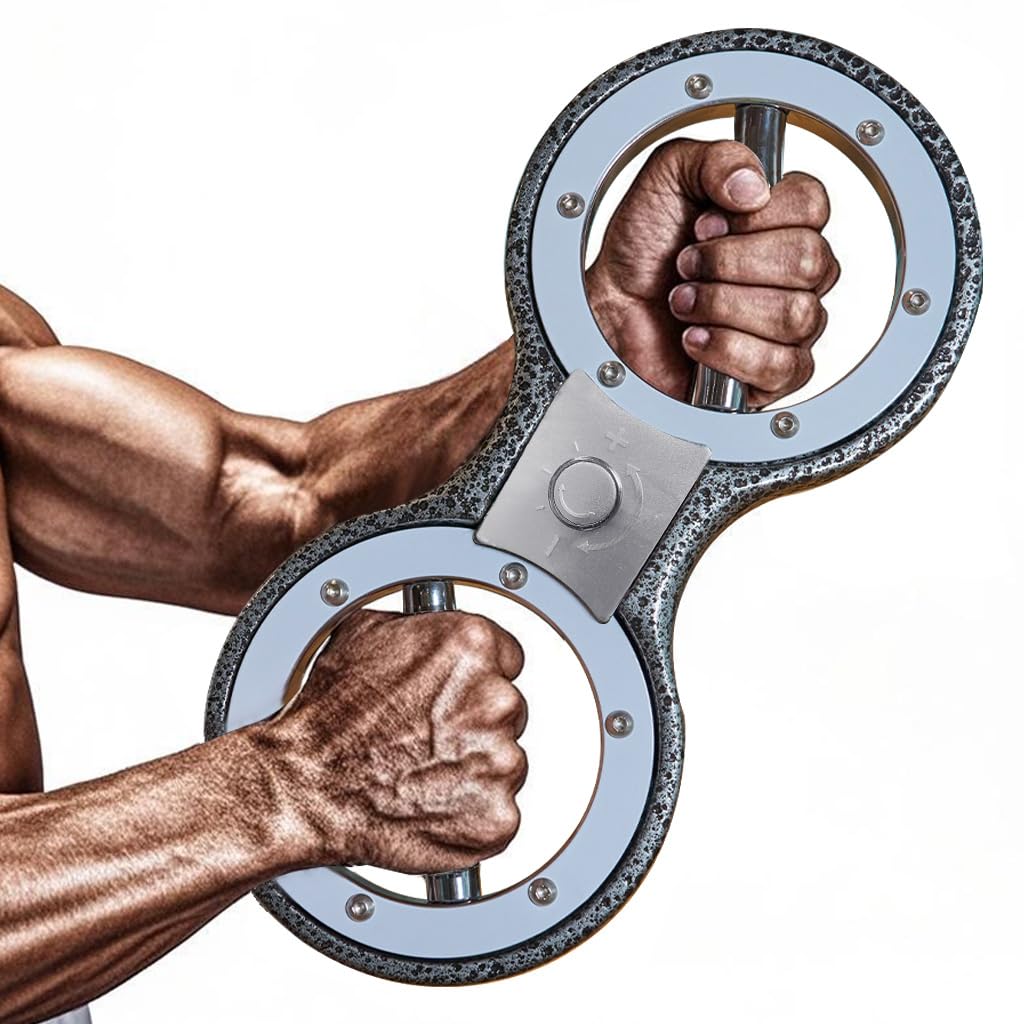
The Fitarc Rotator Burn Machine is the outlier on this list because it doesn’t use hydraulics or cables — instead, it relies on a spinning weighted rotor (12 pounds of steel) combined with a replaceable felt friction pad to create constant isometric tension through rotation. This design is particularly effective for rehab purposes: users with tendonitis, wrist mobility issues, and elbow tendinosis report significant improvement after just a few days of use. The tapered knurled grips prevent slipping even with sweaty hands, and the all-metal construction feels far more premium than the price suggests.
What makes this machine unique for arm training is the constant-motion aspect. Unlike a press where the resistance is only felt during the concentric phase, the rotor forces your forearms, biceps, and shoulders to stabilize throughout the full 360-degree spin. This translates to serious endurance gains and grip strength improvements that static exercises don’t replicate. The unit weighs 12 pounds itself, so the mass provides a baseline load that you can supplement by pressing harder against the friction pad.
The obvious limitation is that it’s not a progressive overload tool for mass building. The 12-pound rotor and friction pad can’t match the top-end resistance of a hydraulic unit or a cable stack, so pure strength gains will plateau faster. It also requires two hands to operate, which means you can’t isolate a single arm asymmetrically. For rehab, grip endurance, and shoulder conditioning, it’s a standout; for serious bicep curling, you’ll need a different machine.
Why it’s great
- All-metal construction with knurled grips feels indestructible for the price
- Constant rotational isometrics build forearm and shoulder endurance uniquely
- Replaceable friction pad extends the life of the device indefinitely
Good to know
- 12-pound rotor limits progressive overload for advanced strength training
- Requires both hands — no single-arm isolation possible
6. OWLSKY Ab Machine
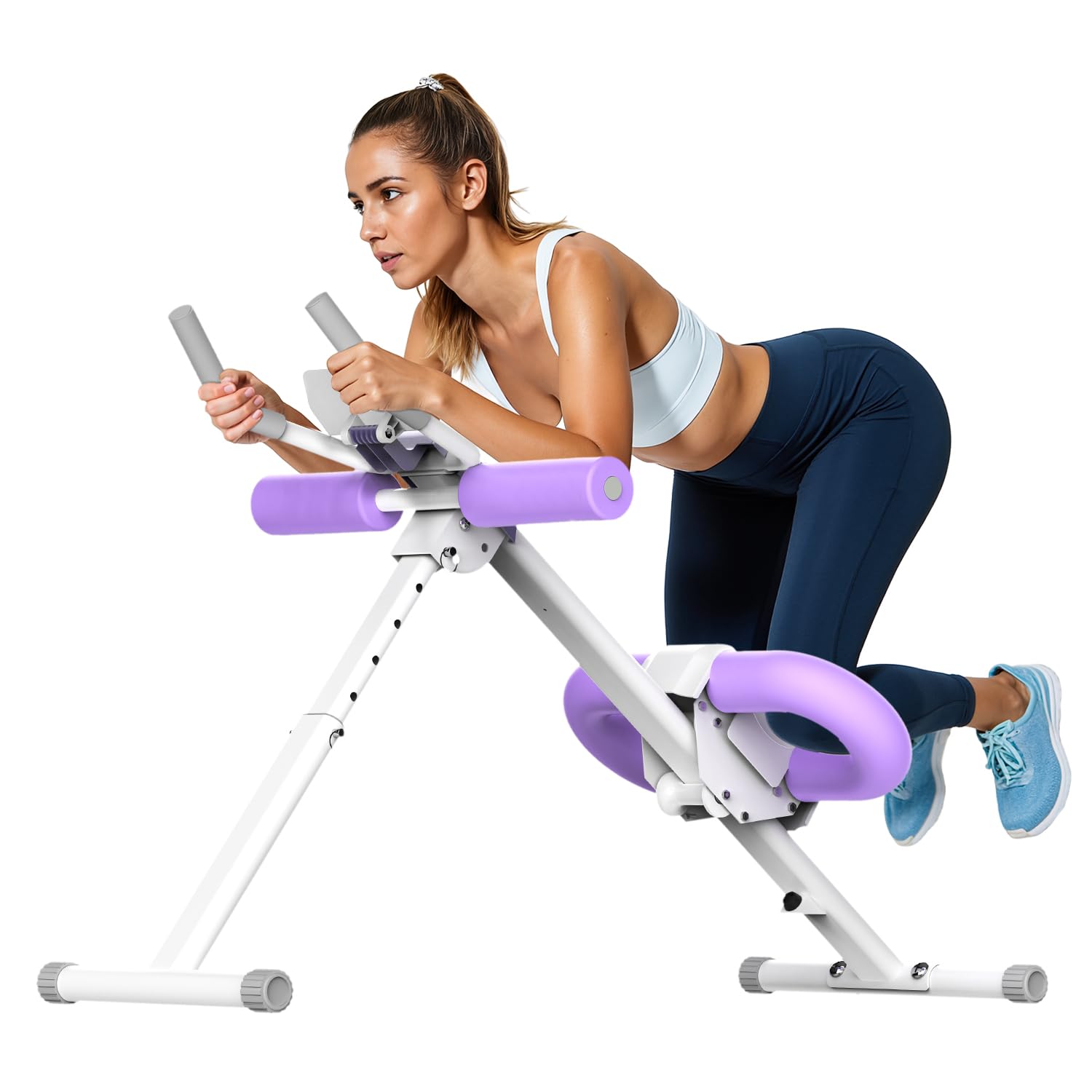
The OWLSKY ab machine earns a spot on this arm-focused list because its track-slide design engages the arms throughout every rep — as you curl forward, your biceps and shoulders act as stabilizers, and the pushing motion back to the starting position loads the triceps. The adjustable incline (2 settings) and 5 height adjustments let you dial in the difficulty, and the 400-pound weight capacity means it accommodates larger users without feeling unstable. The thick sponge padding at the knees and elbows prevents pressure points during longer sessions.
The integrated LCD monitor tracks reps, time, and calories, giving you immediate feedback without needing a separate fitness tracker. The phone holder is positioned low enough that you can watch form videos or follow along with a timer without craning your neck. Users consistently report that 20-30 minute sessions feel effective for both core and arm conditioning, and the foldable design collapses small enough to slide under a bed or into a closet.
This is not a dedicated arm machine — the arms are secondary movers during ab work, so you won’t get the same isolation you would from a press or cable unit. The plastic and foam construction, while comfortable, doesn’t match the durability of the all-steel frames on the premium pick. For someone who wants a full-body home machine that happens to hit the arms during core training, it’s a pragmatic choice; for arm-only training, pair it with one of the hydraulic units above.
Why it’s great
- Adjustable incline and height settings accommodate different fitness levels
- 400-pound capacity and sturdy frame support users of all sizes
- Foldable design with LCD display adds convenience for home use
Good to know
- Arms are secondary movers — not a primary arm isolation machine
- Plastic and foam components are comfortable but less durable than steel
7. MERACH Ab Machine
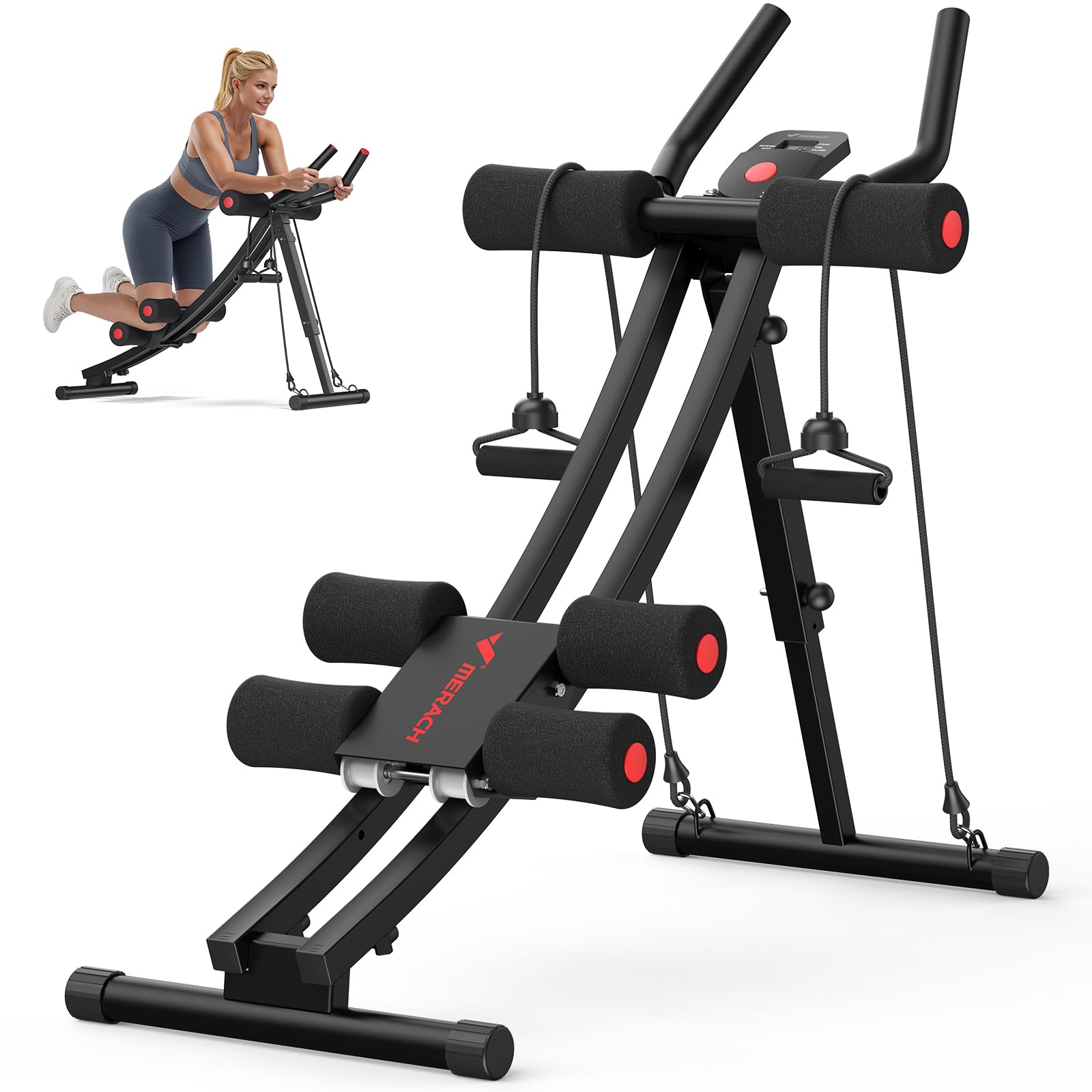
The MERACH ab machine uses a dual-track steel frame and an ergonomic curved track that mimics the natural movement of a crunch, which in turn requires the arms to stabilize the upper body throughout the rep. The triangular dual-track design is noticeably more stable than single-track alternatives, and the quiet gliding mechanism produces almost no noise — a real advantage for apartment dwellers or late-night exercisers. The 4 height adjustments allow you to progress from light toning to intense ab work, all while the arms absorb a portion of the load.
Commercial-grade alloy steel supports up to 330 pounds, and the thick foam padding at the knees and elbows prevents soreness even during high-rep sets. The LCD screen shows reps, time, and calories burned, and the anti-slip handles give you a secure grip when you start sweating. Users report that the machine enables quality lower ab reps without the back strain that plagues floor crunches, and the compact fold reduces storage footprint significantly.
Like the OWLSKY, the arm engagement here is secondary — you’re primarily training the core, with the arms acting as stabilizers and load absorbers. The stretch bands that come with the unit have drawn some criticism for being less user-friendly than the rest of the machine. For someone seeking a quiet, joint-friendly ab machine that happens to involve the arms, it’s a solid pick, but for dedicated arm hypertrophy, it’s a complementary piece rather than a primary tool.
Why it’s great
- Dual-track steel frame provides superior stability over single-track machines
- Silent gliding mechanism allows noise-free use at any hour
- 4 incline levels enable progressive overload for both core and arms
Good to know
- Arm engagement is secondary to core work — not a primary arm builder
- Stretch bands included are less ergonomic than the rest of the machine
FAQ
Can an arm workout machine replace free weight curls and extensions?
How much resistance do I need for effective arm growth?
Are hydraulic arm machines safe for tendonitis and joint issues?
What is the difference between a rotator trainer and a hydraulic press for arms?
Final Thoughts: The Verdict
For most users, the arm workout machine winner is the FLYBIRD Twister Arm Trainer because it combines 15-level hydraulic resistance, a detachable ab wheel, and full portability in a single kit that serves both arm hypertrophy and core work without needing a garage or rack. If you want a dedicated pressing machine with a built-in rep counter, grab the LifePro ShredForce. And for rehab, grip endurance, and shoulder conditioning, nothing beats the Fitarc Rotator Burn Machine.