
Our readers keep the lights on and the weekend projects moving. As an Amazon Associate, I earn from qualifying purchases.
Professional art demands materials that perform under pressure, delivering consistent, vibrant results without frustrating setbacks like wax bloom, brittle cores, or poor lightfastness. The gap between student-grade supplies and what working illustrators, architects, and fine artists require is vast, defined by binder quality, pigment load, and archival stability. Choosing the wrong medium can compromise a commission or degrade a portfolio piece over time.
I’m Rikta — the co-founder and writer behind FitlyFast. The recommendations here are the result of deep dives into pigment chemistry, binder formulas, and archival standards, cross-referenced with hundreds of verified artist reviews across multiple disciplines.
Whether you are rendering hyper-realistic portraits, drafting architectural concepts, or building layers in a watercolor landscape, this guide to the best art supplies for professionals focuses only on the tools that meet uncompromising studio standards.
How To Choose The Best Art Supplies For Professionals
Professional-grade supplies are defined by measurable performance metrics, not marketing. Understanding pigment sources, binder chemistry, and archival certifications will prevent expensive mistakes and ensure your work holds its value over time.
Pigment Load and Lightfastness Rating
The single most important spec for any coloring medium is the pigment concentration. Artist-grade products use a high ratio of pigment to filler, giving intense, opaque coverage with fewer passes. Lightfastness, measured on the ASTM Blue Wool Scale (I to V), tells you how long the color will last before fading. For professionals, only pigments rated I (excellent) or II (very good) under museum conditions should be considered, ensuring your work remains vibrant for decades. Student-grade supplies often skip this rating entirely, using cheaper dyes that can shift color within a year of exposure.
Binder Type and Its Effect on Workflow
The binder — the substance that holds pigment to the surface — dictates the handling characteristics of the medium. In colored pencils, oil-based binders (found in Faber-Castell Polychromos and Caran d’Ache Pablo) create harder, more resilient cores that hold a fine point for detail work and layer without waxy buildup. Wax-based binders (like Prismacolor Premier) are softer and creamier but prone to wax bloom — a cloudy film that appears months after application. For watercolors, gum arabic quality varies; premium paints like Schmincke Horadam use the highest-grade, most transparent gum, allowing glazing techniques without muddiness. Alcohol-based markers like Copic Sketch use a dye-suspension system that dries instantly and allows for seamless, overlapping gradations without damaging paper fibers.
Surface Compatibility and Archival Construction
The substrate is as important as the medium. Professional painters should demand acid-free, lignin-free boards, as acidity in MDF or paper causes yellowing and brittleness over time. For oil painting, an oil-primed linen panel (as opposed to acrylic-primed canvas) provides a non-absorbent surface that allows paint to sit on top rather than sink in, preserving color saturation. The weave texture also matters: a medium-tooth linen is ideal for building thin glazes, while a smooth hot-press paper suits ink and watercolor detail. For markers, paper weight should exceed 180 GSM (gram per square meter) to prevent bleed-through and buckling.
Quick Comparison
On smaller screens, swipe sideways to see the full table.
| Model | Category | Best For | Key Spec | Amazon |
|---|---|---|---|---|
| Faber-Castell 102 Polychromos | Colored Pencil | Oil-based detail & layering | 3.8mm oil-bound lead | Amazon |
| Copic Sketch 36pc | Alcohol Marker | Smooth blending & illustration | Super Brush & Medium Broad tips | Amazon |
| Prismacolor Premier 150ct | Colored Pencil | Soft shading & color range | Soft wax core, 150 colors | Amazon |
| Centurion Linen Panels 6pk | Painting Surface | Oil & alkyd painting | Oil-primed, acid-free MDF | Amazon |
| Schmincke Horadam 48 pan | Watercolor | High-pigment watercolor washes | Highest lightfastness rating | Amazon |
| Caran d’Ache Museum Aquarelle 76pc | Watercolor Pencil | Dry-to-wet vibrant transitions | Water-soluble, 76 shades | Amazon |
| Caran d’Ache Pablo 120pc | Colored Pencil | Premium water-resistant detail | 3.7mm oil-based core | Amazon |
In‑Depth Reviews
1. Faber-Castell 210061 Polychromos Pencils 102ct
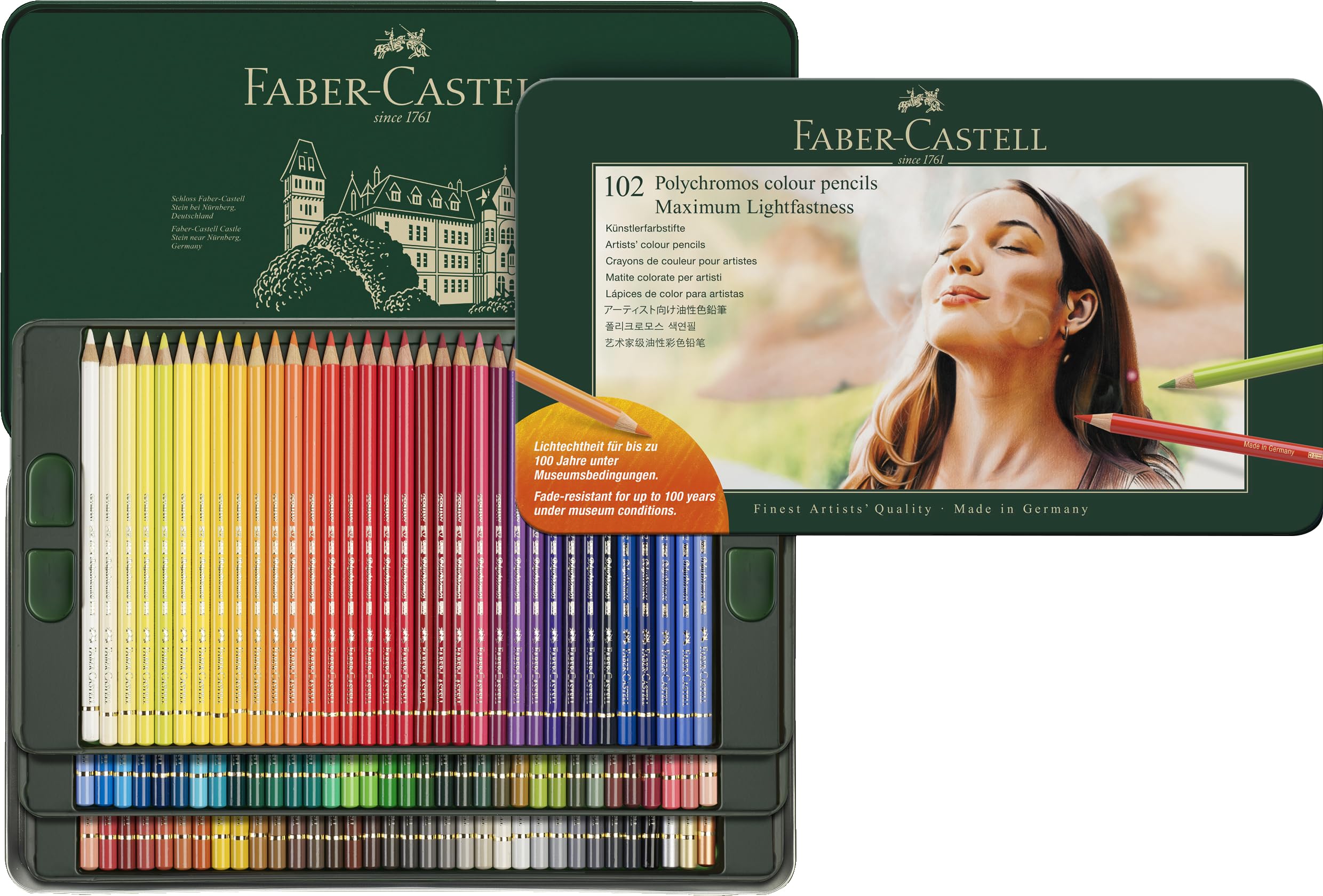
The Faber-Castell Polychromos represent the gold standard for oil-based colored pencils. The 102-color set in a metal case offers a breadth of hues that covers everything from botanical greens to architectural neutrals. The oil binder creates a core that is hard enough to hold a needle-sharp point for micro-detail but still lays down pigment with a smooth, waxy feel during layering. Each pencil is made in Germany using acid-free, lightfast pigments that remain vibrant for up to 100 years under museum conditions.
Artists who switch from wax-based pencils immediately notice the absence of wax bloom — no cloudy film appears on finished work. The 3.8 mm lead resists snapping during sharpening, a common frustration with softer brands. Because the color is translucent by nature, you build saturation through multiple passes, giving you exceptional control over gradients and shadow depth. Reviewers consistently highlight how well Polychromos blend without becoming muddy, especially when used with solvents like Gamsol for painterly effects.
The metal tin is robust and keeps pencils organized during studio use or travel. The only real complaint is a slight warm lean in the color selection, with a notable absence of dedicated flesh tones — a gap you would need to fill with individual pencil purchases. This is not a beginner set; it assumes you understand dry layering and are willing to invest in a tool that demands technique over instant opacity.
Why it’s great
- Oil-based core resists breakage and holds a sharp point through heavy use
- Unmatched layering and blendability without wax bloom
- Museum-grade lightfastness ensures archival permanence
Good to know
- Color selection is heavily skewed toward warm tones
- Lacks essential flesh tones for portraiture
- Premium pricing reflects the professional-grade materials
2. Copic Sketch Alcohol Markers 36ct

Copic Sketch markers are the undisputed workhorse of professional illustrators, concept artists, and architectural renderers. The 36-color starter set includes a balanced selection of bold primaries, secondaries, and a crucial range of warm and cool grays for shading and depth. The alcohol-based ink dries in seconds, allowing for rapid layering without lifting the layer beneath, and glides seamlessly without streaking even over large areas. The Super Brush tip delivers variable line widths from hair-thin to broad washes, while the Medium Broad tip fills flat areas efficiently.
The true professional value lies in the refillability of the system. When a marker runs dry, you buy a bottle of Copic Ink and refill the barrel, paying pennies per refill rather than replacing the entire marker. The nibs are also replaceable, extending the lifespan of each marker to years of daily use. Artists working on commissions or in production art environments depend on this consistency — every marker in a 358-color set behaves identically to the same color purchased five years prior. The 36-piece set is widely considered the ideal entry point, providing enough range for serious shading without overwhelming the user with redundancy.
The included carrying case is transparent and stackable, but reviewers note that it is not designed for heavy travel; the markers can shift and bump into each other. Some artists also wish the set skewed more toward earth tones and pastels for character design. However, given the build quality, blending performance, and eco-friendly refill model, this set is the most cost-effective route into a system that scales to the largest color library in the marker world.
Why it’s great
- Premium alcohol ink blends streak-free and dries instantly
- Fully refillable and nib-replaceable for a long service life
- Dual-tip design adapts to both fine linework and broad coverage
Good to know
- 36-color range may lack specialist earth tones for some illustrators
- Carrying case is functional but not durable for daily commutes
- Initial investment is high but pays off through refills
3. Prismacolor Premier Colored Pencils 150ct

Prismacolor Premier remains the most ubiquitous series in professional colored pencil work, and the 150-count set is the most comprehensive offering. The soft wax core delivers an intensely creamy laydown that saturates paper in fewer passes than almost any other pencil on the market. For artists creating hyper-realistic portraits, botanical illustrations, or large-scale compositions demanding rich, solid color, the Prismacolor Premier is the immediate choice. The color range is vast, spanning every needed tint, shade, and gray.
The well-documented trade-off is core fragility. The wax binder is soft, and the pencils drop or press against each other in the tin, causing the leads to crack and fall out during sharpening — a frustration echoed in hundreds of reviews. The recommended workaround is a quality manual sharpener with a conical blade, such as the Pro Art PRO 3083 or Alvin 9866 brass bullet, and warming the pencils to room temperature before use. Wax bloom is another factor: finished pieces need to be sealed with a fixative to prevent a cloudy white residue from forming after weeks or months.
Despite these quirks, the sheer color saturation and blendability are unmatched at this price tier. Three hundred dollars for 150 pencils works out to roughly sixty-seven cents per pencil, making it the most affordable entry to a truly professional color library. Artists who rely on wax-based blending techniques or who work in a high-volume style will overlook the breakage because the results are faster and more vivid than oil-based alternatives. This set is not for fine detail or archival commission work, but for learning, practicing, and producing commercial work, it remains the industry standard.
Why it’s great
- Unbeatable color saturation and smoothness for its price point
- Huge 150-color palette inspires creative freedom
- Excellent for wax-based shading and blending techniques
Good to know
- Soft cores are prone to breakage and require a quality sharpener
- Wax bloom appears on unsealed work over time
- Not suitable for high-lightfastness archival applications
4. Centurion Deluxe Oil Primed Linen Panel 24×36 6pk
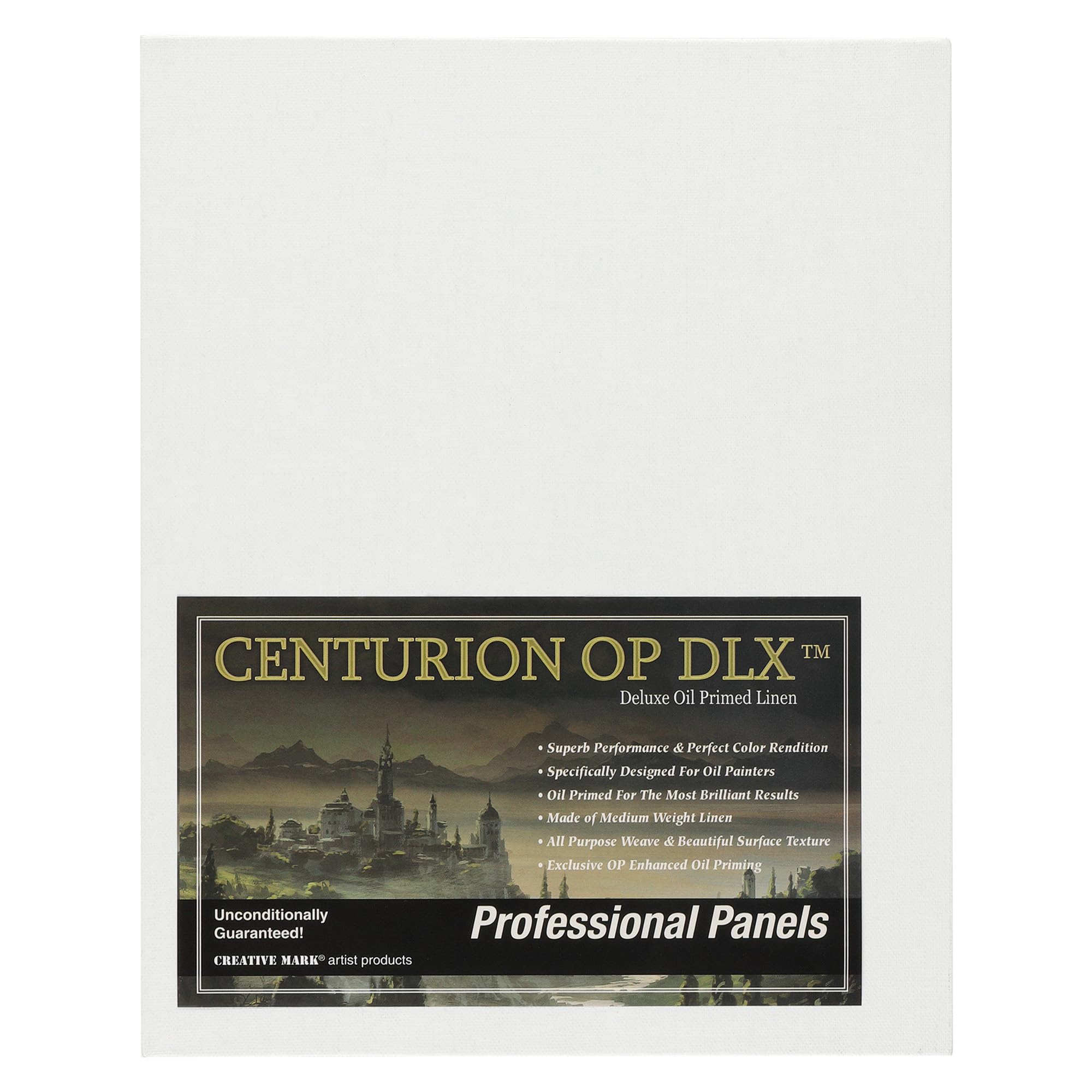
Serious oil painters know that the surface is half the painting. The Centurion Deluxe Oil Primed Linen Panels offer a professional-grade alternative to stretched canvas, built on a rigid 3mm MDF board that will never warp or sag. The key differentiator is the OP Enhanced Oil Priming — a lead- and zinc-free formula that creates a non-absorbent, acid-free barrier between the linen and the paint. This allows oil colors to sit on top of the weave, preserving the chroma and brushstroke integrity rather than being absorbed into the canvas fibers and dulling the color.
The medium texture linen weave is fine enough to support delicate glazing techniques yet toothy enough to hold multiple layers of impasto. Each panel comes ready to use straight from the box, requiring no additional gesso or sanding. Artists who work in series will appreciate the consistency: every panel in a 6-pack has the exact same surface absorbency, ensuring uniform results across a set of works. The panels are also about a quarter of the bulk of an equivalent stretched canvas, making them ideal for plein air paint-outs, studio storage, and shipping.
At just over fifteen pounds for a 24×36-inch 6-pack, these panels are a significant investment in shipping weight and initial cost. Some reviewers note that the MDF edges could be finished more smoothly, and the weight makes them less ideal for board-mounted gallery presentations without a frame. However, for oil and alkyd painters who demand archival construction and a non-toxic priming layer, Centurion delivers a surface that performs like a museum-grade linen panel at a price that undercuts boutique board makers.
Why it’s great
- Oil-primed with lead- and zinc-free formula for archival safety
- Rigid MDF will not warp, sag, or bend during painting
- Ready-to-use surface saves hours of preparation time
Good to know
- Weight is substantial; less practical for portable display frames
- Panel edges may benefit from sanding for a finer finish
- Premium cost reflects the specialty linen and priming process
5. Schmincke Horadam Aquarell 48 Half-Pan Set

The Schmincke Horadam Aquarell 48 half-pan set is the definition of an investment in color quality. Founded in 1881, Schmincke uses the highest grade of artist pigments available, ground to a microscopic particle size that allows the gum arabic binder to suspend them without clumping. The result is a watercolor that reactivates instantly with a wet brush, even after months of sitting in the pan, and lifts cleanly from the palette without cracking. The 48 colors are curated to cover the spectrum with both opaque and transparent options, including essential earth tones and outliers like the rare ONETZ shade.
The lightfastness ratings on Horadam colors are among the highest in the industry, with most pigments earning ASTM I or II ratings. This matters for watercolorists who work on commission or exhibition pieces, where archival permanence is non-negotiable. The metal box is compact — roughly the size of a deck of cards — with an integrated mixing palette and a water reservoir slot. Artists working outdoors or in small studios appreciate the footprint, though the enamel paint on the box has been noted by some as rough-to-the-touch, a minor quality-control flaw for a premium product.
Every half-pan is also refillable using Schmincke Horadam tube colors, which means you can replace individual shades without buying a whole new set. Over the long term, this is both cost-effective and sustainable. Reviewers consistently describe the paint as “creamy” and “effortless” — the way pigment disperses into water without chalkiness is the hallmark of a truly premium binder. This set is not for casual painters; it is for watercolorists who need to trust every wash, every glaze, and every dry-brush stroke to behave predictably across years of use.
Why it’s great
- Ultra-high pigment load produces vibrant, clean washes
- Excellent lightfastness ratings for archival work
- Compact metal box with integrated mixing palette and refillable pans
Good to know
- Enamel finish on the metal box can feel rough and cheap
- Premium pricing positions it as a top-tier professional purchase
- Magnetic pans are recommended to prevent movement inside the tin
6. Caran d’Ache Museum Aquarelle Watercolor Pencils 76pc
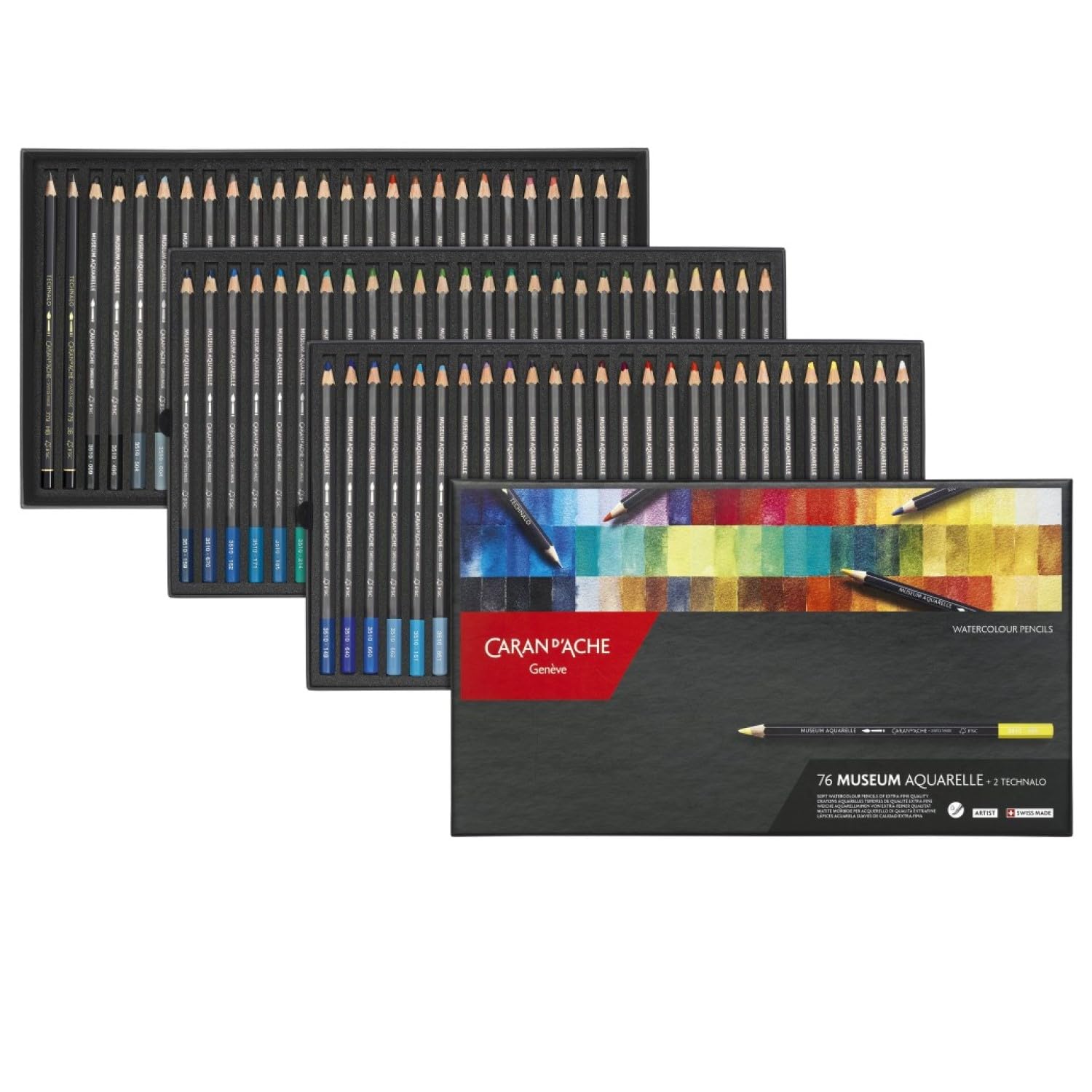
Caran d’Ache Museum Aquarelle pencils sit at the pinnacle of water-soluble colored pencils. The 76-color range represents the brand’s commitment to color purity, with every shade being completely water-soluble and leaving zero white film upon drying — a common issue with cheaper watercolor pencils. The pigment load is so dense that a simple brush activation transforms a dry pencil stroke into a saturated wash, maintaining the vibrancy of a tube watercolor without the loss of control inherent in wet media. Artists who need both the precision of a pencil and the spread of a wash find this hybrid essential.
The set includes two water-soluble graphite pencils (HB and 3B), plus a selection of warm and cool grays that are indispensable for tonal value studies. The color range leans toward high-chroma shades that resist fading, all rated for exceptional lightfastness. The pencils are packaged in a sturdy box with foam slots that prevent jostling — a detail that matters when you have spent over three hundred dollars on a set. Reviewers who own Faber-Castell Albrecht Dürer pencils frequently note that Museum Aquarelle pencils outperform them in pigmentation and smoothness, particularly when activated with water.
The main barrier is cost. At this price, you are paying for Swiss precision manufacturing, top-tier pigments, and a color selection that covers virtually every needed transition from cool to warm across the full visible spectrum. Some artists find the set too large for travel and wish for a more compact selection. But for watercolorists, illustrators, and mixed-media artists who require the ability to sketch, paint, and tint without switching between separate tool kits, the Museum Aquarelle set is the definitive choice.
Why it’s great
- Intense pigmentation transforms to saturated wash with water
- Zero white film residue after drying
- Includes water-soluble graphite and tonal gray shades for complete sketching
Good to know
- Very high price point limits it to professional or dedicated users
- Large set is not ideal for portable field kits
- Requires a separate watercolor brush set for full capability
7. Caran d’Ache Pablo Colored Pencil Set 120pc

The Caran d’Ache Pablo set is the pinnacle of colored pencil technology, offering 120 water-resistant, oil-based pencils that combine the buttery feel of wax with the resilience and lightfastness of a premium oil formula. The 3.7 mm lead is a perfect midpoint between the soft Prismacolor Premier and the hard Faber-Castell Polychromos, making it ideal for artists who need fine detail without sacrificing layering capability. The hexagonal barrel provides a comfortable grip, and the angled sides prevent the pencils from rolling off a slanted drafting table.
The color selection is carefully curated to include a full spectrum of primaries, secondaries, earths, and grays, with no obvious gaps. The water-resistant binder means the pencils do not smudge easily once laid down, and they are erasable with gentle use, making them suitable for mixed-media work. Lightfastness ratings are exceptionally high, with most colors rated I to III on the ASTM scale, ensuring up to 100 years of color stability under museum conditions. The metal tin holds all 120 pencils in two layers, though some users have noted that the stacking design causes pencils to jostle in transit.
At over four hundred dollars for the full set, this is not an impulse purchase. Reviewers consistently draw comparisons to Polychromos, stating that the Pablo feels creamier and more saturated, offering a slightly better compromise between point retention and blendability. The set is overkill for casual colorists but is an endgame purchase for professional illustrators, portrait artists, and designers who use colored pencils as a primary medium. If you can afford the outlay, the Pablo set removes any need to look for another brand.
Why it’s great
- Perfect balance of wax-creaminess and oil-based resilience for detail
- Excellent lightfastness ratings for archival work
- Water-resistant formula prevents unwanted smudging during layering
Good to know
- High cost makes it a long-term investment, not a starter set
- Metal tin stacks pencils, leading to potential jostling without foam inserts
- Heavier than equivalent sets, less portable for field use
FAQ
What does the ASTM lightfastness rating mean for my colored pencils?
How do I fix wax bloom on Prismacolor Premier pencil drawings?
Can I refill Copic markers, or are they disposable?
Final Thoughts: The Verdict
For most users, the art supplies for professionals winner is the Faber-Castell Polychromos 102pc set because it offers the best all-around balance of oil-based durability, layering capability, and lightfastness for the price. If you need an illustrator’s workhorse for blending and linework, grab the Copic Sketch 36pc markers for their refillable system and seamless blending. And for the watercolorist who demands the cleanest washes and highest pigment purity, nothing beats the compact, museum-quality Schmincke Horadam 48 half-pan set.