
Our readers keep the lights on and the weekend projects moving. As an Amazon Associate, I earn from qualifying purchases.
Between a grainy smudge of a nebula and a crisp, color-rich image of the Lagoon Nebula lies the right sensor choice, the right cooling strategy, and the right mount compatibility. Your camera is the single component that determines whether those photons you collected for an hour become art or noise.
I’m Rikta — the co-founder and writer behind FitlyFast. For this guide, I’ve dissected the sensor architecture, pixel sizes, quantum efficiency curves, cooling delta ratings, and ecosystem compatibility for eleven distinct astronomy cameras, from planetary shooters to deep-sky cooled units to all-in-one smart telescopes.
Whether you are after lunar craters or the spiral arms of a distant galaxy, finding the right astronomy camera means comparing sensor surface area, back-illumination, and TEC cooling depth against your telescope’s focal length.
How To Choose The Best Astronomy Camera
Astronomy cameras are not one-size-fits-all. A camera optimized for rattling off 100 frames per second of Jupiter is a poor match for capturing the faint hydrogen-alpha glow of the California Nebula. Before you buy, align three variables: your target (Solar System or deep-sky), your telescope’s focal ratio, and your willingness to post-process calibration frames.
Sensor Technology: Back-Illuminated vs Front-Illuminated
Back-illuminated (BSI) sensors rearrange the wiring behind the photodiodes, allowing photons to hit the light-sensitive area directly. This boosts quantum efficiency (QE) into the 80%+ range, which is critical for faint deep-sky objects. Front-illuminated sensors absorb less light at the same aperture—usable for bright lunar and planetary targets, but noisy on dim nebulae without heavy stacking.
Cooling: TEC Delta and Dark Current
Thermoelectric cooling (TEC) drops the sensor temperature 30°C to 45°C below ambient. Every 6°C of cooling roughly halves dark current, the thermal noise that builds up during long exposures. For deep-sky integration times exceeding 60 seconds, a cooled camera is non-negotiable. Uncooled cameras work for lucky imaging of planets where exposure times are under 50 milliseconds.
Pixel Size and Sampling
Your telescope’s focal length and seeing conditions determine the ideal pixel size. Small pixels (2.4 µm) suit short focal ratio scopes (f/5 or faster) and good seeing. Larger pixels (4.63 µm or bigger) match longer focal ratio scopes and average seeing, preventing undersampling. The rule: pixel scale in arcseconds per pixel = (pixel size in µm / focal length in mm) * 206.3. Aim for 1-2 arcseconds per pixel for most deep-sky work.
Software Ecosystem and Compatibility
Deep-sky imaging runs on capture platforms like NINA, SharpCap, ASIAIR, and Astroberry. A camera must have native ASCOM drivers and a solid SDK. Planetary shooters typically use dedicated capture apps like iCap or FireCapture. Smart telescopes like the Vaonis Vespera and Unistellar Odyssey bundle everything into a single app, sacrificing flexibility for zero-friction operation.
Quick Comparison
On smaller screens, swipe sideways to see the full table.
| Model | Category | Best For | Key Spec | Amazon |
|---|---|---|---|---|
| ZWO ASI294MC-Pro | Deep-Sky Cooled | Nebulae & Galaxies | 11.3 MP, 4/3″ BSI, TEC 35°C delta | Amazon |
| ZWO ASI183MC Pro | Deep-Sky Cooled | High-Res Deep-Sky | 20 MP, 1″ BSI, TEC 45°C delta | Amazon |
| SVBONY SV405CC | Deep-Sky Cooled | DSO & EAA | 11.7 MP, 4/3″ BSI, TEC 30°C delta | Amazon |
| Canon EOS R8 | Full-Frame Mirrorless | Wide-Field Nightscapes | 24.2 MP, Full-Frame, 4K60p | Amazon |
| Sky-Watcher Star Adventurer 2i Pro | Star Tracker | Portable Nightscapes | Motorized EQ tracker, WiFi, 7 lb | Amazon |
| Canon EOS Rebel T7 (New) | Entry DSLR | Beginner Night Sky | 24.1 MP APS-C, 9-point AF | Amazon |
| Canon EOS Rebel T7 (Renewed) | Entry DSLR | Budget Astro Start | 24.1 MP APS-C, Renewed | Amazon |
| Celestron NexImage 20 | Planetary | Moon & Planets | 20 MP, 1/1.8″ BSI, USB-C | Amazon |
| Vaonis Vespera | Smart Telescope | One-Button Imaging | Sony IMX462, 200mm f/4.5 | Amazon |
| Unistellar Odyssey Pro (Red) | Smart Telescope | All-in-One Pro | 85mm f/3.9, RAW/FITS, 5h battery | Amazon |
| Unistellar Odyssey Pro (Black) | Smart Telescope | All-in-One Pro | 85mm f/3.9, RAW/FITS, 5h battery | Amazon |
In‑Depth Reviews
1. ZWO ASI294MC-Pro

The ZWO ASI294MC-Pro sits in a sweet spot that few cameras reach: the sensor diagonal of the Micro 4/3 format (approximately 22.5 mm) covers a generous field of view through most refractors and Schmidt-Cassegrains, while the 11.7 MP resolution at 4.63 µm pixels matches the typical focal ratios of f/6 to f/10 scopes without undersampling. The back-illuminated IMX294 architecture delivers around 80% peak QE, so faint hydrogen-alpha regions reveal themselves in under 60 seconds of exposure.
The two-stage TEC cooler pulls the sensor down 35°C below ambient, enough to suppress dark current to negligible levels for 300-second subs. A 256 MB DDR3 buffer smooths USB 3.0 transfer at 16 fps full-frame, and the separate USB 2.0 hub lets you daisy-chain an electronic focuser or OAG without adding a separate hub. The 12V power input for the cooler is a dedicated barrel jack—avoid powering the cooler through the USB bus.
Some early units had a silicone oil migration issue inside the sensor chamber, though ZWO revised the sealing on later production runs. The amp glow pattern, visible on single frames, calibrates out fully with dark frames. For intermediate imagers graduating from a DSLR, this camera delivers the biggest jump in signal-to-noise ratio per dollar spent.
Why it’s great
- Excellent balance of sensor size, pixel scale, and QE for most setups
- Reliable TEC cooling with 35°C delta
- Built-in USB hub for accessory power
Good to know
- Requires separate 12V supply for cooling
- Amp glow present but calibrates out
- Ownership experience depends on proper plate-solving workflow
2. ZWO ASI183MC Pro

The ASI183MC Pro packs 20.1 megapixels onto a 1-inch (13.2 mm diagonal) back-illuminated sensor with 2.4 µm pixels. This tiny pixel pitch makes it ideal for short focal ratio telescopes (f/5 or faster) and excellent seeing conditions, as the resolution reveals fine detail in galaxies and planetary nebulae that larger-pixel sensors would undersample. At f/4.7, the pixel scale hits approximately 1 arcsecond per pixel—right at the typical seeing limit.
The TEC cooling reaches 45°C below ambient, the deepest delta in this roundup, which effectively kills thermal noise on 5-minute subs. However, the 2.4 µm pixels also mean the sensor saturates faster on bright stars. You will need to shoot shorter subs and stack more of them to avoid clipping the core of a bright star. The amp glow is significant—it appears as a bright band on the right edge of the frame—but dark frames remove it cleanly if taken at the same temperature and exposure.
This camera is older in ZWO’s lineup and newer options like the ASI533MC Pro offer lower amp glow and a square sensor. But for imagers chasing the highest resolution on a fast telescope and willing to manage nightly dark libraries, the 183MC Pro delivers an unmatched level of planetary-nebula detail for its price bracket.
Why it’s great
- Highest pixel count in class (20 MP)
- Deep TEC cooling (45°C delta)
- Ideal for fast f/5 and under telescopes
Good to know
- Needs fresh dark frames each session
- 2.4 µm pixels demand good seeing
- Lower full-well capacity clips bright stars faster
3. SVBONY SV405CC

SVBONY’s SV405CC uses the same Sony IMX294 sensor as the ZWO ASI294MC-Pro, giving it an identical 11.7 MP resolution, 4.63 µm pixels, and back-illuminated construction. The 4/3-inch format covers the same field of view, and the 63 ke- full-well capacity preserves highlights in star clusters. The two-stage TEC cooler achieves 30°C below ambient—slightly less aggressive than ZWO’s implementation but still sufficient for cutting dark current to acceptable levels for 5-minute exposures.
The camera ships with a comprehensive accessory kit: a 1.25-inch nosepiece, a 2-inch adapter, M42 and M48 threads, and a dedicated 12V power supply. The 256 MB DDR3 buffer works well with USB 3.0, delivering 19 fps in RAW8 mode at full resolution. Smart HCG mode kicks in automatically at gain 120, reducing read noise to around 1.2 e- while preserving dynamic range—a genuine convenience feature for one-shot color capture of faint nebulae.
Early firmware had a concerning bug where the “previous image” would display in NINA instead of the live frame, breaking plate solving and risking telescope crashes. Some users report the issue persists on certain units. USB cable length is also critical; longer passive cables may cause connection drops. If SVBONY has resolved the NINA display bug on recent stock, this camera matches the ASI294MC-Pro’s image quality at a notably lower cost.
Why it’s great
- Same IMX294 sensor as premium competitors at a lower price
- Automatic HCG mode simplifies gain settings
- Included 12V supply and adapter kit
Good to know
- Firmware compatibility issues with NINA reported
- Cooler is slower to reach target delta
- USB cable length sensitivity
4. Canon EOS R8

The Canon EOS R8 is Canon’s lightest full-frame mirrorless body at 461 grams, and its 24.2 MP sensor features the same DIGIC X processor found in the EOS R6 Mark II. For astrophotography, the full-frame sensor offers a massive 36×24 mm imaging area—ideal for wide-field nightscapes using fast manual lenses like a Sigma 14mm f/1.8 or a Rokinon 24mm f/1.4. The native ISO range extends to 102400, and the Dual Pixel CMOS AF II works in near darkness for focusing on bright stars.
The key spec for astrophotographers is the uncropped 4K60 video oversampled from 6K—this allows high-quality frame extraction for lunar or planetary time-lapses. In stills mode, the electronic shutter reaches 40 fps with full AF tracking. Rolling shutter performance has improved dramatically over the RP generation, making the R8 usable for tracking aurora or meteor showers. Canon Log 3 preserves 10-bit dynamic range for stretching gradients in post-processing.
The R8 lacks in-body image stabilization, so you must rely on a tracking mount for exposures longer than 1 second. The LP-E17 battery gives roughly 350 shots on a night session—pack spares. There is a single UHS-II SD slot, no IBIS, and the body is plastic, but for a hybrid shooter who wants a lightweight night-sky camera that also serves as a vlogging body, the R8 delivers Full-Frame sensor performance at a body-only price that undercuts much of the competition.
Why it’s great
- Excellent low-light performance with full-frame sensor
- Uncropped 4K60 oversampled from 6K
- Fast and accurate Dual Pixel AF II in near-dark
Good to know
- No in-body image stabilization
- Small battery for long night sessions
- Single SD card slot
5. Sky-Watcher Star Adventurer 2i Pro

The Star Adventurer 2i Pro is a lightweight equatorial tracking mount, not a camera itself, but it is the bridge that turns any DSLR or mirrorless camera into a dedicated night-sky imaging rig for wide-field astrophotography. At 7 pounds with the counterweight, it packs down into a carry-on bag and can track the sky for up to 4 minutes at 50mm focal length without star trailing—long enough to capture the Milky Way core with good signal.
What separates the 2i Pro from the base model is the built-in WiFi module that connects to Sky-Watcher’s SAM Console app for remote control of tracking speed, direction, and time-lapse intervals. The illuminated polar scope simplifies alignment, though the included red dot finder feels flimsy. A 1/4-inch-20 thread at the top accepts standard ball heads, and the dual-axis motor drive compensates for both RA and Dec drift when used with an external autoguider.
Payload capacity is rated at 11 pounds, but practical experience shows that a 6-pound camera-and-lens combo needs a counterweight on the DEC bracket to prevent backlash. The included counterweight bar works, but an additional weight is necessary for heavier setups. The SNAP port is fragile—one reviewer reported the retaining ring falling off. For budget-conscious imagers, this mount with a used DSLR outperforms any alt-azimuth star tracker at a fraction of the cost of a full equatorial mount and cooled camera rig.
Why it’s great
- Portable and lightweight for travel
- WiFi app control for remote operation
- Excellent tracking for wide-field nightscapes
Good to know
- Counterweight needed for heavier camera setups
- Polar scope illumination requires extra accessory
- SNAP port is not very robust
6. Canon EOS Rebel T7 (New)

The Canon EOS Rebel T7 is the standard entry-level DSLR for beginners who want to try astrophotography without diving into dedicated astronomy cameras. The 24.1 MP APS-C sensor offers decent sensitivity up to ISO 6400 (expandable to 12800), and the 18-55mm kit lens at 18mm and f/3.5 can capture star fields with a star tracker if kept to short exposures of 15-20 seconds on a fixed tripod.
The built-in WiFi and NFC allow basic remote control via the Canon Camera Connect app, which is useful for triggering exposures without shaking the tripod. The optical viewfinder covers 95% of the frame, and the 9-point AF system with AI Servo is basic but functional for lunar photography where you focus manually anyway. Live View with 10x magnification makes manual focusing on a bright star straightforward.
The T7 lacks modern features like 4K video (it does 1080p at 30 fps), a vari-angle screen, and high-speed burst rates. The ISO performance above 6400 produces noticeable noise, and the absence of an intervalometer means you need an external shutter release cable for time-lapses. As a dedicated astronomy camera, it is outclassed by cooled CMOS units.
Why it’s great
- Familiar DSLR ecosystem with interchangeable lenses
- Built-in WiFi for remote shutter control
- Great for daytime photography too
Good to know
- No 4K video recording
- ISO above 6400 is noisy
- No built-in intervalometer
7. Canon EOS Rebel T7 (Renewed)

The renewed version of the Canon EOS Rebel T7 offers identical imaging specs to the new unit—24.1 MP APS-C sensor, 9-point AF, and 1080p video—at a lower entry price. For a beginner building a first astrophotography setup, every dollar saved on the camera body goes toward a better tripod or star tracker. The renewed units from reputable sellers often look like new with zero scratches and function perfectly, as noted by multiple verified buyers.
The low-light performance of the T7 is adequate for lunar imaging with a 200mm lens and for wide-field shots of the Milky Way using a fast prime lens. The 1.6x crop factor of the APS-C sensor gives an effective focal length of 480mm with a 300mm lens, which helps when imaging the moon or planets, though the resolution at planetary scales will not match a dedicated planetary camera with smaller pixels.
The renewed route carries the usual caveats: no warranty beyond the seller’s policy, potential for cosmetic imperfections, and no guarantee on shutter actuations. However, for a budget-conscious learner who wants to determine whether astrophotography is worth a larger investment before buying a cooled camera, the renewed Rebel T7 is the most affordable DSLR gateway available at its price tier.
Why it’s great
- Lowest cost entry point for astrophotography
- Renewed units often in like-new condition
- Same sensor as new T7 at a discount
Good to know
- Limited warranty compared to new camera
- Same performance limitations as new T7
- Shutter actuation count unknown
8. Celestron NexImage 20
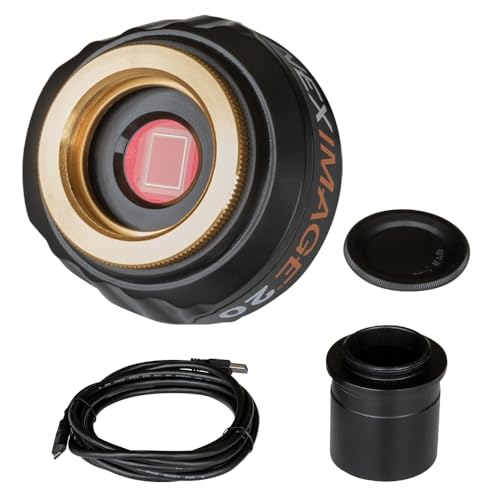
The Celestron NexImage 20 is a dedicated planetary and solar-system camera designed for one job: capturing high frame-rate video of the Moon, planets, and Sun (with a solar filter). The 20 MP AR2020 back-illuminated CMOS sensor (5240 x 3840 pixels) with 1.4-micron pixels delivers high resolution for detecting fine lunar rilles and the Cassini Division in Saturn’s rings. The tiny pixel size is ideal for the long focal lengths of Schmidt-Cassegrain telescopes (f/10 or f/20), where it produces oversampled data that you can drizzle-stack for detail.
The headlining feature is plug-and-play simplicity: the 1.25-inch nosepiece fits any focuser, and the USB-C connection (with included USB-A cable) provides both power and data. The included iCap software handles capture, gain adjustment, and ROI cropping. The ROI feature is critical—by selecting a smaller region around the planet, you boost the frame rate from around 30 fps at full resolution to over 100 fps, which freezes atmospheric seeing. For autoguiding during deep-sky imaging, the NexImage 20 also functions as a guide camera.
A significant number of users reported that the camera driver version 5.3.0.2793 would not install on Windows 11, requiring a manual download of an updated driver from Celestron’s support site. The sensor is small (1/1.8-inch), so the field of view is tight—you will see only the Moon or a single planet at a time. This is not a deep-sky imager. For the Lunar and planetary enthusiast with a long-focal-length scope, however, the NexImage 20 captures detail that larger-sensor cameras miss because of their bigger pixels.
Why it’s great
- High 20 MP resolution for planetary detail
- ROI mode for high-speed lucky imaging
- USB-C connectivity for modern computers
Good to know
- Driver issues on clean Windows 11 installs
- Small sensor limited to Solar System targets
- No built-in cooling for long exposures
9. Vaonis Vespera

The Vaonis Vespera is a self-contained observation station that bundles a 200mm f/4.5 quadruplet apochromatic refractor with a Full HD Sony IMX462 sensor (1920×1080, 2 MP) inside a lightweight body weighing under one pound. It is a complete “smart telescope” — you place it on the included tripod, connect via WiFi to the Singularity app, select a target from the catalog, and the Vespera automatically aligns, focuses, and begins stacking images in real-time.
The 2 MP sensor and 200mm focal length produce a field of view of roughly 1 degree. In mosaic mode, the software stitches multiple frames to produce an 8.2 MP composite, though each individual sub-exposure is limited by the small sensor area. The built-in image stacking generates a final TIFF or JPEG without requiring computer post-processing—a true turnkey experience. Battery life reaches about 4-6 hours, and the motorized alt-azimuth mount tracks well for a lightweight design rated for sub-arcsecond seeing.
The Vespera prioritizes simplicity over performance. Astrophotographers who want to control exposure time, gain, and calibration frames will find the app limiting—there is no RAW/FITS output, no manual focus override, and no PC software. The 2 MP sensor, even with stacking, cannot match the resolution or light-gathering ability of a dedicated astronomy camera on the same budget. It is a consumer lifestyle product for casual observers who want shareable images of bright DSOs without learning the technical workflow.
Why it’s great
- Complete turnkey astrophotography in one package
- Extremely lightweight and portable
- Real-time stacking and sharing via smartphone app
Good to know
- 2 MP sensor limits resolution
- No RAW/FITS export for advanced processing
- App-dependent and no PC software available
10. Unistellar Odyssey Pro (Red)
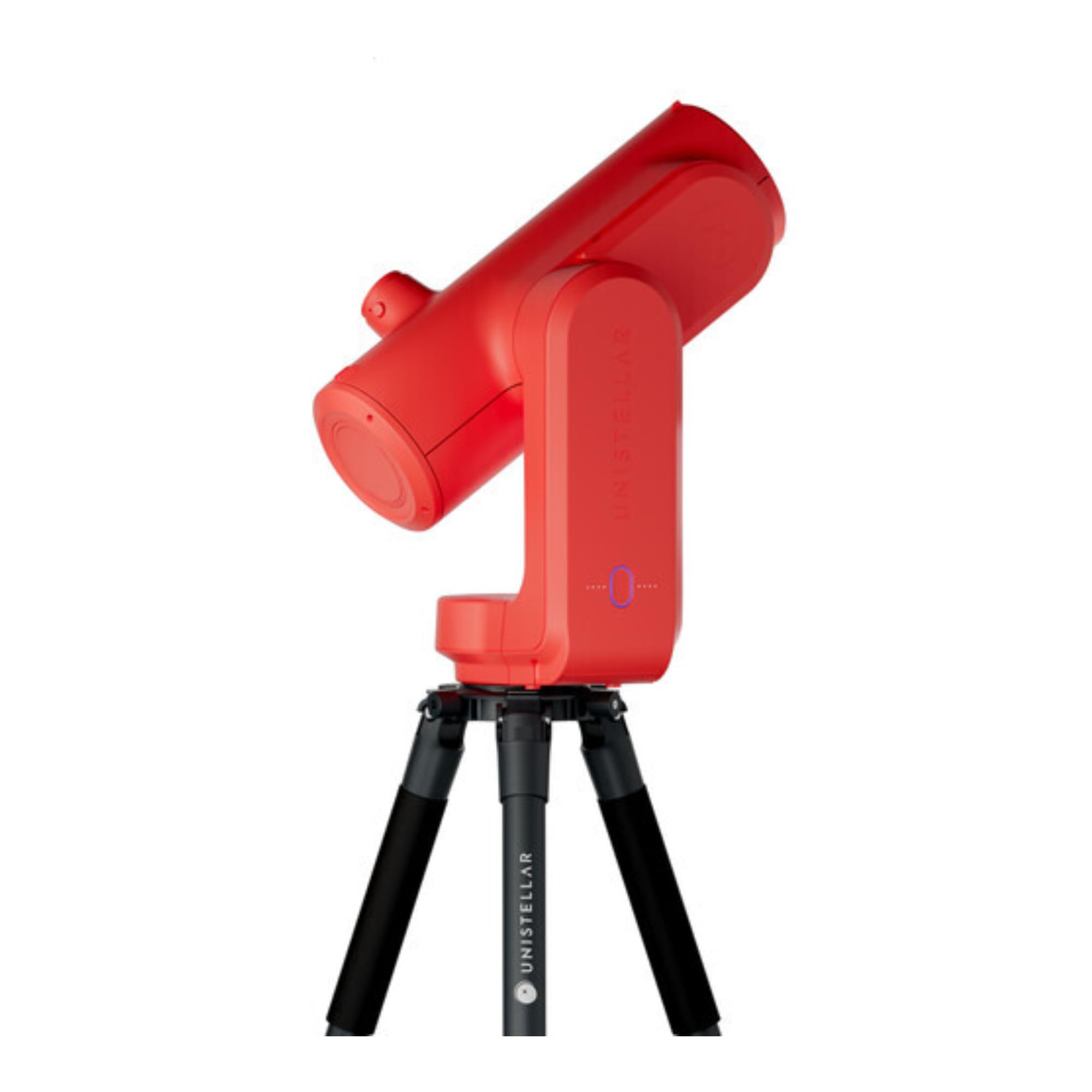
The Unistellar Odyssey Pro is a pro-grade all-in-one smart telescope that goes beyond the Vespera by offering RAW/FITS export, a 5,000-object catalog with a 37-million-star database, and an exclusive eyepiece for direct visual observation—a feature unique to Unistellar’s smart telescope line. The 85mm f/3.9 optics (320mm focal length) gather significantly more light than the Vespera’s 50mm aperture, and the limiting magnitude of 17.2 reaches fainter globular clusters and planetary nebulae.
The integrated camera uses 1.45 µm pixels with a sampling rate of 0.93 arcseconds per pixel, and the motorized alt-az mount with GoTo does not require polar alignment or calibration—just power on, connect the app, and select a target. The onboard 64 GB storage and 5-hour battery mean you can run an observing session without external power or a laptop. The ability to export RAW and FITS data allows post-processing in PixInsight or Photoshop, bridging the gap between smart telescopes and traditional astrophotography.
User feedback highlights inconsistent WiFi connections that can break the session, requiring a restart of the scope. The app lacks manual control over individual exposure parameters and star identification. At the premium tier, the Odyssey Pro is competing with a full equatorial mount, a 80mm ED refractor, and a cooled camera setup of similar cost that would offer more flexibility and better image quality. For the imager who values instant setup and one-tap observation over ultimate image quality, the Odyssey Pro delivers a unique all-in-one experience.
Why it’s great
- Full smart telescope with RAW/FITS export for pro processing
- Eyepiece for direct visual observation
- Large 5,000-object catalog with GoTo
Good to know
- WiFi connectivity can be inconsistent
- Limited manual control in the app
- High cost; competes with traditional setups
11. Unistellar Odyssey Pro (Black)

The Unistellar Odyssey Pro in the black chassis is identical in specifications to the red version: the same 85mm f/3.9 quadrupole apochromat, the same IMX sensor with 1.45 µm pixels, the same 64 GB storage and 5-hour battery, and the same eyepiece technology for visual observation. The color choice is purely aesthetic, allowing users to match their gear or personal preference.
The core value proposition remains the all-in-one convenience combined with RAW/FITS export capability—a rare feature that lets the discerning user take the stacked data from the smart telescope into post-processing software for color calibration, deconvolution, and noise reduction. The mount does not require polar alignment, which makes it accessible for observers who want to set up quickly in the backyard or a dark-sky site without the learning curve of an equatorial mount.
As with the red edition, the same WiFi connectivity issues apply, and the app’s lack of manual exposure control frustrates advanced users who want to dial in specific gain and exposure values for challenging targets. The overall package is expensive, but for an imager who values the integration and is willing to accept the closed-ecosystem limitations, the black Odyssey Pro delivers the same impressive performance as the red version with a different color accent.
Why it’s great
- Identical premium features to the Red edition
- RAW/FITS export for advanced post-processing
- No polar alignment required; instant setup
Good to know
- WiFi connectivity can be inconsistent
- No manual exposure control in app
- High cost; competes with traditional setups
FAQ
What pixel size is ideal for my telescope?
Do I really need a cooled camera for deep-sky imaging?
What is the difference between one-shot color (OSC) and monochrome astronomy cameras?
Can I use a regular DSLR for deep-sky astrophotography?
Final Thoughts: The Verdict
For most users, the astronomy camera winner is the ZWO ASI294MC-Pro because its Micro 4/3 back-illuminated sensor, efficient TEC cooling, and broad ecosystem compatibility deliver the best balance of field coverage and sensitivity for the largest number of telescope setups. If you want the highest pixel-count for a fast telescope, grab the ZWO ASI183MC Pro. And for a complete turnkey system that eliminates the learning curve, nothing beats the Unistellar Odyssey Pro with its automated GoTo, eyepiece, and RAW/FITS export capability.