
Our readers keep the lights on and the weekend projects moving. As an Amazon Associate, I earn from qualifying purchases.
Your morning coffee lost its spark the moment those pre-roasted beans passed the three-day mark. For most drinkers, the aroma fades, the flavor flattens, and that bright, complex origin note you paid for becomes a dull memory. The answer isn’t a different bag from the same shelf — it’s taking control of the roast yourself.
I’m Rikta — the co-founder and writer behind FitlyFast. I’ve spent hundreds of hours analyzing the specs, batch consistency, and real-world durability of home drum and fluid-bed roasters, cross-referencing customer reports across hundreds of roast cycles to find the models that actually deliver repeatable results.
Whether you are chasing a light Ethiopian floral profile or a deep French press Vienna, the at home coffee roaster you choose determines how much of that potential you unlock in every batch.
How To Choose The Best At Home Coffee Roaster
Picking the right roaster starts with matching your daily consumption to the machine’s batch size and heating method. Fluid-bed roasters use convection for clean, fast roasts that highlight acidity and origin clarity. Drum roasters use conduction for deeper body and more caramelization. Your decision also depends on how much smoke and chaff you can manage indoors versus outdoors.
Batch Size and Your Routine
If you drink one to two cups a day, a roaster handling 100 to 200 grams per batch gives you fresh beans every few days without waste. For a household of three or more, a 300 to 500 gram capacity means fewer roast sessions per week. Oversized drums for small loads can lead to uneven heat distribution, so match the machine to your typical green bean weight.
Heating Method and Control
Fluid-bed roasters (Fresh Roast SR series) rely on hot air to suspend and heat beans, offering fast roast times and excellent visibility of color changes. Drum roasters (like the precision coffee roaster models) rotate beans over a heat source, producing a more traditional roast with heavier body. Look for independent heat and fan controls — they allow you to stretch the drying phase and manage ramp rates during first crack.
Smoke and Chaff Management
All roasting produces smoke, especially past first crack. Machines with integrated chaff collectors capture the papery skins that release during roasting. Some drum roasters include smoke filters or exhaust ports for venting outdoors. If you plan to roast in your kitchen, a fluid-bed unit under a range hood or a model with a proper smoke filter makes a significant difference in indoor air quality.
Build Quality and Longevity
The motor that drives the drum or agitator, the heating element, and the temperature sensor are the components most likely to wear. Premium models with stainless steel drums, robust cooling fans, and replaceable parts typically outlast budget units that rely on plastic gearing. Checking whether the manufacturer sells replacement parts is a strong indicator of long-term support.
Quick Comparison
On smaller screens, swipe sideways to see the full table.
| Model | Category | Best For | Key Spec | Amazon |
|---|---|---|---|---|
| Fresh Roast SR800 | Fluid Bed | Mid-range balance & control | 226g capacity / 9 heat settings | Amazon |
| Fresh Roast SR540 Bundle | Fluid Bed | Starter bundle value | 180g capacity + ext. tube | Amazon |
| MAGO MAGA Roma Pro | Fluid Bed | Smart auto/manual modes | 300g capacity / 120V | Amazon |
| Fresh Roast SR540 | Fluid Bed | Entry-level fluid bed | 120g capacity / 9 power levels | Amazon |
| Precision Coffee Roaster PKF-500 | Drum | High capacity drum roasting | 500g capacity / auto profiles | Amazon |
| NIASIA PKF-500g | Drum | Serious home drum roasting | 500g capacity / dual smoke exhaust | Amazon |
| ANGELLOONG Upgrade | Drum | Mid-range drum alternative | 750g capacity / timer function | Amazon |
| JIAWANSHUN Upgraded | Drum | Budget drum starter | 500g capacity / adjustable temp | Amazon |
| JIAWANSHUN 500g | Drum | Ultra-budget home drum | 500g capacity / 1200W | Amazon |
In‑Depth Reviews
1. Fresh Roast SR800
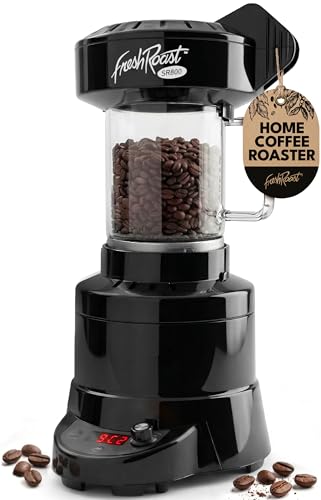
The SR800 sits at the sweet spot of the Fresh Roast lineup, doubling the batch capacity of the SR540 to 226 grams while retaining the same intuitive control scheme. The nine-level heat and variable fan speed give you real-time authority over the roast curve, letting you stretch the drying phase or push through first crack with precision. Users consistently report even roasts across the full chamber, something the smaller SR540 struggles with at its max load.
Experienced roasters will appreciate the manual override that lets them adjust fan speed as beans lose weight and begin circulating faster. The digital display shows real-time temperature, though the readout reflects air temp rather than bean surface temp — a common distinction in fluid-bed machines. Many owners recommend pairing the SR800 with an infrared thermometer for accurate bean temperature monitoring. The unit operates well under a standard range hood, but heavier roasts still produce enough smoke to warrant outdoor use for the smoke-sensitive.
Longevity reports are strong, with several users logging hundreds of batches over multiple years. The manufacturer charges a flat fee for out-of-warranty repairs, a sign of confidence in the product’s serviceability. The one common friction point is the chaff collector and glass chamber fit — they don’t clip in, so accidental knocks can dislodge them mid-roast. For anyone serious about graduating from entry-level roasting without jumping to four-figure machines, the SR800 is the clear benchmark.
Why it’s great
- Largest batch of any Fresh Roast home model
- Independent heat and fan controls offer real roast curve management
- Durable with accessible manufacturer repair program
Good to know
- Chaff collector and chamber don’t clip in securely
- Multi-function knob takes a few roasts to get used to
2. MAGO MAGA Roma Pro
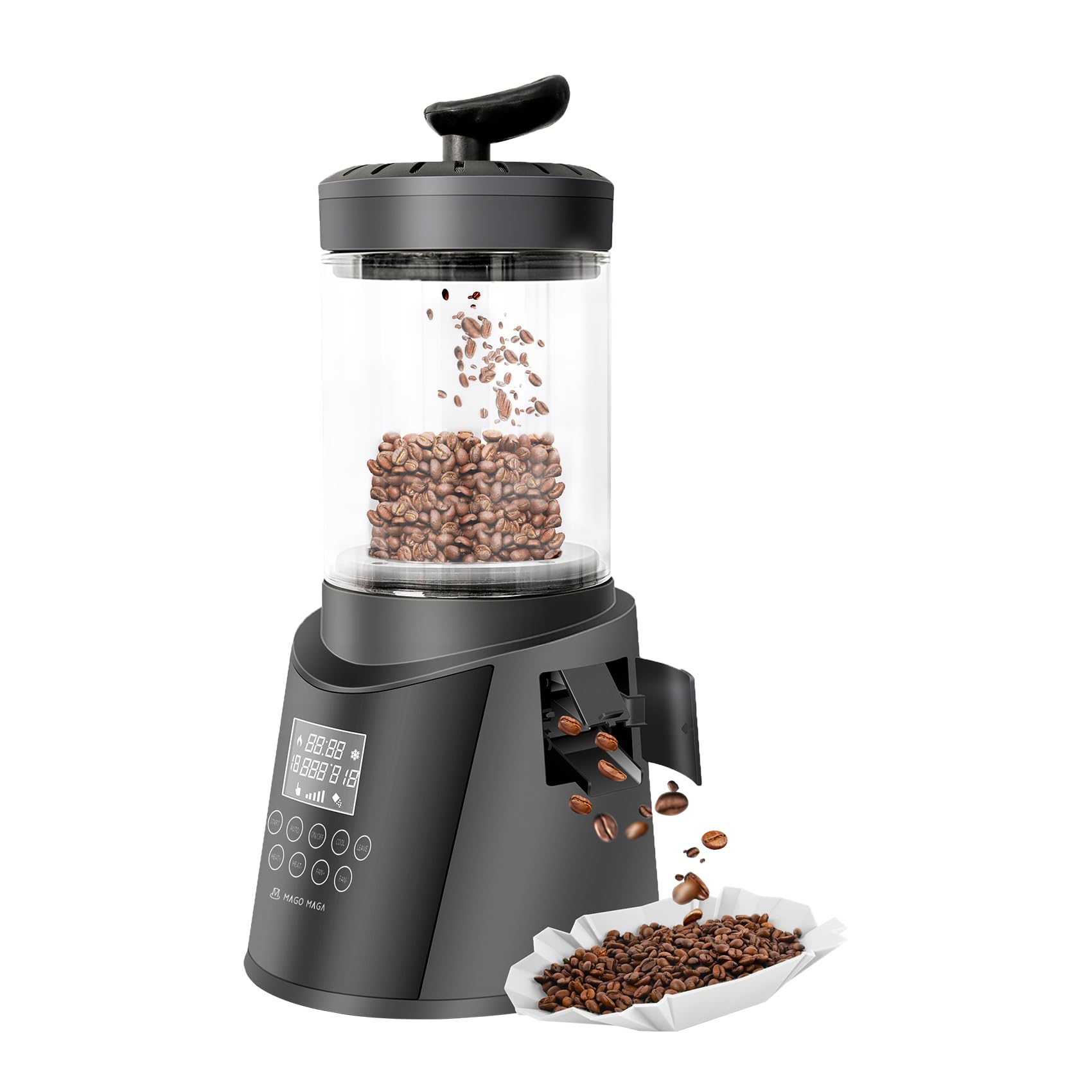
The Roma Pro bridges the gap between beginner-friendly automation and enthusiast-grade manual control. Its auto mode uses pre-programmed profiles that handle the drying, Maillard, and development phases without user intervention, while the manual mode exposes full heat and fan adjustment for those who want to dial in specific origin characteristics. The double-layer glass viewing window stays cool enough to watch color changes without fogging, a small but meaningful detail for visual roasters.
The 300-gram capacity sits between the SR800 and the larger drum machines, making it ideal for households that go through a pound of coffee per week. The built-in auto-cooling cycle drops bean temperature quickly after the roast ends, preserving the flavor profile you worked for. The ultra-low smoke claim holds up for light and medium roasts, though dark roasts still produce noticeable smoke that requires ventilation. The digital display switches between Celsius and Fahrenheit, and the timer keeps you oriented during the roughly 10 to 15 minute roast cycle.
Customer reports note that the automatic profiles work best with washed and natural processed beans, while decaf green beans benefit from manual mode due to their different density and moisture content. A few users experienced glass tube breakage during cleaning, but the manufacturer responded quickly with replacements. The build quality feels solid for the price tier, though the heating element longevity remains unproven beyond 50 pounds of throughput. For anyone who wants a set-and-forget option with the option to go deep, the Roma Pro delivers a rare combination of convenience and control.
Why it’s great
- Auto mode produces consistent results without supervision
- 300g capacity fits daily home use perfectly
- Effective auto-cooling locks in roast profile
Good to know
- Heating element durability unknown past 50 lbs
- Dark roasts still produce significant smoke
3. Fresh Roast SR540
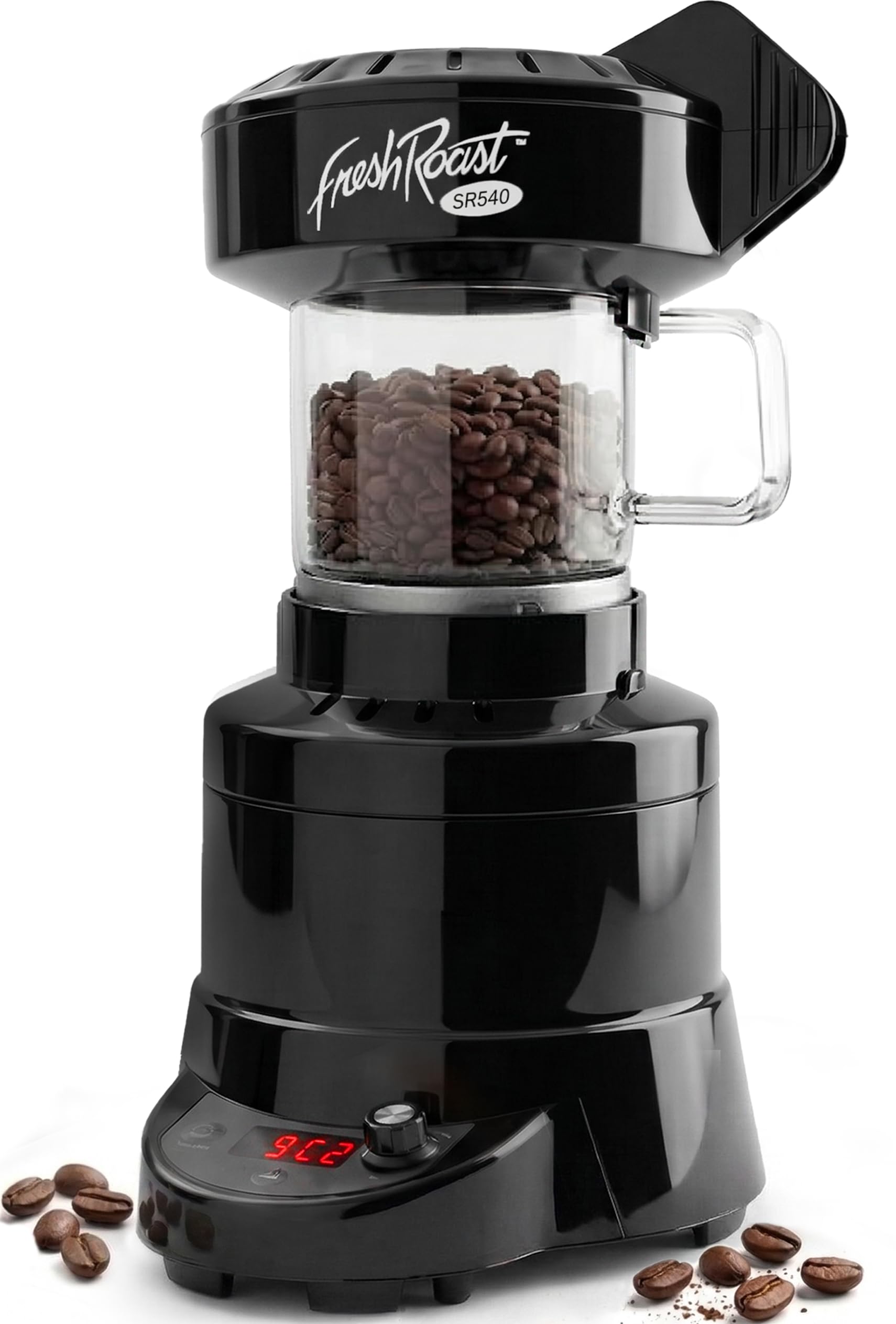
The SR540 is the entry point into the Fresh Roast ecosystem, offering the same fluid-bed technology as the SR800 but at a 120-gram batch size. That smaller capacity actually works in its favor for single-drip drinkers who roast every two to three days — you never have stale beans sitting around. The nine heat settings and variable fan speed provide the same level of control as its bigger sibling, and the glass roasting chamber gives you a clear view of bean color changes from yellow through first crack to second crack.
Real-world roast times land between 6 and 10 minutes depending on the target profile, with light roasts finishing faster. The analog control knobs are straightforward but lack the precision of a digital encoder — users report that the knobs can feel a bit loose after extended use. The included chaff basket catches most of the papery skins, though some fines can escape during aggressive fan settings. Owners recommend operating under a range hood or near an open window, as the smoke output is comparable to the SR800.
Durability is a mixed picture. Several owners have logged hundreds of batches without issues, while a few experienced heating element failure after 18 to 24 months. The manufacturer’s customer service is responsive, with one user reporting a free motherboard replacement after the warranty period. For anyone who wants the fluid-bed experience at a lower upfront cost and doesn’t mind the smaller batch size, the SR540 remains a solid, proven platform.
Why it’s great
- Excellent control for the price point
- Quick 6-10 minute roast cycles
- Clear glass chamber for visual monitoring
Good to know
- Analog knobs can feel imprecise over time
- Small 120g batch requires frequent roasting for heavy drinkers
4. Fresh Roast SR540 Bundle
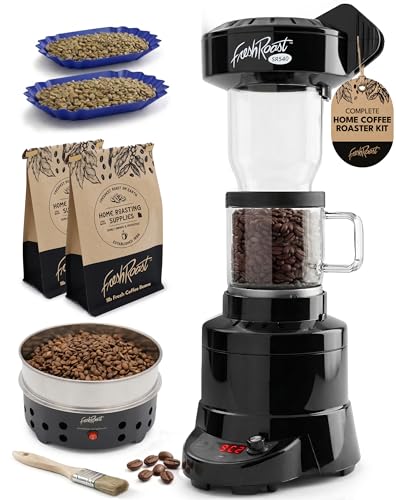
This bundle takes the standard SR540 and adds three accessories that address its core limitations: a glass extension tube that increases capacity and improves bean movement, a dedicated bean cooler that halts the roast instantly, and a chaff brush for cleanup. The extension tube is the standout addition — it raises the effective batch size closer to 180 grams and enhances heat retention, resulting in more consistent roasts, especially with dense beans like Ethiopians. The bean cooler uses a fast fan to drop bean temperature in under three minutes, which is critical for locking in the flavor development you designed.
The bundle also includes sample trays of green coffee beans and a chaff brush, making it a true turnkey solution for first-time roasters. Users report that the extension tube alone justifies the bundle, as the standard SR540 chamber can feel restrictive when trying to hit consistent light roasts. The cooler is less essential if you already have a metal colander and a strong fan, but it shaves a minute or two off the process and reduces the risk of over-development from residual heat.
One note: the extension tube makes the roaster taller and more prone to tipping if bumped, so a stable countertop spot is important. The gaskets between the extension tube and the main chamber may need occasional adjustment to maintain a good seal. For anyone starting from zero equipment, this bundle eliminates the guesswork of buying accessories separately and delivers a noticeably better roasting experience than the base SR540 alone.
Why it’s great
- Extension tube improves capacity and roast consistency
- Bean cooler locks in flavor immediately
- Complete starter package with green beans included
Good to know
- Taller assembly is less stable on the counter
- Gaskets need periodic adjustment
5. Precision Coffee Roaster PKF-500
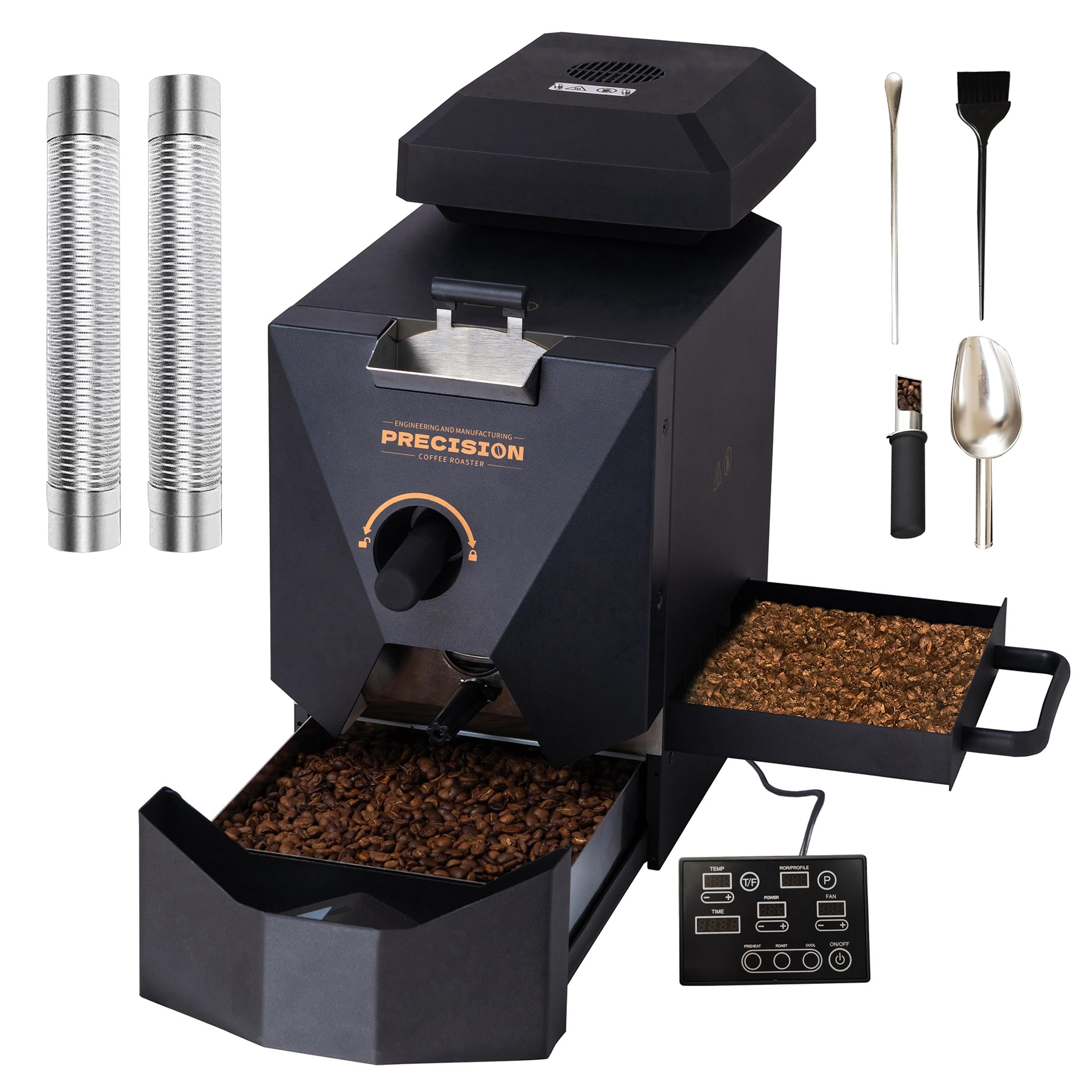
The PKF-500 moves into drum roasting territory, offering a 500-gram stainless steel drum with automatic, assisted, and manual modes. The automatic profiles cover light, medium, and dark roasts with pre-programmed temperature curves, while the manual mode gives you direct control over drum speed and heat for custom profiling. The built-in smoke filter and dual exhaust chimney tubes allow for indoor use during light roasts, though medium and dark roasts still produce enough smoke that most users vent outdoors through the included aluminum pipes.
The observation window and sample spoon let you pull beans mid-roast to check color and listen for crack sounds — a feature that drum roaster enthusiasts consider essential for dialing in new bean origins. The touchscreen interface is responsive, though the display brightness has been noted as excessive with unreadable labels in direct light. Users who have run over 50 pounds through the machine report consistent results with the pre-set profiles, especially for medium roasts, but recommend prompt cooling after the cycle ends to prevent over-roasting.
Build quality is sturdy, with a mostly stainless steel construction that feels durable. Some users experienced issues with heat buildup causing mid-roast shutdowns, but resolved this by allowing a cool-down period between consecutive batches. The manufacturer’s tech support has been helpful for initial troubleshooting, though responsiveness waned after the initial setup period. For home roasters ready to move beyond fluid-bed machines and explore the richer body that drum roasting provides, the PKF-500 offers premium features at a fraction of the cost of commercial drum roasters.
Why it’s great
- Large 500g stainless steel drum for bigger batches
- Multiple operating modes from automatic to manual
- Sample spoon allows mid-roast inspection
Good to know
- Heat buildup can cause mid-roast shutdown without cooldown
- Touchscreen display is very bright with hard-to-read labels
6. NIASIA PKF-500g

The NIASIA PKF-500g is a direct competitor to the Precision PKF-500, sharing the same drum-based design and 500-gram capacity but adding a separate cooling tray with a high-speed fan. The nine built-in roasting profiles cover light, medium, and dark roasts, plus specific profiles for sun-dried, washed, and honey-processed beans — a level of origin-specific pre-programming that reduces the guesswork for new drum roasters. The dual smoke exhaust system includes a smoke purifier for light roasts and aluminum vent pipes for medium and dark roasts that need external ventilation.
Seasoned home roasters have noted that the automatic mode tends to over-roast beans, so many rely on the assist or manual modes for finer control. The drum speed is fixed, which means you can’t adjust rotation independently of the heat settings. Users recommend a minimum load of 150 grams for consistent drum movement, with the sweet spot between 350 and 400 grams for even heat distribution. The carbon steel drum conducts heat efficiently, producing roasts with good body and development in about 10 minutes.
Build quality reports are generally positive, with one user logging over 50 pounds without issues. The motor is audible during operation, making it harder to hear first and second cracks — a common drum roaster challenge. The separate cooling tray is effective but takes up extra counter space. Customer support responsiveness has been mixed, with some users reporting quick replacements and others experiencing long delays. For experienced roasters who want a dedicated drum machine with strong heat output and are comfortable working in manual mode, the PKF-500g delivers serious performance.
Why it’s great
- Origin-specific auto profiles reduce trial and error
- Fast 10-minute roast cycle with strong IR heater
- Dual smoke exhaust with purifier and vent pipes
Good to know
- Automatic mode tends to over-roast; manual mode recommended
- Motor noise makes it hard to hear crack sounds
7. ANGELLOONG Upgrade

The ANGELLOONG Upgrade offers the largest stated capacity in the lineup at 750 grams, though experienced users consistently report best results with 300- to 400-gram batches for even roasting. The adjustable thermostat ranges from 100 to 240 degrees Celsius, and the 0-60 minute timer gives you a wide window for experimentation. The honeycomb non-stick interior helps with even heat distribution and makes cleanup straightforward with a damp cloth.
The transparent heat-resistant lid with four ventilation holes lets you monitor bean color throughout the roast, and the anti-scalding handles on both sides make it easy to maneuver. Users note that the fixed stirring arm can cause small or defective beans to get stuck, leading to jams that require manual clearing. Many owners bend the arm slightly to improve clearance, a simple modification that significantly reduces binding. The machine also doubles as a popcorn and nut roaster, adding versatility for households that want a multi-purpose appliance.
Longevity is a concern: several users report that the heating element fails after 18 months to two years with monthly use. The build uses a mix of metal and heat-resistant plastic, which feels sturdy but not industrial-grade. For the price, it delivers solid results when used within its optimal batch size, but it’s best viewed as an entry-level drum roaster with a defined lifespan. The ANGELLOONG makes sense for someone who wants to experiment with drum roasting without a major financial commitment, accepting that it may need replacement after a couple of years.
Why it’s great
- Large capacity suitable for big batches or multi-purpose roasting
- Adjustable thermostat and timer for roast curve control
- Honeycomb non-stick surface is easy to clean
Good to know
- Stirring arm jams with small beans; may need manual modification
- Heating element lifespan typically 18-24 months
8. JIAWANSHUN Upgraded

The JIAWANSHUN Upgraded model is the most affordable drum roaster that still includes adjustable temperature control and a timer, making it a low-risk entry point for home roasting. The recommended batch size of 300 to 500 grams produces even results, though customers note that small or defective beans can jam the stirring rod, causing the motor to reverse direction. Pre-sorting green beans before roasting is essential to avoid this issue.
The transparent glass cover with four ventilation holes gives you a clear view of the roast progression, and the honeycomb non-stick interior wipes clean easily. The 1200-watt heating element roasts a 300-gram batch in about 13 to 18 minutes, depending on target roast level. Users strongly recommend using an infrared thermometer to measure bean surface temperature, as the built-in thermostat doesn’t always reflect what the beans are experiencing. Preheating the unit for five to six minutes helps stabilize the temperature before adding beans.
Build quality is the main trade-off at this price point. Multiple users report that the stirring blade is slightly misaligned from the factory, leading to chronic jamming. The plastic casing and glass lid feel less durable than the metal-bodied alternatives, and the lack of a warranty or replacement parts means that any defect effectively ends the machine’s useful life. For someone who wants to confirm that home roasting is a hobby they’ll stick with, the JIAWANSHUN offers a functional, if imperfect, introduction at the lowest possible cost.
Why it’s great
- Lowest price point for an adjustable temperature drum roaster
- Clear glass lid provides good visibility during roast
- Easy to clean honeycomb non-stick interior
Good to know
- Stirring blade alignment issues can cause frequent jamming
- No warranty or replacement parts available
9. JIAWANSHUN 500g

The standard JIAWANSHUN 500g model shares the same chassis and 1200-watt heating element as the Upgraded version but drops the timer function. The 100 to 240 degree Celsius adjustable temperature control remains, giving you basic roast curve capability. The recommended batch size of 300 to 500 grams mirrors its sibling, and users report that the automatic stirring rod produces even results when beans are properly sorted beforehand.
This model has been on the market longer, so there is a larger body of long-term usage data. Some users have logged over 550 roasts before the heating element failed, while others experienced switch failures after a few months. The variability in quality control is the biggest drawback: two units from the same production run can behave differently. The glass lid and plastic construction are identical to the Upgraded model, and the same pre-sorting and infrared thermometer recommendations apply.
For those on the tightest budget, this machine can produce drinkable home-roasted coffee, but it requires patience and a willingness to work around its quirks. The learning curve is steeper than fluid-bed alternatives, and the smoke output is significant enough that outdoor operation is strongly recommended. The JIAWANSHUN 500g is best viewed as a proof-of-concept tool: if you enjoy the process, you will likely upgrade within a year to a more reliable machine.
Why it’s great
- Most affordable way to start drum roasting at home
- Adjustable temperature control for basic roast profiling
- Decent batch size for family use
Good to know
- Quality control is inconsistent between units
- Significant smoke output requires outdoor operation
FAQ
How long do green coffee beans stay fresh before roasting?
Can I roast indoors without setting off the smoke alarm?
What is the difference between first crack and second crack?
Do I need to rest the beans after roasting before brewing?
How does chaff affect the roasting process?
Can I use an extension tube on the SR540 with any roast profile?
Final Thoughts: The Verdict
For most users, the at home coffee roaster winner is the Fresh Roast SR800 because it offers the largest fluid-bed batch size with independent heat and fan control, supported by a reliable manufacturer repair program. If you want a smart roaster with automated profiles and a larger 300g capacity, grab the MAGO MAGA Roma Pro. And for serious drum roasting with 500g batches and origin-specific presets, nothing beats the NIASIA PKF-500g in this price range.