
Our readers keep the lights on and the weekend projects moving. As an Amazon Associate, I earn from qualifying purchases.
The most honest smell test for any kitchen composter happens on day three: the lingering odor of forgotten fruit peels, the surprise fruit flies, the inevitable guilt of tossing food scraps into the landfill bin. Home composting used to demand a sprawling backyard pile or a worm bin that required constant attention. The shift toward compact, odor-controlled machines has changed that, but only if you pick the right process — aerobic microbes, heat dehydration, or bokashi fermentation — for your actual habits. Each method solves a different problem, and picking the wrong one means you will fight the system instead of letting it work.
I’m Rikta — the co-founder and writer behind FitlyFast. For this guide, I analyzed over 30 hours of user feedback and technical data across seven different at-home composting systems, comparing their capacity, odor control methods, noise levels, and the real-world maintenance that determines whether a unit gets used daily or abandoned after a month.
You need an at home composter that aligns with how your kitchen actually runs — not one that looks good on a shelf but requires you to change your cooking habits to make it work.
How To Choose The Best At Home Composter
Every composter on the market operates on one of three core technologies: heat dehydration and grinding, aerobic microbial decomposition, or anaerobic bokashi fermentation. Your choice defines everything — the type of waste you can process, the end product you get, the frequency of maintenance, and whether the machine smells like fresh soil or stale kitchen. Below, the three critical decision points every buyer must resolve before spending a dollar.
Know Your Processing Method: Heat vs Microbe vs Fermentation
Heat-based electric units (like the Food Cycler and Airthereal Revive) dry and grind food scraps into a coarse, dry powder within four to eight hours. This is not finished compost — think of it as pre-compost that still needs soil contact to fully break down. The advantage is speed and the ability to handle meats and bones; the trade-off is a product that requires a curing step before it feeds your plants. Microbial units (like the Reencle Prime) use patented aerobic bacteria to digest scraps into true compost in 24 hours, producing a soil-like output you can use immediately. Bokashi systems (like the Sunwood Life kit) pickle food waste anaerobically in a sealed bucket, preserving nutrients and allowing citrus, dairy, and meat without the smell typical of rotting scraps.
Match Capacity to Your Kitchen Output
A two-person household generates roughly two to three pounds of food scraps per day. A compact 2.5-liter electric unit will require daily emptying; a 14-liter microbial composter can handle a week’s worth before you need to harvest. Larger is not always better — if you underfill a high-capacity unit, the microbes starve or the drying cycle becomes inefficient. Measure your weekly scrap volume by filling a standard one-gallon bucket and counting how many days it takes to fill, then double that number to find your ideal capacity in liters.
Odor Filtration Is Not Optional
Every enclosed composter claims to be odorless, but the filter quality separates the winners from the headaches. Carbon filters with a high density (measured in grams per square meter) adsorb volatile organic compounds far longer than cheap foam-based filters. Check whether the filter requires proprietary replacements or accepts standard carbon sheets — proprietary filters from brands like Food Cycler and Reencle run about three to five months per cartridge, while generic replacements for some tumbler-style bins can be refilled with bulk activated charcoal. A filter that is not easily replaceable will turn your composter sour within weeks.
Quick Comparison
On smaller screens, swipe sideways to see the full table.
| Model | Category | Best For | Key Spec | Amazon |
|---|---|---|---|---|
| Reencle Prime | Microbial Electric | True compost in 24 hours | 14L capacity, 28 dB noise | Amazon |
| Food Cycler Eco 5 | Heat Dehydrator | Large capacity, quiet drying | 5L bucket, Vortech grinder | Amazon |
| Ouaken 4L | Heat Dehydrator | Sleek countertop, auto-clean | 4L capacity, ferment mode | Amazon |
| Airthereal Revive R500 | Heat Dehydrator | Budget-friendly electric drying | 2.5L bucket, aluminum build | Amazon |
| Marcytop Tumbler | Outdoor Tumbler | High-volume yard waste | 45 gal dual chamber, PP | Amazon |
| VermiHut 5-Tray | Worm Composter | Continuous vermicomposting | 50L, HDPE, worm saver tray | Amazon |
| Sunwood Life Bokashi | Bokashi Ferment | Meat and dairy processing | 20L, BPA free, spigot | Amazon |
In‑Depth Reviews
1. Reencle Prime Electric Composter
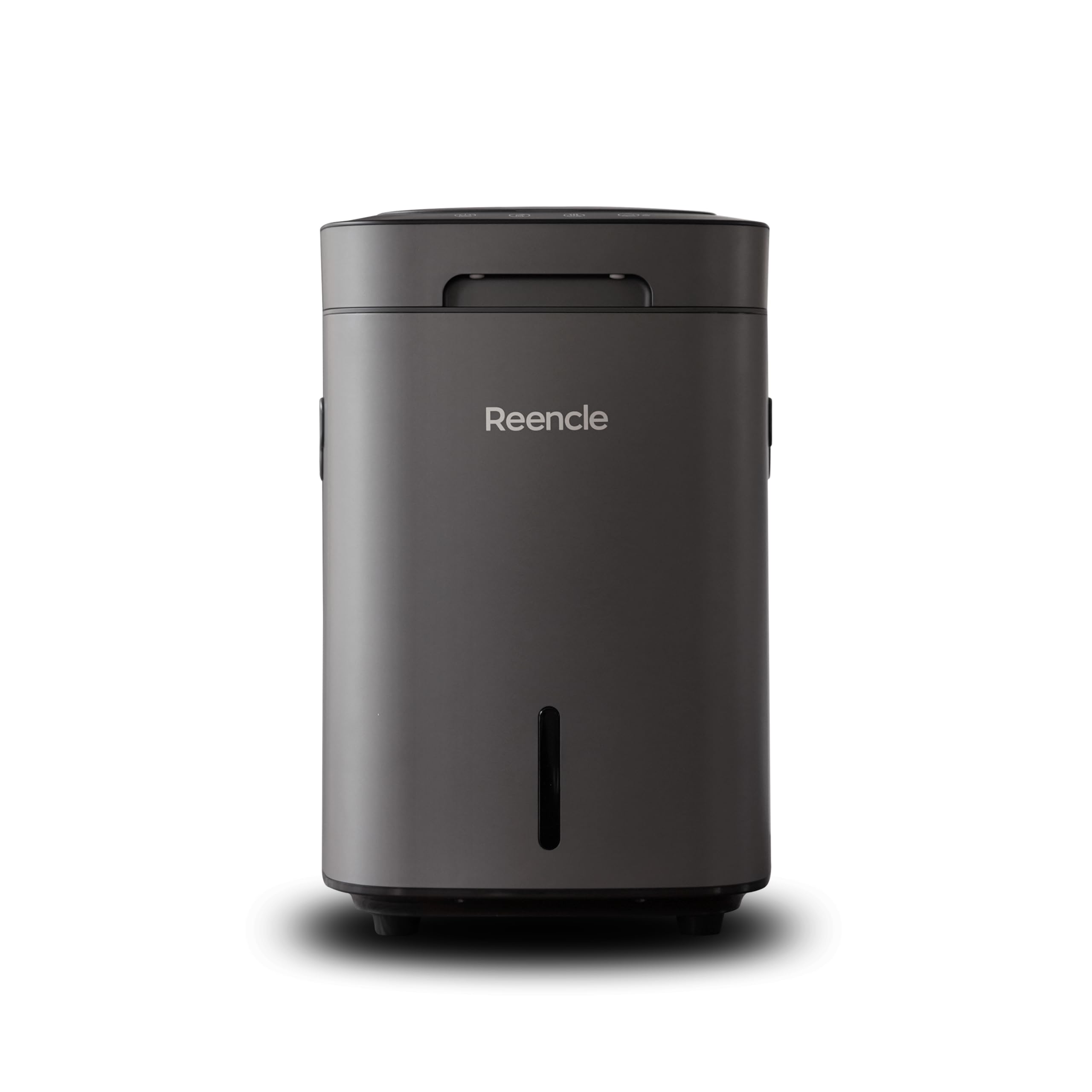
The Reencle Prime uses a patented aerobic microbe culture to break down organic matter into finished compost in 24 hours, rather than simply drying it like most electric units. This biological process produces a crumbly, soil-like output that you can spread directly on garden beds or potted plants without needing to cure it in the ground. The 14-liter capacity handles up to 2.2 pounds of food scraps daily, making it a realistic match for households of three to four people who want to compost without freezing scraps in the freezer between runs.
Noise is practically absent at 28 decibels — quieter than a refrigerator hum. The three-layer carbon filter system traps odors effectively, with users reporting a faint yeasty smell similar to rising bread rather than rotting food. The machine requires a balancing act: you maintain proper moisture levels by monitoring the microbe environment, and fibrous or stringy scraps can trigger the blender if the load exceeds the chamber’s tolerance. Over a year of daily use, owners describe zero insect issues, no smell, and only a monthly wipe-down of the lid filter.
The trade-off is price and footprint. It stands 18.4 inches tall and weighs 20 pounds, so it sits more like a small appliance than a discrete countertop gadget. Replacement carbon filters and microbe starter packs add a recurring cost, though the microbe colony is self-sustaining once established.
Why it’s great
- Produces true finished compost in 24 hours via aerobic microbe digestion
- Whisper-quiet operation at 28 dB with effective three-layer odor filtration
- 14-liter capacity handles multiple days of scraps for a family of four
Good to know
- Larger footprint and heavier than dehydrator-style electric composters
- Requires proper moisture balancing and occasional microbe starter maintenance
2. Food Cycler Eco 5
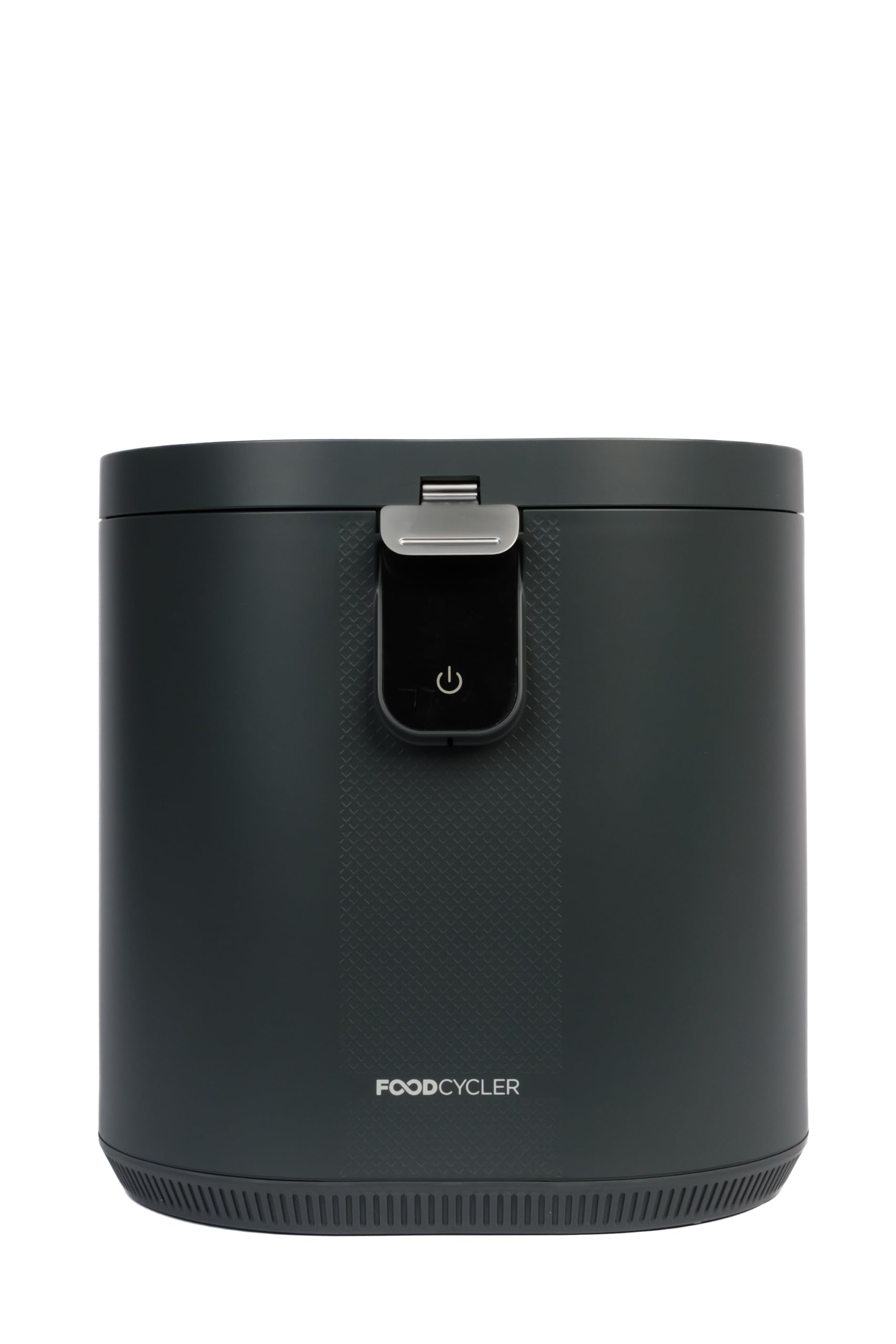
The Food Cycler Eco 5 takes a different approach than microbial units: it uses heat and the patented Vortech grinding system to reduce food waste volume by up to 90 percent within an eight-hour cycle. The 5-liter bucket is the largest among countertop electric dehydrators, capable of handling pits, bones, peels, and leftovers in a single load. The output is a dry, coarse powder that you can mix into soil as a fertilizer base or toss into your green bin without the smell and weight of wet scraps.
Noise levels hover around near-silent during most of the cycle, with only the grinding phase producing a noticeable hum. The refillable carbon filter absorbs odors effectively, though heavy loads of overly wet scraps like grapes can produce a soggy end product that requires a second cycle or manual mixing. The 3-year limited warranty is notably longer than most competitors, and the removable bucket moves easily from prep area to machine without lifting the entire unit.
The main consideration is that this is a dehydrator-grinder, not a biological composter — the end product benefits from a curing phase in soil before it becomes plant-ready. The 13.6-kilogram weight makes it less portable than smaller models, and the proprietary carbon cartridges need replacement every three to five months depending on use. For households that want maximum volume reduction and odor-free immediate storage, the Eco 5 delivers the largest bucket in the category.
Why it’s great
- Largest countertop bucket at 5 liters with effective Vortech grinding for bones and pits
- Quiet, near-silent operation with refillable carbon odor filter
- 3-year limited warranty offers strong long-term coverage
Good to know
- Output is dried pre-compost, not finished soil — needs a curing step for plant use
- Proprietary carbon cartridges require periodic replacement
3. Ouaken 4L Smart Electric Composter

The Ouaken 4L differentiates itself with a smart interface that offers three distinct modes: Crush for volume reduction, Ferment for accelerated biological breakdown, and Clean for automated maintenance. This flexibility lets you choose between a quick dehydration cycle when you want to store pre-compost and a longer fermentation cycle when you want a nutrient-rich output closer to traditional compost. The aluminum alloy bucket is dishwasher safe, and the transparent lid lets you monitor progress without breaking the seal.
At under 40 decibels, the unit operates quietly enough to run overnight on a kitchen counter. The large-capacity carbon filter lasts up to five months, and the low-speed, high-torque blades handle most food materials without jamming. After eight months of daily use, one reviewer reported a broken gear mechanism that was replaced under warranty with a new inner bucket shipped from the manufacturer — indicating that long-term durability varies, but the support structure holds.
The 4-liter capacity sits between the compact 2.5-liter units and the larger 5-liter dehydrators, making it a middle-ground option for households that generate moderate daily waste. The empty-bucket-before-each-cycle rule is critical: leaving dried material in the chamber while starting a second run causes clumping that can damage the blades and fan. For users who want a modern-looking countertop appliance with controllable processing modes, this is a solid mid-range electric option.
Why it’s great
- Three processing modes (Crush, Ferment, Clean) give control over final output type
- Quiet operation under 40 dB with dishwasher-safe aluminum bucket
- Large carbon filter lasts up to five months before replacement
Good to know
- Bucket must be emptied between cycles to prevent clumping and mechanical strain
- Warranty support required replacement of inner bucket in some long-term cases
4. Airthereal Revive R500 Electric Composter

The Airthereal Revive R500 is a countertop dehydrator-grinder with a 2.5-liter aluminum bucket and a tri-blade SHARKSDEN system that pulverizes food scraps into a fine, dry powder within four hours. The one-button operation is straightforward: collect scraps through the day, load the bucket, press start, and empty the dried powder in the morning. The reduced volume — roughly one-third of the original waste — is ideal for households that want to eliminate smelly kitchen trash without committing to a full composting routine.
Users consistently describe the machine as quiet and easy to clean, with the cast aluminum bucket being dishwasher safe. The carbon filter helps suppress odors during operation, though some reviewers note that leaving the machine running overnight with particularly fragrant scraps like fish or onion can produce a detectable smell if the filter is not fresh. The 16.8-pound weight is manageable for countertop placement, and the compact 12.5-inch height fits under most upper cabinets.
The critical shortcoming is the machine’s nature as a dryer-grinder: it does not produce finished compost, and the resulting powder needs to be mixed into soil to complete the biological breakdown. A smaller subset of units have suffered heating-element failures, and customer service responsiveness has been inconsistent in those cases, with some users reporting unreturned emails after providing diagnostic photos. At its price point, the R500 is a functional entry into electric dehydration, but buyers should verify the warranty terms before purchasing.
Why it’s great
- Fast four-hour cycle reduces food scraps to dry powder with one-button simplicity
- Compact countertop size (12.5 inches tall) fits under standard cabinets
- Dishwasher-safe cast aluminum bucket makes cleanup straightforward
Good to know
- Output is dried pre-compost, not finished soil — requires a curing step
- Some units have experienced heating-element failure with inconsistent support responses
5. Marcytop 45 Gallon Dual Chamber Tumbler

The Marcytop 45-gallon dual chamber tumbler is a traditional outdoor aerobic composter on a rotating axis, designed for households with substantial yard waste — grass clippings, leaves, and garden trimmings — alongside kitchen scraps. The two 22.5-gallon chambers let you fill one side while the other side finishes decomposing, creating a continuous cycle that mimics industrial windrow composting at a home scale. The hexagonal polypropylene drum has deep fins and aeration holes that improve oxygen circulation and break up clumps during rotation.
Assembly takes about 40 minutes with a rubber mallet and screw gun, and the sliding doors on each chamber make loading and unloading simple compared to lid-based tumblers. The 30.2-pound frame with powder-coated steel base holds up well outdoors, though users note that once the chambers are full, the tumbler becomes heavy enough to require two hands for rotation. In hot climates, the composting process speeds up noticeably, producing usable soil in six to eight weeks during summer months.
The trade-off is that this is not a set-and-forget appliance: you need to tumble the drum five to six times every few days, maintain a proper green-to-brown ratio, and monitor moisture levels. It does not include a thermometer, and the hexagonal shape can make it slightly harder to roll than round drums. For anyone with a garden who wants to process large volumes of organic waste without electricity, this is a sturdy, high-capacity workhorse that handles what no countertop machine can.
Why it’s great
- Dual 22.5-gallon chambers allow continuous feeding while one side finishes composting
- Deep fins and aeration holes promote oxygen flow for faster aerobic decomposition
- Durable polypropylene and powder-coated steel construction withstands weather
Good to know
- Becomes heavy to rotate when fully loaded; requires two hands for turning
- No built-in thermometer for monitoring internal temperature
6. VermiHut 5-Tray Worm Composter
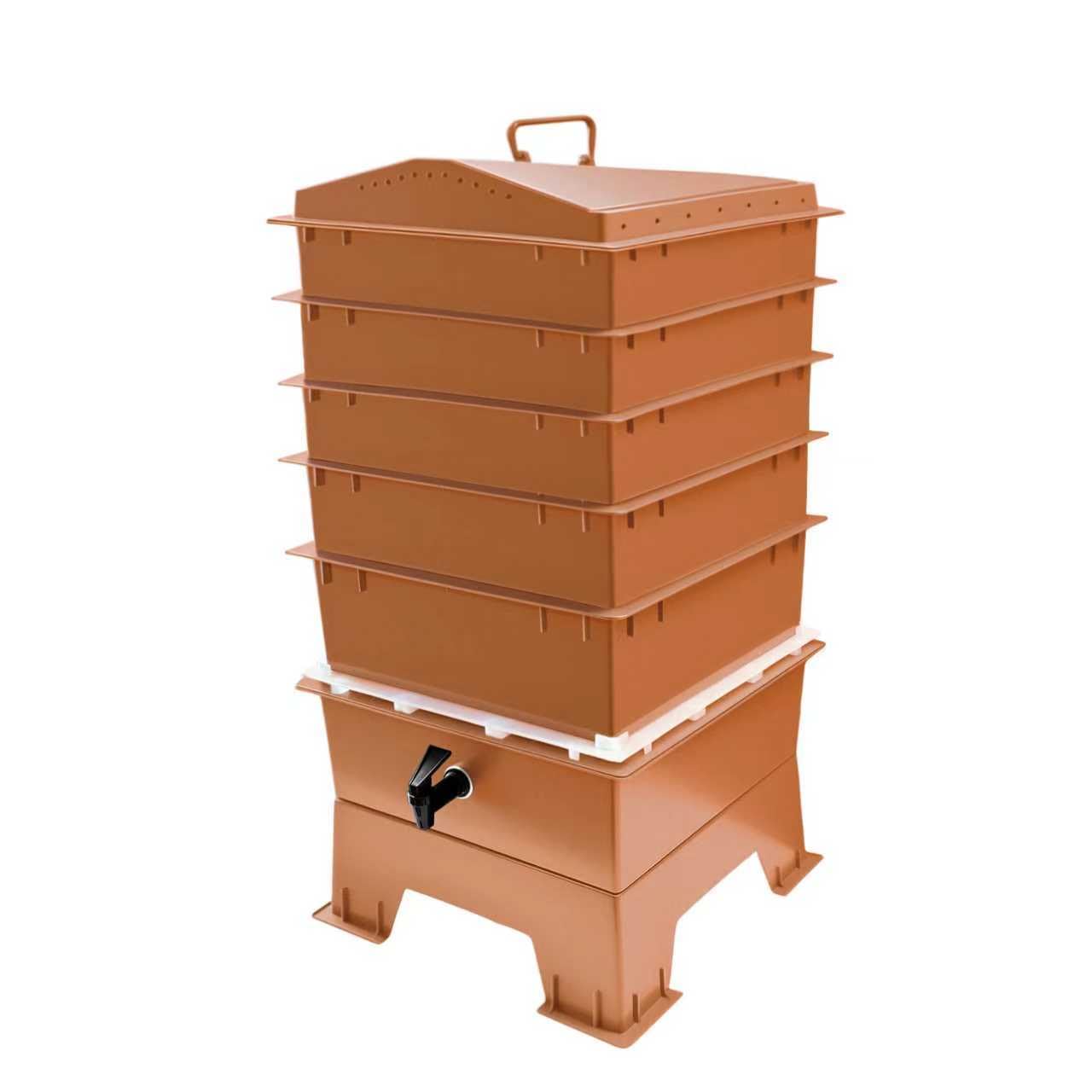
The VermiHut 5-tray system is a vertical worm composting bin that uses red wrigglers to convert kitchen scraps into vermicast (worm castings) — arguably the most nutrient-dense organic fertilizer available for home gardeners. The five stacking trays provide 50 liters of total surface area, and worms migrate upward through the trays as they finish processing each layer, leaving finished castings in the lower trays for easy harvesting. The HDPE plastic is UV-stable and the included spigot drains worm tea (liquid fertilizer) from the base reservoir.
Assembly is straightforward, and the worm saver tray prevents worms from falling into the liquid collection basin. Users report that the system produces no foul odors when managed correctly — the key is covering fresh scraps with damp bedding material like coconut coir or shredded newspaper to discourage fruit flies. The compost output is ready to use immediately as a soil amendment, unlike the pre-compost from dehydrators, and the worm population self-regulates based on available food.
The main operational demands are more hands-on than any electric unit: you must avoid overfeeding, maintain proper moisture, harvest finished castings every four to six weeks, and protect the bin from temperature extremes. The trays can become top-heavy if the water collection bin is not emptied regularly. For dedicated gardeners who want the highest-quality compost and are willing to interact with a living system, the VermiHut delivers performance that no heat-based machine can match.
Why it’s great
- Produces premium worm castings and liquid worm tea for direct soil application
- Stackable 5-tray design simplifies harvesting as worms migrate upward
- HDPE construction is UV-stable and durable for indoor or outdoor use
Good to know
- Requires regular maintenance: feeding, moisture monitoring, and tray rotation
- Can become top-heavy; water collection bin must be emptied frequently
7. Sunwood Life Bokashi Composter Kit
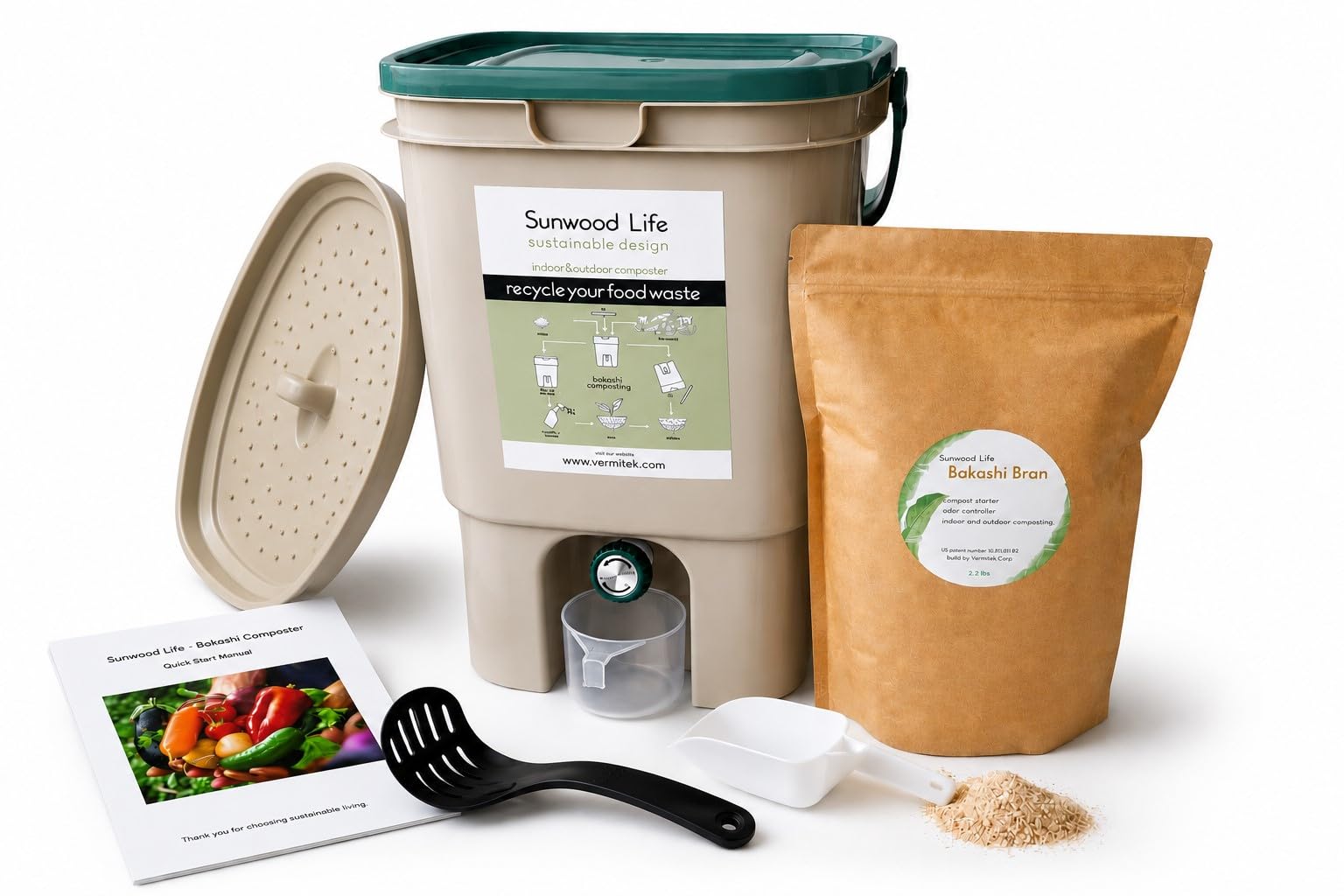
The Sunwood Life Bokashi system uses anaerobic fermentation rather than aerobic decomposition, meaning you add inoculated bokashi bran to each layer of food scraps inside a sealed 20-liter bucket, and the microbes pickle the waste instead of rotting it. This method is uniquely capable of handling everything Western composting struggles with: citrus rinds, onion skins, cooked food, dairy, meat, and bones — all without producing the sour smell of putrefaction. The airtight lid and spigot let you drain fermented liquid (bokashi tea) every few days, which serves as an excellent diluted fertilizer for houseplants.
Users consistently praise the included 2.2-pound bag of premium bokashi bran, which fills the bucket approximately twice before needing a refill. The spigot works reliably for draining, and the square shape with the included masher helps compress waste to fit more material per layer. The beige metal kitchen bucket looks better than a plastic pail, and the system operates completely without electricity — no noise, no power consumption, no moving parts.
The downside is that the fermented output is not finished compost: after two to three weeks of fermentation, the pickled scraps must be buried in soil for another two to four weeks to complete the breakdown into usable earth. The bucket can produce a detectable pickling odor when opened, and some users report that the plastic bucket retains smell between uses. For those who want to divert meat and dairy from the landfill without buying an expensive electric machine, this kit is an affordable entry into a different composting philosophy.
Why it’s great
- Processes meat, dairy, citrus, and bones that most composters cannot handle
- No electricity, no noise, and zero moving parts — operates silently on any counter
- Drains usable liquid fertilizer (bokashi tea) for houseplants throughout the cycle
Good to know
- Fermented output must be buried in soil for 2-4 weeks to become finished compost
- Bucket can retain pickling odors between uses; requires thorough cleaning
FAQ
Can I put meat and dairy in an at home composter?
How often do I need to replace carbon filters in electric composters?
Is the output from a dehydrator composter actually compost?
Final Thoughts: The Verdict
For most users, the at home composter winner is the Reencle Prime because it produces real, finished compost in 24 hours without the need for a curing step. If you want the largest bucket capacity and quiet dehydration with a strong warranty, grab the Food Cycler Eco 5. And for processing meat and dairy without electricity, nothing beats the Sunwood Life Bokashi Kit.