
Our readers keep the lights on and the weekend projects moving. As an Amazon Associate, I earn from qualifying purchases.
The moment you hear that rapid, rhythmic flutter for the first time, pregnancy becomes undeniably real. An at-home fetal Doppler lets you capture that sound between doctor visits, offering a private bonding ritual that clinical checkups simply can’t replicate. But navigating this category requires understanding the difference between acoustic pinard horns and electronic ultrasound devices, each with its own gestation window and learning curve.
I’m Rikta — the co-founder and writer behind FitlyFast. I’ve spent countless hours analyzing customer feedback and technical specifications across the entire range of at-home fetal heart rate monitoring devices, from passive fetoscopes to smart wearables.
This guide cuts through the marketing noise to help you choose the right tool for your pregnancy journey, whether you’re seeking an affordable acoustic monitor or a premium smart sock with pulse rate tracking. I’ll help you find the best at home fetal doppler that fits your needs and budget.
How To Choose The Best At Home Fetal Doppler
Selecting the right fetal monitor for home use depends primarily on your gestation stage, budget, and desire for clinical data versus simple bonding. The wrong choice can lead to frustration, so understanding the core technology is essential.
Acoustic vs. Electronic: The Core Technology Divide
Acoustic fetoscopes, or Pinard horns, are passive, non-invasive devices that amplify sound through a horn and require no batteries. They are entirely safe but only effective after 28–30 weeks of gestation and demand a very quiet environment and precise placement. Electronic Dopplers use ultrasound waves to detect movement and heartbeat, working earlier (typically 12–16 weeks) but requiring a gel medium and battery power. Smart wearables like socks or clips use optical or motion sensors to track pulse rate and movement patterns, offering continuous overnight data but at a significantly higher cost.
Sensor Accuracy and Battery Life
For electronic monitors, the sensor type dictates reliability. Standard Dopplers use a single-element ultrasound probe, while premium smart socks employ optical pulse oximetry sensors for heart rate and SpO2 readings. Battery life varies dramatically: a basic Doppler may run for 8 hours of intermittent use on two AA batteries, whereas a smart sock like the Owlet Dream Sock boasts a 16-hour battery for overnight wear. If you plan to use the device nightly, look for rechargeable lithium-ion batteries with at least a 7-day average life to avoid constant charging.
Gestation Compatibility and User Skill
The most common cause of negative reviews is using a device too early. Acoustic fetoscopes are marketed for “24 weeks” but real-world success stories begin around 30 weeks. Electronic Dopplers can detect heartbeats as early as 12 weeks, but the user must learn to angle the probe correctly and differentiate fetal heartbeat from placental sounds. Smart wearables like the BEMPU clip or Sense-U sock are designed for newborns and infants, not fetal detection — they track movement and breathing after birth. Always check the recommended age range before purchasing.
Quick Comparison
On smaller screens, swipe sideways to see the full table.
| Model | Category | Best For | Key Spec | Amazon |
|---|---|---|---|---|
| Owlet Dream Sock | Smart Sock | Overnight pulse & oxygen tracking | Pulse oximetry sensor for HR & SpO2 | Amazon |
| Sense-U Smart Sock & Camera | Sock + Camera | All-in-one tracking with video | Optical sensor for HR + 2.5K PTZ camera | Amazon |
| Aurio Smart Monitor | Smart Clip | Breathing & wet diaper alerts | 14-day rechargeable coin battery | Amazon |
| Sense-U Pro Baby Movement | Smart Clip | Movement & temperature monitoring | 7+ day lithium-ion battery | Amazon |
| BEMPU Baby Movement Monitor | Motion Clip | Simple movement detection for sleep | 56-hour rechargeable battery | Amazon |
| Skywin Fetoscope (Green) | Acoustic Horn | Battery-free bonding after 30 weeks | 12.9″ long plastic Pinard horn | Amazon |
| Skywin Fetoscope (White) | Acoustic Horn | Affordable acoustic alternative | 14.4 oz lightweight construction | Amazon |
In‑Depth Reviews
1. Owlet Dream Sock

The Owlet Dream Sock is the market leader in smart baby monitoring, tracking pulse rate and oxygen saturation in real-time via a comfortable fabric sock worn on the foot. The base station and app deliver alerts when readings leave preset zones, backed by 256-bit encryption for data security. With a 16-hour battery life, it supports overnight use from 1 to 18 months.
Customer feedback underscores its ability to reduce parental anxiety, with 94% of owners reporting better sleep. Real-world reviews highlight accurate sleep stage tracking and heart rate data after proper sock placement, though a minority experience Bluetooth disconnection issues requiring sensor replacement. False alarms most commonly occur with newborn movement and suboptimal wrapping.
The sock fabric requires hand-washing, and the base station lacks a portable battery, meaning it must stay plugged in near the crib. Parents who prioritize clinical-grade data and are comfortable with a subscription for deeper analytics will find this the most comprehensive solution for at-home monitoring after birth.
Why it’s great
- Real-time pulse rate and SpO2 tracking with preset zone alerts
- 16-hour rechargeable battery supports overnight wear
- Predictive Sleep Technology offers daily routine insights
Good to know
- Requires 2.4 GHz Wi-Fi for setup and operation
- Some Bluetooth connectivity dropouts reported
- Sock must be hand-washed, not machine washable
2. Sense-U Smart Baby Sock Monitor and 2.5K PTZ Camera
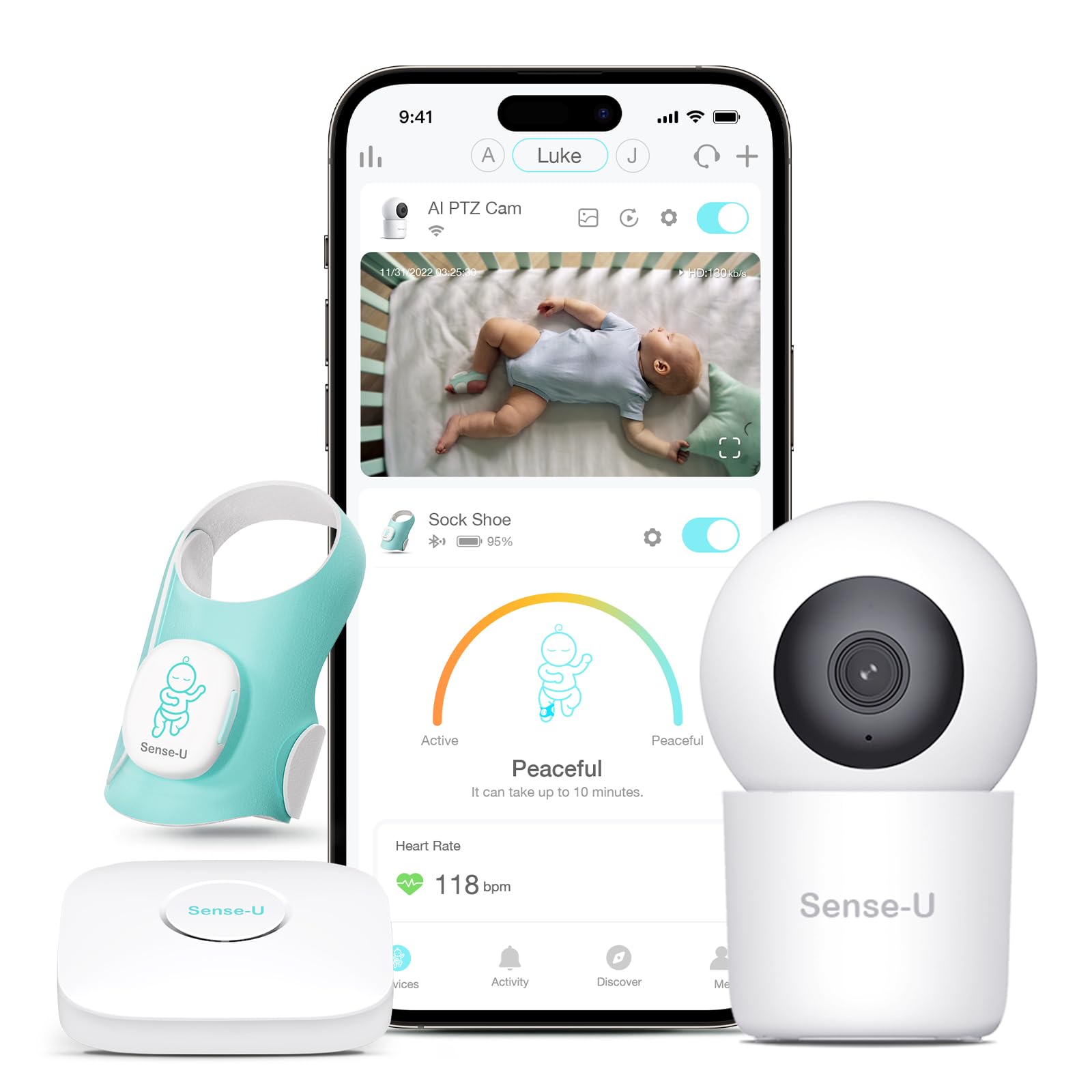
This bundle pairs Sense-U’s smart sock with a 2.5K pan-tilt-zoom camera, creating a unified monitoring ecosystem. The sock tracks heart rate, movement, and sleep cycles, while the camera adds cry detection, two-way talk, and night vision — all accessible from anywhere via a base station that requires a 2.4 GHz Wi-Fi network. The shoe-style design stays on active babies better than traditional socks.
Users report the sock fits more securely than competitors, with a user-friendly app and customizable alert strength. The camera is praised for its clear video quality and ease of setup. Some found the alarm loud enough to wake a deep sleeper during a baby’s RSV episode, which was seen as a benefit. A few users wished for SpO2 reading capability and better battery life.
Unlike the Owlet, this system supports twins with two socks and one base station, and it stores footage locally on a microSD card with no monthly fee. The optical sensor tracks heart rate reliably, though the battery life is shorter than the Owlet’s overnight 16-hour claim. It is an excellent choice for parents wanting both video and vital sign tracking in one package.
Why it’s great
- Combines heart rate sock with 2.5K PTZ camera for complete monitoring
- Shoe-style design prevents baby from kicking it off
- Supports twin monitoring with two socks and one base station
Good to know
- Requires 2.4 GHz Wi-Fi for base station connection
- Shorter battery life compared to premium socks
- No SpO2 reading — only heart rate tracking
3. Aurio Smart Baby Monitor

The Aurio monitor is a compact, flexible clip that attaches to the baby’s diaper to track breathing rate, sleep position, rollovers, and wet diaper events. Its patented technology uses an optical sensor and a fully sealed rechargeable coin battery that lasts 2–3 weeks per charge. All alerts are delivered exclusively through the Aurio app; the device itself does not emit sound, vibration, or light.
Customer reviews praise its soft, baby-safe rubber material and intuitive app setup. The wear detection feature reduces false alerts by confirming the clip is properly positioned. Battery life consistently meets the 10–14 day range in real-world use. A small number of users reported pairing difficulties or complete non-functionality, with concerns about product reliability.
Because the Aurio sends alerts only through the app, parents who sleep without their phone nearby may miss notifications. It excels for those who want continuous 24/7 breathing monitoring without a wearable sock, making it ideal for lightweight, diaper-clip convenience. Its thin 0.3-inch profile is barely noticeable under onesies.
Why it’s great
- Ultra-thin diaper clip design with soft rubber material
- 2–3 week battery life between charges
- Tracks breathing, rollovers, and wet diaper events
Good to know
- All alerts sent through app only — no device audio or vibration
- Requires USB activation during setup
- Some users experienced pairing and calibration issues
4. Sense-U Pro Baby Breathing Movement & Sleep Position Monitor
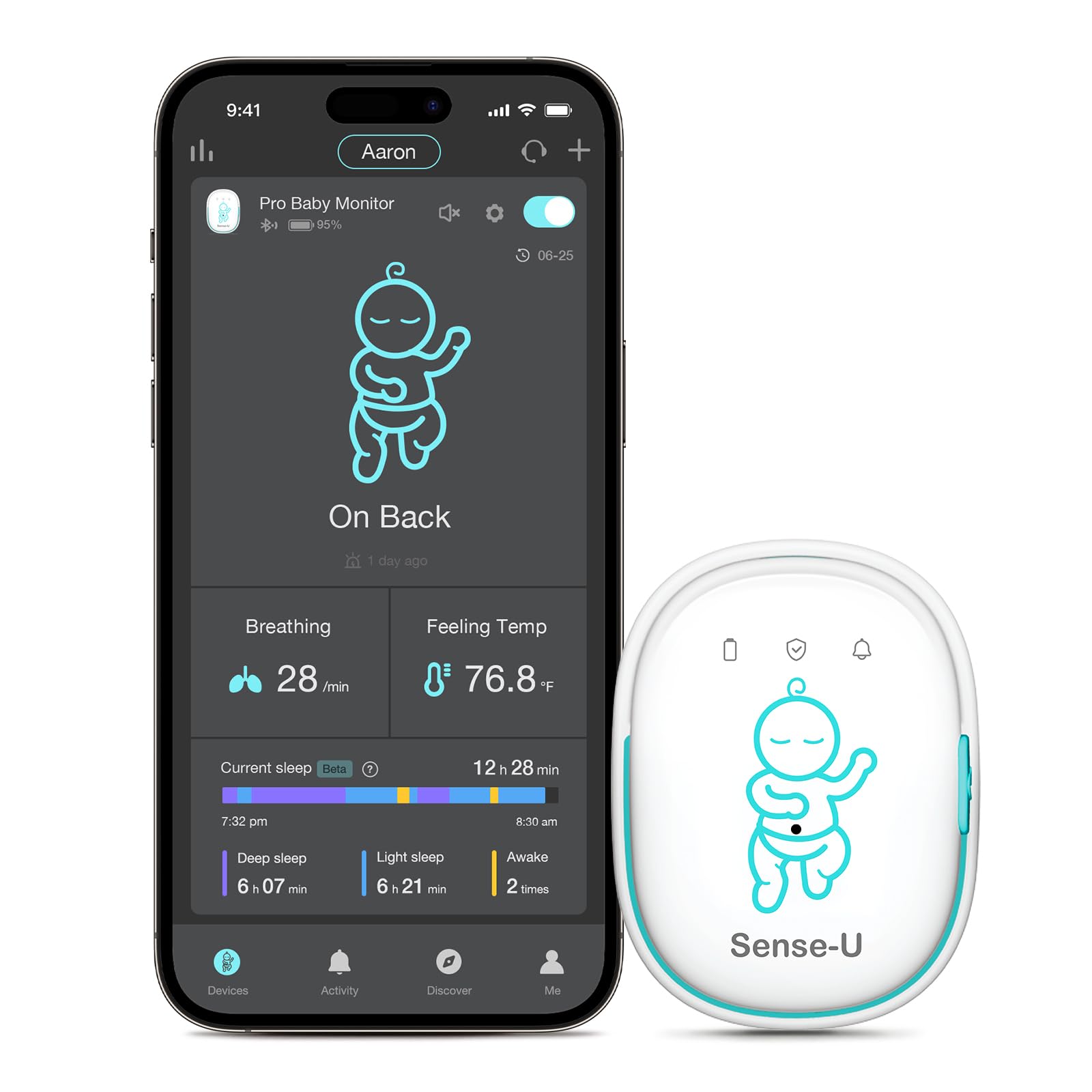
The Sense-U Pro is a mid-range diaper clip monitor that tracks abdominal movement, sleep position, and feeling temperature trends. If movement pauses for 15 seconds, the device triggers a gentle vibration to rouse the baby, followed by an audible alarm and smartphone notification. It delivers detailed sleep cycle breakdowns including light and deep sleep stages and awake time.
Users consistently report that this monitor provides meaningful peace of mind, with many switching from competitors that frequently disconnected. Its temperature tracking is a standout feature that helps parents gauge room conditions. The 7+ day battery life holds up well with nightly use, and the clip-on design makes it simple to reposition during diaper changes.
While it lacks the pulse oximetry of premium socks, the Sense-U Pro offers a strong mid-range alternative for parents who want movement verification and temperature data without a full sock system. Its FSA/HSA eligibility adds financial flexibility. The vibration feature is subtle enough to not startle a sleeping baby but strong enough to encourage a gentle stir.
Why it’s great
- Gentle vibration attempts to rouse baby before audible alarm
- Tracks body temperature trends in addition to movement
- FSA/HSA eligible and easy one-hand clip design
Good to know
- No pulse or SpO2 tracking
- Battery life drops to ~7 days with continuous app connectivity
- Temperature tracking is trend-based, not a precise reading
5. BEMPU Baby Movement Monitor
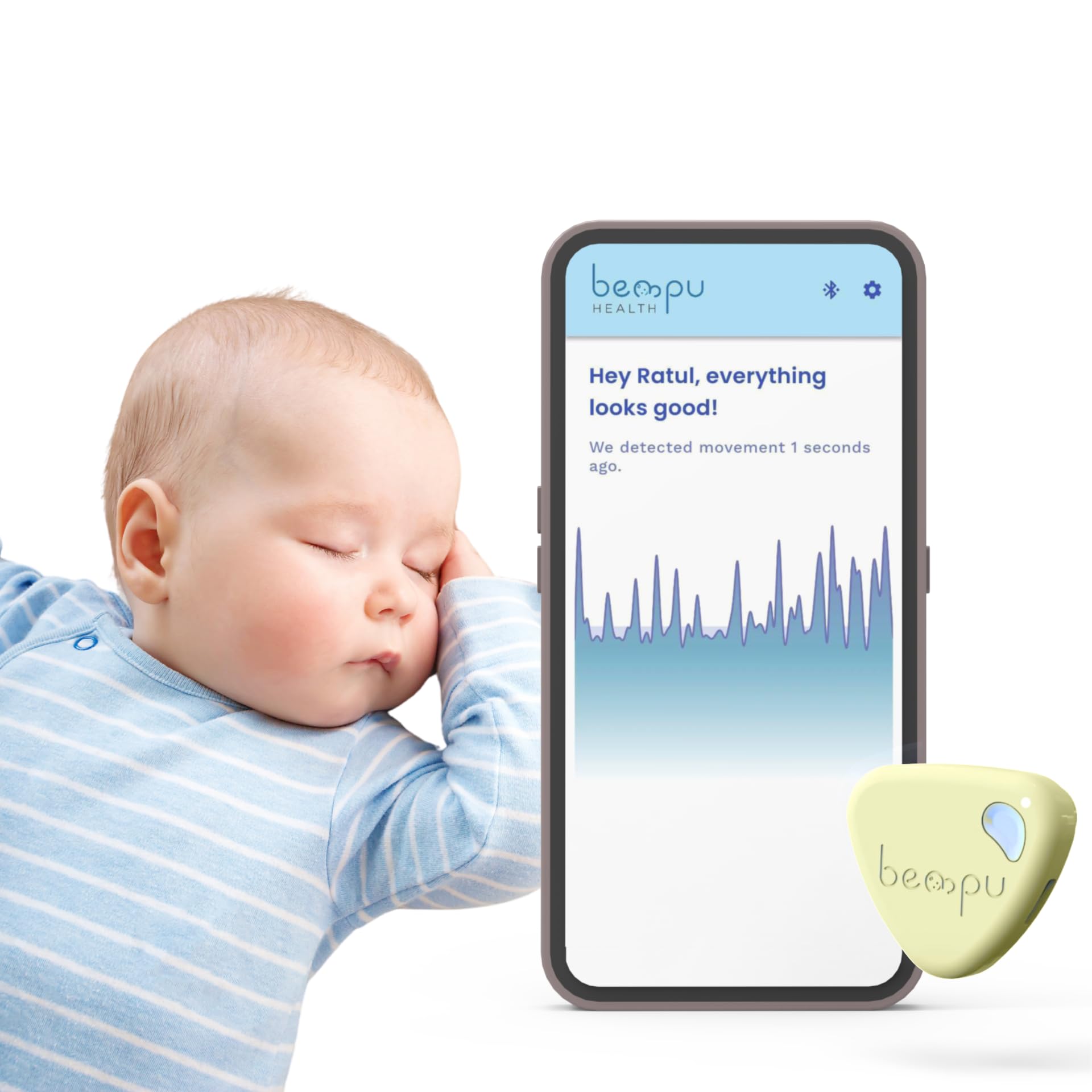
The BEMPU BellyButton is a minimalist movement monitor designed for simplicity. It clips to the baby’s diaper or clothing and tracks gentle abdominal movements. If no movement is detected, a vibration encourages natural motion; if movement remains absent, an audible alarm and app notification activate. It requires no Wi-Fi, operating solely via Bluetooth to a free app, with a rechargeable battery lasting up to 7 days on a 1-hour charge.
Reviews are overwhelmingly positive, highlighting the device’s simplicity and reliability. Users report zero false alarms in weeks of use, and the standalone vibration-alert function works without the phone app. The lightweight 13-gram clip is comfortable for newborns and fits easily under swaddles. The battery consistently lasts 7–9 days in practice.
The BEMPU is specifically a “yes/no” alive monitor — it does not track heart rate, oxygen, temperature, or sleep stages. Its single-minded focus on movement verification makes it ideal for parents who want a simple safety net without data overload. The compact 1.4-inch size is about the size of a large coin, making it easy to tuck into a diaper bag for travel.
Why it’s great
- Ultra-light 13-gram clip design comfortable for newborns
- No Wi-Fi required — works standalone with Bluetooth
- 7-day battery on a 1-hour recharge cycle
Good to know
- Only tracks movement — no heart rate or oxygen data
- App can disconnect when closed, requiring re-pairing
- Not suitable for fetal heartbeat detection — designed for infants
6. Skywin Fetal Heartbeat Monitor (Green)

The Skywin fetoscope is a classic Pinard horn made from plastic, designed for passive acoustic amplification of fetal heart tones. It requires no batteries, no gel, and no electronics — just a quiet room and correct placement. The manufacturer recommends using it from 24 weeks onward, though real-world success is highest between 30–36 weeks. The 12.9-inch length allows comfortable access to the lower abdomen.
Customer experiences are sharply divided. Some users report success after patience and practicing positioning, particularly after 28 weeks. Others, including trained OB nurses, could not detect any heartbeat even beyond 24 weeks, calling the device ineffective. Positive reviews often mention bonding benefits for partners and siblings. Negative reviews consistently cite the steep learning curve and inability to hear anything before the third trimester.
This is not a Doppler — it will not produce the amplified “whoosh” sound familiar from clinical visits. Instead, it delivers a faint, natural acoustic tone that requires very quiet conditions. The device works on the user’s own heartbeat, which can mislead beginners into thinking they found the baby’s. It is best suited for parents willing to practice daily from 30 weeks onward and who value battery-free simplicity.
Why it’s great
- No batteries, no electronics — completely passive design
- Compact and portable for easy travel storage
- Affordable entry point for acoustic fetal listening
Good to know
- Only reliable after 30–36 weeks gestation
- Very quiet sound requires optimal positioning and silent room
- Many users report inability to hear anything before 28 weeks
7. Skywin Fetal Heartbeat Monitor (White)

This white variant of the Skywin fetoscope is functionally identical to the green model, sharing the same plastic Pinard horn design and operating principles. It includes an updated user manual with step-by-step instructions and troubleshooting tips printed in the image gallery, addressing common issues like positioning and timing. The device weighs 14.4 ounces and measures 12.56 x 6.26 inches in packaging.
Customer reviews mirror the green version exactly — same praising comments about patience and bonding, and same criticisms about ineffectiveness before 28 weeks and poor construction quality. The identical feedback suggests the product core is unchanged; only the color and packaging differ. Two trained nurses failed to detect sound even after 24 weeks, reinforcing that this is a challenging tool to master.
Like its green counterpart, this is a purely acoustic device that requires no power source. The inclusion of detailed troubleshooting guidance may help beginners improve their placement technique. However, the fundamental limitation remains: passive acoustic detection relies heavily on the user’s skill and the baby’s position. Parents expecting immediate results similar to a clinical Doppler will be disappointed.
Why it’s great
- Completely battery-free and maintenance-free operation
- Includes detailed troubleshooting guide in packaging
- Lightweight 14.4-ounce construction for easy handling
Good to know
- Late gestation window — reliable detection starts at 30 weeks
- Identical performance to green model, same learning curve
- Fails to detect heartbeat for many users even at 27+ weeks
FAQ
Can I use an acoustic fetoscope before 20 weeks of pregnancy?
What is the difference between a Doppler and a fetoscope?
Do smart baby socks track fetal heart rate during pregnancy?
Why can’t I hear anything with my fetoscope at 24 weeks?
Are at-home fetal Dopplers safe to use every day?
Final Thoughts: The Verdict
For most users, the at home fetal doppler winner is the Owlet Dream Sock because it delivers clinical-grade pulse rate and SpO2 tracking with comprehensive sleep insights, offering the highest level of peace of mind for parents monitoring an infant after birth. If you want a lightweight diaper clip with breathing and temperature data at a mid-range price, grab the Sense-U Pro. And for battery-free, acoustic bonding in the third trimester, nothing beats the simplicity of the Skywin Fetoscope.