
Our readers keep the lights on and the weekend projects moving. As an Amazon Associate, I earn from qualifying purchases.
A dull kitchen knife is not just frustrating — it’s the leading cause of slipped cuts and crushed herb leaves. The real trick to maintaining that factory-fresh slice lies in choosing the right sharpening system for your steel, ceramic, or serrated blades without turning your counter into a workshop.
I’m Rikta — the founder and writer behind FitlyFast. I’ve spent years analyzing the mechanical and material specs of consumer sharpening tools, from diamond-grit density to motor torque curves, so you know exactly what’s worth the counter space.
This guide breaks down seven proven models across manual, electric, and whetstone setups to help you find the best at home kitchen knife sharpener for your daily cooking routine, your knife steel type, and your skill level.
How To Choose The Best At Home Kitchen Knife Sharpener
Choosing between a manual pull-through, a whetstone kit, an electric 3-stage unit, or a belt system comes down to three things: the type of steel in your knife block, how much time you want to spend per blade, and your tolerance for a learning curve. A Japanese 15-degree edge needs different treatment than a German 20-degree chef’s knife, and the wrong abrasive can round off your blade’s geometry in seconds.
Abrasive Material: Diamond vs. Corundum vs. Ceramic
Diamond abrasives are the hardest natural substance and cut through high-carbon stainless and ceramic blades efficiently. Corundum stones (often labeled white or pink alumina) are cheaper but load up faster with metal swarf and require frequent flattening. Ceramic rods are best for honing, not reprofiling — they micro-polish an existing edge but won’t fix a chipped blade. For an at-home sharpener, diamond plates or diamond-infused wheels offer the fastest material removal and longest service life per dollar.
Angle Consistency: Guides vs. Freehand
If you are new to sharpening, a built-in angle guide (usually 15 or 20 degrees) ensures you reprofile both sides evenly without guesswork. Freehand whetstone sharpening gives you total control over edge geometry but requires practice to maintain a steady angle across the full blade length. The best home sharpeners balance guide precision with flexibility — the guide should be rigid enough to prevent wobble but simple enough to swap between blade widths.
Stage Count: 2-Stage vs. 3-Stage vs. Belt Systems
A 2-stage sharpener (coarse grind + fine hone) is sufficient for routine maintenance of straight-edge knives. A 3-stage adds a stropping/polishing step that finishes the edge to a mirror-like surface, useful for ceramic knives and presentation-level cuts. Belt-driven sharpeners like the Work Sharp Mk2 offer the fastest throughput — you can refresh a dozen knives in under 30 minutes — but require light pressure to avoid overheating the blade edge.
Quick Comparison
On smaller screens, swipe sideways to see the full table.
| Model | Category | Best For | Key Spec | Amazon |
|---|---|---|---|---|
| Work Sharp MK2 | Belt System | High-volume kitchen + garden tool sharpening | 2-speed motor, 3 interchangeable belts | Amazon |
| Chef’sChoice 0312000S | Electric 2-Stage | 20-degree German steel (Wusthof/Henkels) | 100% diamond abrasives, 2 precision stages | Amazon |
| VIDOME Professional | Electric 3-Stage | Ceramic + straight-edge knives, 15-degree edges | Elastic constant force guide, magnetic chip tray | Amazon |
| Homly Professional | Electric 3-Stage | All-metal straight knives, fast reprofiling | Diamond abrasives, 3-stage slots, ~60 dB noise | Amazon |
| Mercer Culinary Double Diamond | Manual Pull-Through | Quick touch-ups between pro line shifts | 100% diamond abrasives, 2-stage arch edge | Amazon |
| Goodjob Premium Whetstone Kit | Whetstone Set | Hobbyists wanting full edge control | Four grits (400/1000 + 3000/8000), angle guide | Amazon |
| Saker Chisel Sharpening Jig | Honing Guide + Whetstone | Home woodworkers sharpening chisels and plane irons | Aluminum alloy jig, wide bearing roller, 0.2-2.55″ clamp | Amazon |
In‑Depth Reviews
1. Work Sharp MK2 Electric Knife Sharpener
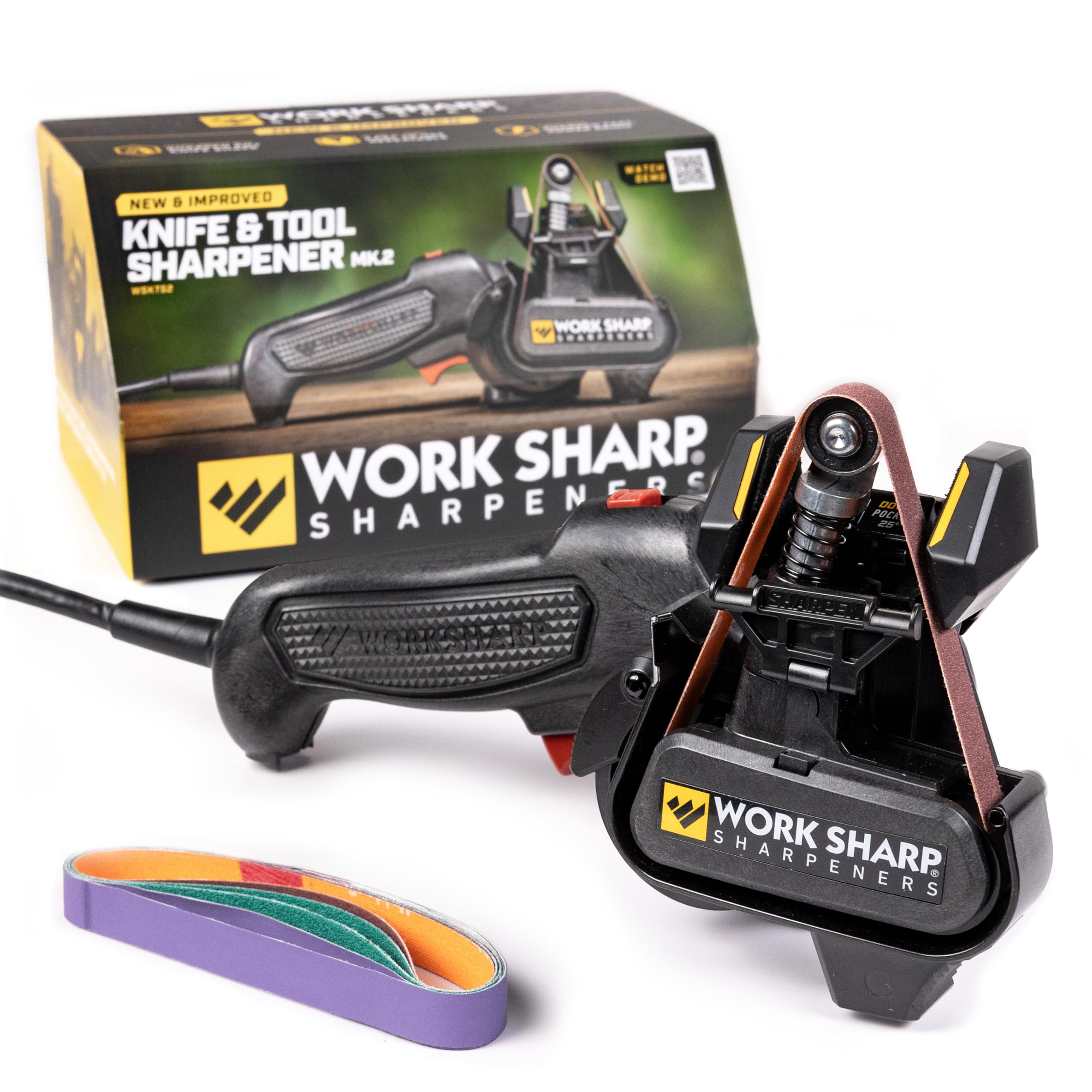
The Work Sharp Mk2 is the most versatile single-device sharpening system for the home cook who also wields gardening shears, pocket knives, and even lawn mower blades. Its two-speed motor lets you dial down for delicate kitchen knives or crank up for reshaping a dull axe edge, and the three interchangeable grit belts cover everything from coarse reprofiling to fine honing. The edge guide supports the blade all the way to the tip, solving the common electric-sharpener problem of leaving the last inch of the heel untouched.
Real-world performance from first-time users shows you can run a dozen neglected kitchen knives through the Mk2 in under 30 minutes and come out with edges that rival professional sharpening services. The included replacement belts extend the unit’s life significantly, and the 3-year warranty reflects Work Sharp’s confidence in the motor. One caveat: because it’s belt-based, you need to use light, even passes — excessive pressure or lingering on one spot can overheat the edge and ruin temper.
If you own a mixed collection of kitchen knives plus outdoor tools and want one machine that does it all without a separate angle jig, the Mk2 delivers faster throughput than any stone or pull-through. It’s also engineered and calibrated in Oregon, which adds a layer of quality assurance that budget electric sharpeners often lack.
Why it’s great
- Two-speed motor handles everything from flexible fillet knives to thick garden blades
- Belt system conforms to curved and serrated edges without angle drift
- Edge guide runs full blade length, including the heel
Good to know
- Requires light, consistent pressure to avoid heat damage on thin steel
- Not ideal for very short ceramic paring knives
2. Chef’sChoice Professional UltraHone 0312000S

Stage 1 uses a coarser diamond matrix to reshape the edge, while Stage 2 switches to advanced micron-size diamonds that polish the bevel to a mirror smoothness. The precision angle guide locks in a consistent 20-degree edge, which is exactly what most Western knife makers use from the factory.
Owners report that dull knives from Chicago Cutlery and Wusthof come out sharper than new after a single pass sequence. The machine is also remarkably quiet for a diamond electric sharpener — no whining or grinding noise that might disturb a quiet kitchen. It handles both straight-edge and serrated blades, though serrated knives require a slower, gentler pull to avoid stripping the scalloped points. The build is all polycarbonate, so it’s lightweight and easy to store, but the plastic housing feels a bit less solid than the metal-clad alternatives.
For home cooks who mainly use 20-degree German or French knives and want a foolproof electric solution without the learning curve of a whetstone, the UltraHone is the benchmark. It won’t sharpen 15-degree Japanese blades accurately, but if your knife block is mostly Western steel, this machine earns its reputation.
Why it’s great
- 100% diamond abrasives in both stages handle German stainless effortlessly
- Precision 20-degree guide restores factory edge geometry
- Low noise operation and fast results (10-15 seconds per knife)
Good to know
- Not suitable for 15-degree Japanese or ceramic blades
- Polycarbonate shell can feel light compared to premium electrics
3. VIDOME Professional Electric Knife Sharpener
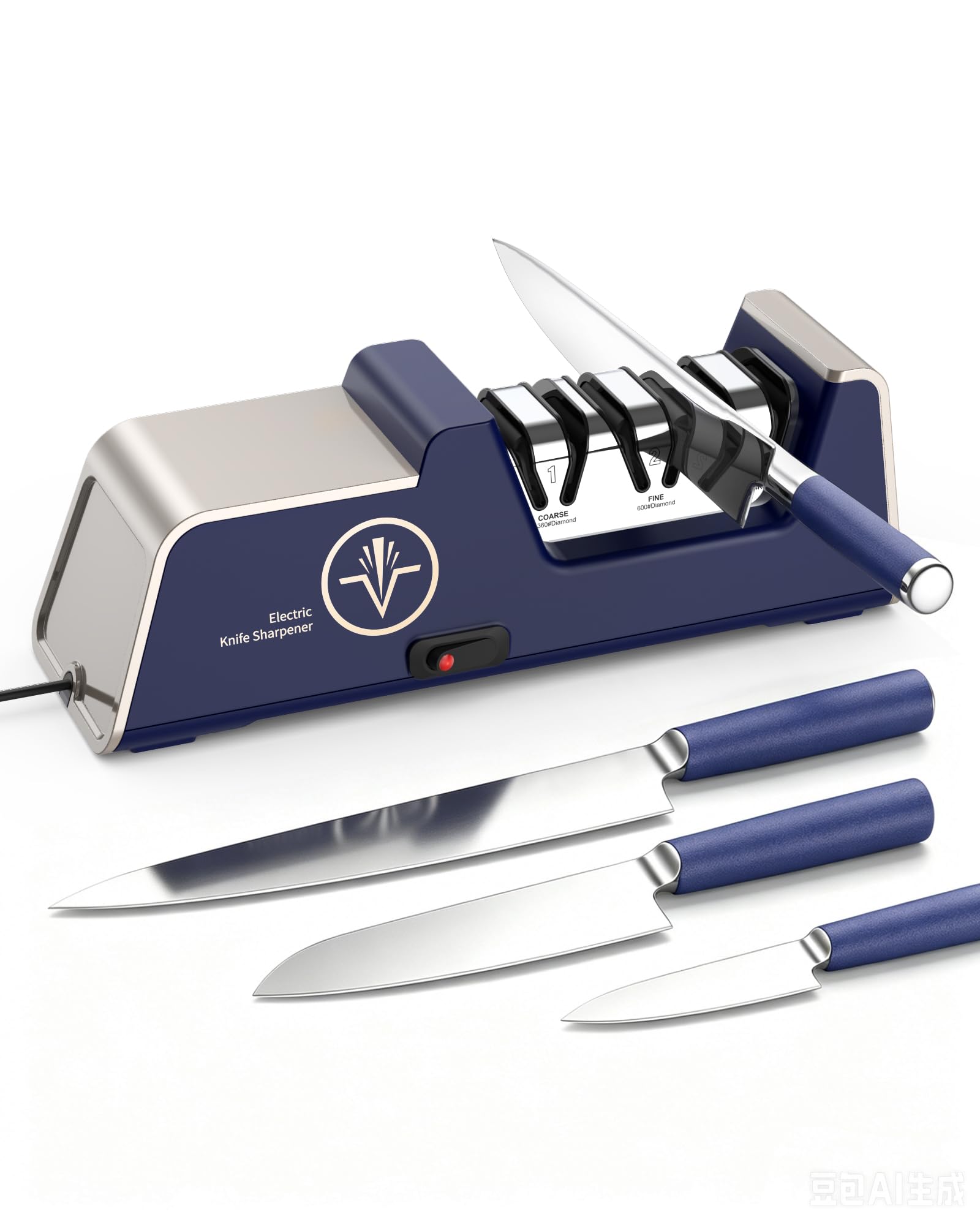
VIDOME’s 3-stage electric sharpener stands out for its elastic constant force guide, which applies uniform pressure across the blade’s full length regardless of how hard you pull. This design prevents the uneven edge geometry that happens with rigid spring guides on cheaper units. Stage 1 and 2 use 100% diamond abrasives for sharpening and honing, while Stage 3 employs safe stropping disks to polish the edge to a high-gloss finish. The champagne gold body is surprisingly compact — 9.5 inches long — so it sits unobtrusively on a countertop.
The real differentiator is its ceramic knife compatibility. Most electric sharpeners destroy ceramic edges because the abrasive is too aggressive; VIDOME’s diamond matrix operates at a fine enough level to refresh ceramic blades without chipping. Owners have reported restoring dull German steel knives to near paper-cutting sharpness in under 60 seconds. The magnetic chip collection tray is a thoughtful touch — it catches metal swarf so you don’t have to wipe down the counter after every session.
One design quirk: the slot arrangement on Stage 1 starts about 10 mm from the handle, which means very short paring knives may not reach the abrasive. For standard chef’s knives, santokus, and serrated bread knives, the VIDOME delivers consistent results with minimal effort. The noise level sits between 60-80 dB, comparable to a quiet conversation.
Why it’s great
- Elastic constant force guide prevents uneven edge pressure
- Safe for ceramic and serrated knives, not just straight-edge steel
- Magnetic chip tray simplifies cleanup
Good to know
- Slot position limits use with very short blades
- At ~, it competes directly with the Homly — choose based on ceramic vs. steel focus
4. Homly Professional Electric Knife Sharpener

The Homly Professional electric sharpener is essentially the 3-stage sibling to the VIDOME, sharing the same diamond-abrasive architecture but tuned more aggressively for all-metal steel knives. Its three-stage slots follow the same coarse-sharpen-hone-polish sequence, but the Homly’s motor runs slightly faster, making it better for reprofiling badly dulled edges quickly. The flexible spring guide rods hold the blade at the ideal angle, and the double-layer shell paint with electroplating resists fingerprints and kitchen grease.
In testing, the Homly pulled a very dull Santoku back to paper-cutting sharpness in about 40 seconds — faster than any manual method. The motor noise is moderate, though slightly louder than the Chef’sChoice. The 2-year manufacturer warranty plus lifetime customer service is a solid commitment for an electric sharpener in this price bracket. One caution: the instructions emphasize using light pressure and a quick pulling motion — lingering can create a small indent near the blade handle, a common complaint among heavy-handed users.
If you cook daily with a mix of Western and Asian steel knives (excluding ceramic) and want a fast, electric solution that doesn’t require angle-guide fiddling, the Homly delivers professional-grade results at a mid-range cost. The 12.2-inch length means it needs a bit more counter space than the VIDOME, but the trade-off is a more stable base during use.
Why it’s great
- Fast diamond reprofiling on all-metal straight knives
- Flexible spring guides maintain consistent angle
- 2-year warranty with lifetime customer support
Good to know
- Not suitable for ceramic knives
- Requires light pressure to avoid blade indent near handle
5. Mercer Culinary Double Diamond Manual Knife Sharpener

Mercer Culinary’s Double Diamond manual sharpener is the go-to for cooks who want a quick, portable edge maintenance tool without plugging in or soaking stones. The 100% diamond abrasives are embedded in two V-shaped slots: the first side grinds a new edge on dull blades, and the second side hones and polishes. The unique arch-shaped edge produced by this design is stronger than a standard V-edge — it resists chipping better during heavy chopping. The textured handle gives a secure grip even with wet or greasy hands.
Professional cooks report that a single pass through each slot (3-4 pulls) restores a dull chef’s knife to serviceable sharpness in seconds, and the compact 8-inch body slides easily into a tool drawer or knife roll. The precision guides hold the blade at the correct angle automatically, so there is no learning curve. The main limitation is blade thickness — very thick pocket knives or hunting blades struggle to seat properly in the guides, and it cannot sharpen scissors.
For home cooks who don’t want to dedicate counter space to an electric unit and prefer a fast, mess-free touch-up between professional sharpening sessions, the Mercer Double Diamond is the most practical manual option. The fact that it’s made by the same parent company as Chef’sChoice (EdgeCraft) assures the diamond quality is up to commercial standards.
Why it’s great
- 100% diamond abrasives in two stages for fast edge restoration
- Arch-shaped edge improves resistance to chipping
- Compact enough for a knife roll or utility drawer
Good to know
- Best for thin to medium kitchen knives; thick blades (hunting) are tricky
- Cannot sharpen scissors
6. Goodjob Premium Whetstone Kit

The Goodjob Premium Whetstone Kit is the most complete entry-level stone system for home cooks who want full control over edge geometry. It includes two dual-grit stones (400/1000 and 3000/8000) fired using Japanese Osaka production technology — a 48-hour, 20-process sintering at 2000 degrees that produces a hard, uniform abrasive surface. The kit also includes a bamboo non-slip base, a honing guide, cut-resistant gloves, a flattening stone, two leather strops, and green polishing compound. That’s everything a beginner needs to go from dull to razor sharp without buying accessories separately.
The 400 grit side sets a new edge on very dull or chipped knives quickly, while the 1000 grit refines it to a working sharpness. Moving to the 3000/8000 stones produces a polished edge that can slice newspaper. The silicone bamboo base grips the counter effectively, and the angle guide is clear enough for a first-time whetstone user. The only quality concern is the stone surface — some units have a small manufacturer logo area that feels slightly rough; a light sanding with the included flattening stone solves it.
If you are willing to spend 5-10 minutes per knife and enjoy the meditative process of freehand sharpening, this kit offers significantly more value than buying each component separately. The quality of the corundum stones is good enough for high-carbon Japanese knives and Western stainless, though the stones remove steel slower than diamond plates.
Why it’s great
- Comprehensive kit with four grits, strop, gloves, and bamboo base
- Japanese-sintered stones provide uniform, durable abrasive surface
- Angle guide makes freehand learning accessible
Good to know
- Stone logo area can cause slight roughness until sanded
- Slower on cheap stainless or heavily damaged edges
7. Saker Chisel Sharpening Jig with Whetstone

The Saker Chisel Sharpening Jig is a specialized tool for home woodworkers who need to sharpen chisels and plane irons with repeatable precision. The all-aluminum-alloy body clamps blades from 0.2 to 2.55 inches wide, and the upgraded off-center roller design improves stability when sharpening short planer blades. The wide bearing roller at the bottom glides smoothly across the whetstone, eliminating the wobble that plagues cheaper jigs. The included diamond stone works well for initial edge setting.
The jig uses the backside of the chisel as a reference plane, which means the resulting edge angle depends directly on how square and flat that backside is. Chisels with thickness variation (common in older Stanley or cheap chisels) can produce an uneven angle — you may need to manually shim the blade or flatten the back first. Owners report that after an initial setup on a sacrificial blade to remove any substrate burrs, the jig produces gleaming edges on clean chisels with just 40 passes per side repeated a few times.
It won’t handle kitchen knives (the clamp isn’t designed for thin chef’s blades), but for chisels and plane irons, it delivers professional-grade angle repeatability.
Why it’s great
- All-metal construction provides weight and stability for consistent angles
- Wide bearing roller prevents tipping on narrow blades
- Works with chisels and planer blades from 0.2 to 2.55 inches
Good to know
- Edge angle depends on chisel back squareness — may need shimming
- Not designed for standard kitchen knives
FAQ
Can I use an electric knife sharpener on ceramic blades?
How often should I sharpen my kitchen knives at home?
Manual whetstone vs electric sharpener which is better for a beginner?
What does the 20-degree vs 15-degree angle difference mean for my knives?
Final Thoughts: The Verdict
For most users, the best at home kitchen knife sharpener winner is the Work Sharp Mk2 because its belt-driven two-speed system handles everything from delicate kitchen knives to garden tools with unmatched speed and versatility. If you primarily own German 20-degree steel and want a foolproof electric solution, grab the Chef’sChoice UltraHone. And for those who enjoy the craft of freehand sharpening and want the most complete starter kit, nothing beats the Goodjob Premium Whetstone Kit.