
Our readers keep the lights on and the weekend projects moving. As an Amazon Associate, I earn from qualifying purchases.
A cheap gadget that just throws a few green dots on your ceiling is not a planetarium — it’s a disappointment. Real home planetariums use precision optics, accurate star-field discs, or rich digital 3D engines to transform a bedroom ceiling into a cosmic dome where you can actually recognize constellations and watch nebula colors shift. The difference between a toy and a tool is measured in pixel density, projection distance, and light-engine quality.
I’m Rikta — the co-founder and writer behind FitlyFast. After studying the engineering specs, lens quality data, and real-world projection performance of this entire market segment, I’ve broken down exactly how these machines differ in ways that matter to someone who actually wants to sleep under stars, not just static glow.
From disc-based optical projectors to app-driven LED units and even 4K 3D holographic models, this guide will walk you through the key specs and real trade-offs of the best at home planetarium options available right now.
How To Choose The Best At Home Planetarium
Choosing the right at-home planetarium means looking past the flashy product images and understanding the three pillars that define a real celestial experience: light engine quality, projection medium, and field fidelity. Every product in this category trades off between brightness, sharpness, and authenticity, so knowing which pillar matters most to your use case is critical.
Disc-Based vs Digital Projection
Disc-based projectors (like the Sega Homestar) use etched glass or film discs that are physically moved past a bright LED. This method produces the truest star-field geometry — each star’s position is mechanically accurate to real constellations. Digital projectors (like the Govee and most 3D models) use algorithmic patterns or stored images. They offer more color effects and scene variety, but the stars are computer-generated approximations, not astronomically precise maps. For constellation recognition and authentic star shapes, discs win. For colorful nebula art and mood lighting, digital wins.
Brightness and Projection Distance
A planetarium’s brightness is measured in lumens or LED wattage, but the real-world metric is how far the unit can project a clear, visible image. Many budget units advertise large coverage areas (like 540 sq. ft.) but quickly become dim, blurry, or grainy past 8-10 feet. Premium disc units with focused optics maintain sharp individual star points even at 12 feet onto a ceiling. For a convincing planetarium, you need enough brightness that the image is visible in a dim (not pitch-black) room, and enough lens quality that each star remains a clear dot, not a fuzzy blob.
Scene Authenticity and Motion
Barely any home projectors simulate true diurnal motion (the slow rotation of the night sky). The Sega Homestar Matataki includes disc rotation for this. Most digital units use pulsing or swirling effects that look more like a lava lamp than a sky. If your goal is relaxation through a realistic night sky, prioritize units with slow, natural rotation or twinkling star effects rather than rapid color-shifting nebula modes. If your goal is immersive visual art for a gaming room or party, colorful 3D themes with Bluetooth audio will be more satisfying.
Motor Noise and Build Quality
Disc-based and rotating projectors use internal motors, and not all are silent. A whirring or clicking motor in a quiet room can ruin the illusion of a peaceful night sky. Check customer feedback specifically for motor noise levels. The best units operate below 25dB — quieter than a whisper. Also, plastic build quality varies significantly. Units that feel hollow or flimsy often have lens alignment issues that cause distorted projections, especially on uneven surfaces.
Additional Features: Sound, Timers, and Control
Built-in speakers are common, but many project cheap, tinny audio that you will want to mute in favor of your own speaker. Bluetooth connectivity is a genuine plus for syncing your own playlists without extra wires. Adjustable timers (1H, 2H, 4H) are essential for sleep use, preventing the unit from running all night. App control via WiFi or Matter adds convenience for changing scenes without getting up, but adds complexity. For a strictly sleep-focused device, a simple remote control with timer buttons is often more reliable than a finicky app.
Quick Comparison
On smaller screens, swipe sideways to see the full table.
| Model | Category | Best For | Key Spec | Amazon |
|---|---|---|---|---|
| Sega Homestar Matataki | Disc-Based | Authentic star projection | 60,000 solid stars with twinkling mode | Amazon |
| Rovmiment 60-in-1 | Digital 3D | Built-in scene variety | 60 built-in HD themes, no discs needed | Amazon |
| Brizled 4K 3D Holographic | 3D Holographic | Visual spectacle | True 4K resolution projection | Amazon |
| Rossetta Galaxy Projector | Digital 3D | Multipurpose ambiance | 60 immersive 3D themes + 29 nebula effects | Amazon |
| AIRIVO 3D Galaxy Projector | Digital 3D | Versatile 3D scenes | 90 3D scenes across 11 themes | Amazon |
| Govee Star Projector 7-Zone | Digital LED | Customizable LED light show | 7-zone stardust with DIY control | Amazon |
| POCOCO Galaxy Star Projector | Disc-Based | Ultra-sharp galaxy projection | 2M-pixel industrial-grade lens | Amazon |
| Ainael Meteor & Galaxy Projector | Disc-Based | Dynamic meteor effects | 6500K light source + rotating disc | Amazon |
| Govee Star Light Wave | Digital LED | Ocean wave ambiance | 540ft² projection with wave ripples | Amazon |
In‑Depth Reviews
1. Sega Homestar Matataki (Navy) Home Planetarium Star Projector

The Sega Homestar Matataki is the benchmark for authentic home planetariums. Its 3-watt LED engine projects 10,000 twinkling stars or up to 60,000 solid stars onto your ceiling, using two exchangeable projection discs. The disc rotation simulates diurnal motion — the slow drift of the night sky — which is a feature nearly no digital projector can replicate. The twinkling effect, enabled by a rotating filter, makes the stars genuinely shimmer.
In a pitch-black room, the image is sharp and recognizable, especially the northern hemisphere disc. The built-in natural sounds (crickets, ocean, etc.) are decent but not exceptional. The biggest caveat is the manual: it is entirely in Japanese, so setting up the twinkling effect requires some trial and error. The unit is compact and polished, typical of Sega Toys’ build quality.
For anyone who wants a true astronomical star projector — one that you could use to teach constellation shapes — this is the clear leader. The disc library from Sega is extensive (available separately), allowing you to swap in deep space nebulae or southern hemisphere skies. It is not cheap, but the optical precision and authenticity justify the premium tier placement.
Why it’s great
- Authentic twinkling star effect with diurnal rotation.
- 60,000-star discs produce constellation-accurate images.
- Compact, premium build from a legacy Japanese brand.
Good to know
- Default discs are dim; extra discs are sold separately.
- Manual is Japanese-only; initial setup can be confusing.
- Requires complete darkness for best visibility.
2. Rovmiment 60-in-1 Galaxy Projector
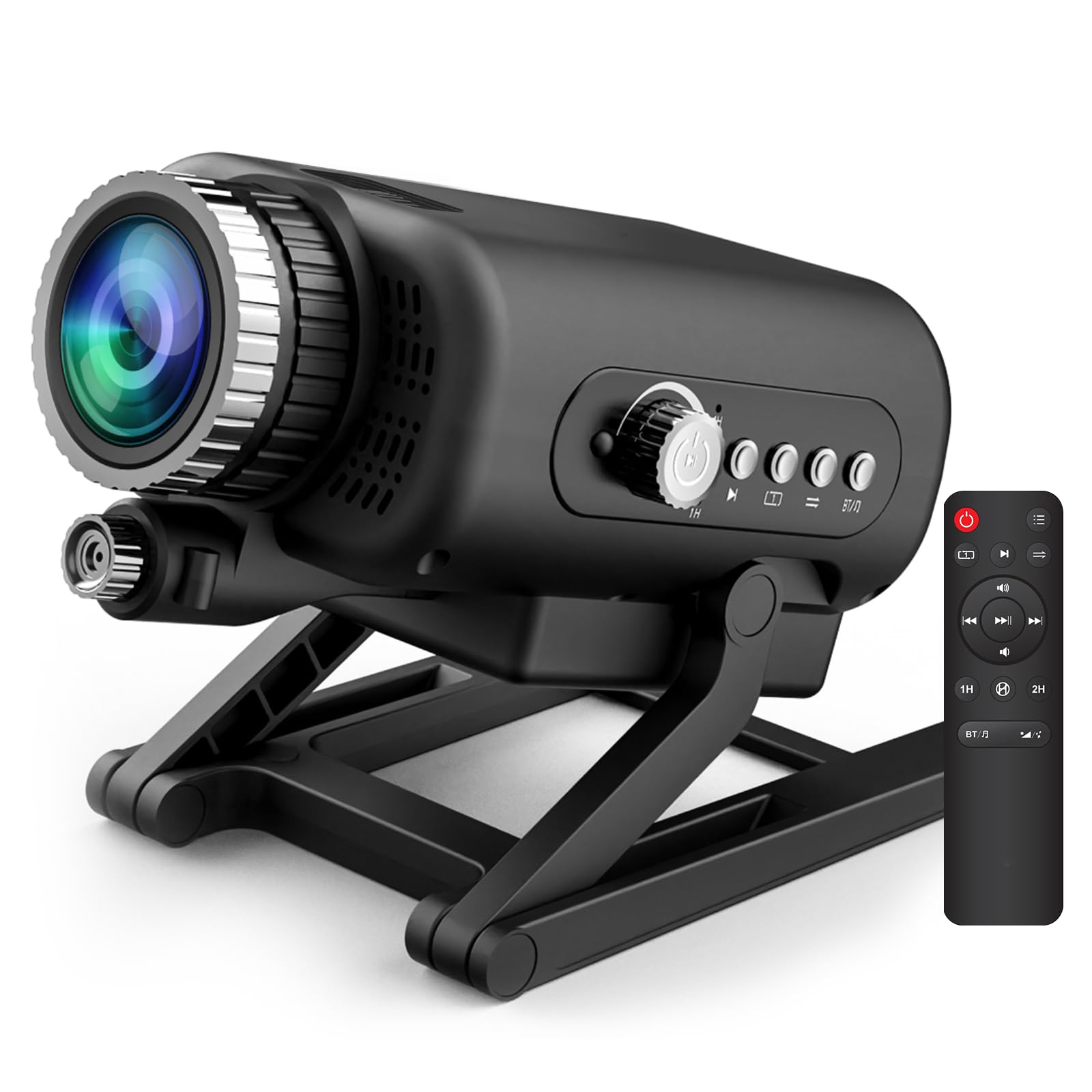
The Rovmiment 60-in-1 sidesteps the disc problem entirely by embedding 60 HD themes directly into the unit. No discs to lose or scratch. The themes range from realistic space galaxies to holiday motifs, each rendered with a crisp 3D effect. The projection covers up to 500 sq. ft., and the manual focus ring lets you tighten the image at different distances.
The built-in Hi-Fi Bluetooth speaker is genuinely better than most projector speakers, and the 6 white noise tracks (rain, crickets, fireplace) are useful for sleep. The 270° adjustable stand is a practical design win — it can aim at walls or ceilings without wobbling. The remote control handles theme switching, 4-level brightness, and timer setting (1H/2H/4H) without needing a phone app.
The trade-off is that the scenes, while numerous, are not astronomically accurate. These are artist renderings, not star maps. The animal and holiday scenes can feel cartoony, and the aurora scenes cycle in short loops that become repetitive. But as a versatile all-in-one atmosphere creator — for sleep, parties, sensory rooms — it is hard to beat this feature density at a mid-premium price.
Why it’s great
- 60 built-in HD themes with no discs to manage.
- 270° adjustable stand for flexible ceiling and wall projection.
- Hi-Fi Bluetooth speaker with white noise tracks.
Good to know
- Scenes are artistic renderings, not constellation-accurate.
- Some themes (animal, holiday) look cartoony.
- Aurora loops are short and may feel repetitive.
3. Brizled Galaxy Projector Pro, 4K 3D Holographic
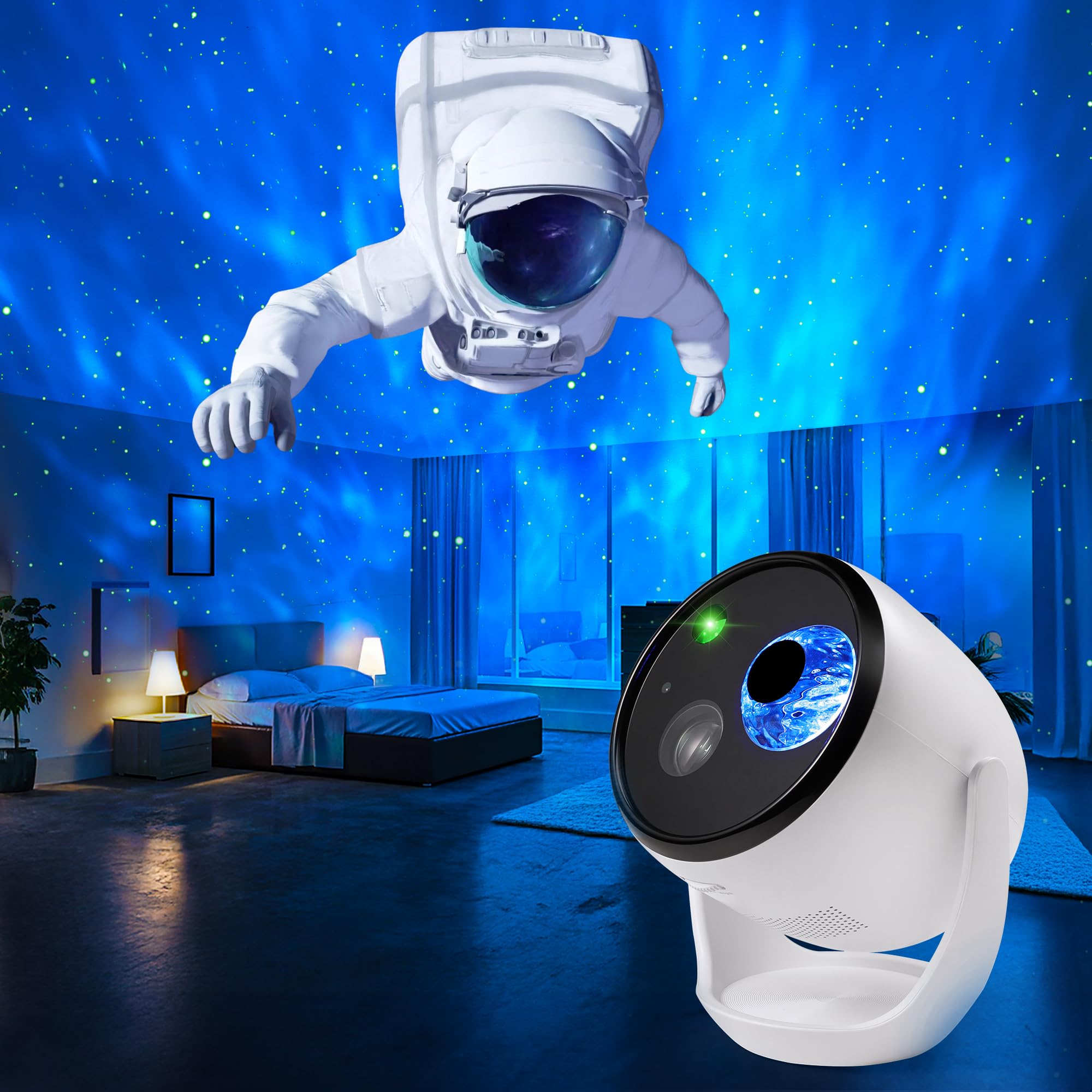
The Brizled Galaxy Projector Pro advertises true 4K resolution and a glasses-free 3D holographic effect. The optical engine uses a high-definition lens with a projection range of 10 to 20 feet, covering 160 to 375 sq. ft. The 90+ built-in dynamic themes include planets, marine life, and festivals, and the 180° adjustable angle lets you aim the image precisely.
The image quality is genuinely impressive for a consumer projector in this class — colors are saturated, and the spatial depth effect is noticeable without being gimmicky. The built-in stereo Bluetooth speaker is powerful enough for a bedroom. However, calling it “3D holographic” is a stretch; it creates a layered depth effect, not floating holograms. Early adopters report that the 4-hour auto shut-off cannot be overridden, which is frustrating for all-night use.
This is the unit to buy if you want a visual centerpiece for a gaming room, home theater, or Halloween party. The theme library is vast and high-quality, but the astronomical authenticity is zero — these are CGI scenes, not a star map. For pure wow-factor and resolution, it is among the best in the premium tier.
Why it’s great
- 4K-class resolution with vivid color saturation and depth.
- 90+ dynamic themes covering planets, festivals, and marine life.
- Stereo Bluetooth speaker with strong volume and clarity.
Good to know
- Not true 3D holography; it is a depth-effect projection.
- Fixed 4-hour auto shut-off cannot be disabled.
- No constellation accuracy — all scenes are artistic.
4. Rossetta Galaxy Projector, 3D with Bluetooth Speaker

The Rossetta Galaxy Projector is a 4-in-1 system that combines a nebula projector, starry sky projector, 3D theme projector, and a Bluetooth speaker. It offers 60 immersive 3D themes and 29 separate nebula effects, all controllable via a remote. The HD projection lens has an adjustable focus for different ceiling heights, and the three separate light sources (stars, nebula, 3D visuals) can be mixed and matched independently.
User feedback is consistently positive about the sheer number of combinations possible — you can set a specific nebula color, overlay a star pattern, and add a moving 3D scene. The Bluetooth speaker is functional for background music or white noise. The unit is silent in operation, which is crucial for sleep use. Timer options of 1H, 2H, and 6H give flexibility.
The trade-off is that the 3D scenes are pre-rendered loops rather than real-time generated graphics. Some scenes look noticeably more polished than others. The remote has been reported to occasionally lose connection, requiring a power cycle. As a versatile mood lighting system with genuine 3D visual content, it offers excellent value in the premium tier.
Why it’s great
- Independent mixing of stars, nebula, and 3D scenes.
- 60 themes plus 29 nebula effects for near-infinite combos.
- Silent motor and 6-hour timer option.
Good to know
- 3D scenes are pre-rendered loops; some look low-poly.
- Remote can lose sync intermittently.
- No Wi-Fi or app control — remote only.
5. AIRIVO 3D Galaxy Projector, 90 Scenes
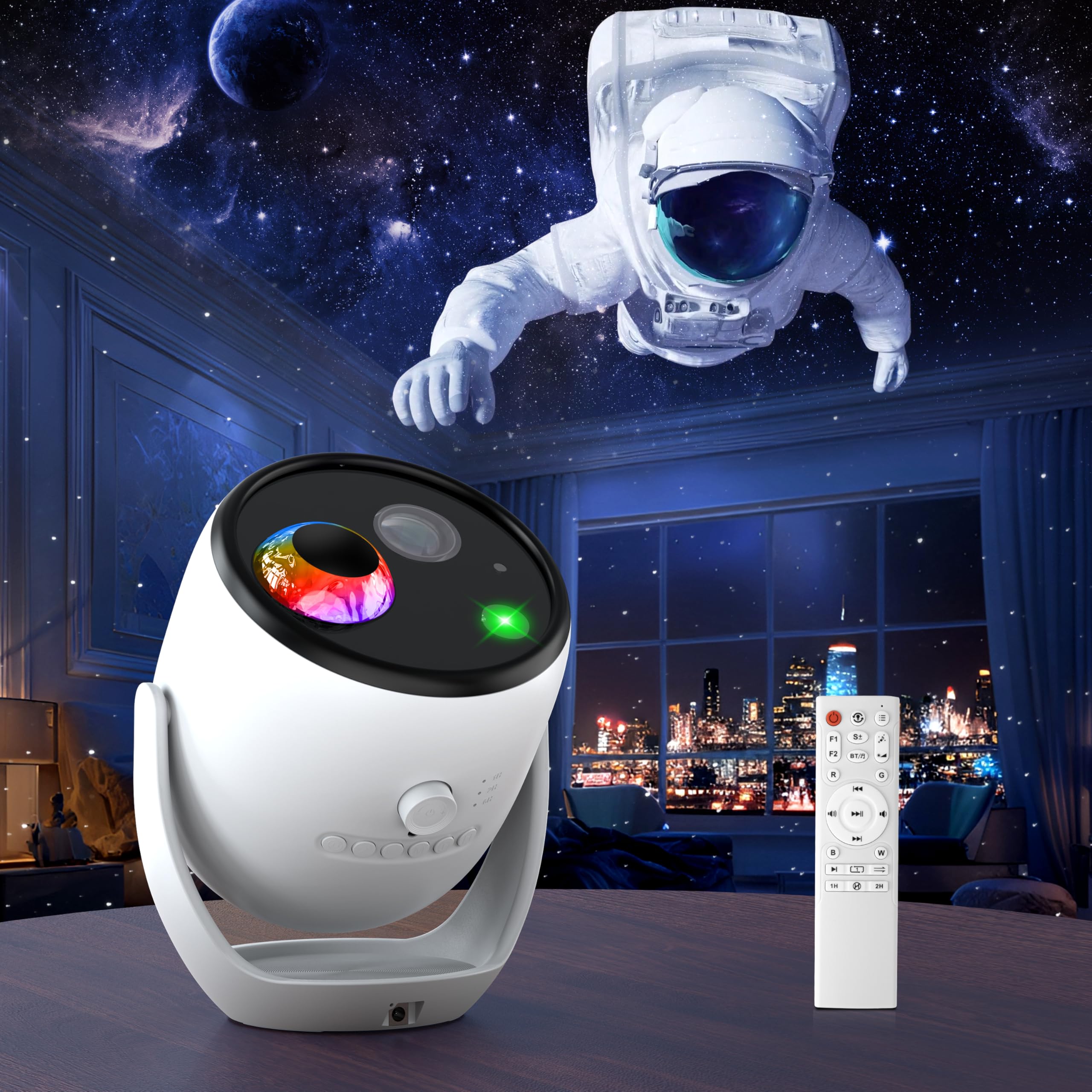
The AIRIVO 3D Galaxy Projector packs the largest scene library in this review — 90 dynamic projections across 11 themes, from ocean depths to dinosaur epochs. Its advanced optical system with a high-resolution lens projects sharp images within a 3-5 meter range, with a focus wheel for fine-tuning. The 3-in-1 lighting engine lets you combine 3D scenes, nebula effects, and moving green stars independently.
One unique engineering choice is the built-in cooling fan with heat dissipation holes. This is necessary because the high-power LED for 3D scenes generates noticeable heat. The fan is designed to be low-noise, but it is not silent — something to consider if you are sensitive to mechanical hum during sleep. The non-adjustable 6-hour safety auto shut-off is a safety feature, but it can interrupt all-night viewing.
The Bluetooth speaker serves both music streaming and built-in ambient sounds. The remote works well, though some users report occasional desync that requires a power reset. For someone who wants a massive theme library for parties, sensory rooms, or daily mood changes, the AIRIVO delivers more variety than any other unit here, with the cooling system being a necessary and acceptable trade-off.
Why it’s great
- 90 scenes across 11 themes — largest library in this list.
- 3-in-1 lighting with independent 3D, nebula, and star control.
- Built-in cooling fan prevents overheating.
Good to know
- Cooling fan is audible; not ideal for dead-silent rooms.
- Fixed 6-hour auto shut-off cannot be overridden.
- Remote can lose sync; requires power cycle to reset.
6. Govee Star Projector Lights, 7-Zone Nebula Effect
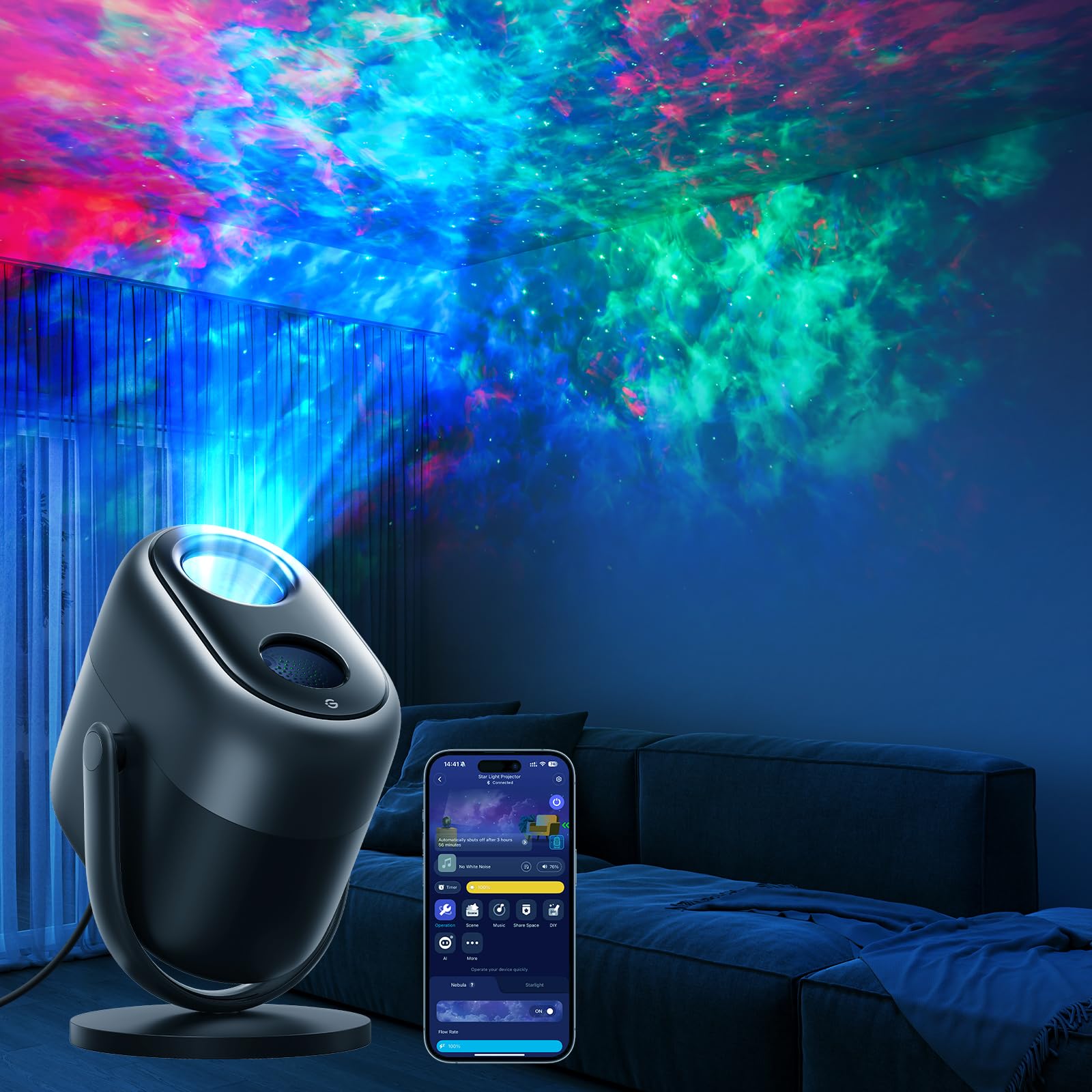
The Govee 7-Zone Stardust projector is a smart-led light show rather than a planetarium. Its 7 independently controllable zones can be set to different colors, brightnesses, and motion speeds (flowing, breathing, blink, orbit). The dual large field-of-view lenses cover up to 540 sq. ft., which is enough for an entire living room. The Matter compatibility ensures seamless integration with Alexa and Google Assistant for voice control.
The 50+ scene modes are app-driven, giving you granular control that disc-based projectors cannot match. The 18 white noise options include nature sounds (rain, ocean) and lullabies, making this a strong sleep aid. The included power adapter is a welcome addition — the cheaper Govee wave model (Product 1) omitted it. The motor is quiet, and the build uses sturdy ABS plastic with a painted finish.
The limitation is that the “stars” are LED pinhole projections, not optical star fields. They look more like a sprinkle of tiny colored lights than a real night sky. The nebula effect is swirling fog, not a star cluster. This is a premium ambient light projector, not an astronomical instrument. For a multipurpose room decorator that doubles as a smart home device, it is excellent.
Why it’s great
- 7 independent zones with unlimited color and motion customization.
- Matter, Alexa, and Google Assistant voice control.
- 540 sq. ft. coverage with quiet operation.
Good to know
- “Stars” are LED pinhole spots, not optical star fields.
- Nebula effect is a fog swirl, not a celestial image.
- No White noise — only music and nature sounds.
7. POCOCO Galaxy Star Projector, 2M-Pixel Lens
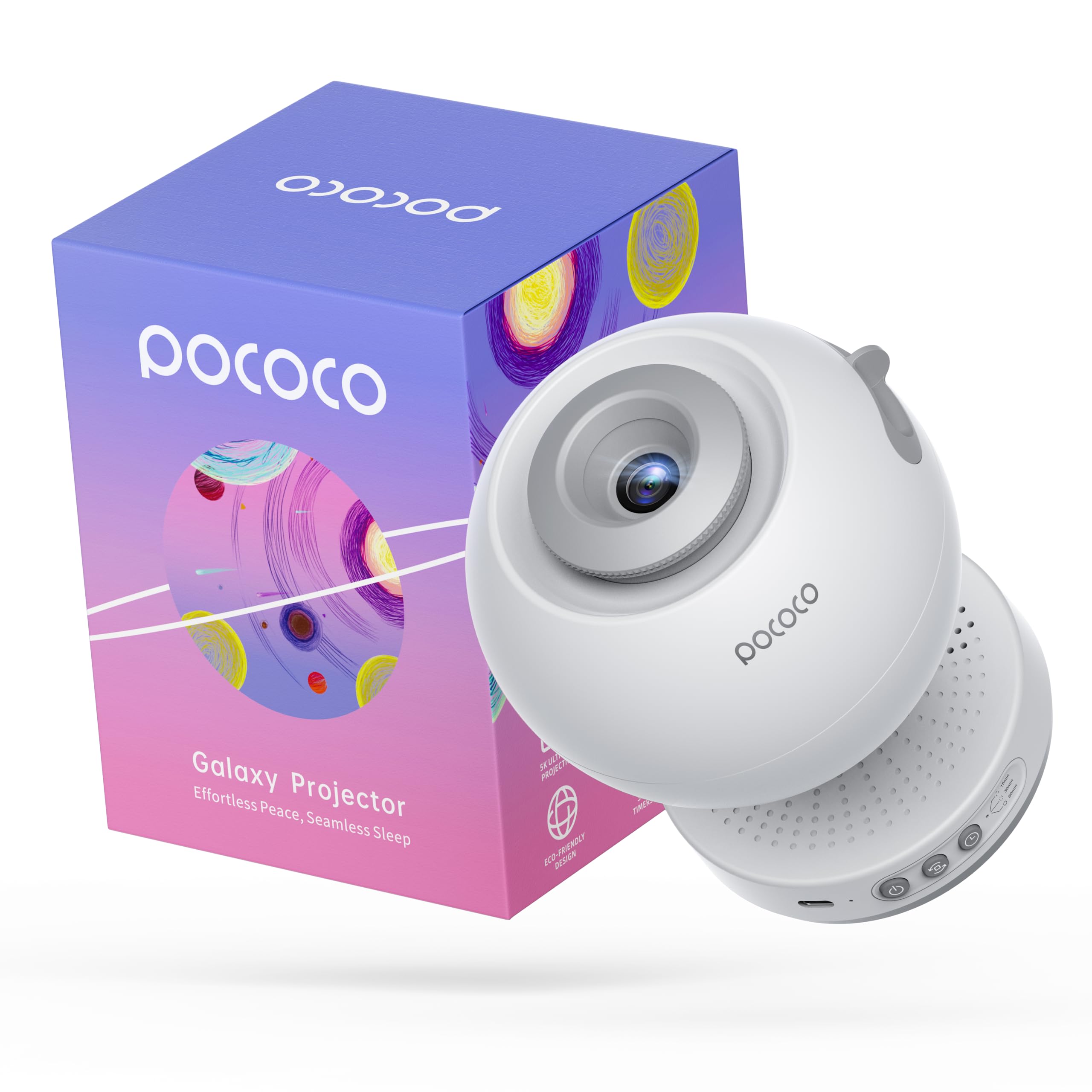
The POCOCO Galaxy Star Projector is a disc-based unit that uses an industrial-grade 2-million-pixel lens to project “5K” ultra-HD discs. The difference between this and standard projectors is immediately visible: the galaxy and nebula discs produce images that are remarkably sharp, with defined edges and rich color gradients. The 1W LED is ultra-low power but produces a gentle, easy-on-the-eyes projection perfect for sleep.
It includes a rechargeable battery, making it truly portable — charge it and take it to a camping tent, a friend’s house, or a backyard. The 30° adjustable angle is a bit limited compared to the 270° stands on some competitors, but the image quality compensates. The three timer settings (15/30/60 mins) are short for sleep use; the 2-hour auto-off is built-in for safety.
A common criticism is that the projection disc rotation speed is fixed and too fast — the stars zip by rather than drifting slowly. This breaks the natural sky illusion. The image is also grainier when projected onto textured ceilings. Still, for pure optical sharpness of galaxy images, this is the best disc-based unit outside of the Sega ecosystem.
Why it’s great
- 2M-pixel industrial-grade lens produces exceptionally sharp galaxy images.
- Rechargeable battery for true portable use.
- Adjustable focus and 30° angle for positioning.
Good to know
- Disc rotation speed is fixed and too fast.
- Image grains out on textured ceiling surfaces.
- Timer options are short (15/30/60 min).
8. Ainael Meteor and Galaxy Projector

The Ainael Meteor and Galaxy Projector distinguishes itself with a unique light strip design and a dynamic meteor function. The main lens projects a glass disc image (star field or nebula), while two independent meteor effects shoot streaks of light across the ceiling. The 6500K light source is very bright and cool white, producing sharp images even at a distance of 20 sq. meters.
The projector body is compact (roughly 5 inches cubed) and lightweight. The silent rotation motor operates under 30dB, and you can select slow (13-minute rotation) or fast (6-minute) cycles. The 180° rotation allows ceiling or wall projection. One-touch buttons on the unit control power, meteor, timer (1H/2H), and ambient lighting — no remote or app needed, which some users prefer for simplicity.
The downsides are the limited disc selection included (only 2 film discs plus 1 glass disc), and the fact that the meteor effects, while fun, are clearly artificial streaks — they are not natural shooting stars. The image can become stretched and distorted when projected onto sloped or domed ceilings. As a compact, meteor-feature-forward unit, it is a solid mid-range pick for novelty value.
Why it’s great
- Unique integrated meteor effect with independent control.
- Compact size with silent rotation and simple button controls.
- Bright 6500K light source projects clearly in dark rooms.
Good to know
- Only 2 film discs included; wider disc library sold separately.
- Meteors look artificial — not natural shooting stars.
- Image distorts on non-flat ceilings.
9. Govee Star Light Projector with Ocean Wave Ripple Effects

The Govee Star Light Projector with Ocean Wave Ripple Effects is an entry-level smart light projector that excels at creating a combined underwater and starry sky ambiance. Its 4 RGBW LEDs and dual-layer lens project vivid water ripples across 540 sq. ft., while star patterns float above. The 40+ scene modes and 18 white noise tracks (including ocean sounds) make it a capable sleep aid.
The Matter support and compatibility with Alexa and Google Assistant give it strong smart home integration. The motor runs under 25dB, which is genuinely silent. However, it does not include a power adapter — you must provide a 5VDC 2A USB power brick separately. The app is powerful but has a learning curve, and the “stars” are just the green laser dots, not a constellation map.
If you want a gentle ocean-and-stars effect to lull a child or light sleeper to sleep, this is a cost-effective choice. The wave ripple effect genuinely looks like moving water across the ceiling, which is unique in this category. But it is also the least “planetarium-like” product here — it is an atmospheric light show, not a star-field projector.
Why it’s great
- Unique ocean wave ripple effect combined with star projection.
- 18 high-fidelity white noise tracks integrated with visuals.
- Matter-compatible with strong smart home voice control.
Good to know
- No power adapter included in the box.
- Stars are green laser dots, not an optical constellation map.
- Motor noise can be distracting when laser mode is off.
FAQ
Are disc-based planetarium discs interchangeable between brands?
Can I project on a textured ceiling without losing image quality?
How important is the auto-off timer for sleep use?
Does a built-in Bluetooth speaker add real value?
Final Thoughts: The Verdict
For most users, the best at home planetarium winner is the Sega Homestar Matataki because it delivers true constellation-accurate star fields with twinkling effects and diurnal motion that no digital projector can match. If you want unlimited built-in scene variety without managing discs, grab the Rovmiment 60-in-1. And for pure visual spectacle with 4K-class 3D effects and Bluetooth audio, nothing beats the Brizled 4K 3D Holographic projector.