
Our readers keep the lights on and the weekend projects moving. As an Amazon Associate, I earn from qualifying purchases.
Specs are compiled from manufacturer listings and verified buyer reviews and can change over time — please confirm the key details on the product page before buying.
Knowing your blood oxygen level and pulse rate gives you a crucial window into your respiratory health, especially when you are feeling short of breath or monitoring a condition like COVID-19, asthma, or COPD. The challenge is cutting through the dozens of look-alike fingertip clips to find the one that delivers a reading you can trust without needing a hospital-grade machine. This guide walks you through the reliable models that consistently match clinical equipment, explained in plain language so you can spot the winner for your situation.
I’m Rikta — the founder and writer behind FitlyFast. This guide is built by comparing the manufacturers’ published specifications and the patterns across verified customer reviews, so you get each pick’s real strengths and trade-offs instead of marketing spin.
You want a pulse oximeter that gives you the same accurate readings a doctor gets, whether you are checking your oxygen during a workout or managing a chronic condition. The key specs to look for are SpO2 (blood oxygen saturation) accuracy within ±2%, a clear display, and long battery life.
Quick Picks
- Concord Fingertip Deluxe OLED Pulse Oximeter — Best Overall
- Innovo Deluxe iP900AP Fingertip Pulse Oximeter — Premium Pick
- Santamedical Dual Color OLED Pulse Oximeter — Top Performer
- Easy@Home Fingertip Pulse Oximeter EHP035 — Display Champ
- mibest OLED Finger Pulse Oximeter — Feature Rich
- Zacurate 500 Series Fingertip Pulse Oximeter — Budget Champion
- Fingertip Pulse Oximeter (JPD-500E) — Entry Level
How To Choose The Best At Home Pulse Oximeter
A pulse oximeter clips onto your fingertip and shines light through your skin to measure how much oxygen is in your blood (SpO2) and your pulse rate. The trick is picking one that reads consistently rather than jumping around with every slight movement. Here are the three key things to look for.
Display Type and Readability
The two common screens are OLED (organic light-emitting diodes) and LED (standard light-emitting diodes). OLED screens offer sharper contrast, wider viewing angles, and are easier to read in direct sunlight or a dark room because each pixel lights up individually. A red LED display is perfectly fine for low light but can wash out under bright sun. If you plan to use the oximeter outdoors or during exercise, prioritize an OLED display with adjustable brightness.
Measurement Speed and Plethysmograph
You want a device that settles on a stable number within 8 to 10 seconds. More important is whether the device shows a plethysmograph — that little waveform or bar graph that pulses with your heartbeat. This waveform tells you the device is actually detecting a good pulse signal. Without it, a fluctuating number might just be the device struggling to find a signal rather than your oxygen level changing.
Battery Life and Auto Shut-Off
Most fingertip pulse oximeters run on two AAA batteries. Look for battery life in the spec: 24 hours versus 30 hours of continuous use is a meaningful difference if you are checking multiple times a day. Also check how quickly the device powers off after you remove your finger. An 8-second shut-off saves more battery than a 10-second delay, but the difference is small in practice.
Quick Comparison
| Model | Best For | Display Type | Battery Life | Weight | Amazon |
|---|---|---|---|---|---|
| Concord Fingertip Deluxe | Long-term durability & 2-year warranty | OLED | 30+ hours | 1.6 oz | Amazon |
| Innovo Deluxe iP900AP | Low perfusion accuracy & alarm feature | OLED | 30 hours | — | Amazon |
| Santamedical Dual Color | Cold finger reliability | OLED (Dual Color) | — | 3.21 oz | Amazon |
| Easy@Home EHP035 | Bright outdoor readability | OLED (Rotatable) | 24 hours | — | Amazon |
| mibest Dual Color OLED | Display flexibility & 10 brightness levels | OLED (Dual Color) | — | 2.89 oz | Amazon |
| Zacurate 500 Series | Bang-for-buck & easy readout | LED | — | 3.5 oz | Amazon |
| Fingertip Pulse Oximeter (JPD-500E) | Budget-friendly & fast readings | LED | — | 2.4 oz | Amazon |
In‑Depth Reviews
1. Concord Fingertip Deluxe OLED Pulse Oximeter

The tank that kept running after a decade of daily drops.
The Concord Fingertip Deluxe OLED stands out for its battery life: over 30 hours of continuous use from two AAA batteries, while the Easy@Home offers 24 hours. It shows your SpO2 (blood oxygen saturation), pulse rate, and a pulse-strength bar graph on a bright OLED screen. A 2-way rotating display lets you read the numbers without twisting your wrist, and the shock-resistant silicone cover protects it when it gets knocked off a nightstand.
Owners mention that this unit is incredibly durable: one reviewer noted their first Concord oximeter lasted 8 years despite being dropped and even going through the washing machine. Another owner said theirs lasted over 10 years and bought a second as a backup. The included accessories — a carrying case, lanyard, and batteries — mean it is ready the moment you open the box. The one limitation is its physical size: at 1.6 ounces and compact dimensions, it weighs 1.6 ounces versus the Santamedical at 3.21 ounces, but some customers note the screen is small, though still acceptable for quick glances.
This is the set-and-forget pick for anyone who wants a durable device that outlasts cheaper models. The 2-year warranty and USA-based support give you backup that budget picks like the Zacurate 500 Series lack. skip it if you need an auditory alarm for low oxygen alerts — the Innovo Deluxe iP900AP has that feature instead.
Built to Endure
- Exceptional durability — multiple reviewers point out 8-10 years of reliable use
- 30+ hour battery life; the Easy@Home is listed at 24 hours
- Includes shock-resistant silicone cover and carrying case
The Trade-Offs
- Small screen size may be tough for some to read quickly
- Not recommended for use during or immediately after sweaty exercise
The long-haul champion: If you want one pulse oximeter that survives years of bumps and drops and still delivers steady numbers, this Concord is the clear choice.
Who might look elsewhere: If you need a device with an auditory alarm for very low oxygen alerts, the Innovo iP900AP below is a better fit.
2. Innovo Deluxe iP900AP Fingertip Pulse Oximeter
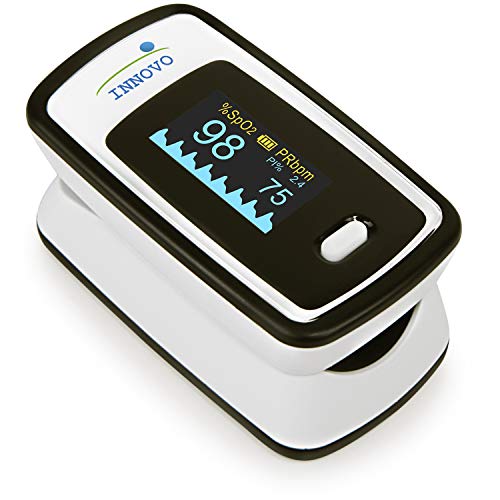
The clinical-grade choice with a built-in alarm that watches while you rest.
The Innovo iP900AP is the only model in this lineup that includes an auditory alarm and a perfusion index (a measurement of pulse strength at the fingertip). The alarm sounds if your SpO2 or pulse rate drops outside of set limits, which is invaluable if you are monitoring someone who might not notice their oxygen slipping overnight. It also displays a plethysmograph (the moving waveform) so you can confirm the sensor is getting a good signal before trusting the number. The device measures SpO2 across a range of 70% to 100% with a rated accuracy of +/-2%.
A buyer and nurse who purchased this device reported it is consistent and accurate, replacing a faulty mid-priced model. Another reviewer noted battery placement was a bit tricky, but the device itself has been working great after two months of daily use. At 30 hours of battery life per set of AAA batteries, it matches the Concord on endurance. The included lanyard and batteries mean it is ready immediately, but unlike the Concord, there is no silicone cover or carrying case included. One buyer comparison noted that the Santamedical felt better made and more reliable than the Innovo Deluxe, so the extra alarm feature here comes at the cost of a slightly less solid build feel.
If you need the safety net of an alarm for low oxygen or you want the extra data from a perfusion index, the Innovo is the strongest contender. For simple at-rest spot checks without alarms, the Concord or Santamedical may offer better value.
Extra Safety Layer
- Auditory alarm alerts you if SpO2 or pulse goes out of range
- Perfusion index and plethysmograph provide data on signal quality
- Rated accuracy of +/-2% for reliable readings
Considerations
- No carrying case or silicone cover included
- Some shoppers say the build does not feel as solid as the Santamedical
The alarm keeper: If you or a family member needs continuous monitoring with a warning for low oxygen, this Innovo stands alone among these picks for that crucial feature.
A simpler choice exists: For just taking a quick reading a few times a day without any beeps, the Concord or Santamedical is simpler and tougher.
3. Santamedical Dual Color OLED Pulse Oximeter

The cold-finger specialist that refuses to give up reading.
A pulse oximeter that fails to get a reading on cold fingers is useless in a winter home. The Santamedical Dual Color model stands out because an RN with 20 years of experience reported it works reliably on cold fingers when other devices, including the mibest if you check its reviews, fail. It uses a dual-color OLED screen that shows your SpO2 level, pulse rate, and pulse bar graph clearly in dark rooms, bright sunlight, and everything in between. At 3.21 ounces, it weighs 3.21 ounces versus the 1.6-ounce Concord and the 2.4-ounce budget option, but buyers report the slightly larger size makes it easier to handle, especially for older hands.
Owners mention that it is “accurate for home use; 1% less accurate than hospital models,” which is a very acceptable trade-off for a device you can keep on your nightstand. One reviewer tested it against multiple people and called it the best pulse oximeter they had used. It also performed well in a head-to-head: one buyer compared it against the Innovo Deluxe and another named “Ankovo” and found the Santamedical was the most well-made, reliable, and easy to use. The automatic shut-off activates after just 10 seconds of non-use, saving battery. The lanyard is included but some customers note it is hard to install for people with less dexterity in their hands.
If you or someone in your house tends to have cold hands or you want a device that works equally well for multiple people, this Santamedical is a strong contender for the top spot.
Cold Hands, No Problem
- Reliable readings on cold fingers where other pulse oxes fail
- Bright dual-color OLED readable in any lighting
- Clinically tested with a small error margin for home accuracy
Watch For
- Lanyard can be tricky to thread for people with limited hand strength
- Heavier than the Concord (3.21 oz vs 1.6 oz)
Everyone’s finger fits: This is the pick if you need a reliable reading on cold hands or want an oximeter that works for multiple family members without hassle.
Consider the trade-off: At 3.21 ounces versus the Concord at 1.6 ounces, it feels more substantial, but some might prefer the lighter option for travel.
4. Easy@Home Fingertip Pulse Oximeter EHP035

The display that rotates to your angle and blocks bright sunlight.
If you plan to check your oxygen outside on a sunny patio or during a run, the Easy@Home EHP035 is purpose-built for that. It uses a rotatable OLED screen that shows the reading in four different directions, so you can read it no matter how the device is clipped on your finger. More importantly, reviewers point out it has side shields that block stray light, enabling accurate readings outdoors and in bright conditions where open-design oximeters like the basic JPD-500E can struggle. It also offers a plethysmograph (waveform) display, a bar graph, and seven display modes with 10 adjustable brightness levels.
On battery life, it runs for 24 hours on two AAA batteries, which is solid but falls short of the 30+ hours the Concord and Innovo deliver. The device measures pulse rate from 25 BPM to 250 BPM and SpO2 from 35% to 100% with an accuracy of +/-2%. The package includes a lanyard, carrying case, and batteries. One buyer mentioned it works well and is a nice size to take while traveling. The downside, consistent with many fingertip oximeters, is that it is not designed for use after heavy exercise when hands are sweaty — the sensor may lose the signal.
For the person who wants a clear, readable screen both indoors and out, and values the ability to orient the display at any angle, this is the best choice of the bunch.
Read Anywhere
- Side shields allow accurate outdoor readings in bright sunlight
- 4-direction rotatable OLED and 10 brightness levels for flexible viewing
- 7 display modes to customize the info you see
The Catch
- 24-hour battery life is shorter than the Concord and Innovo models
- Not designed for use during or immediately after sweaty exercise
Your outdoor health tracker: If you regularly measure SpO2 in bright sun or want a screen you can flip to any angle, the Easy@Home earns its place.
Not for the long haul: With 24-hour battery life, you will be changing batteries more often than with the 30-hour Concord.
5. mibest OLED Finger Pulse Oximeter

The feature-packed OLED that matches hospital equipment at home.
This mibest model brings a crisp dual-color OLED screen with six display modes and four screen orientations, plus 10 adjustable brightness levels — essentially the most visual customization of any device here, rivaling the Easy@Home’s seven modes. The large power button makes it easy to turn on one-handed, and it includes a finger-out warning that reminds you when your finger is not inserted far enough for a stable reading. Shoppers say that it is accurate, with one specifically noting it “matched hospital unit,” and another praising the clear OLED display with its 4-direction screen orientation and good grip.
Reviewers also noted that it works very well for elderly users thanks to the large button and clear screen. However, there is a catch: one buyer found that while the device is accurate at rest and matched a clinic unit perfectly, it fails to get a reading if your hands are sweaty from exercise. This is not unique to the mibest — it is a limitation of optical fingertip sensors in general — but it is worth knowing if you plan to check your oxygen right after a workout. At 2.89 ounces and dimensions of 2.5 x 1.2 x 1.15 inches, it is still very pocketable.
For someone who wants a high-contrast screen with multiple viewing options and a hospital-verified match during rest, this mibest delivers a premium feel without a premium price.
Screen Customization King
- 6 display modes and 4 screen orientations for flexible viewing
- Large power button and finger-out warning add ease of use
- Buyers confirm readings matched a hospital unit at rest
Known Limitation
- Cannot get a reading on sweaty hands after exercise
- No auditory alarm or perfusion index like the Innovo
A display for every angle: If you want maximum flexibility in screen layout and brightness, plus hospital-matched accuracy at rest, the mibest is a strong choice.
Skip if you exercise hard: The sensor struggles with sweaty skin, so this is best for at-rest checks.
6. Zacurate 500 Series Fingertip Pulse Oximeter

The LED workhorse that matches your doctor’s numbers for under thirty.
If you just need a simple, dependable pulse oximeter without spending on a premium OLED model, the Zacurate 500 Series is a proven value pick. It uses a large digital LED display (not OLED, so it is not as crisp in sunlight) that faces you for an easy read. One standout spec: it is the only LED model here that reads and displays SpO2 up to 100%, whereas some other budget units cap at a lower number. Buyers report that “it’s numbers matched my doctor’s oxi numbers,” giving confidence that you are not just guessing. The device takes about 10 seconds to deliver a stable reading.
It includes a silicone cover to protect the device from dirt and drops, plus a lanyard and batteries. At 3.5 ounces and 2.25 x 1.25 x 1.25 inches, it weighs 3.5 ounces versus the Santamedical at 3.21 ounces and the JPD-500E at 2.4 ounces. One buyer compared it directly to the mibest and preferred the Zacurate for its value and readability. It works for ages 12 and above, and the SMART Spring System in the finger chamber accommodates a wide range of finger sizes. The main trade-off? The red LED display is not as easy to read in bright outdoor light as the OLED models from Easy@Home or mibest.
For anyone monitoring at home who wants a reliable, tried-and-true option that does not break the bank, the Zacurate is the safest bet in the budget tier.
Proven and Popular
- Buyers confirm readings match their doctor’s equipment
- Only LED model that reads SpO2 up to 100%
- Includes silicone cover, lanyard, and batteries for immediate use
Display Trade-Off
- Standard LED display harder to read in bright sunlight than OLED models
- Slightly heavier than the JPD-500E (3.5 oz vs 2.4 oz)
The sensible starter: If you want an accurate, affordable pulse oximeter that comes reviewed as matching clinical readings, the Zacurate is your entry point.
Upgrade for outdoor use: If you need to read the screen in bright sunlight, step up to an OLED model like the Easy@Home or Santamedical.
7. Fingertip Pulse Oximeter (JPD-500E)

The featherlight option that clocks a 96% O2 in under 10 seconds.
This JPD-500E model is the lightest at 2.4 ounces and the smallest at 3.2 x 2.5 x 1.9 inches, making it the easiest to slip into a pocket or pouch. It uses a large digital red LED display for reading your SpO2, pulse rate, and a pulse bar graph. Owners mention that it gives “accurate O2 (96%) and pulse (86 bpm) readings within seconds” and that it matches the doctor’s equipment. The device is clinically tested and provides consistent results within 8 to 10 seconds. It includes a carry case, 2 AAA batteries, and a neck/wrist cord.
One owner reported a minor quirk: the instruction to “read when the numbers stabilize” is a bit vague, and for one user the readings fluctuated for a while before finally stabilizing at 98% O2 and 60 bpm. This is typical for low-cost pulse oximeters — they need a good consistent pulse signal. The silicone finger chamber is latex-free and accommodates a range of sizes. The auto shut-off helps preserve battery life, though no specific battery life in hours is listed in the specs. At its price point, the trade-off is clear: you get a functional, accurate device but without the advanced display features (OLED, rotatable screen, multiple brightness levels) of the higher-tier picks.
If you need a basic, no-frills pulse oximeter for occasional use and want to keep your investment minimal, this is a solid choice. For daily or long-term use, spending a few dollars more on the Concord or Santamedical will give you a better display and longer battery life.
Light and Fast
- Lightest option at 2.4 oz for easy pocket carry
- Buyers confirm O2 and pulse readings match doctor’s equipment
- Comes with carry case, batteries, and cord from the start
Basic Only
- Standard red LED display, not as bright as OLED
- Readings may fluctuate briefly before stabilizing in some users
Ultra-portable starter: Perfect for the glovebox or gym bag if you only need occasional spot checks and want the lightest device possible.
Not for daily monitoring: Upgrading to the Concord or Santamedical gives you an OLED display and proven long-term durability.
Understanding the Specs
SpO2 and Pulse Rate Accuracy
SpO2 stands for peripheral capillary oxygen saturation — the percentage of oxygen in your blood. A normal reading is usually 95% to 100%. A pulse oximeter shines two wavelengths of light through your fingertip to measure how much oxygen is attached to your red blood cells. The +/-2% accuracy spec you see on the Innovo and Easy@Home means the reading could be up to 2% higher or lower than your true value, which is standard for home-use devices. The plethysmograph (moving waveform) confirms the device is detecting a real pulse before you trust the number.
OLED vs. LED Displays
OLED (organic light-emitting diode) screens make each pixel glow individually, giving you sharper contrast, wider viewing angles, and better readability in both bright sun and total darkness. Models like the Santamedical, mibest, and Easy@Home use OLED. LED (light-emitting diode) displays are simpler, use less power in some cases, and are perfectly fine in low-light indoor settings, but they tend to wash out under direct sunlight. The Zacurate and JPD-500E use red LED displays. For most home use indoors, either works, but if you plan to read it outside, go OLED.
FAQ
How accurate are home pulse oximeters compared to hospital models?
What does SpO2 mean and what is a normal reading?
Can I use a pulse oximeter on a child or baby?
Why does my pulse oximeter show fluctuating numbers?
What is a plethysmograph and why does it matter?
How long do the batteries last in a fingertip pulse oximeter?
Will a pulse oximeter work during or after exercise?
Can a pulse oximeter detect COVID-19 or pneumonia at home?
What does the perfusion index mean on the Innovo iP900AP?
How do I clean and maintain my fingertip pulse oximeter?
Final Thoughts: The Verdict
For the majority of shoppers, the best at home pulse oximeter winner is the Concord Fingertip Deluxe OLED because it combines proven multi-year durability, a 30+ hour battery, and an OLED display in a lightweight package with a 2-year warranty backing it up. If you want the safety net of an auditory alarm for low oxygen alerts, grab the Innovo Deluxe iP900AP. And for a budget-friendly option that matches clinical readings at a lower price, the Zacurate 500 Series is a reliable choice.
How We Picked
We do not accept paid placement. Every pick is matched to a real buyer and a real use-case; we do not hands-on test units.
Sources & Methodology
Specifications: manufacturer listings and product documentation. Review insights: verified customer reviews, as of July 2026. Pricing: not shown on this page (it changes often); check the current price via the retailer link.
As an Amazon Associate, FitlyFast earns from qualifying purchases. This does not affect which products we feature.