
Our readers keep the lights on and the weekend projects moving. As an Amazon Associate, I earn from qualifying purchases.
The difference between a room that sounds flat and one that feels alive comes down to the speakers you choose. Most people settle for the thin, boxy audio from a soundbar or a smart speaker, but a proper set of bookshelf or floorstanding speakers unlocks a layer of detail and depth you didn’t know your music or movies were missing. Whether you’re building a dedicated home theater or just want better sound while streaming your favorite playlist, the hardware you pick defines the entire experience.
I’m Rikta — the co-founder and writer behind FitlyFast. I’ve spent hundreds of hours researching speaker drivers, crossover designs, and amplifier matching so you don’t have to guess which pair actually delivers on its promises.
This guide breaks down the best options for every room size and listening style so you can confidently choose your at home speakers without getting lost in specs that don’t matter.
How To Choose The Best At Home Speakers
Picking the right speakers for your home isn’t about buying the most expensive pair you can afford. The best choice depends on your room size, how loud you want to listen, and whether you already own an amplifier or receiver. Start by deciding between passive speakers (which need an external amp) and powered speakers (which have the amplifier built in). Then look at driver size and cabinet type to match the bass output to your space.
Driver Size and Bass Capability
The woofer size directly affects how much low-end thump you get without a subwoofer. A 4-inch driver found in bookshelf speakers like the Edifier R1280T delivers tight, punchy bass for a desktop or small room. A 6.5-inch driver in a tower speaker like the Polk ES60 moves more air and can fill a living room with deeper bass. If you want floor-shaking lows without a separate sub, look for at least two 6.5-inch woofers or passive radiators per speaker.
Sensitivity and Amplifier Power
Sensitivity measured in decibels (dB) tells you how efficiently a speaker converts power into volume. A speaker with 94dB sensitivity like the Klipsch R-610F will play louder with less wattage than a lower-sensitivity design. If you pair a low-sensitivity bookshelf speaker with a weak amp, the sound will be thin and lifeless. For most home setups, look for sensitivity above 87dB and an amp that delivers at least 50 watts per channel.
Cabinet Design: Ported vs. Sealed vs. Passive Radiator
The cabinet design changes how the low frequencies behave. Ported cabinets (bass reflex) use a tuned tube to reinforce bass, giving you more output at the cost of some tightness. Sealed cabinets produce tighter, more accurate bass but roll off earlier. Passive radiators like those on the Polk XT60 let a small cabinet produce deeper bass without the chuffing noise that can come from a port. For music that demands accuracy, sealed or passive radiator designs often sound cleaner, while ported designs work great for home theater impact.
Quick Comparison
On smaller screens, swipe sideways to see the full table.
| Model | Category | Best For | Key Spec | Amazon |
|---|---|---|---|---|
| KEF LS50 Meta | Bookshelf | Audiophile detail | MAT absorber, 0.07% THD | Amazon |
| SVS Prime Pinnacle | Floorstand | Full-range home theater | Triple 6.5″ woofers | Amazon |
| Polk ES60 | Floorstand | Balanced home cinema | Power Port, 3x woofers | Amazon |
| Marshall Stanmore III | Powered | Stylish plug-and-play | BT 5.2, RCA, 3.5mm | Amazon |
| Klipsch R-610F | Floorstand | High sensitivity setups | 94dB sensitivity | Amazon |
| Sony SS-CS5M2 | Bookshelf | Budget nearfield listening | 3-way, 5.12″ woofer | Amazon |
| Klipsch R-50M | Bookshelf | Horn-loaded surround | 90°x90° Tractrix horn | Amazon |
| Polk XT60 | Floorstand | Affordable tower sound | Dual passive radiators | Amazon |
| Edifier R1280T | Bookshelf | Desktop and small rooms | 42W RMS, wood cabinet | Amazon |
In‑Depth Reviews
1. KEF LS50 Meta (Mineral White)

The KEF LS50 Meta represents a serious leap in bookshelf speaker design thanks to the Metamaterial Absorption Technology (MAT) that absorbs 99% of unwanted rear-wave noise from the driver. The 12th-generation 5.25-inch Uni-Q driver places the tweeter concentrically inside the midrange cone, creating a single point source that delivers extraordinarily precise stereo imaging and a wide sweet spot. The result is a soundstage that feels holographic, with instruments locked in space even when you move around the room.
These speakers demand high-quality amplification — they present a 3-ohm load at some frequencies, and a cheap receiver will struggle to drive them properly. They also lack deep sub-bass extension, so adding a dedicated subwoofer is almost mandatory if you want to feel the lowest octaves. But in the midrange and treble, the LS50 Meta offers resolving power that rivals speakers costing far more, revealing subtle details in recordings you may have never heard before.
Build quality is exceptional, with a rigid cabinet that produces virtually zero resonance. The 0.07% total harmonic distortion figure is among the best in its class. If you have a quality amplifier and sit within a moderate listening distance, these are the most transparent bookshelf speakers on this list.
Why it’s great
- MAT eliminates 99% of driver rear-wave distortion
- Uni-Q driver delivers pinpoint imaging and wide soundstage
- Extremely low THD for natural, uncolored sound
Good to know
- Requires high-current, powerful amplifier
- Needs a subwoofer for full-range bass
- Best at moderate volumes in small to medium rooms
2. SVS Prime Pinnacle Floorstanding Speakers (Black Ash)

The SVS Prime Pinnacle delivers a rare combination of effortless bass extension and refined midrange clarity that few tower speakers can match in its tier. Each cabinet houses three 6.5-inch woofers and a dedicated 5.25-inch midrange driver, all working together with a 1-inch aluminum dome tweeter to produce a frequency response that drops to 27 Hz without a subwoofer. The bass is tight and tuneful, not boomy, and you can fine-tune the low-end by adjusting how far the speakers sit from the wall due to the rear-firing ports.
The sound signature is balanced rather than bright, with a slightly laid-back treble that makes these speakers easy to listen to for hours without fatigue. They come alive at higher volumes, opening up with dynamic punch that fills a large room. The build quality is superb for the price, with a braced cabinet and beautiful Black Ash or high-gloss piano finishes. Each speaker weighs over 50 pounds, so they feel substantial and inert.
These are passive speakers, so you need an amplifier with real current. A 20-watt tube amp won’t cut it — look for at least 80 clean watts per channel to hear the Prime Pinnacle at its best. They are not ideal for very small rooms where the bass could overwhelm, but for a dedicated listening space or large living room, they offer true high-end sound without the high-end price.
Why it’s great
- Triple 6.5-inch woofers deliver deep, clean bass to 27 Hz
- Balanced, non-fatiguing sound for long listening sessions
- Exceptional build quality and substantial cabinet weight
Good to know
- Requires a powerful amplifier with strong current output
- Rear ports need breathing room from the wall
- Large footprint — not suited for tiny rooms
3. Polk Signature Elite ES60 Tower Speaker (Black)
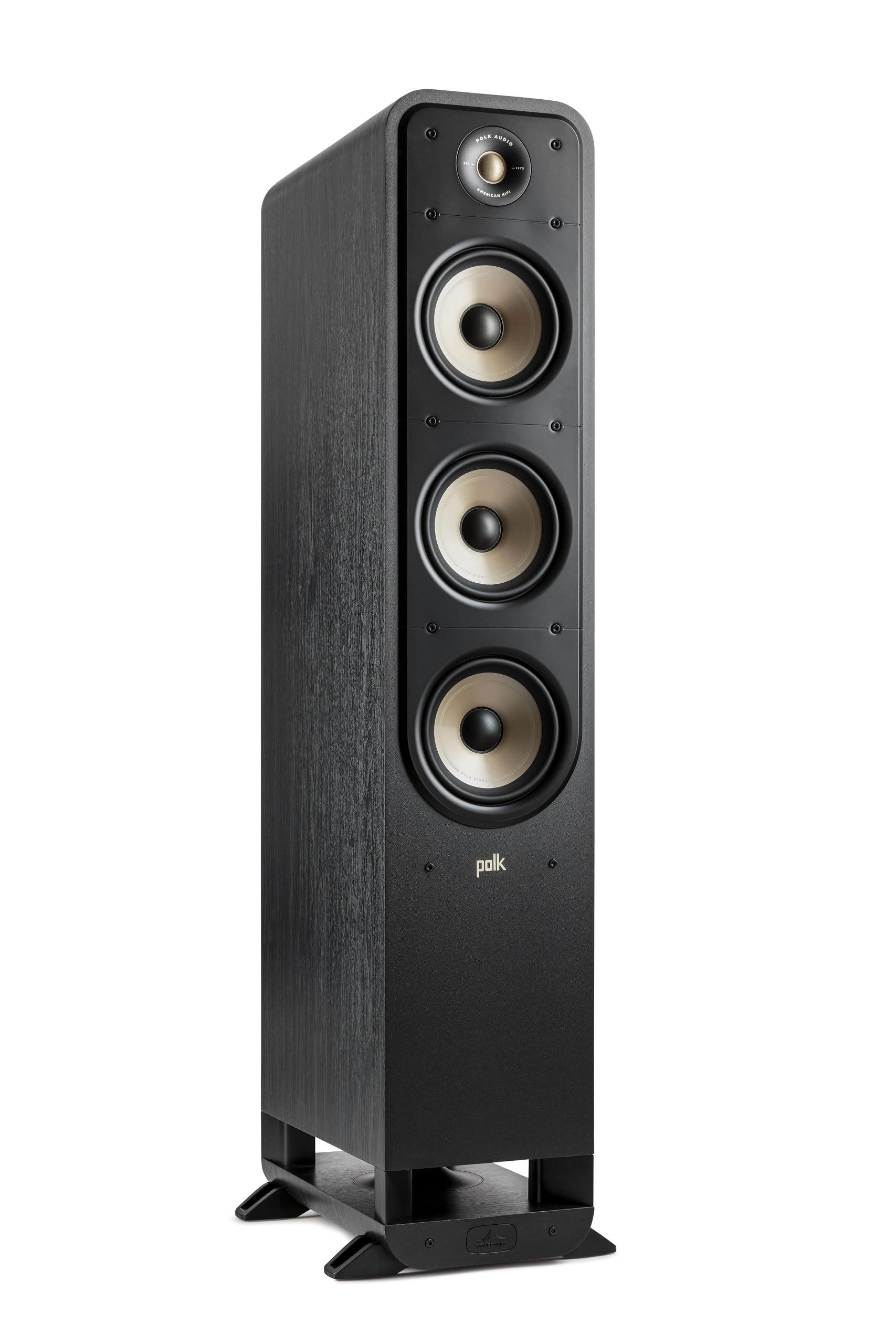
The Polk Signature Elite ES60 uses a 2.5-way cascading crossover design with three 6.5-inch dynamically balanced woofers and a 1-inch Terylene tweeter to create a towering soundstage that works beautifully for both movies and music. Polk’s Power Port technology extends down into the bass reflex port to smooth airflow, reducing chuffing and delivering deeper, cleaner bass compared to a standard ported design. The result is a speaker that reproduces dialogue with clarity and plays music with a full, warm character that doesn’t get harsh at high volumes.
These towers are surprisingly sensitive and work well with a wide range of amplifiers, including entry-level AV receivers. The ES60 produces tight, controlled bass even without a subwoofer — thanks to the three 6.5-inch drivers working together — but pairing them with a sub lets you cross them over around 60 Hz for even cleaner midbass. The cabinet stands about 44 inches tall and looks modern with a sleek black finish and magnetic grille.
Owners consistently praise the ES60 for its neutral, uncolored sound and excellent off-axis dispersion. The speakers weigh about 50 pounds each, so plan for sturdy placement. They also support Dolby Atmos and DTS:X when used with an Atmos-capable receiver, making them a long-term investment that can grow with your system.
Why it’s great
- Power Port delivers 3dB louder bass with less distortion
- Neutral, clear sound with no midrange boom
- Works well with both budget and premium amplifiers
Good to know
- Plastic enclosure feels less premium than rivals
- Not as sensitive as Klipsch alternatives
- Best with a subwoofer for cinema-level impact
4. Marshall Stanmore III Bluetooth Home Speaker (Cream)
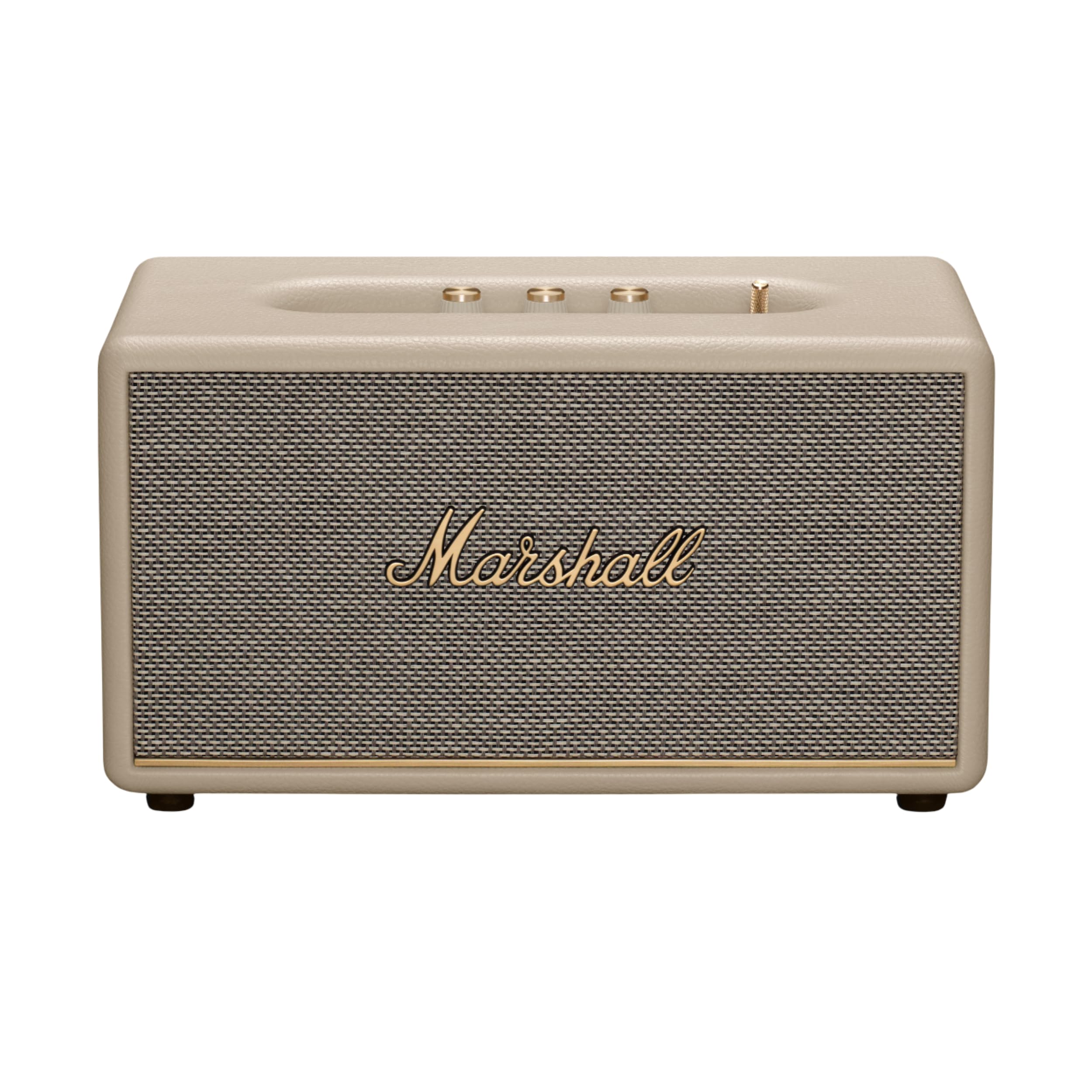
The Marshall Stanmore III is a powered all-in-one speaker that prioritizes style and simplicity without sacrificing sound quality. Its iconic design features a cream-colored vinyl wrap, gold-toned controls, and a vintage Marshall amp aesthetic that instantly becomes a furniture statement. Under the hood, a 5-inch woofer and dual tweeters deliver home-filling sound with a wide soundstage that outperforms most smart speakers in its footprint. The bass is punchy, and the treble and bass knobs on the top panel let you dial in the EQ instantly without any app.
Connectivity includes Bluetooth 5.2 for future-proof wireless streaming, plus RCA and 3.5mm aux inputs for connecting a turntable or computer. Setup is truly plug-and-play — no complicated app configuration, just pair and play. The Marshall app is available if you want to tweak EQ further, but it’s not required. The speaker is corded only (no battery), so it stays put on a console, desk, or bookshelf.
The soundstage, while wide, is not fully stereo like a pair of separated bookshelf speakers — the left and right channels are very close together. This means you won’t get the same pinpoint imaging that a proper passive setup delivers. But for casual listening in a bedroom, office, or living room where convenience and aesthetics matter, the Stanmore III is a joy to use and listen to every day.
Why it’s great
- Iconic retro design that stands out in any room
- Built-in amplifier means no extra equipment needed
- Bluetooth 5.2, RCA, and aux inputs for versatile connectivity
Good to know
- Not true stereo separation due to single cabinet
- Cannot replace a full passive bookshelf system for critical listening
- Corded only — not portable
5. Klipsch Reference R-610F Floorstanding Speaker, Pair (Black)

The Klipsch Reference R-610F floorstanding speakers offer a huge advantage for anyone using a modest amplifier: a 94dB sensitivity rating means they produce high volume levels with very little power. Each tower features a 1-inch aluminum LTS tweeter with a 90×90 square Tractrix horn and dual 6.5-inch spun-copper woofers. The horn-loaded tweeter gives dialogue and vocals a crisp, forward presence that cuts through a room without needing to crank the volume, and the copper woofers deliver solid bass down to 45 Hz.
The build quality is typical Klipsch: a black wood-grain vinyl wrap over MDF with a magnetic grille that hides the fasteners for a clean look. Each speaker weighs about 36 pounds, so they are manageable to position. The rear-firing ports need some space from the wall, but placement is otherwise straightforward. The 8-ohm impedance makes them compatible with nearly any AV receiver, and the 85W continuous / 340W peak power handling means they can handle dynamic movie soundtracks without strain.
Some listeners find the Klipsch horn tweeter a bit bright or aggressive, especially in rooms with hard floors and bare walls. Pairing them with a warmer amplifier or adding some room treatment can tame this. As rear surrounds in a 5.1 system, the R-610F also performs excellently, providing clear directional cues that match Klipsch front speakers perfectly.
Why it’s great
- 94dB sensitivity produces loud sound from low-powered amps
- Crisp, clear horn-loaded highs for dialogue and vocals
- Solid bass response without a subwoofer
Good to know
- Horn tweeter can sound bright or fatiguing in reflective rooms
- Vinyl finish looks good but doesn’t match real wood veneer
- Leg screws feel cheap compared to the rest of the build
6. Sony CS Speakers, SS-CS5M2 3-Way 3-Driver Bookshelf Speakers (Pair, Black)

The Sony SS-CS5M2 is a rare beast in the budget bookshelf category: a true 3-way design with a dedicated super tweeter, a precision tweeter, and a 5.12-inch woofer in a bass reflex cabinet. The wide-dispersion super tweeter extends the frequency response to 50 kHz, well beyond human hearing, but it also improves the air and spaciousness of the soundstage. The 5.12-inch woofer delivers surprisingly deep bass for its size, though it rolls off below 53 Hz, so pairing with a subwoofer is recommended for full-range playback.
These speakers sound natural and detailed, with lively highs that reveal texture in cymbals and string instruments without becoming harsh. The mids are slightly recessed, which can make vocals sound slightly pulled back compared to the treble and bass. They perform best on sale — the build quality is solid but the materials feel entry-level, with a simple black vinyl wrap and lightweight cabinet. The rear ports require a few inches of clearance, and using isolation feet improves clarity significantly.
Owners consistently note that the SS-CS5M2 outperforms its price point when paired with a decent amplifier. They work beautifully as nearfield monitors on a desk or as mains in a small living room. If you catch them at a discounted price, they represent one of the best entry points into quality home audio without breaking the bank.
Why it’s great
- True 3-way design for detailed, spacious sound
- Super tweeter extends frequency response for airy soundstage
- Excellent value when purchased at a discount
Good to know
- Mildly recessed mids can make vocals less forward
- Bass roll-off below 53 Hz requires a subwoofer
- Build materials feel budget-grade
7. Klipsch Reference Next-Generation R-50M Horn-Loaded Bookshelf Speakers (Black)

The Klipsch R-50M bookshelf speakers bring the company’s signature horn-loaded technology to a compact form factor. The 90×90 Tractrix horn coupled with a 1-inch aluminum LTS tweeter delivers the clean, detailed highs that Klipsch is known for, while the 5.25-inch spun-copper TCP woofer handles midrange and bass. The woofer uses a steeper cone angle trickled down from the Reference Premiere series, which improves accuracy and reduces distortion compared to older models.
These speakers are noticeably heavy for their size, which speaks to the quality of the MDF cabinet and bracing. The hidden fasteners and edge-to-edge magnetic grille give them a clean, modern look that fits well in any room. They can serve as main left/right channels in a small system or as surround speakers in a larger home theater. The horn design makes dialogue crisp and effects snappy, which is ideal for action movies and gaming.
Some listeners may find the horn tweeter too forward, especially in smaller rooms where reflections are more prominent. They also lack deep bass extension below about 60 Hz, so a subwoofer is recommended for full-range use. But if you want clear, dynamic sound that punches above its size and you value efficiency, the R-50M is a strong choice.
Why it’s great
- Horn-loaded tweeter delivers clear, dynamic highs
- Solid, heavy cabinet construction for reduced resonance
- Magnetic grille and hidden fasteners for clean aesthetics
Good to know
- Horn sound can be aggressive in small reflective rooms
- Limited bass extension below 60 Hz
- Best paired with a subwoofer for full-range sound
8. Polk Monitor XT60 Tower Speaker (Single, Midnight Black)

The Polk Monitor XT60 is a floorstanding speaker that uses a unique approach to bass: instead of a port, it relies on two 6.5-inch passive radiators flanking the active 6.5-inch woofer. This design allows the XT60 to produce deeper bass than a sealed cabinet of the same size without the chuffing noise that can plague ported designs. The 1-inch tweeter handles high frequencies with smoothness, making these towers sound balanced and natural across the frequency range.
These speakers are timbre-matched with the rest of Polk’s Monitor XT series, so you can build a complete home theater system by adding the XT20 bookshelf speakers, XT30 center channel, and XT12 subwoofer. The XT60 alone works beautifully for stereo music listening, especially in smaller to medium-sized rooms. The soundstage is wide, and the passive radiators give bass a surprising amount of weight for the cabinet size.
The build quality is good for the price, though the vinyl wrap is not as premium as wood veneer. Some users have reported minor cosmetic damage in shipping, so inspect them carefully upon arrival. They don’t need a subwoofer for casual listening, but adding one improves the low-end authority for action movies and bass-heavy music.
Why it’s great
- Passive radiator design for deep, clean bass without port noise
- Wide soundstage ideal for music and movies
- Timbre-matched with the Monitor XT series for easy expansion
Good to know
- Vinyl finish is durable but not luxurious
- May require careful inspection for shipping damage
- Best in small to medium rooms for optimal performance
9. Edifier R1280T Powered Bookshelf Speakers (Wood)
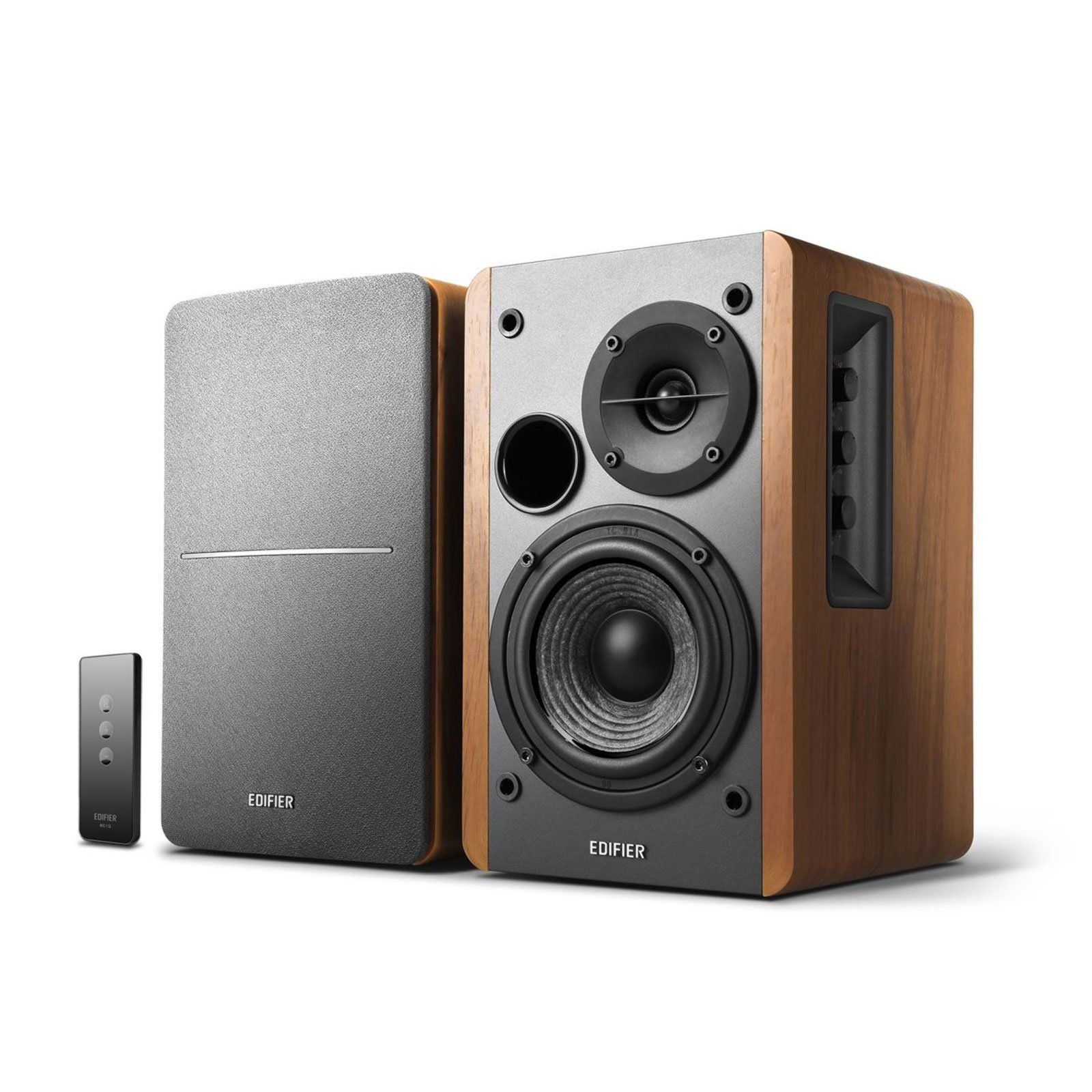
The Edifier R1280T is the ultimate entry point into quality home audio for anyone who wants great sound without the complexity of a separate amplifier. These are powered bookshelf speakers, meaning the amplifier is built into the cabinet — just plug them into power and connect your phone, computer, or TV via the dual RCA aux inputs. The 42 watts RMS of power is more than enough for a desktop setup or small living room, delivering rich, clear sound with a surprising amount of bass from the 4-inch woofers.
The classic wood-finish MDF cabinet looks far more expensive than the speakers cost. The side panel gives you individual knobs for volume, bass, and treble, so you can fine-tune the sound without a remote — though a remote control is included for convenience. The silk dome tweeters provide smooth highs without harshness, making these speakers enjoyable for long listening sessions. Setup takes about two minutes.
The R1280T does not include Bluetooth, so you are limited to wired connections. Some listeners find the sound slightly colored, with a warmth that adds a bit of muddiness to the mids. But at this price point, no other powered speaker offers the same combination of build quality, sound quality, and included features.
Why it’s great
- Powered design — no separate amplifier needed
- Remote control and adjustable bass/treble knobs
- Classic wood cabinet looks premium for the price
Good to know
- No Bluetooth — wired connection only
- Bass and treble controls can color the sound too much
- Best for desktop or small room use
FAQ
Do I need a subwoofer with bookshelf speakers?
What amplifier power do I need for floorstanding speakers?
Final Thoughts: The Verdict
For most users, the at home speakers winner is the SVS Prime Pinnacle because it delivers full-range bass down to 27 Hz without a subwoofer, combined with balanced, fatigue-free sound that works for both music and movies. If you want audiophile-level detail in a compact form, grab the KEF LS50 Meta and pair it with a quality sub. And for the best bang-for-your-buck powered speakers that require zero extra equipment, nothing beats the Edifier R1280T.