
Our readers keep the lights on and the weekend projects moving. As an Amazon Associate, I earn from qualifying purchases.
That first look at a lunar crater through your own telescope changes how you see the sky. For anyone who has ever wanted to move beyond standing under the stars to actually studying them, the barrier has always been one of confusion: Apertures, mounts, focal ratios, eyepieces, and an endless supply of marketing hype that makes choosing a first scope feel more stressful than exciting.
I’m Rikta — the co-founder and writer behind FitlyFast. Over the years I’ve spent hundreds of hours sorting through the spec sheets, trade-offs, and real-world reviews that matter for home astronomy, mapping exactly what gets a beginner from the backyard to the rings of Saturn without the frustration of a bad purchase.
Whether you are buying for a curious child or reigniting your own love of the night sky, understanding the optics and the hardware that actually deliver is the only way to cut through the noise. This guide breaks down the critical specs of the best at home telescope and matches them to real-world use so you know exactly what you are getting before it arrives.
How To Choose The Best At Home Telescope
A telescope is not a camera — the spec that matters most is the aperture (the diameter of the main lens or mirror), because that single number determines how much light the scope captures. More light means you see fainter stars, more detail on Jupiter’s cloud bands, and the soft glow of the Andromeda Galaxy instead of just a faint smudge. Magnification is secondary: you can always swap an eyepiece, but you can never add aperture after the purchase.
Mount Type: Alt‑Azimuth vs. Equatorial
An alt‑azimuth mount moves up‑down and left‑right, like a camera tripod. It is intuitive and works perfectly for casual observing. An equatorial mount aligns with Earth’s axis, letting you track objects with a single slow‑motion control as the sky rotates. EQ mounts have a steeper learning curve but are essential if you later want to take long‑exposure astrophotography. For the absolute beginner sticking to visual observing, a sturdy alt‑azimuth mount is often the better choice.
Optical Design: Refractor vs. Reflector
A refractor uses a glass lens at the front — it is sealed, maintenance‑free, and produces crisp contrasty images. A reflector uses a mirror at the bottom of the tube, which gives you more aperture per dollar but requires occasional collimation (mirror alignment) and is more sensitive to temperature changes. For a first scope used mostly from home, a good refractor offers the least fuss. A large‑aperture reflector such as a Dobsonian becomes a better option once you are ready for deeper sky objects.
What to Do With Magnification Numbers
The advertised magnification (e.g., 150X, 240X) is calculated by dividing the telescope’s focal length by the eyepiece focal length, then multiplying by the Barlow lens factor. In reality, the maximum useful magnification is about 50X per inch of aperture. A 70mm scope (2.75 inches) tops out around 138X on a perfect night — anything beyond that is empty magnification that dims and blurs the image. Ignore the headline zoom number and check the aperture first.
Quick Comparison
On smaller screens, swipe sideways to see the full table.
| Model | Category | Best For | Key Spec | Amazon |
|---|---|---|---|---|
| Celestron StarSense Explorer 150AZ | Tabletop Dobsonian | Best Overall Deep‑Sky Views | 150mm aperture / 650mm FL | Amazon |
| Celestron StarSense Explorer LT 80AZ | App‑Enabled Refractor | Easiest for Beginners | 80mm aperture / 400mm FL | Amazon |
| MEEZAA 150EQ Reflector | Reflector (EQ Mount) | Highest Light‑Gathering at Value | 150mm aperture / 650mm FL | Amazon |
| Hawkko 90mm 900mm Refractor | Premium Refractor | Bright Lunar & Planetary Detail | 90mm aperture / 900mm FL | Amazon |
| MEEZAA 90mm 800mm Refractor | Mid‑Range Refractor | Best Mid‑Range Starter Package | 90mm aperture / 800mm FL | Amazon |
| HUGERSTAR 90mm 800mm Refractor | Mid‑Range Refractor | Lunar & Planetary Views | 90mm aperture / 800mm FL | Amazon |
| HUGERSTAR 80mm 600mm Refractor | Entry Refractor | Budget‑Friendly Starter Scope | 80mm aperture / 600mm FL | Amazon |
| Gskyer 70mm 400mm Refractor | Compact Travel Scope | Lightweight Travel & Kids | 70mm aperture / 400mm FL | Amazon |
| Hawkko 80mm 500mm Refractor | Compact Starter Kit | Beginner Family Value | 80mm aperture / 500mm FL | Amazon |
In‑Depth Reviews
1. Celestron StarSense Explorer 150AZ
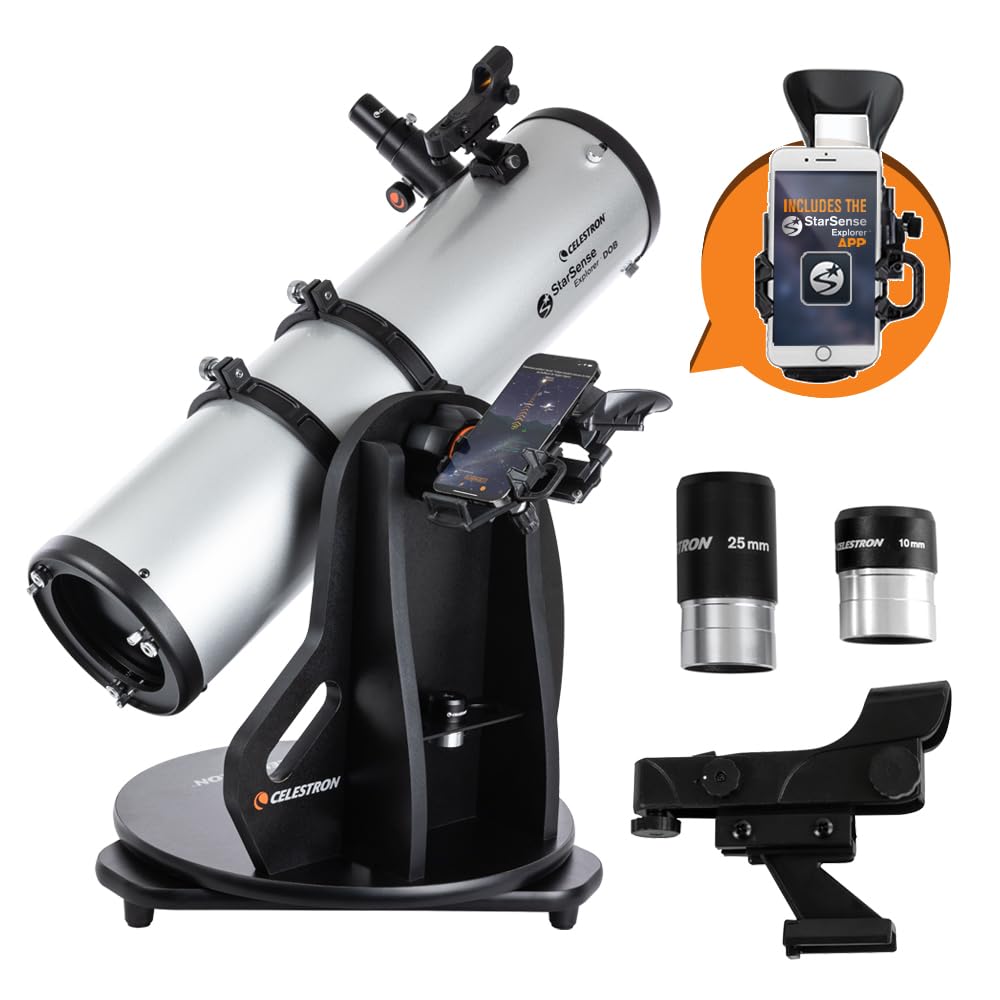
A six‑inch (150mm) parabolic mirror on a solid tabletop Dobsonian base captures enough light to resolve the Orion Nebula as a structured cloud with visible wings, not just a fuzzy patch. The StarSense app turns your phone into a real‑time star map showing you exactly where to push the tube — no prior knowledge of the sky is required. The entire setup sits low and stable, eliminating the vibration problems that plague tripod‑mounted scopes at this aperture.
Collimation was clean out of the box according to multiple users, and the focuser uses a standard 1.25‑inch barrel format so you can upgrade eyepieces later without buying a new set of adapters. The included 25mm and 10mm Kellner eyepieces provide 26X and 65X respectively, which is a perfect starting range for sweeping the Milky Way and then zooming into Saturn’s rings. The red‑dot finder complements the phone dock for the moments you want to skip the app and hunt manually.
This is a semi‑permanent backyard scope that delivers serious deep‑sky performance at a price that undercuts motorized go‑to systems with smaller mirrors. The trade‑off is portability — the pressboard base is heavy, and the whole rig is best kept assembled near a patio table or deck where you can use it frequently without packing and unpacking. For anyone ready to move past the 80mm starter tier, this is the best value upgrade path available.
Why it’s great
- Six inches of aperture resolves globular clusters and nebula detail that smaller scopes cannot touch
- StarSense app eliminates the frustration of trying to locate objects blind
- Rock‑solid Dobsonian base dampens vibration instantly, unlike wobbly tripod mounts
Good to know
- Tabletop design requires a steady flat surface — not ideal for remote field use
- Build takes some assembly and the particle‑board base is heavy to move frequently
2. Celestron StarSense Explorer LT 80AZ

This 80mm refractor on a lightweight alt‑azimuth tripod is the easiest telescope to get started with because the patented StarSense dock eliminates the hardest part of astronomy — finding objects. You place your phone in the dock, open the app, and the phone’s camera analyzes the star patterns overhead to triangulate exactly where the telescope is pointed. On‑screen arrows guide you to any target in the database, and when the bullseye turns green, you look through the eyepiece and the object is centered.
The optical tube uses fully coated glass and a 400mm focal length, delivering wide 1.7‑degree fields at 16X with the included 25mm eyepiece. That field of view is ideal for the Pleiades, the double cluster in Perseus, and sweeping the Milky Way. The 10mm eyepiece plus the 2X Barlow pushes it to 80X — enough to clearly see Saturn’s rings as separate from the planet and to pick out Jupiter’s equatorial bands on a steady night.
Build quality from Celestron is dependable: the tripod legs are aluminum with a center brace, the alt‑az mount has a smooth slow‑motion rod for fine adjustment, and the red‑dot finder gives you a backup when you want to go manual. This is the scope to buy if you want to spend your first night looking at objects instead of learning how to star‑hop with a finder chart. The only real limit is the 80mm aperture — deep‑sky objects like galaxies will remain dim smudges even under dark skies.
Why it’s great
- Patented StarSense app makes navigation effortless for absolute beginners
- Lightweight, portable, and assembles without tools in minutes
- Sharp 80mm optics deliver crisp lunar and planetary views at low and medium powers
Good to know
- 80mm aperture limits deep‑sky performance — galaxies and faint nebulas will be dim
- Standard tripod can wobble in a breeze; adding weight to the accessory tray helps stability
3. MEEZAA 150EQ Newtonian Reflector
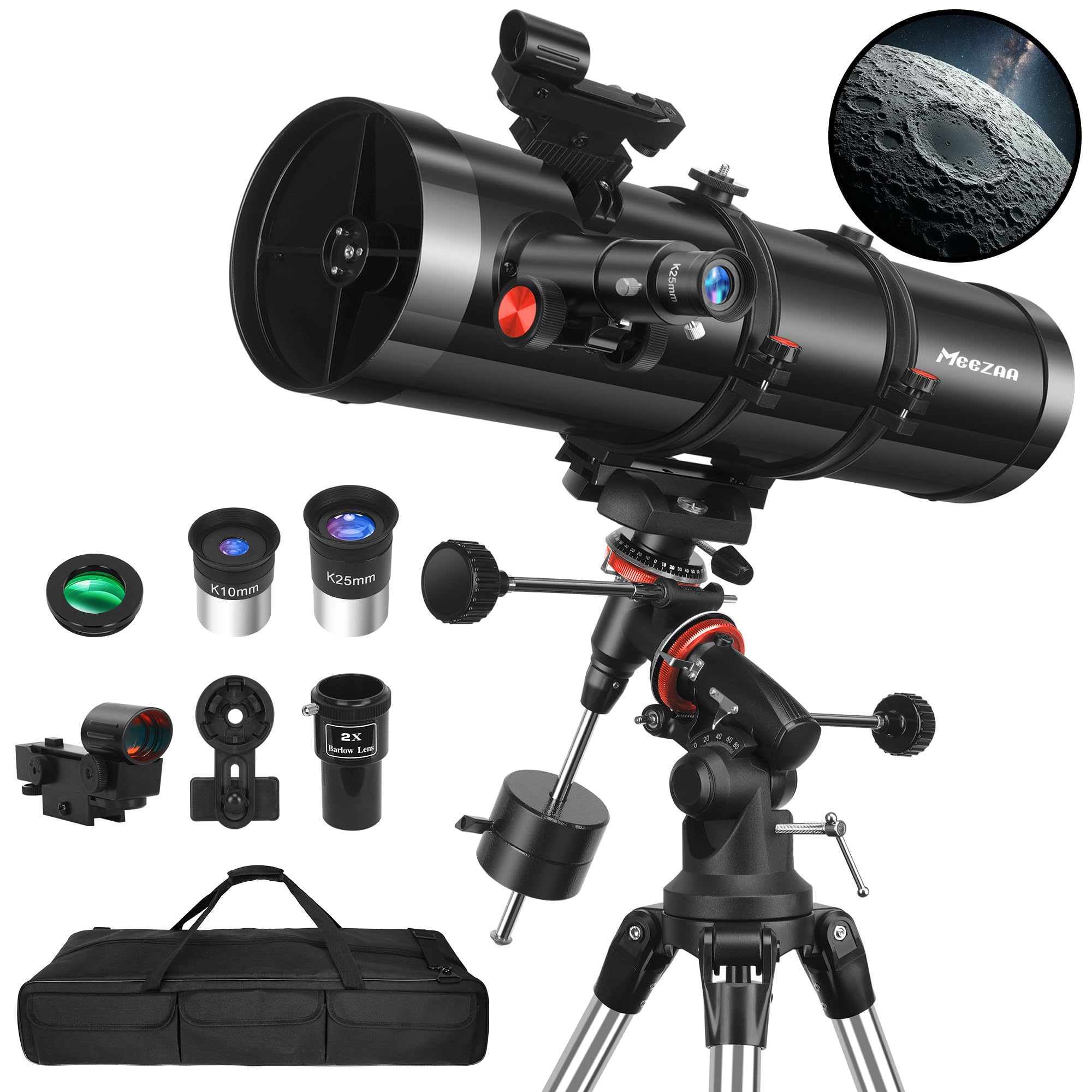
This 150mm Newtonian reflector on a German equatorial mount brings the light‑gathering power of a six‑inch mirror to a price usually associated with 90mm refractors. The f/4.3 focal ratio means short exposure times if you ever attach a camera, but also demands careful collimation and quality eyepieces to keep the edges of the field sharp. The included 25mm and 10mm Kellner eyepieces deliver 26X and 65X, and the 2X Barlow pushes you to 130X for planetary work.
Users note that the equatorial mount has smooth slow‑motion control cables that let you track objects with one hand while a single axis is aligned to the celestial pole. The tripod is heavy‑duty stainless steel with a spreader tray that adds rigidity. Multiple customer reviews highlight that the build quality exceeds expectations at this price bracket, and that the scope performs well on the moon, Jupiter, Saturn, and even brighter deep‑sky objects like the Hercules globular cluster.
The main compromises are the supplied eyepieces, which are functional but not sharp at the edges, and a plastic focuser that some users find imprecise. Both are field‑replaceable upgrades that let you grow with the scope over time. Unlike a tabletop Dobsonian, the EQ mount adds a layer of complexity — you need to polar‑align the mount each session — but that same mount also unlocks the possibility of basic deep‑sky astrophotography later. This is the telescope for someone who wants the most aperture per dollar and is willing to invest a few sessions learning the EQ setup.
Why it’s great
- 150mm parabolic mirror gathers vastly more light than any 80–90mm scope in this price range
- EQ mount with slow‑motion controls enables manual tracking of celestial objects
- Complete accessory kit includes tripod, moon filter, phone adapter, and carry bag
Good to know
- EQ mount has a steeper learning curve than alt‑azimuth mounts
- Entry‑level eyepieces and plastic focuser are functional but worth upgrading over time
4. Hawkko 90mm 900mm Refractor

With a 90mm aperture and a long 900mm focal length, this refractor from Hawkko delivers the high contrast and minimal false color that makes lunar observing a standout experience. The f/10 focal ratio is inherently forgiving on inexpensive eyepieces, meaning you get sharp, clean images at the center of the field even with the stock 25mm and 10mm Kellners. The included 3X Barlow pushes magnification up to 270X on the 10mm eyepiece, though the practical limit on most nights will be closer to 180X due to atmospheric turbulence.
The stainless steel tripod and alt‑azimuth mount are stable enough to handle the long tube without excessive vibration — a common failure point with budget refractors. Users report that the setup takes under 15 minutes from box to first observation and that the moon filter helps reduce glare when moving from a crescent to a full disk. The phone adapter captures decent afocal images of the moon that are shareable on social media, and the included carry bag makes storage simple.
What you trade with a long‑tube refractor is field of view — at 36X with the 25mm eyepiece, the true field is about 1.4 degrees, which is too narrow for sweeping the Milky Way or framing the Pleiades in one view. This is a high‑power instrument optimized for the moon, planets, and close double stars. If you want to hop quickly between wide‑field targets, a shorter‑tube 80mm scope is a better match. For someone who mainly wants to study the lunar surface in high relief, this is a precise tool.
Why it’s great
- Long 900mm focal length provides high inherent contrast and minimal chromatic aberration
- Stainless steel tripod and AZ mount hold the tube steady for high‑power lunar viewing
- Full multi‑coated optics with 90mm aperture gather enough light for crisp planetary detail
Good to know
- Narrow true field of view limits use for wide‑field deep‑sky objects
- Long tube can be cumbersome to transport despite the carry bag
5. MEEZAA 90mm 800mm Refractor

At 90mm of aperture and 800mm focal length, this MEEZAA refractor sits in the sweet spot where you get enough light gathering to show Jupiter’s cloud bands as distinct colored stripes and enough focal length to push magnification without the image falling apart. The f/8.88 focal ratio is slower than the short‑tube designs, which reduces false color significantly compared to 500mm‑class refractors. Fully multi‑coated lenses transmit about 90 percent of incident light, giving you bright, neutral images.
The package is generous: two Kellner eyepieces (25mm and 10mm), a 3X Barlow, a 5×24 straight‑through finder, a star diagonal, a phone adapter, and a padded carry bag. Users report that the 25mm eyepiece at 32X is excellent for framing the moon in its entirety, while the 10mm at 80X pulls out crater detail and the Cassini division in Saturn’s rings on nights with steady seeing. The aluminum tripod has a 1.25‑inch steel center column, and the accessory tray clips onto the leg spreader for easy access to eyepieces.
No telescope at this price is perfect, and the limiting factor here is the standard straight‑through finderscope, which requires you to contort your neck to locate objects. Swapping to a red‑dot finder is a low‑cost upgrade that dramatically improves the user experience. The mount uses slow‑motion cables for altitude but not for azimuth, so fine‑tuning in the horizontal plane requires loosening and nudging the tube. Still, for the aperture and accessory count, this is the best value in the mid‑range bracket for anyone who wants a complete package out of the box.
Why it’s great
- 90mm aperture at f/8.9 provides bright, low‑false‑color views of the moon and planets
- Full accessory kit with carry bag, moon filter, and phone adapter means nothing extra to buy
- Stainless steel tripod legs add stability over standard aluminum leg sets
Good to know
- Straight‑through finderscope is uncomfortable to use and a red‑dot upgrade is recommended
- Mount lacks fine azimuth adjustment, making centering a target at high power slightly tedious
6. HUGERSTAR 90mm 800mm Refractor

The HUGERSTAR 90800 uses the same 90mm aperture and 800mm focal length as the MEEZAA model above but ships with a redesigned stainless steel tripod that extends from 28.7 to 46.4 inches, accommodating taller users without hunching. The optical tube features fully multi‑coated lenses, and the alt‑azimuth mount includes a slow‑motion altitude rod with a sliding rod design that feels smoother than the gear‑based systems on cheaper mounts.
The supplied 25mm eyepiece yields 32X with a 1.5‑degree field, enough to take in the full moon with room to spare. The 10mm delivers 80X, and the 3X Barlow multiplies that to 240X, though as with any long‑tube refractor, 240X is only usable on nights of exceptional atmospheric steadiness. Users consistently report that the 80X and 160X levels produce contrasty, color‑correct views of the moon’s Tycho crater and the Cassini division in Saturn’s rings — details that 70mm scopes struggle to show.
Included accessories mirror the MEEZAA kit: finder scope, moon filter, phone adapter, and a carrying case. The notable addition is a more thoughtfully designed accessory tray that fits under the tripod spreader without wobbling. The main downside is the same across all scopes in this class — the finderscope is straight‑through and the mount has no slow‑motion in azimuth. For the dedicated planetary and lunar observer who wants a stable tripod that will not leave them bent over, this is a refined choice.
Why it’s great
- Stainless steel tripod with extended height range reduces stooping for adult users
- Fully multi‑coated 90mm optics provide high contrast on planetary and lunar targets
- Smooth altitude slow‑motion rod makes fine adjustments easy
Good to know
- No slow‑motion control for azimuth — horizontal fine tuning requires nudging the tube
- Straight‑through finder requires an awkward position for comfortable use
7. HUGERSTAR 80mm 600mm Refractor
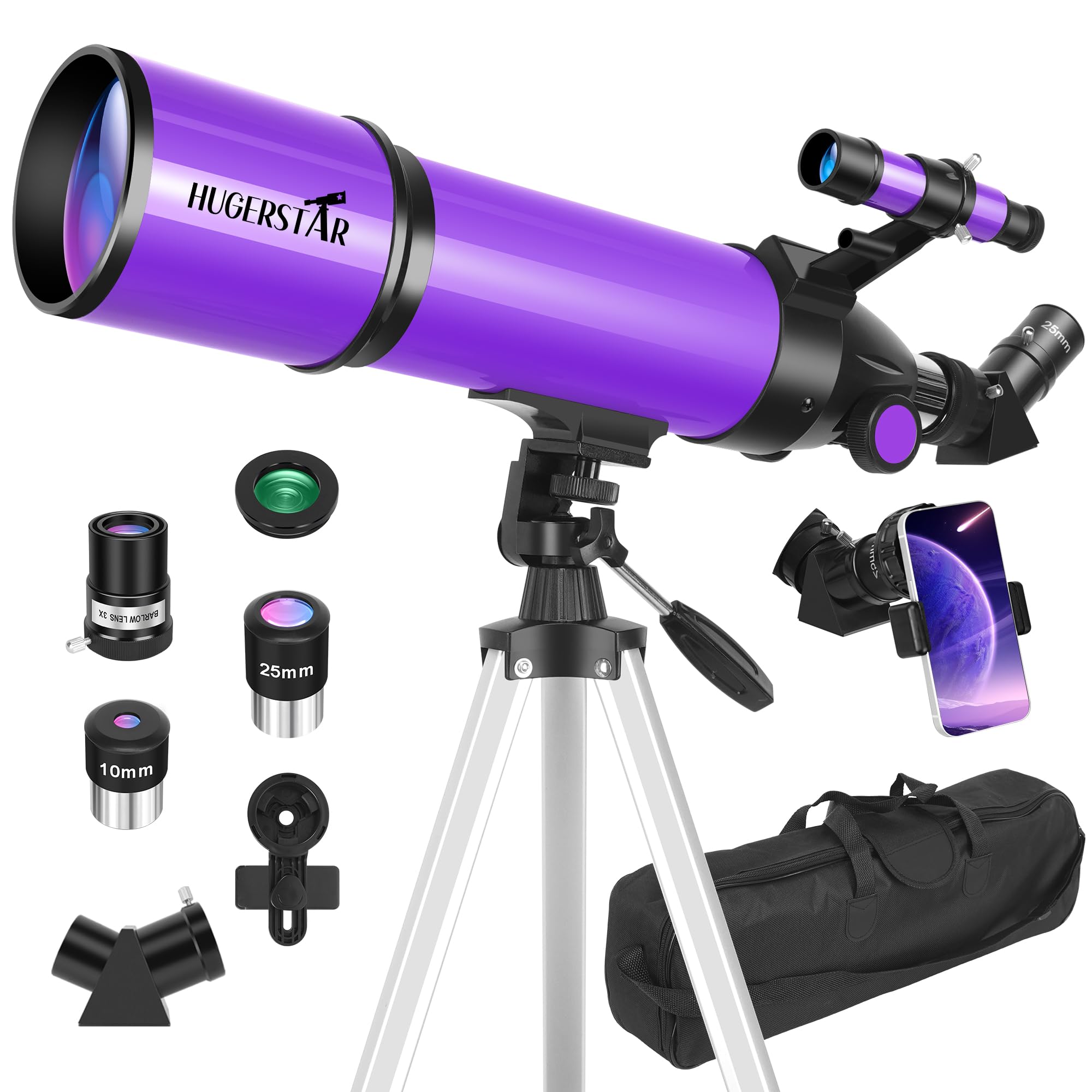
The HUGERSTAR 80600 is an 80mm refractor with a 600mm focal length that hits a practical balance between portability and performance. The f/7.5 focal ratio is fast enough to keep the tube at a manageable 23‑inch length, meaning it slips into the included carry bag without breaking down into multiple sections. Fully multi‑coated optics give you 60 percent more light gathering than a 70mm scope, which translates into visible detail on Jupiter’s moons as distinct disks rather than points.
The package includes 25mm and 10mm eyepieces, a 3X Barlow lens, a 5×24 straight‑through finder, an erect‑image diagonal for daytime terrestrial use, a moon filter, and a smartphone adapter. With the 25mm eyepiece plus Barlow you get 72X — the sweet spot for observing the moon at full phase without flooding your eye with light. Users note that the 10mm alone at 60X shows Saturn’s rings as clearly separated from the planet, which is a meaningful benchmark for any beginner scope.
The alt‑azimuth tripod is aluminum with adjustable height from 21 to 44 inches, and the mount head has a captive lock lever that does not require tools. The biggest limitation is the finderscope — like others in this tier, it is a straight‑through unit that can be uncomfortable to look through when the scope is pointed anywhere near the zenith. This is a minor ergonomic annoyance in an otherwise excellent first telescope that gets you looking at real astronomical detail for a low entry point.
Why it’s great
- 80mm aperture with fully coated optics delivers bright lunar and planetary views
- Compact 600mm focal length keeps the tube portable and easy to store
- Includes a moon filter, smartphone adapter, and carry bag for a complete out‑of‑box experience
Good to know
- Straight‑through finderscope design makes it uncomfortable to locate objects near zenith
- Aluminum tripod is functional but benefits from adding weight to the accessory tray for wind stability
8. Gskyer 70mm 400mm Refractor

At 70mm of aperture and 400mm focal length, the Gskyer is a compact grab‑and‑go refractor designed for portability over deep‑sky power. The fully coated optics and short tube make this the lightest full‑sized scope in this guide at about 5.7 pounds, and the included carry bag means you can bring it on a camping trip or to a dark‑sky site without dedicating a full car seat to it. The f/5.7 focal ratio gives wide fields that are well suited to sweeping the Milky Way and viewing large star clusters.
The kit includes two eyepieces (providing 16X and 40X by themselves) plus a 3X Barlow that extends the range to 48X and 120X. A wireless remote and smartphone adapter are bundled for afocal photography, which is a nice touch for sharing moon images with friends. Users report that the scope clearly shows the moon’s major craters, the four Galilean moons of Jupiter as aligned dots, and Saturn’s rings as a discernible shape — though ring separation is subtle at this aperture.
The tripod is aluminum and adjustable, but at only 70mm of aperture, the practical magnification ceiling is around 140X, so expectations must be calibrated. Faint objects like galaxies and nebulas beyond the Orion Nebula will appear as dim, diffuse patches. This scope is best viewed as a high‑quality starter that lets a child or casual observer explore the moon and bright planets without the intimidation of a complex setup. It is not a scope for growth — you will outgrow it once your interest deepens — but as a low‑commitment entry point, it fills the role perfectly.
Why it’s great
- Ultra‑lightweight build makes it genuinely portable for travel and camping
- Wireless remote and phone adapter simplify moon and planet photo sharing
- Wide fields at low magnification are perfect for scanning star clusters and the Milky Way
Good to know
- 70mm aperture limits light gathering — most deep‑sky objects remain faint and indistinct
- Short tripod height may require a table or crouching for comfortable use
9. Hawkko 80mm 500mm Refractor
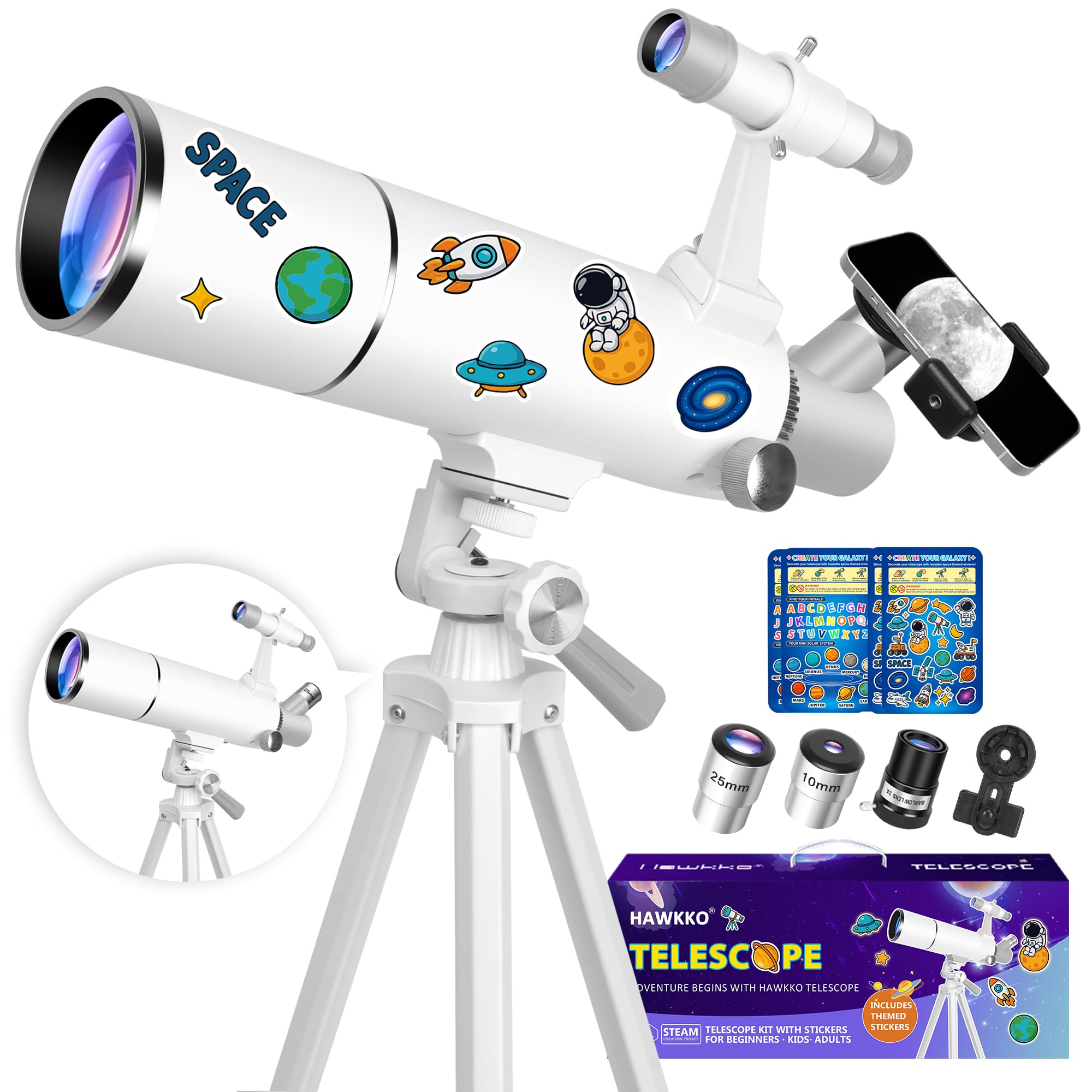
The Hawkko 80500 offers a genuine 80mm aperture and 500mm focal length in a package that prioritizes the family experience with a thoughtful extra: a sheet of space‑themed stickers for kids to personalize the tube. This may sound like a gimmick, but it signals that the kit is designed around lowering the barrier for a child’s first encounter with a telescope. The long 500mm focal length is housed in a short 22‑inch tube that an eight‑year‑old can carry.
Optically, the fully multi‑coated lens gathers about 60 percent more light than a 70mm model, which matters when showing a child Jupiter for the first time. The included 25mm eyepiece delivers 20X — a low, forgiving power that keeps the target in the eyepiece even though the manual alt‑azimuth mount has no slow‑motion controls. The 10mm eyepiece plus the 3X Barlow reaches 150X, which is above the practical limit for most nights, but the 50X and 100X ranges are usable for lunar close‑ups. The straight‑through finderscope is basic, but the package also includes a smartphone adapter for capturing images.
At this price point, the mount is the main compromise — the aluminum tripod is lightweight and the mount head uses simple friction locks, so a slight breeze can cause vibration. Placing the scope on a stable surface rather than fully extending the tripod legs helps. The instruction manual is clear, and multiple users confirm they were observing within ten minutes of opening the box. For a family wanting a tool that gets kids excited about the moon without a large financial commitment, this is a well‑considered choice that leaves room for upgrade later.
Why it’s great
- Genuine 80mm aperture delivers noticeably brighter views than typical 70mm beginner scopes
- Space‑themed stickers and smartphone adapter engage kids and encourage hands‑on exploration
- Quick tool‑free setup gets you observing the moon in under ten minutes
Good to know
- Lightweight tripod and friction mount are prone to shake in wind
- Straight‑through finderscope is awkward and benefits from a simple red‑dot upgrade
FAQ
Can I see galaxies and nebulas with an 80mm refractor from my backyard?
What does the 3X Barlow lens actually do to the image quality?
Is a smartphone adapter worth using, or should I buy a dedicated camera?
Why do some telescopes have a straight‑through finder and others a red‑dot finder?
Final Thoughts: The Verdict
For most users, the at home telescope winner is the Celestron StarSense Explorer 150AZ because its six‑inch aperture and app‑guided navigation combine the best deep‑sky performance with the lowest learning curve. If you want a portable, user‑friendly refractor that works right out of the box, grab the Celestron StarSense Explorer LT 80AZ. And for budget‑minded families who want a complete kit with no hidden extras, nothing beats the Hawkko 80mm 500mm Refractor.