
Our readers keep the lights on and the weekend projects moving. As an Amazon Associate, I earn from qualifying purchases.
Choosing a receiver for Dolby Atmos means committing to a speaker configuration — 5.1.2, 7.1.4, or something in between — and the hardware must cleanly decode object-based audio while managing HDMI 2.1 bandwidth for gaming and 8K video. A mismatch between channel count and your room’s layout wastes money on unused amp channels or leaves you unable to place height speakers where they sound best.
I’m Rikta — the co-founder and writer behind FitlyFast. I’ve spent hundreds of hours cross-referencing THD+N figures, HDMI 2.1 bandwidth specs, and room-correction algorithms so buyers can match a receiver to their actual speaker setup without guessing.
The real test of any atmos av receiver is how its onboard room correction handles your specific space and whether your planned speaker count lines up with the unit’s processing channels.
How To Choose The Best Atmos AV Receiver
Atmos audio uses object-based metadata that assigns sounds to specific spots in three-dimensional space. Your receiver must process at least 5.1.2 channels (five ear-level, one sub, two overhead) to hear rain from above. Buyers often fixate on wattage while ignoring the room-correction algorithm, which is what actually makes the soundstage feel accurate in an imperfect room.
Match Channel Count to Your Room
A 7.1.4 system uses eleven amp channels — nine ear-level and four overhead — requiring a receiver that processes eleven channels natively or allows external amplification for the last pair. If your ceiling can only accommodate two height speakers, a 5.1.2 or 7.1.2 receiver saves money and complexity. Over-buying channels you can’t wire leaves processing power idle.
Room Correction Is Not Optional
Dirac Live, Audyssey MultEQ, YPAO R.S.C., and Sony’s Digital Cinema Auto Calibration IX each measure speaker distance and frequency response, but they differ in correction granularity. Dirac Live on the Onkyo TX-RZ50 allows full-bandwidth adjustment on a PC, while YPAO on the Yamaha RX-A4A uses precision EQ and low-frequency mode to tighten bass. Without good room correction, even premium speakers sound boomy or hollow.
HDMI 2.1 Bandwidth for Gaming
If you game at 4K/120Hz or plan to, look for receivers with 40 Gbps HDMI 2.1 inputs that support Variable Refresh Rate (VRR) and Auto Low Latency Mode (ALLM). The Denon AVR-S970H and Onkyo TX-NR7100 include these, while older HDMI 2.0b units cap out at 4K/60. Pure movie watchers can safely prioritize eARC over gaming features.
Power Ratings Are Not Equal
Manufacturers rate watts at different distortion levels and channel counts. A “100W per channel” claim may be measured at 1 kHz with one channel driven, not all channels at full bandwidth. Compare watts at 0.08% THD with two channels driven — the Onkyo TX-RZ50 and Sony STR-AZ3000ES deliver cleaner headroom under real load than budget units that list a single-channel peak figure.
Quick Comparison
On smaller screens, swipe sideways to see the full table.
| Model | Category | Best For | Key Spec | Amazon |
|---|---|---|---|---|
| Onkyo TX-RZ50 | Premium 9.2-ch | 7.1.4 Atmos with Dirac Live | 120W/ch (8 ohms, 2-ch) | Amazon |
| Denon AVR-S970H | Mid-range 7.2-ch | 5.1.2 with phono input | 90W/ch (8 ohms, 2-ch) | Amazon |
| Sony STR-AZ3000ES | Premium 9.2-ch | 360 Spatial Sound Mapping | 120W/ch (8 ohms, 2-ch) | Amazon |
| Yamaha RX-A4A | Premium 7.2-ch | Surround:AI tuning | 100W/ch (8 ohms, 2-ch) | Amazon |
| Onkyo TX-NR7100 | Mid-range 9.2-ch | Dirac Live at lower cost | 100W/ch (8 ohms, 2-ch) | Amazon |
| Sony STR-AZ1000ES | Premium 7.2-ch | 7.2.4 with external amp | 100W/ch (8 ohms, 2-ch) | Amazon |
| Denon AVR-S770H | Mid-range 7.2-ch | Budget 5.1.2 entry | 75W/ch (8 ohms, 2-ch) | Amazon |
| Yamaha RX-V6A | Mid-range 7.2-ch | MusicCast multi-room | 100W/ch (8 ohms, 2-ch) | Amazon |
| JBL MA710 | Mid-range 7.2-ch | Phono + slim chassis | 110W/ch (8 ohms, 2-ch) | Amazon |
| Pioneer VSX-935 | Entry 7.2-ch | Budget HDMI 2.1 | 80W/ch (8 ohms, 2-ch) | Amazon |
| WiiM Amp Ultra | Streaming Amp | Compact 2.1 + RoomFit | 100W/ch (4 ohms, 2-ch) | Amazon |
In‑Depth Reviews
1. Onkyo TX-RZ50

The Onkyo TX-RZ50 processes up to 11.2 channels — enough to run a full 7.1.4 Atmos layout when you add an external two-channel amp for the rear height pair. Dirac Live room correction comes included, and the full-bandwidth PC-based calibration gives you control over target curves that most receivers lock away. THX certification means it passes the strict signal-integrity tests that ensure nothing is added or stripped from the source.
With 120 watts per channel measured at two channels driven, this unit drives demanding Klipsch Reference or Polk towers cleanly. The built-in HDMI 2.1 inputs support 8K60 and 4K120 pass-through with VRR and ALLM for gaming. Users consistently report warm, detailed sound after Dirac calibration, though the setup process for the room-correction software is more involved than pressing a single button.
The unit lacks an 11-channel amplifier onboard, so you must budget for an extra stereo amp to reach the full 7.1.4 configuration. The remote is not backlit, and the Onkyo Music Control app is less polished than Denon’s HEOS. For buyers who prioritize Dirac Live room correction above all else, this is the most affordable path to a professionally calibrated Atmos system.
Why it’s great
- Full Dirac Live license included with PC customization
- 120W/ch clean output with THX certification
- 11.2-channel processing for future 7.1.4 expansion
Good to know
- Requires external 2-ch amp for 7.1.4 Atmos
- Setup complexity higher than Audyssey-based units
2. Sony STR-AZ3000ES

Sony’s flagship ES receiver outputs 120 watts per channel across nine internal amplifier channels, giving you a native 5.1.4 or 7.1.2 Atmos layout without external amps. The 360 Spatial Sound Mapping algorithm processes sound objects with a degree of phantom-height precision that makes a 5.1.2 configuration audibly mimic a 7.1.4 array. Digital Cinema Auto Calibration IX measures speaker distances and applies frequency correction from nine positions.
HDMI 2.1 support includes 8K60 and 4K120 pass-through with VRR, though the implementation lacks QMS and QFT. The receiver runs hot during extended play — users recommend active cooling — and the front cover plate gives the unit a clean, rack-mountable look. The backlit remote is a welcome upgrade over competitor remotes that force you to navigate in the dark.
No HDR10+ support limits compatibility with some Samsung and Panasonic displays, and the auto-calibration mic needs correct port assignments to avoid mapping height channels incorrectly. For buyers building a new Atmos system around Sony’s ecosystem, the 360 Spatial Sound Mapping delivers a uniquely wide and tall soundstage that competes with systems costing twice as much.
Why it’s great
- 360 Spatial Sound Mapping creates phantom height channels
- 9 internal amp channels for 5.1.4 without external amp
- Backlit remote and rack-mountable front cover
Good to know
- No HDR10+ support
- Runs hot; active cooling recommended for long sessions
3. Yamaha RX-A4A

The RX-A4A sits in Yamaha’s Aventage line, which uses a rigid frame construction and premium DAC components to reduce vibration and noise. Surround:AI analyzes audio content in real time and adjusts the sound field to prioritize dialogue clarity during quiet scenes or widen the stage during action sequences. YPAO R.S.C. with 3D multipoint measurement and low-frequency mode tightens bass response across multiple seating positions.
Seven HDMI inputs support 8K60 and 4K120 at 40 Gbps, and all three outputs allow eARC plus independent Zone 2 HDMI switching — watch a movie in the main room while the kids stream cartoons on a second display. The MusicCast app controls multi-room audio and integrates with Sonos via an optional Port. A phono input handles turntables directly.
Firmware updates require a USB flash drive rather than an over-the-air download, which some users find tedious. The lack of Dirac Live means you depend entirely on YPAO’s proprietary algorithm, which is effective but offers less manual tuning than competitors. For home theater enthusiasts who want automatic real-time optimization and solid multi-zone video, the RX-A4A delivers reliable, detailed sound.
Why it’s great
- Surround:AI adjusts sound field in real time
- Three HDMI outputs with independent Zone 2
- Phono input and MusicCast multi-room streaming
Good to know
- Firmware updates require a USB drive
- No Dirac Live; YPAO tuning is less customizable
4. Denon AVR-S970H

The Denon AVR-S970H outputs 90 watts per channel across seven channels, enough for a 5.1.2 Atmos setup in medium rooms. It includes Audyssey MultEQ room correction — less granular than Dirac Live but far simpler to run — and HEOS multi-room streaming that integrates with Denon Home speakers. Eight HDMI ports (six inputs, two outputs) support 8K60 and 4K120 with VRR, ALLM, and QFT for lag-free gaming.
The built-in phono input lets you connect a turntable without an external preamp, and the onscreen setup guide walks first-time users through speaker configuration. In practice, users report clear, warm sound that outperforms earlier Denon models at this power level, and the unit runs cooler than equivalent Onkyo receivers — typically around 80°F during normal use.
Powered Zone 2 uses the rear surround channels, limiting the main room to 5.2 channels when Zone 2 is active. The remote lacks a dedicated TV power button, and HEOS cannot stream Bluetooth audio to wireless headphones. For buyers who want a reliable mid-range receiver with solid room correction and straightforward setup, this is the strongest all-rounder.
Why it’s great
- Audyssey MultEQ room correction with simple setup
- Phono input and 8 HDMI ports with 8K/4K120
- Runs cooler than competing mid-range receivers
Good to know
- Powered Zone 2 reduces main room to 5.2 channels
- Remote lacks programmable TV power button
5. Sony STR-AZ1000ES

The Sony STR-AZ1000ES delivers 100 watts per channel across seven channels, with the same 360 Spatial Sound Mapping and Digital Cinema Auto Calibration IX found in the flagship AZ3000ES. The algorithm creates convincing phantom height effects, making a 5.1.2 system sound wider and taller than conventional calibration. HDMI 2.1 inputs handle 8K60 and 4K120, and the receiver includes Chromecast built-in, AirPlay 2, and Spotify Connect.
The ES build quality shows in the solid chassis and front-mounted USB port behind a hinged cover. The receiver works with Sonos via a Port and supports IP control for custom home-integration systems. Users consistently praise voice clarity during dialogue-heavy scenes and the depth of the Dolby Atmos soundstage after calibration.
No HDR10+ support and the lack of QMS/QFT gaming features limit appeal for some display owners. The unit also runs hot enough to warrant consideration of external cooling for all-day use. For buyers who want Sony’s spatial processing in a 7.2-channel package without stepping up to the 9.2-channel flagship, this is the sweet spot.
Why it’s great
- 360 Spatial Sound Mapping with phantom height effects
- ES build quality with front USB port and cover plate
- Chromecast, AirPlay 2, and Spotify Connect built in
Good to know
- No HDR10+ or QMS/QFT gaming features
- Runs hot; active cooling recommended for extended use
6. Onkyo TX-NR7100
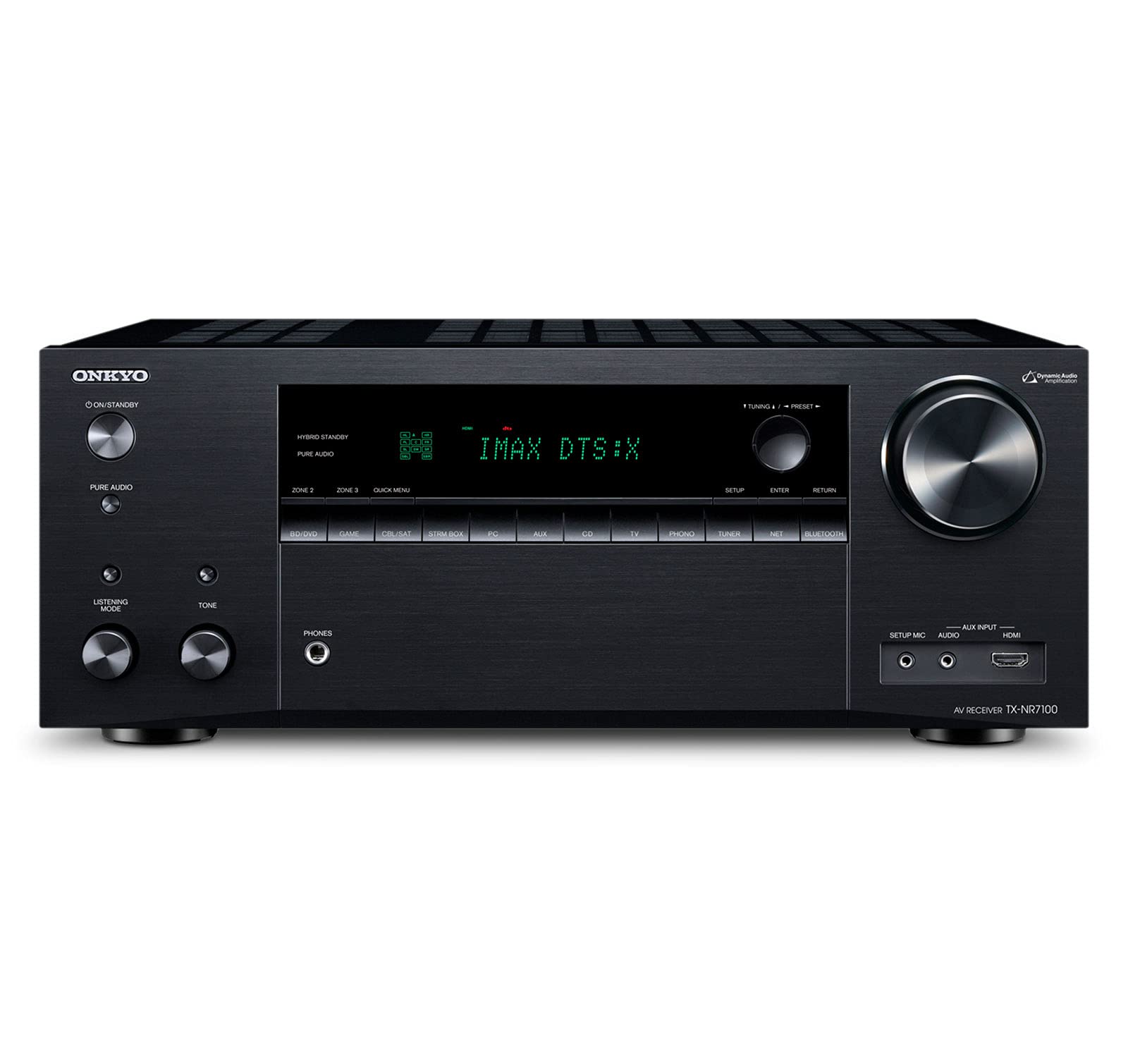
The Onkyo TX-NR7100 offers nine channels of processing and Dirac Live room correction at a lower entry point than the TX-RZ50. It outputs 100 watts per channel and supports 5.1.4 Atmos directly or 7.1.2 with the internal amplifiers. HDMI 2.1 inputs pass 8K60 and 4K120 with VRR and ALLM, and the receiver includes bi-directional Bluetooth that can transmit audio to wireless headphones using aptX HD.
THX Select certification ensures the amplifier section meets strict distortion and noise standards. The Works with Sonos certification allows integration with a Sonos Port for multi-room control. Users report that Dirac Live improves soundstage depth dramatically, though the calibration setup takes longer than a basic Audyssey run.
Some users have reported intermittent HDMI glitches and a non-backlit remote that is difficult to use in dark rooms. The unit also lacks pre-outs for an external amp, so the nine internal channels are the hard limit unless you bypass the receiver’s processing entirely. For buyers who want Dirac Live without paying for the RZ50’s 11.2 processing, this is the logical step down.
Why it’s great
- Dirac Live included at a lower price than RZ50
- Bi-directional Bluetooth with aptX HD transmission
- THX Select certified for clean amplification
Good to know
- No pre-outs for external amplifier expansion
- Remote is not backlit; HDMI glitches reported
7. Denon AVR-S770H

The Denon AVR-S770H is the entry-level 7.2-channel receiver in Denon’s lineup that still supports Dolby Atmos Height Virtualization, allowing you to simulate overhead effects without ceiling speakers. At 75 watts per channel, it powers a 5.1.2 system in smaller rooms but runs out of headroom with low-sensitivity speakers in larger spaces. HEOS multi-room streaming lets you send audio to Denon Home speakers throughout the house.
HDMI 2.1 inputs support 8K60 and 4K120 with VRR and ALLM, making it viable for gaming on a budget. Audyssey MultEQ room correction is included and calibrates quickly. Users consistently note that the S770H produces warm, detailed sound that exceeds expectations at this power tier.
Some units have experienced firmware-related volume drops and occasional no-picture output after updates, requiring power cycling. The remote takes time to learn due to the dense button layout, and the advanced menu system is less intuitive than Yamaha’s. For buyers who want Denon’s proven amplification and HEOS ecosystem at the lowest entry price, this is the starting point.
Why it’s great
- Dolby Atmos Height Virtualization without ceiling speakers
- HEOS multi-room streaming and HDMI 2.1 gaming support
- Audyssey MultEQ room correction included
Good to know
- 75W/ch limits performance with low-sensitivity speakers
- Firmware glitches reported by some users
8. Yamaha RX-V6A

The Yamaha RX-V6A is a 7.2-channel receiver that supports Dolby Atmos with Height Virtualization and DTS:X, plus MusicCast for whole-home audio. It outputs 100 watts per channel and includes seven HDMI inputs with HDCP 2.3 and eARC. Three of those inputs support 8K60 and 4K120 through HDMI 2.1, making it compatible with the latest gaming consoles.
YPAO multipoint room correction provides reliable calibration, and the receiver handles 4-ohm speaker loads without difficulty, which is rare at this price tier. Users upgrading from older Yamaha models report noticeably cleaner treble and better bass control, along with easy integration with Fire TV and Roku via eARC.
The on-screen menu system looks dated compared to Denon’s graphical interface, and the initial firmware update process can be confusing. Some users find the learning curve steep for configuring advanced DSP modes. For buyers invested in the MusicCast ecosystem or those needing stable 4-ohm drive, the RX-V6A remains a solid performer.
Why it’s great
- Stable 4-ohm speaker drive capability
- Three HDMI 2.1 inputs with 8K60 and 4K120
- MusicCast multi-room and voice control with Alexa/Google
Good to know
- On-screen menu and remote feel dated
- Steep learning curve for advanced DSP settings
9. JBL MA710

The JBL MA710 is a 7.2-channel receiver rated at 110 watts per channel, with a shallow chassis that fits media consoles where deeper units won’t. It decodes Dolby Atmos and DTS:X in 5.1.2 or 7.1 configurations and includes a moving magnet phono input for turntable integration. Six HDMI inputs with eARC handle 8K video, and the unit streams via Bluetooth, Chromecast, and AirPlay 2.
The slim design does not compromise cooling — users report stable operation even in enclosed cabinets. With a full firmware update, the HDMI ARC auto-power feature works reliably, and the on-screen setup menu guides wiring assignments clearly. The MA710 drives in-wall speakers and towers well, delivering impressive clarity for the price.
The remote lacks a backlight, and the unit does not mix down DTS-HD Master Audio to stereo for 2.1 setups — a significant limitation for buyers using only a pair of speakers. JBL’s firmware support has been slow to address known issues. For buyers who need a shallow-profile receiver with a phono input and solid power, this works well in its niche.
Why it’s great
- Slim chassis fits shallow media consoles
- Phono input and 8K HDMI with eARC
- Stable thermal performance in enclosed cabinets
Good to know
- No DTS-HD downmix for 2.1 stereo setups
- Remote not backlit; firmware updates slow
10. Pioneer VSX-935
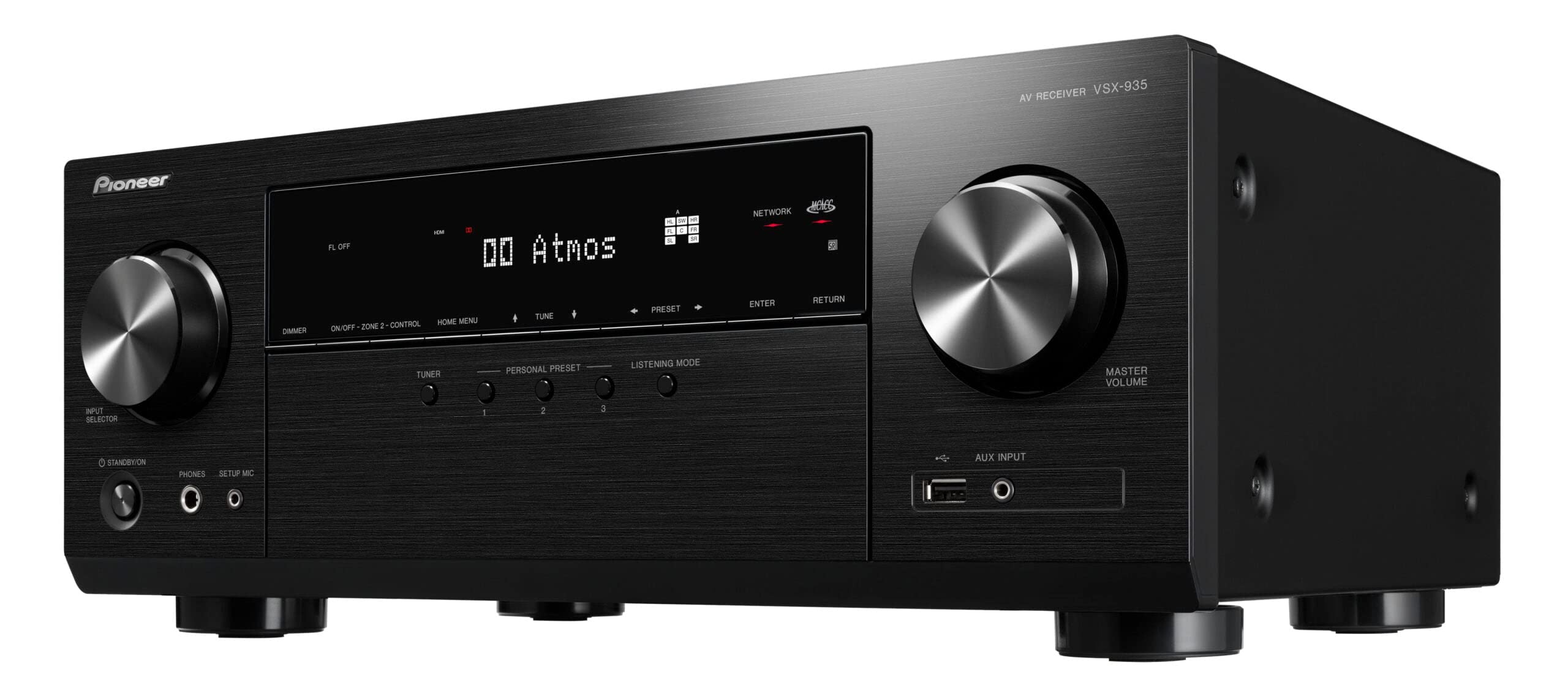
The Pioneer VSX-935 is a 7.2-channel receiver with HDMI 2.1 support for 8K60 and 4K120 pass-through, making it one of the most affordable entry points for gaming-oriented Atmos setups. It includes Dolby Atmos Height Virtualization for simulating overhead effects without ceiling speakers and supports DTS:X and multi-room streaming via Chromecast and AirPlay 2.
The unit delivers crisp, dynamic audio with good dialogue clarity, and the dual-zone output allows a second audio source in another room. A clear front-panel display with adjustable brightness helps in dim theaters. Users upgrading from much older receivers consistently praise the detailed sound and improved movie immersion.
The Bluetooth implementation is two-way but unreliable — some users find the menu navigation for Bluetooth pairing frustrating. A minority of units arrived with defects, and the firmware user interface feels outdated. For buyers who want HDMI 2.1 at the lowest entry price and are willing to work through interface quirks, the VSX-935 gets the job done.
Why it’s great
- HDMI 2.1 with 8K60 and 4K120 at entry-level price
- Dolby Atmos Height Virtualization included
- Dual-zone audio output for second room
Good to know
- Two-way Bluetooth pairing is unreliable and menu-heavy
- Some units arrive with defects; firmware interface outdated
11. WiiM Amp Ultra
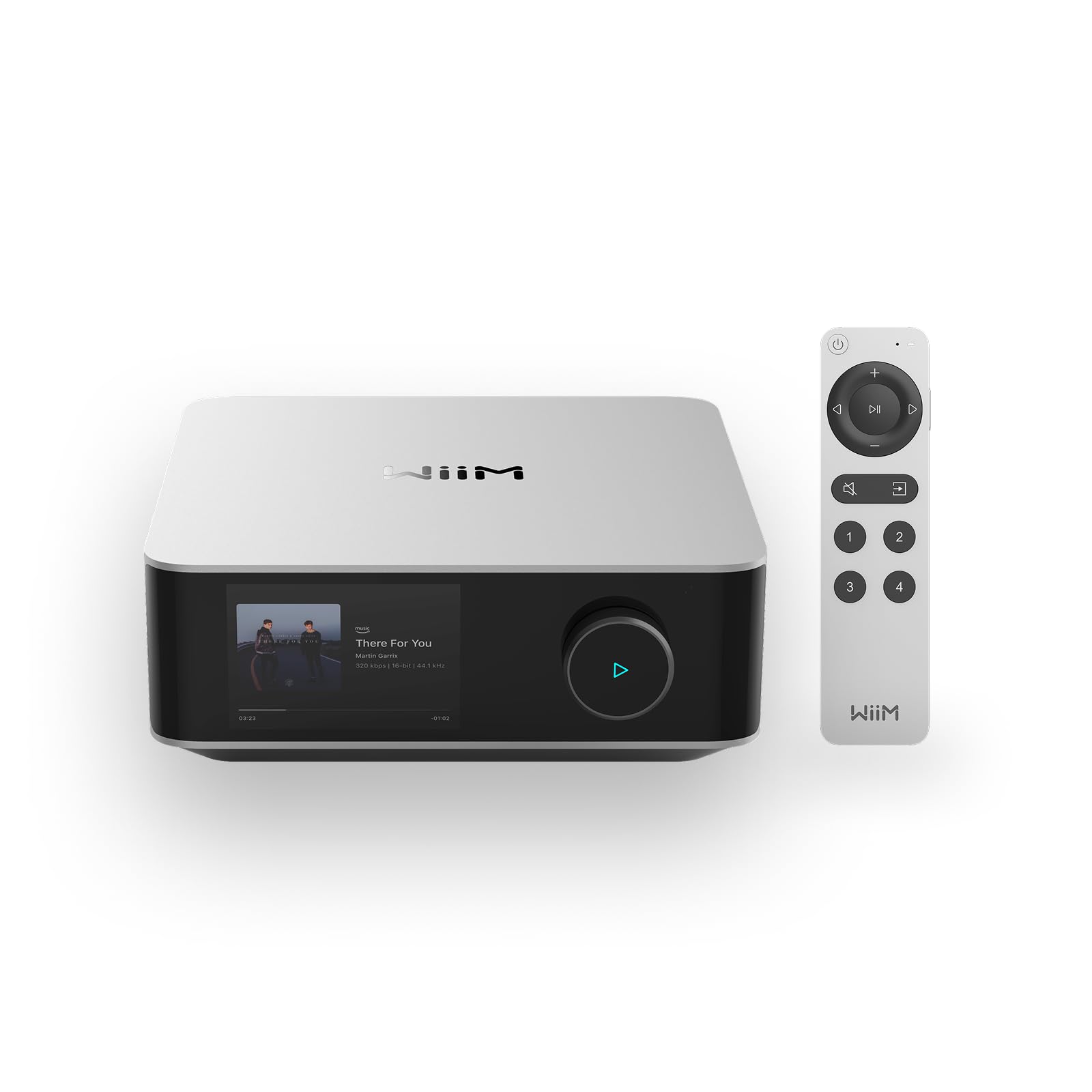
The WiiM Amp Ultra is a 100-watt-per-channel streaming amplifier, not a traditional AV receiver with multiple HDMI inputs and surround processing. It drives up to four passive speakers in a stereo or 2.1 configuration and uses an ESS ES9039Q2M DAC with dual TI TPA3255 amps for ultra-low distortion measured at -106 dB THD+N. RoomFit room correction auto-calibrates the sound based on your space.
HDMI ARC input connects to your TV for audio return, and the 3.5-inch touchscreen displays album art and system settings. Wi-Fi 6 and Bluetooth 5.3 with LE Audio ensure fast, stable streaming from Spotify, TIDAL, Qobuz, Amazon Music, and Roon. The included voice remote and full control via the WiiM Home app make operation straightforward.
This is not an Atmos receiver — it lacks surround decoding, height channels, and multiple HDMI inputs. It also does not support AirPlay. For buyers looking to upgrade a stereo music system with room correction and high-resolution streaming, the Amp Ultra is a superb all-in-one solution. For full Atmos surround, look elsewhere.
Why it’s great
- ESS SABRE DAC with -106 dB THD+N for clean stereo
- RoomFit EQ auto-calibrates to your listening space
- Touchscreen interface with Wi-Fi 6 and Bluetooth 5.3
Good to know
- Not an Atmos receiver — stereo/2.1 only
- No AirPlay support; no multiple HDMI inputs
FAQ
Should I buy a 7.1.2 or 5.1.4 Atmos receiver for my room?
Can I add height speakers to an existing 5.1 receiver without buying a new one?
Is Dirac Live worth the extra cost over Audyssey or YPAO?
What is the difference between HDMI eARC and regular ARC?
Do I need an external amplifier for 7.1.4 Atmos?
Final Thoughts: The Verdict
For most users, the atmos av receiver winner is the Onkyo TX-RZ50 because it combines Dirac Live room correction, THX certification, and 11.2-channel processing at a price that undercuts competitors with similar features. If you want Sony’s 360 Spatial Sound Mapping in a 9.2-channel package, grab the Sony STR-AZ3000ES. And for budget-conscious buyers who still want HDMI 2.1 gaming support, nothing beats the Denon AVR-S970H.