
Our readers keep the lights on and the weekend projects moving. As an Amazon Associate, I earn from qualifying purchases.
Adding overhead channels to a home theater is the single biggest upgrade you can make for 3D audio immersion. Dolby Atmos requires speakers that project sound directly downward or at a precise angle toward the listening position, turning a flat surround mix into a true bubble of audio where rain falls, helicopters circle, and objects move with spatial believability. The challenge is choosing between in-ceiling designs, up-firing modules, and dedicated elevation speakers — each with specific installation, driver, and crossover demands that determine whether the effect lands or disappoints.
I’m Rikta — the co-founder and writer behind FitlyFast. I have spent hundreds of hours analyzing in-ceiling speaker specifications, decoding frequency response graphs, and cross-referencing real-world user impressions to separate marketing claims from actual performance in Dolby Atmos installations.
This guide examines nine purpose-built options across budget, mid-range, and premium tiers, explaining which driver sizes, dispersion technologies, and mounting configurations deliver the most convincing overhead soundstage. Whether you are retrofitting an existing 5.1 system or building a dedicated 7.1.4 setup, the atmos ceiling speakers featured here will help you choose the right pair for your room dimensions, receiver power, and installation constraints.
How To Choose The Best Atmos Ceiling Speakers
Selecting ceiling speakers for Dolby Atmos involves more than just matching the cutout diameter. The woofer size, tweeter pivot range, cabinet depth, and sensitivity rating all determine whether the overhead channel integrates seamlessly with your existing floor-level speakers. Below are the most critical factors to evaluate before making a purchase.
Woofer Size and Low-Frequency Extension
An 8-inch woofer can typically reach down to 45 Hz or lower, adding weight to explosions and rumble to aircraft flyovers. Smaller 6.5-inch drivers bottom out around 60 Hz and require a subwoofer crossover at 80 Hz, which many receivers already set. If your receiver has a dedicated crossover for height channels, the larger woofer offers a fuller sound without demanding a subwoofer to fill the gap. Rooms with low ceilings (under 8 feet) can still benefit from the 8-inch driver because the reduced distance from the listener preserves the perception of bass weight.
Angled Drivers and Tweeter Directivity
An in-ceiling speaker with a fixed flat baffle fires sound straight down, which works only if the listening position is directly beneath the speaker. A 15-degree angled driver tilts the entire driver assembly toward the listening area, directing both midrange and treble energy where you sit. Pivoting tweeters add another layer of control: you can aim the high frequencies toward the center of the room without moving the whole speaker. Speakers with fixed baffles and no tweeter pivot are best reserved for rooms where the seats are directly under each ceiling opening.
Installation Depth and Ceiling Clearance
Mounting depth is the distance from the ceiling surface to the back of the speaker. Most modern homes have standard 2×6 joists providing about 5.5 inches of depth. Speakers that require more than 5 inches of clearance may not fit without creating a soffit or using a shallow back box. Always measure your available depth before cutting. Additionally, many in-ceiling designs require a minimum distance from insulation; polyfill or fiberglass backing can prevent resonance and improve bass response in sealed cavities.
Quick Comparison
On smaller screens, swipe sideways to see the full table.
| Model | Category | Best For | Key Spec | Amazon |
|---|---|---|---|---|
| Klipsch CDT-5800-C II | Premium In-Ceiling | Pivoting driver precision | 8″ Cerametallic w/ horn-loaded tweeter | Amazon |
| Bose 791 In-Ceiling II | Premium In-Ceiling | Wide coverage with Stereo Everywhere | 7″ woofer + dual 1″ tweeters | Amazon |
| SVS Prime Elevation | Premium Elevation | Versatile multi-angle mounting | 4.5″ mid-woofer + 1″ aluminum dome tweeter | Amazon |
| Sonos In-Ceiling by Sonance | Premium In-Ceiling | Sonos Amp ecosystem integration | 165 mm woofer + 25 mm tweeter | Amazon |
| Polk Audio 80F/X-RT | High-End In-Ceiling | Vanishing grille design | 8″ Dynamic Balance woofer + dual 3/4″ tweeters | Amazon |
| Klipsch RP-500SA | Premium Up-Firing | Up-firing on tower speakers | 5.25″ Spun Copper Cerametallic woofer | Amazon |
| Monoprice 2-Way Carbon Fiber 8″ | Mid-Range In-Ceiling | Value with 15° angled drivers | 8″ carbon fiber woofer + 1″ silk dome tweeter | Amazon |
| Polk Monitor XT90 | Value Height Add-On | Top-mounted on bookshelf/tower speakers | 4″ Dynamically Balanced woofer | Amazon |
| Yamaha NS-IW280CWH | Budget In-Ceiling | Affordable 3-way with swivel tweeter | 6.5″ polypropylene mica cone woofer | Amazon |
In‑Depth Reviews
1. Klipsch CDT-5800-C II

The Klipsch CDT-5800-C II combines an 8-inch Cerametallic woofer with a pivoting horn-loaded 1-inch titanium tweeter, delivering controlled dispersion that outclasses most competitors. The Controlled Dispersion Technology (CDT) lets you angle the entire driver assembly toward the listening position, which is essential when the ceiling speaker is not directly above the seating area. Real buyers consistently report that these speakers punch well above their price point, with several describing them as a massive upgrade over the Micca M-8C for Dolby Atmos performance.
The treble and midbass attenuation switches on the front baffle allow fine-tuning for room acoustics without needing receiver EQ. Users pairing these with a Pioneer SC-LX801 in a 9.2 configuration note that the magnetic grilles sit flush and look fantastic, while the pivoting mechanism simplifies aiming during installation. The 8-inch woofer extends down to 60 Hz, which means you can cross over at 80 Hz with the subwoofer and still get satisfying weight from overhead effects without sounding thin.
Buyers upgrading from entry-level in-ceiling speakers report a night-and-day difference in clarity and directional accuracy for Atmos content. The horn-loaded tweeter provides the efficiency (92 dB sensitivity) that many receivers need to drive four or more height channels without straining. For anyone building a dedicated 7.1.4 system, these represent the sweet spot where performance meets value without requiring custom back boxes or external amplification.
Why it’s great
- Pivoting 8-inch woofer and horn tweeter allows precise aiming toward the listening position
- Treble and midbass attenuation switches provide on-board room tuning
- High 92 dB sensitivity reduces amplifier load
Good to know
- Only available individually, not as a pair in the box
- Requires a minimum 9.5-inch cutout diameter
2. Bose Virtually Invisible 791 In-Ceiling Speaker II

The Bose 791 In-Ceiling II uses a 7-inch woofer paired with two 1-inch tweeters positioned on opposite sides of the baffle, a design Bose calls Stereo Everywhere. This layout spreads sound horizontally across the room, which is ideal for larger spaces where the listening area is not concentrated in a single sweet spot. Owners report that the frequency response reaches down to approximately 40 Hz, which is unusually deep for a 7-inch driver and helps the overhead channel blend with the subwoofer crossover.
Installation is straightforward thanks to the standard dogleg clamps and magnetically attached grilles. The near-bezel-less construction means the speaker virtually disappears once painted. Users upgrading from mid-range Sonance 6.5-inch speakers describe a significant improvement in overall clarity and bass presence. The 4.4-inch mounting depth fits most ceiling cavities, and spring-loaded binding posts accept bare wire or banana plugs.
The primary trade-off is the premium price tag. Some buyers feel the improvement over the Bose 500 series is marginal for the cost difference. Still, for those who prioritize seamless aesthetics and room-filling overhead sound without requiring perfect seating placement, the 791 delivers a level of integration that few other in-ceiling models can match. The Stereo Everywhere design also works well for whole-home audio beyond home theater.
Why it’s great
- Dual tweeter configuration provides wide horizontal coverage across the room
- Deep frequency response (approx. 40 Hz) for an in-ceiling design
- Near-bezel-less grille design blends invisibly into painted ceilings
Good to know
- Premium price may not justify the upgrade from Bose’s own 500 series
- Requires careful painting of grilles to avoid obstructing the tweeter openings
3. SVS Prime Elevation Speaker (Pair)
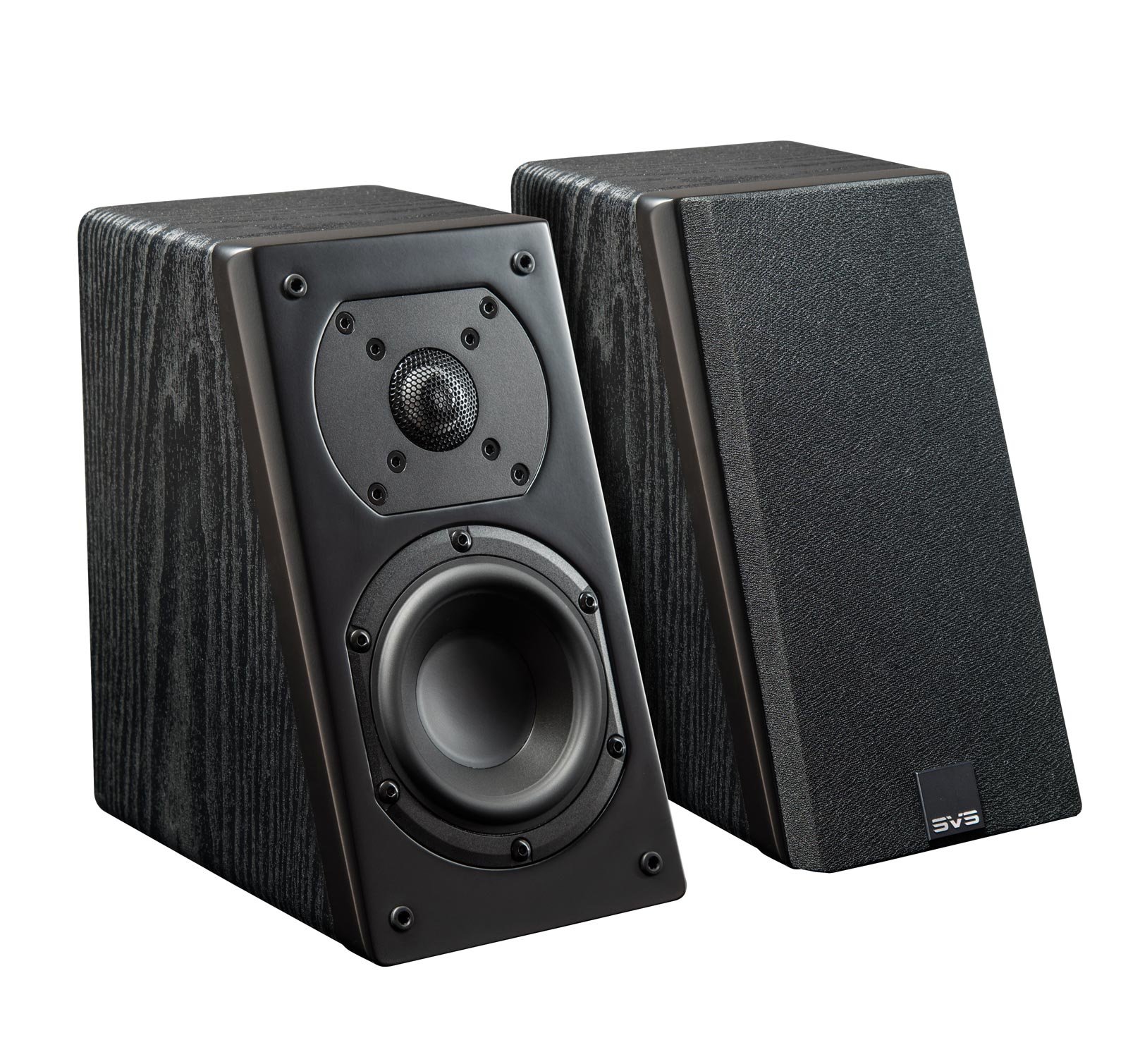
The SVS Prime Elevation is not an in-ceiling speaker in the traditional sense — it is a dedicated elevation module that mounts on walls or ceilings using a patent-pending multi-angle bracket. Unlike up-firing designs that bounce sound off the ceiling, this speaker fires directly toward the seating area, eliminating the frequency response dips and room-dependence issues that plague reflective Atmos implementations. The 4.5-inch mid-woofer and 1-inch aluminum dome tweeter deliver full-range sound down to about 50 Hz.
Real-world users consistently praise the build quality, noting that the cabinet matches the aesthetics of high-end brands like B&W and Definitive Technology. The multi-angle bracket allows the speaker to be mounted as a front height, side surround, rear surround, or directly overhead on the ceiling. Widescreen Review gave it a 10 out of 10, specifically highlighting its performance as a height channel speaker. The SoundMatch crossover ensures seamless integration with the Prime series floor-standing and bookshelf speakers.
Installation can be tricky on drywall because the bracket requires solid anchoring. Bare wire connections are recommended over banana plugs or U-spades due to the tight space behind the bracket. Once dialed in, the Prime Elevation creates a convincing overhead bubble that makes Atmos content feel genuinely three-dimensional. It is the top choice for anyone who wants the flexibility to reposition height channels later without cutting new ceiling openings.
Why it’s great
- Direct-firing design avoids the frequency limitations of up-firing/reflective Atmos
- Multi-angle bracket allows ceiling, wall, or shelf mounting in multiple orientations
- Full-range response down to 50 Hz with high sensitivity
Good to know
- Not a traditional in-ceiling speaker — requires surface mounting on wall or ceiling
- Bare wire is recommended; banana plugs do not fit easily behind the bracket
4. Sonos In-Ceiling by Sonance

The Sonos In-Ceiling by Sonance is optimized specifically for the Sonos Amp, making it the obvious choice for anyone already invested in the Sonos ecosystem. The 165 mm (6.5-inch) woofer and 25 mm (1-inch) tweeter are voiced to work with the Amp’s DSP platform, which uses Trueplay to automatically adjust the frequency response based on room acoustics. The measured frequency response reaches 36 Hz with DSP engaged, which is exceptional for an in-ceiling design and eliminates the need for a separate subwoofer in many rooms.
Owners report that the sound is crystal clear and comfortable for ambient listening, even at high volumes. The 110 dB maximum SPL at one meter ensures these can fill large rooms without distortion. Installation requires a 152 mm cutout diameter and 120 mm depth, which fits most ceiling cavities. The round grille is paintable and designed to disappear visually. Sonance, a well-regarded architectural speaker manufacturer, co-designed the drivers and crossover to Sonos specifications.
The primary limitation is the requirement for a Sonos Amp to unlock the full DSP tuning and wireless streaming capabilities. Without the Amp, these function as passive speakers that any receiver can drive, but you lose the Trueplay room correction and multi-room integration. For those who want a clean, wirelessly controlled whole-home audio system with Atmos-capable ceiling speakers, the Sonos-Sonance pairing offers a level of convenience and sound quality that is hard to replicate with separate components.
Why it’s great
- Trueplay optimization tailors sound to your specific room geometry
- 36 Hz low-end extension with DSP reduces subwoofer dependency
- Seamless integration with the Sonos ecosystem for multi-room streaming
Good to know
- Requires a Sonos Amp for full DSP and Trueplay function
- Premium pricing per pair, especially when paired with the Amp
5. Polk Audio 80F/X-RT In-Ceiling 2-Way (Pair)
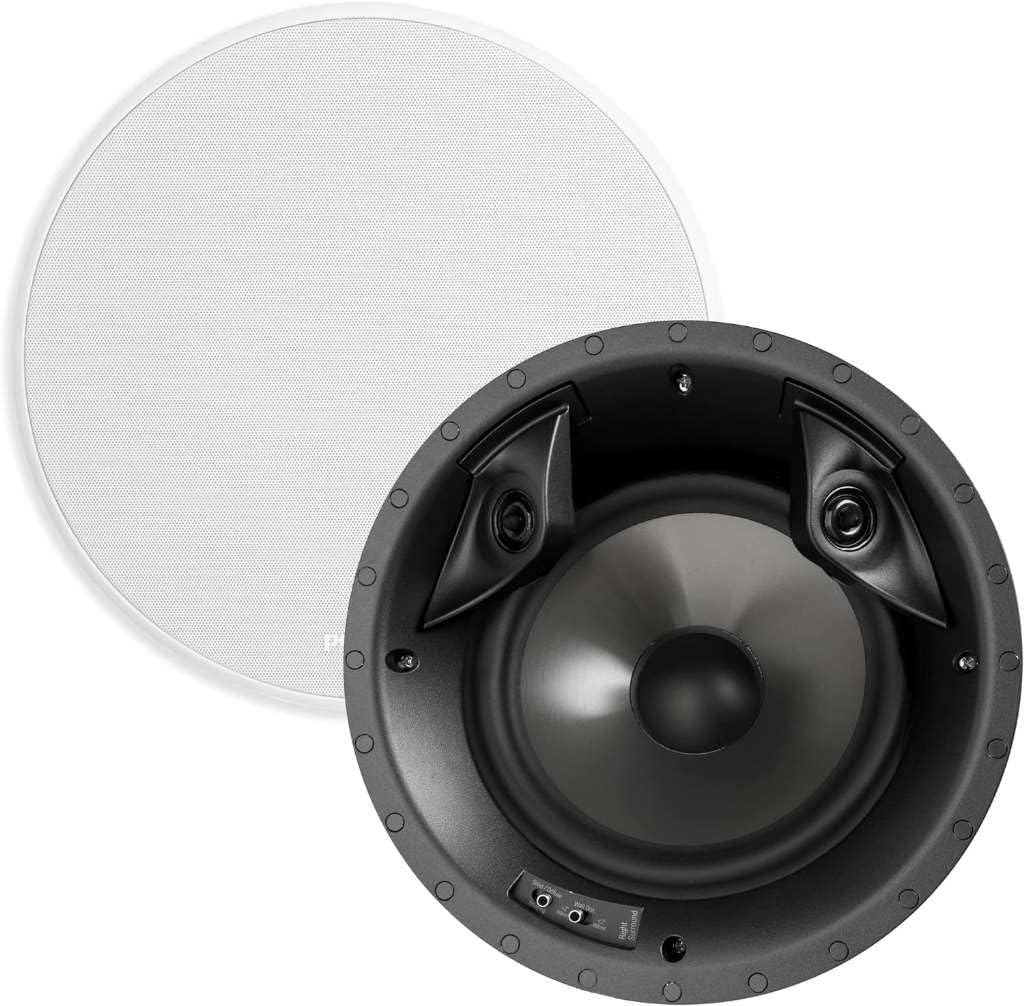
The Polk Audio 80F/X-RT is part of the Vanishing Series, designed to disappear both sonically and visually. An 8-inch Dynamic Balance woofer is paired with twin 0.75-inch tweeters, arranged to provide wide dispersion even in rooms with multiple seating rows. The detachable wafer-thin grille is paintable to match any ceiling color, and owners consistently say that after painting, the speaker becomes virtually invisible. The cutout diameter is 9-3/8 inches, and the mounting depth is 4-3/4 inches, fitting most standard ceiling cavities.
Sound quality is described as smooth and balanced, with enough bass weight to handle overhead explosions without sounding thin. Users with 15-foot vaulted ceilings report that these speakers fill the large space with clear, distinctive sound. The angled tweeters rotate to point toward the listening area, improving off-axis response. The 100-watt handling capacity pairs well with most mid-range to high-end AV receivers.
The biggest knock against the 80F/X-RT is that the Polk logo is stamped on the grille and is not removable before painting. Some owners find that the painted logo area creates a blank spot, which can be a minor cosmetic annoyance. Additionally, the lack of detailed top-end clarity compared to more expensive competitors means these are better suited for rear surround or height channels than for front mains. But for their intended role as immersive overhead Atmos speakers, they deliver excellent performance that seamlessly blends with Polk’s RTi series floor speakers.
Why it’s great
- Wafer-thin paintable grille virtually disappears into the ceiling
- 8-inch Dynamic Balance woofer provides solid low-end weight for overhead effects
- Rotatable tweeters improve off-axis dispersion for multi-row seating
Good to know
- Polk logo is stamped on the grille and cannot be removed before painting
- Does not offer the same detailed high-frequency clarity as premium competitors
6. Klipsch RP-500SA Reference Premiere (Pair)

The Klipsch RP-500SA is the most popular up-firing Atmos module on the market, designed to sit on top of floor-standing or bookshelf speakers and bounce sound off the ceiling. It features a 5.25-inch spun copper Cerametallic woofer and a 1-inch titanium LTS vented tweeter with a Hybrid Tractrix horn. The switchable crossover setting lets you choose between a Dolby Atmos up-firing mode (bypassing the internal crossover) and a surround sound mode for use as side or rear surrounds.
Real-world owners report that these speakers blend perfectly with the RP-8000F II towers and RP-504C II center. The sound is detailed and crisp, with the horn-loaded tweeter providing the presence that makes rain, wind, and helicopter blades feel real. For rooms with 8-foot ceilings, the up-firing effect is subtle but noticeable, though some users note that wall mounting the modules at ear height delivers a more convincing effect than placing them on tower speakers.
The sealed cabinet design limits bass extension below 100 Hz, so crossing over at 100 Hz is recommended. Some buyers feel the RP-500SA is overpriced compared to dedicated in-ceiling speakers, which can provide more convincing overhead localization. However, for renters or homeowners who cannot cut into the ceiling, the RP-500SA offers the simplest path to a 5.1.2 or 5.1.4 setup without drilling holes or running wires inside the ceiling.
Why it’s great
- Switchable crossover allows use as up-firing Atmos or traditional surrounds
- Premium piano finish and Tractrix horn provide Klipsch’s signature detailed sound
- No ceiling cuts or structural modifications required for installation
Good to know
- Up-firing effect is subtle and highly dependent on ceiling height and material
- Sealed design limits bass response; cross over at 100 Hz
7. Monoprice 2-Way Carbon Fiber In-Ceiling 8″ (Pair)

The Monoprice Alpha Series 8-inch in-ceiling speaker uses a carbon fiber woofer, a material typically reserved for more expensive speakers, to achieve lower mass and higher stiffness than polypropylene or paper cones. The result is higher sensitivity (more volume with less power) and lower distortion at high output levels. The 1-inch silk dome tweeter provides smooth treble without the harshness that some metal tweeters introduce. The 15-degree angled driver aims sound toward the listening area without needing a pivot mechanism.
Real buyers confirm that these speakers work exceptionally well as Atmos ceiling speakers. Audyssey calibration in one user’s system showed a flat EQ down to 40 Hz, which is remarkable for any in-ceiling design. The magnetic metal grilles are paintable and the built-in high-frequency attenuator switch (three settings) allows treble adjustment without receiver EQ. Users specifically note that the sound is clean, with no rattles or punchiness at reference volume levels.
The only common complaint is that one of the mounting tab screws can snap if over-tightened, so careful installation is needed. The template is hidden inside the box rather than printed on the outside, which some buyers find inconvenient. At this price point, the combination of 8-inch carbon fiber woofers, 15-degree angled baffle, and 160-watt handling capacity makes this the strongest value play for anyone building a budget-conscious 5.1.4 system.
Why it’s great
- Carbon fiber woofer provides low distortion and high sensitivity
- 15-degree angled driver improves directivity toward the listening position
- Extended low-frequency response (40 Hz flat) surpasses many more expensive models
Good to know
- Mounting tab screws can snap if over-tightened
- Installation template is hidden inside the packaging
8. Polk Monitor XT90 Height Speaker Pair

The Polk Monitor XT90 is a compact height speaker designed to sit on top of the Monitor XT20 bookshelf speakers or XT60/XT70 towers, firing upward toward the ceiling. It features a 4-inch Dynamically Balanced woofer and is Dolby Atmos and DTS:X certified. The XT90 is timbre-matched with the entire Monitor XT series, so it blends seamlessly with Polk’s entry-level floor-standing and center channel speakers. The finish is midnight black, matching the modern aesthetic of the Monitor line.
Owners report that the XT90 delivers clear and present overhead effects, with Starship flyovers in sci-fi movies sounding convincing. Up-firing performance is dependent on ceiling material (flat, non-textured ceilings work best). Some users note that the effect is subtle, especially compared to in-ceiling speakers, but the convenience of simply placing the speakers on top of existing towers cannot be overstated. The build quality is solid, and the keyhole slots allow wall mounting if you prefer the elevation channel approach.
The 4-inch woofer limits low-frequency output, and the XT90 is best suited as a pure height effects channel with a crossover at 120 Hz or higher. For the price, it is a legitimate way to add a 5.1.2 setup without cutting holes or running new wires. Buyers who want a more dramatic Atmos experience should consider the larger Monoprice 8-inch in-ceiling option, but for those with limited space or a rental situation, the XT90 is a practical, well-built entry point.
Why it’s great
- Dolby Atmos and DTS:X certified with timbre-matched Monitor XT series
- No ceiling cutting required — sits on top of existing Polk towers or bookshelves
- Can also be wall-mounted using built-in keyhole slots
Good to know
- Subtle overhead effect depends heavily on ceiling height and texture
- 4-inch woofer limits bass extension; requires a high crossover setting
9. Yamaha NS-IW280CWH In-Ceiling Speaker (Pair)

The Yamaha NS-IW280CWH is a 3-way in-ceiling speaker featuring a 6.5-inch polypropylene mica cone woofer and dual 3/4-inch dome tweeters with SoundMax technology. The angled woofer and aim-able tweeters allow you to direct sound toward the listening area, which is rare at this price point. The frame size is 10.2 inches, and the 100-watt maximum input makes it compatible with most consumer AV receivers. The paintable aluminum grille and protective cover simplify installation.
Real owners consistently praise the easy DIY installation, with the included cardboard template making ceiling cutting straightforward. The spring-loaded wire connectors accept banana plugs or bare wire, and the cosmetic grille snaps into place without tools. Sound quality is described as good for the price, with one audiophile noting that with a powered subwoofer, the speakers deliver surprisingly good performance for movies and music. The swivel tweeter provides wide dispersion, and the narrow bezel is aesthetically clean.
The primary trade-off is that the 6.5-inch woofer cannot match the low-end extension of 8-inch designs. High-frequency bass is present, but deep impact requires subwoofer integration. Some users found the sound upgrade minimal when used strictly as rear surrounds, but for the cost, this pair offers an affordable way to add any speaker to a multi-room audio system or to build a budget-friendly 5.1.2 Atmos setup when paired with a subwoofer. For those exploring ceiling-mounted Atmos on a tight budget, the Yamaha NS-IW280CWH provides a solid foundation.
Why it’s great
- Angled woofer and aim-able tweeters improve sound directionality
- Easy DIY installation with included cardboard template and snap-on grille
- Good value for a 3-way in-ceiling design with dual tweeters
Good to know
- 6.5-inch woofer lacks the bass weight of 8-inch alternatives
- Requires a subwoofer for satisfying low-frequency performance
FAQ
What size ceiling speaker is best for Dolby Atmos?
Can I use any in-ceiling speaker for Dolby Atmos?
Should I use in-ceiling speakers or up-firing modules for Atmos?
Final Thoughts: The Verdict
For most users, the best atmos ceiling speakers winner is the Klipsch CDT-5800-C II because it combines an 8-inch pivoting Cerametallic woofer with a horn-loaded titanium tweeter, delivering controlled dispersion and high sensitivity that makes Atmos effects convincingly overhead. If you want a versatile mounting option and direct-firing precision without cutting a ceiling hole, grab the SVS Prime Elevation. And for a budget-conscious 5.1.4 system that still delivers 8-inch bass extension and excellent value, nothing beats the Monoprice Carbon Fiber 8-Inch.