
Our readers keep the lights on and the weekend projects moving. As an Amazon Associate, I earn from qualifying purchases.
A home theater system that lacks height is like a 2D movie in a 3D world: the action stays flat on a plane instead of wrapping around you. Adding dedicated elevation speakers—whether they fire upward from the floor or are embedded in the ceiling—transforms the experience, making rain feel like it’s falling from your rafters and helicopters sound like they’re circling overhead instead of just passing across the screen. That third dimension is the single largest upgrade you can make to a traditional 5.1 or 7.1 setup.
I’m Rikta — the co-founder and writer behind FitlyFast. I’ve spent hundreds of hours analyzing the acoustic physics, driver materials, and crossover designs that separate a convincing overhead sound bubble from a muffled blur that you can barely localize.
Whether you choose a modular add-on, a dedicated ceiling mount, or a floor-standing tower with integrated up-firing drivers, the right atmos speakers will convincingly trick your ears into hearing sounds that originate above your head, not in front of it.
How To Choose The Best Atmos Speakers
Picking the right height speaker for Dolby Atmos means balancing the type of driver, the shape of the cabinet, and how that speaker integrates with your existing receiver and room. The most common mistake beginners make is assuming any small speaker placed high on a wall will produce a convincing overhead effect — in reality, the dispersion pattern and crossover slope dictate whether the sound reflects off the ceiling cleanly or just blends into the stereo signal.
The Three Form-Factors: Up-firing, In-ceiling, and Tower-Mounted
Up-firing modules sit on top of your bookshelf or floor-standing speakers and fire sound toward the ceiling, relying on a hard, flat ceiling surface to reflect the signal down to your ears. These work best with ceilings between 7.5 and 9 feet and a smooth texture. In-ceiling speakers are the most convincing option because they eliminate the reflection variable entirely — you simply cut a hole in the drywall and mount the driver flush with the ceiling. Tower-mounted drivers are integrated into the top of a floor-standing cabinet and function the same as up-firing modules but in a single tall box.
Driver Composition and Dispersion Control
A dedicated Atmos speaker should use a concentrically mounted tweeter and woofer so that the high and low frequencies originate from the same point. This prevents comb filtering and keeps the reflected sound coherent. Look for a tweeter that can pivot or swivel in up-firing modules — fixed tweeters limit your ability to aim the sound toward the sweet spot. For in-ceiling models, a pivoting woofer and swiveling tweeter let you angle the sound toward the listening position even after installation.
Timbre Matching with Your Existing Speakers
If your left, center, and right speakers use a specific tweeter material — silk dome, titanium dome, or ceramic — you want your height speakers to use the same material, or at least a voicing that the receiver’s room correction software can smooth out. Many manufacturers offer timbre-matched Atmos modules that share the same driver materials and crossover characteristics as their floor-standing siblings, which keeps sounds from changing tone as they move across the soundstage.
Quick Comparison
On smaller screens, swipe sideways to see the full table.
| Model | Category | Best For | Key Spec | Amazon |
|---|---|---|---|---|
| Polk Monitor XT90 | Up-firing Pair | Adding height to Polk towers | 4″ Dynamically Balanced Woofer | Amazon |
| Yamaha NS-IW280CWH | In-ceiling Pair | Budget in-ceiling install | 6.5″ polypropylene mica cone woofer | Amazon |
| Yamaha NS-IC800 | In-ceiling Pair | Powerful ceiling surrounds | 8″ woofer, 140W | Amazon |
| Klipsch CDT-5800-C II | In-ceiling Single | High-output Atmos ceiling | 8″ pivoting Cerametallic woofer | Amazon |
| Polk Monitor XT60 | Tower Speaker | Full-range floor-standing | 6.5″ woofer + dual passive radiators | Amazon |
| ELAC Debut 2.0 A4.2 | Up-firing Module | Balanced, neutral sound | 4″ aramid fiber concentric driver | Amazon |
| Klipsch RP-500SA | Up-firing/Surround Pair | Cinematic horn-loaded height | 5.25″ Cerametallic spun copper woofer | Amazon |
| Hisense AX5140Q Soundbar | Soundbar + Rears | All-in-one Atmos soundbar system | Up-firing front & rear, 6.5″ sub | Amazon |
| Sonos In-Ceiling by Sonance | In-ceiling Pair | Whole-home Sonos ecosystem | 6.5″ woofer, 25mm tweeter, Trueplay | Amazon |
In‑Depth Reviews
1. ELAC Debut 2.0 A4.2 Dolby Atmos Module Speakers

The ELAC Debut 2.0 A4.2 uses a concentric driver — a 0.5-inch polymer tweeter nested inside a 4-inch aramid fiber woofer — so the high and low frequencies originate from the same point in space. This geometry eliminates the phase offset that plagues side-by-side driver designs, and it makes the reflected ceiling sound feel like it’s actually dropping down from above rather than bouncing off two separate surfaces. The aramid fiber cone is stiffer than polypropylene, giving it cleaner midrange and better damping when an explosion rumbles through the height channels.
Build quality is exceptional for an add-on module. The cabinet is thick MDF with a black vinyl wrap that blends seamlessly with the Debut 2.0 floor-standing lineup. Customers who paired these with ELAC towers reported that the timbre match is virtually perfect — sounds move from the main stage to the height layer without any tonal shift. In a 5.1.2 configuration with a Denon X3600H, the sense of immersion is dramatic; rain and overhead pan effects are precisely localized without sounding diffuse.
The main trade-off is that the A4.2 works best with a flat, smooth ceiling between 7.5 and 9 feet. Cathedral ceilings or acoustic tile surfaces will scatter the reflection and reduce the effect. If your room has a textured popcorn ceiling, you’ll lose coherence in the reflected wave, and you should consider in-ceiling options instead. For anyone with a standard drywall ceiling, these modules deliver the most natural, full-bodied overhead sound in the mid-range price tier.
Why it’s great
- Concentric driver design eliminates phase smear and creates pinpoint overhead imaging.
- Aramid fiber cone provides excellent stiffness and low distortion compared to polypropylene.
- Seamless voicing with ELAC Debut 2.0 towers and bookshelves for cohesive soundstage.
Good to know
- Reflection-based effect requires a flat, smooth ceiling between 7.5 and 9 feet to work optimally.
- Not as convincing as dedicated in-ceiling mounted speakers for pinpoint object placement.
2. Klipsch RP-500SA Reference Premiere Dolby Atmos Speakers

The Klipsch RP-500SA is engineered for the aggressive, high-output cinema experience that Klipsch fans expect. Its 1-inch titanium LTS vented tweeter with a Hybrid Tractrix horn delivers crisp, extended highs that cut through the room without sounding harsh, while the 5.25-inch spun copper Cerametallic woofer handles mid-bass punch that other up-firing modules can’t match. The switchable crossover lets you toggle between Atmos duty and standard surround mode, giving you flexibility if you later decide to wall-mount them as side or rear surrounds.
Customer reports highlight how well the RP-500SA blends with the Reference Premiere floor-standing line — particularly the RP-8000F II towers and RP-504C center. One reviewer noted that watching Twisters with this system made them feel like they were inside the storm, with objects panning overhead with precise localization. The premium scratch-resistant finish and solid cabinet construction also elevate the physical feel compared to entry-level Klipsch reference models.
The biggest decision point is placement. When sitting on top of towers in up-firing mode, the effect is dependably good with 8-foot ceilings, but wall-mounting them high on the front wall produces better overhead separation because the driver fires directly toward the listening area instead of relying on a ceiling reflection. The unit is sealed, so bass extension is limited — you should cross them over at 100 Hz or higher via your receiver’s crossover settings. If you want the most dramatic overhead slam from an up-firing design, this is the one to beat.
Why it’s great
- Horn-loaded titanium tweeter delivers high-output, low-distortion highs that cut through loud action scenes.
- Switchable crossover lets you repurpose the speakers as dedicated surrounds if you change your setup later.
- Premium copper woofer and scratch-resistant cabinet feel substantially more upscale than entry-level models.
Good to know
- Wall-mounting is required for best overhead separation; up-firing mode is adequate but not the primary design strength.
- The sealed enclosure limits bass extension, so a high crossover point (100 Hz) is recommended.
3. Klipsch CDT-5800-C II In-Ceiling Speaker

The CDT-5800-C II uses Controlled Dispersion Technology (CDT), which means both the 8-inch pivoting Cerametallic woofer and the 1-inch titanium tweeter can be angled after installation to aim the sound toward the main listening position. This is the absolute killer feature for Atmos in-ceiling speakers: you don’t have to guess the angle during the rough-in phase. After the drywall is cut and the speaker is mounted, you simply swivel the driver assembly to point at the center of your couch. The horn-loaded tweeter preserves the dynamic, punchy Klipsch house sound that action movie fans love.
Users who upgraded from basic in-ceiling models like the Micca M-8C reported a massive improvement in clarity and localization for Dolby Atmos content. The treble and mid-bass attenuation switches on the front baffle let you tailor the frequency response to compensate for placement in a reflective or absorptive room — a feature that reduces long-term listening fatigue. The 60 Hz frequency response means these speakers will produce meaningful low-end without a subwoofer, though a sub is still recommended for dedicated home theater use.
The magnetic grille sits flush with the ceiling and can be painted to match, which makes the installation vanish visually. For anyone building a serious Atmos system with ceiling-mounted drivers, this is among the most flexible and sonically capable options in its class.
Why it’s great
- Pivoting woofer and horn-loaded tweeter can be angled post-installation to dial in the sweet spot.
- Treble and mid-bass attenuation switches give you room-tuning flexibility without needing receiver EQ.
- Cerametallic woofer produces solid low-end extension down to 60 Hz, reducing the strain on a subwoofer.
Good to know
- Sold as a single speaker, so a four-speaker Atmos configuration requires two separate purchases.
- The horn-loaded design is less neutral for critical music listening compared to a soft-dome tweeter.
4. Sonos In-Ceiling by Sonance

The Sonos In-Ceiling by Sonance is not a standalone speaker — it is an architectural component designed to pair exclusively with a Sonos Amp. The combination unlocks Trueplay room-tuning, which measures the ceiling height, wall reflections, and furniture placement, then adjusts the DSP to flatten the frequency response and optimize the stereo image. The 6.5-inch woofer and 25-millimeter tweeter are voiced by Sonance to be neutral and articulate, making them suitable for both music and film dialog.
Users who installed these with a single Sonos Amp reported that you can power up to three pairs — six speakers total — for whole-home background audio or a discrete surround system. The grilles are paintable and designed to disappear into the ceiling, which is essential for living rooms where visible hardware is not welcome. The 120-millimeter mounting depth is manageable for most ceiling joist bays, and the included template makes the cutout straightforward for any DIY enthusiast with a drywall saw.
The biggest limitation is the price: at over for a single pair, plus the cost of a Sonos Amp (sold separately), this is a significant investment. The 90-degree nominal coverage angle means these speakers are best used in a defined listening area rather than for diffused whole-room fill. If you are already invested in the Sonos ecosystem and want invisible ceiling speakers that sound great and integrate without a separate processor, this is the cleanest solution. For pure value-performers, the ELAC or Klipsch options deliver more raw Atmos height power for the money.
Why it’s great
- Trueplay DSP calibration tailors the sound to your room’s specific ceiling height and reflective surfaces.
- Paintable, flush-mount grilles vanish into the ceiling for a completely unobtrusive installation.
- A single Sonos Amp can drive up to three pairs, enabling multi-room or surround configurations.
Good to know
- Requires a Sonos Amp (sold separately) to operate; cannot be driven by a standard AVR directly.
- Premium price makes this a luxury choice compared to similarly specified passive in-ceiling speakers.
5. Hisense AX5140Q 5.1.4ch Soundbar System
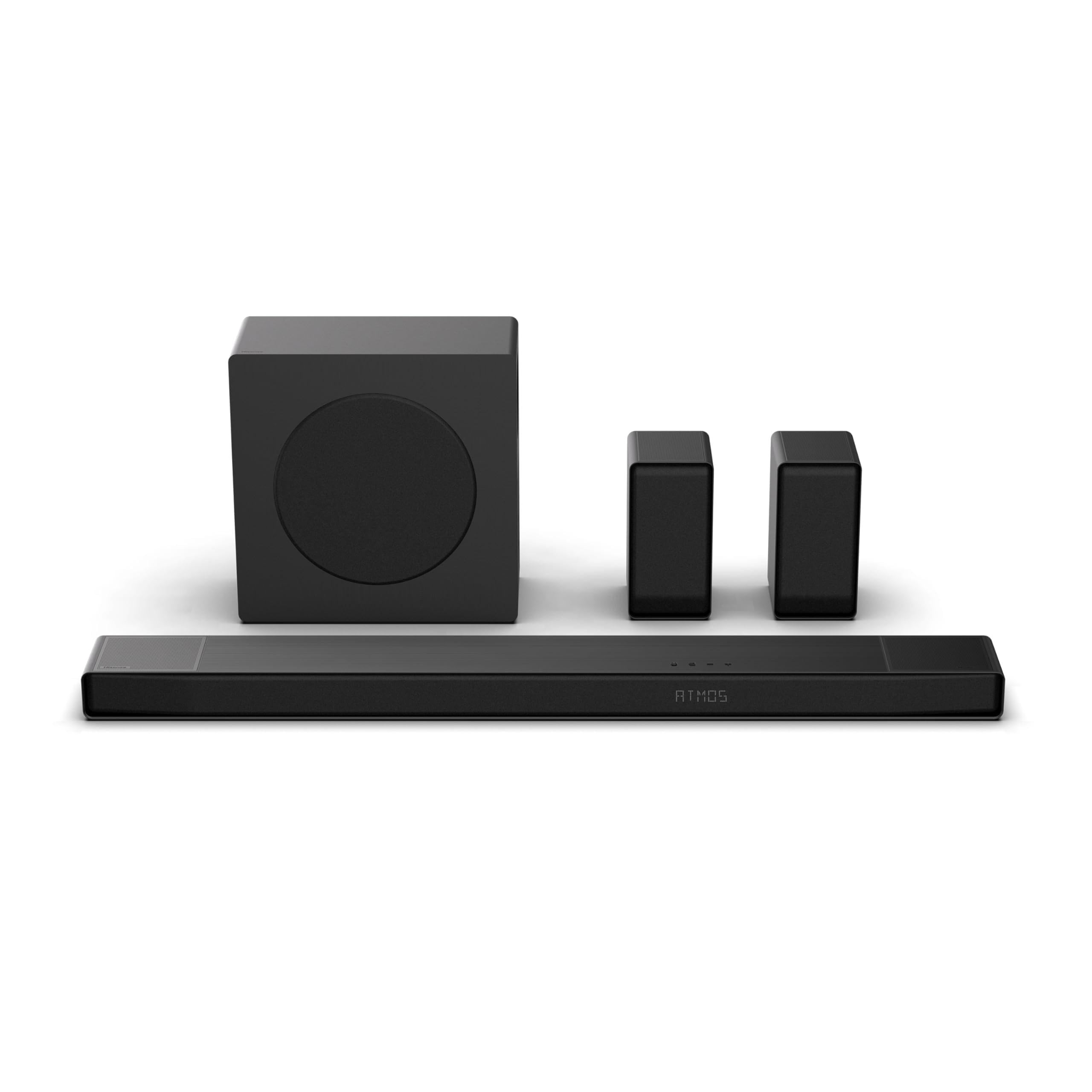
The Hisense AX5140Q is a 5.1.4-channel soundbar system that includes a wireless subwoofer and wireless rear speakers — each rear contains an up-firing driver for true height effects without needing to install ceiling speakers or separate modules. The two up-firing drivers in the main bar and the two up-firing drivers in the rears create a four-channel height array that, combined with Dolby Atmos and DTS:X processing, generates a genuinely immersive bubble around the listener. The 6.5-inch subwoofer hits down to 40 Hz, providing bass weight that complements the clear overhead effects.
Customer feedback consistently highlights how easy the system is to set up: HDMI eARC carries the Atmos signal from a modern TV through a single cable, and the wireless speakers pair automatically. The 7 EQ modes let you fine-tune for movies, music, news, and gaming without digging into a multi-step app menu. In medium-sized rooms, the upward-firing effect is surprisingly convincing — a reviewer noted that the system made them feel like they were inside a storm during an action movie, with rain clearly falling from above.
The trade-off is that the rear speakers are powered by the subwoofer wirelessly, so they are tethered to that component’s range. In very large rooms, the rear surround effect can feel slightly underpowered compared to a wired in-ceiling system. The upward-firing Atmos effect also depends on ceiling texture and height — popcorn or vaulted ceilings will scatter the reflected sound. For renters or anyone who cannot cut holes in their ceiling, the AX5140Q delivers a convincing 5.1.4 experience straight out of the box with no drilling required.
Why it’s great
- True 5.1.4 layout with dedicated up-firing drivers in both the main bar and the rear speakers.
- Wireless subwoofer and rears eliminate cable runs, making setup quick and clean.
- HDMI eARC carries uncompressed Atmos audio through a single cable with no lip-sync issues.
Good to know
- Rear speakers are powered via the subwoofer, limiting placement range in very large rooms.
- Up-firing Atmos effect can be inconsistent with textured or vaulted ceilings.
6. Polk Monitor XT90 Height Speaker Pair

The Polk Monitor XT90 is the dedicated height module for the Monitor XT series, and it is explicitly designed to sit on top of the XT60 towers or XT20 bookshelves. The 4-inch Dynamically Balanced woofer is timbre-matched to the larger drivers in the floor-standing models, so when a sound effect pans from the front stage up to the ceiling, the tonal character remains consistent. The grille design matches the rest of the XT line, creating a visual stack that looks like a unified speaker rather than an add-on brick.
Users who paired the XT90s with XT70 towers and a Yamaha RX-V6A receiver reported a noticeable improvement in the height layer, particularly for overhead effects in films like Star Trek Beyond, where ships flying overhead felt clearly localized above the listening position. The keyhole slots on the back also allow wall-mounting if you prefer to place them high on the front wall instead of on top of your towers — a flexibility that not all add-on modules offer. The crossover is set to handle the height band without heavy bass, letting the main speakers and subwoofer handle the low frequencies.
The 4-inch woofer is smaller than the 5.25-inch driver found on the Klipsch RP-500SA or the 8-inch driver in the Yamaha NS-IC800, so the XT90s are best used in a smaller to medium-sized room where they won’t be asked to fill a large space. One customer noted that the effect was subtle when added to a 7.1 system — correct calibration and receiver room correction (like Yamaha YPAO) are essential to dial in the crossover and distance settings. For Polk loyalists who want a seamless, affordable Atmos upgrade to their existing Monitor XT setup, these modules are the obvious choice.
Why it’s great
- Timbre-matched to Polk Monitor XT series for seamless tonal blending during panning effects.
- Accepts both on-top placement and wall-mounting via built-in keyhole slots for flexible installation.
- Compact design stacks neatly on XT60 and XT70 towers without looking like an afterthought.
Best for
- The 4-inch woofer limits output in very large rooms; best suited to small and medium-sized home theaters.
- Subtle effect if not properly calibrated; receiver room correction is critical for optimal performance.
7. Polk Monitor XT60 Tower Speaker

The Polk Monitor XT60 is a floor-standing tower that uses a 1-inch tweeter, a 6.5-inch Dynamically Balanced woofer, and two 6.5-inch passive radiators to produce surprisingly deep bass without a port. The passive radiator design eliminates port noise and reduces cabinet resonance, giving the XT60 a clean, controlled low end that works well in small to medium rooms without requiring a subwoofer. While the XT60 is not an Atmos speaker in itself, it is DTS:X, Auro 3D, and Dolby Atmos compatible — meaning it can serve as the front left and right channels in a system where the height layer is handled by the XT90 modules.
Customer reports highlight that the sound signature is smooth and non-fatiguing, with a soft tweeter that takes some break-in time to open up. One reviewer noted that the XT60 works wonderfully with techno and rap music when paired with a Crown mono amp and SMSL PS200 DAC, describing the sound as “enclosed and portless” with a commercial feel. The passive radiators provide meaningful bass kick that some listeners prefer over ported designs because the low-end stays tight and doesn’t boom unevenly at different seating positions.
The physical cabinet is relatively compact for a tower — about the size of a large bookshelf on a stand — so the XT60 does not dominate a room visually. Two customers mentioned receiving units with minor cosmetic damage, suggesting the packaging could be more robust during shipping. If you are building a Polk Monitor XT series system and want floor-standing mains that can handle music and movies with authority while leaving the height channel to the XT90, the XT60 is the logical partner.
Why it’s great
- Dual passive radiators deliver tight, port-noise-free bass that doesn’t need a subwoofer in smaller rooms.
- Compact tower footprint fits comfortably in rooms where large floorstanders would be overwhelming.
- Timbre-matched to the XT series for seamless integration with XT90 height modules and XT30 center.
Good to know
- Soft tweeter may sound rolled-off to listeners accustomed to bright, horn-loaded treble.
- A few buyers have reported minor cabinet damage in transit due to packaging.
8. Yamaha NS-IC800 8-Inch In-Ceiling Speakers

The Yamaha NS-IC800 packs an 8-inch polypropylene mica cone woofer into an in-ceiling form factor, giving it significantly more low-end authority than the 6.5-inch models in Yamaha’s own lineup. The 140-watt maximum input handling means it can play loud without distortion, making it suitable for larger rooms where you need the height layer to keep up with tower speakers. The swiveling dome tweeter lets you aim the high frequencies toward the listening position even after the speaker is mounted flush, a critical feature for Dolby Atmos where tweeter alignment determines whether the reflection sounds pinpoint or vague.
Customers who installed these as rear surrounds in a 5.1 setup praised the easy flush-mount process — the included template and sturdy clamp system make cutting drywall and securing the speaker straightforward. One reviewer compared the NS-IC800 directly to comparably priced Polks and found the Yamaha superior in build quality, citing the full magnetic grille, enclosed electronics, and gold-plated spring binding posts as evidence of better engineering. The low-end punch was described as surprising for an in-ceiling design, with enough bass that a subwoofer is optional for music but still recommended for home theater LFE effects.
The trade-off is that the high-frequency extension tops out at 28 kHz, which is adequate for Dolby Atmos but not exceptional for high-resolution audio content. Some listeners found the treble a bit rolled off for critical music listening, preferring the NS-IC800 as a dedicated surround or height speaker rather than a primary music channel. If you need an in-ceiling speaker that can handle the height layer with authority and produce convincing low-end without a subwoofer crossover helping it, the NS-IC800 is one of the most robust options you can install in a standard ceiling cutout.
Why it’s great
- The 8-inch woofer provides deeper bass extension than typical 6.5-inch in-ceiling speakers without needing a subwoofer.
- Swiveling dome tweeter allows precise aiming of high frequencies for optimal Atmos reflection or direct sound.
- Robust build quality with magnetic grille, gold-plated posts, and enclosed electronics that reduce dust ingress.
Good to know
- High-frequency extension is decent but not exceptional for high-res music; best used as a surround/height channel.
- Deeper mounting depth requires verification that your ceiling joist bay can accommodate the 4.3-inch depth.
9. Yamaha NS-IW280CWH In-Ceiling Speaker System

The Yamaha NS-IW280CWH is a 3-way in-ceiling speaker that uses a 6.5-inch polypropylene mica cone woofer, two 3/4-inch dome tweeters, and a unique 10-inch frame size that provides more baffle area than typical 6.5-inch designs. The dual tweeters with SoundMax technology increase the high-frequency dispersion, which helps create a broader sweet spot — useful if your seating area is wider than a single chair. The swivel tweeter and angled woofer in a later iteration of this design give you the ability to aim the sound even after the speaker is set in the ceiling.
Customers repeatedly praised the value proposition, with several reviews noting that they purchased pairs for under and found the sound quality and build far exceeded expectations. The easy installation process — using the included template, cutting just outside the line, and snapping the speaker into place with spring-loaded connectors — was described as straightforward even for DIY beginners. As rear surrounds in a 5.1 setup, these speakers provide clear, detailed audio that blends well with more expensive front-stage speakers, though a subwoofer is definitely needed for low-end reproduction.
The main limitation is that the 100-watt maximum input is lower than the NS-IC800, so they won’t play as loud in large rooms without distortion. The polypropylene cone is less stiff than the aramid fiber used in the ELAC Debut 2.0, meaning midrange clarity is good but not reference-level. For budget-conscious buyers who want to add in-ceiling height channels to an existing system without cutting into the subwoofer or main speaker budget, the NS-IW280CWH offers impressive bang-for-the-buck per pair.
Why it’s great
- Very low cost per pair makes adding a four-speaker Atmos height layer financially feasible without compromising other channels.
- Dual tweeters create wider high-frequency dispersion, improving the off-axis sweet spot for group viewing.
- Spring-loaded binding posts and included template simplify installation for first-time ceiling speaker buyers.
Good to know
- The 100-watt maximum input is lower than competitors, limiting maximum output in large rooms.
- Polypropylene cone is less stiff than aramid fiber, so midrange detail is good but not audiophile-grade.
FAQ
Do Atmos speakers need a special receiver to work?
What is the ideal ceiling height for up-firing Atmos speakers?
Can I use bookshelf speakers as Atmos height speakers?
How many height speakers do I need for a good Atmos experience?
Should I buy up-firing modules or in-ceiling speakers?
Final Thoughts: The Verdict
For most users building a dedicated Atmos layer, the atmos speakers winner is the ELAC Debut 2.0 A4.2 because its concentric driver design delivers the most coherent reflected sound for a flat-ceiling room at a price that doesn’t force you to compromise on the main channels. If you want the highest output and most cinematic slam from an up-firing design, grab the Klipsch RP-500SA. And for an all-in-one solution that requires zero installation and still provides convincing height effects, nothing beats the Hisense AX5140Q.