
Our readers keep the lights on and the weekend projects moving. As an Amazon Associate, I earn from qualifying purchases.
The door to your attic is the single largest unsealed hole in your home’s thermal envelope, silently bleeding conditioned air every hour of the day. Whether you’re hauling holiday decorations down or trying to keep the upstairs bedrooms comfortable, the wrong attic door turns your ceiling into a drafty sieve. A well-chosen unit doesn’t just provide access — it becomes a structural insulator that stops air infiltration at the source.
I’m Rikta — the co-founder and writer behind FitlyFast. I’ve spent hundreds of hours analyzing insulation R-values, ladder weight ratings, rough opening tolerances, and installation hardware specifications across the attic door market to separate the energy-efficient solutions from the air-leaking alternatives.
This guide breaks down the critical specs — from R-factor insulation values to step load capacities and seal quality — that determine whether a attic door actually saves you energy or just gives you another access point to a hot attic.
How To Choose The Best Attic Door
Selecting the right attic door is a balancing act between insulation performance, structural load capacity, and installation compatibility with your existing ceiling opening. A mismatch in any of these three criteria will either waste energy or create a safety hazard.
R-Value and Insulation Integrity
The thermal resistance of the door itself is the primary barrier between your conditioned living space and the extreme temperatures of your attic. An uninsulated or poorly insulated door panel can raise your heating and cooling costs by as much as 20%. Look for doors with an R-value of at least 3.0 for basic protection, and R-10 or higher if you live in a climate with extreme seasonal swings. The insulation material — whether rigid foam, ceramic neoprene, or multilayer reflective barriers — must also be sealed at the perimeter to prevent air bypass.
Weight Capacity and Ladder Construction
Every pull-down attic ladder is rated for a maximum static load, typically between 250 and 375 pounds. This rating must account for your body weight plus anything you carry up or down. Type IAA ladders, which support up to 375 pounds, are the standard for residential use. The material — aluminum versus steel versus wood — affects both the weight of the ladder and its resistance to corrosion. Aluminum ladders are light enough to operate smoothly but must use heavy-duty hinges and diagonal bracing to prevent lateral wobble during ascent.
Rough Opening Dimensions and Fit
The rough opening in your ceiling dictates which attic door or ladder you can install. Standard openings are typically 22.5 inches by 54 inches or 30 inches by 54 inches, but many homes have non-standard sizes. Measure the width and length of the opening at the narrowest point before purchasing, and check whether the door’s mounting flanges are deep enough to reach the joists — especially if you have thick or double-layer drywall. A door that relies on drywall anchors instead of stud attachment is a structural weakness waiting to fail.
Quick Comparison
On smaller screens, swipe sideways to see the full table.
| Model | Category | Best For | Key Spec | Amazon |
|---|---|---|---|---|
| Louisville Ladder AL3040MG-R10 | Premium | Maximum Energy Efficiency | R-10 Insulated Door | Amazon |
| Vantic 10-Foot Aluminum | Mid-Range | Heavy-Duty Stability | 350 lb Capacity, Gas Rod | Amazon |
| Attic Tent AT-5 Cover | Insulation Cover | Existing Stair Seal | R-3.2, 30″x60″ Fit | Amazon |
| Remington Solar ThermoClimb | Insulation Cover | Zipper Access Insulation | R-3.8, 54″x25″x13″ | Amazon |
| Thctvous 10-Foot Aluminum | Mid-Range | Wider Non-Slip Steps | 350 lb, 3″ Treads | Amazon |
| AVGVLIJ Aluminum Attic Ladder | Budget-Friendly | Value Aluminum Build | 375 lb, 7.8-10.3′ Height | Amazon |
| VPXTA Aluminum Attic Ladder | Budget-Friendly | Quiet Operation | 380 lb, ANSI 14.9 | Amazon |
| Premier Access Doors 3000 Series | Access Panel | Wall/Ceiling Access | 20-Gauge Steel, 24×24 | Amazon |
| Premier Access Doors 2002 Series | Access Panel | Flush Mount Ceiling | 24×24, Deep Flanges | Amazon |
In‑Depth Reviews
1. Louisville Ladder AL3040MG-R10

The Louisville Ladder AL3040MG-R10 sits in a class of its own because it integrates a fully insulated door panel with an R-10 rating directly into the ladder assembly. Most attic ladders treat the door as an afterthought — a thin sheet of metal or wood that conducts heat freely. Louisville pairs that thick insulated door with a Type IAA aluminum ladder rated for 375 pounds, offering a 30-by-54-inch opening that is noticeably more spacious than the standard 22.5-inch-wide alternatives.
The ladder itself is built from heavy-duty aluminum with pre-drilled mounting holes, slip-resistant treads on every rung, and a top handrail that provides secure purchase when stepping onto the top steps. The weather stripping around the door perimeter seals tightly against the rough opening frame, eliminating the drafts that plague uninsulated doors. At 45 pounds, the aluminum frame is light enough for smooth operation yet rigid enough that users report zero flex under load.
Installation requires an exact 30-by-54-inch rough opening, which may demand framing adjustments in homes with standard 22.5-inch openings. The trade-off is meaningful: the wider opening improves carrying access for large storage bins and the insulated door delivers measurable energy savings. For homeowners prioritizing thermal efficiency and premium build quality, this is the clear performance leader.
Why it’s great
- R-10 insulated door seals against extreme attic temperatures.
- 375-pound Type IAA rating provides professional-grade load capacity.
- Wider 30×54 opening improves carrying access and storage room.
Good to know
- Premium price reflects the insulated door assembly.
- Rough opening is non-standard for many homes, requiring framing modifications.
2. Vantic 10-Foot Aluminum Attic Ladder
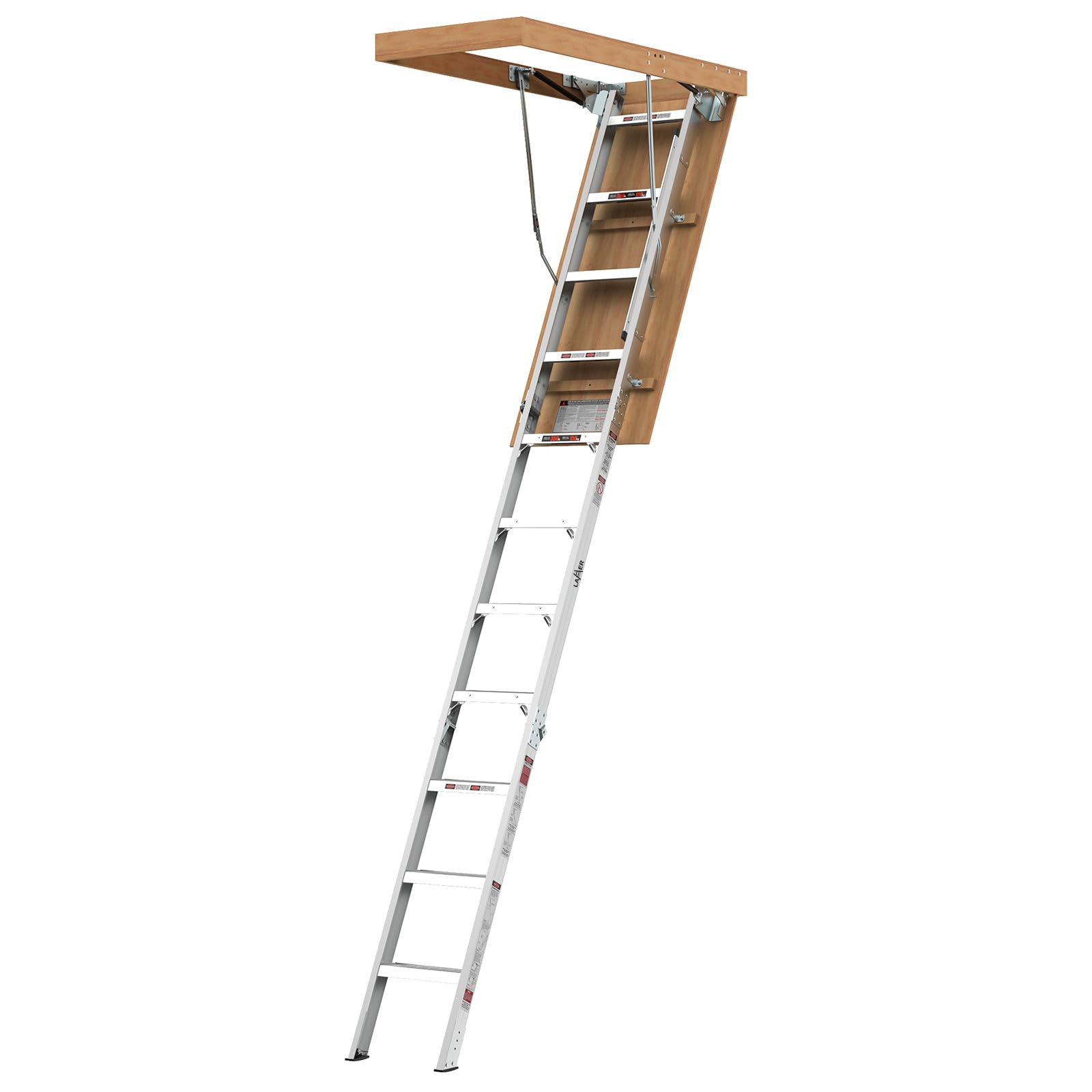
The Vantic 10-Foot Aluminum Attic Ladder brings a set of thoughtful engineering upgrades to the mid-range category, starting with an integrated gas rod that controls the descent of the ladder. This pneumatic damper prevents the sudden drop and jarring stop that many pull-down systems produce, which also reduces wear on the hinges over time. Diagonal stabilizing bars at the base of the ladder add lateral rigidity, addressing the common complaint of aluminum ladders wobbling during climbing.
The ladder is designed for a 22.5-by-54-inch rough opening and adjusts to ceiling heights from 7 feet 8 inches to 10 feet 3 inches. Solid pine side rails paired with a reinforced plywood base give the ladder a weight of 57 pounds — heavier than pure aluminum designs, but the added mass translates to a planted feel during use. The 3-inch slip-resistant steps exceed the width of most budget ladders, providing more secure footing for each rung.
Installation is straightforward with pre-drilled mounting holes and clear instructions, though the weight of the unit makes a two-person setup advisable. The ladder meets ANSI 14.9 safety standards, and the gas rod mechanism maintains a slow, controlled close even after multiple cycles. For homeowners who climb into the attic several times a week, the Vantic’s smooth operation and robust frame make it a durable daily driver.
Why it’s great
- Gas rod damper provides smooth, controlled lowering every time.
- Diagonal stabilizing bars eliminate lateral wobbling on the steps.
- Slip-resistant 3-inch treads improve footing confidence.
Good to know
- Heavier than pure aluminum ladders at 57 pounds.
- Gas rod may require occasional lubrication for long-term consistency.
3. Attic Tent AT-5 Cover

The Attic Tent AT-5 Cover is not a replacement attic door — it is a retrofit insulation tent that wraps around your existing pull-down ladder to stop air leakage at the source. Energy audits consistently identify the attic stair opening as the number one source of heat loss in a home, and this nylon tent with an R-3.2 insulation value creates a sealed barrier that prevents conditioned air from escaping into the attic while still allowing full access via the zippered opening.
Designed to fit ladders with a 30-by-60-inch rough opening and 1×5 or 1×6 side rails, the AT-5 installs in four steps: staple the mounting flange to the door frame, pull the tent over the ladder, seal the edges, and zip open when needed. Users report that the tent reduced attic temperatures by nearly 20 degrees Fahrenheit and cut return vent temperatures by 10 degrees, a measurable improvement in HVAC efficiency that translates directly to utility savings.
The primary limitation is the zipper durability — some users report zipper failure after extended use, though the tent itself remains functional. At roughly 4.5 pounds total weight, the AT-5 adds negligible load to the door while delivering meaningful thermal separation. For anyone whose existing attic ladder is still structurally sound but leaking air, this cover offers the highest return on investment per dollar spent of any product in this category.
Why it’s great
- Stops the #1 source of attic air leakage without replacing the ladder.
- Simple staple-and-seal installation takes under 30 minutes.
- Measurable reductions in attic temperature and HVAC load.
Good to know
- Zipper durability varies with frequency of use.
- Only fits 30×60 rough openings with specific rail sizes.
4. Remington Solar ThermoClimb

The Remington Solar ThermoClimb takes a similar insulation-tent approach to the Attic Tent but adds ceramic and neoprene material construction with an R-value of 3.8, slightly higher than the AT-5. Its dimensions — 54 inches wide by 25 inches deep by 13 inches tall — are designed to accommodate a wide range of stair sizes, and the adjustable Velcro straps allow for a tailored fit that cinches around the ladder frame without hard mounting hardware.
Where the ThermoClimb differentiates itself is in the material quality and the zipper mechanism. The ceramic-infused neoprene reflectivity helps block radiant heat transfer, while the heavy-duty zipper travels smoothly around the corners of the tent without binding — a common failure point on budget covers. Users report that after two years of seasonal use, the zipper continued to operate without snagging, and the insulation material showed no signs of degradation from the temperature extremes in the attic space.
Installation is genuinely tool-free: you staple or screw the top flange to the door frame and then wrap the adjustable straps around the ladder. The tent collapses when the ladder is stowed, and deploys automatically when the ladder is pulled down. At an R-3.8 rating, it provides adequate insulation for moderate climates, though homes in extreme northern or southern zones may need a higher R-value for optimal energy savings.
Why it’s great
- Ceramic neoprene material reflects radiant heat effectively.
- Adjustable Velcro straps accommodate non-standard stair widths.
- Zipper corners resist binding during repeated open-close cycles.
Good to know
- R-3.8 rating may be insufficient for extreme climate zones.
- Requires staple or screw attachment to the door frame for a proper seal.
5. Thctvous 10-Foot Aluminum Attic Ladder

The Thctvous 10-Foot Aluminum Attic Ladder prioritizes footprint stability with a pair of non-slip foot mats at the base and 3-inch-wide treads across all rungs. The foot mats are textured rubber pads that grip the floor surface, preventing the ladder from sliding laterally during ascent even when the floor is smooth concrete or dusty plywood. This attention to ground-contact safety is rare in the mid-range price bracket and directly addresses the instability that diminishes confidence on cheaper pulldowns.
Built from high-strength aluminum with a 350-pound capacity, the ladder uses heavy-duty hinges and pneumatic springs for the opening and closing action. The springs assist the lift, reducing the effort needed to push the ladder back into the ceiling, which is a genuine advantage for users with limited shoulder or upper body strength. The 22.5-by-54-inch rough opening is standard, and the ceiling height adjustment range of 7 feet 8 inches to 10 feet 3 inches covers the vast majority of residential applications.
The ANSI 14.9 compliance certification adds a layer of verified safety, covering load distribution and structural integrity testing. The ladder weighs 41 pounds, making it one of the lighter aluminum models, which simplifies the installation process. The trade-off is that the lighter frame may feel less substantial during heavy use compared to the Vantic’s wood-reinforced design, but for standard residential access needs, the Thctvous offers a well-balanced package of safety features and ease of operation.
Why it’s great
- Non-slip foot mats prevent lateral sliding on smooth floors.
- Pneumatic springs assist the closing motion for easier operation.
- ANSI 14.9 certification verifies load and structural safety.
Good to know
- Lighter frame may not feel as solid as wood-reinforced ladders.
- Spring tension may need adjustment with sustained daily use.
6. AVGVLIJ Aluminum Attic Ladder

The AVGVLIJ Aluminum Attic Ladder delivers a 375-pound load capacity at an entry-level price point, making it the most weight-capable option in the budget-friendly tier. The aluminum alloy construction resists rust and corrosion, which is essential for attic environments where humidity and temperature fluctuations can degrade steel hardware over time. The retractable and folding design stows completely flush with the ceiling when not in use, maintaining the room’s visual clean lines.
Safety hardware includes heavy-duty hinges rated for the full 375-pound load, non-slip footing on the base, and widened step treads that provide more surface area than narrow budget steps. The ladder adjusts for ceiling heights between 7 feet 8 inches and 10 feet 3 inches, and the 22.5-by-54-inch rough opening fits standard residential framing. The five-step configuration reaches the full height without overextending the rung spacing, which keeps each step at a comfortable stride length.
The primary compromise is in the hinge and latch mechanism quality — the closing latch may require periodic adjustment to maintain a tight seal against the door frame, and the latch alignment can shift during temperature changes. Installation is straightforward and can be completed in about one hour with two people, though some users found the included hardware soft for the torque required during framing attachment. For the weight capacity and aluminum construction, the AVGVLIJ represents the strongest value proposition in the budget segment.
Why it’s great
- 375-pound capacity exceeds most budget ladders by 25 pounds or more.
- Aluminum construction resists attic humidity and corrosion.
- Standard 22.5×54 opening fits most residential framing without modification.
Good to know
- Latch mechanism may need periodic alignment adjustment.
- Five-step design means taller stride distance per rung.
7. VPXTA Aluminum Attic Ladder

The VPXTA Aluminum Attic Ladder edges ahead of the AVGVLIJ by offering a slightly higher 380-pound load capacity and an opening-and-closing mechanism explicitly designed for quiet operation. The hinge pins are fitted with nylon bushings that reduce metal-on-metal scraping, and the ladder’s pivot points are lubricated at the factory to minimize the creaking that plagues many pulldown ladders. This makes the VPXTA a strong choice for attic access located directly above bedrooms or living spaces where noise disturbance matters.
The six-step configuration provides a more gradual climb than five-step alternatives, with rung spacing that feels natural for users of average height. The 22.5-by-54-inch rough opening accepts standard framing, and the ladder adjusts to ceiling heights from 7 feet 8 inches to 10 feet 3 inches. The ANSI 14.9 compliance ensures the ladder has passed structural testing for its rated load, including cyclic loading and hinge durability tests.
Installation requires two people due to the ladder’s fold-out design, which is awkward for a single installer to hold while attaching the framing brackets. Some users noted that the pre-drilled holes in the mounting brackets could be slightly larger to accommodate a wider range of screw sizes, but the included hardware suffices for standard lumber framing. The durable powder-coated finish resists scratching during installation, and the slip-resistant treads maintain grip even when dusty from attic debris.
Why it’s great
- Nylon-bushed hinges operate with minimal noise during opening and closing.
- 380-pound capacity is the highest in the budget-friendly tier.
- Six-step design creates comfortable rung spacing for average heights.
Good to know
- Requires two people for safe installation.
- Pre-drilled mounting holes could benefit from wider tolerances.
8. Premier Access Doors 3000 Series Panel

The Premier Access Doors 3000 Series Panel serves a different purpose than pull-down attic ladders — it is a flush-mount access door for walls and ceilings where you need periodic access to plumbing, electrical, or HVAC components. Made from 20-gauge steel with a white powder-coated finish, the panel is designed to fit a rough opening of 24-3/8 by 24-3/8 inches and can be painted to match the surrounding drywall or tile surface for a nearly invisible installation.
The screwdriver latch mechanism allows tool-free opening: simply turn the latch with a standard screwdriver, and the door swings open on its hinges. The removable door panel simplifies initial installation because you can mount the frame without the door attached, then snap the door back into place after the frame is secured. Pre-drilled holes and mounting brackets grab directly into studs, not drywall, giving the panel structural rigidity that plastic alternatives lack.
The steel construction adds weight — nearly 10 pounds — but that mass translates to a solid feel when opening and closing. The powder-coated surface accepts latex and oil-based paints with equal adhesion, allowing a seamless blend with finished walls. This panel is not designed for foot traffic or as a primary attic entrance, but for concealing access points to behind-wall infrastructure, its steel build quality outperforms every plastic or MDF alternative at a comparable price point.
Why it’s great
- 20-gauge steel construction provides superior durability over plastic panels.
- Paintable white finish blends seamlessly with finished walls and ceilings.
- Screwdriver latch offers tool-free access without visible handles.
Good to know
- Not designed for load-bearing or foot traffic.
- 24×24 size may not accommodate all wall access needs.
9. Premier Access Doors 2002 Series Panel

The Premier Access Doors 2002 Series Panel refines the 3000 Series formula with deeper mounting flanges specifically engineered to reach studs even behind 5/8-inch drywall — a detail that matters because many access panel flanges are too shallow to grab structural framing when installed in thick finished walls. The 24-by-24-inch size fits a 24-3/8-by-24-3/8-inch rough opening and uses the same screwdriver latch mechanism for tool-free operation.
The steel construction is identical in thickness to the 3000 Series, but the 2002 Series ships with enhanced packaging — the unit is encased in custom-fit Styrofoam and form-fitting cardboard that prevents the shipping damage that has historically been a complaint for this product line. The powder coating is application-ready and accepts paint without priming, and the removable door design mirrors the 3000 Series for simplified installation.
One advantage of the 2002 Series is the universal flush-mount design that works equally well in drywall, plaster, tile, or any flat surface. The mounting hardware included with the panel is adequate for standard installations, though the deep flanges may require slightly longer screws than what is provided for 5/8-inch drywall plus stud depth. For homeowners who need a flush ceiling access point and have thick wall material, the 2002 Series’s deeper flanges eliminate the frustration of flanges that stop short of the studs.
Why it’s great
- Deep flanges reach studs behind 5/8-inch thick drywall.
- Enhanced packaging eliminates shipping damage issues.
- Universal flush mount works in drywall, plaster, and tile surfaces.
Good to know
- Mounting screws may need to be longer for deep drywall installations.
- Identical steel gauge to the 3000 Series at a slightly higher price.
FAQ
What R-value should I look for in an insulated attic door?
Can I install an attic ladder myself or do I need a professional?
Do insulation covers work with all folding attic stairs?
Final Thoughts: The Verdict
For most users, the attic door winner is the Louisville Ladder AL3040MG-R10 because its R-10 insulated door and 375-pound Type IAA rating deliver the highest thermal efficiency and structural capacity in a single package. If you want a retrofit solution that seals existing ladder air leaks without replacing the whole system, grab the Attic Tent AT-5 Cover. And for a balanced mid-range ladder with smooth gas-rod operation and reinforced stability, nothing beats the Vantic 10-Foot Aluminum Attic Ladder.