
Our readers keep the lights on and the weekend projects moving. As an Amazon Associate, I earn from qualifying purchases.
Onboard audio is a bottleneck. The hiss, the distortion, the flat soundstage that masks enemy footsteps — it’s a competitive disadvantage you don’t have to accept. A dedicated audio card transforms your gaming audio through a cleaner DAC, a more powerful headphone amp, and hardware-accelerated surround processing that pinpoints every sound cue.
I’m Rikta — the co-founder and writer behind FitlyFast. I’ve spent years dissecting audio hardware specifications, from DAC chip architectures (ESS Sabre versus AKM versus R2R ladder) to output impedance and THD+N figures, to separate genuine performance gains from marketing fluff in the gaming audio market.
The challenge is parsing specs like dynamic range, bit depth, and amplifier power to find the audio card for gaming that delivers a real competitive edge without wasting money on features you don’t need.
How To Choose The Best Audio Card For Gaming
Not every audio card delivers the same competitive advantage. The critical factors are the DAC chip quality, amplifier power relative to your headphone impedance, and the implementation of virtual surround sound. Understanding these three pillars will prevent you from overpaying for gimmicks or under-buying on performance.
DAC Chip Architecture and Dynamic Range
The digital-to-analog converter determines clarity, soundstage width, and noise floor. ESS Sabre chips (9018, 9028, or SABRE32) are the gold standard in gaming cards, delivering 120+ dB dynamic range with ultra-low jitter. A dynamic range above 115 dB is the floor for competitive gaming — below that, you lose subtle positional cues in loud environments.
Amplifier Power and Headphone Impedance Matching
Your card must drive your headphones to clean, distortion-free volume. Check the milliwatt rating at your headphone’s impedance: 300mW into 32 ohms is fine for most IEMs and low-impedance gaming headsets, but 250-ohm studio headphones like the Beyerdynamic DT 990 Pro need 100mW or more at that impedance. Cards with discrete headphone bi-amps (like Creative’s Xamp) deliver cleaner power per earcup than single-amp designs.
Virtual Surround and Audio Processing
Virtual 7.1 surround matters most in competitive first-person shooters where split-second directional awareness wins fights. Look for cards that offload processing to a dedicated DSP or quad-core processor — this reduces CPU overhead and delivers lower latency. DTS Headphone:X v2.0 and Dolby Digital Live are the standards; Sound Blaster’s Surround Virtualization is the most configurable software suite on the market.
Quick Comparison
On smaller screens, swipe sideways to see the full table.
| Model | Category | Best For | Key Spec | Amazon |
|---|---|---|---|---|
| Fosi Audio K7 | Desktop DAC/Amp | Versatile workstation with mic input | 2100mW @ 32Ω balanced output | Amazon |
| Creative AE-7 | Internal PCIe Card | Audiophile-grade internal surround | 127 dB DNR, ESS SABRE 9018 DAC | Amazon |
| Creative AE-5 Plus | Internal PCIe Card | Mid-range internal with Xamp bi-amp | 122 dB DNR, 600Ω headphone drive | Amazon |
| Sound BlasterX G6 | External USB DAC | Cross-platform console and PC use | 384 kHz / 24-bit, 32-bit processing | Amazon |
| SteelSeries GameDAC | External USB DAC | Console-focused DTS surround | 121 dB dynamic range, 96 kHz / 24-bit | Amazon |
| FiiO K11 R2R | Desktop DAC/Amp | Natural, warm R2R sound signature | 1300mW @ 32Ω, 24-bit R2R DAC | Amazon |
| Schiit Fulla E | Desktop DAC/Amp | Budget-friendly USA-made DAC/Amp | 300mW @ 16Ω, 24-bit mic input | Amazon |
In‑Depth Reviews
1. Fosi Audio K7
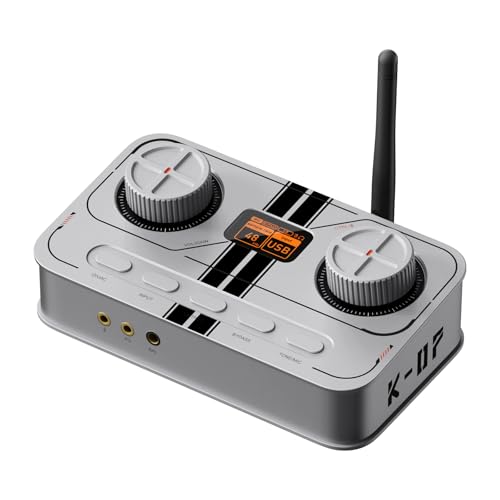
The Fosi Audio K7 is the most versatile desktop hub on this list, combining a high-fidelity AK4493S DAC with a beastly 2100mW balanced headphone amplifier. That power figure means it drives everything from sensitive IEMs to power-hungry planar-magnetic headphones without breaking a sweat. The inclusion of Bluetooth aptX HD/LL and a 3.5mm microphone input makes it a genuine all-in-one solution for gamers who also stream or take calls from the same desk.
Build quality is excellent — the all-aluminum chassis with dual large control knobs and an angled front panel feels substantial and premium. The high-resolution display shows bitrate, volume, and input source at a glance. For both PC and PS5 users, the USB-C connectivity with XMOS XU208 processor ensures low-latency, high-bandwidth audio transmission that bypasses the console’s mediocre internal DAC entirely.
The only compromises are the continuous-rotation volume knob (no hard limit) and the slightly limited EQ, which only offers bass and treble sliders through the hardware. Software control from the desktop is minimal. But for raw power, clarity, and connectivity breadth, the K7 is the most complete external gaming audio card in this lineup.
Why it’s great
- 2100mW balanced output drives nearly any headphone
- Bluetooth aptX HD/LL for wireless convenience
- Built-in mic input with 3.5mm connection
- Excellent all-metal build and knobs
Good to know
- No hardware EQ beyond bass/treble
- Volume knob has no physical stop point
- Display viewing angles are limited
2. Creative Sound Blaster AE-7

The Creative AE-7 is the pinnacle of internal PCIe sound cards for gamers who demand the highest clean output. Its ESS SABRE-class 9018 DAC delivers a class-leading 127 dB dynamic range with vanishingly low total harmonic distortion (0.0001%). That translates to a completely black background behind game audio — no hiss, no noise floor, just pure positional audio cues cutting through the mix.
The Xamp discrete headphone bi-amp drives each earcup independently with a 1-ohm output impedance, handling headphones up to 600 ohms. The included Audio Control Module puts a physical volume knob, ¼-inch and ⅛-inch headphone and microphone jacks on your desktop, eliminating the need to reach behind your PC tower. The dedicated quad-core processor offloads all surround processing from your CPU, which can reduce input lag in CPU-bound titles.
The downside is software — the Sound Blaster Command app is powerful but sometimes unintuitive, and the EQ documentation is thin. A minor hardware complaint: the control module’s volume knob introduces a slight channel imbalance at very low listening levels. For pure, uncompromised internal audio with the best DAC in this segment, the AE-7 is hard to beat.
Why it’s great
- 127 dB DNR with ESS SABRE 9018 DAC
- Xamp bi-amp handles up to 600 ohm headphones
- Hardware-accelerated quad-core processor
- Desktop Audio Control Module included
Good to know
- Software can be unintuitive
- Volume knob imbalance at very low levels
- No physical headphone/speaker switch
3. Creative Sound BlasterX AE-5 Plus

The AE-5 Plus is the middle sibling in Creative’s internal PCIe lineup, but it punches well above its weight class. It uses the same SABRE32 ultra-class DAC platform found in higher-end models, delivering 32-bit/384 kHz playback with a 122 dB dynamic range. The Xamp discrete headphone bi-amp is present here as well, individually driving each earcup with a 1-ohm output impedance for improved channel separation and clarity.
Gamers who own studio-grade headphones like the Beyerdynamic DT 990 Pro (250 ohms) or Sennheiser HD 6XX will find the AE-5 Plus provides ample clean power without distortion. The card supports Dolby Digital Live and DTS Connect encoding, which means you can output surround sound to a home theater receiver via a single S/PDIF cable — a rare feature at this price tier. The RGB lighting and included LED strip are tasteful extras that let you match your build’s aesthetic.
The main trade-off versus the AE-7 is the DAC chip (SABRE32 versus the 9018) and the lack of a desktop audio control module. The software suite is identical, which means you still get the full suite of Sound Blaster audio processing including Scout Mode for boosting quiet footsteps. For the price, the AE-5 Plus delivers 90 percent of the AE-7’s performance.
Why it’s great
- SABRE32 DAC with 122 dB dynamic range
- Xamp discrete bi-amp for 600 ohm headphones
- Dolby Digital Live and DTS Connect encoding
- RGB lighting with included LED strip
Good to know
- No external Audio Control Module
- May block airflow below GPU in tight cases
- Software can be quirky
4. Sound BlasterX G6

The Sound BlasterX G6 is Creative’s flagship external DAC/amp, designed for gamers who split time between PC and console. Its 32-bit processing engine and 384 kHz DAC resolution are overkill for most game audio source files, but that headroom allows the G6 to deliver exceptionally clean amplification for 250-ohm headphones like the DT 990 Pro. Users report a dramatic reduction in background hiss and a wider perceived soundstage compared to motherboard audio or console controller output.
Connectivity is the G6’s strongest asset: it connects via USB to PC, PS4, PS5, and Nintendo Switch, and also accepts optical input for devices without USB audio support. The hardware controls — volume wheel, SBX profile button, and mic gain knob — let you adjust on the fly without opening software. The Sound Blaster Connect app provides access to Scout Mode, equalizer presets, and virtual 7.1 surround processing.
The elephant in the room is the intermittent popping and clicking issue some units exhibit with certain driver versions. Creative has never fully acknowledged or fixed this across all firmware revisions. If you get a unit without this problem, the G6 is arguably the most convenient cross-platform gaming DAC available. Buy from a retailer with a solid return policy to be safe.
Why it’s great
- Works on PC, PS4, PS5, Switch via USB/Optical
- Drives 250 ohm headphones with ease
- Hardware controls for volume and mic gain
- Scout Mode for enhanced footstep audio
Good to know
- Intermittent popping/clicking in some units
- Driver compatibility can be finicky
- No balanced output option
5. SteelSeries GameDAC

The SteelSeries GameDAC was the first Hi-Res Audio-certified gaming DAC, and it remains a top choice for console-focused gamers who own high-impedance headphones. It packs an ESS Sabre DAC with 121 dB dynamic range and -115 dB THD+N, paired with a DTS Headphone:X v2.0 surround processor that creates a 360-degree soundfield. For competitive shooters on PS4 or PS5, this translates to precise directional audio that lets you pinpoint enemy positions by sound alone.
The built-in OLED display and control wheel let you adjust EQ, surround settings, and game/chat mix without relying on a phone app or PC software. The form factor is slim and unobtrusive, fitting neatly in front of a console or beside a laptop. It works with any headset that has a 3.5mm connection, but it was designed to pair perfectly with SteelSeries’ own Arctis Pro line.
The biggest limitation is that the GameDAC only supports a single custom EQ preset, which is frustrating for players who switch between game genres with different audio profiles. The optical cable input is also fairly stiff and difficult to insert fully. For PS5 players who want a dedicated, no-compromise DAC that prioritizes positional audio, this is still one of the best options on the market.
Why it’s great
- Hi-Res Audio certified ESS Sabre DAC
- DTS Headphone:X v2.0 surround sound
- OLED display with on-device controls
- Excellent fit for PS4/PS5 gamers
Good to know
- Only one custom EQ preset slot
- Optical cable port is stiff
- No way to power off the unit
6. FiiO K11 R2R

The FiiO K11 R2R is unique on this list because it uses a full 24-bit resistor ladder (R2R) DAC architecture rather than a delta-sigma chip like the ESS Sabre. R2R DACs are prized by audiophiles for their natural, analog-like sound with smoother treble and more organic midrange — a warmer tonal character that reduces listening fatigue during long gaming sessions. The K11 R2R offers both NOS (Non-OverSampling) and OS (OverSampling) modes, letting you choose between pure, unprocessed audio or a cleaner, more detailed presentation.
With 1300mW of output power into 32 ohms, the amplifier section is potent enough to drive demanding headphones like the Sennheiser HD 6XX or Hifiman HE5xx at moderate gain settings. The build is a compact aluminum block with a single multifunction knob that controls volume, input selection, and menu navigation. Connectivity includes USB-C, coaxial, optical, and RCA outputs, making it a flexible addition to either a gaming or dedicated music setup.
The R2R architecture is not ideal for competitive gaming where absolute transparency and surgical precision are required — the warmth can slightly blur micro-details in chaotic soundscapes. The single-knob UI is also tedious for frequent adjustments. The K11 R2R is best suited for gamers who also listen to music critically and prefer a non-fatiguing, musical sound signature.
Why it’s great
- Warm, natural R2R sound reduces fatigue
- 1300mW output power at 32 ohms
- NOS mode preserves original sampling rate
- USB-C, coaxial, and optical inputs
Good to know
- Not ideal for competitive precision audio
- Single-knob navigation is cumbersome
- Headphone amp underwhelming as standalone
7. Schiit Fulla E

The Schiit Fulla E is the budget champion that punches far above its weight class. It combines a clean DAC, a headphone amplifier delivering up to 300mW into 16 ohms, and a dedicated microphone input with a 24-bit TI analog-to-digital converter and automatic gain control — all in a compact, USA-made aluminum enclosure. For gamers on a tight budget who still want a genuine upgrade over motherboard audio, the Fulla E delivers surprising soundstage width and clarity without introducing distracting noise.
The microphone input is the Fulla E’s hidden superpower: the AGC ensures consistent voice levels without manual adjustment, and the ADC quality makes your friends think you upgraded your mic rather than just your audio interface. The dual USB-C cable setup (one for data, one for optional external power) ensures clean power delivery even from noisy PC USB ports. It’s plug-and-play with no driver installation required on Windows, Mac, or even consoles via USB.
The limitations are real: the amplifier struggles with high-impedance headphones (300 ohms and above) and may not reach satisfying volume levels. The microphone input also has an aggressive hardware limiter that can distort loud voices, making it better for chat than for podcasting or streaming. A minority of users report the mic input failing after a few weeks, which suggests inconsistent quality control. Still, for pure price-to-performance value in entry-level gaming audio, the Fulla E has few peers.
Why it’s great
- High-quality 24-bit microphone input with AGC
- Clean DAC and amp at a budget price
- USA-made with quality components
- Plug-and-play with no drivers needed
Good to know
- Low power for high-impedance headphones
- Mic input limiter can clip loud voices
- Some reports of mic input failure
FAQ
Does a dedicated audio card improve my K/D ratio in shooters?
Internal PCIe card versus external USB DAC — which is better for gaming?
Will a gaming audio card work with my console?
What is virtual 7.1 surround and do I need it for competitive gaming?
How much amplifier power do I need for 250 ohm headphones?
Final Thoughts: The Verdict
For most users, the audio card for gaming winner is the Fosi Audio K7 because it combines massive 2100mW amplifier power, excellent AK4493S DAC clarity, Bluetooth versatility, and a microphone input in one desktop package. If you want an internal card with the highest clean output and a discrete headphone bi-amp, grab the Creative AE-7. And for console-first gaming with DTS virtual surround on PS5, nothing beats the SteelSeries GameDAC.