
Our readers keep the lights on and the weekend projects moving. As an Amazon Associate, I earn from qualifying purchases.
Building a mix on headphones that color the sound is like painting in the dark — every adjustment you make disappears as soon as you check the master on a different system. Audio engineering headphones must deliver a flat, uncolored frequency response so your EQ cuts, panning choices, and compression settings translate reliably across every playback device, from studio monitors to phone speakers.
I’m Rikta — the founder and writer behind FitlyFast. I specialize in market analysis and hardware specification research, spending hundreds of hours cross-referencing driver materials, impedance curves, and diaphragm technologies to identify which studio headphones genuinely serve the critical-listening workflow.
This guide breaks down the specific performance metrics, acoustic designs, and physical ergonomics that separate a true reference tool from a decent listening pair, helping you choose the right candidate from the best audio engineering headphones available today.
How To Choose The Best Audio Engineering Headphones
Selecting studio headphones for engineering work means prioritizing accuracy over entertainment. You need a pair that reveals flaws — sibilant consonants, muddy low-end overlap, transient smearing — without exaggerating them. Focus on these four factors to match the tool to your specific studio role.
Closed-Back vs. Open-Back: Isolation or Soundstage
Closed-back headphones like the beyerdynamic DT 770 Pro X physically block ambient noise and prevent audio from bleeding into a live microphone — essential for vocal tracking and recording sessions. Open-back designs, such as the Sennheiser HD 490 PRO, allow air to pass through the ear cups, creating a wider, more natural soundstage with superior spatial imaging. Open-back models cannot be used near open microphones, but they give you a more accurate representation of stereo placement and reverb decay during mixing and critical listening.
Impedance and Sensitivity: Matching Your Output
Impedance (measured in ohms) determines how much voltage a headphone needs to reach a given volume. Low-impedance models (32–48 Ohms) work directly from laptops, audio interfaces, and portable DACs without additional amplification. High-impedance models (250–600 Ohms) require a dedicated headphone amp to deliver clean, undistorted levels. Check your interface’s output specs — the AKG K371 at 32 Ohms runs efficiently on almost any device, while the Audio-Technica ATH-R70x at 470 Ohms demands a strong amp for proper volume headroom.
Driver Type: Dynamic vs. Planar Magnetic
Dynamic drivers, found in the majority of studio headphones, use a voice coil and magnet to move a diaphragm — they are durable, affordable, and well-understood. Planar magnetic drivers, like the HIFIMAN Edition XS, sandwich a conductive diaphragm between two arrays of magnets, producing faster transient response and significantly lower distortion at high volumes. Planar headphones tend to be heavier and less efficient, but they offer exceptional detail retrieval for mastering-level critical listening.
Build Quality and Serviceability
Studio headphones endure daily wear — dropped cables, bent headbands, flattened earpads. Models with detachable locking cables (the Shure SRH840A and beyerdynamic DT 990 Pro X use mini-XLR connectors), replaceable velour or leather ear cushions, and available driver replacement parts reduce long-term ownership cost. Avoid headphones with fixed cables or glued assemblies; a replaceable cable alone can triple the useful life of a set in a busy studio environment.
Quick Comparison
On smaller screens, swipe sideways to see the full table.
| Model | Category | Best For | Key Spec | Amazon |
|---|---|---|---|---|
| Sennheiser HD 490 PRO | Premium Open-Back | Mixing & mastering | 5 – 36,000 Hz frequency range | Amazon |
| Audio-Technica ATH-R70XA | Premium Open-Back | Reference monitoring | 199 g weight, 45mm driver | Amazon |
| Audio-Technica ATH-R70x | Premium Open-Back | Analytical listening | 470 Ohm impedance | Amazon |
| Sony MDR-M1 | Premium Closed-Back | Recording & monitoring | 5 Hz – 80 kHz playback | Amazon |
| HIFIMAN Edition XS | Mid-Range Planar | Detail-critical listening | Planar magnetic driver | Amazon |
| AKG K371 | Mid-Range Closed | Portable mixing | 32 Ohm, 50mm driver | Amazon |
| beyerdynamic DT 770 Pro X | Mid-Range Closed | Tracking & isolation | 48 Ohm, STELLAR.45 driver | Amazon |
| beyerdynamic DT 990 Pro X | Mid-Range Open-Back | Critical editing | 48 Ohm, 5–40 kHz response | Amazon |
| Shure SRH840A | Budget Closed-Back | Entry-level monitoring | Foldable, detachable cable | Amazon |
In‑Depth Reviews
1. Sennheiser HD 490 PRO

The HD 490 PRO delivers an uncolored frequency response from 5 Hz to 36,000 Hz that reveals mix imperfections without exaggeration, making it the clearest window into your session among all headphones on this list. Sennheiser’s Open-frame Architecture reduces total harmonic distortion, and the patented cable coil structure blocks cable-borne noise that can mask low-level details during quiet passages.
Two sets of included earpads — one labeled for producing, one for mixing — change the distance between the driver and your ear, shifting the perceived frequency balance slightly so you can cross-reference tonal decisions without switching gear. The low-frequency cylinder system delivers full, distortion-free bass extension that helps you evaluate sub-bass content without false rumble.
At just over 200 grams with flexible circumaural cups, it remains comfortable for sessions lasting eight hours or more, and the washable, replaceable earpads extend service life. The right- and left-ear jacks accommodate detachable cables on either side, adapting to any studio patchbay layout without cable strain.
Why it’s great
- Neutral, uncolored response ideal for critical mixing
- Two sets of earpads let you hear tonal shifts from the same driver
- Low-impedance design runs cleanly from most interfaces
- Replaceable earpads and cable for long studio life
Good to know
- Proprietary earpad design limits third-party pad options
- Single-sided cable lacks balanced XLR output for some setups
2. Audio-Technica ATH-R70XA
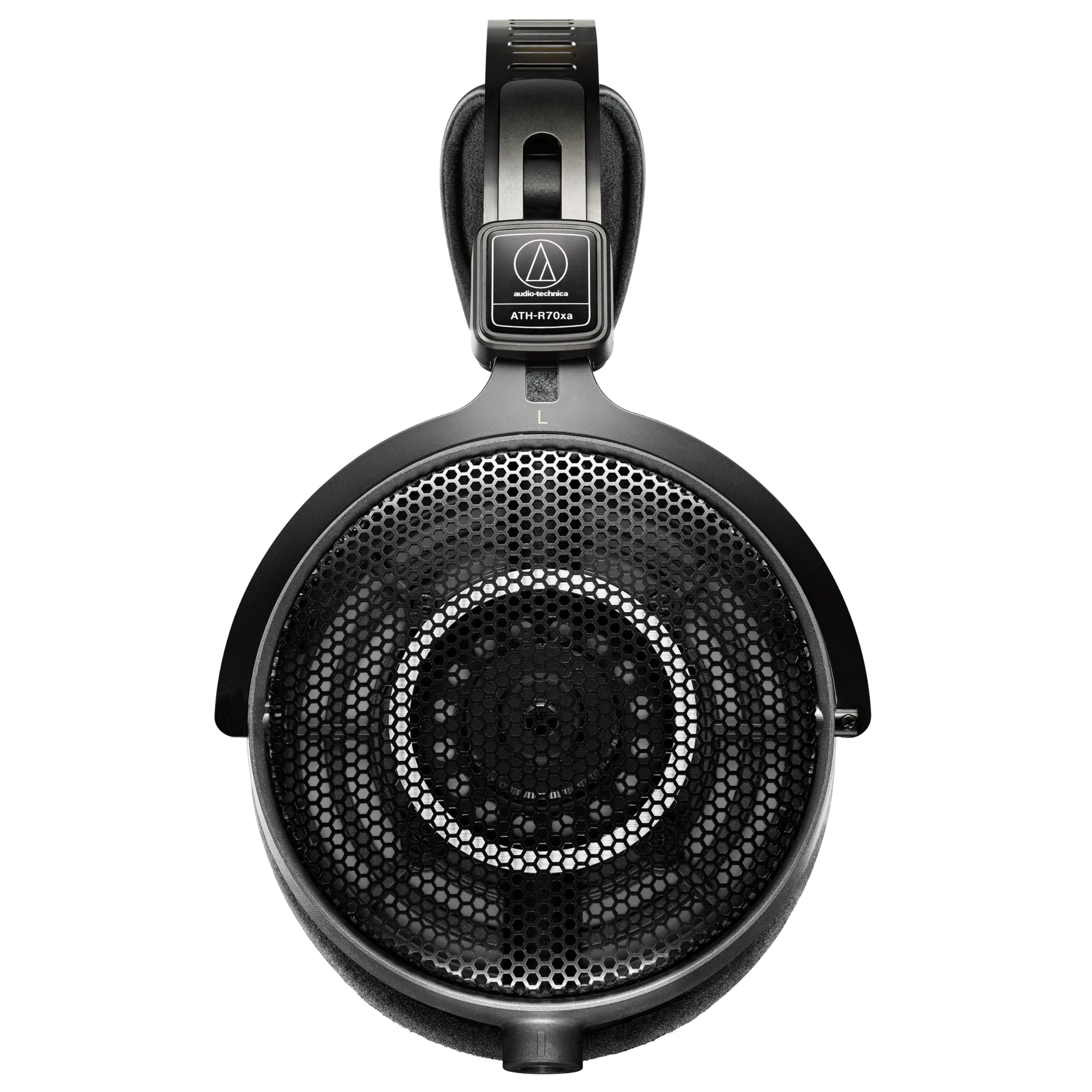
The ATH-R70XA refines Audio-Technica’s reference formula with a fully open-back design that eliminates internal resonance and delivers extremely fast transient response. The 45mm dynamic driver, paired with carbon composite resin baffles, produces a wide natural soundstage where instrument separation and spatial depth rival planar magnetic designs without the added weight.
Assembled in Audio-Technica’s Tokyo factory, each unit undergoes individual testing before leaving the production line. The featherlight 199-gram chassis — the lightest full-size open-back reference headphone on this list — combined with the reimagined 3D Wing Support headband, distributes pressure evenly across the crown and eliminates hot spots on the top of the skull.
The dual-sided 3.0-meter detachable locking cable maintains L/R signal independence so a cable fault never disables both channels. Replaceable velour earpads and a streamlined metal-reinforced frame support years of daily studio use. Users report that the sound scales noticeably with higher-quality DACs and balanced amplification, rewarding investment in a clean signal chain.
Why it’s great
- Extremely low weight reduces fatigue during long sessions
- Neutral, revealing sound with excellent bass extension
- Dual-sided locking cable ensures channel independence
- Japanese assembly with rigorous quality testing
Good to know
- 470 Ohm impedance requires a dedicated headphone amplifier
- Non-detachable cable design on the R70x predecessor frustrates some users
3. Audio-Technica ATH-R70x

The ATH-R70x uses a unique pure alloy magnetic circuit with high-efficiency magnets to deliver a near-perfectly neutral frequency response that avoids the upper-mid emphasis common in many budget reference headphones. The 45mm dynamic driver, housed in acoustically transparent aluminum honeycomb-mesh grilles, creates an open, airy presentation with impressive depth and layering for stereo image evaluation.
Weighing approximately 210 grams without the cable, it features the 3D Wing Support headband that floats the ear cups around your head rather than clamping them against your skull — a design that users with larger head sizes consistently report as the most comfortable for extended wear. The breathable fabric earpads prevent heat buildup during hours of A/B comparison work.
The dual-sided detachable locking cable maintains L/R independence and includes a 6.3 mm screw-on adapter for connection to studio interfaces. The 470 Ohm impedance demands a clean amplifier for sufficient headroom, but the reward is exceptionally low distortion at high listening levels. Sub-bass extension is slightly rolled off compared to closed-back designs, making it best suited for mixing decisions where midrange and treble accuracy are paramount.
Why it’s great
- Extremely neutral midrange for vocal sibilance and snare decay evaluation
- Wing Support headband eliminates clamp fatigue
- Breathable fabric pads stay cool in warm studios
- Detailed transient response reveals compression artifacts
Good to know
- High impedance requires a dedicated headphone amplifier
- Sub-bass roll-off may require EQ for sub-heavy genres
4. Sony MDR-M1

The Sony MDR-M1 was developed in collaboration with professional recording engineers to reproduce the creative intent of a mix accurately, not to flatter the listener. The 40mm dynamic driver with ultra-wideband playback from 5 Hz to 80 kHz captures subsonic rumble and high-frequency air without introducing the treble peakiness that causes ear fatigue during long sessions.
Weighing approximately 216 grams, it is one of the lightest closed-back reference headphones available, reducing neck strain during tracking sessions that run several hours. The closed acoustic structure provides high sound isolation that prevents live microphone bleed during vocal takes, while the screw-in cable connector ensures the cable stays locked during movement around the studio.
Two detachable cables — a 1.2-meter 3.5mm version for portable interfaces and a 2.5-meter 6.3mm version for console patching — are included. The ear pads are designed for easy replacement, and the fold-flat mechanism simplifies storage in a drawer or backpack. Users transitioning from the MDR-7506 report a warmer, less fatiguing tonal balance with better bass extension and a wider soundstage.
Why it’s great
- Ultra-lightweight design for fatigue-free tracking sessions
- Excellent noise isolation prevents microphone bleed
- Non-fatiguing treble suitable for extended critical listening
- Two detachable cables with locked connectors
Good to know
- Earpads can get warm during long summer sessions
- No hard carrying case included in the package
5. HIFIMAN Edition XS

The Edition XS brings planar magnetic technology into the mid-range price tier by using Stealth Magnets that reduce wave diffraction turbulence, producing a cleaner sound wave path and lower distortion than conventional planar designs. The NEO supernano diaphragm is 75% thinner than previous generations, resulting in faster transient response and detailed imaging that reveals subtle reverb tails and room reflections in your mix.
The open-back structure creates a wide, naturally layered soundstage that places instruments in a three-dimensional space, aiding panning and depth decisions during the mixing phase. Bass extension is full and controlled without bleeding into the lower mids, allowing sub-bass content to be evaluated independently of the kick drum fundamental frequency.
Build quality uses a lightweight metal frame with memory foam headband padding, though the large earcup size may not provide a secure seal on smaller head shapes. The detachable 3.5mm cable uses standard connectors, making replacement simple. This headphone responds well to EQ, enabling users to dial in specific target curves for mastering reference work.
Why it’s great
- Planar speed reveals micro-detail in transients
- Excellent bass extension without midrange bleed
- Wide, immersive soundstage for spatial mixing decisions
- Responds exceptionally well to EQ correction
Good to know
- Low clamp force can cause slippage on smaller heads
- Large earcup size may not suit every head shape
6. AKG K371

The K371 is engineered to match AKG’s reference response curve, a target derived from years of perceptual research to produce a neutral sound that translates consistently across playback systems. The 50mm titanium-coated transducer with pure OFC voice coils delivers a frequency range from 5 Hz to 40 kHz, capturing both deep sub-bass and high-frequency detail without introducing the mid-bass hump common in consumer-oriented closed-back cans.
With a 32 Ohm impedance and 114 dB sensitivity, it is the most efficient model on this list — it reaches full dynamic range from a smartphone or basic audio interface without needing an external amplifier. This makes it the practical choice for engineers who move between project studios, tracking rooms, and home setups with different output devices.
The oval, closed-back design conforms to the natural ear shape for a secure seal that improves bass accuracy and passive isolation. Three detachable cables — a 1.2-meter straight, a 3-meter straight, and a 3-meter coiled — are included along with a protective carrying pouch. The fold-flat mechanism reduces storage footprint, and the earcups swivel for single-ear monitoring in the control room.
Why it’s great
- Very low impedance works with any device without an amp
- Neutral frequency response with tight, clean low-end
- Three included cables for varied studio setups
- Foldable design for portable use between rooms
Good to know
- Build quality is lighter-duty than German-made alternatives
- Earpads may not seal perfectly with glasses
7. beyerdynamic DT 770 Pro X

The DT 770 Pro X upgrades the legendary DT 770 platform with the STELLAR.45 driver, a hand-assembled 45mm dynamic driver that improves clarity and reduces distortion compared to the previous generation while maintaining the closed-back isolation that made the original a tracking-room staple. The frequency range of 5 Hz to 40 kHz captures ultra-low kick drum fundamentals and harmonic overtones without introducing the harsh upper-mid peak that some older Beyerdynamic models exhibited.
The 48 Ohm impedance provides a practical middle ground — it runs cleanly from most audio interfaces while still benefiting from the damping factor of a dedicated headphone amp. The detachable cable with a locking mini-XLR connector solves the primary complaint of the original DT 770, which used a non-removable fixed cable that was the first component to fail in heavy studio use.
Velour ear pads, an ergonomic headband, and the familiar circumaural fit deliver the same extended-wear comfort that has kept the DT 770 in professional studios for decades. The design uses fully replaceable parts — earpads, headband padding, cable, and driver assembly — so a single purchase can serve a decade of daily mixing and tracking duty.
Why it’s great
- STELLAR.45 driver delivers exceptional clarity and low distortion
- Detachable locking mini-XLR cable solves the original’s main weakness
- Every component is replaceable for long service life
- Excellent passive isolation for tracking sessions
Good to know
- Treble may still sound bright to ears accustomed to rolled-off monitors
- Long cable plug can bump the neck when moving around
8. beyerdynamic DT 990 Pro X

The DT 990 Pro X leverages the same STELLAR.45 driver as the closed-back 770 variant but places it in a fully open-backed housing that creates a wide, natural soundstage with highly detailed spatial imaging. The open design allows room ambience to blend with the headphone output, helping you make mix decisions that account for how the track will sound in a real listening environment rather than in an isolated null.
The frequency response extends from 5 Hz to 40 kHz with a slight emphasis in the upper treble region that makes sibilance, hiss, and digital artifacts clearly audible — precisely what you need during the editing phase to catch subtle clipping and noise floor issues. The 48 Ohm impedance ensures compatibility with most interfaces, and the locking mini-XLR cable connection provides security during critical listening sessions.
Handcrafted in Germany, the headphone uses replaceable velour ear pads, a serviceable headband, and all-metal yoke construction that prioritizes durability. The open-back nature means zero isolation, so it cannot be used for tracking with live microphones, but the transparent sound makes it an excellent second reference pair to check spatial balance and depth after initial mixing on closed-back monitors.
Why it’s great
- Wide, holographic soundstage aids spatial mixing decisions
- Upper treble emphasis reveals mix artifacts and noise
- Detachable locking mini-XLR cable adds reliability
- German manufacture with fully serviceable parts
Good to know
- Zero isolation — unsuitable for tracking sessions
- Treble emphasis can sound bright to some ears
9. Shure SRH840A

The SRH840A delivers a tailored frequency response that balances controlled bass, articulate mids, and extended highs, making it a reliable entry point for new engineers learning to hear mix issues. The closed-back, circumaural design provides sufficient passive isolation to reduce ambient noise in a home studio or shared workspace without the expense of active cancellation circuitry.
The wide padded headband and plush ear cushions are designed for the long sessions typical of recording and editing workflows, and the lightweight collapsible design stows neatly in the included carrying case when you need to transport your monitoring rig between locations. The detachable locking cable system allows quick replacement if the cable is damaged, preventing the headphone itself from becoming e-waste due to a frayed wire.
Users upgrading from the previous SRH440 report improved padding, better stitching, and a more refined overall finish. The natural tonality avoids listener fatigue during prolonged A/B comparisons, though some users note that the midrange definition is slightly softer than open-back designs, making it a better fit for EDM, hip-hop, and pop mixing where bass control is critical rather than acoustic rock where mid-clarity is paramount.
Why it’s great
- Balanced sound with controlled bass perfect for entry-level monitoring
- Detachable locking cable saves the headphones from cable failure
- Collapsible design with included carrying case for portability
- Comfortable for extended recording sessions
Good to know
- Midrange definition is slightly softer than open-back alternatives
- Cable is not braided, which may affect long-term durability
FAQ
Should I choose open-back or closed-back headphones for mixing?
What impedance is best for studio headphones?
Can I use audio engineering headphones for casual listening?
Do I need a DAC or headphone amplifier for studio headphones?
Final Thoughts: The Verdict
For most users, the best audio engineering headphones winner is the Sennheiser HD 490 PRO because it combines a truly neutral frequency response, dual-earpad versatility for different mix tasks, and the comfort needed for eight-hour sessions — all while running cleanly from standard interface outputs. If you want maximum isolation for vocal recording and closed-back clarity, grab the beyerdynamic DT 770 Pro X. And for a featherlight open-back reference that scales with premium amplification, nothing beats the Audio-Technica ATH-R70XA.