
Whether you are tracking a vocal take, hosting a two-person podcast, or setting up a livestream that sounds as clean as it looks, the gear between your source and your listener defines the final result. A muddy preamp or a noisy interface can undo hours of editing, while the right setup captures the performance the first time.
I’m Rikta — the co-founder and writer behind FitlyFast. This guide breaks down seven specific audio solutions, from compact field recorders to full PA bundles, by focusing on the preamp quality, conversion specs, and build integrity that matter most when you hit record.
After hundreds of hours analyzing specs, user reports, and real-world noise floors, I built this roundup of the best audio equipment to cut through marketing hype and match you with the gear that fits your exact workflow.
How To Choose The Best Audio Equipment
Audio gear serves different masters: a podcast interface prioritizes voice clarity and instant muting, a studio monitor demands flat frequency response for mixing, and a portable recorder needs ruggedness and battery life. Before you buy, map your use case against these three pillars.
Preamp Quality and Gain Range
The preamp is the first electronic stage your signal hits. A weak preamp forces you to crank gain, which amplifies noise floor and hiss. Look for interfaces with at least 60dB of gain range — models like the Focusrite Vocaster Two offer over 70dB — so you can drive dynamic microphones without a separate booster.
Dynamic Range and Bit Depth
Dynamic range, measured in dB, defines the gap between the quietest and loudest signal the unit can capture cleanly. For studio work, 24-bit/192kHz converters are standard, but 32-bit float recording (found on the Zoom H4 Essential) pushes the ceiling so high that clipping becomes nearly impossible, saving takes in unpredictable field recording.
Connectivity and Monitoring
Count your inputs: a solo podcaster needs one XLR input with headphone monitoring, while a duo requires two mic preamps and independent headphone outputs. Bluetooth phone integration (Vocaster Two) or built-in sound effects (FIFINE KS5) reduce post-production work. Monitors should offer XLR or balanced TRS inputs to reject interference.
Quick Comparison
On smaller screens, swipe sideways to see the full table.
| Model | Category | Best For | Key Spec | Amazon |
|---|---|---|---|---|
| FIFINE KS5 | Bundle | Gaming & Streaming | XLR/USB Dynamic Mic + Mixer | Amazon |
| Focusrite Vocaster Two | Interface | Podcasts & Duo Hosting | 70dB Gain, Bluetooth Phone | Amazon |
| Universal Audio Volt 2 | Interface | Singer-Songwriters & Guitar | Vintage 610 Preamp Mode | Amazon |
| Zoom H4 Essential | Recorder | Field & On-Location Capture | 32-Bit Float, 19.4mm Mics | Amazon |
| JBL 305P MkII (Pair) | Monitor | Mixing & Critical Listening | Image Control Waveguide | Amazon |
| Focusrite Scarlett 2i2 Studio | Bundle | All-in-One Home Studio | 120dB Dynamic Range | Amazon |
| Pyle PPHP28AMX | PA System | Live Events & Parties | 300W, 8-Channel Mixer | Amazon |
In‑Depth Reviews
1. Focusrite Scarlett 2i2 Studio 4th Gen
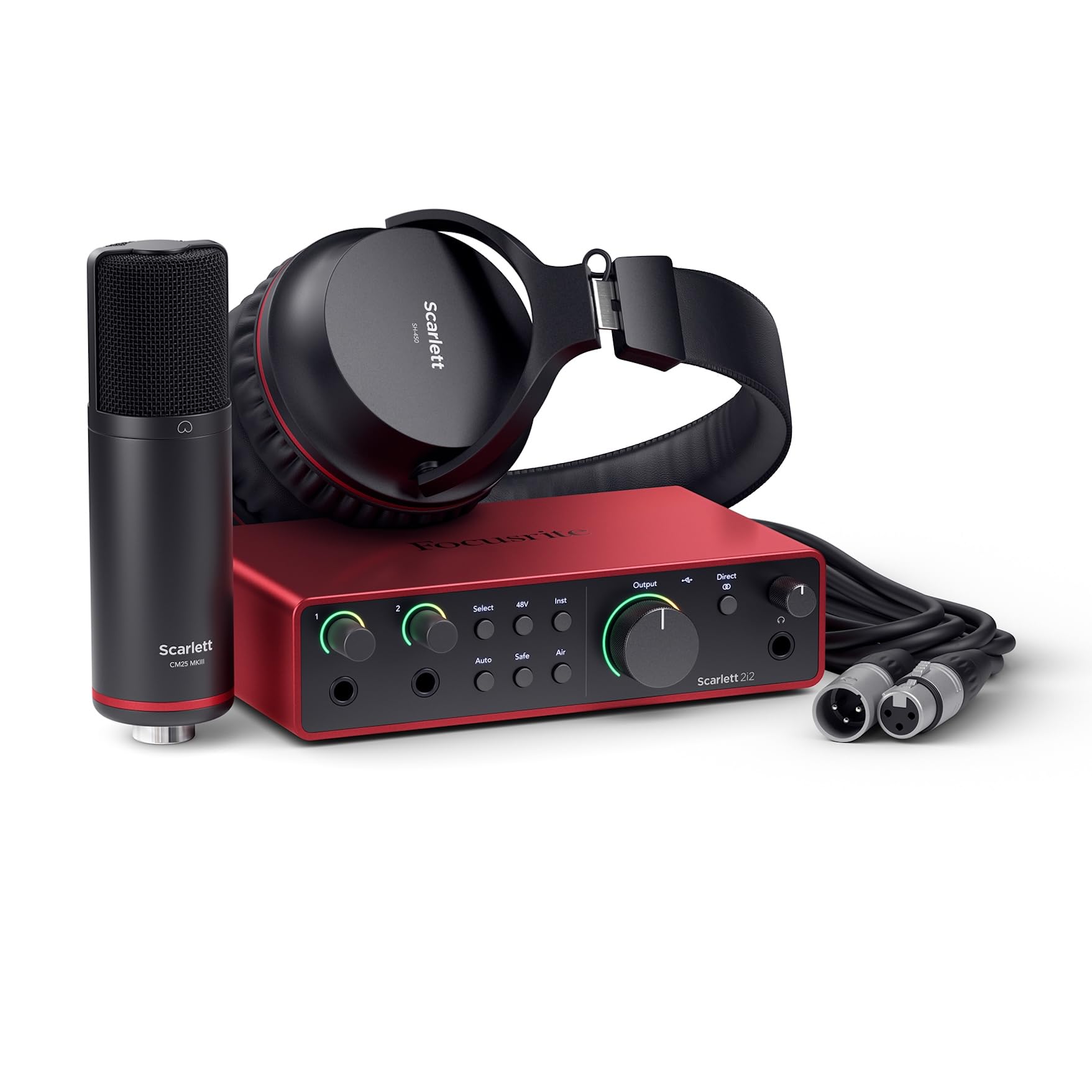
The Scarlett 2i2 Studio 4th Gen delivers a 120dB dynamic range using the same converters found in Focusrite’s flagship RedNet line, giving you a noise floor low enough for serious mixing and mastering. Auto Gain sets input level in seconds, and Clip Safe prevents digital distortion mid-take — crucial for capturing dynamic vocal performances or guitar DI without babysitting the meter.
Air mode engages a fixed high-pass filter and a high-frequency boost that lifts vocals and acoustic guitars forward in the mix without sounding harsh, a feature borrowed from the larger Red interfaces. The included CM25 MkIII condenser microphone and SH-450 headphones form a complete tracking chain that works out of the box with any DAW.
The bundle includes Pro Tools Intro+, Ableton Live Lite, Cubase LE, and the Hitmaker Expansion plugin suite — a value that saves a separate software purchase. Build quality is robust with a metal chassis, and the USB-C connection provides low-latency performance even on mobile rigs. For a songwriter or podcaster who wants one purchase to cover recording, monitoring, and software, this is the complete package.
Why it’s great
- Professional-grade 120dB dynamic range converters
- Auto Gain and Clip Safe eliminate level-setting errors
- Full studio bundle with mic, headphones, and DAW software
Good to know
- No additional 3.5mm auxiliary input for external audio
- Condenser mic requires phantom power (supplied via interface)
2. JBL 305P MkII (Pair)

The JBL 305P MkII is a 2-way active studio monitor with a 5-inch woofer and a 1-inch tweeter driven by dual 41-Watt Class-D amplifiers, delivering a flat frequency response that reveals mix errors consumer speakers mask. The patented Image Control Waveguide creates a wide, consistent sweet spot, so you don’t have to sit perfectly centered to trust the stereo image.
Boundary EQ and HF trim switches let you compensate for room acoustics — placing them near a wall or desk corner often boosts low frequencies, and one dip on the Boundary EQ restores neutrality. This feature alone makes the 305P MkII more forgiving in untreated rooms than many competitors in the same size class.
The pair includes XLR and balanced TRS inputs, ensuring compatibility with any audio interface output. Listeners upgrading from consumer speakers or smaller nearfields consistently report hearing width, depth, and low-mid fullness they missed before. For any producer or editor who needs accurate, uncolored translation to other playback systems, these monitors are the reference standard at this tier.
Why it’s great
- Wide sweet spot from Image Control Waveguide
- Boundary EQ adapts to room placement
- Accurate, uncolored frequency response for mixing
Good to know
- Requires separate balanced cables (XLR or TRS)
- No built-in Bluetooth or streaming features
3. Focusrite Vocaster Two

The Vocaster Two is designed specifically for podcast duos: two XLR inputs with over 70dB of gain drive even low-output dynamic mics without needing a Fethead or Cloudlifter. Auto Gain sets input level in seconds, and the Enhance button applies one of four broadcast-voiced EQ presets that instantly add presence and clarity without manual tweaking.
Each presenter gets their own headphone output with independent Show Mix control, letting them balance their own voice against the guest or program audio. The hardware mute button on the front panel cuts audio instantly — a lifesaver for live streams where a cough or side conversation would go out on air.
Bluetooth phone connectivity allows remote guests to call in without a physical TRRS cable, and the camera line-out sends your mix directly to a DSLR or mirrorless camera for video pairing. The USB-C connection and compact footprint (under 2 pounds) make it easy to pack for location recordings or run from an iPad. For serious podcasters who need two-person capability with no fuss, this is the smart pick.
Why it’s great
- 70dB+ clean gain drives dynamic mics directly
- Dual headphone outputs with independent mix
- Bluetooth caller integration
Good to know
- Plastic chassis feels less premium than metal alternatives
- Software EQ is limited to four presets via Enhance
4. Zoom H4 Essential

The H4 Essential houses the largest microphone capsule (19.4mm) of any handheld recorder, paired with 32-bit float AD converters that eliminate the need to set recording levels beforehand. In 32-bit float mode, the dynamic range exceeds 130dB, so a whisper and a slammed door can coexist in the same file without clipping — you normalize the levels in post-production.
Two XLR/TRS combo inputs with dedicated gain knobs give you the option to connect external shotgun or lavalier mics while the onboard X/Y stereo pair captures ambience. Recording up to four tracks simultaneously at 192kHz in WAV format makes it suitable for music rehearsals, film dialogue, and sound design capture in one device.
Battery life averages 20 hours with standard settings, and the unit can be powered via USB-C from a portable battery pack for extended sessions. At 243 grams it is lightweight enough for a camera bag or field recorder pouch. The 32-bit float safety net alone justifies the purchase for anyone who records unpredictable live sources and cannot afford a blown take.
Why it’s great
- 32-bit float eliminates clipping in any environment
- 19.4mm X/Y mic capsule captures rich stereo
- Four-track simultaneous recording at 192kHz
Good to know
- Onboard mics sensitive to wind noise and handling rumble
- Menu navigation can feel dense for first-time users
5. Universal Audio Volt 2

The Volt 2 channels Universal Audio’s heritage by incorporating a Vintage mode that emulates the UA 610 tube preamp used on countless classic records. Engaging Vintage mode adds harmonic saturation and a subtle high-frequency sheen that gives vocals and DI guitar a finished quality before any plugins are applied, reducing mixing time.
With 24-bit / 192kHz conversion and low-latency USB-C operation, the Volt 2 delivers the same transparent A/D and D/A performance UA is known for in its Apollo line, at a fraction of the entry cost. The included LUNA DAW integrates tightly with the hardware, offering an analog-style tape workflow and access to UA’s UAD Spark plugin library on subscription.
Build quality is solid metal, inputs are straightforward, and the unit draws power entirely over USB, eliminating wall warts for mobile laptop setups. Guitarists will appreciate the built-in direct input that bypasses extra DI boxes. For a creator who wants hardware character and professional conversion in a compact desktop package, the Volt 2 is a clear step up from generic interface designs.
Why it’s great
- Vintage preamp mode adds analog warmth
- Low-latency USB-C with 192kHz converters
- Includes LUNA DAW with tape-style workflow
Good to know
- Requires external power supply for iPad/iPhone use
- No independent headphone mix without DAW routing
6. FIFINE KS5

The FIFINE KS5 bundles a dynamic XLR/USB microphone with a dedicated gaming audio mixer, giving streamers and entry-level podcasters a complete front-end without buying separate components. The dynamic microphone capsule rejects room echo and keyboard clatter better than a condenser, and the USB fallback connection works as a standalone mic if the mixer isn’t needed.
The four-channel mixer includes individual mute buttons, headphone monitoring, a volume fader per channel, and selectable RGB lighting that syncs with a gaming desktop aesthetic. Built-in sound effects and voice changer modes add variety to live streams without needing third-party software running in the background.
USB-C connectivity keeps setup simple for PC gamers, and the included XLR cable future-proofs the mic for integration into a higher-end interface later. That said, the mixer controls — including mute and RGB — are only functional via USB, not XLR mode. For a budget-minded streamer who wants one box for voice, effects, and desk presence, this bundle delivers surprising value.
Why it’s great
- Dynamic mic rejects background noise well
- Four-channel mixer with mute, effects, and RGB
- Dual XLR/USB connectivity for upgrade path
Good to know
- Mixer controls only active in USB mode
- Plastic build expected at this entry tier
7. Pyle PPHP28AMX
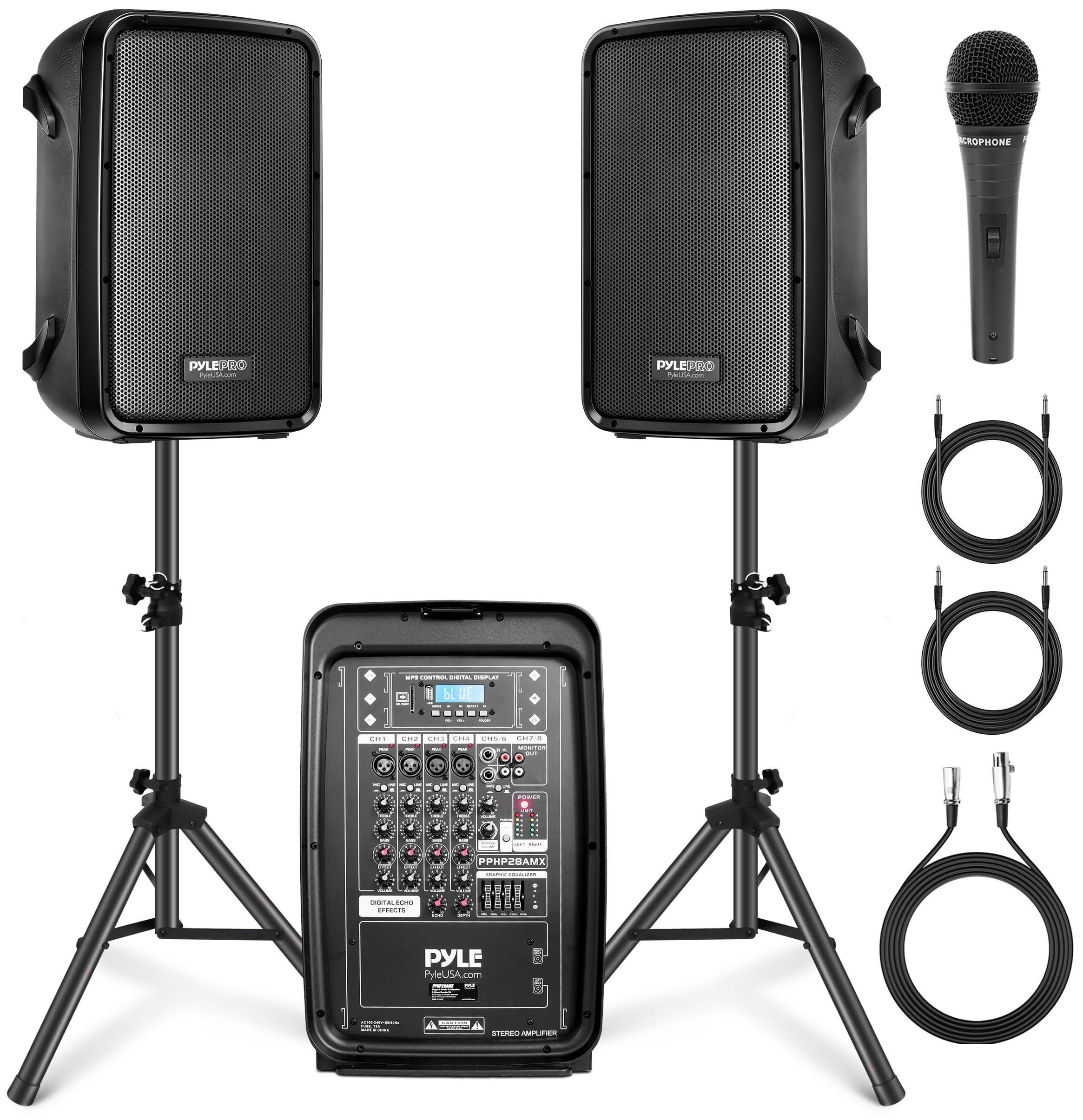
The Pyle PPHP28AMX is a complete PA bundle: two 8-inch speakers with 1-inch tweeters, an 8-channel powered mixer, wired handheld microphone, two tripod speaker stands, and all necessary cables — everything needed to sound-reinforce a room of 30-50 people straight out of the box. The 300-watt rating provides enough headroom for speeches, karaoke, and small band rehearsals.
Bluetooth streaming lets a DJ or presenter play backing tracks wirelessly from a phone or tablet, while the physical inputs include four XLR jacks, two 1/4-inch mic/guitar inputs, USB and SD card readers for pre-recorded files, and RCA line inputs for connecting a CD player or external mixer. The built-in digital LCD display shows EQ levels clearly across the eight channels.
The bundle saves the hassle of matching separate components, and the tripod stands get the speakers to ear height for better projection. However, some users report the left channel failing after a few uses, and the system operates in mono-only mode — you cannot pan channels independently. For temporary event setups where simplicity and all-in-one packaging matter more than channel flexibility, it is a workable solution.
Why it’s great
- Complete system with stands, cables, and mic included
- Bluetooth audio streaming from any device
- Eight-input mixer with USB/SD media playback
Good to know
- Plastic components and handle are fragile for regular transport
- Mono-only output with no independent pan control
FAQ
Do I need an audio interface or just a USB microphone?
What is 32-bit float recording and do I need it?
Do studio monitors need a subwoofer?
Final Thoughts: The Verdict
For most users, the audio equipment that fits the broadest range of workflows is the Focusrite Scarlett 2i2 Studio 4th Gen because it bundles a pro-grade interface, studio mic, headphones, and full software — ready to record from unboxing. If your focus is podcasting with a co-host, grab the Focusrite Vocaster Two for its dual headphone outputs and Bluetooth phone integration. And for field recording where you cannot risk a clipped take, nothing beats the Zoom H4 Essential with its 32-bit float safety net.