
Our readers keep the lights on and the weekend projects moving. As an Amazon Associate, I earn from qualifying purchases.
Plugging an electronic drum kit into a standard computer microphone jack delivers a muddy, high-latency signal that destroys the feel of a live performance. The result is a playback that lags behind your sticks, collapsing any sense of timing. A real audio interface solves this by converting your drum module’s outputs into pristine, ultra-low-latency digital streams that your DAW treats as individual tracks.
I’m Rikta — the co-founder and writer behind FitlyFast. This buying guide is the result of hundreds of hours comparing input counts, preamp noise floors, driver stability, and round-trip latency data across the top contenders for drummers who demand their recorded hits match their playing energy.
Whether you are tracking a full kit with eight toms and cymbals or just stereo room mics, choosing the right audio interface for electronic drums means matching input count, headroom, and sample rate to your recording workflow without overspending on features you will never use.
How To Choose The Best Audio Interface For Electronic Drums
Electronic drum modules output line-level signals via TS or TRS jacks, which an interface must digitize with low noise and zero coloration. The core requirements differ from vocal or guitar recording — you need enough discrete inputs to separate every pad, ultra-low latency to avoid audible delay, and drivers that handle multi-channel streams without glitching.
Input Count and Routing
A standard e-drum module has up to 10 individual trigger outputs (snare, kick, three toms, hi-hat, ride, crash, and auxiliary pads). For true multi-track recording where each pad lands on its own DAW track, you need at least 8 analog inputs. If your module outputs a stereo master mix only, a 2-input interface suffices, but you lose the ability to mix individual drums later.
Latency and Buffer Size
Round-trip latency below 3 ms at a 32 or 64 sample buffer (44.1–96 kHz) is the threshold for natural drum feel. Higher latency introduces a flamming effect between your stick hit and the monitored sound. Interfaces with well-optimized USB drivers, like those from MOTU and Focusrite, consistently achieve 2.5 ms, while budget models often exceed 5 ms at the same buffer setting.
Preamp Design and Headroom
You are not recording loud acoustic drums, but your drum module’s line outputs can still peak near +10 dBu. The interface preamp must handle these levels without distortion, even at conservative gain settings. Preamps with at least 50 dB of gain range and a maximum input level above +8 dBu prevent clipped transients from sharp cymbal hits.
ADAT Expansion for Future Growth
Starting with an 8-input ADAT-equipped interface lets you later add an 8-channel preamp or ADA8200 to reach 16 inputs. This path is far more cost-effective than buying a 16-input interface upfront. Without ADAT, your input count is permanently locked to the unit’s onboard jacks.
Quick Comparison
On smaller screens, swipe sideways to see the full table.
| Model | Category | Best For | Key Spec | Amazon |
|---|---|---|---|---|
| Behringer U-Phoria UMC204HD | 2-In / 4-Out | Compact stereo drum tracking | MIDAS preamps, 192 kHz | Amazon |
| Behringer UMC404HD | 4-In / 4-Out | Multi-pad recording on a budget | 4 MIDAS preamps, 192 kHz | Amazon |
| Zoom AMS-24 | 2-In / 4-Out | Mobile drum recording with phone | USB-C bus power, 48 kHz | Amazon |
| Universal Audio Volt 2 | 2-In / 2-Out | Warm, analog-style drum submix | Vintage preamp mode, 192 kHz | Amazon |
| Korg NANOKEY-ST | MIDI Controller | MIDI drum pattern input | Bluetooth LE, 25 keys | Amazon |
| Behringer UMC1820 | 18-In / 20-Out | Full kit multi-track recording | 8 MIDAS preamps, ADAT | Amazon |
| Tascam US-16×08 | 16-In / 8-Out | Large e-drum setups with line inputs | 8 HDDA preamps, 16 inputs | Amazon |
| MOTU M6 | 6-In / 4-Out | Lowest latency with ESS conversion | 2.5 ms RTL, ESS Sabre32 DAC | Amazon |
| Focusrite Scarlett 18i20 4th Gen | 18-In / 20-Out | Professional studio drum recording | 69 dB preamp gain, 122 dB DNR | Amazon |
In‑Depth Reviews
1. MOTU M6

The MOTU M6 sets a new benchmark for drummers who demand sub-3 ms round-trip latency without upgrading to a Thunderbolt unit. Its ESS Sabre32 DAC delivers 120 dB dynamic range on the line outputs, ensuring every hi-hat shimmer and kick transient hits the DAW with studio-grade clarity. The full-color LCD meters let you visually balance all four inputs simultaneously — a serious advantage when your drum module sends separate snare, kick, and overhead signals.
With two independent headphone outputs driven by the same ESS converters, you can monitor the stereo drum bus on one pair while sending a click or separate mix to the drummer on another. The A/B monitor switching makes quick A/B comparisons between nearfield and midfield monitors effortless during mixing. At 2.2 pounds, the rugged extruded aluminum shell survives frequent transport between practice space and recording studio.
The included Ableton Live Lite and Performer Lite DAWs give you a full production environment out of the box. The loopback channels simplify streaming drum sessions live, routing your DAW mix and microphone commentary together without external hardware. For drummers who prioritize feel, the ultra-low 2.5 ms round-trip latency preserves the natural attack-to-sound relationship that makes electronic drumming convincing.
Why it’s great
- Industry-best 2.5 ms round-trip latency keeps drum hits perfectly in sync.
- ESS Sabre32 DAC delivers 120 dB dynamic range for pristine cymbal transients.
- Color LCD meters let you see input levels across all four channels at a glance.
- Two headphone outs with independent mixes for drummer and engineer.
Good to know
- Only 4 preamp inputs — not enough for a full 8-piece kit without ADAT expansion.
- Requires external DC power adapter for stand-alone operation away from computer.
2. Behringer UMC1820

The Behringer UMC1820 delivers 8 MIDAS-designed mic preamps on a budget that leaves room for a ADAT expander later. For a 5- or 6-piece electronic drum kit, these eight inputs directly accept every trigger output from your module — kick, snare, three toms, hi-hat, ride, and crash — without needing to repatch cables mid-session. The 96 kHz maximum sample rate captures all the detail your module sends, and the ultra-low latency drivers keep the round-trip tight enough for comfortable monitoring.
The rack-mountable metal chassis integrates neatly into a home studio rack. MIDI I/O lets you sync your drum module’s tempo to your DAW or trigger virtual instruments from your e-kit simultaneously. The direct monitoring switch eliminates DAW monitoring delay entirely, giving you a zero-latency headphone mix of all eight inputs. The included USB cable and AC adapter mean you are ready to record right after installing the driver.
Customer reports describe clean, neutral preamps that drive 250-ohm headphones without an external amp. The unit works plug-and-play on macOS with Logic Pro and GarageBand, while Windows users benefit from the stable ASIO driver. If your drum kit grows to 10+ triggers, adding an ADA8200 via ADAT jumps your input count to 16 without replacing the UMC1820.
Why it’s great
- Eight MIDAS preamps give you enough inputs for a full e-drum kit.
- ADAT expansion lets you grow to 16 inputs later without buying a new interface.
- MIDI I/O syncs drum module tempo with your DAW seamlessly.
- Rack-mountable design fits standard studio racks for permanent integration.
Good to know
- 96 kHz maximum sample rate vs 192 kHz on some competitors.
- Fewer hardware routing options compared to the Focusrite Scarlett 18i20.
3. Focusrite Scarlett 18i20 4th Gen
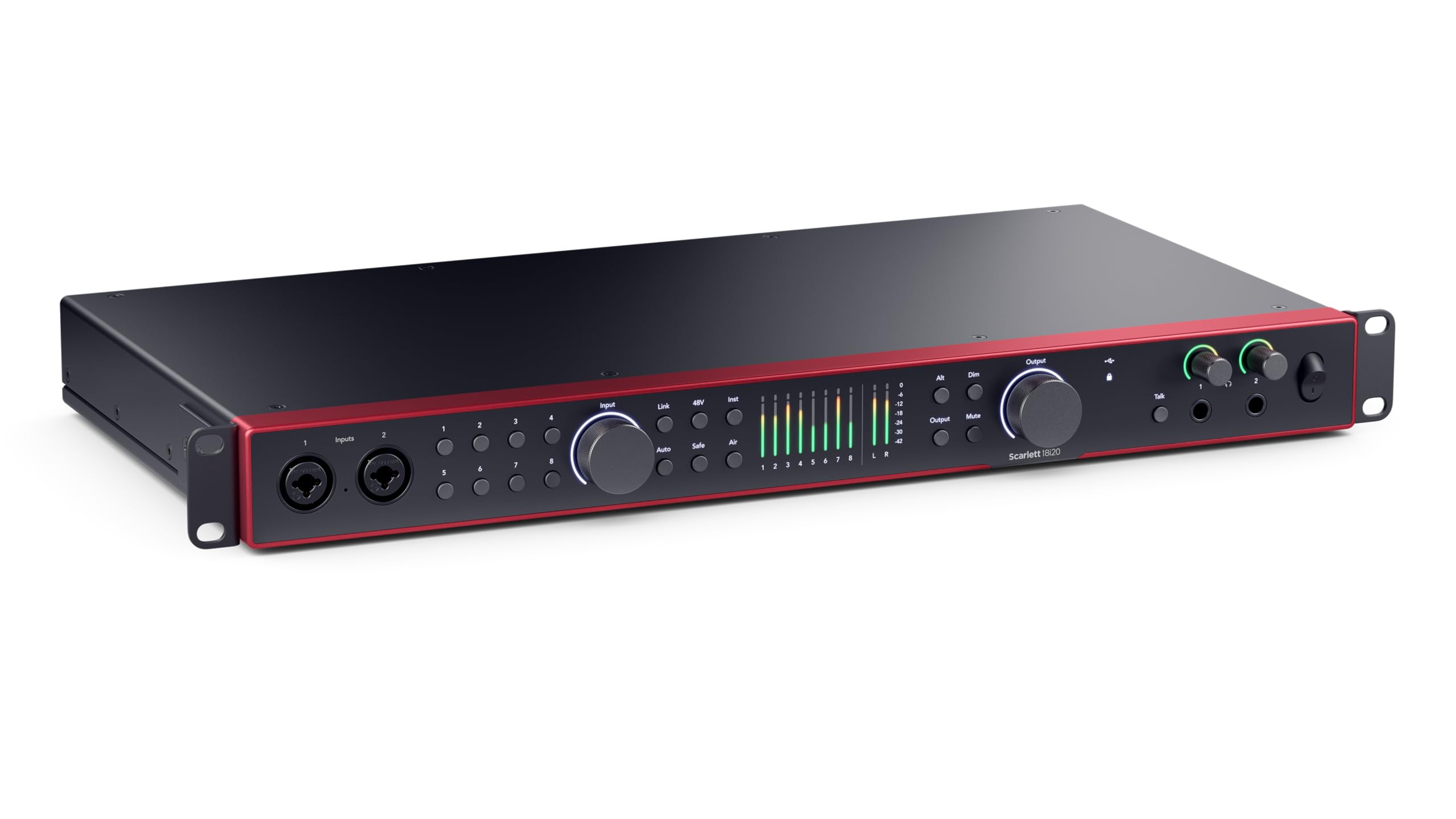
The Focusrite Scarlett 18i20 4th Gen represents the current flagship for multi-track drum recording in a single chassis. Its eight preamps deliver 69 dB of gain with a remarkably low noise floor, letting you capture soft ghost notes on the snare without hiss. The 24-bit/192 kHz converters, derived from Focusrite’s RedNet line, achieve 122 dB dynamic range — the highest in this roundup — which preserves the full transient impact of a kick drum hit through to the mix bus.
Auto Gain and Clip Safe features are genuinely useful for drummers who set levels quickly before a take: Auto Gain sets the preamp level to a healthy signal in seconds, and Clip Safe dynamically reduces gain if a sudden rimshot spike threatens to clip. The Air mode adds harmonic presence to the signal path, useful for adding a bit of analog sheen to sterile module outputs. The bundled software bundle includes Pro Tools Intro, Ableton Live Lite, Cubase LE, and the Hitmaker Expansion with emulations of classic compressors and EQs.
The ADAT, S/PDIF, and Word Clock I/O allow expansion up to 18 simultaneous inputs, sufficient for recording a full acoustic drum kit with eight microphones plus room mics. The metal construction weighs 8 pounds, signaling it is built for permanent studio installation rather than mobile rigs. For drummers who eventually want to record acoustic drums alongside their e-kit, this interface offers the most future-proof input architecture.
Why it’s great
- 122 dB dynamic range and 69 dB preamp gain capture every drum transient with clarity.
- Auto Gain and Clip Safe prevent clipping during dynamic drum performances.
- ADAT, S/PDIF, and Word Clock I/O allow expansion to 18 inputs for future acoustic kits.
- Air mode adds analog presence to sterile drum module outputs without outboard gear.
Good to know
- Heavy 8-pound build not ideal for frequent transport between locations.
- Continuous knobs require visual indicator checks rather than tactile position feedback.
4. Zoom AMS-24

The Zoom AMS-24 is the only interface in this guide that runs entirely on bus power from a USB-C port — including iOS devices — making it the go-to choice for drummers who record on location or at rehearsals with an iPad. Its 2 XLR/TRS combo inputs accept your drum module’s stereo master output, and the integrated Music/Streaming switch toggles between multi-track DAW routing and a combined feed for live-streaming platforms.
Direct monitoring comes via a dedicated hardware switch, ensuring zero added latency when monitoring your drum module through headphones. The two independent headphone outputs both support separate mixes. The compact metal-and-plastic body weighs just 280 grams and slips into a stick bag pocket. The 48 kHz maximum sample rate is fine for stereo drum recording, but serious multi-track projects will hit the input ceiling quickly.
Customer feedback highlights the AMS-24’s pickiness with USB-C cables — only high-quality, data-rated cables reliably maintain the connection with iPhones. The loopback feature works well for streaming drum covers directly to Twitch or YouTube without an external mixer. For drummers who primarily record stereo mixes and want the smallest possible rig, the AMS-24 delivers excellent portability.
Why it’s great
- USB-C bus power works with Mac, PC, iOS, and Android without a wall plug.
- Dedicated Music/Streaming switch simplifies routing for recording vs live streaming.
- Ultra-lightweight 280-gram body fits in a stick bag for mobile recording.
- Two headphone outs with independent mixes for drummer and engineer on location.
Good to know
- 48 kHz sample rate max limits high-resolution drum capture.
- USB-C cable compatibility is inconsistent — use the included cable for reliable connections.
5. Behringer U-Phoria UMC204HD
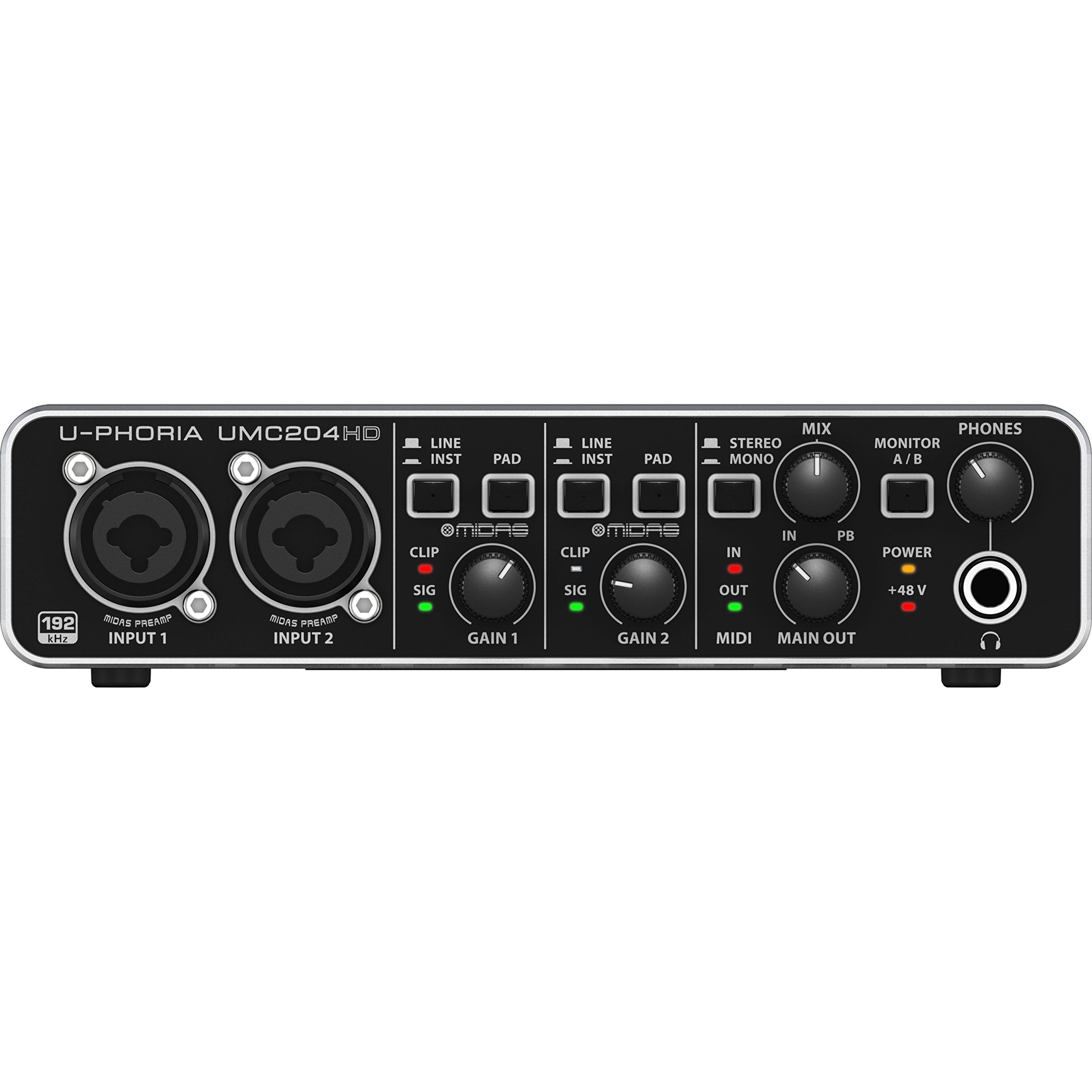
The Behringer UMC204HD punches far above its price tier with two MIDAS-designed mic preamps and 24-bit/192 kHz conversion. For drummers recording a stereo submix from their module, the two combo inputs handle balanced line levels cleanly, and the dedicated instrument input lets you plug an external trigger pad directly. The metal chassis feels substantial and the knobs resist accidental movement during takes.
MIDI I/O is included, letting you sync your drum module’s internal sequencer or trigger VST instruments from your kit. The internal mixing engine supports zero-latency direct monitoring through the headphone out. The USB 2.0 connection is class-compliant on macOS and Linux, with a stable ASIO driver available for Windows. Several customer reviews report excellent performance driving 250-ohm headphones without additional amplification.
The only real trade-off is the lack of a hardware power switch — you must disconnect the USB cable or power down the computer to fully power off the unit. The 2-in/4-out configuration also maxes out at two discrete inputs, so multi-track drum recording requires stepping up to the UMC404HD or UMC1820. For stereo tracking at 192 kHz with MIDI sync, the UMC204HD offers exceptional value for a compact rig.
Why it’s great
- MIDAS preamps deliver clean gain up to 192 kHz for detailed drum submixes.
- MIDI I/O syncs drum module tempo or triggers VST instruments from your kit.
- Sturdy metal build feels premium far beyond its price position.
- Proven Linux compatibility for open-source recording workflows.
Good to know
- No power switch — must unplug USB to fully power off the interface.
- Only 2 inputs limit you to stereo recording; multi-track requires a different model.
6. Behringer UMC404HD

The Behringer UMC404HD expands the UMC philosophy to four inputs, giving you exactly enough channels for a 4-piece electronic drum kit — kick, snare, hi-hat, and one crash/ride — or a full stereo module plus two external trigger inputs. The four MIDAS preamps share the same low-noise, high-headroom circuit found in the 1820 model, and the 24-bit/192 kHz converters capture all the nuance your module outputs.
MIDI I/O and inserts on each channel make this interface particularly versatile: you can insert a hardware compressor on the kick channel before it hits the DAW, and the MIDI connection keeps your module and computer in perfect tempo sync. The built casing fits desktop setups comfortably, and the large gain knobs are easy to adjust mid-take. A reported periodic ticking noise when idle (audible through connected speakers, not in recordings) appears in some units, so check your specific sample.
For drummers who want to separate drum elements across four tracks without jumping to a rack-mount interface, the UMC404HD hits the sweet spot between price and capability. The included USB cable and driver setup for Windows and macOS are straightforward. Its main limitation is the 4-input ceiling — once you add more toms or cymbals, you will need to consolidate tracks on the module side.
Why it’s great
- Four MIDAS preamps allow discrete tracking of a 4-piece e-drum kit.
- Per-channel inserts let you glue a compressor onto kick before conversion.
- MIDI I/O syncs drum module clocks or triggers VST instruments seamlessly.
- 192 kHz sample rate preserves all the detail your module outputs.
Good to know
- Some units exhibit a periodic idle ticking noise audible through monitors.
- Four inputs limit you to a 4-piece kit; larger setups need the 1820 or ADAT expansion.
7. Universal Audio Volt 2

The Universal Audio Volt 2 brings UA’s 610 tube preamp emulation into a compact desktop form factor. The Vintage switch engages a circuit that adds harmonic warmth and subtle compression — ideal for fattening up sterile electronic drum sounds before they hit the DAW. The 24-bit/192 kHz converters deliver clean, detailed capture, and the included LUNA DAW and UAD plugin bundle give you access to professional mixing tools from the start.
The two combo inputs accept your drum module’s stereo master output or two separate trigger channels. The dedicated instrument input works for direct connection of a bass drum trigger or external pad. The metal construction with a retro-style knob and chrome accents looks at home on any desk. Customer reviews consistently praise the warm, natural sound of the Vintage mode compared to neutral interfaces in the same range.
The Volt 2 requires an external USB power supply when used with iOS devices, and the headphone output is a single stereo jack shared across the main mix — no separate cue mix for a drummer and producer. For drummers who want a characterful stereo recording chain with instant analog vibe and a generous software bundle, the Volt 2 delivers without breaking the bank.
Why it’s great
- Vintage mode adds analog harmonic warmth to sterile drum module outputs.
- 192 kHz conversion preserves all transient detail from your e-kit.
- Includes LUNA DAW and UAD plugin bundle for professional mixing tools out of the box.
- Solid metal build with retro design looks professional on any desk.
Good to know
- 2 inputs limit you to stereo recording; no multi-track capability.
- Requires external power adapter for iOS use — bus power is not sufficient.
8. Tascam US-16×08

The Tascam US-16×08 offers a staggering 16 inputs in a single rack-mountable chassis — 8 XLR with Ultra-HDDA preamps plus 8 line inputs. For electronic drummers running a 10-trigger kit with room to spare, this interface accepts every drum trigger, external pads, and a vocal mic simultaneously. The DSP mixer provides zero-latency monitoring with onboard EQ and compression on each channel, letting you craft a polished headphone mix before the signal ever reaches your DAW.
The preamps deliver up to 56 dB of gain with a noise floor low enough for dynamic recordings. The included control software allows full routing and mixing from your computer. The unit can operate as a standalone mixer without a computer connected, useful for rehearsals where you just need a headphone mix of the drum module. Customer reviews highlight the quiet preamps and rock-solid build, though the driver installation process is less streamlined than Focusrite or MOTU.
The US-16×08 records 16 separate analog channels at 96 kHz/24-bit with no dropouts. The price positions it as a cost-effective alternative to the Scarlett 18i20 for drummers who prioritize input count over the latest converter chips. The only notable omission is the lack of a dedicated master bus compressor in the DSP mixer — you need to apply compression in your DAW or on the master outputs.
Why it’s great
- 16 total inputs (8 XLR + 8 line) accommodate even the largest e-drum and hybrid setups.
- DSP mixer with EQ/compression provides zero-latency monitoring without computer.
- Can operate as a standalone mixer for rehearsals without a DAW.
- Ultra-HDDA preamps deliver 56 dB of clean gain with minimal noise.
Good to know
- Driver installation can be finicky on some Windows setups; macOS users face fewer issues.
- Plastic knobs positioned close together make fine gain adjustments trickier.
9. Korg NANOKEY-ST

The Korg NANOKEY-ST is not an audio interface but a wireless MIDI controller that pairs with your interface setup to trigger drum VST instruments. Its 25 low-profile keys and 8 velocity-sensitive pads let you input drum patterns, trigger one-shot samples, or play melodic parts on the fly. The Bluetooth LE connectivity eliminates cable clutter when used with an iPad running Korg Gadget or GarageBand.
The X-Y touch pad maps to modulation, pitch bend, or parameter control — useful for shaping drum hits in real time. The included Korg Kontrol Editor unlocks deep MIDI mapping, letting you assign each pad to a specific drum sound or scene in your DAW. The build is lightweight plastic, but the keys offer enough velocity sensitivity for expressive drum programming.
The NANOKEY-ST works best as a secondary input device alongside a dedicated audio interface. It does not convert analog drum signals — it sends only MIDI data over USB or Bluetooth. For drummers who also produce electronic music or sketch out beats on the go, this tiny controller adds serious creative firepower when paired with any audio interface in this guide.
Why it’s great
- Wireless Bluetooth LE connection works seamlessly with iPad and Mac for mobile beat-making.
- 8 velocity pads let you trigger drum samples and create patterns without a full keyboard.
- X-Y touch pad provides real-time modulation control for shaping drum sounds.
- Ultra-compact size fits inside a laptop bag alongside your audio interface.
Good to know
- Not an audio interface — requires a separate unit to capture analog drum signals.
- Wobbly mini-keys feel cheap compared to full-size MIDI controllers.
FAQ
Can I plug my electronic drum module directly into an audio interface?
How many inputs do I need for a typical electronic drum kit?
What sample rate is best for electronic drum recording?
Do I need MIDI connectivity on my audio interface for electronic drums?
Final Thoughts: The Verdict
For most drummers, the audio interface for electronic drums winner is the MOTU M6 because it combines best-in-class 2.5 ms round-trip latency, ESS Sabre32 DAC clarity, and four preamps in a rugged portable build — enough for a compact kit with room for expansion. If you need eight inputs for a full kit today with ADAT expansion for tomorrow, grab the Behringer UMC1820. And for professional studio recording with 18 inputs, Auto Gain, and the highest dynamic range, nothing beats the Focusrite Scarlett 18i20 4th Gen.