
Our readers keep the lights on and the weekend projects moving. As an Amazon Associate, I earn from qualifying purchases.
That moment you nail a vocal take only to find the waveform clipped into a square wave is the exact reason home studio buyers obsess over preamp headroom, converter bit-depth, and signal-to-noise specs. An interface that can’t handle dynamic range without distortion isn’t a tool—it’s a bottleneck between your performance and the final mix.
I’m Rikta — the co-founder and writer behind FitlyFast. I’ve spent dozens of hours analyzing preamp gain staging, AD/DA converter specifications, driver stability across operating systems, and bundle value to find the interfaces that actually deliver professional results without forcing you to upgrade six months later.
This guide walks through nine contenders, from all-in-one starter packages to rack-ready production hubs, to help you find the right audio interface for home studio setup that matches your recording ambitions and connectivity needs.
How To Choose The Best Audio Interface For Home Studio
Selecting an interface isn’t about picking the most expensive unit. The right choice balances preamp quality, the number of simultaneous inputs you need, converter resolution, and the software bundle that gets you recording immediately. Understanding a few core specs will save you from the frustration of outgrowing your gear too quickly.
Preamp Quality and Gain Range
Preamps are the first stage your microphone signal hits. The cleaner the preamp and the wider its gain range (measured in dB), the more headroom you have before noise becomes audible. Entry-level interfaces typically offer 50-56dB of gain, while premium units push past 60dB. For quiet dynamic mics like the Shure SM7B, higher gain is non-negotiable.
Input and Output Channel Count
A solo singer-songwriter can thrive with two inputs. A band recording live takes, or a podcaster running multiple mics simultaneously, needs four, eight, or more channels. Also count your outputs: separate headphone mixes and multiple monitor pairs require more output channels. ADAT and S/PDIF expansion ports let you add channels later without replacing the interface.
Sample Rate and Bit Depth
24-bit / 48kHz is the standard for most platforms. Higher rates like 96kHz and 192kHz reduce aliasing and offer more timing precision during mixing, but double and quadruple your file sizes. The bigger shift is 32-bit float recording, which captures a wider dynamic range and lets you “fix” gain after recording without clipping or noise penalties.
Quick Comparison
On smaller screens, swipe sideways to see the full table.
| Model | Category | Best For | Key Spec | Amazon |
|---|---|---|---|---|
| Focusrite Scarlett 18i16 4th Gen | Multi-Channel Hub | Band recording & complex routing | 18-in / 16-out, 69dB preamp gain, ADAT/SPDIF | Amazon |
| Universal Audio Apollo Solo USB HE | Studio-Grade | Zero-latency UAD plugin tracking | 192kHz, UAD Solo Core, Unison preamps | Amazon |
| Solid State Logic SSL 2 MKII | Premium Compact | Crisp vocal capture & podcasting | 2-in/2-out, 32-bit/192kHz, Legacy 4K | Amazon |
| MOTU M4 | Desktop Workhorse | Multi-input production with metering | 4-in/4-out, 192kHz, built-in LCD metering | Amazon |
| Zoom H4 Essential | Portable Recorder | Field recording & backup interface | 4-track 192kHz, 32-bit float, X/Y mics | Amazon |
| Universal Audio Volt 2 | Entry Premium | First studio interface with vintage tone | 2-in/2-out, 192kHz, Vintage mic mode | Amazon |
| PreSonus AudioBox USB 96 Studio | Complete Bundle | Beginner all-in-one studio setup | 2-in/2-out, 96kHz, includes mic & headphones | Amazon |
| M-Audio AIR 192×4 VSPro | Value Bundle | Budget-friendly recording package | 2-in/2-out, 192kHz, 2.59ms round-trip latency | Amazon |
| Pyle PMXU46BT | Live Mixer Hybrid | Multi-mic live streaming & events | 4-channel mixer, Bluetooth, USB interface | Amazon |
In‑Depth Reviews
1. Focusrite Scarlett 18i16 4th Gen
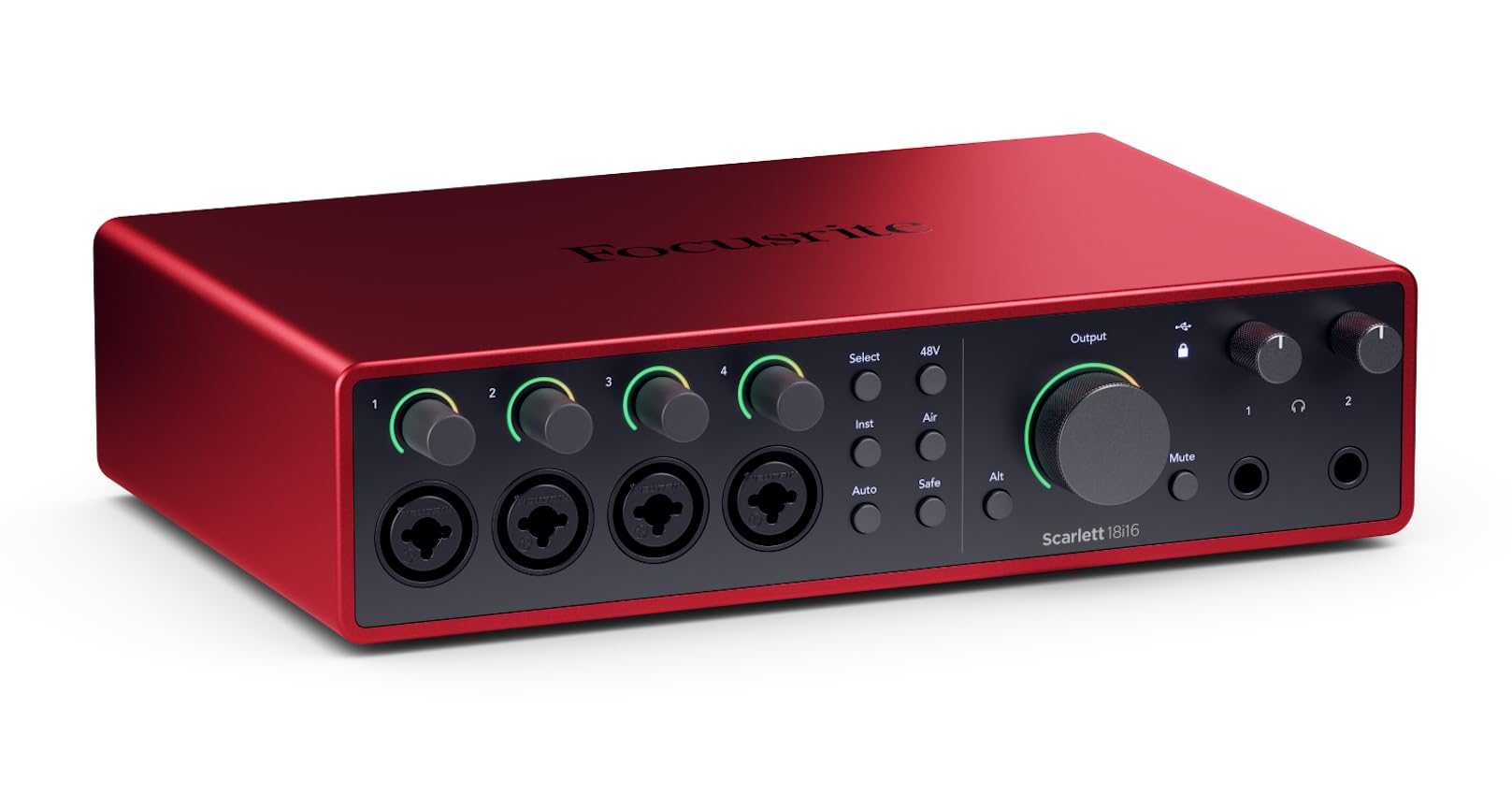
The 4th generation Scarlett 18i16 represents Focusrite’s most refined multi-channel interface for the home studio producer who needs serious I/O. The four mic preamps deliver 69dB of gain each, enough to drive dynamic mics cleanly without an external cloudlifter. The two Hi-Z inputs accept guitar and bass directly with instrument-level impedance matching.
Auto Gain and Clip Safe are genuinely useful workflow tools: Auto Gain sets the optimal recording level by analyzing your source, while Clip Safe continuously adjusts gain in real-time to prevent clipping without you touching a knob. The 122dB dynamic range across the 24-bit/192kHz converters gives you headroom for dynamic instruments and vocals.
The included software bundle is substantial: Pro Tools Intro+, Ableton Live Lite, Cubase LE, and the Hitmaker Expansion with effects and instruments. The ADAT and S/PDIF ports mean you can expand to 18 inputs later without replacing the unit. The Air mode adds presence and harmonic drive to vocals and acoustic instruments, recreating the character of classic console preamps.
Why it’s great
- Eight onboard preamps with ADAT expandability for up to 18 inputs
- Auto Gain and Clip Safe eliminate level-setting guesswork
- Seamless routing for multiple independent headphone mixes
Good to know
- Requires external power supply—not bus-powered for mobile use
- Most rear input controls require the Focusrite Control app
2. Universal Audio Apollo Solo USB Heritage Edition

The Apollo Solo USB Heritage Edition brings UA’s flagship converter and preamp technology to a compact, bus-powered form factor. The UAD Solo Core DSP chip lets you track through vintage compressors, EQs, tape machines, and mic preamp emulations with near-zero latency—the plugins apply at the hardware level before the signal hits your DAW. The Heritage Edition adds five premium titles including Teletronix LA-2A and Pultec EQP-1A.
Unison preamp technology physically reconfigures the input impedance and gain stage to match the hardware being emulated. Plug in a Shure SM57 and select the Marshall Plexi amp emulation, and the interface behaves like the real circuit. The headphone amplifier is best-in-class for its size, delivering loud, detailed, low-noise monitoring suitable for critical mix checking.
Compatibility is a consideration: the unit requires a Thunderbolt 4 or USB-C connection on Windows and has historically lagged on macOS driver updates after major OS releases. The single Unison input limits you to one processed channel at a time, making this a solo vocalist or single-instrument workstation rather than a band recording hub.
Why it’s great
- Near-zero latency UAD plugin processing for tracking through classic gear
- Unison preamp technology changes impedance to match hardware emulations
- Superb headphone amplifier with low noise floor
Good to know
- Only one Unison-enabled input limits simultaneous processed tracking
- Has historically been slow to support new macOS versions
3. Solid State Logic SSL 2 MKII

SSL brings its legendary console sound to the desktop with the SSL 2 MKII. The mic preamps have a remarkably low noise floor and the Legacy 4K analog enhancement button adds presence and harmonic richness that emulates the SSL 4000 series console—ideal for vocals that need to cut through a dense mix without aggressive EQ. The 32-bit/192kHz AD/DA converters offer headroom beyond typical 24-bit interfaces, though the MKII is not a 32-bit float recorder; the 32-bit refers to the D/A conversion stage.
The high-pass filter is a standout feature for voice artists and podcasters. A simple switch cuts subsonic rumble from HVAC systems, traffic, or handling noise without affecting the vocal frequencies. The MIDI I/O on standard 5-pin DIN jacks is a welcome inclusion for home studios using hardware synthesizers or drum machines.
The stainless steel chassis feels dense and the knobs have the weighted, smooth rotation of SSL’s larger consoles. The stereo loopback channel simplifies live streaming and podcast recording by routing your computer audio back through the interface. The SSL Production Pack software bundle includes various plugins and virtual instruments to get started.
Why it’s great
- Legacy 4K analog enhancement adds console-style presence to vocals
- Built-in high-pass filter eliminates rumble without external processing
- MIDI I/O for hardware synth integration
Good to know
- Not a 32-bit float recorder—can still clip if gain is set too hot
- Larger and heavier than comparable 2-in/2-out interfaces
4. MOTU M4 4×4 USB-C Audio Interface

The MOTU M4 is a desktop workhorse that punches well above its weight class. The two mic preamps are transparent with extremely low noise and distortion, and the ESS Sabre32 Ultra DAC delivers a 120dB dynamic range on the outputs. The built-in LCD level meters on each input channel are a luxury usually reserved for rack-mounted units—they let you visually confirm gain staging at a glance without looking at your DAW.
The physical direct monitoring mix control is a major advantage. A front-panel knob blends the input signal with the DAW playback, giving you zero-latency cue mixes without any software configuration. The dedicated loopback output simplifies recording computer playback for streaming, podcasting, or sampling. ASIO drivers on Windows are rock-solid with tested low latency performance.
The headphone amp is adequate for monitoring but not powerful enough for high-impedance studio headphones—you may need an external headphone amplifier for critical mixing sessions. The four inputs handle two mics plus two line-level sources simultaneously, making it suitable for a small band demo session or a multi-mic podcast.
Why it’s great
- LCD level meters provide precise visual gain staging
- Physical direct monitoring knob for zero-latency cuing
- Rock-solid ASIO drivers with very low round-trip latency
Good to know
- Headphone amp lacks power for high-impedance headphones under bus power
- Volume knobs have a dead zone in the first 25% of rotation
5. Zoom H4 Essential Handheld Recorder

The Zoom H4 Essential is the Swiss army knife for content creators who need to record anywhere. The 19.4mm X/Y microphone capsule is the largest on any handheld recorder, capturing rich, detailed stereo audio with a wide dynamic range. The 32-bit float recording eliminates the anxiety of setting levels—you can capture a whisper and a drum hit in the same take without clipping, then adjust the level in post-production with no noise penalty.
It functions as a 2-in/2-out USB audio interface for your computer, so one device serves as both a portable field recorder and a desktop interface. The dual XLR/TRS combo inputs on the bottom are well-placed for tabletop use, accepting dynamic and condenser microphones with phantom power. Battery life hits about 20 hours on standard AA cells, and it can also run from a USB power bank.
The interface is straightforward: power on, press record, and walk away. The menu navigation is intuitive with accessibility options for visual impairment. The handling noise from the chassis is noticeable when holding it—using the included windscreen and a shock mount or tripod mitigates this. It’s lightweight at 243 grams, making it a viable everyday carry for field recording, songwriting capture, or interview backup.
Why it’s great
- 32-bit float recording prevents clipped takes regardless of input level
- Large-diaphragm X/Y mics capture detailed stereo imaging
- Dual functionality: portable recorder and USB audio interface
Good to know
- Handling noise is severe without a tripod or shock mount
- Onboard mics are prone to wind noise outdoors
6. Universal Audio Volt 2

The Volt 2 is Universal Audio’s entry-level interface that borrows the preamp topology from their acclaimed 610 console. The Vintage mode engages a tube-emulation circuit that adds warmth and harmonic richness to vocals and acoustic instruments, giving you a more polished sound straight into your DAW without plug-ins. The 24-bit/192kHz converters capture detail with clarity that rivals interfaces costing significantly more.
The build quality is impressive—the metal chassis feels solid and the knobs have a damped, premium rotation. USB bus power removes the need for a wall outlet, making it genuinely portable for laptop recording sessions. The included LUNA Digital Audio Workstation integrates tightly with the Volt hardware, offering an analog tape-style workflow with the included UAD instruments and effects.
The single instrument input and two combo mic/line inputs limit you to one guitar and one microphone at a time. The vintage mode is a single button—you can’t adjust the amount of saturation. For late-night apartment guitar recording or mobile vocal tracking, the Volt 2 performs far beyond its price tier.
Why it’s great
- Vintage mode preamp adds console-style warmth without software
- USB bus-powered for true mobile recording
- Solid metal construction with premium knob feel
Good to know
- Only one instrument input limits simultaneous guitar and mic recording
- Vintage mode is a single toggle—no variable saturation control
7. PreSonus AudioBox USB 96 25th Anniversary Studio

The AudioBox USB 96 Studio package is designed for the first-time home studio buyer who wants one box with everything needed to start recording today. The AudioBox interface delivers 24-bit/96kHz audio with two combo inputs for microphones and instruments, and the latency is acceptable for monitoring direct signals. The rugged steel chassis with the half-rack form factor can survive being tossed in a gig bag.
The included M7 large-diaphragm condenser microphone performs well above its bundle-tier reputation, capturing vocals and acoustic guitar with warmth and clarity. The HD7 closed-back headphones offer balanced frequency response and good isolation for tracking without bleed into the microphone. All necessary cables and a desktop mic stand are included.
Studio One Artist is a fully capable DAW—not a stripped-down trial—and the Studio Magic bundle adds dozens of virtual instruments, effects loops, and mastering tools. The complete setup costs less than buying an interface, mic, and headphones separately. The 96kHz maximum sample rate is adequate for podcasting and most music production, though 192kHz is missing if you need ultrasonic frequency capture.
Why it’s great
- Complete recording package with mic, headphones, cables, and stand
- Studio One Artist DAW is a full-featured production environment
- Rugged steel chassis withstands regular transport
Good to know
- Maximum sample rate is 96kHz, not 192kHz
- Only two inputs limit simultaneous recording sources
8. M-Audio AIR 192×4 VSPro

The AIR 192×4 VSPro is a value-oriented bundle that pairs a capable 2-in/2-out interface with a Nova condenser microphone, HDH40 headphones, and all necessary cables. The interface itself delivers 24-bit/192kHz resolution with a class-leading round-trip latency of only 2.59ms, making it responsive for real-time monitoring and virtual instrument play. The crystal preamps are transparent and the AD converters capture clean recordings.
The included Nova microphone is a competent starter condenser with a cardioid pattern and a shock mount in the box. The HDH40 headphones provide acceptable monitoring for tracking, though their frequency response leans bright. The software bundle includes MPC Beats, Ableton Live Lite, Touch Loops, and a suite of virtual instruments like Xpand!2 and Mini Grand.
The USB-C connectivity with both USB-C-to-USB-C and USB-C-to-USB-A cables ensures compatibility with modern laptops and older desktops. Some users have reported driver recognition issues on Windows, but the RMA process is responsive. The combination of low latency and high sample rate makes this a strong entry point for beatmakers and vocalists on a tight budget.
Why it’s great
- Exceptionally low 2.59ms round-trip latency for responsive tracking
- Complete kit with condenser mic, headphones, and shock mount
- USB-C connectivity with both cable types included
Good to know
- Included microphone quality is adequate but not studio-grade
- Some users report Windows driver recognition issues
9. Pyle PMXU46BT 4-Channel Bluetooth Mixer

The Pyle PMXU46BT is a hybrid device that functions as both a 4-channel analog mixer and a USB audio interface, making it uniquely suited for live streaming, church sound, or event hosting where you need multiple mic inputs and Bluetooth music playback simultaneously. The four channels accept XLR and 1/4-inch combo inputs, with independent channel EQ for high, mid, and low frequency adjustments.
Bluetooth streaming is a genuine convenience: you can wirelessly connect a phone or tablet for background music, interview audio, or backing tracks, and route that signal through the mixer along with your microphones. The +48V phantom power supplies condenser microphones on all XLR inputs. The 12-segment LED output meter gives visual feedback for overall mix level.
The USB interface function records a stereo mix to your computer, not individual tracks—this is a live mixer workflow, not a multitrack recording interface. The USB connection can sometimes require reinsertion to be recognized. The build quality is rugged with a metal chassis and smooth sliders, and the analog effects add character to drums and synths.
Why it’s great
- Four independent channels with individual EQ for multi-mic setups
- Bluetooth input for wireless music and backing track streaming
- Rugged construction with long-lasting slider potentiometers
Good to know
- Records a single stereo mix—no multitrack recording capability
- USB driver recognition can be inconsistent
FAQ
Do I need 192kHz sample rate for home recording?
How many inputs should I buy for starting out?
Can I use a dynamic mic like the SM7B with any interface?
What does loopback do and do I need it?
Is a USB-C interface better than USB-A?
Final Thoughts: The Verdict
For most users, the audio interface for home studio winner is the Focusrite Scarlett 18i16 4th Gen because it offers the ideal balance of input count, preamp quality, and expandability for producers who will grow into their setup. If you want the legendary SSL console sound in a portable package, grab the Solid State Logic SSL 2 MKII. And for mobile field recording and backup capture with 32-bit float safety, nothing beats the Zoom H4 Essential.