
Our readers keep the lights on and the weekend projects moving. As an Amazon Associate, I earn from qualifying purchases.
The built-in sound card on your PC is a compromise designed for beeps and streaming, not for capturing a vocal take or tracking a guitar riff. You need a dedicated interface to bypass that noisy, high-latency signal path and get studio-quality audio into your digital audio workstation.
I’m Rikta — the co-founder and writer behind FitlyFast. I’ve spent countless hours dissecting the technical specs of USB audio interfaces, from preamp gain staging to converter dynamic range, to separate marketing claims from genuine performance for this guide.
Whether you are a podcaster, musician, or home-studio producer, finding the best audio interface for pc requires focusing on preamp quality, driver stability, and connectivity for your gear.
How To Choose The Best Audio Interface For PC
Choosing your first or next interface means balancing connectivity, preamp quality, and your specific recording needs. Focus on these three aspects to avoid buyer’s remorse.
Inputs and Outputs: Match Your Workflow
The number of inputs dictates how many microphones or instruments you can record simultaneously. A solo podcaster needs one XLR input, while a band tracking drums needs eight or more. Outputs matter for connecting multiple monitor speaker pairs and headphone mixes. ADAT expansion is a future-proofing feature for adding more channels later.
Preamps and Analog Sound Quality
The preamp is the first stage your microphone signal hits. A cleaner preamp with more usable gain (measured in dB) delivers a lower noise floor and richer detail. Features like a pad switch prevent distortion from loud sources, while a high-pass filter removes low-end rumble before it even hits your DAW.
Driver Stability and Latency Performance
Windows is notoriously sensitive to audio drivers. Interfaces with mature, regularly updated drivers (like those from Focusrite, MOTU, and RME) offer lower round-trip latency with fewer glitches. ASIO drivers are essential for bypassing Windows’ default audio path. Loopback functionality is a major plus for streamers and podcasters needing to capture system audio.
Quick Comparison
On smaller screens, swipe sideways to see the full table.
| Model | Category | Best For | Key Spec | Amazon |
|---|---|---|---|---|
| SSL 2 MKII | Premium 2×2 | Producers seeking analog character | 32-bit / 192 kHz converters | Amazon |
| MOTU M4 | High-End 4×4 | Low-latency multi-instrument recording | 192 kHz, 8 channels | Amazon |
| Focusrite Scarlett 18i16 4th Gen | Large Studio Hub | Big sessions with ADAT expansion | 69 dB preamp gain | Amazon |
| Universal Audio Volt 2 | Character 2×2 | Vintage-inspired vocal and guitar tracking | 24-bit / 192 kHz quality | Amazon |
| Behringer UMC1820 | High-Channel Value | Multi-channel recording on a budget | 18 in / 20 out with ADAT | Amazon |
| Tascam US-16×08 | Rackmount Powerhouse | Drum and band tracking in a rack | 8 Ultra-HDDA preamps | Amazon |
| Universal Audio Apollo Solo | Studio-Grade DSP | Near-zero latency UAD plugin tracking | UAD Solo Core processing | Amazon |
| Focusrite Scarlett Solo 3rd Gen | Entry-Level Workhorse | Solo singer-songwriter recording | 192 kHz, Air mode | Amazon |
| Arturia MiniFuse 1 | Compact Starter | Ultra-portable travel and podcasting | 192 kHz, 5-year warranty | Amazon |
In‑Depth Reviews
1. Solid State Logic SSL 2 MKII

The SSL 2 MKII brings legendary console mojo into a compact 2×2 format. The standout feature is the Legacy 4K analog enhancement button, which adds a high-frequency shine and subtle harmonic distortion that emulates the classic SSL console sound — perfect for adding presence to a vocal or direct guitar track.
It houses 32-bit/192 kHz converters, offering a dynamic range and headroom that outclasses most rivals in its tier. The two XLR mic preamps are extremely clean, with a high-pass filter that effectively cuts low-end rumble before it reaches your DAW, a godsend for voice-over artists recording in untreated rooms.
Physical build quality is rock-solid with a stainless steel chassis that feels premium. The headphone output is powerful and clear, easily driving high-impedance headphones. The included SSL Production Pack software bundle adds significant value, giving you a professional starting point for production.
Why it’s great
- Legacy 4K analog enhancement adds sought-after console character
- Excellent 32-bit/192 kHz converters for high dynamic range
- Robust metal build with intuitive layout
Good to know
- Slightly larger and heavier than comparable 2×2 interfaces
- Does not support 32-bit float recording, only 32-bit D/A conversion
2. MOTU M4

The MOTU M4 is often praised by engineers for its incredibly low round-trip latency and transparent sound signature. It operates via USB-C bus power and features two mic preamps that are notably clean, with a high headroom floor that captures transients without distortion.
The inclusion of an LCD screen for real-time level metering is rare at this price point and extremely useful for setting gain accurately without guessing. Its loopback feature is excellent for streamers who need to mix PC audio with their microphone feed without extra software.
Windows driver stability is industry-leading, making it a top choice for PC users who have struggled with glitchy drivers on other brands. The physical direct monitoring mix knob allows you to blend your input with the DAW playback in zero latency.
Why it’s great
- Industry-leading ultra-low latency performance on Windows
- LCD level metering for precise gain staging
- Transparent, high-headroom preamps with low noise floor
Good to know
- Headphone amp is functional but not the most powerful in its class
- Volume knobs can have a small dead zone at the start of rotation
3. Focusrite Scarlett 18i16 4th Gen
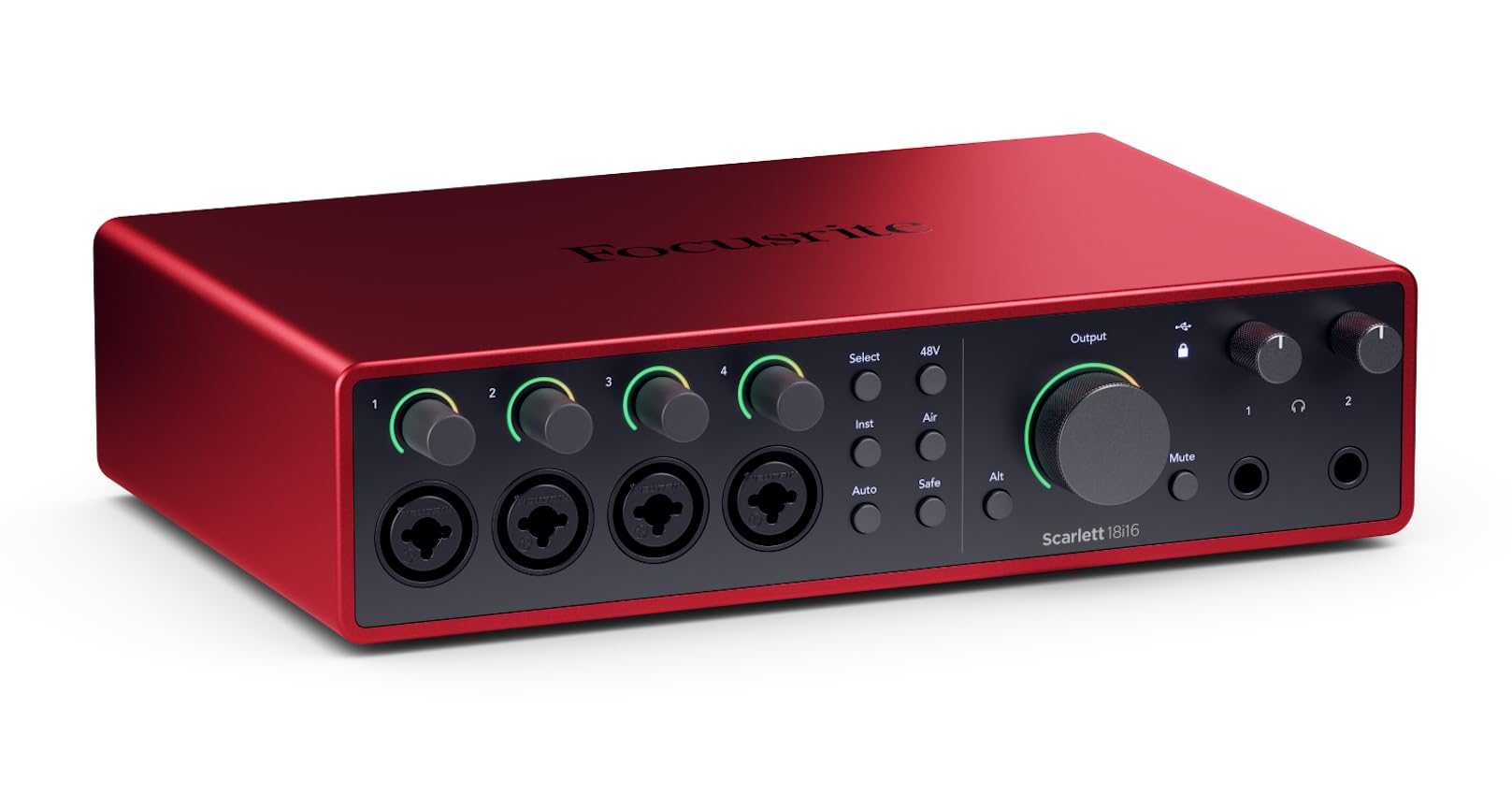
The 4th Gen Scarlett 18i16 is a serious upgrade for the growing studio, offering 18 inputs and 16 outputs through a combination of analog ports, ADAT, and S/PDIF. The preamps now deliver a massive 69dB of gain, easily driving low-output ribbon microphones without an external booster.
Smart features like Auto Gain and Clip Safe are genuinely useful time-savers. Auto Gain sets the optimal recording level at the press of a button, while Clip Safe acts as a safety net, adjusting gain in real-time to prevent digital clipping during a take. The Air mode now includes a Harmonic Drive option for adding analog-style saturation.
Build quality is robust with a metal chassis, and the connectivity is extensive enough to be the center of a serious home project studio. The 122dB dynamic range on the converters matches the clarity found in much more expensive interfaces.
Why it’s great
- 69dB of preamp gain handles any microphone type
- Auto Gain and Clip Safe eliminate level guesswork
- ADAT expandable for up to 18 simultaneous inputs
Good to know
- Requires an external power supply (not bus-powered)
- Rear inputs must be configured via the desktop control app
4. Universal Audio Volt 2

The Volt 2 brings Universal Audio’s analog heritage down to an affordable level. Its defining feature is the Vintage mode, which emulates the circuitry of UA’s classic 610 tube preamp, adding a warm, rich harmonic character that is noticeably pleasing on vocals and acoustic instruments.
It records at up to 24-bit/192 kHz with crystal-clear converters that capture the nuance of your performance. The included LUNA DAW offers a unique analog workflow that integrates seamlessly with Volt’s hardware, providing a tactile recording experience reminiscent of a real console.
The build is compact yet sturdy, making it a great choice for a mobile recording setup or a minimalist desktop. Bus-powered via USB, it works with Mac, PC, and iPad, offering great flexibility for musicians on the go.
Why it’s great
- Vintage mode adds analog tube-like warmth and presence
- Includes powerful LUNA DAW with an analog feel
- High-quality 24-bit/192 kHz converters
Good to know
- No DSP for UAD plugin processing (unlike the Apollo line)
- Headphone output is adequate but not class-leading in power
5. Behringer UMC1820

The Behringer UMC1820 is the go-to option for recording multiple sources simultaneously without a huge investment. It features eight Midas-designed mic preamps that are remarkably quiet and neutral, providing a solid foundation for tracking drums, a full band, or multiple podcast guests.
Its ADAT I/O allows you to expand the system to 18 inputs and 20 outputs by connecting a second unit like the Behringer ADA8200. This makes it a scalable solution for a home studio that needs to grow. The 24-bit/96 kHz resolution ensures professional-grade audio fidelity.
Setup is straightforward on Windows with reliable ASIO drivers that offer low latency. The unit’s rack-mountable design keeps your setup tidy, and the analog control of monitoring levels is a welcome feature.
Why it’s great
- Eight Midas-designed preamps provide clean, neutral gain
- ADAT expansion allows for up to 18 inputs
- Rack-mountable form factor for organized studios
Good to know
- Maximum sample rate is 96 kHz, not 192 kHz
- Preamps have a subtle low-mid bump that some users EQ out
6. Tascam US-16×08

The Tascam US-16×08 is a professional rackmount interface built for serious multi-track recording sessions. Its eight Ultra-HDDA mic preamps deliver up to 56dB of clean gain, renowned for being some of the quietest in their class, making them excellent for acoustic sources and sensitive microphones.
In addition to the eight XLR inputs, it provides eight analog line outputs and an additional two front-panel instrument inputs. The built-in DSP mixer allows for zero-latency monitoring with EQ and compression applied to each monitor mix, which is invaluable for live tracking where the talent needs a polished headphone mix.
The unit is built like a tank, designed to endure years of studio use. It connects via USB and has proven to be reliable on Windows systems, with user reports of stable performance over five years of daily use.
Why it’s great
- Ultra-HDDA preamps are exceptionally clean and quiet
- Onboard DSP mixer for low-latency headphone mixes with effects
- Durable rackmount chassis built for long-term use
Good to know
- Initial driver installation can be confusing on Windows
- Gain knobs are small and closely spaced, requiring careful adjustments
7. Universal Audio Apollo Solo USB Heritage Edition

The Apollo Solo USB is the entry point to Universal Audio’s renowned UAD ecosystem. Its key differentiator is the UAD Solo Core DSP, which allows you to record through vintage compressor, EQ, and preamp emulations with near-zero latency, directly onto the track in your DAW.
The Unison preamp technology goes beyond simple emulation by physically adjusting the impedance and gain staging of the analog preamp to match the component behavior of classics like the Neve 1073 or API 512c. This transforms the way a mic or DI signal interacts with the interface.
It features a best-in-class headphone amplifier that delivers loud, detailed, and low-noise monitoring. The Heritage Edition includes a premium suite of five award-winning plugins, representing substantial value for those committed to high-quality DSP tracking.
Why it’s great
- UAD DSP enables near-zero latency tracking through premium plugins
- Unison preamp emulations change the hardware’s analog behavior
- Superior headphone amplifier with immense clarity and power
Good to know
- Driver compatibility with new Windows and MacOS versions can lag at launch
- Requires a Thunderbolt 4 cable for reliable connection on some Windows setups
8. Focusrite Scarlett Solo 3rd Gen

The Scarlett Solo 3rd Gen remains a standard by which other entry-level interfaces are measured. Its Air mode adds a high-frequency boost that brings clarity and openness to vocal recordings, a subtle but effective feature for achieving a more polished sound without extra processing.
The Gain Halos are a practical visual aid: they glow green for a healthy signal level and turn red if you are clipping, making it nearly impossible to set a bad level. The two instrument inputs offer high headroom, allowing you to record a hot guitar signal without unwanted distortion.
Build quality is durable with a full metal chassis that survives life on the road. The 24-bit/192 kHz converters are transparent, and the included software bundle with Ableton Live Lite, Pro Tools Intro+, and the Hitmaker Expansion provides a full creative suite from day one.
Why it’s great
- Air mode adds a polished top-end shine to recordings
- Gain Halos give simple, effective visual level metering
- Rock-solid metal build and reliable Windows driver support
Good to know
- Only one XLR input limits simultaneous mic recording
- Software activation for the included bundle can be time-consuming
9. Arturia MiniFuse 1

The Arturia MiniFuse 1 is an ultra-portable interface that punches above its size class. Its clever addition of a USB-A hub on the front is a game-changer for mobile setups, allowing you to connect a USB microphone, controller, or even charge a phone directly from the interface without needing an extra port on your PC.
Despite its small footprint, it offers a 5-year warranty — one of the longest in the industry — which speaks to its build reliability and component quality. It records at up to 192 kHz and includes a built-in Loopback feature for capturing computer audio alongside your mic, perfect for podcasting or streaming.
The included software bundle is generous, featuring Ableton Live Lite, Analog Lab Intro, and other premium plugins. The preamps are clean and the latency is low, making it a fantastic option for beginners and travelers who need a simple, capable, and durable solution.
Why it’s great
- Integrated USB-A hub adds essential port for mobile recording
- Industry-leading 5-year warranty for long-term peace of mind
- Very compact and lightweight design for travel
Good to know
- Single input limits recording to one source at a time
- Headphone output is best suited for studio headphones, not sensitive IEMs
FAQ
Why does my audio interface have latency, and how can I reduce it?
What is the difference between a bus-powered interface and one with an external power supply?
How do I know how many inputs I need for my home studio?
Final Thoughts: The Verdict
For most users, the best audio interface for pc winner is the SSL 2 MKII because its legendary analog character and high-quality converters provide a step-up in sound quality that serious producers will appreciate immediately. If you want the absolute lowest latency and most transparent signal path for your PC, grab the MOTU M4. And for an entry-level interface that delivers professional reliability and a superb software bundle, nothing beats the Focusrite Scarlett Solo 3rd Gen.