
Our readers keep the lights on and the weekend projects moving. As an Amazon Associate, I earn from qualifying purchases.
That faint hiss underneath your vocal take isn’t a creative choice — it’s the noise floor of a subpar preamp, and no amount of post-processing will scrub it clean without wrecking the transients. The right audio interface delivers pristine, broadcast-ready signal from the moment the waveform hits your DAW, turning your untreated bedroom into a credible control room.
I’m Rikta — the co-founder and writer behind FitlyFast. I’ve spent hundreds of hours cross-referencing preamp specs, converter chip sets, driver stability reports, and real-world latency benchmarks across the current market to build this guide.
Whether you are tracking vocals, miking a guitar cabinet, or recording a full band live, your signal chain begins and ends with the audio interface for recording you choose — making its preamp quality, converter resolution, and driver reliability the single most important gear decision in your studio.
How To Choose The Best Audio Interface For Recording
Selecting the right interface is a balancing act between the number of simultaneous inputs you require, the transparency of the mic preamps, and the stability of the driver on your operating system. A guitarist recording DI tracks at home has different needs than a podcast host managing two microphones or a producer tracking drums with eight mics.
Preamps: The Headroom And Noise Floor
The preamp is the first active circuit your microphone signal hits. Look for units that offer at least 56 dB of gain to drive dynamic mics like the SM7B without an external booster. A low EIN rating (typically -127 dBV or better) ensures the preamp adds minimal hiss. Switchable features like high-pass filters and analog enhancement circuits (such as SSL’s Legacy 4K or UA’s Vintage mode) can shape the tone before it hits the converter.
Converters: Bit Depth And Sample Rate
Modern interfaces almost universally support 24-bit depth and sample rates up to 192 kHz. The real differentiator is the quality of the A-D and D-A converters themselves — premium units offer lower jitter, flatter frequency response, and higher dynamic range (typically above 115 dB). Unless you are recording sample libraries or doing heavy pitch-shifting, 24-bit/96 kHz delivers a professional dynamic range of roughly 144 dB.
Connectivity And I/O
Count your inputs: a solo vocalist needs one XLR input, a two-person podcast requires two, and a small band may need four or more. Consider whether you need MIDI I/O for synth control, ADAT expansion for adding more channels later, and zero-latency direct monitoring that routes the input signal straight to your headphones without passing through the DAW. USB-C bus power is convenient for mobile rigs, but higher channel counts always require an external power supply.
Quick Comparison
On smaller screens, swipe sideways to see the full table.
| Model | Category | Best For | Key Spec | Amazon |
|---|---|---|---|---|
| SSL 2 MKII | Mid-Range | Vocal Clarity | Legacy 4K Analog Enhancement | Amazon |
| MOTU M4 | Mid-Range | Multi-Track Recording | 4 Inputs with LCD Meters | Amazon |
| Focusrite Clarett+ 8Pre | Premium | Pro-Level Studio | 8 Preamps w/ All-Analogue Air | Amazon |
| Universal Audio Apollo Solo | Premium | Real-Time UAD Processing | UAD SOLO Core & Unison Preamps | Amazon |
| RME Babyface Pro FS | Premium | Rock-Solid Drivers | SteadyClock FS Jitter Reduction | Amazon |
| RØDE RØDECaster Duo | Premium | All-in-One Production | Revolution Preamps, 76dB Gain | Amazon |
| Focusrite Scarlett Solo | Entry-Level | First-Time Setup | Switchable Air Mode | Amazon |
| M-AUDIO AIR192x4 VSPro | Entry-Level | Complete Starter Package | Bundle Includes Mic & Headphones | Amazon |
| Universal Audio Volt 2 | Entry-Level | Mobile & Desktop Recording | Vintage Mic Preamp Mode | Amazon |
In‑Depth Reviews
1. SSL 2 MKII

The SSL 2 MKII brings the legendary British console sound to a desktop form factor with its hallmark Legacy 4K analog enhancement circuit. A single push of that button adds a subtle high-frequency sheen and harmonic saturation that makes vocals and acoustic guitars sit naturally in a mix without additional plugin processing. The preamps are clean, quiet, and deliver ample gain for demanding dynamic mics.
With 32-bit / 192 kHz AD/DA converters, dual headphone outputs with independent mixes, and a steel chassis that feels substantially built, this unit punches well above its price tier. The integrated high-pass filter on each channel effectively cuts rumble and handling noise before it hits the converter — a feature typically reserved for far more expensive consoles.
Early adopter reports praise the immediate driver stability on both macOS and Windows 11, and the included SSL Production Pack software bundle provides a solid foundation of plugins and virtual instruments to start recording right away. The MIDI I/O on 5-pin DIN jacks is a welcome inclusion for producers controlling external synths.
Why it’s great
- Legacy 4K analog enhancement delivers studio-grade tonal shaping at the source
- High-pass filters on both channels eliminate low-end rumble before recording
- Rock-solid metal construction with smooth, weighted knob feel
Good to know
- Bus-powered only — may supply less current to phantom power with certain mics
- No MIDI breakout cable included despite the 5-pin DIN jacks
2. MOTU M4

The MOTU M4 is the gold standard for the producer who needs more than two inputs without jumping to a rackmount chassis. Its four-in/four-out configuration — two combo XLR/TRS mic preamps plus two dedicated line/instrument inputs — allows simultaneous recording of a vocal mic, an acoustic guitar, and a stereo synth, all while maintaining a vanishingly low noise floor.
The standout feature here is the bank of LCD level meters next to each input, giving you precise visual feedback when dialing in gain. Combined with a dedicated hardware direct monitoring mix knob and a separate loopback channel for streaming, the M4 eliminates the guesswork and latency that plague software-based routing.
Users consistently report rock-solid ASIO drivers on Windows and class-compliant plug-and-play on macOS, with round-trip latency figures that rival interfaces costing twice as much. The only compromise is the headphone output power — bus-powered USB-C limits how loud it drives high-impedance cans, but it handles most studio headphones up to 150 ohms capably.
Why it’s great
- LCD input meters provide precise gain staging without looking at a computer screen
- Dedicated hardware mix knob for zero-latency direct monitoring
- Built-in loopback channel simplifies podcast and livestream routing
Good to know
- Headphone output lacks power for high-impedance headphones above 250 ohms
- Some users report a zero-point offset on the main volume knob
3. Focusrite Clarett+ 8Pre
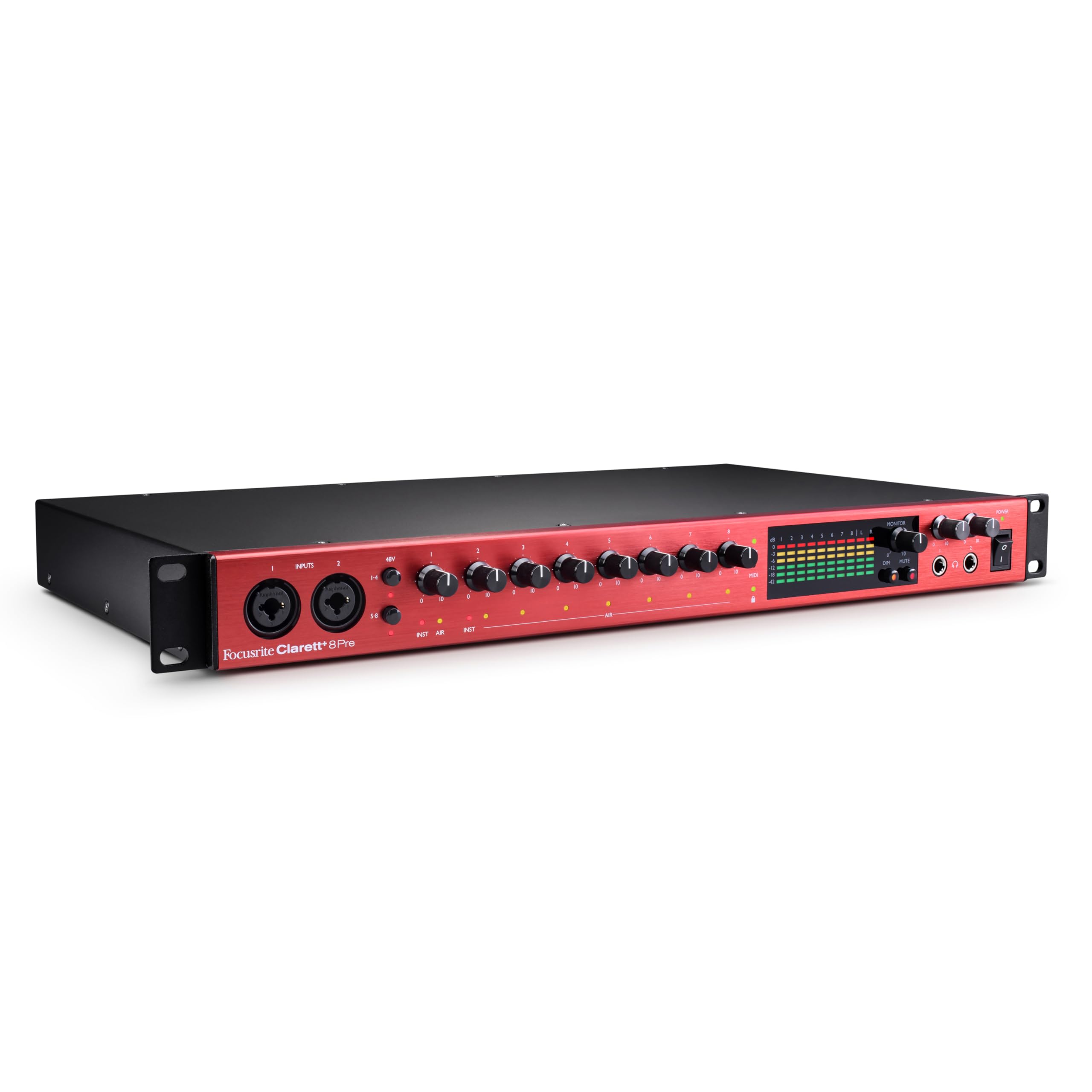
The Clarett+ 8Pre is the bridge between the compact Scarlett line and the full-on professional console. Its eight Clarett+ preamps deliver an EIN of -127 dBV and over 60 dB of clean gain, making them among the quietest in their class. The all-analogue Air mode replicates the classic Focusrite ISA 110 transformer-based preamp by switching the input impedance and adding two cumulative high shelves — a genuine 4 dB boost that adds presence without noise.
With 18-in/20-out connectivity via USB and ADAT optical expansion, this unit can scale to accommodate a full drum kit or a band tracking live. The independent A-D and D-A converters maintain a dynamic range exceeding 120 dB, preserving the purity of analog sources throughout the recording chain without added coloration or jitter.
The headphone outputs are a significant upgrade from the Scarlett series — they deliver a flat frequency response at all output levels, providing accurate monitoring even when driving multiple headphones. The Focusrite Control software allows for comprehensive routing and mix customization, though a note from users suggests avoiding simultaneous 24-bit/192 kHz recording on all inputs to prevent glitching.
Why it’s great
- 8 transparent preamps with ultra-low noise floor capture every nuance
- All-analogue Air mode adds genuine high-frequency presence, not a digital emulation
- ADAT expansion allows easy scaling for up to 16 inputs
Good to know
- Does not support simultaneous 24-bit/192kHz across all channels without errors
- 9-pound rackmount unit is not portable for mobile recording sessions
4. Universal Audio Apollo Solo USB Heritage Edition

The Apollo Solo is the entry point into Universal Audio’s UAD ecosystem, and its calling card is UAD SOLO Core processing — a dedicated DSP chip that lets you track through classic compressors, EQs, and reverb plugins with near-zero latency. The Unison preamp technology physically reconfigures the input impedance and gain stage to match the hardware being emulated, so a Neve 1073 emulation behaves like the real console preamp rather than a post-conversion digital effect.
The Heritage Edition sweetens the deal with a premium bundle of five award-winning UAD plugins from Teletronix, Pultec, and UA — a combined retail value that significantly exceeds the interface’s own cost. The converters run at 24-bit/192 kHz, and the headphone amplifier is best-in-class for a bus-powered unit, delivering loud, detailed, low-noise monitoring that reveals mix issues before they reach the master bus.
That said, the Apollo Solo has a reputation for finicky driver support on Windows — users frequently report needing specific USB cables (often a Thunderbolt 4 cable for actual functionality after a USB-A cable for the initial install) and encountering connectivity drops. macOS users generally fare better, but OS compatibility updates from UA have historically lagged behind Apple’s release schedule, leaving early adopters on unsupported systems for months.
Why it’s great
- Real-time UAD DSP processing for tracking through vintage compressor and EQ models
- Unison preamp technology physically alters the input stage for authentic hardware emulation
- Heritage Edition includes premium UAD plugins worth well over the purchase price
Good to know
- Windows driver instability is a recurring issue across multiple user reports
- Bus-powered only, limiting headroom for high-impedance headphones and certain mics
5. RME Babyface Pro FS
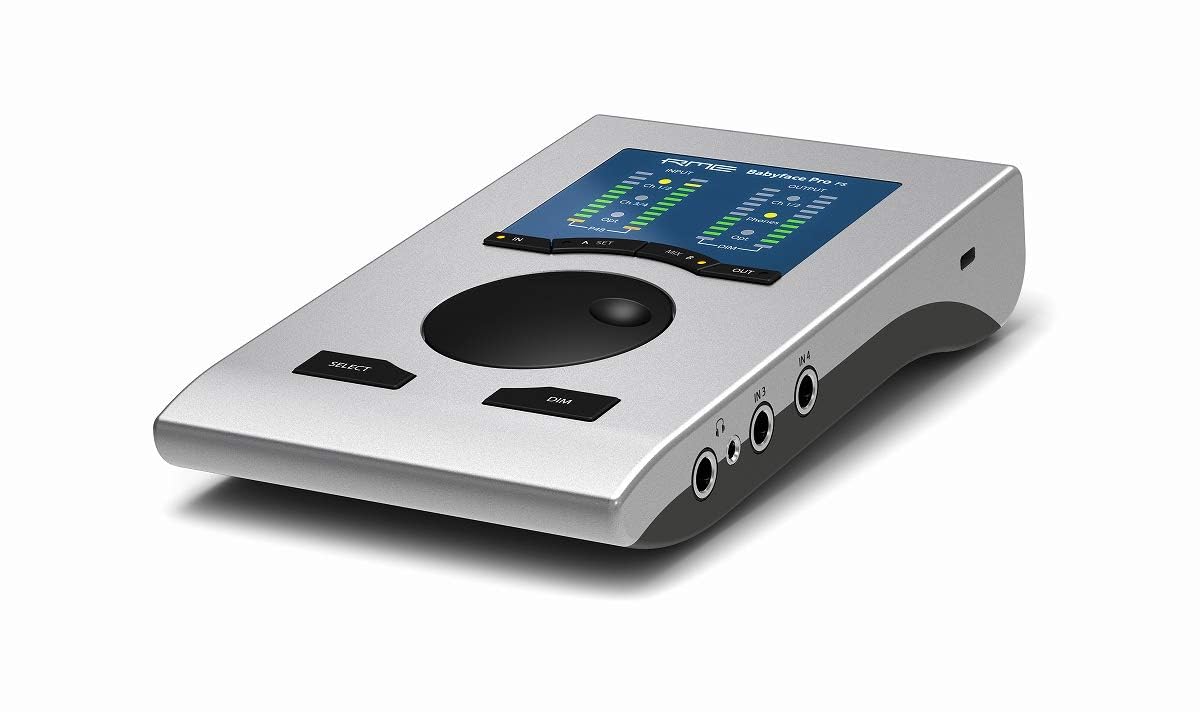
RME’s Babyface Pro FS is the interface for professionals who prioritize absolute driver stability and bulletproof clocking above all else. Its SteadyClock FS circuit is derived from RME’s flagship ADI-2 Pro, delivering the lowest jitter and highest jitter immunity of any interface in its class — a critical spec for digital audio that translates directly to cleaner, more accurate conversion across the entire frequency spectrum.
Despite its compact aluminum chassis, the Babyface Pro FS offers 12 inputs and 12 outputs with 24 total recording channels via its breakout cable and ADAT expandability. The preamps are clean and transparent with ample gain, and the unit is famously plug-and-play — users consistently report zero driver issues on both Windows and macOS, including with AMD-based systems that cause problems for other high-end interfaces like the UA Apollo.
TotalMix FX, RME’s onboard software mixer, gives you complete control over routing, monitoring, and effects with a flexibility that serious engineers expect. The 5-sample AD latency and 7-sample DA latency are among the lowest in any USB interface, making this the go-to choice for musicians who need real-time foldback without any perceptible delay.
Why it’s great
- Industry-leading driver stability across both Windows and macOS with AMD support
- SteadyClock FS virtually eliminates jitter for pristine digital conversion
- Extremely low round-trip latency ideal for real-time monitoring
Good to know
- Breakout cable design can be less convenient than built-in ports
- Premium pricing places it well above the mid-range tier
6. RØDE RØDECaster Duo
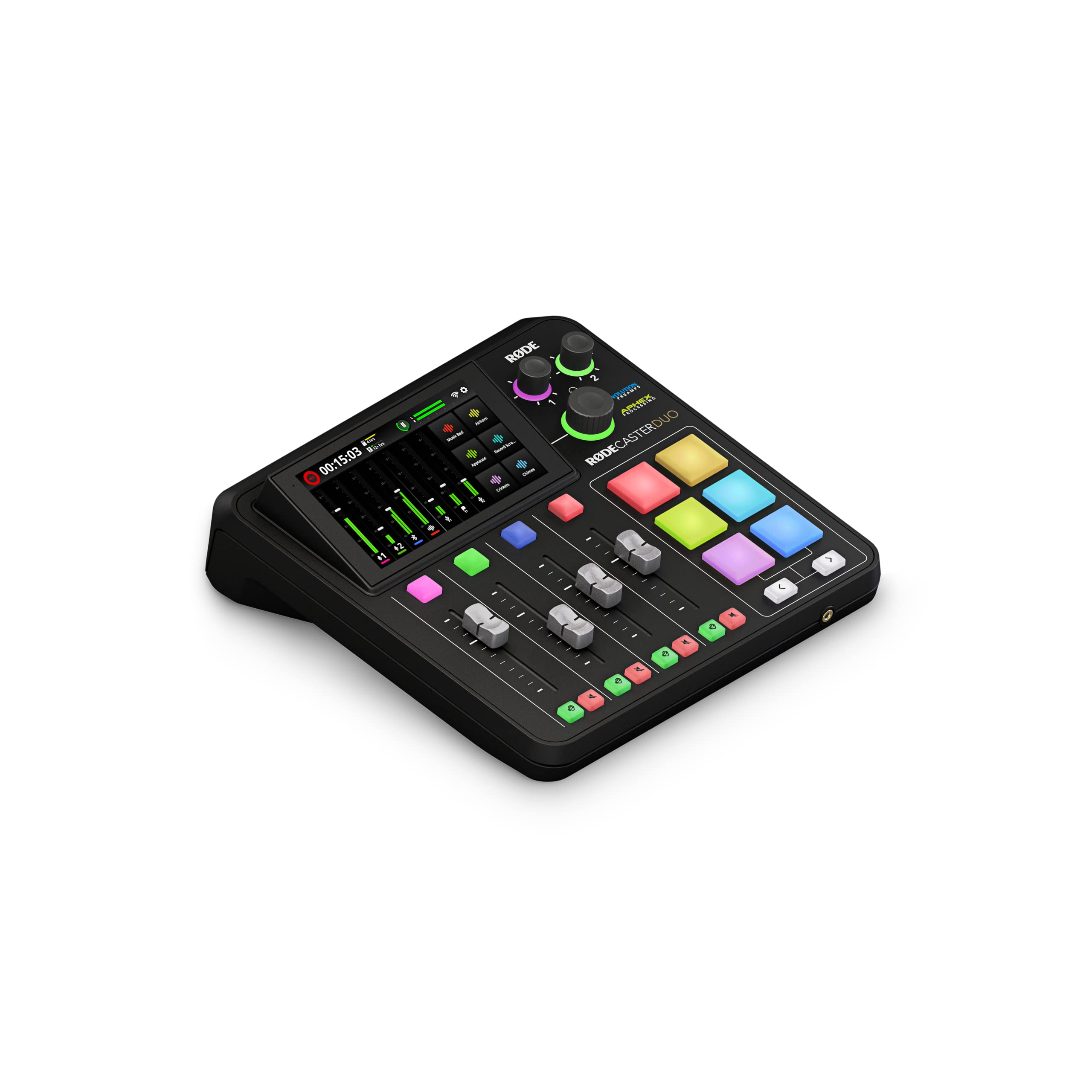
The RØDECaster Duo is less a traditional audio interface and more a fully integrated production console for podcasters, streamers, and content creators who want broadcast-quality results without a rack of outboard gear. Its Revolution Preamps deliver an extraordinary -131.5 dBV EIN with 76 dB of gain — enough to run even the most gain-hungry dynamic microphones like the Shure SM7B without a cloudlifter.
The unit integrates four broadcast-quality faders, a high-resolution touchscreen with haptic feedback, and six SMART pads for triggering sound effects, jingles, or MIDI commands. The built-in APHEX processing suite includes the legendary Aural Exciter and Big Bottom effects, instantly adding polish and presence to spoken word without requiring any post-production work.
It also functions as a multi-track recorder to SD card and a 4-channel USB audio interface, making it incredibly versatile for both live streaming and traditional DAW-based recording. However, the workflow has a steeper learning curve than a standard interface — setting up iPhone streaming or complex routing can be frustrating for beginners, and some users report buggy behavior with the virtual fader system in firmware.
Why it’s great
- Revolution Preamps provide 76 dB of gain with ultra-low noise for demanding mics
- Built-in APHEX processing eliminates the need for post-production vocal chains
- All-in-one design replaces a full rack of compressors, EQs, and soundboards
Good to know
- Setup workflow is not beginner-friendly, especially for mobile devices
- Virtual routing and driver software can be buggy on initial configuration
7. Universal Audio Volt 2

The Universal Audio Volt 2 is a budget-friendly interface that brings a taste of UA’s revered analog heritage to the entry-level market. Its Vintage mode engages a circuit modeled after UA’s classic 610 tube preamp, adding a subtle warmth and harmonic richness that makes microphones sound more polished and musical without any plugin processing — a rare feature at this price point.
The converters deliver full 24-bit/192 kHz resolution, and the build quality is surprisingly solid for a USB-powered unit, with a metal chassis and a large, satisfying monitor volume knob. It is class-compliant on macOS and iPadOS, and the included LUNA DAW software provides a fully functional recording environment that emulates analog studio workflow, complete with virtual tape machines and console channels.
Users consistently praise the low latency performance and the excellent sound quality from the preamp, with many noting that the Vintage mode alone gives the Volt 2 a sonic character that rivals its more expensive Apollo siblings. The main limitation is the single headphone output and the lack of MIDI connectivity, which may be a dealbreaker for producers with external gear.
Why it’s great
- Vintage mode adds analog tube warmth that elevates vocal and guitar recordings
- Class-compliant on macOS and iPadOS for plug-and-play mobile recording
- Includes LUNA DAW software with analog-style workflow and virtual tape machines
Good to know
- No MIDI I/O for connecting external synthesizers or drum machines
- Single headphone output with limited power for high-impedance headphones
8. M-AUDIO AIR192x4 VSPro

The M-AUDIO AIR192x4 VSPro is the rare interface purchase that includes everything a beginner needs to start recording immediately: the interface itself, the Nova Black condenser microphone, a shock mount, XLR cable, and HDH40 studio headphones. The interface itself is a solid 2-in/2-out USB-C unit with 24-bit/192 kHz converters and Crystal preamps that deliver transparent sound with low noise.
The standout spec here is the claimed round-trip latency of just 2.59 ms — among the lowest in its class — made possible by the Hi-Speed USB/USB-C circuitry. This makes the unit feel responsive when monitoring through software effects, which is a common pain point for entry-level interfaces. The included software suite is generous: MPC Beats, Ableton Live Lite, and a collection of virtual instruments from XPand!2, Mini Grand, and Revalver.
That said, some users report durability issues with the interface over time — specifically, USB connection failures that cause the device to stop being detected, and phantom power instability. The bundled microphone and headphones are functional but entry-level in quality, so serious recordists may eventually want to upgrade those components separately.
Why it’s great
- Complete recording package includes XLR mic, headphones, and shock mount
- Exceptionally low round-trip latency of 2.59 ms for responsive monitoring
- Generous software bundle with Ableton Live Lite and MPC Beats
Good to know
- Some units develop USB connection failures and phantom power instability over time
- Bundled microphone and headphones are entry-level quality, not studio staples
9. Focusrite Scarlett Solo 3rd Gen Bundle

The Focusrite Scarlett Solo is arguably the most recognizable name in the entry-level interface market, and the 3rd Gen version refines the formula with the switchable Air mode — a circuit that emulates the impedance and high-frequency response of Focusrite’s classic ISA transformer-based preamp. Engaging Air immediately brightens a microphone signal, adding clarity and presence that helps vocals and acoustic instruments cut through a mix.
This bundle includes a 25-foot XLR cable and a pop filter, along with the Hitmaker Expansion software package that includes Pro Tools First Focusrite Creative Pack, Ableton Live Lite, the Softube Time and Tone Bundle, and Focusrite’s own Red Plug-in Suite. The converters are capable of 24-bit/192 kHz, and the high-headroom instrument input handles both passive and active pickups without clipping.
Users generally find the Scarlett Solo incredibly easy to set up — plug it in, install the driver, and select it in your DAW. The build feels durable enough for home studio use, and the bundle eliminates the immediate need to buy extra cables. However, the included software download process can be time-consuming, and some users find the USB connection slightly loose over time, occasionally requiring a reset.
Why it’s great
- Switchable Air mode adds ISA-style transparency and presence to microphone recordings
- Bundle includes XLR cable, pop filter, and professional DAW software
- Proven track record of reliability and ease-of-use for beginners and intermediate users
Good to know
- USB connection can become loose over time requiring a reset
- Software download and registration process is multi-step and time-consuming
FAQ
What is the difference between 24-bit/96kHz and 24-bit/192kHz recording?
Do I need an external power supply or is bus power enough?
How important is driver stability compared to specs like sample rate?
Final Thoughts: The Verdict
For most users, the audio interface for recording winner is the SSL 2 MKII because it delivers genuinely useful analog signal shaping with the Legacy 4K enhancement, rock-solid build quality, and the latest 32-bit converter technology at a mid-range price. If you need multi-track recording and appreciate hardware meters and loopback, grab the MOTU M4. And for pro-level multi-channel capability with the most transparent preamps in its class, nothing beats the Focusrite Clarett+ 8Pre.