
Our readers keep the lights on and the weekend projects moving. As an Amazon Associate, I earn from qualifying purchases.
Striking the balance between professional-grade preamps, low-latency monitoring, and enough I/O for a growing setup without breaking the bank is the core challenge for any home studio builder. The market offers a dizzying array of specs and promises, making it easy to spend too much on features you won’t use or too little on gear that introduces noise and latency into your workflow.
I’m Rikta — the co-founder and writer behind FitlyFast. I’ve spent hundreds of hours cross-referencing technical specifications, reading user reports on driver stability and real-world latency performance, and analyzing the value proposition of each unit to cut through the marketing noise for this guide.
Whether you are a vocalist, guitarist, podcaster, or producer, finding the right audio interface under $300 means prioritizing clean preamps, reliable drivers, and the specific input/output count your workflow demands.
How To Choose The Best Audio Interface Under $300
Selecting the right interface for your home studio comes down to matching hardware specifications to your specific recording needs. The sub-$300 range is fiercely competitive, offering excellent preamp quality, but the wrong choice can leave you with too few inputs, noisy preamps, or finicky drivers. Focus on these three pillars before making your decision.
Input & Output Count: Match Your Gear
The most critical spec is the number and type of inputs. A solo vocalist or podcaster recording one mic at a time can thrive on a 1-in/2-out interface like the Shure MVX2U. A guitarist who also sings will need a 2-in/2-out unit like the Focusrite Solo or ESI Amber i1. If you plan to record a stereo synth, a second microphone, or a drum machine simultaneously, step up to a 4-in/4-out model like the MOTU M4 or Focusrite Scarlett 4i4. Also check for Hi-Z inputs for direct guitar/bass connection and line inputs for synths and external preamps.
Preamps, Converters, and Latency
The preamp quality defines your recording’s noise floor. Look for ultra-low EIN (Equivalent Input Noise) figures — typically -129dBu or better — and high dynamic range on the converters (120dB+ is pro-grade). The DAC matters too: the MOTU M2 and M4 use ESS Sabre32 Ultra technology, delivering exceptional clarity. Low-latency performance via ASIO or Core Audio is non-negotiable for monitoring your performance through effects in real-time without a distracting delay. Reliable drivers are just as important; an unstable driver can ruin a session no matter how good the hardware sounds.
Special Features: Loopback, MIDI, and DSP
Beyond raw inputs, consider your workflow. Loopback is a must-have for streamers and podcasters who need to mix computer audio with a microphone into a single stream. MIDI I/O is essential for connecting keyboards and external sequencers. Some interfaces, like the Universal Audio Volt 2 and SSL 2 MKII, include analog enhancement circuits (e.g., Vintage mode, Legacy 4K) that add character to your recordings. The Shure MVX2U offers onboard DSP for auto-leveling and real-time noise reduction, making it a powerful tool for live streaming without a computer.
Quick Comparison
On smaller screens, swipe sideways to see the full table.
| Model | Category | Best For | Key Spec | Amazon |
|---|---|---|---|---|
| Focusrite Scarlett 4i4 4th Gen | Premium | Multi-instrument recording | 120dB dynamic range, 4 inputs | Amazon |
| MOTU M4 | Premium | Transparent sound & extra I/O | ESS Sabre32 Ultra DAC, 4 in/4 out | Amazon |
| Solid State Logic SSL 2 MKII | Premium | Vocalists & voice artists | 32-Bit/192kHz AD/DA, Legacy 4K | Amazon |
| MOTU M2 | Mid-Range | High-fidelity headphone monitoring | 120dB dynamic range, ESS DAC | Amazon |
| Universal Audio Volt 2 | Mid-Range | Warm analog character | UA 610 preamp emulation, 2 inputs | Amazon |
| Shure MVX2U Gen 2 | Mid-Range | Mobile & podcast setup | Onboard DSP, +60dB gain | Amazon |
| Focusrite Scarlett Solo 3rd Gen | Budget | Entry-level solo recording | Air mode, 24-bit/192kHz | Amazon |
| Behringer U-Phoria UMC204HD | Budget | Best bang for buck with MIDI | MIDAS preamps, MIDI I/O | Amazon |
| ESI Amber i1 | Budget | RCA-based home recording | Separate line ins, loopback | Amazon |
In‑Depth Reviews
1. Focusrite Scarlett 4i4 4th Gen
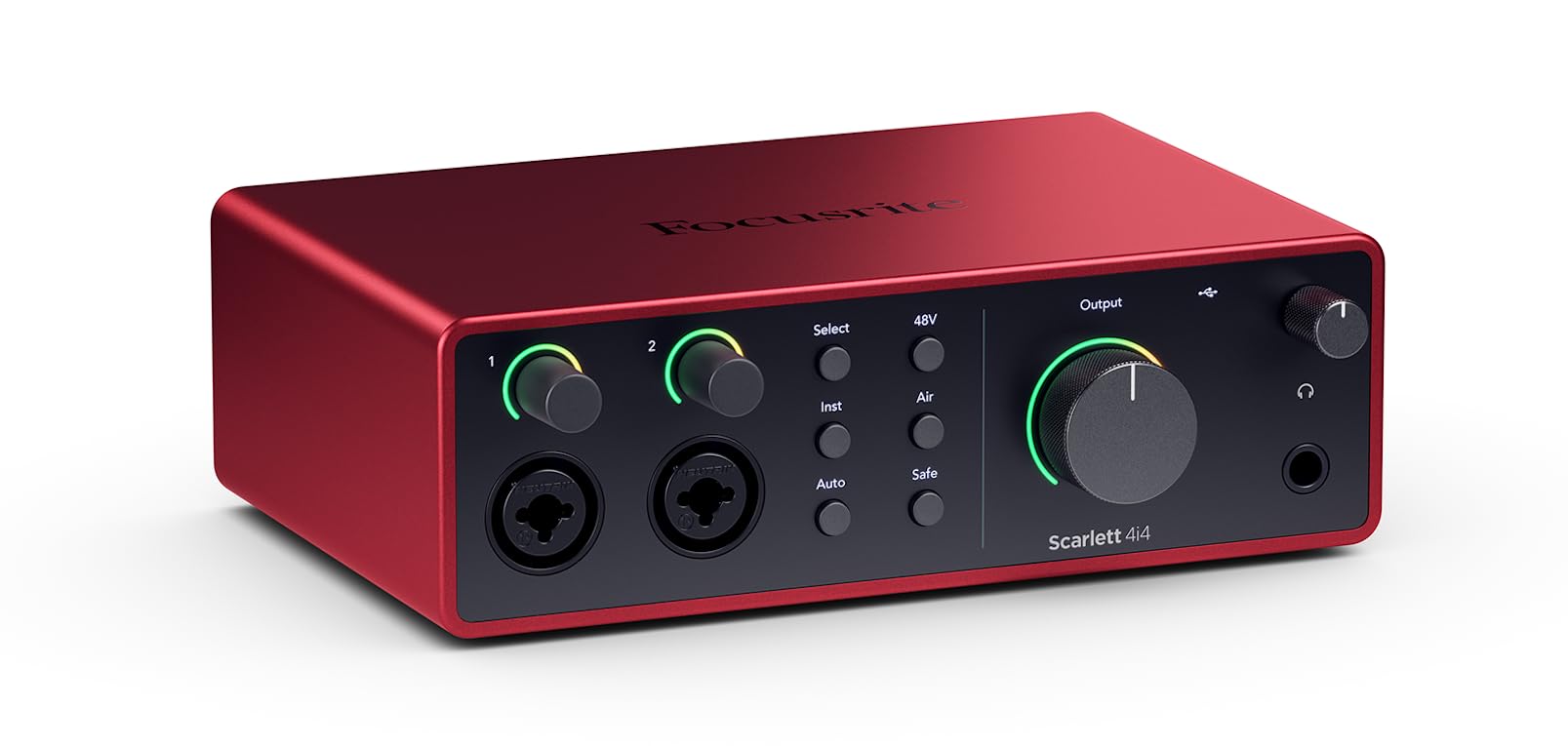
The Scarlett 4i4 4th Gen is the multi-tool of the sub-$300 audio interface market. With its 120dB dynamic range converters borrowed from Focusrite’s flagship RedNet line, it offers a transparent, high-headroom sound that matches pro studio standards. The two 4th Gen mic preamps are exceptionally clean, and the addition of Auto Gain and Clip Safe features removes the guesswork from setting levels, a huge advantage for solo creators who can’t ride the gain knob live.
Connectivity is generous: two combo inputs with switchable Air mode for enhanced presence, four line-level outputs for routing to multiple monitor pairs or outboard gear, and full MIDI I/O. The included software bundle — Pro Tools Intro+, Ableton Live Lite, Cubase LE, and the Hitmaker Expansion — provides a complete starting production suite. The dedicated power supply ensures stable operation even over complex USB hub setups, a detail that separates it from many bus-powered rivals.
For a home studio that has outgrown a 2-in/2-out interface, the Scarlett 4i4 is the most future-proofed option. The ability to record two microphones simultaneously while maintaining dedicated line outputs for external effects or headphone mixes makes it a production hub rather than just a sound card. The robust metal build and intuitive layout justify its top-tier position in this price bracket.
Why it’s great
- Auto Gain and Clip Safe simplify recording
- 120dB dynamic range and clean preamps
- Includes MIDI I/O and 4 line outputs
- Comprehensive software bundle included
Good to know
- Requires external power supply
- Two XLR inputs only
2. MOTU M4 4×4 USB-C Audio Interface

The MOTU M4 is engineered for those who demand absolute signal transparency with the lowest possible noise floor. Its onboard ESS Sabre32 Ultra DAC technology is typically found in interfaces costing significantly more, offering a measured 120dB dynamic range on the outputs and an exceptional -129dBu EIN on the mic inputs. This results in recordings that are pristine, with no perceptible hiss or converter artifacts.
The standout feature here is the full-color LCD screen that provides real-time metering for all four inputs and the main output, a rarity at this price point. Hardware-based direct monitoring with a flexible mixer lets you blend the input signal with your DAW playback with zero latency. The inclusion of two independent headphone outputs — each with its own mix — is a game-changer for collaboration or for having a separate monitor mix for the musician and the engineer.
The M4’s 4×4 architecture includes two combo mic/line/Hi-Z inputs and two dedicated 1/4-inch line inputs on the back, perfect for synths or external preamps. Its loopback feature is widely recognized as one of the best implementations for streamers and podcasters. Keep in mind the headphone output is bus-powered, so it may lack the raw power for very high-impedance headphones without an external amp.
Why it’s great
- Exceptional DAC and converter quality
- Built-in LCD metering for precise level control
- Two independent headphone outputs with separate mixes
- Excellent loopback implementation
Good to know
- USB bus power limits headphone amp power
- Can exhibit pitch-shift bug if Windows fast startup is enabled
3. Solid State Logic SSL 2 MKII

The SSL 2 MKII brings the legendary sound of Solid State Logic’s large-format console preamps into a compact, bus-powered form factor. The most defining feature is the Legacy 4K analog enhancement, which adds a subtle harmonic distortion and a high-frequency EQ boost that emulates the SSL 4000 series console. This single button is capable of adding ‘air’ and presence to any source, making vocals and acoustic instruments cut through a mix without plug-ins.
Beyond the analog mojo, the MKII features 32-bit/192kHz AD/DA converters that deliver an exceptionally wide dynamic range and low noise floor. The preamps themselves are rated with an ultra-low noise floor, making them suitable for very quiet sources like spoken word or ambient recording. The high-pass filter (HPF) on each channel is a lifesaver for voice artists and podcasters, eliminating room rumble and handling noise before it hits the recording.
The hardware layout includes two headphone outputs, loopback for streaming, and a five-pin MIDI I/O for connecting keyboards. The built-in noise gate visualizer (displaying a numeric noise floor reading) is an ingenious tool for troubleshooting signal issues. While the Metal chassis feels robust, its larger footprint means it occupies more desk space than competing 2-in/2-out units.
Why it’s great
- Legacy 4K button adds sought-after analog character
- Ultra-low noise preamps with high-pass filters
- 32-bit/192kHz converters deliver wide dynamic range
- Noise gauge visualizer helps identify interference
Good to know
- Larger and heavier than many 2×2 rivals
- Not true 32-bit float recording; DA converter only
4. MOTU M2 2×2 USB-C Audio Interface

The MOTU M2 is widely considered the benchmark for audio quality in the 2-in/2-out category, and for good reason. It uses the same ESS Sabre32 Ultra DAC found in its bigger sibling, delivering a class-leading 120dB dynamic range on the outputs. This translates to a playback experience that is incredibly detailed, with a wide soundstage and pristine clarity that makes mixing decisions easier.
The preamps are equally impressive, boasting a -129dBu EIN that rivals much more expensive interfaces. This makes the M2 a fantastic choice for recording quiet, dynamic sources like fingerpicked acoustic guitar or delicate vocal performances. Its headphone output is also notably powerful, driven by the ESS chip, making it one of the few bus-powered interfaces that can effectively drive 250-ohm headphones like the Beyerdynamic DT 990 Pro.
The M2 includes an LCD screen for input and output metering, a loopback feature for streaming, and a straightforward hardware direct monitoring mix. Its drivers are rock-solid on both macOS and Windows, offering some of the lowest round-trip latency figures in its class. The main compromise is the lack of MIDI I/O and only a single headphone output, but for someone prioritizing pure sonic fidelity above all else, the M2 is the top pick.
Why it’s great
- ESS Sabre32 Ultra DAC provides outstanding clarity
- Powerful headphone output for high-impedance cans
- Ultra-low latency performance
- Excellent loopback for streaming
Good to know
- No MIDI I/O
- Only one headphone output
5. Universal Audio Volt 2

The Universal Audio Volt 2 sets itself apart with its Vintage mode, which emulates the iconic UA 610 tube preamp used on countless classic recordings. Engaging this button introduces a subtle, musical saturation that can make vocals sound richer and guitars sound fuller, adding analog weight straight to the recording without any post-processing. This is a genuine differentiator in a market dominated by clean, transparent preamps.
Beyond its special analog circuit, the Volt 2 offers high-quality 24-bit/192kHz converters that capture every detail. It comes with a free subscription to UA’s LUNA DAW, a powerful recording software that emulates the workflow of a classic analog console, complete with built-in tape echo and summing. Universal Audio’s reputation for creating analog hardware means the build quality and component selection are top-notch.
The interface includes two combo inputs (one with Hi-Z switching), a dedicated instrument input, and a built-in 48V phantom power switch. While it is bus-powered, it does offer an optional external power supply for stable operation when connecting to devices that provide less power over USB, like certain tablets. For the musician or producer seeking that classic, warm signature sound without the cost of outboard outboard gear, the Volt 2 is a compelling choice.
Why it’s great
- Vintage preamp mode adds classic tube-like warmth
- Includes excellent LUNA DAW with analog emulations
- Solid build quality and reliable design
- High-quality 24-bit/192kHz converters
Good to know
- No MIDI I/O
- Bus-powered but may need external power for some mobile setups
6. Shure MVX2U Gen 2
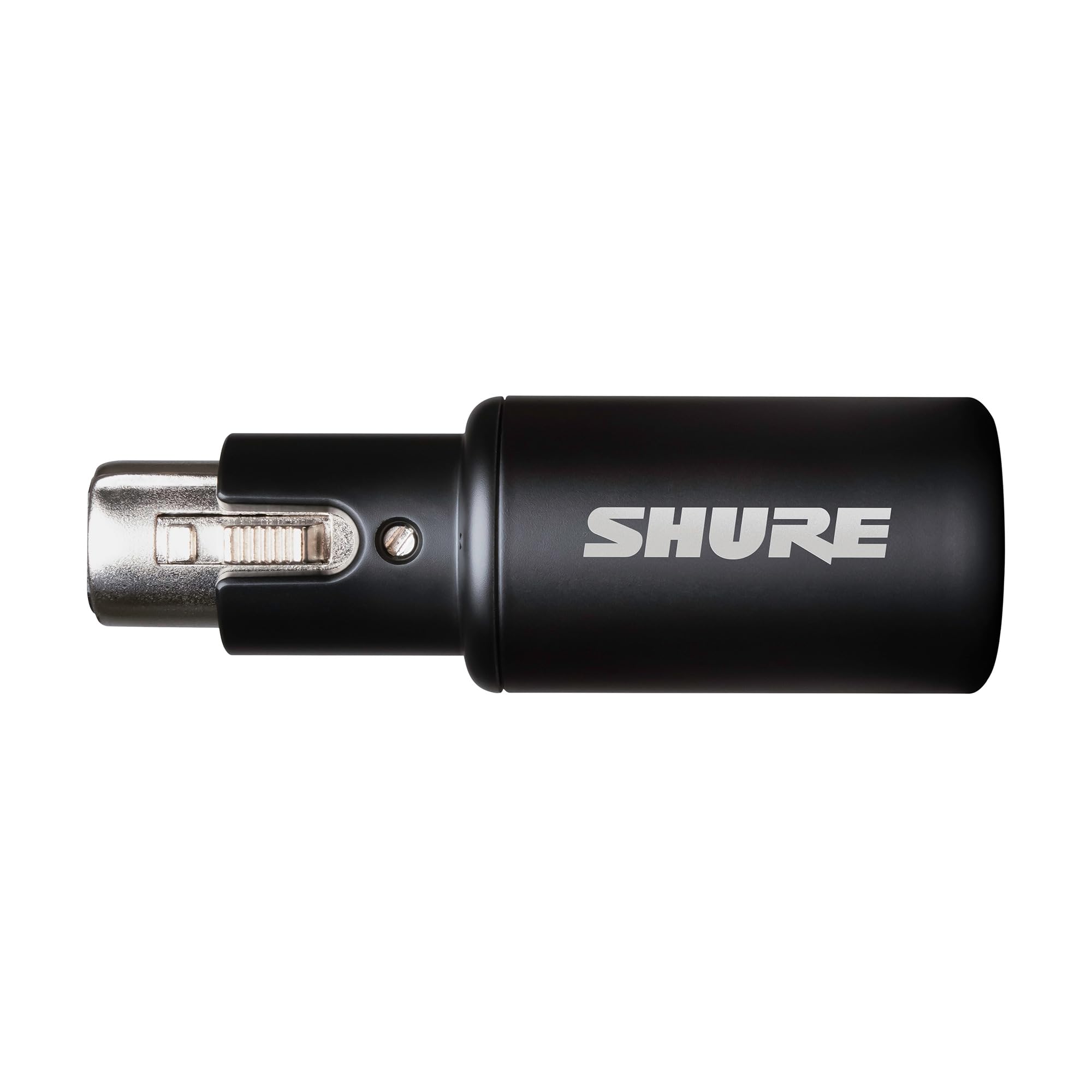
The Shure MVX2U Gen 2 is a specialized XLR-to-USB-C adapter that prioritizes signal processing and portability over traditional I/O. It forgoes knobs for onboard digital audio processing, including Auto Level Mode, which dynamically adjusts gain to prevent clipping during loud moments and boost quiet sections. This is an incredibly powerful tool for live streaming, podcasting, or any solo recording where you can’t monitor your levels constantly.
The user-selectable tone modes (Dark, Natural, Bright) and the Real-Time Denoiser allow you to achieve a polished, broadcast-ready sound with a single dynamic mic like the Shure SM7B. The preamp provides up to +60dB of crystal-clean gain, meaning you can drive low-output dynamic mics without needing an additional inline booster like a Cloudlifter. Combined with zero-latency headphone monitoring via a standard 3.5mm jack, this makes for an incredibly compact and self-contained recording solution.
This unit is Apple MFi certified and works plug-and-play with iPhones and iPads, making it an exceptional partner for mobile content creators. The companion MOTIV app on desktop and mobile gives you full control over compression, EQ, and limiting. The trade-off is a single XLR input and no line-level or Hi-Z inputs for instruments, so it is purpose-built for spoken word, vocals, and mono mic sources.
Why it’s great
- Auto Level Mode and Denoiser deliver polished sound
- +60dB of clean gain eliminates need for a Cloudlifter
- Compact and portable with iPhone/iPad compatibility
- MOTIV app provides full DSP control
Good to know
- Single XLR input, no instrument input
- Great for vocals and spoken word, not for multi-track recording
7. Focusrite Scarlett Solo 3rd Gen

The Scarlett Solo 3rd Gen has long been the go-to entry point for home recording for good reason. Its preamp, with the switchable Air mode, provides an instant high-frequency lift that brings vocals and acoustic instruments forward in the mix, mimicking the effect of a high-end console. The performance is reliable, with -120dB dynamic range that ensures a clean signal path for most home studio needs.
The hardware is minimalist: one XLR combo input, one Hi-Z instrument input, two balanced 1/4-inch outputs, and a headphone output with independent level control. The Gain Halos around the input knob provide an intuitive visual cue for setting levels, turning from green to red to indicate clipping. The included software bundle — Pro Tools Intro+, Ableton Live Lite, and the Focusrite Hitmaker Expansion — offers a comprehensive starter pack of production tools and effects.
Its fully metal chassis is durable, and its compact footprint will fit on any desktop. The Solo is the perfect choice for a solo singer-songwriter or podcaster who only needs to record one microphone and one instrument at a time. While it doesn’t offer the converter quality of the MOTU M2 or the I/O of the Scarlett 4i4, its simplicity, proven reliability, and massive community support make it a safe and smart purchase for getting started.
Why it’s great
- Air mode adds clarity to recordings instantly
- Proven, rock-solid driver stability
- Compact, all-metal build
- Comprehensive software package for beginners
Good to know
- Limited to one XLR input
- No MIDI I/O or loopback
8. Behringer U-Phoria UMC204HD
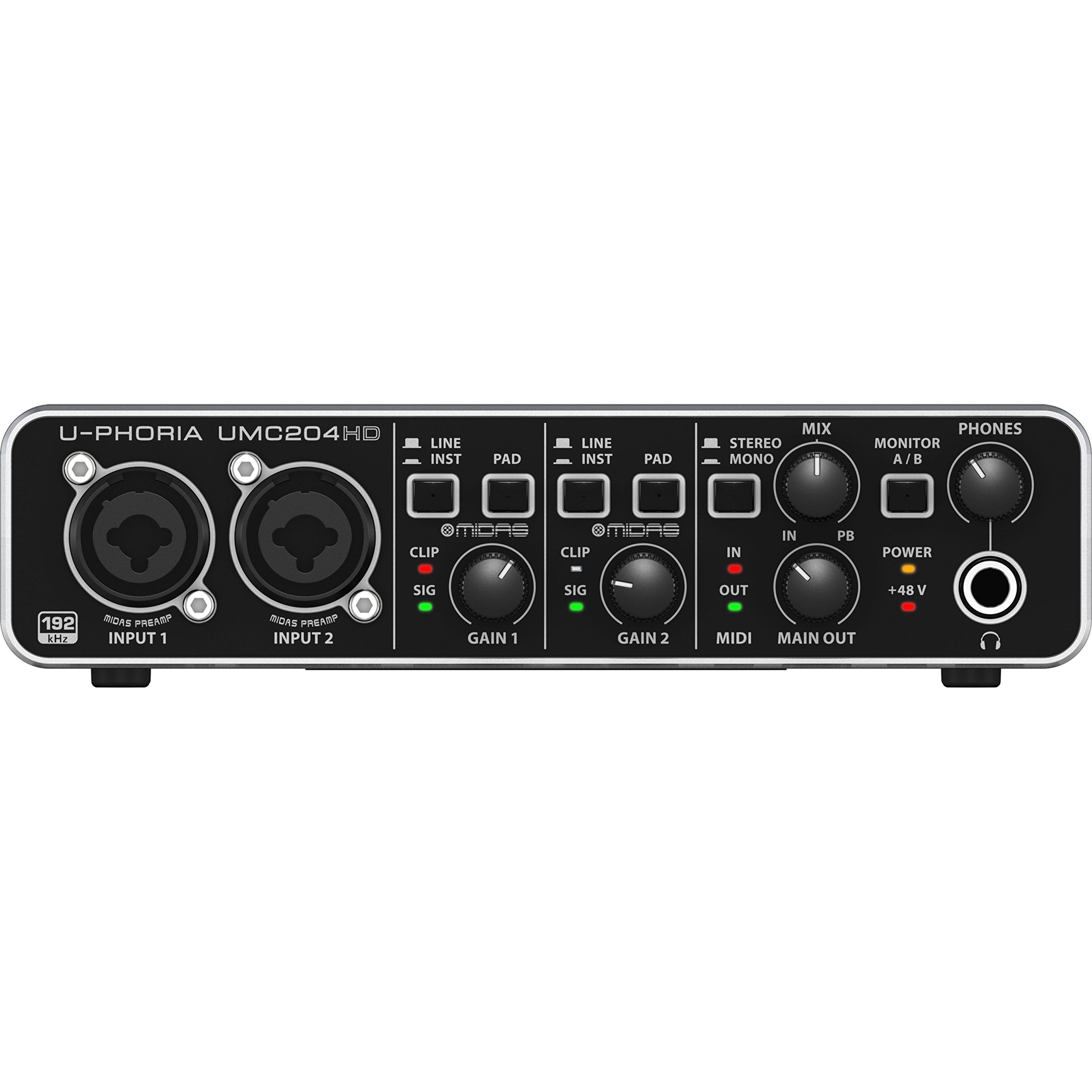
The Behringer UMC204HD punches far above its price class, directly challenging more expensive rivals by incorporating authentic MIDAS-designed microphone preamps. These preamps provide a remarkably low noise floor and a clean, detailed sound signature that undermines the idea that you need to spend significantly more for professional-level recording. The 2-in/4-out configuration offers balanced outputs and inserts on each channel, features usually reserved for premium interfaces.
This unit includes features many entry-level competitors lack: full MIDI I/O on five-pin DIN jacks for connecting keyboards and controllers, a separate headphone mix with source selection, and +48V phantom power. The solid metal chassis and robust knob construction give it a feel that defies its cost. Many users report excellent driver performance on Linux and older macOS systems, making it a versatile choice for specific operating systems.
The main trade-off is in the converter quality and overall clarity when compared directly to the MOTU M2 or Focusrite 4i4. While the MIDAS preamps are excellent, the conversion digital section is not as refined. Also, the UMC204HD can produce a loud ‘pop’ through the outputs when powered on, which requires users to follow a specific power-up sequence to protect their monitors. For the price, however, it is an unbeatable value proposition for a functional home studio setup.
Why it’s great
- MIDAS preamps provide excellent sound quality
- Includes MIDI I/O and channel inserts
- Solid metal construction at a low cost
- Reliable with Linux operating systems
Good to know
- Loud power-on pop can damage speakers if not managed
- Converter quality lags behind premium options
- No power switch
9. ESI Amber i1

The ESI Amber i1 is a compact, value-oriented interface that fills a unique niche for those needing dedicated RCA line inputs alongside standard XLR and 1/4-inch inputs. This makes it an ideal choice for converting vinyl records or audio cassettes to digital, as it can accept the unbalanced RCA outputs from a turntable preamp or tape deck directly. Its 24-bit/192kHz converters ensure these transfers are captured with full fidelity.
The physical design is clean and functional, with a solid metal chassis available in a distinct orange color. It features a front-panel 48V phantom power switch, a direct monitoring blend knob, and a headphone amplifier with its own level control. The inclusion of DirectWIRE loopback for internal audio routing is a welcome bonus for streamers who need to mix system audio with their microphone.
The preamps are quiet and clean for the price, but they don’t match the dynamic range or headroom of the more expensive competitors. The USB-C connectivity is a modern touch, and the included software bundle (Bitwig Studio 8-Track, WaveLab LE) provides a solid foundation. It’s a functional, straightforward choice for a specific set of tasks — home archiving, basic podcasting, or as a simple interface for a second workstation.
Why it’s great
- RCA inputs perfect for converting vinyl/tapes
- DirectWIRE loopback for streaming
- USB-C connectivity and compact design
- Quiet preamps with good signal-to-noise ratio
Good to know
- Preamps lack the headroom of premium options
- Plastic volume knob feel could be better
FAQ
How many preamps do I need for recording a guitar and vocals at the same time?
Can I use my audio interface with an iPad or iPhone?
What does the Air mode or Vintage mode button actually do to my sound?
Is a higher sample rate like 192kHz always better for recording?
Final Thoughts: The Verdict
For most users, the audio interface under $300 winner is the Focusrite Scarlett 4i4 4th Gen because it offers a future-proof I/O count with four inputs, clean 120dB converters, and user-friendly Auto Gain features. If you want the absolute purest, most transparent sound quality for mixing on high-impedance headphones, grab the MOTU M2. And for a mobile creator who values onboard DSP and plug-and-play simplicity with an XLR microphone, nothing beats the Shure MVX2U Gen 2.