
Our readers keep the lights on and the weekend projects moving. As an Amazon Associate, I earn from qualifying purchases.
Streaming audio is a battlefield of competing sources: game sounds, chat calls, microphone input, music tracks, and browser tabs all jostle for the same output. Without dedicated hardware, you rely on mouse clicks and software sliders that lag or glitch at the worst possible moment. An audio mixer for streaming hands you physical faders and mute buttons so every source gets its own lane and your audience hears exactly what you intend.
I’m Rikta — the founder and writer behind FitlyFast. I’ve spent years analyzing digital audio hardware, comparing preamp noise floors, loopback routing, and DSP effect engines to separate the serious streaming tools from the toy boards.
Whether you run a single-PC gaming channel or a multi-host podcast, selecting the right audio mixer for streaming determines whether your broadcasts sound crisp or cluttered with background hiss and dropped packets.
How To Choose The Best Audio Mixer For Streaming
Streaming mixers vary from simple analog boards with a USB out to full digital consoles with app control and per-source submixes. Narrow your choice by matching the feature set to your live workflow.
Channel Count and Input Types
A two-person podcast with a single PC needs at least two XLR mic inputs plus a stereo line or Bluetooth channel for background music. Solo streamers with a single mic and game audio can work with a three- or four-channel unit. Check for combo jacks that accept both XLR and 1/4-inch instrument cables so you can add a guitar or synth without an external DI box.
Loopback and Submix Routing
Loopback sends your computer’s audio back through the mixer so the stream captures both your mic and desktop sounds on one USB track. Submix routing lets you send a different audio mix to your headphones than what goes out to the broadcast — essential for hearing your game at one volume while your audience hears a balanced blend.
Preamp Quality and Phantom Power
Streaming microphones, especially dynamic models like the Shure SM7B or Rode PodMic, need clean gain. Look for mixers with noise floors below -120 dBV and at least 50 dB of gain. Phantom power at +48V is mandatory for condenser mics, while a high-pass filter cuts low-frequency rumble from desk bumps or HVAC noise.
Quick Comparison
On smaller screens, swipe sideways to see the full table.
| Model | Category | Best For | Key Spec | Amazon |
|---|---|---|---|---|
| RØDE RØDECaster Duo | Digital All-in-One | Professional multi-source streams | Revolution Preamps -131.5dBV EIN | Amazon |
| Mackie ProFX10v3+ | Analog/Digital Hybrid | Live bands and complex studio setups | 24-bit / 96 kHz 2×4 USB-C | Amazon |
| Mackie ProFX6v3+ | Analog/Digital Hybrid | Solo streamers needing 24-bit/192 kHz | GigFX+ color LCD effects | Amazon |
| BEACN Mix Create | Digital Desktop Controller | Software-defined per-app mixing | 5-inch full-color display | Amazon |
| Behringer FLOW 8 | Digital Mixer | Mobile DJs and app-based control | Two Midas preamps + Bluetooth | Amazon |
| Yamaha AG03MK2 White | Streaming Mixer | Compact podcaster with loopback | 3-channel mixer + DSP effects | Amazon |
| Pyle PMXU46BT | Analog Mixer | Multi-mic live call routing | 4-channel + Bluetooth streaming | Amazon |
| MAONO MaonoCaster AME2 | Podcast Production Board | Sound pad and auto-tune use | 10-channel + 11 customizable pads | Amazon |
| Behringer XENYX 802S | Analog Utility Mixer | Adding clean analog inputs | 8-input stereo USB interface | Amazon |
In‑Depth Reviews
1. RØDE RØDECaster Duo Compact All-in-One Audio Production Solution
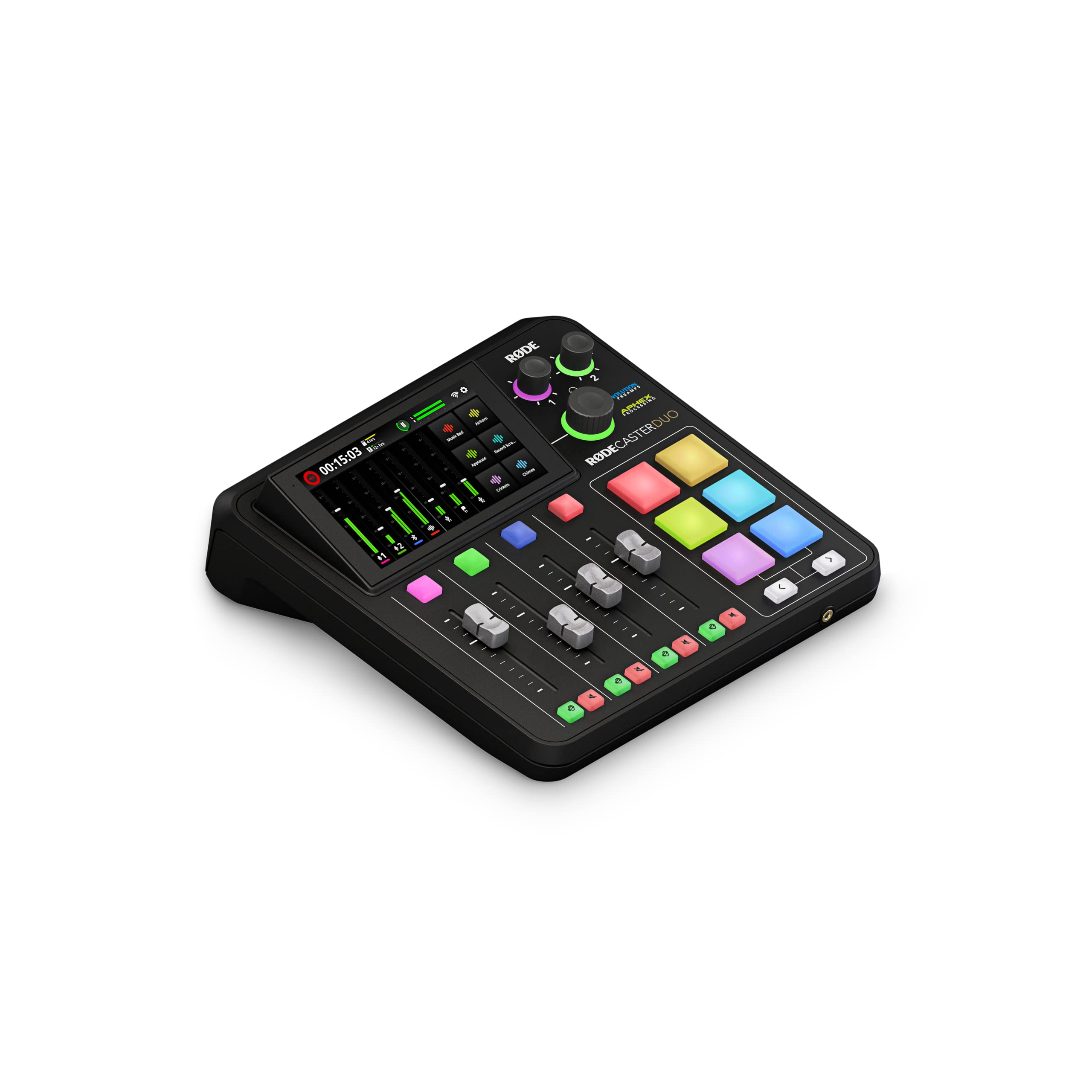
The RØDECaster Duo packs two Neutrik combo inputs with Revolution Preamps that deliver 76 dB of gain and an EIN of -131.5 dBV — enough to drive even the most gain-hungry dynamic mics without audible hiss. Its four broadcast-quality faders feel smooth under your fingertips, and the high-resolution touchscreen gives you immediate access to APHEX processing, including the Aural Exciter and Big Bottom effects that polish vocal presence on the fly.
Six SMART pads with bank switching let you trigger stingers, sound effects, or custom MP3s during a live stream. The USB-C interface handles two separate stereo outputs, making it easy to send one mix to your stream and another to your headphones. Built-in Bluetooth input adds a wireless channel for phone calls or background music without a separate adapter.
Setting up the iPhone streaming configuration requires the correct RØDE cable and a short learning curve, but once dialed in, the Duo operates as a self-contained production console. For serious podcasters and streamers who want studio-grade preamps and a modular effects chain, this is the most capable compact unit currently available.
Why it’s great
- Ultra-low-noise Revolution Preamps paired with APHEX processing
- Touchscreen interface with haptic feedback for quick menu navigation
- Dual USB-C outputs supporting separate stream and monitor mixes
Good to know
- Setup is not plug-and-play out of the box
- iPhone streaming requires a specific RØDE cable
2. Mackie ProFX10v3+ 10-Channel Professional Analog Mixer with USB

The ProFX10v3+ merges an analog console layout with a USB-C audio interface, giving you ten channels for microphones, instruments, and line inputs. Onyx preamps deliver a quiet noise floor across all XLR inputs, and one-knob compression on channels one and two saves you from having to patch external compressors for vocal processing.
Its GigFX+ effects engine runs 12 presets that you can edit and save through a full-color LCD screen — reverb, delay, chorus, and modulation settings are stored per scene for repeatable live mixes. Bidirectional Bluetooth with Mix Minus handles phone call integration seamlessly, routing your caller’s audio into the stream without feeding their voice back to them.
Three USB recording modes let you choose between the full mix with effects, loopback capture for streaming, or a dry interface signal. At ten channels, this board supports multi-mic podcasts, live bands, and complex studio setups where you need more faders than the smaller ProFX6v3+. The 100 Hz low-cut filter on every channel cleans up rumble before it hits your stream.
Why it’s great
- Onyx preamps with one-knob compression on critical channels
- Editable GigFX+ presets stored and recalled from color LCD
- Mix Minus Bluetooth for clean phone call integration
Good to know
- Heavier than smaller mixers at nearly 5 pounds
- USB driver is required to access separate recording channels
3. Mackie ProFX6v3+ 6-Channel Professional Analog Mixer with USB
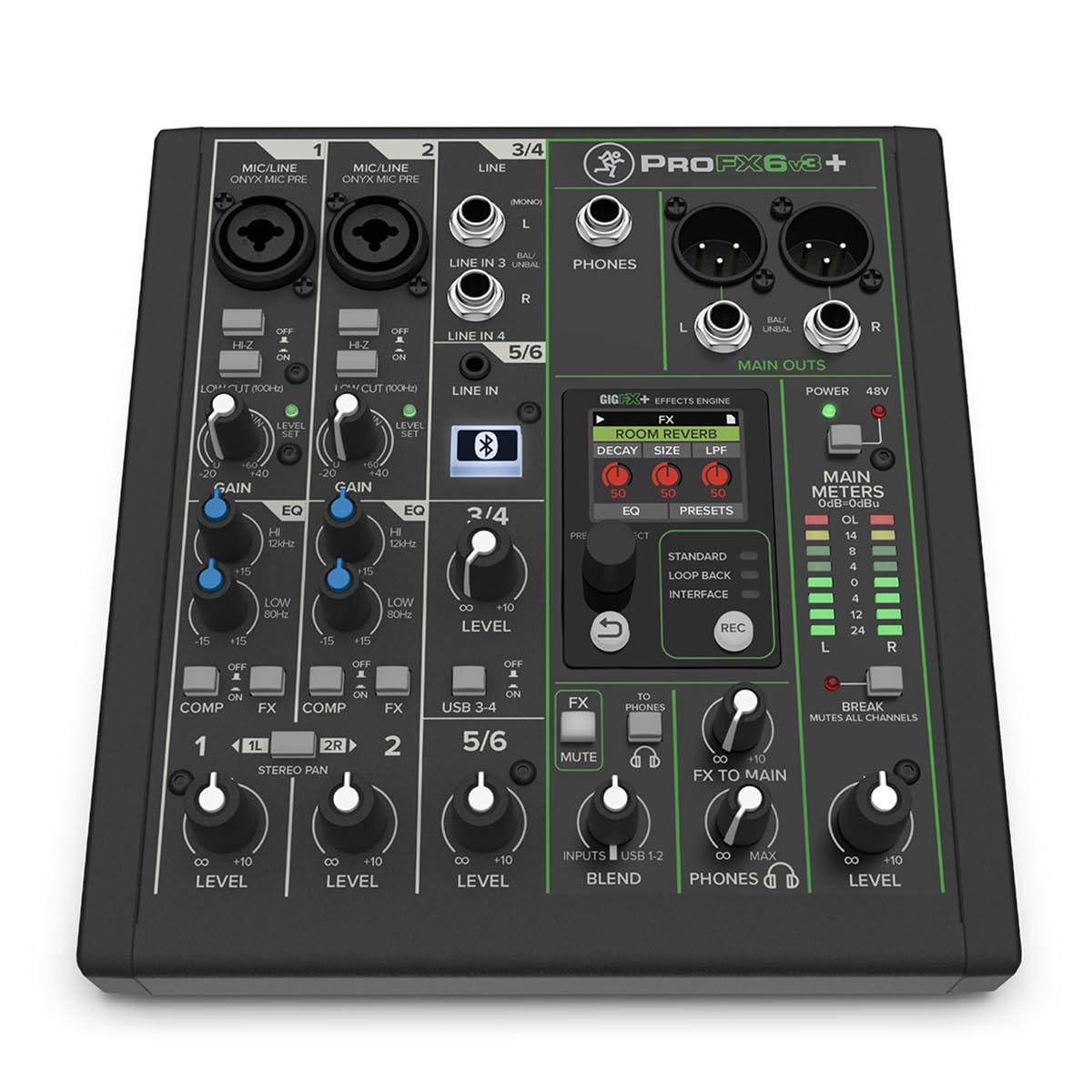
The six-channel ProFX6v3+ delivers the same Onyx preamps and GigFX+ effects engine as its larger sibling but in a footprint that fits beside a single monitor. Sampling up to 24-bit / 192 kHz through the USB-C interface captures transients and vocal articulation with more headroom than typical 96 kHz converters.
Three USB recording modes — standard full mix, loopback for streaming, and interface mode for dry channel capture — give you the flexibility to record your raw vocal for post-processing while OBS picks up the processed stream mix. The dedicated Bluetooth channel with Mix Minus makes it easy to bring a co-host on a phone call without echo.
Battery operation is a plus for mobile setups, and the analog warmth from the discrete console-style EQ feels more natural than digital plugin emulations. For solo streamers who want a single box with pristine audio quality and a small desktop footprint, the ProFX6v3+ is a strong mid-range contender.
Why it’s great
- 192 kHz sampling rate for high-fidelity capture
- Battery-powered for portable streaming rigs
- Loopback mode built into the hardware switch
Good to know
- Only six channels may feel limited as you add sources
- FX engine presets are not as deep as dedicated multi-effects units
4. BEACN Mix Create Audio Mixer for PC & Mac

The BEACN Mix Create reimagines the streaming mixer as a software-defined desktop controller. A 5‑inch full-color display shows your assigned audio sources, and the push-button encoders let you adjust volume and mute individual applications — game, Discord, music player, browser — without tabbing out of your broadcast.
Its advanced audio routing table gives you per-source submix control, so your headphones can play game audio at full volume while your stream hears a balanced blend of mic, game, and music. The dedicated submix button lets you check your audience’s mix instantly, ensuring no source is too loud or too quiet on the broadcast.
The unit relies on the BEACN software running in the background, so it won’t function independently from your PC, but that tight integration allows for unlimited source assignments across multiple pages. For streamers who want a clean desktop controller that replaces virtual audio cable configurations, this is the most intuitive digital solution available.
Why it’s great
- Per-app volume control with visual display feedback
- Submix button to preview audience mix in real time
- Clean USB-C connection with no analog cable clutter
Good to know
- Useless without the companion PC software running
- Does not handle XLR microphones — separate interface required
5. Behringer FLOW 8 8-Input Digital Mixer with Bluetooth and App Control

The FLOW 8 is a digital mixer that puts wireless remote control at your fingertips via the FLOW App for iOS and Android. Two Midas microphone preamps supply 48V phantom power with programmable gain, and the EZ-Gain function analyzes your input signal and sets the optimum gain level automatically — a huge time saver during live setup.
Sixty-millimeter channel faders provide tactile, precise level adjustment, while the master rotary control is ringed with an LED collar that indicates signal presence and clipping at a glance. Two FX processors let you layer reverb and delay independently per bus, and the built-in Bluetooth input streams audio from any paired device.
The micro USB port feels fragile compared to USB-C connectors, and channels 3-4 can introduce a small amount of noise when pushed hard. Still, the combination of digital processing with analog faders in a compact package makes the FLOW 8 a smart choice for mobile DJs and streamers who want to tweak their mix from across the room.
Why it’s great
- Bluetooth remote control via free FLOW App
- EZ-Gain automatic input level optimization
- Two independent FX processors for reverb and delay layering
Good to know
- Micro USB connector is less durable than USB-C
- Headphone amplifier output is weaker than average
6. Yamaha AG03MK2 White 6-Channel Live Streaming Loopback Mixer

The AG03MK2 is purpose-built for live streaming with a dedicated loopback button that sends your computer audio and microphone signal to the stream as one USB track. Its three-channel design supports one XLR microphone, one stereo line input, and one headset TRRS jack, covering the essentials for a solo broadcaster.
DSP effects, including a reverb preset and one-knob compression, are managed through the AG Controller software for Windows, Mac, or iOS, giving you fine control over EQ and dynamics. The mute button on the front panel cuts your mic instantly — a simple but critical feature when you need a private moment during a live broadcast.
Some users report a ground loop buzz when using the headset input connected to a desktop PC, and the single reverb setting limits tonal variety. For streamers who prioritize loopback simplicity and want the smallest possible footprint, the AG03MK2 delivers Yamaha’s reliable audio quality in a purpose-built streaming package.
Why it’s great
- Dedicated hardware loopback button for instant stream capture
- Compact footprint fits in tight desk spaces
- AG Controller software for detailed EQ and dynamics tweaks
Good to know
- Headset input can produce a ground loop buzz on desktop PCs
- Only one reverb preset with no user customization
7. Pyle 4-Channel Bluetooth Studio Audio Mixer PMXU46BT

The PMXU46BT gives you four channels with two XLR/1/4-inch combo inputs, Bluetooth streaming, and a USB soundcard interface for PC recording. Its 12-segment stereo output level meter provides visual feedback from -30 to clip, helping you dial in levels without hitting distortion.
Rotary knobs for high, mid, and low frequency adjustments on each channel give you three-band EQ control, and the +48V phantom power switch supplies condenser mics. Mute and audition buttons on each channel allow quick solo checks during soundcheck without pulling down faders.
The Bluetooth input works best for background music rather than critical audio due to slight latency, and the USB interface records a single stereo mix rather than individual tracks. For multi-mic live call setups or simple PA applications where you need four channels with Bluetooth at a practical price point, the PMXU46BT covers the basics reliably.
Why it’s great
- Four channels with separate EQ and mute per channel
- Bluetooth input for wireless music streaming
- Clear 12-segment level meter for visual gain staging
Good to know
- USB only records a stereo mix, not multitrack
- Bluetooth latency makes it less ideal for live instrument monitoring
8. MAONO MaonoCaster AME2 10-Channel Podcast Mixer

The AME2 packs ten channels into a compact desktop unit with 11 customizable sound pads — three of which support up to 60 seconds of looping audio. This layout is ideal for podcasters and social streamers who rely on jingles, stingers, and recurring sound effects during live broadcasts.
The built-in preamp provides 60 dB of gain with ultra-low noise and 48V phantom power, supporting both dynamic and condenser XLR microphones. Six reverb modes, 12-step auto-tune, and independent treble, mid, and bass knobs give you studio-level vocal processing without outboard gear. The sidechain and loopback switches let you duck music volume automatically when your mic is active.
Several users reported unit failures after roughly one year of use, particularly with the USB-C ports. For creators who want an all-in-one production board with sound pad functionality and are comfortable with the potential longevity risk, the AME2 offers robust feature density at a mid-range price point.
Why it’s great
- 11 customizable sound pads with looping support
- Built-in auto-tune and six reverb modes
- Sidechain compression for automatic music ducking
Good to know
- Reported reliability issues after extended use
- Headphone monitoring may include reverb not present in the recording
9. Behringer XENYX 802S Premium Analog 8-Input Mixer with USB Streaming Interface

The XENYX 802S is an analog mixer with a stereo USB interface that streams your mix directly to a PC without driver installation. Its eight inputs include four mono channels with built-in 3-band EQ and two stereo channels, giving you room for multiple microphones, game audio, and a music source.
Ultra-low noise operation means no background hiss or hum even when all channels are active — a critical spec for streamers who keep their mix running all session. The main mix and monitor outputs are independently controlled, so you can adjust your headphone blend without affecting the broadcast.
Direct mixing of PC and gaming audio into the streaming output is achieved by routing your computer’s USB playback through the mixer’s stereo channel. This is an analog-first workflow that lacks the software routing flexibility of a digital mixer, but it delivers reliable, low-latency performance for streamers who prefer physical faders and don’t need DSP effects.
Why it’s great
- Ultra-low noise floor even with all channels active
- Eight inputs for multi-source streaming setups
- Separate main and monitor outputs for independent level control
Good to know
- No built-in effects or Bluetooth
- Analog routing lacks per-channel USB separation
FAQ
Do I need a mixer if I only use a USB microphone?
What is the difference between analog and digital mixers for streaming?
How many channels does a solo streamer actually need?
Final Thoughts: The Verdict
For most users, the audio mixer for streaming winner is the RØDE RØDECaster Duo because it combines studio-grade Revolution Preamps with a touchscreen interface and APHEX processing in a single production console. If you want a hardware submix controller that manages per-app audio sources with visual feedback, grab the BEACN Mix Create. And for a compact analog board with pristine 192 kHz capture and loopback mode, nothing beats the Mackie ProFX6v3+.