
Our readers keep the lights on and the weekend projects moving. As an Amazon Associate, I earn from qualifying purchases.
A music-first audio receiver is built differently than a home-theater unit. Where an AV receiver spreads its budget across seven or nine channels of amplification and a maze of surround-sound codecs, a dedicated stereo receiver concentrates every watt and every circuit component on delivering a clean, two-channel signal. The result is a soundstage with precise instrument placement, vocal clarity that doesn’t fatigue, and enough headroom to let your speakers breathe during demanding passages.
I’m Rikta — the founder and writer behind FitlyFast. Over the last fifteen years I’ve analyzed hundreds of amplifiers in this category, from budget streaming decks to high-current separates, always focusing on the measurable specs that translate to real musical enjoyment.
Whether you spin vinyl, stream hi-res files, or cue up lossless playlists, the right amplifier determines how much of your music you actually hear. This guide breaks down the best audio receiver for music across every platform and price tier so you can match the hardware to your listening habits.
How To Choose The Best Audio Receiver For Music
Picking a music receiver isn’t about chasing the highest wattage or the longest feature list. It’s about matching the amplifier topology, DAC quality, and connectivity to the way you actually listen. Below are the four criteria that separate a genuinely musical receiver from one that merely makes noise.
Amplifier Class: AB vs. D vs. Tube
Class AB amps (Denon PMA-600NE, Cambridge Audio CXA81 MkII) deliver a warm, linear sound with low distortion at moderate volumes but run hotter and draw more current. Class D amps (WiiM Amp, WiiM Amp Ultra) run cool, fit into compact chassis, and achieve excellent efficiency — modern Class D designs from TI and Infineon now rival AB for clarity, though some listeners find them slightly less organic in the midrange. Tube amps (MUZISHARE X7) introduce even-order harmonic distortion that many perceive as “musical” or “liquid,” but they require high-sensitivity speakers, warm-up time, and periodic tube replacement.
DAC and Digital Inputs
A receiver’s digital-to-analog converter defines its ceiling with digital sources. Look for ESS Sabre chips (CXA81 MkII, WiiM Amp Ultra) for low jitter and high dynamic range, or AKM converters for a slightly smoother top end. If you listen from a TV, game console, or CD transport, ensure the receiver has at least one optical (TOSLINK) and one coaxial input. An HDMI ARC port (WiiM Amp, WiiM Amp Ultra) simplifies TV audio backhaul and eliminates a separate cable box.
Phono Stage Quality
Vinyl lovers should check whether the phono input uses discrete op-amp circuitry (Onkyo TX-8470’s MM/MC phonostage) or a budget chip. A good phono stage preserves channel separation and applies the correct RIAA equalization curve. The Sony STRDH190 includes a basic moving-magnet phono input that works fine for casual turntable owners, while the Onkyo and Denon units offer noticeably quieter backgrounds and better transient attack.
Power Output and Speaker Pairing
More important than raw wattage is whether the receiver can deliver clean current into your speaker’s nominal impedance. A 40W NAD D 3020 V2 driving 90dB-sensitive speakers will fill a room, while an 80W Cambridge Audio CXA81 MkII might struggle with 84dB floorstanders in a large space. Check continuous power per channel (both 8-ohm and 4-ohm ratings) — the latter tells you how well the amp handles speakers that dip in impedance.
Quick Comparison
On smaller screens, swipe sideways to see the full table.
| Model | Category | Best For | Key Spec | Amazon |
|---|---|---|---|---|
| Cambridge Audio CXA81 MkII | Premium Integrated | High-resolution two-channel | 80W/ch, ESS Sabre DAC, XLR inputs | Amazon |
| WiiM Amp Ultra | Streaming Integrated | Multi-room with room correction | 100W/ch, ESS DAC, Wi-Fi 6/HDMI ARC | Amazon |
| Onkyo TX-8470 | Network Stereo Receiver | Vinyl + streaming hybrid | High-current class G amp, MM/MC phono | Amazon |
| Denon PMA-600NE | Integrated Amplifier | Warm analog-focused listening | 70W/ch, AHC circuit, analog mode | Amazon |
| NAD D 3020 V2 | Compact Integrated | Desktop or small-room hi-fi | 30W/ch, aptX BT, MM phono, pre-outs | Amazon |
| WiiM Amp | Streaming Amplifier | Value smart multi-room system | 60W/ch (8 ohm), HDMI ARC, voice control | Amazon |
| Sony STRDH190 | Budget Stereo Receiver | Entry-level turntable setup | 100W/ch (2 ch), Bluetooth, MM phono | Amazon |
| MUZISHARE X7 KT88 | Tube Integrated | Ultralinear/triode tube sound | 45W/ch ultralinear, XLR, VU meters | Amazon |
| OSD Audio Nero HTA7200 | Multi-Channel Power Amp | High-current 7-channel cinema | 7x210W, balanced XLR, 110 dB SNR | Amazon |
In‑Depth Reviews
1. Cambridge Audio CXA81 MkII

The CXA81 MkII delivers 80 watts per channel from a toroidal-based Class AB amplifier stage that drives demanding speakers like the Monitor Audio Silver 500 and KEF LS50 Meta with authority. Its ESS ES9018K2M Sabre32 DAC decodes up to 24-bit/192kHz files from TOSLINK, coaxial, or USB inputs, giving digital sources the same resolution as a dedicated outboard DAC.
Balanced XLR inputs allow a clean signal path from high-end source components, while Bluetooth aptX HD provides wireless convenience without compromising detail — aptX HD’s 24-bit/48kHz stream preserves enough data to satisfy critical listening sessions. The toroidal transformer is isolated physically from the sensitive preamp circuits, which reduces mechanical hum and keeps the noise floor quiet even at low volumes.
Listeners consistently praise the CXA81 MkII for its spacious soundstage, instrument separation, and a tonal balance that leans warm-neutral rather than clinical. A few users note that the remote is large and that Bluetooth is version 4.2 rather than 5.3, but those are minor compromises in a unit that otherwise rivals amplifiers costing considerably more.
Why it’s great
- Reference-level Sabre DAC eliminates the need for an external converter
- Toroidal transformer delivers deep, stable bass and wide soundstage
- Balanced XLR inputs for premium source pairing
Good to know
- Remote control is large and doesn’t operate Cambridge CD players
- Bluetooth 4.2 instead of 5.3 — fine for CD-quality but not future-proofed
- No HDMI ARC; TV integration requires optical or analog input
2. WiiM Amp Ultra
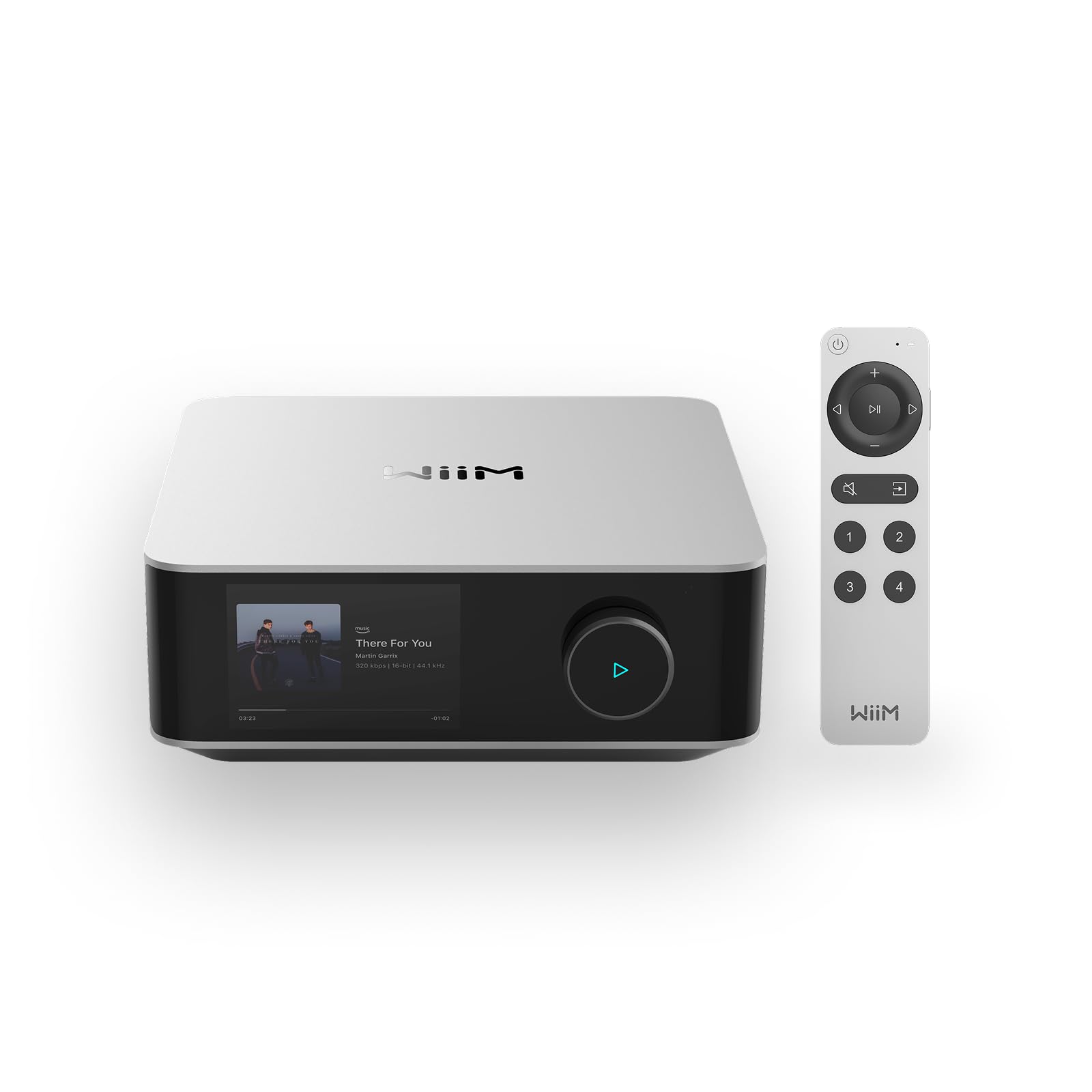
The WiiM Amp Ultra packs a 100-watt-per-channel Class D amplifier built around an ESS Sabre ES9039Q2M DAC and dual TI TPA3255 chips — a combination that yields ultra-low total harmonic distortion (‑106 dB THD+N) across the audible band. Its small footprint houses a 3.5-inch touchscreen that displays album art and system settings, making it the most physically interactive streaming amp in this review.
Built-in RoomFit EQ uses the microphone on your smartphone to measure in-room response and apply digital correction filters, automatically taming room modes that muddy bass and smear imaging. Wi-Fi 6 and Bluetooth 5.3 with LE Audio ensure stable multi-room streaming to other WiiM devices, and the HDMI ARC port lets the amp serve double duty as a stereo TV sound system. Owners report that the automatic input switching and per-source EQ presets make day-to-day use nearly frictionless.
The only notable omission is AirPlay — the Ultra cannot act as an AirPlay receiver, so Apple users must rely on Chromecast or direct app streaming. And the touchscreen, while responsive, is relatively small for navigating long playlists; most owners prefer the WiiM Home App for heavy browsing.
Why it’s great
- RoomFit EQ dramatically improves bass response and stereo imaging in imperfect rooms
- ESS Sabre DAC and dual TI TPA3255 amps deliver near-silent background
- HDMI ARC simplifies TV audio integration without needing a separate preamp/processor
Good to know
- No AirPlay support — a significant gap for Apple ecosystem users
- Touchscreen is too small for playlist navigation; app is required
- Bluetooth source switching has a slight delay that can be annoying
3. Onkyo TX-8470

The Onkyo TX-8470 is a two-channel network stereo receiver with a discrete MM/MC phono stage that uses patented op-amp circuitry to keep delicate phono signals isolated from digital noise. The Class G amplifier design switches between low- and high-voltage rails dynamically — it runs cool during quiet passages and supplies higher current when the music demands it, a topology that maximizes efficiency without the switching artifacts sometimes associated with pure Class D.
Built-in Wi-Fi and Bluetooth give access to streaming platforms like TIDAL, Deezer, and Qobuz, and the TX-8470 is Roon Ready, which makes it a natural fit for multi-room systems managed on a single interface. A gold-plated speaker terminal and audio-grade capacitors further clean the output path. Early adopters describe the sound as powerful and clean with Klipsch floorstanders, and the separate bass and treble controls let you tailor the voicing without diving into EQ menus.
Setup, however, is less intuitive than the competition — initial Wi-Fi configuration requires pressing a button on the front panel before the app can detect the unit. The included remote is large and button-dense, and some users found the online manual confusing during first-time setup.
Why it’s great
- High-quality MM/MC phono stage with discrete op-amp circuitry
- Class G amplifier runs cool while delivering ample current
- Roon Ready for seamless multi-room integration
Good to know
- Wi-Fi setup process is not plug-and-play; requires front-panel button press
- Remote control has small buttons and a steep learning curve
- Online manual is hard to follow, especially for non-technical users
4. Denon PMA-600NE

The PMA-600NE uses Denon’s Advanced High Current (AHC) push-pull circuit to deliver 70 watts per channel into 4 ohms with a warm, tube-like voicing. Divided circuitry lets the user engage Analog Mode, which disconnects the Bluetooth and digital stages entirely for a purer signal path when listening to vinyl or external analog sources — a rare feature in this price bracket.
Two optical and one coaxial input feed an internal DAC that listeners rate as competitive with external converters from WiiM and iFi, and a dedicated subwoofer output makes it easy to integrate a powered sub for fuller low-end extension. Headphone output drives high-impedance cans (300-ohm Sennheisers) without strain. The chassis uses a vibration-resistant design with a low center of gravity that minimizes microphonic feedback from speaker vibration.
While the PMA-600NE pairs wonderfully with speakers in the 86–90 dB sensitivity range, its 18-pound weight and larger footprint require a sturdy shelf. The remote is laggy and the LED indicators are dim enough to be hard to read across a room. Some users also report that Source Direct mode can reduce sound quality with certain digital sources, so experimentation is needed.
Why it’s great
- Analog Mode fully decouples digital circuitry for purer analog playback
- AHC circuit delivers warm, tube-like tonality with ample current
- Subwoofer output simplifies 2.1 system integration
Good to know
- Remote has noticeable lag and small range
- LED indicators are too dim for easy reading across a living room
- Source Direct mode may degrade sound with lower-quality digital files
5. WiiM Amp

The original WiiM Amp remains one of the best value streaming amplifiers on the market. It delivers 60 watts per channel at 8 ohms (120 watts at 4 ohms) from a compact chassis that measures roughly the size of a hardcover book. Connectivity is comprehensive: HDMI ARC for TV, optical and RCA inputs, USB for a thumb drive, plus Wi-Fi and Bluetooth streaming from Spotify, TIDAL, Amazon Music, and Qobuz.
Owners frequently cite the low-noise DAC and the WiiM Home App’s parametric EQ and subwoofer crossover adjustments as differentiators that allow fine tuning without external gear. The amplifier runs cool enough to stack with other components, and the voice remote supports Alexa, Google Assistant, and Siri. Listeners describe the sound as neutral and open, with good dynamic range for a digital amp in this price tier.
The main trade-offs relative to the Ultra model are the lower power (60W vs. 100W) and the lack of a touchscreen — all settings and playback navigation require the app. There is no phono input, so turntable owners need an external preamp, and the amplifier lacks AirPlay support entirely.
Why it’s great
- Excellent value proposition — delivers clean 60W/ch with rich app-based EQ
- HDMI ARC integrates TV audio without an extra processor
- Compact design runs cool and fits on any shelf
Good to know
- No phono input; turntable users need an external preamp
- No AirPlay support
- All playback control is through the app — no physical controls beyond volume knob
6. NAD D 3020 V2

The NAD D 3020 V2 is a 30-watt-per-channel hybrid digital integrated amplifier that channels the original 3020’s legacy into a modern, compact package. Its oversized power supply delivers more current per watt than typical mini-amps, allowing the D 3020 V2 to drive 86dB-sensitive bookshelf speakers to room-filling levels without strain. A built-in MM phono stage and Bluetooth aptX make it a true do‑it‑all hub for a desktop or small living room system.
Optical, coaxial, and RCA inputs feed a 24-bit/192kHz DAC that reviewers consistently rate as clean and detailed, easily matching the performance of dedicated outboard DACs at twice this unit’s price. The V2 adds pre‑outs, which let advanced users connect a subwoofer or higher-power amplifier downstream. The physical design is deliberately minimal — only a volume knob and source selector on the front face — so all deeper menu settings are handled via included remote or discrete hardware buttons.
Where the D 3020 V2 falls short is raw grunt. At 30W per channel, it won’t drive inefficient 84dB floorstanders past moderate levels, and larger listening rooms may push it beyond its comfort zone. The auto-standby circuit engages rather quickly and can be disruptive during quiet passages, and some owners find the power-on lag and multi‑tap source switching tedious.
Why it’s great
- Oversized PSU provides clean headroom well beyond its 30W nominal rating
- Built-in MM phono stage and aptX Bluetooth simplify a desktop system
- Pre‑outs allow future expansion and subwoofer integration
Good to know
- Limited to 30W/ch — insufficient for large rooms or inefficient speakers
- Auto-standby engages too quickly and can interrupt quiet sections
- Volume control uses a dot‑based display with a narrow usable window
7. Sony STRDH190
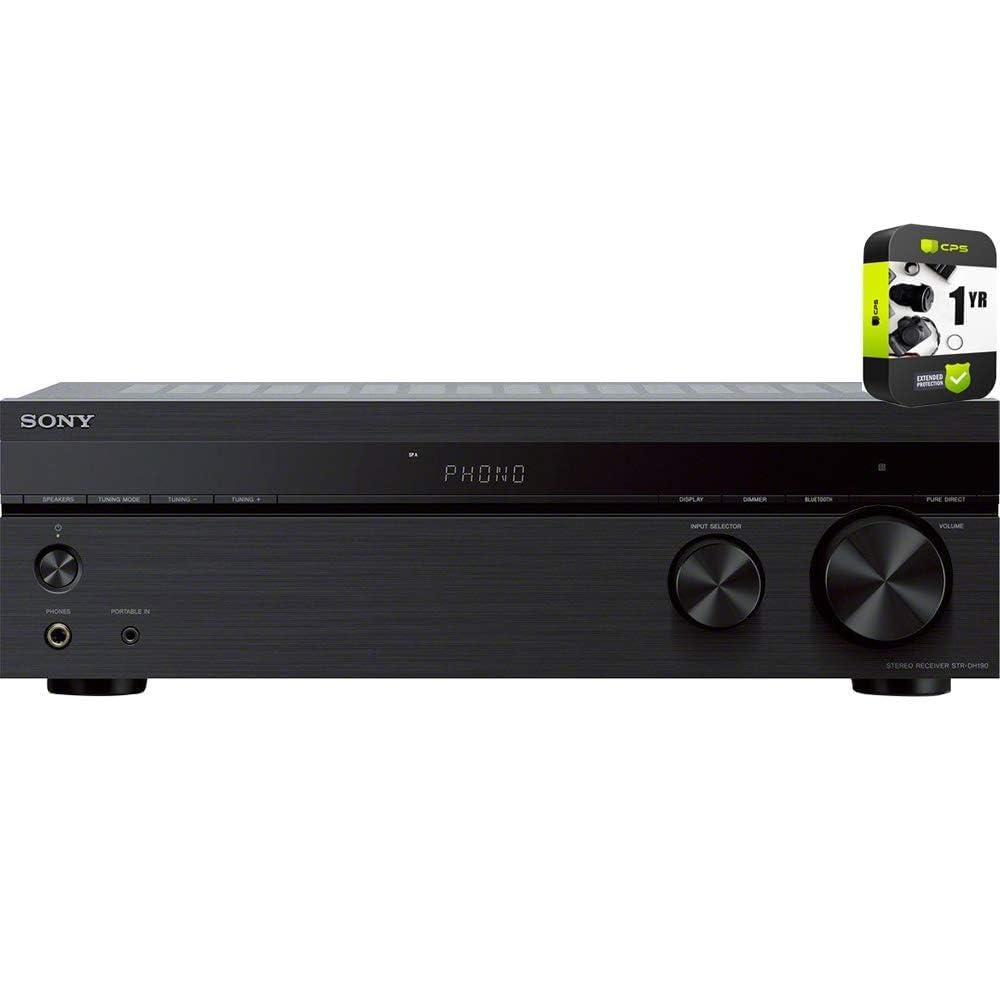
The Sony STRDH190 is a straightforward two-channel stereo receiver that includes a moving-magnet phono input and Bluetooth for under three hundred dollars. Its 100-watt-per-channel rating (into 6 ohms) provides enough muscle to drive entry-level tower speakers to satisfying levels in medium-sized rooms, making it a solid foundation for a first turntable setup or a secondary system.
Users consistently note that the sound is clean and punchy for the price, with the Bluetooth delivering crisp, synchronized audio to passive speakers. The built-in equalizer lets you tweak bass and treble independently. The receiver supports WAV and WMA formats from connected devices and provides a dedicated headphone jack for private listening. Many buyers report pairing it with vintage JVC or Sony components and enjoying a lively, musical presentation.
The STRDH190 does not include FM radio — a point of confusion for some buyers who expected an analog tuner in this classic-looking chassis. Speaker connections use spring clips rather than binding posts, which makes bare-wire connections secure but limits thicker banana-plug compatibility. More critically, a small number of units arrived with power‑related defects, so verifying functionality immediately after delivery is wise.
Why it’s great
- Surprisingly robust build and clean sound at a friendly price point
- Bluetooth pairs easily with smartphones and tablets
- Simple layout with physical knobs for bass, treble, and source selection
Good to know
- No FM tuner — a surprising omission for the vintage-styled form factor
- Speaker terminals are spring clips, not 5‑way binding posts
- Quality control inconsistency: occasional defective units require immediate return
8. MUZISHARE X7 KT88
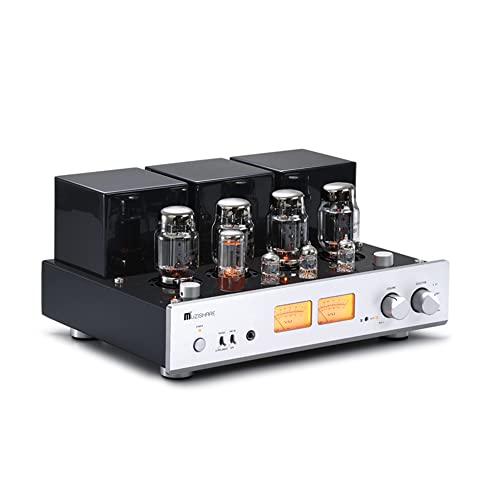
The MUZISHARE X7 is a hand‑wired KT88‑based push‑pull integrated amplifier that offers both triode (25W per channel) and ultralinear (45W per channel) modes, switchable from the front panel. It uses Japanese EI output transformers with Z11 cores, a toroidal power transformer, and a silver‑film coupling capacitor that the designer custom‑voiced for extension and density. Four VU meters, glowing KT88 tubes, and a remote control add visual drama to the audio performance.
In triode mode, the X7 delivers a smooth, liquid midrange that brings vocals forward with a natural presence—ideal for intimate jazz and vocal recordings. Switching to ultralinear mode opens the soundstage and tightens the bass, making it more suitable for large-scale orchestral works or classic rock. An MM phono stage is built in, as is a front‑panel headphone output. Balanced XLR inputs provide an option for higher-end source components, and the analog VU meters give clear visual feedback on output levels.
The X7’s modest power output means it pairs best with speakers of 90 dB sensitivity or higher — owners report excellent results with Polk Audio i200 and JBL Es90. The built-in phono stage is described as “average” compared to dedicated external preamps, and the unit runs hot enough to demand three inches of clearance on all sides. Some users also note that tube rolling (swapping stock tubes for Mullard or Gold Lion) takes the X7’s performance to a noticeably higher level.
Why it’s great
- Triode/ultralinear switch changes tonal character to suit different genres
- Hand-wired construction with high-quality Japanese output transformers
- VU meters and tube glow create a captivating visual centerpiece
Good to know
- Only 25W (triode) or 45W (ultralinear); needs high-sensitivity speakers
- Built-in phono stage is mediocre compared to external options
- Runs very hot; requires proper ventilation and a dedicated shelf
9. OSD Audio Nero HTA7200

The OSD Audio Nero HTA7200 is a 7‑channel Class AB amplifier rated at 210 watts per channel into 4 ohms (145W into 8 ohms) with all channels driven simultaneously — a spec that puts it in a different league from typical receiver‑based amplification. Balanced XLR inputs ensure low‑noise signal transfer over longer cable runs, and the 110 dB signal‑to‑noise ratio keeps the noise floor invisible even during quiet passages in concert recordings.
Owners describe the build quality as “tank‑like” — the unit weighs over 70 pounds and uses a heavy toroidal transformer and massive heat sinks that never exceed warm to the touch even under heavy loads. Pairing it with a dedicated preamp or processor transforms the dynamics of any speaker system, with users reporting 9 dB of additional headroom compared to typical integrated receivers. The channel status LEDs (ON/Standby/Protection) offer real‑time monitoring without a separate display.
The HTA7200 lacks streaming, DAC, and phono capabilities entirely — it is purely a power amplifier, designed to be driven by an external preamp/processor. Its 17‑inch depth and substantial weight require a heavy, well-ventilated rack or sturdy shelf. The price point also reflects its specialist role: most music‑only listeners will be better served by a stereo integrated amplifier unless they need multi‑channel power for a high‑end home theater.
Why it’s great
- All‑channels‑driven 210W per channel into 4 ohms with zero strain
- 110 dB SNR for absolute background silence
- Balanced XLR inputs reject noise over long cable runs
Good to know
- Pure power amplifier — no DAC, streaming, or phono capability
- Extremely heavy (71 lbs) and deep chassis requires dedicated rack space
- Overkill for 2‑channel music unless paired with a high‑end preamp
FAQ
Do I need a power amplifier or an integrated amplifier for music listening?
Can I use a 7‑channel power amplifier for a two‑channel music system?
What sensitivity rating do my speakers need for a low‑wattage tube amp like the MUZISHARE X7?
Final Thoughts: The Verdict
For most listeners, the audio receiver for music that delivers the best balance of resolution, power, and long-term value is the Cambridge Audio CXA81 MkII because its ESS Sabre DAC and toroidal-based Class AB stage extract detail from every source without sounding clinical or fatiguing. If you want a feature-packed streaming hub with room correction, grab the WiiM Amp Ultra. And for a warm, immersive tube experience that becomes a visual centerpiece, nothing in this roundup beats the hand‑wired MUZISHARE X7 KT88.