
Our readers keep the lights on and the weekend projects moving. As an Amazon Associate, I earn from qualifying purchases.
Ghost hunting investigations live or die by the quality of your EVP captures. A recorder that misses whispers or fills your files with hiss and room rumble is worse than no recorder at all—it creates false positives and buries real evidence in noise. You need a device with a low-noise microphone preamp, adjustable gain, and a form factor that doesn’t glow in the dark or click audibly every time you press a button.
I’m Rikta — the co-founder and writer behind FitlyFast. I’ve spent years studying the hardware specifications of field recording gear, from self-noise floors to bit-depth, to understand what separates a scientific-grade capture from a garbled mess.
This guide cuts through the paranormal hype to compare build, sensitivity, battery endurance, and sweep capabilities so you can buy the best audio recorder for ghost hunting that fits your investigation style and budget.
How To Choose The Best Audio Recorder For Ghost Hunting
Not every recorder is built for the dark silence of an abandoned building. A cheap dictation device tuned for a single voice in a quiet office will fail you when you need to catch a faint response over floor creaks and distant traffic. You need purpose-built gear.
Microphone Sensitivity and Self-Noise
The microphone is your primary sensor. Look for a unit with a low self-noise floor—ideally below 20 dB SPL—so the hiss you hear is the environment, not the recorder. Dual or three-mic arrays give you stereo separation that helps isolate directional sound sources during playback analysis.
Sweep Modes vs. Standard Recording
A standard dictaphone records everything, then you review later. A spirit box sweeps through AM or FM frequencies in real time, hoping to catch a voice that forms from fragments of radio static. If you prefer a more methodical, evidence-based approach, a high-quality linear PCM recorder gives you clean files you can analyze in audio software. If you want real-time interaction, a dedicated spirit box is mandatory.
Battery Endurance for Long Sessions
Overnight investigations drain power fast. A recorder with fewer than 30 hours of continuous recording at decent bitrates will leave you dead halfway through the most active hours. Rechargeable lithium packs are convenient, but models running on standard AA or AAA batteries let you swap fresh cells in the field without hunting for an outlet.
Storage Capacity and File Format
Recordings at 24-bit/48 kHz or higher eat storage space quickly. A 32 GB card gives you roughly 60 hours of high-fidelity PCM audio. MP3 recording saves space but discards subtle high-frequency information that could be vital evidence. Always choose a recorder that supports external microSD cards so you can swap them between sessions without downtime.
Quick Comparison
On smaller screens, swipe sideways to see the full table.
| Model | Category | Best For | Key Spec | Amazon |
|---|---|---|---|---|
| OM SYSTEM LS-P5 | High-Resolution Recorder | Stereo environment capture | 24-bit/96kHz WAV, 3-mic ORTF | Amazon |
| PSB7 PRO Spirit Box | Specialized Sweep Box | Real-time EVP communication | 40-frequency blend, REM sensors | Amazon |
| Olympus WS-883 | Premium Standard Recorder | Reliable all-night control recording | 8GB internal, 68h battery, low-cut filter | Amazon |
| Spirit Box Kit (Paranormic) | Beginner Sweep Kit | All-in-one starter sweep box | FM/AM sweep, 32GB card, 6h+ battery | Amazon |
| Olympus WS-882 | Mid-Range Standard Recorder | Budget-friendly PCM recording | Linear PCM/MP3, 4GB internal, 68h battery | Amazon |
| Innioasis R1 | Touchscreen Recorder | Portable backup with transcription | Dual mics, 1TB expandable, touchscreen | Amazon |
| Vormooi V71 | Budget Field Recorder | Long sessions with external mic | 110h battery, 160GB total, zinc alloy case | Amazon |
In‑Depth Reviews
1. OM SYSTEM LS-P5

This is the gold standard for serious paranormal investigators who need pristine audio evidence. The LS-P5 captures up to 24-bit/96kHz WAV files using three configurable microphones in an ORTF or mid-side array—that means you get true stereo separation with adjustable directional focus. Its self-noise is exceptionally low, which is critical for catching whispers that fall below the ambient floor.
The unit is remarkably compact for its capabilities, fitting in a shirt pocket while delivering audio quality that rivals much larger field recorders. It supports both internal 16 GB storage and microSD expansion, so you can run multi-night investigations without dumping files. Bluetooth connectivity lets you monitor via headphones with an app for remote start, but be aware that Bluetooth monitoring introduces a slight delay unsuitable for critical real-time review.
Some units ship with Japanese menus, and the plastic chassis feels more fragile than the Olympus metal-bodied alternatives. But for capturing environmental EVPs with scientific-grade fidelity that survives spectral analysis, nothing else here touches it. If your priority is clean, reviewable evidence rather than live sweeps, this is your top choice.
Why it’s great
- Studio-grade 24-bit/96kHz audio with three configurable microphones
- Extremely low self-noise for picking up faint room-level sounds
- Compact, pocket-friendly design with microSD expansion
Good to know
- Some units have menus in Japanese; English manual available online
- Plastic build feels less durable than metal alternatives
- Bluetooth headphone monitoring has noticeable latency
2. PSB7 PRO Spirit Box

Designed from the ground up for paranormal research, the PSB7 PRO uses a proprietary blend of 40 specific frequencies identified as a “sweet spot” for EVP communication. It sweeps both FM and AM bands at 17 adjustable speeds—from a fast 30-millisecond scan to a slow 350-millisecond crawl—giving you granular control over how much audio fragment you expose per step.
The standout features here are the REM (Residual Electromagnetic) touch pad and sensors. In mute mode, the box stays silent until a sensor is triggered, at which point the communication line opens without the constant scanning noise that fatigues your ears. This is a major advantage for long investigations where you want to avoid auditory burnout. The automatic temperature deviation detection adds another layer of environmental data logging.
It runs on three AA batteries, which you can swap instantly in the field—a huge plus for overnight stakeouts. The plastic build feels functional but not premium, and the learning curve for all the button functions is real. But users consistently report clearer, more frequent responses compared to standard sweep boxes. For real-time interactive sessions, this is the most purpose-built tool here.
Why it’s great
- Proprietary frequency blend optimized for EVP communication
- REM sensors enable silent standby until a trigger occurs
- 17 sweep speeds for precise control over scanning rate
Good to know
- Requires studying the manual to understand all functions
- Plastic body does not feel as durable as metal recorders
- AA batteries are not rechargeable via USB from the box itself
3. Olympus WS-883

If you prefer a straightforward, reliable dictaphone-style recorder over a sweep box, the Olympus WS-883 is the most field-ready standard option. It delivers 68 hours of continuous battery life on two AAA batteries—enough for a full weekend of investigations without recharging. The true stereo microphones with a low-cut filter let you roll off low-frequency rumble from HVAC systems or distant traffic, cleaning up your EVP captures significantly.
It records in both Linear PCM and MP3 formats, so you can choose high-fidelity WAV files for serious analysis or compressed MP3 for longer sessions. The 8 GB internal memory holds roughly 2080 hours at the lowest quality, but at 16-bit PCM you’ll still get plenty of recording time. The integrated USB-A connector charges NiMh batteries directly, so you never need a separate charger.
The build is tiny and rugged—a proven Olympus design that has been reliable for court reporters and journalists for decades. The main drawback is the inability to disable auto power-off, which can cut a recording short if you forget to reset the timer. It also lacks an external mic input, limiting your ability to use a dedicated parabolic or clip-on microphone for targeted capture.
Why it’s great
- Exceptional 68-hour battery life on standard AAA batteries
- Low-cut filter removes ambient rumble from recordings
- Proven Olympus build quality in a pocket-friendly size
Good to know
- Auto power-off cannot be fully disabled
- No external microphone input for specialized mics
- Non-rechargeable batteries require AAAs; USB charges NiMh only
4. Paranormic Spirit Box Kit
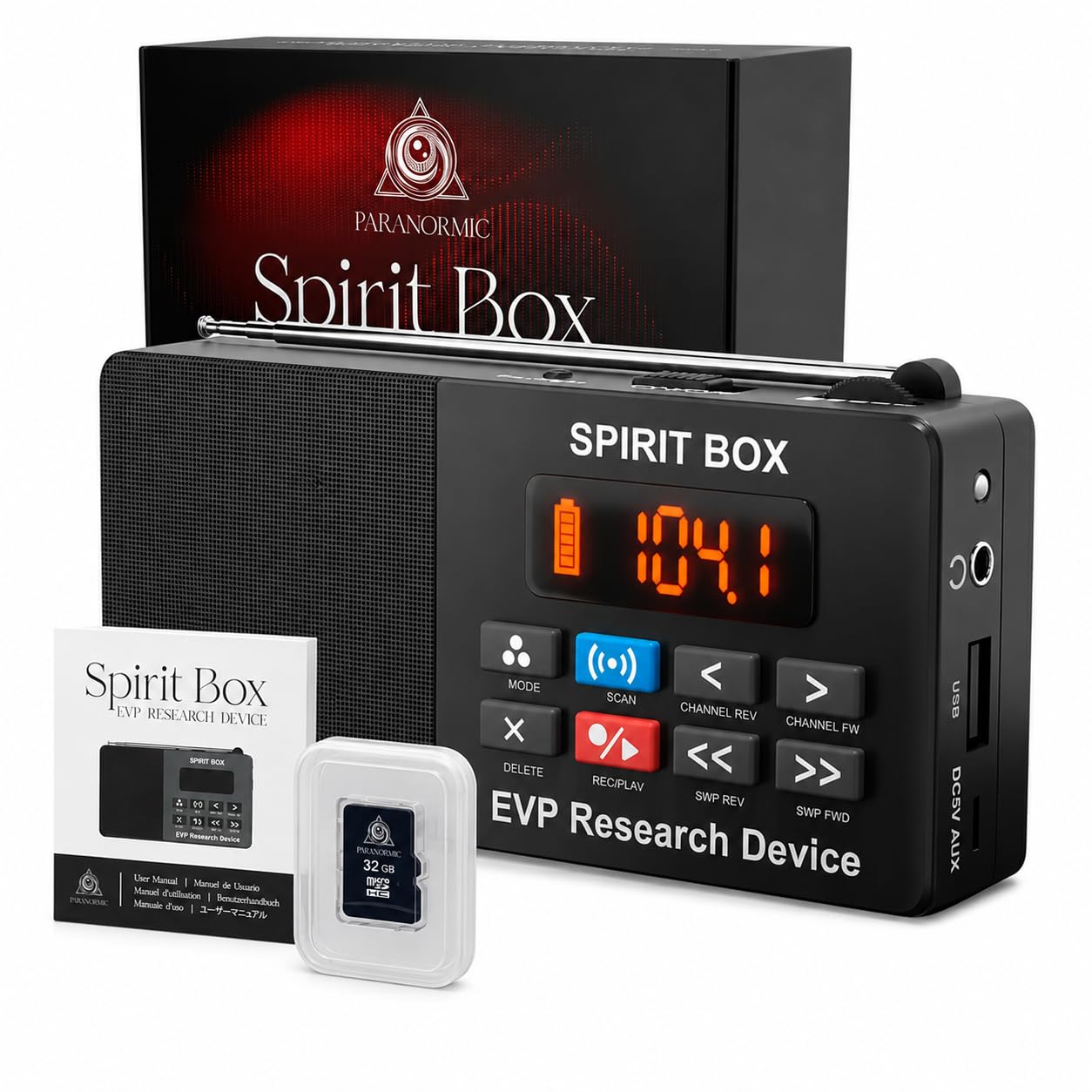
This kit is the fastest path from unboxing to an active investigation. It scans FM (87.5-108 MHz) and AM (522-1710 kHz) in manual, auto, and reverse sweep modes, with a sweep pause feature that lets you dwell on a frequency that sounds promising. The 86 dB built-in speaker is loud enough for a small group to hear without headphones, and the 3.5mm headphone jack allows private monitoring when you need to focus.
The included 32 GB microSD card records at 128 kbps MP3, giving you about 600 hours of sweep audio to review later. The backlit LCD display and glove-friendly buttons make it usable in complete darkness, and the built-in flashlight is a practical bonus for navigating around trip hazards. Battery life is a solid 6-10 hours from the rechargeable internal pack, and the full USB charging setup is in the box.
Some users report that the FM mode picks up distant radio stations, which can muddy the sweeps with actual broadcasts. The unit also has a slower maximum sweep speed compared to premium spirit boxes. But for a beginner or a team that wants a complete, ready-to-go kit without buying accessories separately, this delivers strong value and solid build quality.
Why it’s great
- Complete kit with 32GB card, cables, and manual included
- Glove-friendly buttons and backlit display for dark environments
- Built-in flashlight and loud speaker useful in the field
Good to know
- FM mode can pick up real radio stations causing interference
- Max sweep speed is slower than pro-grade boxes
- Some units have low speaker volume from the factory
5. Olympus WS-882

The WS-882 is the slightly leaner sibling of the WS-883, trading 8GB internal storage for 4GB, but retaining the same robust Linear PCM recording core and exceptional 68-hour battery life off two AAA batteries. For investigators who already own a stash of microSD cards, the lower internal memory is a non-issue—you can record directly to a 32GB card for extended sessions.
Like the WS-883, it features a low-cut filter, stereo microphones, and direct USB connectivity for file transfers. The recording quality at 16-bit PCM is clean enough for professional audio analysis, and the MP3 mode stretches recording time to over 1040 hours on the internal memory alone. The power-off switch doubles as a hold function, preventing accidental button presses while the recorder is stowed in a pocket or bag.
The main catch is that the USB connector is a simple stick-style plug, which feels like it could snap off if bent sideways. The recorder also does not charge batteries via USB—you need to use external chargers for rechargeables. But at this price point, you get a reliable, no-nonsense field recorder with a legacy of proven durability that many paranormal teams have trusted for years.
Why it’s great
- Dependable Linear PCM recording with excellent battery life
- Stereo microphones with low-cut filter for clean captures
- Holding switch prevents accidental recordings in transit
Good to know
- USB stick connector is fragile and may break over time
- Batteries are not rechargeable via USB connection
- Only 4GB internal storage; external card recommended
6. Innioasis R1
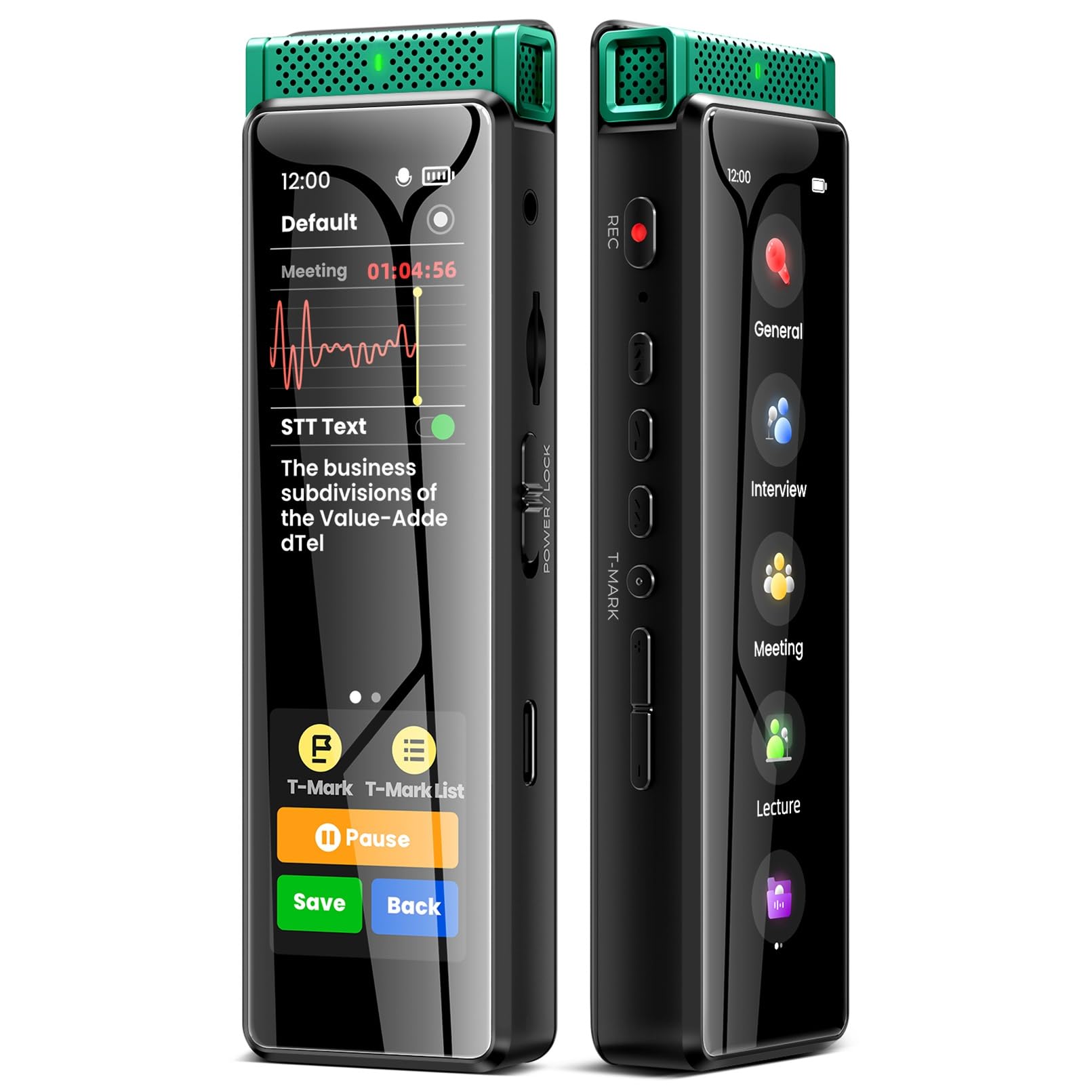
The R1 brings a modern touchscreen interface to the field, which can be a double-edged sword for ghost hunting. Its high-sensitivity and low-sensitivity dual microphone configuration, combined with DSP and RTC noise reduction, produces clean recordings that handle varied environments well. The touchscreen makes navigating menus and setting recording modes—General, Interview, Meeting, Lecture, Pocket—intuitive and fast, even in low light.
A standout feature for investigators is the expandable external storage supporting SD cards up to 1TB. For multi-night, multi-location investigations, this removes any worry about running out of space. The 1100mAh lithium battery delivers solid endurance, and the Bluetooth connectivity allows for remote control, which is handy if the recorder is placed in a potentially active hotspot while you observe from a distance.
The touchscreen is a vulnerability—it can be less reliable with damp or cold fingers on a night investigation, and the glossy finish may catch ambient light. It also creates AAC files by default, which some audio analysis software may not natively support without conversion. But for investigators who value a modern interface and massive storage capacity, the R1 offers flexibility the older button-only recorders cannot match.
Why it’s great
- Expandable storage up to 1TB for long investigations
- Touchscreen interface with multiple preset recording modes
- Bluetooth remote control for distanced monitoring
Good to know
- Touchscreen less reliable in damp or cold conditions
- Default AAC files may need conversion for some analysis software
- Reflective screen can be distracting in dark environments
7. Vormooi V71

The Vormooi V71 is built for endurance. Its 1100mAh battery delivers 110 hours of continuous recording at 512 kbps and charges fully in two hours. The zinc alloy shell is significantly tougher than the plastic bodies of many competitors—it can survive being knocked off a table or tossed in an equipment bag without damage. This is a field recorder designed for rough handling.
It comes with a 3.5mm external microphone and a transcription cable in the box, so you can clip the mic to your collar for hands-free recording or capture audio directly from another device via line-in. The 160 GB total storage (32GB internal + 64GB SD card, which can be upgraded) holds roughly 7000 hours at the lowest 32 kbps setting, though for serious EVP work you will want to record at higher bitrates. The slide-to-record switch is quick and tactile, letting you start capturing in under a second.
The user interface has a learning curve—the rewind and fast-forward controls are not intuitive, and the single-threaded menu structure can be confusing during a tense investigation. The microphone array is mono rather than stereo, which limits spatial separation in your recordings. But if battery life and ruggedness are your top priorities for long stakeouts, the V71 is a compelling budget-conscious workhorse.
Why it’s great
- Industry-leading 110-hour battery for marathon sessions
- Zinc alloy case stands up to drops and rough field use
- Includes external mic and line-in cable out of the box
Good to know
- Mono microphone array limits stereo separation for analysis
- Rewind and fast-forward controls are not user-friendly
- Menu navigation can be confusing without practice
FAQ
Should I use a spirit box or a normal voice recorder for ghost hunting?
What is the best file format for EVP recordings?
How much storage do I need for a night of ghost hunting?
Final Thoughts: The Verdict
For most users, the audio recorder for ghost hunting winner is the Olympus WS-883 because it combines proven reliability, exceptional battery life, and clean PCM recording in a rugged, pocket-friendly package. If you want the highest-fidelity environmental capture for spectral analysis, grab the OM SYSTEM LS-P5. And for real-time interactive sessions that maximize your chance of catching a live response, nothing beats the PSB7 PRO Spirit Box.