
Our readers keep the lights on and the weekend projects moving. As an Amazon Associate, I earn from qualifying purchases.
Forget the muddy, distorted sound from your laptop or that cheap soundbar—real audio speakers breathe life into your movies, music, and games with a physical presence that no all-in-one system can deliver. Choosing the wrong pair, however, means missing the punch of an action scene or the subtle texture of a vocalist’s breath, leaving your media feeling flat and lifeless.
I’m Rikta — the co-founder and writer behind FitlyFast. I’ve spent years dissecting the raw data, spec sheets, and user feedback across the full spectrum of home and professional audio to separate the genuinely great from the merely loud.
Whether you are building a cinematic home theater or upgrading your desktop studio, finding the best audio speakers means understanding the trade-offs between driver materials, power handling, cabinet construction, and connectivity that determine a speaker’s real-world performance, not just its wattage rating.
How To Choose The Best Audio Speakers
Selecting audio speakers is a balancing act of physics, room acoustics, and intended use. A pair that shines in a near-field desktop setup may sound thin in a large living room, while a high-efficiency PA speaker can be overkill for intimate listening. Understanding a few core specs will guide you to the right match for your space and content.
Driver Composition and Woofer Material
The woofer cone material directly dictates stiffness, damping, and overall distortion. Basic paper cones offer a warm tone but can break up at higher volumes. Aramid fiber, as found in the ELAC Debut 3.0, and spun copper cerametallic, used by Klipsch, deliver significantly better rigidity for tighter, more controlled bass without the audible smear that plagues cheaper polypropylene drivers. The tweeter material also matters—a silk dome tends to be smoother, while titanium and aluminum domes offer more sparkle and detail, provided the waveguide is designed well to avoid listener fatigue.
Power Handling and Sensitivity
Wattage alone is a poor measure of a speaker’s potential loudness. Sensitivity, measured in decibels (dB) at 1 watt per 1 meter, tells you how efficiently the speaker converts power into sound. A speaker with 90dB sensitivity will play significantly louder than an 86dB speaker given the same amplifier power. For home use, look for sensitivity ratings above 88dB to ensure your receiver or amp isn’t straining. For professional PA speakers like the ALTO TS408 or JBL EON715, the built-in Class D amplification and DSP are the real factors dictating clean output—not the raw wattage number on the spec sheet.
Enclosure Type: Ported, Passive Radiator, or Sealed
The cabinet design determines how low the speaker can go and how the bass interacts with your room. Ported enclosures (bass reflex) use a tuned tube to reinforce low frequencies but can introduce chuffing noise at high volumes and need careful placement away from walls. Passive radiators, seen on the Polk Monitor XT60, achieve similar bass extension without a port’s turbulence, making placement more forgiving. Sealed enclosures produce the tightest, most accurate bass response but require more amplifier power to reach the same low-end output—a preferred choice for purists who prioritize speed over punch.
Quick Comparison
On smaller screens, swipe sideways to see the full table.
| Model | Category | Best For | Key Spec | Amazon |
|---|---|---|---|---|
| Klipsch RP-600M | Passive Bookshelf | Audiophile music listening | 1″ Titanium LTS Tractrix Horn Tweeter | Amazon |
| ELAC Debut 3.0 DB63-BK | Passive Bookshelf | Neutral, detailed reference sound | 6.5″ Woven Aramid-Fiber Woofer | Amazon |
| Polk ES20 | Passive Bookshelf | Movies with deep bass extension | Power Port Technology for 3dB louder bass | Amazon |
| MEVOSTO DS19 | Powered Bookshelf | Desktop PC and vinyl setups | 36W RMS with USB Digital Audio | Amazon |
| Bose SoundLink Plus | Portable Bluetooth | Outdoor and travel use | IP67 waterproof / 20-hour battery | Amazon |
| Polk Monitor XT60 | Passive Tower | Budget-friendly floorstanding system | Dual 6.5″ Passive Radiators | Amazon |
| ALTO TS408 | Powered PA | Live vocals and DJ monitoring | 2000W peak / 8″ LF + 1.4″ HF drivers | Amazon |
| JBL EON715 | Powered PA | Medium venue full-range sound | 15″ Woofer / 300W Class D Amplification | Amazon |
| Sonos Sub 4 | Wireless Subwoofer | Sonos home theater bass upgrade | Dual force-canceling drivers | Amazon |
In‑Depth Reviews
1. Klipsch RP-600M Bookshelf Speakers (Pair)

The RP-600M is a legendary bookshelf pair that flipped the script on what passive speakers could sound like. The 1-inch titanium LTS vented tweeter mated to the Hybrid Tractrix horn delivers a live, airy top end without the harsh peak that plagued earlier Klipsch designs. The 6.5-inch spun copper Cerametallic woofer uses a rigid anodized aluminum cone that remains pistonic under high dynamic range, producing punchy, articulate bass that defies the cabinet size—no subwoofer required for most music genres.
Vocals and midrange instruments—piano, guitar, brass—project with an immediacy that puts you in the recording space. The rear-firing Tractrix port extends low-end response down to usable depths, but demands careful placement: keep them at least 8 inches from the rear wall to avoid bass bloom. Bi-wire/bi-amp capability via dual binding posts gives you room to tweak the amplifier chain, and the magnetic grille pops off for a clean, industrial look that the walnut veneer complements beautifully.
The catch is that these are not true “bookshelf” speakers in the compact sense. At over 16 pounds each and a depth that extends beyond typical shelves, they require dedicated stands. Partner them with a warm-sounding amplifier—something from Yamaha or Marantz—to smooth out any residual brightness and let that Tractrix horn sing at low volumes without fatigue.
Why it’s great
- Exceptional detail retrieval and soundstage depth
- High sensitivity (94dB) makes them easy to drive with modest amps
- Cerametallic woofer delivers tight, non-portly bass
Good to know
- Physically large for a bookshelf design; need proper stands
- Bright signature can be fatiguing with lower-quality recordings
- Rear port requires careful wall spacing
2. ELAC Debut 3.0 DB63-BK Bookshelf Speakers (Pair)

Andrew Jones’s Debut series has always punched above its weight, and the 3.0 iteration is the most refined yet. The woven aramid-fiber woofer is a massive upgrade from the polypropylene cones of earlier generations—it offers superior stiffness-to-weight ratio, translating to faster transient response and a cleaner midbass that doesn’t cloud the lower mids. The new aluminum dome tweeter with waveguide and phase plug widens the dispersion pattern, meaning the sweet spot is forgiving for real-world seating arrangements.
Sonically, the DB63-BK leans neutral and honest. There is no artificial warmth to mask poor recordings, nor exaggerated treble to impress at a demo. The bass reaches down to 42Hz in-room, which is genuinely deep for a 6.5-inch two-way, and the internal bracing keeps the cabinet dead quiet. Magnetically attached grilles give a flush, premium appearance that integrates into any modern decor without visible hardware.
These speakers demand a clean, competent amplifier—ideally 50 watts or more—to reveal their full soundstage. They are efficient enough that a mid-range receiver can drive them, but pairing with a quality integrated amp (like the Yamaha A-S301) unlocks layered imaging where instruments occupy precise positions in three-dimensional space. For listeners who want reference-grade accuracy without spending reference-grade money, this is the pair to beat.
Why it’s great
- Woven aramid cone provides detailed, low-distortion bass
- Wide dispersion creates a forgiving, expansive sweet spot
- Internal cabinet bracing eliminates boxy resonance
Good to know
- Neutral signature may sound lean without a subwoofer for bass-heavy genres
- Requires a 50+ watt amplifier to perform optimally
- Not the most forgiving of bright or thin-sounding electronics
3. Polk Audio Signature Elite ES20 Bookshelf Speakers (Pair)

The ES20 is Polk’s answer to the question: how do you get thunderous low end without a dedicated subwoofer? Their patented Power Port—a flared port tube that smoothly transitions airflow into the room—delivers measurable bass output 3dB louder than conventional ported designs at the same cabinet volume, with virtually no chuffing noise. For home theater use, that translates to explosions and LFE effects that pressurize a small to medium room convincingly.
The 1-inch Terylene tweeter is voiced to be slightly bright on initial listen, but after a 30-hour break-in period, the treble smooths into a detailed yet non-fatiguing character. Midrange reproduction is natural, especially for vocals and acoustic instruments, making dialogue in movies clear and present. The cabinets are deep—over 12 inches—which is unusual for a bookshelf, so measure your shelf or stand depth before buying.
These speakers shine when paired with a capable AVR and used in a surround configuration. The timbre-matched Signature Elite series means you can add an ES30 center channel and ES10 surround speakers for a seamless 5.1 system. The high sensitivity and 4-8 ohm compatibility make them easy to drive with most modern receivers, even at moderate volumes. The faux wood vinyl finish is the main aesthetic compromise—it looks decent from a distance but doesn’t match the real wood veneer of pricier competitors.
Why it’s great
- Power Port technology adds real, usable bass extension
- Easy to drive with mid-range AVRs
- Timbre-matched to the Signature Elite series for seamless surround
Good to know
- Significant cabinet depth may limit placement options
- Faux wood vinyl looks less premium than real veneer
- Tweeter needs break-in to soften initial brightness
4. MEVOSTO DS19 Active Bookshelf Speakers (Pair)

The DS19 is an all-in-one powered solution that brings studio-grade flexibility to a desktop setup. Each cabinet houses a 5-inch woofer and a 1-inch silk dome tweeter, driven by 36 watts RMS of clean amplification. The silk dome tweeter avoids the piercing top-end of cheaper metal domes, delivering crisp highs that stay smooth even during long listening sessions. The real differentiator here is the USB digital audio input—connecting to your PC via USB bypasses your computer’s noisy analog output entirely, resulting in lower noise floor and better channel separation than a standard 3.5mm jack.
Bluetooth 5.4 provides stable, low-latency pairing with phones and tablets, and the RCA input accepts turntables with a built-in preamp. You get 10 levels of bass and treble adjustment via the front knobs, giving you room to dial in the sound for your specific room acoustics. The wood enclosure is actual natural wood veneer, which enhances resonance characteristics and looks far more premium than the price suggests.
One limitation is the lack of Dolby Audio decoding—these are strictly a stereo pair, so don’t expect virtual surround processing. The USB connection requires your computer’s port to support audio output, which most modern PCs do, but some gaming laptops may not. For a dedicated desktop setup where space is tight but audio quality cannot be compromised, the DS19 delivers an impressive combination of connectivity and clean sound.
Why it’s great
- USB digital audio eliminates computer noise for clean PC sound
- Silk dome tweeters produce relaxed, detailed highs
- Natural wood cabinet improves acoustic resonance
Good to know
- No Dolby Audio or virtual surround processing
- USB audio may not work with all PC ports
- Requires 12V/3A power supply for stable operation at lower voltages
5. Bose SoundLink Plus Portable Bluetooth Speaker

The SoundLink Plus takes the core Bose promise—big sound from a small box—and wraps it in a rugged, IP67-rated chassis that can survive rain, dust, and drops. Unlike budget Bluetooth speakers that compress dynamics to protect tiny drivers, the SoundLink Plus uses a custom passive radiator and a high-excursion woofer to produce genuine bass weight at moderate volumes. The sound signature is warm and rich, with a slight mid-bass emphasis that makes pop, rock, and hip-hop sound energetic outdoors where acoustic reflections are absent.
Portability is the headline: the unit weighs just over 3 pounds, has a built-in carrying loop, and charges via USB-C. Battery life hits 20 hours, and the integrated USB-C charge-out port lets you top off your phone in a pinch. The Bose app provides a full graphic EQ to tweak bass, mid, and treble levels, plus SimpleSync pairing with compatible Bose soundbars for whole-home audio. Stereo Mode links two SoundLink Plus units, while Party Mode plays in mono across both for maximum coverage.
The hardware is not without trade-offs. At 3+ pounds, it is heavier than similarly sized competitors from JBL or Sony, which may matter if you’re backpacking. The 20-hour battery is rated at moderate volume—pushing it to max for long periods cuts that significantly. For a portable that genuinely fills a backyard gathering or a campsite without distortion, the SoundLink Plus delivers a refined, Bose-grade experience that justifies the price premium.
Why it’s great
- IP67 dust/water proofing with shock-resistant build
- Full EQ control via Bose app for customized tuning
- USB-C charge-out port doubles as a power bank
Good to know
- Heavier than many competing portable speakers
- Battery life drops significantly at maximum volume
- No wide stereo separation without a second unit
6. Polk Monitor XT60 Tower Speaker

The XT60 is a floorstanding speaker that takes the classic Polk Monitor formula—big sound, low price—and polishes it with modern engineering. The key innovation is the pair of 6.5-inch passive radiators flanking the active 6.5-inch woofer. Unlike a ported tower, passive radiators move air without the turbulence noise of a reflex tube, giving you substantial low-end extension from a relatively compact cabinet. For a tower at this price tier, the bass is surprisingly articulate—tight enough for techno and punchy enough for action movies, without the one-note boom that plagues cheap multi-driver designs.
The 1-inch tweeter uses a soft-dome design that integrates smoothly with the woofer, avoiding the crossover dip that some two-ways suffer from. Soundstage width is solid, especially when paired with a quality amplifier, and the Hi-Res Audio certification ensures it resolves enough detail for high-resolution streaming. The cabinet is finished in a midnight black vinyl that looks clean and unobtrusive in any room, and the rubber feet work equally well on carpet and hardwood.
These are not speakers for critical near-field monitoring—the soundstage depth is decent but not rivaling audiophile bookshelves at a similar price. The main limitation is maximum loudness: pushing them hard in a large room will show the limits of the single 6.5-inch active driver. Adding a subwoofer (like the Polk MXT12) completes the system for home theater use. For a budget-friendly entry into true floorstanding sound, the XT60 offers a compelling path.
Why it’s great
- Passive radiator design provides smooth, port-free bass extension
- Compact footprint for a floorstanding speaker
- Hi-Res Audio certified for detailed high-resolution playback
Good to know
- Single 6.5″ woofer limits maximum output in large rooms
- Best paired with a subwoofer for full-range theater
- Some units may arrive with minor cosmetic damage
7. ALTO TS408 Powered PA Speaker
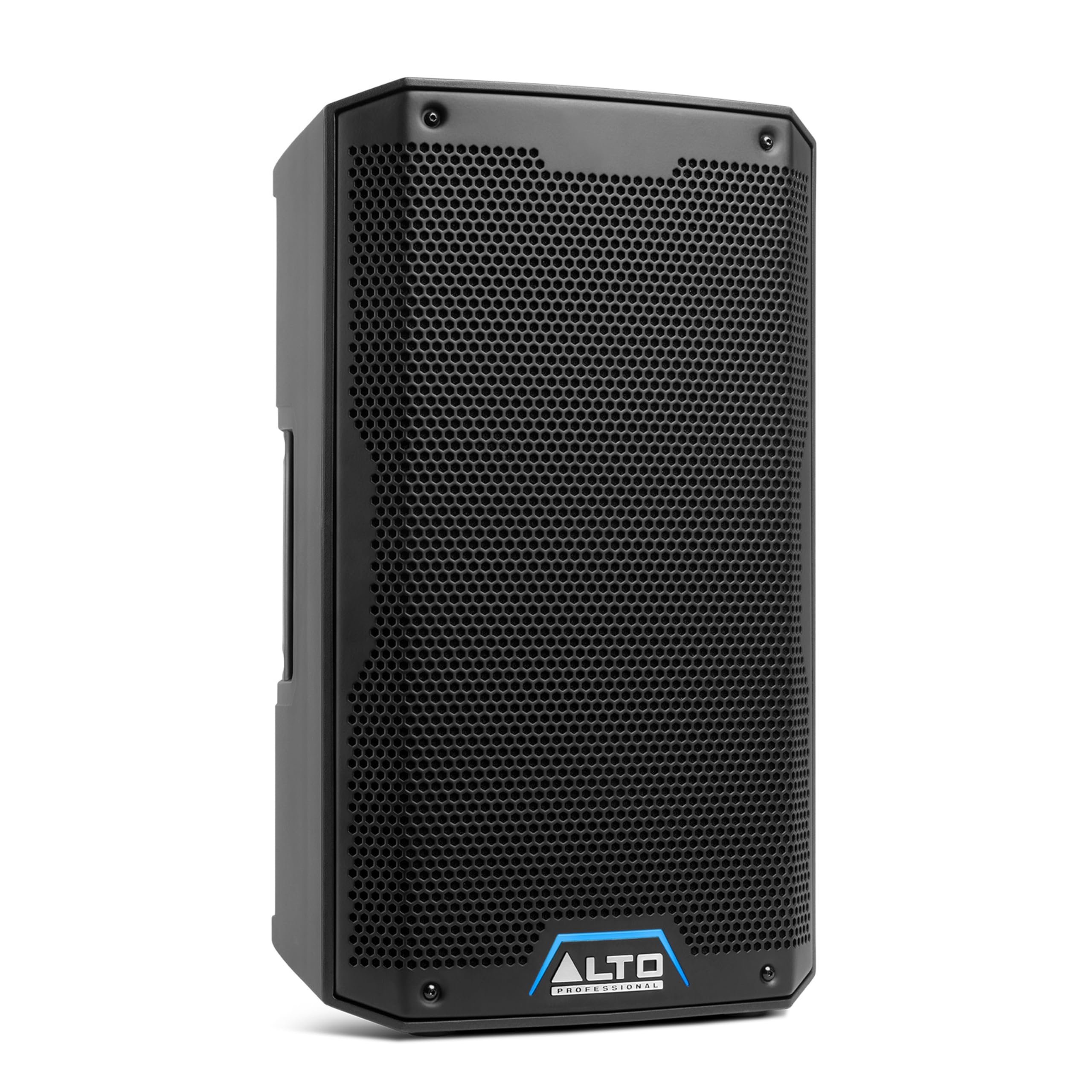
The TS408 is a compact powerhouse for musicians and mobile DJs who need a lightweight PA cabinet that can keep up with vocals and instruments. The 8-inch low-frequency driver and 1.4-inch compression driver are driven by a 2000-watt peak (continuous rating is lower, realistically, but the headroom is there for transient peaks) Class D amplifier that stays cool and efficient. Out of the box, the default voicing is slightly harsh in the upper mids (1.2-3.5kHz) and muddy in the low mids, but the integrated DSP—accessible via the ALTO app—lets you dial in a custom EQ curve that completely transforms the response into something usable for live sound.
The built-in 3-channel mixer accepts XLR, 1/4-inch, and RCA inputs with independent level controls, eliminating the need for an external mixer for basic setups. Bluetooth streaming and wireless speaker linking allow you to connect two TS4-series speakers for true stereo without cables. The cabinet offers multiple mounting options: pole-mount, wedge monitor, or flying with integrated suspension points, making it versatile for different venue configurations.
Physical weight is moderate at just over 20 pounds, but the single handle on the tilt-back side makes one-handed carrying awkward. The DSP app lacks built-in reverb or effects, so vocalists may still want an external mixer with reverb processing. Bass output is limited by the 8-inch woofer—this is a vocal/instrument monitor, not a subwoofer replacement. For the price, the TS408 offers DSP-driven performance that competes with PA speakers costing significantly more, assuming you invest the time to tune the EQ.
Why it’s great
- DSP app allows deep EQ customization to fix default voicing
- Integrated 3-channel mixer eliminates extra gear for simple setups
- Wireless Bluetooth speaker linking for stereo without cables
Good to know
- Default sound profile needs DSP adjustment for critical listening
- 8″ driver limits low-frequency output; requires sub for full-range
- Single handle placement makes transport slightly unbalanced
8. JBL Professional EON715 Powered PA Speaker

The EON715 is a serious tool for rental houses, live bands, and houses of worship that need consistent, intelligible sound across a large area. The 15-inch woofer moves enough air to handle full-range music in venues of up to 500 people without a subwoofer, delivering surprising low-end authority for a single-cabinet PA. The advanced waveguide ensures that the high frequencies reach the back of the room without beaming, maintaining uniform coverage that reduces feedback issues. The 300-watt Class D amplifier is conservative in its continuous rating but highly efficient, translating to clean headroom without thermal shutdown.
The on-board DSP suite is comprehensive: EQ, limiters, delay, dbx Automatic Feedback Suppression, and ducking for spoken-word applications. The backlit color LCD screen makes menu navigation practical on a dark stage, and the free JBL Pro Connect app gives you remote control from the sound booth or the floor. Bluetooth 5.0 streaming is available for playback music during breaks, and the four combo XLR/1/4-inch inputs cover microphones, instruments, and line-level sources.
The cabinet is light enough for its size—roughly 40 pounds—with dual handles that make one-person transport viable. Stacking feet are built-in, and the pole mount is standard. The main compromise is the plastic enclosure, which is durable but not as acoustically inert as a wooden cabinet, though this is standard in the professional PA market. For a venue that needs one box to cover vocals, music, and announcements with JBL reliability, the EON715 is a proven workhorse.
Why it’s great
- 15″ woofer provides full-range output without a sub for small to medium venues
- Integrated DSP with feedback suppression and ducking
- JBL Pro Connect app offers full remote control
Good to know
- Plastic cabinet is standard but not as resonant as wood
- Some units may run hot on the power cable connection
- Maximum SPL is adequate for medium venues but not large outdoor events
9. Sonos Sub 4 Wireless Subwoofer

The Sonos Sub 4 is not a standalone speaker—it is a dedicated low-frequency augmentation engine for the Sonos ecosystem. The core engineering marvel is the dual force-canceling configuration: two drivers face inward, canceling cabinet vibration so that the enclosure itself does not rattle or buzz, even at high output levels. This allows placement flexibility unmatched by conventional subwoofers—stand it upright, lay it on its side, or slide it under a couch, and the bass remains clean and location-independent.
Integration with Sonos soundbars like the Arc Ultra, Arc, or Beam is seamless over Wi-Fi. The Sonos app handles Trueplay tuning, which uses the microphone on your iOS device to analyze the room’s acoustics and calibrate the sub’s output accordingly. The result is low end that feels tactile and immersive—you feel the chest pressure of an explosion in a movie and the weight of a kick drum in music—without the muddy overhang that plagues budget subwoofers.
The premium price reflects the ecosystem lock-in: the Sub 4 only works with other Sonos products. If you are building a non-Sonos system, this is not the right choice. It also requires the Sonos app for setup, which has faced user interface criticism in recent years. But for existing Sonos owners, the Sub 4 is the single most impactful upgrade to a soundbar setup, transforming flat two-channel TV audio into a cinematic, room-pressurizing experience.
Why it’s great
- Force-canceling drivers eliminate cabinet vibration for flexible placement
- Seamless wireless integration with Sonos soundbars
- Trueplay room calibration delivers accurate, location-optimized bass
Good to know
- Exclusive to the Sonos ecosystem; no universal connectivity
- Setup requires the Sonos app, which has UI usability complaints
- Premium price reflects ecosystem value more than raw hardware specs
FAQ
Should I match the tweeter material to my music genre or listening habits?
What size bookshelf speaker works best for a desktop versus a living room?
Is a passive radiator design better than a ported enclosure for bass quality?
Final Thoughts: The Verdict
For most users, the best audio speakers winner is the Klipsch RP-600M because its high sensitivity and dynamic horn-loaded sound make almost any music or movie feel alive without needing a massive amplifier. If you want a neutral, reference-grade sound with the best imaging at the price, grab the ELAC Debut 3.0 DB63-BK. And for a portable outdoor speaker that delivers genuine bass and ruggedness, nothing beats the Bose SoundLink Plus.