
Our readers keep the lights on and the weekend projects moving. As an Amazon Associate, I earn from qualifying purchases.
A home audio system is no longer a luxury; it’s the difference between watching a movie and living inside one. The shift from thin TV speakers to a dedicated setup transforms every explosion, whisper, and bass drop into a physical presence in your room. The challenge isn’t desire—it’s navigating the massive spec sheet: soundbar versus passive speakers, Dolby Atmos channels, wireless versus wired subs, and the power numbers that don’t always tell the truth.
I’m Rikta — the co-founder and writer behind FitlyFast. I’ve spent countless hours analyzing frequency response curves, driver sizes, amplifier topologies, and real owner feedback to separate the genuine performers from the marketing noise in today’s crowded home audio market.
Whether you’re building a dedicated theater room or upgrading your living room, finding the right audio system for home means matching your space and priorities to a system that delivers real surround immersion without wasted features.
How To Choose The Best Audio System For Home
Home audio systems range from compact all-in-one soundbars to sprawling passive tower setups. Your choice hinges on three pillars: the physical layout of your room, your tolerance for visible wires and component boxes, and how critically you listen to music versus how enthusiastically you watch action films.
Channel Count and Height Layers
The first number in a system like “5.1.4” means the bed layer (front left, center, front right, surround left, surround right). The second is the subwoofer count. The third represents overhead or up-firing channels for Dolby Atmos. A 3.1 system is fine for dialogue-driven content. A 5.1.2 or 5.1.4 setup creates the enveloping bubble that makes rain feel like it’s falling above you. If your ceiling is low or has obstructions, up-firing speakers lose effectiveness—dedicated in-ceiling drivers are always superior but require installation.
Soundbar vs. Passive Speakers
Soundbars simulate surround sound using psychoacoustic tricks and multiple drivers in a single bar. They are clean, easy to set up, and increasingly include wireless rears. Passive speaker systems—like floorstanding towers, bookshelf pairs, and a center channel—require an AV receiver. They offer superior soundstage width, driver quality, and upgradeability. The trade-off is visual footprint and the complexity of running speaker wire.
Wireless vs. Wired Surrounds
True wireless rear speakers (battery-powered, like on the JBL Bar 700MK2) offer placement freedom and zero visible cables. The compromise: you must remember to charge them, and battery life degrades over years. Hybrid wireless rears (like the LG S40TR) need a power outlet but no signal cable to the soundbar—they are the sweet spot for most buyers. Wired rears in traditional passive systems deliver absolute signal integrity and never need charging but require cable management.
Subwoofer Size and Room Matching
An 8-inch subwoofer is sufficient for small to medium rooms (up to about 300 sq ft). A 10-inch driver starts to pressurize a larger living room. Dual 10-inch or 12-inch subwoofers (like in the Nakamichi Shockwafe Ultra or the Klipsch Reference 5.2 bundle) distribute bass more evenly, eliminating dead spots. If you share walls with neighbors, a single 8-inch sub with downward-firing porting is more considerate while still delivering chest-thump on action scenes.
Quick Comparison
On smaller screens, swipe sideways to see the full table.
| Model | Category | Best For | Key Spec | Amazon |
|---|---|---|---|---|
| LG S40TR | Soundbar 4.1 | Budget surround upgrade | 4ch + wireless sub + wireless rears | Amazon |
| Polk ES20 (Pair) | Bookshelf Pair | Stereo music / front L/R | 6.5″ woofer + Power Port bass | Amazon |
| ULTIMEA Skywave X50 | Soundbar 5.1.4 | Immersive Atmos on a mid budget | 760W peak, 8″ sub, up-firing rears | Amazon |
| Klipsch Cinema 5.1.4 | Passive 5.1.4 | True Atmos with separate speakers | Satellites + sub + up-firing all 4 | Amazon |
| Sony HT-S60 | Soundbar 5.1 | Plug-and-play Sony ecosystem | 5.1ch, Dolby Atmos, wireless rears | Amazon |
| JBL Bar 700MK2 | Soundbar 7.1 | Battery-powered detachable rears | 780W, 10″ sub, detachable surrounds | Amazon |
| Nakamichi Shockwafe Ultra | Soundbar 9.2.4 | Massive bass + 360° surround | Dual 10″ subs, 4 surround speakers | Amazon |
| Bose Smart Ultra Bundle | Soundbar 5.1 | Premium wireless ecosystem | Soundbar + Bass 700 + wireless surrounds | Amazon |
| Klipsch Reference 5.2 + Yamaha | Passive 5.2 | Full separates with dual 12″ subs | Towers + center + bookshelf + dual subs | Amazon |
In‑Depth Reviews
1. Nakamichi Shockwafe Ultra 9.2.4
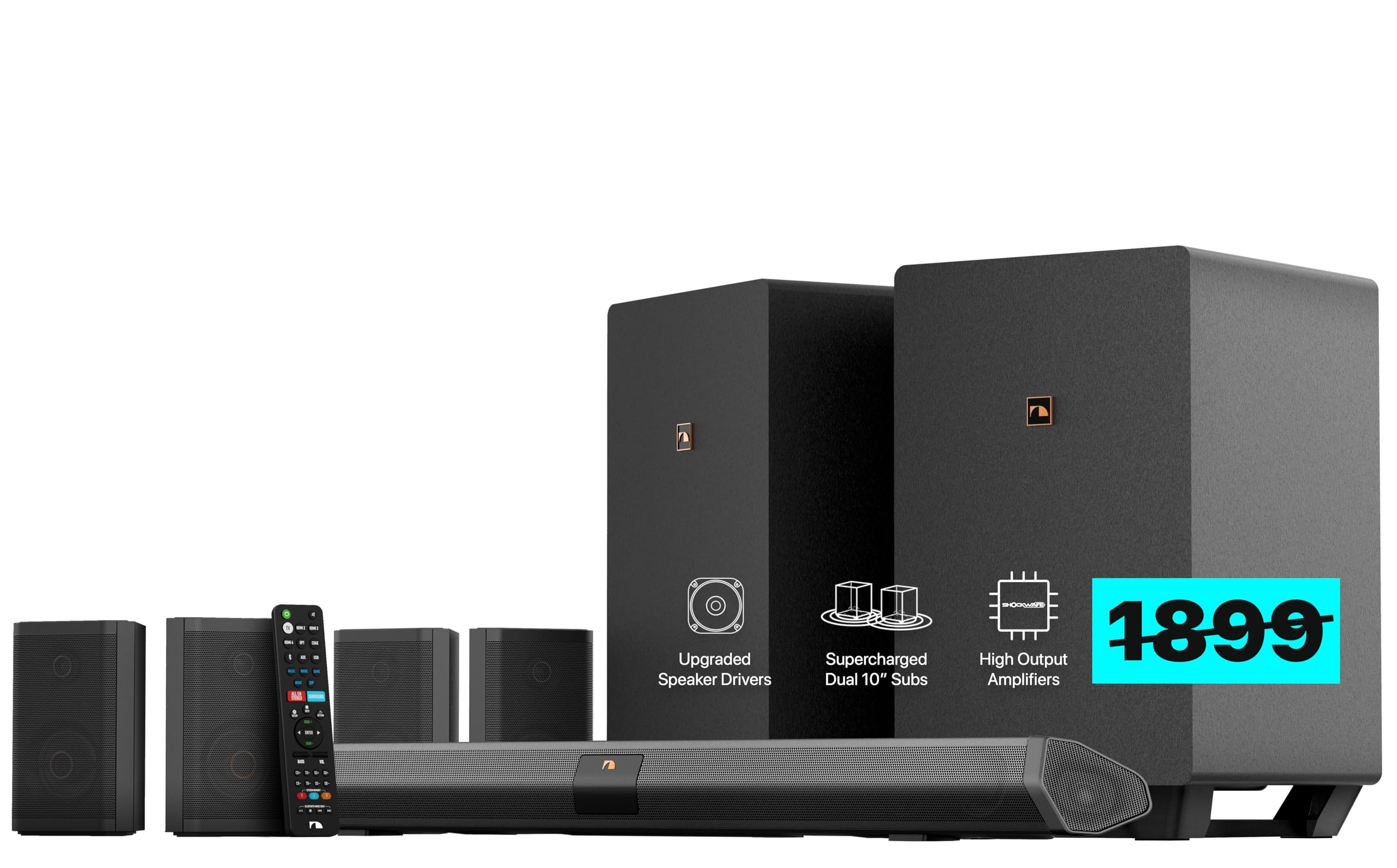
This system is the benchmark for soundbar-based home theater. The dual 10-inch wireless subwoofers pressurize a room evenly, eliminating the localized “one-note bass” that plagues single-sub setups. The four modular surround speakers—each connecting to the sub via RCA cable—create a genuine 360-degree soundfield that rivals many wired passive systems. SSE MAX processing extracts every bit of spatial information from Dolby Atmos and DTS:X sources.
Physical footprint is substantial: the soundbar spans 45.5 inches, and each subwoofer is a 20-inch tall monolith. Placement planning is mandatory. The included remote is backlit (a rare convenience in dark theaters), and Nakamichi provides pre-install guides and configuration tools for both AV novices and pros. HDMI eARC handles lossless audio from 4K Blu-ray players without hiccup.
Some users report minor static from the surround speakers when no audio is playing, and the bundled cables feel cheap given the system’s ambition. But for pure impact—chest-thumping bass, crystal-clear dialogue, and convincing overhead effects—this is the soundbar to beat at its price point. It effectively replaces a mid-range passive 5.1.2 setup with far less wiring.
Why it’s great
- Dual 10″ subs deliver room-filling, low-distortion bass
- Four surround speakers provide true 360° immersion
- HDMI eARC supports lossless Dolby Atmos
Good to know
- Surrounds are wired to subs, not fully wireless
- Individual components are large; needs dedicated space
2. ULTIMEA Skywave X50 5.1.4
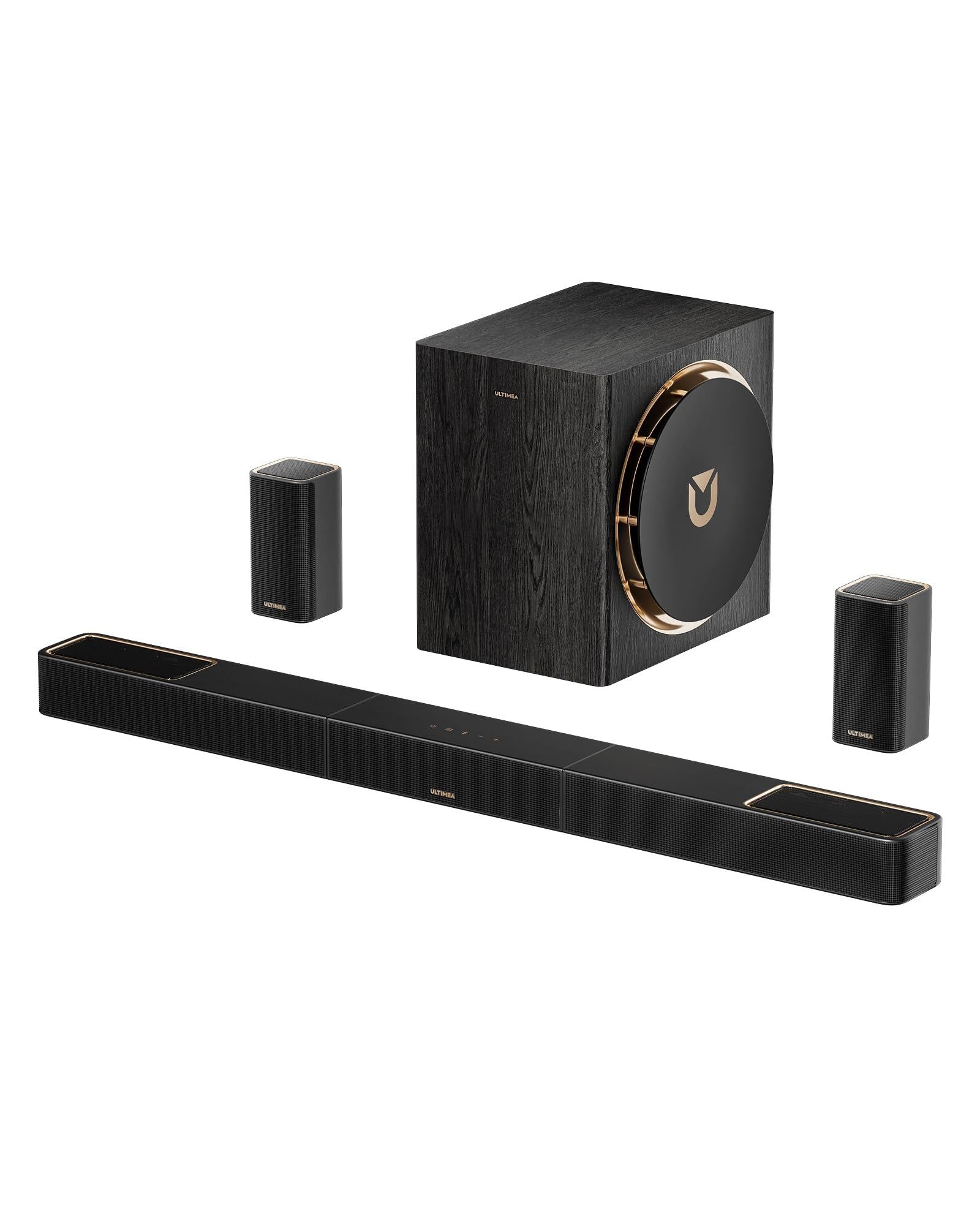
Ultimea has engineered a surprisingly mature Atmos soundbar here. The 5.1.4 channel layout includes two wireless surround speakers with up-firing drivers, plus a dedicated 8-inch subwoofer. The GaN (gallium nitride) amplifier is the headline feature—it runs cooler and responds 8x faster than traditional silicon amps, translating to cleaner transient response during explosive scenes. The 760W peak power rating is aggressive, but the system uses it judiciously without sounding harsh.
The NEURACORE multi-channel audio engine processes 24-bit/192kHz signals with under 0.5% total harmonic distortion. In practice, this means dialogue remains intelligible even when the subwoofer is rattling the floorboards. The wood-crafted subwoofer enclosure reduces cabinet resonance, and the rose gold accents on the metal grille make it a visual statement piece. Setup is genuinely plug-and-play—the surrounds auto-sync within seconds.
The bass can overwhelm dialogue at default settings; the companion app’s EQ is essential for fine-tuning. Rear up-firing effects are subtle compared to dedicated ceiling speakers but still add convincing height to rain and helicopter scenes. For buyers who want Dolby Atmos immersion without running cables or buying a receiver, the Skywave X50 delivers the most complete package in its price tier.
Why it’s great
- GaN amplifier for clean, cool-running power
- Wireless surrounds with up-firing Atmos drivers
- Deep sub-bass extension down to 28Hz
Good to know
- Bass can overpower vocals without EQ adjustment
- Up-firing height effects are subtle, not dramatic
3. JBL Bar 700MK2 7.1

The defining innovation here is the detachable battery-powered surround speakers. They magnetically dock onto the main soundbar for charging and snap off with one hand when you want true wireless rear channels. JBL rates their battery life for hours of continuous playback—enough for a full movie marathon. When docked, they simply recharge overnight. This eliminates the single biggest pain point of surround sound: running speaker wire or finding power outlets for rear speakers.
MultiBeam 3.0 technology uses arrays of drivers to cast a wide soundstage even when the rears are docked. The 10-inch wireless subwoofer produces authoritative bass that fills medium to large rooms. PureVoice 2.0 dynamically adjusts dialogue levels based on scene ambience—whispered conversations stay audible without raising the overall volume. The system also supports AirPlay, Google Cast, Spotify Connect, and Tidal Connect, making it a versatile music hub.
The lower mid-bass region feels slightly recessed compared to bigger passive systems. The subwoofer is wireless but still needs a power outlet. For renters, apartment dwellers, or anyone who moves furniture frequently, the detachable rears are a genuine lifestyle advantage. The sound quality is excellent for a soundbar, but purists will still prefer a wired passive setup for precise imaging.
Why it’s great
- Battery-powered detachable rears for true wireless surround
- 10″ subwoofer delivers deep, room-filling bass
- MultiBeam creates wide soundstage even without rears
Good to know
- Lower mid-bass is slightly recessed
- Rears still need outlet for charging dock
4. Klipsch Reference Cinema 5.1.4

This is a full passive speaker system, not a soundbar. The package includes four satellite speakers plus a center channel, each equipped with Dolby Atmos up-firing drivers. The Tractrix horn-loaded tweeters deliver the characteristic Klipsch high-frequency extension—crisp, detailed, and efficient. The 5.25-inch woofers in the satellites produce surprising bass extension for their size, though the bundled subwoofer handles the lowest octaves.
What sets this apart from soundbar alternatives is the true separation between channels. Each satellite can be positioned independently, creating precise imaging that soundbars can only approximate. The up-firing drivers are present on all four satellites, meaning height effects come from both front and rear—a configuration usually reserved for much more expensive systems. The built-in subwoofer amplifier is all-digital and delivers clean power without audible hum.
No speaker wire is included; you’ll need to purchase 14 or 16-gauge wire separately. The crossover frequencies (center at 90Hz, satellites at 100Hz) are not adjustable, which can create a slight dip in the upper bass region. The subwoofer is decent but won’t satisfy those seeking chest-thumping impact—consider replacing it with a larger unit. For buyers ready to step into separates without breaking the bank, this Klipsch bundle is the entry point.
Why it’s great
- Four up-firing Atmos speakers for front/rear height
- Horn-loaded tweeters for efficient, detailed highs
- True passive speaker separation for precise imaging
Good to know
- Speaker wire not included; must buy separately
- Subwoofer is adequate but not powerful
5. Bose Smart Ultra Bundle
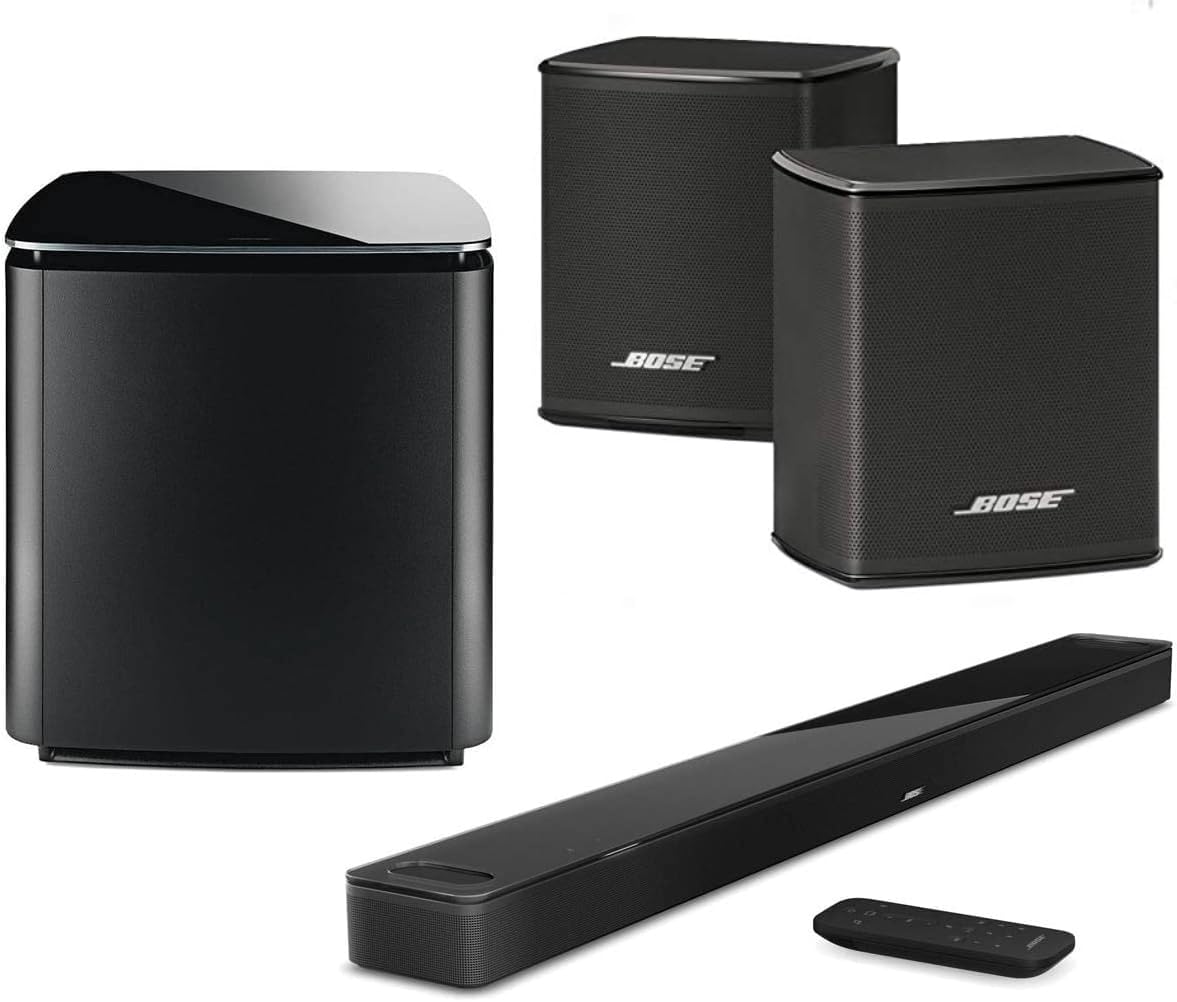
The Bose Smart Ultra Soundbar paired with the Bass Module 700 and two wireless Surround Speakers creates a cohesive, high-end ecosystem. The soundbar uses upward-firing drivers and proprietary PhaseGuide technology to bounce sound off walls and ceiling, creating a convincing Atmos bubble without rear speaker wires. The Bass Module 700 uses dual opposed transducers to cancel cabinet vibration, producing deep, distortion-free bass that feels tighter than typical ported subs.
ADAPTiQ room calibration uses the included headset to measure your room’s acoustics and optimize the soundbar’s output. Voice4Video technology lets you control your TV, cable box, and other devices via the soundbar’s built-in microphones. The wireless surround speakers connect to the soundbar without any additional hub—plug them into power, and they pair automatically. The entire system can be operational in under ten minutes.
The premium price reflects the ecosystem lock-in and Bose’s industrial design. The Bass Module 700 can sound “woofy” and bloated when pushed hard on bass-heavy movie tracks. Some users report mandatory firmware updates that can fail and brick the system temporarily, requiring a three-week service turnaround. For buyers who prioritize simplicity, clean aesthetics, and excellent dialogue clarity over raw SPL, this bundle is a polished choice.
Why it’s great
- Wireless surrounds pair instantly, zero signal cables
- ADAPTiQ calibration tailors sound to your exact room
- Bass Module 700 delivers tight, low-distortion low end
Good to know
- Bass can sound bloated at high volumes
- Firmware update issues can render system unusable
6. Klipsch Reference 5.2 + Yamaha RX-A2AB
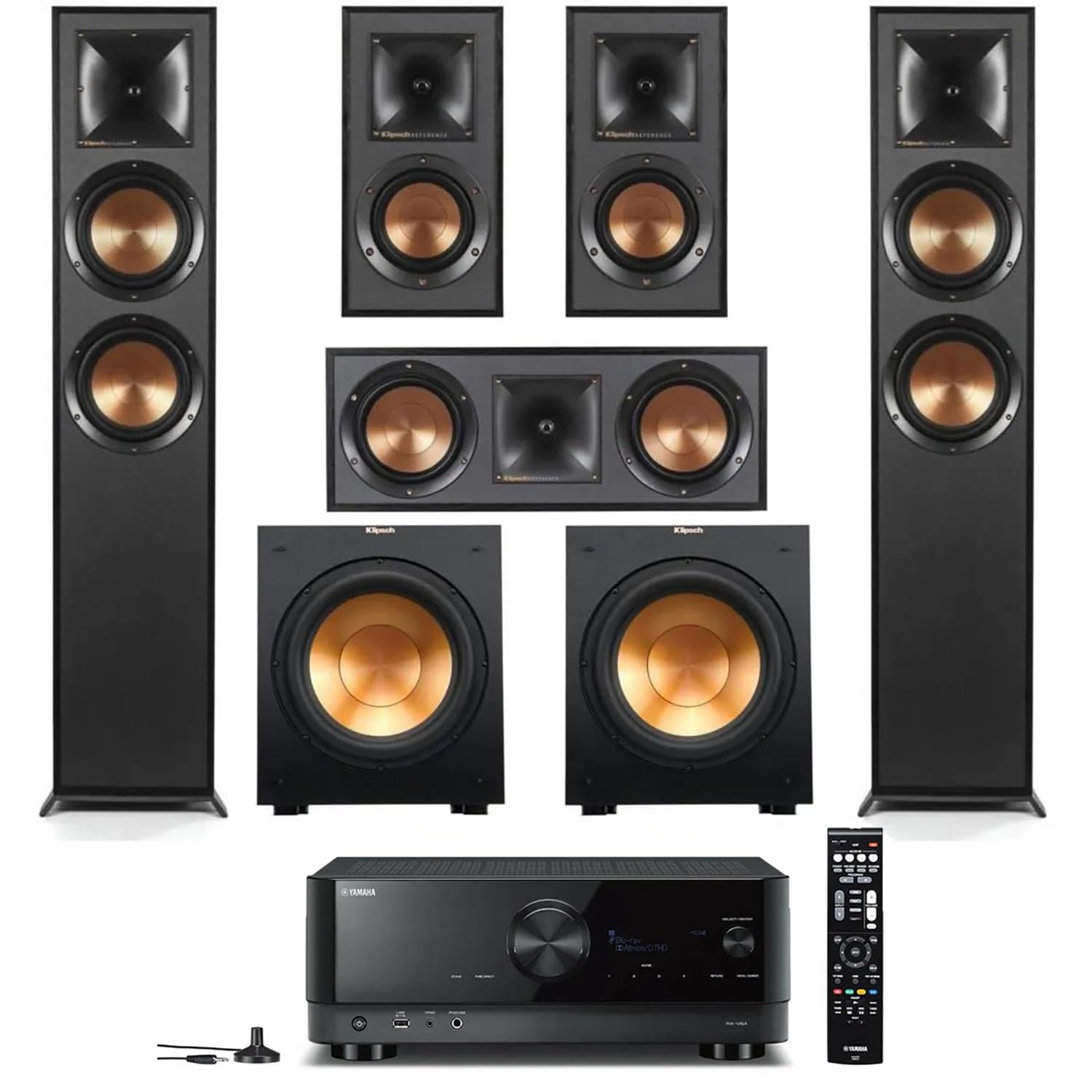
This is a serious passive home theater system in a single bundle. The package includes a pair of R-625FA floorstanding towers with built-in Dolby Atmos elevation drivers, an R-52C center channel, R-41M bookshelf speakers for surrounds, and two R-12SW 12-inch subwoofers. The included Yamaha RX-A2AB 7.2-channel AV receiver provides ample power (100 watts per channel) and supports the latest HDMI 2.1 features including 4K/120 passthrough and VRR.
The dual 12-inch subwoofers are the standout feature. Two subs smooth out in-room frequency response, eliminating the nulls and peaks that plague single-sub setups. The floorstanding towers handle mid-bass and lower-midrange with authority, creating a seamless crossover with the subs. The horn-loaded tweeters deliver the Klipsch sound signature: detailed, forward, and efficient—they play loud with relatively little amplifier power.
This is not a plug-and-play system. You’ll need to position and level-match each speaker, connect them with appropriate gauge wire, and run the Yamaha’s YPAO room calibration. The towers are large and visually dominant; they need floor space and look best with the magnetic grilles removed to show the copper woofers. For buyers who want reference-level dynamics, chest-thumping bass, and the ability to upgrade components over time, this bundle is the ultimate foundation.
Why it’s great
- Dual 12″ subs eliminate bass dead spots
- Floorstanding towers with built-in Atmos elevation
- Yamaha AVR handles 4K/120 for gaming
Good to know
- Requires speaker wire, positioning, and calibration
- Towers are large; need dedicated floor space
7. Sony BRAVIA Theater System 6 (HT-S60)

Sony’s HT-S60 is a 5.1-channel soundbar system with dedicated rear speakers and a subwoofer. It supports both Dolby Atmos and DTS:X—rare in this class—and leverages Sony’s audio processing pedigree. The dedicated center channel speaker within the soundbar ensures dialogue is clear and anchored to the screen. Voice Zoom 3 (available only with compatible BRAVIA TVs) uses AI to isolate and enhance dialogue in real time.
Setup is straightforward: the soundbar connects to the TV via HDMI eARC, and the rear speakers and subwoofer pair wirelessly. The BRAVIA Connect app provides access to sound profiles, EQ adjustments, and firmware updates. Multi Stereo mode plays the same audio from all speakers simultaneously, creating a room-filling effect even when content is only in stereo. The subwoofer produces clean, impactful bass that doesn’t distort at moderate volumes.
The subwoofer must be wired to the TV via a separate audio cable—it’s not a true wireless sub. Some users report HDMI handshake issues where audio drops out momentarily, especially on streaming apps; switching to the optical input resolves this. The rear speaker cable is permanently attached and relatively short, limiting placement options. For a cohesive Sony ecosystem, the sound quality is excellent; for flexibility, the implementation feels slightly compromised.
Why it’s great
- Supports both Dolby Atmos and DTS:X
- Dedicated center channel for clear dialogue
- BRAVIA Connect app provides EQ control
Good to know
- Subwoofer is wired to TV, not wireless
- HDMI may drop audio; optical is more stable
8. Polk Audio Signature Elite ES20 (Pair)

The Polk ES20 bookshelf speakers are not a complete home theater system—they are the building blocks for one. A pair of these, combined with a center channel and subwoofer, forms the front stage of a high-quality passive system. The 6.5-inch Dynamic Balance woofer and 1-inch Terylene tweeter produce a warm, non-fatiguing sound signature that is particularly flattering for acoustic music and vocal-heavy content. The patented Power Port design flared into the cabinet’s base extends bass response significantly for a bookshelf speaker.
These speakers are surprisingly deep at nearly 13 inches, so they will overhang many entertainment centers. The high sensitivity (89 dB) means they play loud with modest amplifier power—ideal for pairing with entry-level to mid-range AV receivers. The impedance is rated at 8 ohms nominal but dips to 4 ohms, so a stable amplifier is recommended. The walnut vinyl finish looks good from a distance but feels less premium up close; the white version is more convincing.
For music lovers who demand accurate stereo imaging and enough bass to feel satisfying without a subwoofer, the ES20s deliver. They also serve as excellent front left/right speakers in a larger Klipsch or Polk system. If your primary goal is movie surround sound, a soundbar with dedicated rears will be more immersive. If your goal is a music-first foundation that can grow into a theater system, this is the starting point.
Why it’s great
- Power Port delivers deep bass without distortion
- Warm, non-fatiguing sound for long listening sessions
- High sensitivity works well with modest amplifiers
Good to know
- Deep cabinet may not fit on standard shelves
- Faux wood finish looks cheap up close
9. LG S40TR 4.1 Soundbar

The LG S40TR proves that a genuine 4.1-channel surround system doesn’t need to cost a fortune. The soundbar itself houses four channels, backed by a wireless subwoofer and wireless rear satellite speakers. The rear speakers are connected to each other by a thin cable that runs to one of them, but neither needs a signal wire back to the soundbar—only power. This hybrid approach gives you true surround separation without the complexity of a full receiver setup.
Dolby Audio and DTS Digital compatibility ensure enhanced sound quality from streaming movies and TV shows. Clear Voice Plus analyzes audio output to boost dialogue through the center speakers, making it effective for quiet conversations in dramatic scenes. The WOW Orchestra feature synchronizes the soundbar with compatible LG TVs to use both sets of speakers simultaneously. The LG Soundbar App provides a 3-band EQ for adjusting bass, treble, and mid-range to your preference.
The rear speakers may ship with the surround function disabled by default; you must activate it via the LG app. The subwoofer and rears each require their own power outlets, which can be a challenge behind a couch without nearby receptacles. For an entry-level upgrade that dramatically improves TV audio with minimal fuss, the S40TR is the most accessible path to true surround sound.
Why it’s great
- Wireless rears provide true surround separation
- Clear Voice Plus enhances dialogue intelligibility
- WOW Orchestra syncs with LG TVs for fuller sound
Good to know
- Rears must be activated via the LG app
- Sub and rears need nearby power outlets
FAQ
Do I need a subwoofer for a home audio system?
Can I use a soundbar with a passive subwoofer?
What is the advantage of a center channel speaker?
How much power do I need for a medium-sized living room?
Does HDMI eARC matter for home audio?
Final Thoughts: The Verdict
For most users, the audio system for home winner is the Nakamichi Shockwafe Ultra 9.2.4 because it combines true 360-degree surround, dual subwoofers, and soundbar simplicity—delivering genuine theater immersion without the complexity of a multi-component passive system. If you want the cleanest wireless setup with battery-powered rears, grab the JBL Bar 700MK2. And for reference-level dynamics and upgradeability, nothing beats the Klipsch Reference 5.2 system with the Yamaha receiver.